
Total Energy in Circular Orbits for HSC Physics
Learn why a satellite in a higher circular orbit can move more slowly yet have more total energy. Connect kinetic, potential, and total energy using E = -GMm/2r.
A satellite in a higher circular orbit moves more slowly than one closer to Earth. So here is the puzzle: if you want to raise a satellite into a higher orbit, should you remove energy because its final speed is lower?
No. You have to add energy.
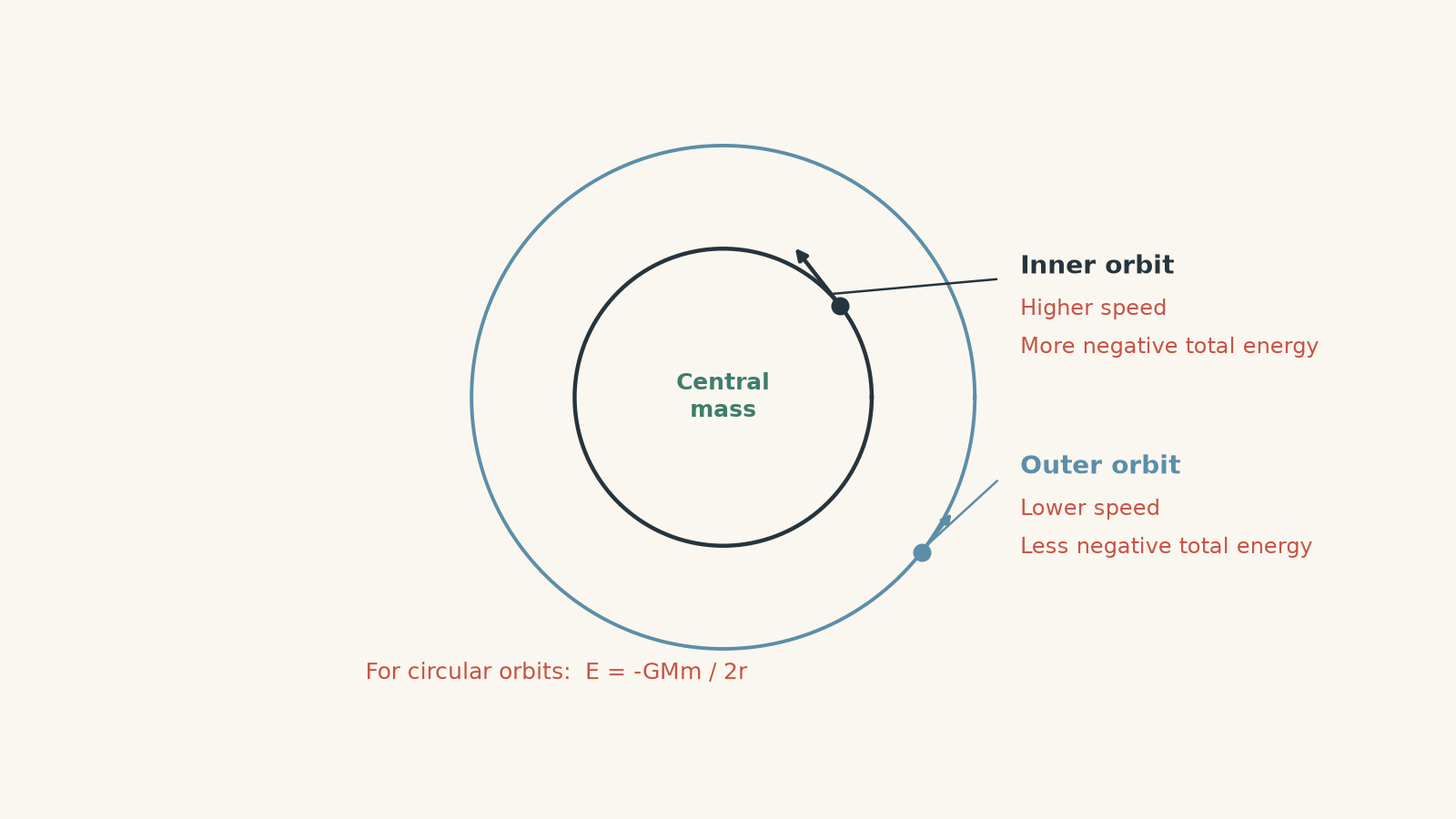
That sounds contradictory until you keep track of both parts of the satellite’s mechanical energy. Its kinetic energy decreases as the orbit gets larger, but its gravitational potential energy increases by a greater amount. The result is the circular-orbit energy equation
\[
E=-\frac{GMm}{2r}.
\]
The minus sign, the factor of \(2\), and the dependence on \(r\) all come from the same piece of physics.
01Start with the two kinds of energy
For a satellite of mass \(m\) orbiting a much larger body of mass \(M\), the total mechanical energy is
\[
E=K+U,
\]
where \(K\) is kinetic energy and \(U\) is gravitational potential energy.
The kinetic energy is familiar:
\[
K=\frac{1}{2}mv^2,
\]
where \(v\) is the satellite’s speed.
For gravity, we choose gravitational potential energy to be zero when the two objects are infinitely far apart. At a separation \(r\),
\[
U=-\frac{GMm}{r},
\]
where:
- \(G=6.67\times10^{-11}\ \text{N m}^2\text{kg}^{-2}\) is the universal gravitational constant
- \(M\) is the mass of the central body, in kilograms
- \(m\) is the satellite mass, in kilograms
- \(r\) is the distance between the centres of the two bodies, in metres.
The negative sign does not mean the satellite has some impossible kind of negative energy stored inside it. It comes from our choice that \(U=0\) at infinity. A satellite near a planet has less gravitational potential energy than it would infinitely far away, so \(U<0\).
If that idea needs refreshing, see Gravitational Potential Energy in a Radial Field for HSC Physics.
02Why circular motion fixes the kinetic energy
Imagine a satellite already moving in a perfectly circular orbit. Gravity is the only force acting on it.
Predict this before continuing: if the orbit radius is fixed, can the satellite have any speed we like?
It cannot. There is exactly one circular-orbit speed for that radius.
Gravity must supply precisely the centripetal force needed to keep the satellite following the circle:
\[
\frac{GMm}{r^2}=\frac{mv^2}{r}.
\]
Cancel \(m\), then multiply by \(r\):
\[
v^2=\frac{GM}{r}.
\]
So
\[
v=\sqrt{\frac{GM}{r}}.
\]
This is why a higher circular orbit has a lower orbital speed. Increasing \(r\) makes \(GM/r\) smaller.
You can see the full derivation in Orbital Velocity: Derivation and Calculations for HSC Physics.
Now substitute the circular-orbit condition \(v^2=GM/r\) into the kinetic energy:
\[
K=\frac{1}{2}mv^2
=\frac{1}{2}m\left(\frac{GM}{r}\right)
=\frac{GMm}{2r}.
\]
That result is the key.
For a circular orbit,
\[
K=\frac{GMm}{2r}
\]
while
\[
U=-\frac{GMm}{r}.
\]
The potential energy is negative and has twice the magnitude of the kinetic energy:
\[
U=-2K.
\]
Therefore,
\[
E=K+U
=\frac{GMm}{2r}-\frac{GMm}{r}
=-\frac{GMm}{2r}.
\]
So the total mechanical energy of a circular orbit is
\[
\boxed{E=-\frac{GMm}{2r}}.
\]
The box is not the important part. The relationships behind it are.
| Quantity | Circular-orbit value | What happens as \(r\) increases? |
|---|---|---|
| Speed \(v\) | \(\sqrt{GM/r}\) | decreases |
| Kinetic energy \(K\) | \(GMm/(2r)\) | decreases |
| Potential energy \(U\) | \(-GMm/r\) | increases towards zero |
| Total energy \(E\) | \(-GMm/(2r)\) | increases towards zero |
Notice that “increases” for a negative quantity means becomes less negative. For example, \(-2\ \text{J}\) is greater than \(-10\ \text{J}\).
03Why a higher orbit has more total energy
Suppose a satellite moves from a circular orbit of radius \(r\) to another circular orbit of radius \(2r\).
Initially,
\[
E_1=-\frac{GMm}{2r}.
\]
Finally,
\[
E_2=-\frac{GMm}{2(2r)}
=-\frac{GMm}{4r}.
\]
Which is larger?
\[
-\frac{GMm}{4r}>-\frac{GMm}{2r}.
\]
The higher orbit has more total mechanical energy, even though the satellite moves more slowly there.
The easiest way to picture this is to treat zero energy like sea level. A value of \(-100\ \text{m}\) and a value of \(-20\ \text{m}\) are both below sea level, but \(-20\ \text{m}\) is higher. The analogy breaks if you push it too far: energy is not literally a height. It only helps make sense of negative values.
The deeper reason is in the relative changes to \(K\) and \(U\). For a circular orbit,
\[
U=-2K.
\]
As the satellite moves outward, \(K\) falls, but \(U\) rises by twice as much in magnitude. The increase in \(U\) wins.
Worked example: Find all three orbital energies
A \(1200\ \text{kg}\) satellite travels in a circular orbit of radius \(7.00\times10^6\ \text{m}\) around Earth. Take Earth’s mass as \(5.97\times10^{24}\ \text{kg}\). Calculate its kinetic energy, gravitational potential energy, and total mechanical energy.
Step 1
\[
\begin{aligned}
\frac{GMm}{r}
&=\frac{(6.67\times10^{-11})(5.97\times10^{24})(1200)}
{7.00\times10^6}\\
&=6.83\times10^{10}\ \text{J}.
\end{aligned}
\]
Step 2
\[
K=\frac{GMm}{2r}
=\frac{6.83\times10^{10}}{2}
=3.41\times10^{10}\ \text{J}.
\]
Step 3
\[
U=-\frac{GMm}{r}
=-6.83\times10^{10}\ \text{J}.
\]
Step 4
\[
\begin{aligned}
E&=K+U\\
&=(3.41\times10^{10})+(-6.83\times10^{10})\\
&=-3.41\times10^{10}\ \text{J}.
\end{aligned}
\]
The satellite has positive kinetic energy, larger-magnitude negative potential energy, and negative total energy. As expected,
\[
U=-2K
\]
and
\[
E=-K.
\]
The negative total energy tells us that the satellite is gravitationally bound under this model.
04What negative total energy actually tells you
A bound satellite does not have enough mechanical energy to reach infinitely far away with any kinetic energy left over.
At infinity,
\[
U\rightarrow0.
\]
If an object could just barely escape, its speed would also approach zero as \(r\rightarrow\infty\), giving
\[
K\rightarrow0.
\]
The boundary between bound and unbound motion is therefore
\[
E=0.
\]
So, broadly:
- \(E<0\): gravitationally bound
- \(E=0\): just at the escape boundary
- \(E>0\): unbound.
There is an important limitation here. The equation
\[
E=-\frac{GMm}{2r}
\]
uses \(r\) as the constant radius of a circular orbit. You cannot automatically take an object moving on some non-circular path, insert its instantaneous distance from Earth, and call that its total energy.
For a general position and velocity, start from
\[
E=\frac{1}{2}mv^2-\frac{GMm}{r}.
\]
The circular-orbit shortcut works only after the circular-motion condition has linked \(v\) and \(r\).
That distinction becomes important surprisingly quickly.
Worked example: Raise a satellite to a higher circular orbit
A \(500\ \text{kg}\) satellite moves from a circular Earth orbit of radius \(7.00\times10^6\ \text{m}\) to a circular orbit of radius \(4.20\times10^7\ \text{m}\). Calculate the change in its total mechanical energy.
Use \(M_{\text{Earth}}=5.97\times10^{24}\ \text{kg}\).
Step 1
\[
E=-\frac{GMm}{2r}.
\]
For the lower orbit,
\[
\begin{aligned}
E_1
&=-\frac{(6.67\times10^{-11})(5.97\times10^{24})(500)}
{2(7.00\times10^6)}\\
&=-1.42\times10^{10}\ \text{J}.
\end{aligned}
\]
For the higher orbit,
\[
\begin{aligned}
E_2
&=-\frac{(6.67\times10^{-11})(5.97\times10^{24})(500)}
{2(4.20\times10^7)}\\
&=-2.37\times10^9\ \text{J}.
\end{aligned}
\]
Step 2
\[
\begin{aligned}
\Delta E
&=E_2-E_1\\
&=(-2.37\times10^9)-(-1.42\times10^{10})\\
&=1.18\times10^{10}\ \text{J}.
\end{aligned}
\]
The positive result means the satellite’s mechanical energy has increased by approximately
\[
1.18\times10^{10}\ \text{J}.
\]
Its final circular speed is lower, but its total energy is greater because its gravitational potential energy has increased substantially.
This calculation gives the difference between the two circular-orbit mechanical energies. An actual orbital transfer passes through non-circular intermediate motion, so you should not imagine the satellite somehow sliding continuously through a sequence of circular orbits.
05The most tempting wrong argument
A student might say:
A higher orbit has a lower speed, so the satellite has less kinetic energy. Therefore, raising its orbit must reduce its total energy.
The first sentence is correct. The second does not follow.
For circular orbits,
\[
K=\frac{GMm}{2r}
\]
and
\[
U=-\frac{GMm}{r}.
\]
Suppose \(r\) increases. The kinetic energy decreases in magnitude according to a coefficient of \(1/2\), while the potential energy increases according to a coefficient of \(1\).
For a change from \(r_1\) to \(r_2\), where \(r_2>r_1\),
\[
\Delta K
=
\frac{GMm}{2}
\left(
\frac{1}{r_2}-\frac{1}{r_1}
\right),
\]
which is negative.
But
\[
\Delta U
=
-GMm
\left(
\frac{1}{r_2}-\frac{1}{r_1}
\right),
\]
which is positive and twice as large in magnitude.
Therefore,
\[
\Delta E=\Delta K+\Delta U>0.
\]
A higher circular orbit is slower, but more energetic overall.
06A compact set of relationships worth knowing
For a circular gravitational orbit,
\[
v^2=\frac{GM}{r},
\]
\[
K=\frac{GMm}{2r},
\]
\[
U=-\frac{GMm}{r},
\]
and
\[
E=-\frac{GMm}{2r}.
\]
These immediately give
\[
U=-2K,
\]
\[
E=-K,
\]
and
\[
E=\frac{U}{2}.
\]
Do not memorise these as four unrelated facts. Once you know that gravity supplies the centripetal force and that \(U=-GMm/r\), the rest can be rebuilt.
07Questions and solutions
Question 1
A \(750\ \text{kg}\) satellite travels in a circular orbit of radius \(8.00\times10^6\ \text{m}\) around a planet of mass \(6.00\times10^{24}\ \text{kg}\).
Calculate the satellite’s total mechanical energy. Use \(G=6.67\times10^{-11}\ \text{N m}^2\text{kg}^{-2}\).
Solution 1
The satellite’s total mechanical energy is approximately \(-1.88\times10^{10}\ \text{J}\).
For a circular orbit,
\[
E=-\frac{GMm}{2r}.
\]
Substitute the given values:
\[
\begin{aligned}
E
&=-\frac{(6.67\times10^{-11})(6.00\times10^{24})(750)}
{2(8.00\times10^6)}\\
&=-1.88\times10^{10}\ \text{J}.
\end{aligned}
\]
The result is negative because the satellite is gravitationally bound.
A tempting mistake is to use \(U=-GMm/r\) and report that as the total energy. That expression gives gravitational potential energy only. In a circular orbit, the positive kinetic energy makes the total energy half as negative as \(U\).
Question 2
A \(300\ \text{kg}\) satellite is moved from a circular Earth orbit of radius \(8.00\times10^6\ \text{m}\) to a circular orbit of radius \(1.60\times10^7\ \text{m}\).
Using \(GM_{\text{Earth}}=3.99\times10^{14}\ \text{m}^3\text{s}^{-2}\):
a. calculate the change in kinetic energy
b. calculate the change in gravitational potential energy
c. calculate the change in total mechanical energy
d. explain how the three results are related.
Solution 2
The kinetic energy decreases by \(3.74\times10^9\ \text{J}\), the potential energy increases by \(7.48\times10^9\ \text{J}\), and the total mechanical energy increases by \(3.74\times10^9\ \text{J}\).
For a circular orbit,
\[
K=\frac{GMm}{2r}.
\]
Initially,
\[
K_1
=
\frac{(3.99\times10^{14})(300)}
{2(8.00\times10^6)}
=
7.48\times10^9\ \text{J}.
\]
Finally,
\[
K_2
=
\frac{(3.99\times10^{14})(300)}
{2(1.60\times10^7)}
=
3.74\times10^9\ \text{J}.
\]
Therefore,
\[
\Delta K=K_2-K_1=-3.74\times10^9\ \text{J}.
\]
Now use
\[
U=-\frac{GMm}{r}.
\]
Initially,
\[
U_1=-1.50\times10^{10}\ \text{J},
\]
and finally,
\[
U_2=-7.48\times10^9\ \text{J}.
\]
So
\[
\Delta U
=
U_2-U_1
=
7.48\times10^9\ \text{J}.
\]
The total-energy change is
\[
\begin{aligned}
\Delta E
&=\Delta K+\Delta U\\
&=(-3.74\times10^9)+(7.48\times10^9)\\
&=3.74\times10^9\ \text{J}.
\end{aligned}
\]
The important relationship is
\[
\Delta U=-2\Delta K.
\]
The potential energy increases by twice the magnitude of the kinetic-energy decrease. That leaves a positive net energy change.
The tempting route is to notice only that \(K\) falls and conclude that energy must have been removed. The missing constraint is that gravitational potential energy changes at the same time.
Question 3
A spacecraft begins in a circular orbit of radius \(r\) and eventually reaches a new circular orbit of radius \(4r\).
A student argues:
“Its final orbital speed is half its initial speed, so its kinetic energy is one quarter as large. The spacecraft must therefore have lost energy overall.”
Without using numerical values, evaluate this claim. Determine the ratios \(K_2/K_1\), \(U_2/U_1\), and \(E_2/E_1\), and state whether external energy must be added or removed overall.
Solution 3
The spacecraft must gain total mechanical energy overall, even though its kinetic energy falls to one quarter of its original value.
For circular motion,
\[
v=\sqrt{\frac{GM}{r}}.
\]
When the radius changes from \(r\) to \(4r\),
\[
\frac{v_2}{v_1}
=
\sqrt{\frac{r}{4r}}
=
\frac{1}{2}.
\]
Therefore,
\[
\frac{K_2}{K_1}
=
\left(\frac{v_2}{v_1}\right)^2
=
\frac{1}{4}.
\]
The student is correct so far.
For potential energy,
\[
U=-\frac{GMm}{r},
\]
so
\[
U_2
=
-\frac{GMm}{4r}
=
\frac{1}{4}U_1.
\]
Because both values are negative, \(U_2=U_1/4\) means the potential energy has increased towards zero.
Similarly,
\[
E=-\frac{GMm}{2r},
\]
so
\[
E_2=\frac{1}{4}E_1.
\]
Again, both total energies are negative. For example, changing from a quantity proportional to \(-1\) to one proportional to \(-1/4\) is an increase.
The net change is
\[
\begin{aligned}
\Delta E
&=E_2-E_1\\
&=-\frac{GMm}{8r}
-\left(-\frac{GMm}{2r}\right)\\
&=\frac{3GMm}{8r}>0.
\end{aligned}
\]
So external energy must be added overall.
The tempting route is to equate lower speed with lower total energy. The constraint that changes the result is gravitational potential energy: the spacecraft is much farther from the central mass, and its increase in \(U\) is larger than its decrease in \(K\).
Question 4
Two identical satellites, each of mass \(m\), travel in the same circular orbit of radius \(r\) around a planet of mass \(M\), but in opposite directions.
They collide head-on and stick together. Assume the collision occurs quickly enough that the impulse from gravity during the collision can be neglected.
a. Find the total mechanical energy of the two-satellite system immediately before the collision.
b. Find the mechanical energy of the joined object immediately after the collision.
c. Explain where the difference has gone.
d. State whether the joined object remains in circular orbit.
Solution 4
Immediately after the collision, the joined object has zero velocity, a more negative mechanical energy than the two satellites had before collision, and it does not remain in circular orbit.
Before the collision, each satellite has circular-orbit energy
\[
E_{\text{one}}=-\frac{GMm}{2r}.
\]
For two satellites,
\[
E_{\text{before}}
=
2\left(-\frac{GMm}{2r}\right)
=
-\frac{GMm}{r}.
\]
Because the satellites have equal masses and equal but opposite velocities, their total momentum immediately before impact is zero.
They stick together, so conservation of momentum during the short collision gives
\[
(2m)v_{\text{after}}=0,
\]
hence
\[
v_{\text{after}}=0.
\]
Therefore,
\[
K_{\text{after}}=0.
\]
The joined mass is \(2m\), so its gravitational potential energy at radius \(r\) is
\[
U_{\text{after}}
=
-\frac{GM(2m)}{r}
=
-\frac{2GMm}{r}.
\]
Thus
\[
E_{\text{after}}
=
-\frac{2GMm}{r}.
\]
The mechanical-energy change is
\[
\begin{aligned}
\Delta E
&=E_{\text{after}}-E_{\text{before}}\\
&=-\frac{2GMm}{r}
-\left(-\frac{GMm}{r}\right)\\
&=-\frac{GMm}{r}.
\end{aligned}
\]
That amount of mechanical energy has been converted into internal energy during the inelastic collision, such as deformation, heating, and other non-mechanical forms.
The tempting argument is that gravity is conservative, so mechanical energy must remain constant. That would be true during motion under gravity alone. The collision introduces an inelastic interaction, so the system’s mechanical energy is not conserved through the impact, even though total energy is conserved.
The joined object also cannot remain in circular orbit. At radius \(r\), a circular orbit requires
\[
v=\sqrt{\frac{GM}{r}},
\]
but its speed immediately after impact is zero. It will begin accelerating towards the planet.
Question 5
Satellite A travels in a circular orbit of radius \(r\) around a planet.
At one instant, satellite B is at exactly the same distance \(r\) from the planet and has exactly the same speed as A. However, A’s velocity is entirely perpendicular to the radius, while B’s velocity has both a tangential component and an inward radial component.
Both satellites have the same mass.
A student makes two claims:
- “A and B have the same total mechanical energy, so they must be in the same orbit.”
- “Because B is currently at radius \(r\), its energy is given by \(E=-GMm/(2r)\), which proves its orbit is circular.”
Determine which parts of these claims are correct. Explain what can, and cannot, be inferred from the equal energies.
Solution 5
A and B do have the same total mechanical energy at that instant, but B is not in the same orbit as A, and the circular-orbit formula alone cannot be used to prove that it is.
At that instant, both satellites are at the same \(r\), so they have the same gravitational potential energy:
\[
U_A=U_B=-\frac{GMm}{r}.
\]
They also have the same speed magnitude, so they have the same kinetic energy:
\[
K_A=K_B=\frac{1}{2}mv^2.
\]
Therefore,
\[
E_A=E_B.
\]
Because A is in circular orbit,
\[
v^2=\frac{GM}{r},
\]
so its total energy is
\[
E_A=-\frac{GMm}{2r}.
\]
Since B has the same \(K\) and \(U\) at that instant,
\[
E_B=-\frac{GMm}{2r}
\]
as well.
That still does not make B’s orbit circular.
Circular motion requires more than a particular energy. The velocity must also be entirely tangential so that the distance \(r\) remains constant. Satellite B has an inward radial velocity component, so its distance from the planet is already decreasing.
The difference can also be described using angular momentum. A has velocity completely perpendicular to the radius, giving the largest possible tangential component for that speed. B has the same speed magnitude but a smaller tangential component, so it has less angular momentum.
The tempting route is to assume that one value of total energy uniquely specifies the orbit. It does not. Energy contains information about the combination of speed and position, but it does not contain the direction of the velocity.
The second claim also reverses the logic of the circular-orbit formula. We derived
\[
E=-\frac{GMm}{2r}
\]
by first assuming circular motion and using
\[
v^2=\frac{GM}{r}.
\]
It is therefore not a general test saying, “if an object has this energy while it is at radius \(r\), its path must be circular”.
B happens to have the same numerical total energy as A because it has the same speed and position at that instant. Its different velocity direction gives it different subsequent motion.
That is the useful next step beyond the circular-orbit energy formula: energy tells you whether motion is energetically possible and whether a gravitational system is bound, but describing the actual path also requires information about the velocity direction and, more generally, angular momentum.