
IUPAC Naming of Acids, Amines, Amides and Halo Compounds
Learn how to name carboxylic acids, amines, amides, and halogenated organic compounds using IUPAC priorities, prefixes, and locants.
A student sees \(\ce{CH3CH(Cl)CH2COOH}\) and says, “The chlorine is closer to the left, so it must be 2-chloro…”. That sounds sensible. After all, organic naming keeps telling you to use low numbers.
But this compound is 3-chlorobutanoic acid, not 2-chlorobutanoic acid. The carboxylic acid group forces the numbering to begin from its carbon, even though that gives chlorine the larger number.
That is the real problem these naming rules solve: when several features are competing for the name, which one gets control?
01The functional group that controls the name
Picture an organic name as a slightly chaotic group presentation. One functional group gets the microphone. That group controls the ending of the name and usually controls the numbering. Everything else has to become a prefix.
The microphone isn’t awarded to whichever group is closest to the end of your drawing. IUPAC uses a fixed priority system.
For the functional groups in this guide, the useful priority is:
\[ \text{carboxylic acid} > \text{amide} > \text{amine} > \text{halogen} \]
This is only the part of the IUPAC priority system relevant here, not the complete hierarchy.
A halogen never takes the suffix in these names. Fluorine, chlorine, bromine, and iodine appear as the prefixes fluoro-, chloro-, bromo-, and iodo-.
The analogy has a limit. Functional groups aren’t actually fighting for a microphone, and chemical importance isn’t being ranked. This is simply a naming convention that lets chemists around the world identify the same structure from the same name.
02Four patterns to recognise immediately
Before worrying about names, train yourself to spot the functional group. If you misidentify the group, every later naming decision can be perfectly executed and still give the wrong answer.
| Group | Structural feature | Main naming form | Key numbering rule |
|---|---|---|---|
| Carboxylic acid | \(\ce{-COOH}\) | -oic acid | The carboxyl carbon is carbon 1 |
| Amine | commonly \(\ce{-NH2}\) | -amine | Give the amine the lowest possible locant when it is the principal group |
| Amide | \(\ce{-CONH2}\) | -amide | The carbonyl carbon is carbon 1 |
| Halogenated compound | \(\ce{-F}\), \(\ce{-Cl}\), \(\ce{-Br}\), or \(\ce{-I}\) | fluoro-, chloro-, bromo-, iodo- | Treat the halogen as a substituent |
A locant is simply the number that tells you where something is attached.
So in 2-bromobutane, the 2 is the locant of the bromine.
03Carboxylic acids: the \(\ce{-COOH}\) carbon counts
Consider:
\[ \ce{CH3CH2COOH} \]
How many carbons are in the parent chain?
It is tempting to see \(\ce{CH3CH2}\) and say two. But the carbon inside \(\ce{-COOH}\) is also part of the chain. There are three carbons altogether, so the compound is propanoic acid.
The pattern is:
- Find the longest chain containing the carboxyl carbon.
- Count the carboxyl carbon as carbon 1.
- Replace the alkane ending
-ewith-oic acid.
For example:
\[ \ce{CH3CH(CH3)COOH} \]
The longest chain containing the \(\ce{-COOH}\) carbon has three carbons, so the parent is propanoic acid. The methyl branch is on carbon 2.
The name is 2-methylpropanoic acid.
Notice that you do not write something like propan-1-oic acid. A carboxylic acid group sits at the end of the parent chain, so its carbon is automatically carbon 1.
When another group is present
Suppose the structure is:
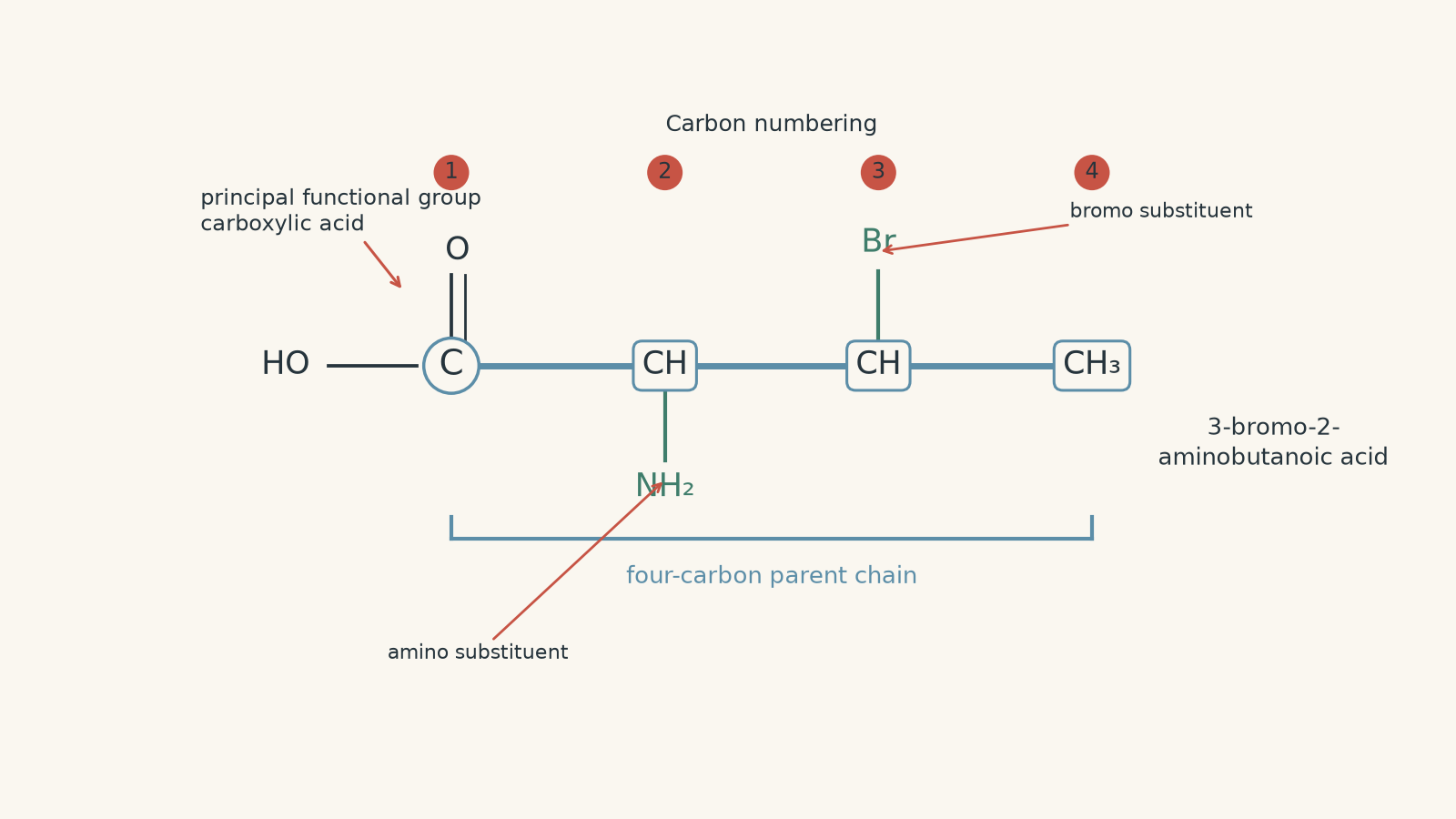
\[ \ce{HOOC-CH(NH2)-CH2-CH3} \]
Predict the ending. Should this be an amine or a carboxylic acid?
The carboxylic acid has higher naming priority, so it keeps the suffix. The \(\ce{-NH2}\) group becomes the prefix amino-.
The parent has four carbons and the amino group is on carbon 2, giving 2-aminobutanoic acid.
This is why simply spotting an \(\ce{-NH2}\) group and immediately writing -amine is dangerous. The suffix depends on what else is present.
04Amines: give the nitrogen-bearing position priority
For a simple primary amine such as
\[ \ce{CH3CH2CH2NH2} \]
the three-carbon parent is propane. The \(\ce{-NH2}\) group is attached to carbon 1, giving propan-1-amine.
Now compare:
\[ \ce{CH3CH(NH2)CH3} \]
The parent is still propane, but the amino group is attached to carbon 2. The name is propan-2-amine.
With an amine as the principal functional group, choose the parent chain containing the carbon bonded to the nitrogen, then number it so the amine receives the lowest possible locant.
That priority comes before trying to minimise the numbers of methyl groups or halogens.
For example:
\[ \ce{BrCH2CH2CH(NH2)CH3} \]
Numbering from the right puts the amine on carbon 2 and bromine on carbon 4. Numbering from the left would put the amine on carbon 3.
The correct name is therefore 4-bromobutan-2-amine.
The amine wins that numbering decision.
05Amides: don’t lose the carbonyl carbon
An amide contains the group
\[ \ce{-CONH2} \]
Students sometimes see the nitrogen and treat an amide as if it were just an amine attached to a ketone. Don’t. The whole \(\ce{-CONH2}\) unit is the characteristic amide group.
Consider:
\[ \ce{CH3CH2CONH2} \]
The carbonyl carbon belongs to the parent chain. Counting from it gives three carbons:
- carbon 1: the carbonyl carbon,
- carbon 2: \(\ce{CH2}\),
- carbon 3: \(\ce{CH3}\).
The name is propanamide.
Now consider:
\[ \ce{CH3CH(CH3)CONH2} \]
The parent chain has three carbons, with a methyl substituent on carbon 2.
The name is 2-methylpropanamide.
As with a carboxylic acid, the amide carbonyl carbon is automatically carbon 1, so you don’t need a locant for the -amide suffix in these structures.
A useful extension: substituents attached to nitrogen
A carbon substituent can also be attached directly to the amide nitrogen.
For example:
\[ \ce{CH3CH2CONHCH3} \]
The methyl group is not attached to carbon 1, 2, or 3 of the propanamide chain. It is attached to the nitrogen.
IUPAC indicates this using \(N\) instead of a number:
N-methylpropanamide
That \(N\) means “attached to nitrogen”.
This becomes important when deciding whether a carbon should be part of the main carbon chain. We will return to it in the final practice problem.
06Halogenated compounds: halogens behave like substituents
The four prefixes you need are:
| Halogen | Prefix |
|---|---|
| \(\ce{F}\) | fluoro- |
| \(\ce{Cl}\) | chloro- |
| \(\ce{Br}\) | bromo- |
| \(\ce{I}\) | iodo- |
For
\[ \ce{CH3CH(Br)CH2CH3} \]
number from the end nearest the bromine. It is attached to carbon 2, so the name is 2-bromobutane.
With several substituents, list them alphabetically in the finished name.
For example, a pentane chain with bromine on carbon 3 and a methyl group on carbon 2 is:
3-bromo-2-methylpentane
Bromo comes before methyl alphabetically.
But be careful: alphabetical order normally arranges the prefixes after you have numbered the chain. It does not normally decide which end gets carbon 1.
Only when the normal numbering rules produce a genuine tie do you need a further tie-break.
If the underlying rules for choosing parent chains and numbering branches still feel shaky, revise IUPAC Naming of Organic Compounds to C8 for HSC Chemistry and Naming Methyl and Ethyl Branched Chains for HSC Chemistry.
07A naming method that works under pressure
When a structure becomes messy, don’t try to read its name from left to right. Build the name in a fixed order.
1. Identify every functional group
Look specifically for \(\ce{-COOH}\), \(\ce{-CONH2}\), \(\ce{-NH2}\), and halogens.
Do this before choosing the chain.
2. Decide which group controls the suffix
Within the groups covered here:
\[ \text{carboxylic acid} > \text{amide} > \text{amine} > \text{halogen} \]
If a carboxylic acid and an amine occur together, for example, the compound is named as an acid and \(\ce{-NH2}\) becomes amino-.
3. Choose the parent chain
Choose the appropriate longest chain containing the principal functional group.
For a carboxylic acid or amide, the carbonyl carbon must be included.
4. Number for the principal functional group first
The suffix group gets priority over ordinary substituents.
Do not number from the “visually closest” branch.
5. Locate and alphabetise the prefixes
Write the locant of each methyl, ethyl, amino, or halo substituent.
Arrange different prefixes alphabetically in the final name.
6. Add the parent and suffix
Check punctuation:
- commas separate numbers, as in
2,3-dibromobutane; - hyphens separate numbers from words;
- there is a space in names such as
butanoic acid.
08Worked example: Name a substituted carboxylic acid
Give the systematic IUPAC name of \(\ce{CH3CH(Cl)CH(CH3)CH2COOH}\).
Step 1
The molecule contains \(\ce{-COOH}\), so it is a carboxylic acid. That group determines the suffix -oic acid.
Step 2
The longest chain containing the carboxyl carbon has five carbons.
The parent is therefore pentanoic acid.
Step 3
Write the structure in the numbering direction:
\[ \ce{HOOC-CH2-CH(CH3)-CH(Cl)-CH3} \]
The carboxyl carbon is carbon 1. This places the methyl group on carbon 3 and chlorine on carbon 4.
Step 4
Chloro comes before methyl alphabetically.
The complete name is 4-chloro-3-methylpentanoic acid.
The important result is not just the name. Chlorine gets locant 4 even though numbering from the opposite end would apparently give it a smaller number. The acid group controls the numbering, so carbon 1 is not negotiable.
09Worked example: Name a branched amine with a halogen
Give the systematic IUPAC name of \(\ce{CH3CH(Cl)CH(CH3)CH2NH2}\).
Step 1
The molecule contains an amine and a chlorine substituent. The amine supplies the suffix, while chlorine becomes chloro-.
Step 2
The longest suitable chain containing the carbon bonded to \(\ce{-NH2}\) has four carbons.
The parent is therefore butane.
Step 3
Numbering from the \(\ce{-NH2}\) end gives:
\[ \ce{H2N-CH2-CH(CH3)-CH(Cl)-CH3} \]
The amine is on carbon 1, the methyl group is on carbon 2, and chlorine is on carbon 3.
Step 4
Chloro comes before methyl alphabetically.
The complete name is 3-chloro-2-methylbutan-1-amine.
The key decision happened before alphabetising anything: the amine had to receive the lowest locant.
10Worked example: Distinguish a carbon substituent from an N-substituent
Name \(\ce{CH3CH(Cl)CONHCH3}\).
Step 1
The \(\ce{-CONH-}\) unit makes this an amide. The carbonyl carbon belongs to the parent chain and is carbon 1.
Step 2
The parent chain containing the carbonyl carbon has three carbons, so the parent is propanamide.
The chlorine is attached to carbon 2.
Step 3
The final \(\ce{CH3}\) is bonded directly to nitrogen, not to one of the three parent-chain carbons.
Its locant is therefore \(N\), giving N-methyl.
Step 4
The systematic name is 2-chloro-N-methylpropanamide.
Calling this 2-chloro-3-methylpropanamide would change the connectivity. \(N\) is doing real chemical work in the name: it tells you which atom the methyl group is bonded to.
11The most tempting naming mistakes
| Tempting idea | Why it feels reasonable | What actually controls the name |
|---|---|---|
| “Number from whichever end gives the first branch the smallest number.” | This works for many simple alkanes. | A principal functional group such as an acid, amide, or amine gets numbering priority. |
| “The carbon in \(\ce{-COOH}\) or \(\ce{-CONH2}\) isn’t part of the chain.” | It sits inside the functional-group formula rather than looking like an ordinary \(\ce{CH2}\). | That carbon is part of the parent chain and is carbon 1. |
“If I see \(\ce{-NH2}\), the name must end in -amine.” | Amines normally use that suffix. | A higher-priority group can take the suffix, turning \(\ce{-NH2}\) into amino-. |
| “Alphabetical order tells me which end to number from.” | Prefixes are alphabetised in the finished name. | Numbering rules come first. Alphabetical order only resolves certain ties. |
| “Once I’ve picked a parent chain, I keep it no matter what.” | It feels as though a structure has one permanently labelled backbone. | You must choose the correct parent from the final structure. A newly attached carbon can change the longest parent chain. |
| “An \(N\)-methyl group is just another numbered methyl branch.” | It contains carbon, just like an ordinary methyl group. | \(N\)- means the group is bonded to nitrogen rather than a numbered parent-chain carbon. |
The broad lesson is that the familiar phrase “use the lowest numbers” is incomplete. The better rule is:
Give the lowest numbers to the features that IUPAC says have priority.
Once that order is clear, the numbers stop feeling arbitrary.
12Questions and solutions
Question 1
Give the systematic IUPAC name of \(\ce{CH3CH(Br)CH2CH3}\).
Solution 1
The compound is 2-bromobutane.
The longest carbon chain has four carbons, so the parent is butane. Bromine is treated as the prefix bromo-.
Numbering from the nearer end places bromine on carbon 2:
\[ \ce{CH3-CH(Br)-CH2-CH3} \]
Numbering from the other end would call its position carbon 3, so the lower valid locant is 2.
A tempting mistake is to write 2-bromobut-ane by trying to separate the parent ending. For a haloalkane, the parent remains the normal alkane name: butane.
Question 2
Give the systematic IUPAC name of \(\ce{CH3CH(Cl)CH(CH3)CONH2}\). Explain which carbon must be carbon 1.
Solution 2
The compound is 3-chloro-2-methylbutanamide, and the amide carbonyl carbon must be carbon 1.
Rewrite the chain beginning at the amide end:
\[ \ce{H2NCO-CH(CH3)-CH(Cl)-CH3} \]
The parent contains four carbons when the carbonyl carbon is included, so it is butanamide.
The positions are:
- carbon 1: the amide carbonyl carbon,
- carbon 2: methyl substituent,
- carbon 3: chloro substituent,
- carbon 4: terminal \(\ce{CH3}\).
The prefixes are written alphabetically, so chloro- appears before methyl-, producing 3-chloro-2-methylbutanamide.
The tempting route is to begin numbering from the left because chlorine would then have locant 2. That fails because the amide is the principal functional group. Its carbonyl carbon fixes carbon 1 before ordinary substituent locants are considered.
Question 3
Give the systematic name of
\[ \ce{HOOC-CH(NH2)-CH(Br)-CH2-CH3} \]
and explain why neither amine nor bromo supplies the ending of the name.
Solution 3
The compound is 2-amino-3-bromopentanoic acid.
The carboxylic acid is the highest-priority functional group present, so the parent must be named as a carboxylic acid. Its carbon is carbon 1.
The five-carbon parent is pentanoic acid:
\[ \ce{HOOC^{(1)}-CH(NH2)^{(2)}-CH(Br)^{(3)}-CH2^{(4)}-CH3^{(5)}} \]
The \(\ce{-NH2}\) group cannot use the suffix -amine because the carboxylic acid has already taken the suffix. It therefore becomes the prefix amino-.
Bromine is always represented here as the prefix bromo-.
The substituents are on carbons 2 and 3. In the finished name, amino- is written before bromo- alphabetically, giving 2-amino-3-bromopentanoic acid.
A plausible wrong answer is 3-bromo-2-aminopentanoic acid. Its locants describe the same positions, but systematic prefix ordering places amino before bromo. Another wrong route is to number from the alkyl end to make bromine carbon 3 and the amino group carbon 4 while treating the acid carbon as carbon 5. That ignores the decisive constraint: a carboxylic acid carbon is carbon 1.
Question 4
Consider the unbranched compound
\[ \ce{CH3-CH(Br)-CH2-CH(NH2)-CH2-CH(Cl)-CH3} \]
Numbering from either end places the amine on carbon 4 and gives the two halogens the locant set \(2,6\).
Determine the preferred systematic name. Then decide whether 2-chloro-6-bromoheptan-4-amine represents a different constitutional compound or the same connectivity written with non-preferred numbering.
Solution 4
The preferred systematic name is 2-bromo-6-chloroheptan-4-amine, and 2-chloro-6-bromoheptan-4-amine corresponds to the same molecular connectivity rather than a different constitutional compound.
First, the parent chain contains seven carbons, so it is a heptane derivative. The amine lies on carbon 4 regardless of which end is chosen:
\[ \text{heptan-4-amine} \]
Now compare the two directions.
From the left:
- bromo: carbon 2,
- amine: carbon 4,
- chloro: carbon 6.
From the right:
- chloro: carbon 2,
- amine: carbon 4,
- bromo: carbon 6.
The usual “lowest set of locants” test cannot distinguish them. Both directions produce \(2,4,6\).
At this genuine tie, the substituent cited first alphabetically receives the lower locant. Bromo comes before chloro, so bromine receives carbon 2. The preferred name is therefore 2-bromo-6-chloroheptan-4-amine.
The deeper trap is to think that swapping 2-bromo, 6-chloro to 2-chloro, 6-bromo must describe a second constitutional isomer. Draw both before deciding.
Reversing the seven-carbon chain maps carbon 2 onto carbon 6 while leaving carbon 4 in the centre. The structure
\[ \ce{CH3-CH(Br)-CH2-CH(NH2)-CH2-CH(Cl)-CH3} \]
is therefore the same connectivity when viewed from the opposite end. The two ends of this particular parent skeleton are related by reversal.
What changes is the numbering description, not which atoms are bonded to which.
A student may confidently argue that “bromine and chlorine have swapped carbons, so the compound changed”. That would be true if carbon 2 and carbon 6 represented chemically distinct fixed positions in an asymmetric parent. Here, however, those position labels depend on which end you call carbon 1. Reversing the entire chain transforms one description into the other.
Question 5
Start with propanamide:
\[ \ce{CH3CH2CONH2} \]
Imagine replacing one hydrogen atom with a methyl group, \(\ce{-CH3}\), in each of the following three ways:
- attach the methyl group to carbon 2 of propanamide;
- attach it to the terminal carbon 3 of propanamide;
- attach it directly to the amide nitrogen.
Give the systematic name of each product. Determine whether the three products are distinct constitutional isomers, and explain why 3-methylpropanamide is not the correct name for product 2.
Solution 5
The three products are 2-methylpropanamide, butanamide, and N-methylpropanamide, and they are three distinct constitutional isomers with the same molecular formula, \(\ce{C4H9NO}\).
For product 1, adding a methyl group to carbon 2 gives:
\[ \ce{CH3CH(CH3)CONH2} \]
The longest chain containing the amide carbonyl carbon still has three carbons. The additional carbon is genuinely a branch on carbon 2.
The name is therefore 2-methylpropanamide.
For product 2, it is tempting to keep the old propanamide numbering and write 3-methylpropanamide. That treats the original parent chain as though it were permanently fixed.
But after the methyl group is attached to the terminal carbon, the final structure is:
\[ \ce{CH3CH2CH2CONH2} \]
There is now a continuous four-carbon chain containing the amide carbonyl carbon. IUPAC naming must be performed on the final structure, so the longer chain becomes the parent.
The correct name is therefore butanamide, not 3-methylpropanamide.
This is the hinge in the problem: a locant describes the final preferred parent structure. It is not a historical record of where you happened to attach something to an earlier molecule.
For product 3, attaching the methyl group directly to nitrogen gives:
\[ \ce{CH3CH2CONHCH3} \]
The methyl carbon cannot be absorbed into the carbon parent chain because the path from that carbon to the carbonyl carbon passes through nitrogen. A parent carbon chain must consist of connected carbon atoms.
The three-carbon parent therefore remains propanamide, and the nitrogen-bound substituent is identified with \(N\):
N-methylpropanamide.
All three compounds contain four carbons, nine hydrogens, one nitrogen, and one oxygen, so each has molecular formula \(\ce{C4H9NO}\). Yet their atoms are connected differently:
- 2-methylpropanamide has a branched carbon skeleton;
- butanamide has an unbranched four-carbon skeleton;
- N-methylpropanamide has one methyl carbon attached directly to nitrogen.
They are therefore constitutional isomers.
The tempting conclusion is that “adding the same methyl group to three positions should simply give three methylpropanamides”. The constraint that breaks that reasoning is parent selection. One modification lengthens the carbon parent chain, while another places the new carbon outside that chain by bonding it to nitrogen. You must rename the completed molecular structure from scratch each time.
13What these rules let you do next
Once you can identify the principal functional group, choose the correct parent, and assign locants in the right order, organic names become more than labels. You can work backwards from a systematic name to a unique structural formula and distinguish compounds that share the same molecular formula but differ in connectivity.
That becomes particularly useful when you move into structural isomers, reaction pathways, and interpreting organic products. A name such as 2-methylpropanamide, butanamide, or N-methylpropanamide already tells you which atoms must be connected before you draw a single bond.