
Properties Across a Homologous Series: HSC Chemistry Guide
Learn how and why boiling point, volatility, viscosity, solubility, and melting point change across an organic homologous series.
Imagine three equal drops of pentane, hexane, and heptane sitting in identical open dishes at the same temperature. Which one disappears first?
A reasonable first guess is heptane. It is the biggest molecule, so perhaps it has “more energy” and escapes more easily. The opposite happens. Pentane is the most volatile, while heptane is the least. As the carbon chain gets longer, the molecules become harder to separate from one another.
That one observation explains a major pattern across organic homologous series. The key is not that the covalent bonds inside each molecule become harder to break. During boiling or evaporation, those bonds stay intact. What changes is the attraction between molecules.
01What changes as you move along a homologous series?
A homologous series is a family of organic compounds with the same functional group and similar chemical properties. Successive members differ by a \(\ce{CH2}\) unit.
For example, part of the alkane series is:
\[
\ce{CH4,\ C2H6,\ C3H8,\ C4H10,\ C5H12,\ldots}
\]
Methane becomes ethane by adding one \(\ce{CH2}\) unit. Ethane becomes propane by adding another.
The functional chemistry stays broadly similar because the important structural feature stays the same. But the physical properties gradually change because the molecules themselves are getting larger.
Before going further, predict the direction of these trends as the carbon chain becomes longer:
- boiling point
- volatility
- viscosity
The usual pattern is:
- boiling point increases,
- volatility decreases, and
- viscosity generally increases.
To explain why, we need to separate two ideas that students often accidentally merge: bonds within a molecule and forces between molecules.
02Covalent bonds are not what boiling breaks
Take hexane, \(\ce{C6H14}\).
Inside each hexane molecule, carbon and hydrogen atoms are held together by covalent bonds. These are intramolecular bonds: bonds within a molecule.
Between one hexane molecule and another, there are much weaker intermolecular forces.
When hexane boils, this does not happen:
\[
\ce{C6H14 -> smaller\ fragments}
\]
The hexane molecules remain hexane molecules. They simply move far enough apart to form a gas.
So if an exam asks why one member of a homologous series has a higher boiling point than another, saying “it has stronger covalent bonds” misses the important physics. The question is asking how strongly neighbouring molecules attract one another.
03The force that grows with the carbon chain
All atoms and molecules experience London dispersion forces.
Electrons are constantly moving. At one instant, the electron cloud in a molecule can become slightly uneven. That produces a temporary dipole, which can induce a dipole in a nearby molecule. The two molecules then attract.
These fluctuations are tiny, but there are enormous numbers of them.
As a molecule gets larger:
- it contains more electrons,
- its electron cloud is generally more polarisable, meaning it is easier to distort, and
- for similar straight-chain molecules, there can be more surface contact between neighbouring molecules.
The overall dispersion attraction therefore tends to become stronger.
A useful mental picture is two strips of very weak Velcro. One tiny hook does almost nothing. Make each strip longer, and lots of weak contacts can add up to a much larger total attraction.
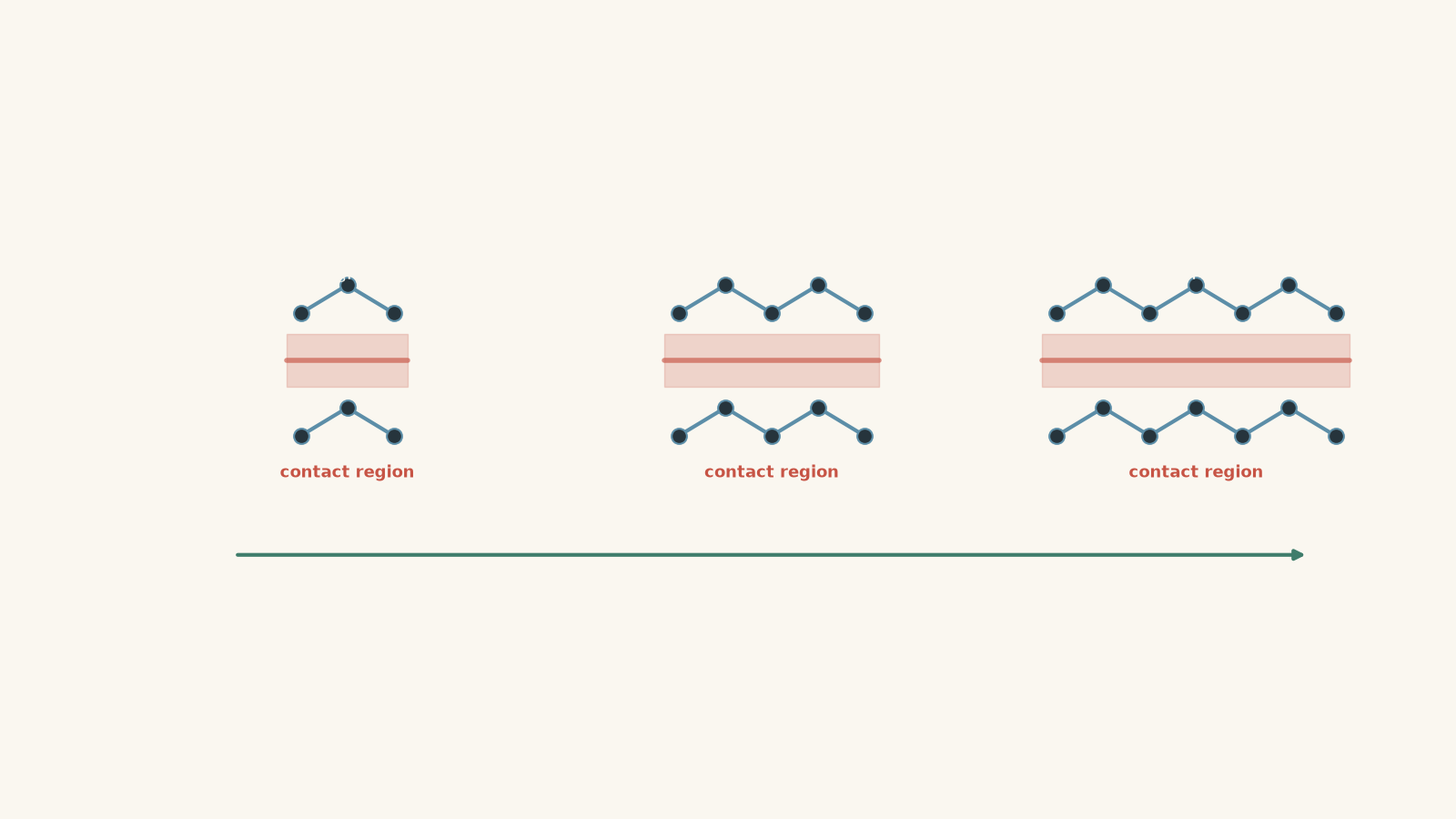
The Velcro picture has a limit. Molecules do not contain literal hooks, and London dispersion forces come from fluctuations in electron distributions. The analogy is only meant to capture one idea: many individually weak interactions can produce a substantial total attraction.
04Boiling point: longer chains usually need more energy to separate
Consider pentane and heptane.
Both are alkanes, so neither molecule has a permanent dipole or an \(\ce{O-H}\) group capable of hydrogen bonding. Their important intermolecular attraction is London dispersion.
Heptane, \(\ce{C7H16}\), has a larger and more polarisable electron cloud than pentane, \(\ce{C5H12}\). Its molecules therefore experience stronger total dispersion forces.
More energy is required to separate heptane molecules into the gas phase.
So:
\[
\text{longer alkane chain}
\rightarrow
\text{stronger dispersion forces}
\rightarrow
\text{higher boiling point}
\]
This pattern appears in many homologous series, not only alkanes. The functional group may add other intermolecular forces, but adding carbon atoms still increases the contribution from dispersion forces.
Worked example: Which alkane boils at the higher temperature?
Pentane, \(\ce{C5H12}\), and octane, \(\ce{C8H18}\), are both straight-chain alkanes. Predict which has the higher boiling point and explain your reasoning using intermolecular forces.
Step 1
Both substances belong to the alkane homologous series. Neither has a permanent molecular dipole or a group capable of hydrogen bonding.
Their main intermolecular attraction is therefore London dispersion forces.
Step 2
Octane has a longer carbon chain and more electrons than pentane. Its electron cloud is more polarisable, and its molecules can make greater intermolecular contact.
Step 3
The stronger dispersion forces between octane molecules require more energy to overcome when the liquid becomes a gas.
Therefore, octane has the higher boiling point.
The important sentence is not “octane is heavier, so it boils higher”. Greater molar mass is a useful clue within this series, but the molecular explanation is the increase in intermolecular dispersion forces.
05Volatility moves in the opposite direction
Volatility describes how readily a substance enters the gas phase.
If molecules attract one another more strongly, fewer of them can escape from the liquid at a given temperature.
So, within a straight-chain alkane series:
\[
\text{carbon chain length} \uparrow
\quad\Rightarrow\quad
\text{boiling point} \uparrow
\quad\Rightarrow\quad
\text{volatility} \downarrow
\]
That explains our opening puzzle. Pentane disappears faster than heptane because pentane molecules are held together by weaker total dispersion forces.
Notice that volatility and boiling point are not two unrelated facts to memorise. They are two consequences of the same molecular behaviour.
06What changes when the functional group is polar?
Now consider a different homologous series: the alkanols.
Methanol, ethanol, propan-1-ol, and butan-1-ol all contain an \(\ce{-OH}\) group.
That changes the intermolecular forces substantially.
The \(\ce{O-H}\) bond is strongly polar because oxygen attracts bonding electrons more strongly than hydrogen. The molecules can therefore form hydrogen bonds with one another.
An alkanol has several intermolecular attractions operating at once:
- London dispersion forces,
- permanent dipole-dipole attractions, and
- hydrogen bonding involving the \(\ce{-OH}\) group.
The first model – “longer molecules have stronger dispersion forces” – is still useful. It is just no longer the entire story.
As you move from ethanol to propan-1-ol to butan-1-ol, each molecule still has one \(\ce{-OH}\) group. The systematic structural change is mainly the growing hydrocarbon chain.
That growing chain adds electrons and increases dispersion interactions. Boiling point therefore generally rises along the series.
Do not say that the \(\ce{O-H}\) hydrogen bonds simply become “stronger” because the chain gets longer. The same type of \(\ce{-OH}\) group is present throughout the series. The increasing dispersion contribution is crucial.
07Water solubility introduces a different competition
Here is a more interesting prediction.
Propan-1-ol and hexan-1-ol both contain one \(\ce{-OH}\) group. Which should be more soluble in water?
You might predict that their solubilities should be similar because both can hydrogen-bond to water.
But propan-1-ol is much more water-compatible.
Why?
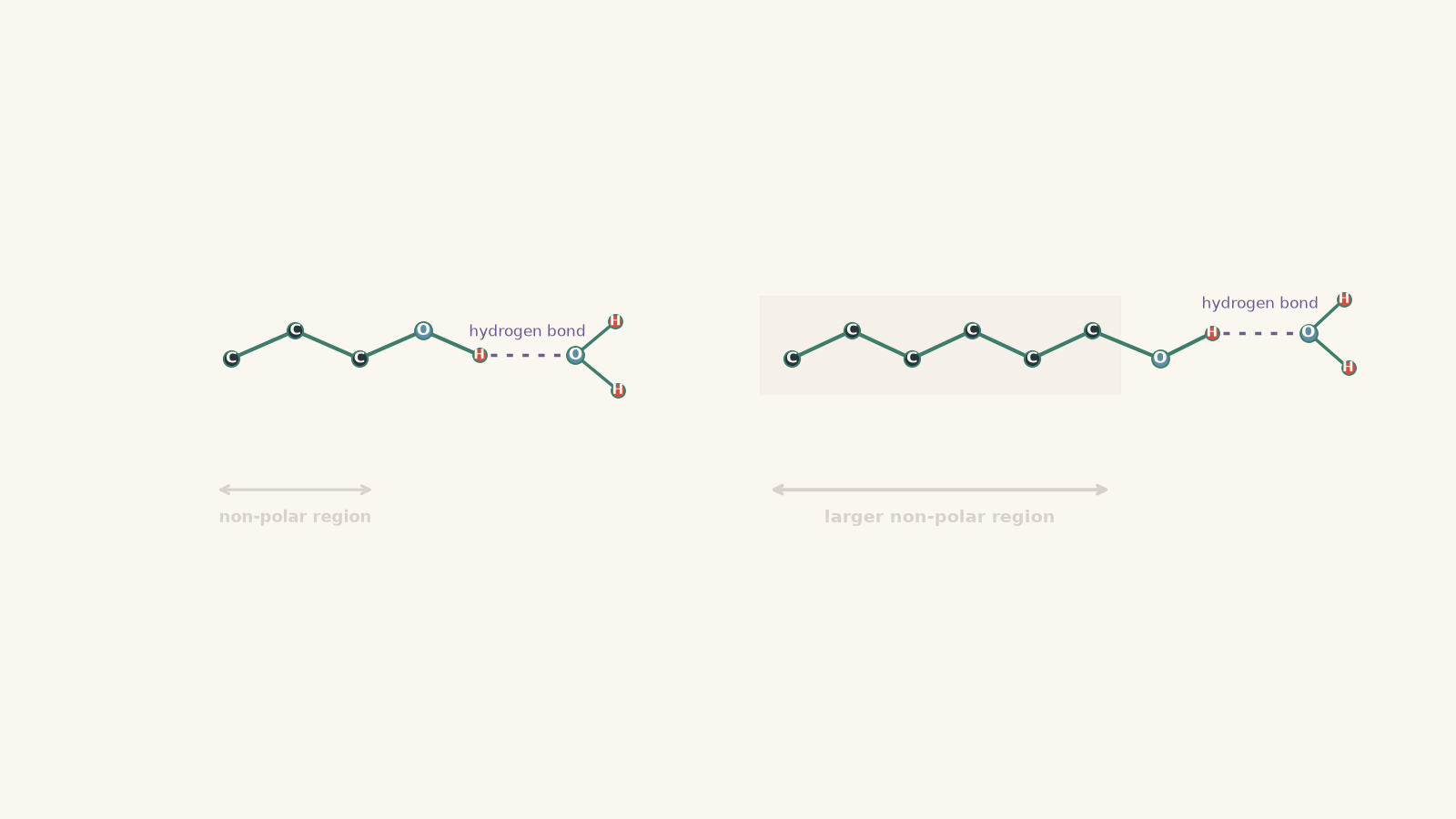
An alkanol has two rather different regions:
- the polar \(\ce{-OH}\) group, which interacts strongly with water, and
- the non-polar hydrocarbon chain, which does not interact favourably with water.
Imagine the \(\ce{-OH}\) group as one sociable person at a party who knows everyone, while the hydrocarbon chain is their increasingly large group of friends who refuse to speak to anyone.
With propan-1-ol, the sociable \(\ce{-OH}\) group is a substantial part of the molecule. As the carbon chain grows, the non-polar portion takes up more of the molecule while there is still only one \(\ce{-OH}\) group.
The analogy breaks because molecules do not make social decisions. The real issue is the balance of intermolecular interactions when solute and solvent are mixed.
For alkan-1-ols, the general trend is:
\[
\text{carbon chain length} \uparrow
\quad\Rightarrow\quad
\text{water solubility} \downarrow
\]
This does not mean the \(\ce{-OH}\) group stops hydrogen-bonding. It means one polar group becomes less able to compensate for the growing non-polar hydrocarbon region.
Worked example: One structural change, two different property trends
Propan-1-ol and pentan-1-ol belong to the same homologous series. Predict which has the higher boiling point and which has the greater water solubility.
Step 1
Both molecules contain one \(\ce{-OH}\) group, so both can form hydrogen bonds with other alkanol molecules and with water.
Step 2
Pentan-1-ol contains five carbon atoms, while propan-1-ol contains three.
Pentan-1-ol therefore has the larger electron cloud and stronger overall London dispersion interactions.
Step 3
Stronger total intermolecular attractions mean that more energy is required to separate pentan-1-ol molecules.
Pentan-1-ol therefore has the higher boiling point.
Step 4
Both substances have one polar \(\ce{-OH}\) group, but pentan-1-ol has the much larger non-polar hydrocarbon region.
The balance of its structure is therefore less compatible with polar water.
Propan-1-ol has the greater water solubility.
The same increase in carbon chain length has produced a higher boiling point but a lower water solubility. There is no contradiction. Boiling point asks how difficult it is to separate molecules from each other. Solubility asks whether interactions in the mixed system are favourable enough to replace the original solute-solute and solvent-solvent interactions.
08Viscosity: why longer molecules tend to flow less easily
Viscosity is a liquid’s resistance to flow.
Compare shorter and longer members of the same homologous series. Longer molecules generally experience stronger dispersion attractions. Their larger surfaces can interact with more neighbouring molecules at once.
As a result, it becomes harder for molecules to move past one another freely.
So viscosity often increases with increasing chain length.
For an alkanol series, hydrogen bonding already produces substantial attraction between molecules. Increasing the hydrocarbon chain adds stronger dispersion interactions on top of this.
Be careful with the explanation “long molecules get tangled”. That picture can become useful for very large polymer molecules, but small HSC organic molecules are better explained using intermolecular attractions and increasing molecular contact.
09Melting point is the awkward one
A student notices that boiling points rise quite smoothly through a homologous series and predicts that melting points must do exactly the same thing.
That prediction is tempting, but it is too simple.
Stronger intermolecular attractions do tend to favour higher melting points. However, melting also depends strongly on how efficiently molecules pack into an ordered solid crystal.
Two neighbouring members of a homologous series can pack differently even though the larger molecule has stronger dispersion forces.
That means melting points often show an overall upward tendency with increasing molecular size, but the pattern can contain irregular jumps.
This is why you should be suspicious of the statement:
“Every physical property changes smoothly with carbon number.”
Boiling points often give a much cleaner homologous trend than melting points.
10A useful decision rule for HSC questions
When you are asked to explain a physical-property trend within a homologous series, do not jump straight to “molar mass”.
Work through the molecular story.
| Property | Common trend as chain length increases | Main reasoning |
|---|---|---|
| Boiling point | Increases | Larger, more polarisable electron cloud gives stronger dispersion forces |
| Volatility | Decreases | Stronger intermolecular attractions make escape into the gas phase less likely |
| Viscosity | Generally increases | Stronger attractions and greater intermolecular contact oppose movement |
| Water solubility of alkanols | Decreases | Non-polar hydrocarbon region grows while the single polar \(\ce{-OH}\) group remains |
| Melting point | Often increases overall, but irregularly | Intermolecular forces matter, but solid-state packing also matters |
The exact wording matters. “Greater molar mass causes a higher boiling point” is weaker than:
Increasing chain length gives a larger, more polarisable electron cloud, strengthening London dispersion forces between molecules. More energy is therefore required to separate the molecules into the gas phase, so the boiling point increases.
That answer gives the mechanism rather than only the correlation.
11The misconception to avoid: “more bonds means a higher boiling point”
Suppose you compare butane and octane.
Octane contains more covalent bonds within each molecule. It also has a higher boiling point.
It is easy to connect those two observations and say:
Octane has more covalent bonds, so more bonds must be broken when it boils.
But no carbon-carbon or carbon-hydrogen covalent bonds need to break during boiling.
The extra atoms matter because they create a larger electron cloud and stronger total intermolecular dispersion forces.
A useful diagnostic question is:
Does the molecule chemically change when the physical process occurs?
If liquid octane becomes gaseous octane, the molecule is still \(\ce{C8H18}\). You should be thinking about intermolecular attractions, not breaking covalent bonds.
12Questions and solutions
Question 1
Pentane and heptane are straight-chain alkanes.
Predict which substance has:
a. the higher boiling point, and
b. the greater volatility.
Explain both predictions using intermolecular forces.
Solution 1
Heptane has the higher boiling point, while pentane has the greater volatility.
Heptane, \(\ce{C7H16}\), has a larger electron cloud and more electrons than pentane, \(\ce{C5H12}\). Its electron cloud is therefore more polarisable, producing stronger London dispersion forces between neighbouring heptane molecules.
More energy is required to separate heptane molecules into the gas phase, so heptane has the higher boiling point.
At the same temperature, pentane molecules experience weaker intermolecular attractions and can escape from the liquid more readily. Pentane is therefore more volatile.
The tempting mistake is to say that heptane has “stronger covalent bonds”. Those bonds are not broken during evaporation or boiling. The relevant difference is the strength of the intermolecular dispersion forces.
Question 2
Propan-1-ol and hexan-1-ol each contain one \(\ce{-OH}\) group.
A student argues:
“They should have similar boiling points and similar water solubilities because each molecule can form hydrogen bonds.”
Evaluate this statement.
Solution 2
The statement is incorrect: hexan-1-ol should have the higher boiling point, while propan-1-ol should have the greater water solubility.
Both molecules contain an \(\ce{-OH}\) group, so both can participate in hydrogen bonding. However, hexan-1-ol has the longer hydrocarbon chain, a larger electron cloud, and stronger London dispersion attractions.
Its total intermolecular attractions are therefore stronger, so more energy is needed to separate its molecules during boiling. Hexan-1-ol consequently has the higher boiling point.
Water solubility involves a different balance. The \(\ce{-OH}\) group can hydrogen-bond with water, but the hydrocarbon chain is non-polar. Hexan-1-ol has a much larger non-polar region than propan-1-ol while still possessing only one \(\ce{-OH}\) group. Its overall compatibility with water is therefore lower.
The tempting route is to count hydrogen-bonding groups and stop there. That ignores the growing hydrocarbon section and the increasing dispersion interactions contributed by the rest of the molecule.
Question 3
Two consecutive members of a straight-chain organic homologous series are labelled X and Y. Y contains one additional \(\ce{CH2}\) unit.
Measurements show that Y has a higher boiling point than X, but a slightly lower melting point.
A student concludes that at least one measurement must be wrong because stronger intermolecular forces should raise both temperatures.
Is the student’s conclusion justified?
Solution 3
No. The measurements can be consistent with the expected intermolecular-force trend.
Adding a \(\ce{CH2}\) unit generally produces a larger, more polarisable molecule. Y can therefore experience stronger London dispersion forces than X. This makes a higher boiling point for Y entirely reasonable because boiling requires molecules to separate extensively from one another.
Melting is more complicated. The solid consists of molecules arranged in an ordered crystal, so melting point depends not only on intermolecular attraction but also on how effectively the molecules pack in that solid structure.
It is therefore possible for Y to have stronger overall intermolecular attractions but form a less favourably packed solid than X. The packing effect can be large enough to make Y’s melting point slightly lower.
The tempting argument assumes that boiling and melting measure exactly the same thing. They do not. Boiling is dominated by the energy needed to separate liquid molecules into a gas, while melting is also strongly affected by the structure and packing of the solid.
Question 4
A mixture contains comparable amounts of pentane, heptane, and octane. It is heated gently in a simple distillation apparatus.
A student makes two claims:
- Pentane should be enriched in the early condensate because it has the weakest carbon-carbon bonds.
- Once most of the pentane has distilled, the temperature measured near the vapour outlet should generally rise.
Assess both claims and explain what should happen to the composition of the condensate as distillation continues.
Solution 4
Claim 1 reaches the correct prediction for the wrong reason, while Claim 2 is broadly correct. The early condensate should be richer in pentane, and later condensate should become progressively richer in the higher-boiling components.
Pentane has the shortest chain of the three compounds. It has the smallest and least polarisable electron cloud, so its molecules experience the weakest total London dispersion forces.
Pentane is therefore the most volatile component and has the lowest boiling point. The vapour above the heated mixture is consequently enriched in pentane relative to the original liquid, so the first collected condensate contains a relatively high proportion of pentane.
The carbon-carbon covalent bonds in pentane do not need to break. Distillation is a physical separation, and each molecule remains chemically intact.
As pentane is preferentially removed, the liquid left in the flask becomes richer in heptane and octane. These compounds have stronger dispersion forces and higher boiling points. A higher temperature is therefore required to produce vapour efficiently from the remaining mixture, so the observed vapour temperature generally rises.
Later fractions become richer first in heptane and then in the least volatile component, octane.
The tempting route in Claim 1 is to connect “easier to boil” with “weaker bonds inside the molecule”. The real constraint is that the molecules are not decomposing. Their relative volatilities are controlled mainly by intermolecular forces.
Question 5
Consider the straight-chain alkan-1-ol homologous series.
As carbon chain length increases, three observations are generally made:
- boiling point increases,
- viscosity increases, and
- water solubility decreases.
A student tries to explain all three observations with one sentence:
“The intermolecular forces become stronger as the molecules get bigger.”
Explain why that sentence is useful but incomplete.
Then predict:
a. how the solubility of the alkanols would generally change in a non-polar hydrocarbon solvent as the carbon chain becomes longer, and
b. whether the melting point must increase at every single step along the homologous series.
Your explanation must use one consistent molecular model for all five properties.
Solution 5
The student’s statement can explain the rise in boiling point and much of the rise in viscosity, but it cannot by itself explain water solubility. Longer alkan-1-ols generally become better matched to non-polar hydrocarbon solvents, while their melting points need not increase at every single step.
Every member of the alkan-1-ol series has an \(\ce{-OH}\) group capable of hydrogen bonding. As the hydrocarbon chain becomes longer, the molecule also gains electrons and a larger, more polarisable electron cloud.
London dispersion attractions therefore become increasingly important.
For boiling point, this means the molecules are harder to separate into the gas phase. More energy is required, so boiling point rises.
For viscosity, the stronger total intermolecular attractions and larger regions of intermolecular contact oppose the motion of molecules past one another. The liquid therefore generally becomes more viscous.
Water solubility cannot be predicted simply by asking whether attractions between alkanol molecules become stronger. Dissolving requires the system to replace some alkanol-alkanol and water-water interactions with alkanol-water interactions.
The \(\ce{-OH}\) group interacts favourably with water through hydrogen bonding, but the hydrocarbon chain is non-polar. As that chain grows, the non-polar fraction of the molecule becomes larger while the molecule still has only one \(\ce{-OH}\) group. Water solubility therefore decreases.
In a non-polar hydrocarbon solvent, the trend is generally reversed. The growing hydrocarbon portion of the alkanol becomes increasingly compatible with the solvent through dispersion interactions. Longer-chain alkanols should therefore generally show greater compatibility with a non-polar hydrocarbon solvent than shorter-chain members, although exact solubilities still depend on the particular solvent and temperature.
Melting point does not have to increase at every step. Larger molecules generally have stronger dispersion attractions, which can raise melting point, but the stability of a solid also depends on molecular packing in its crystal. Consecutive homologues can pack with different efficiencies, producing irregularities.
The tempting route is to search for one quantity called “intermolecular-force strength” and use it to rank every physical property. The deeper model asks a different molecular question for each property:
- boiling point: how difficult is it to separate molecules into a gas?
- viscosity: how strongly is molecular motion through the liquid resisted?
- solubility: are the new solute-solvent interactions favourable enough to produce mixing?
- melting point: how strongly is the solid held together, and how effectively do its molecules pack?
That distinction is what makes trends across homologous series predictable without turning them into rules that fail as soon as the data become interesting.
The next useful step is to apply the same reasoning when the functional group changes, rather than just the carbon-chain length. Comparing an alkane, an alkanol, an aldehyde, and a carboxylic acid forces you to judge London dispersion forces, permanent dipoles, and hydrogen bonding together instead of relying on molecular size alone.