
Carbon-Carbon Bond Shapes: Single, Double and Triple Bonds
Learn how single, double, and triple carbon-carbon bonds affect molecular shape, bond angles, rotation, and local geometry in HSC Chemistry.
Draw ethane, ethene, and ethyne as structural formulae and they can look deceptively similar: carbon atoms joined by one, two, or three lines. But those extra lines do much more than make the bond stronger. They change the three-dimensional arrangement of the atoms around each carbon.
Before reading on, predict this: if carbon forms a double bond instead of a single bond, do the atoms around that carbon move closer together, further apart, or into a completely different arrangement?
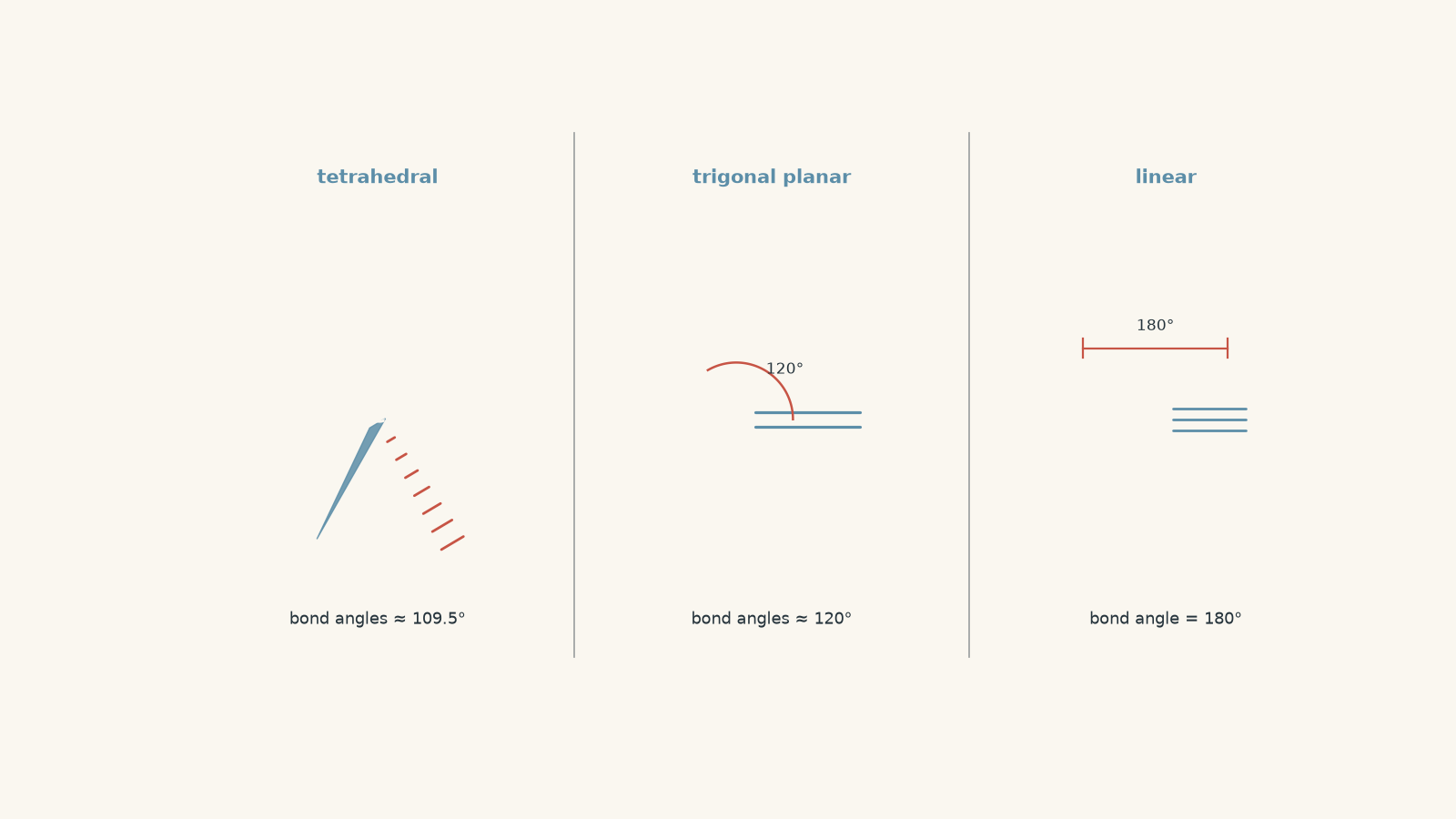
They move into a different arrangement. A carbon with four single bonds is approximately tetrahedral. A carbon involved in one double bond is trigonal planar. A carbon involved in one triple bond is linear. The reason comes from how many different directions the bonding electrons occupy around that carbon.
01The rule that actually determines carbon’s shape
Start with something you already know: electrons repel other electrons.
If several groups of bonding electrons surround a carbon atom, they arrange themselves to stay as far apart as possible. This is the basic idea behind valence shell electron pair repulsion, or VSEPR, theory.
Picture four people who have all turned up to a painfully small party and want maximum personal space. If there are four people, they can’t all stand in one flat circle and be equally separated. The best three-dimensional arrangement is tetrahedral.
The analogy has one important limit. A double bond contains more than one shared pair of electrons, but those electrons connect the carbon to the same neighbouring atom. For basic VSEPR counting, the whole double bond occupies one direction, or one electron region.
The same is true for a triple bond.
So, around carbon:
- a single bond counts as one electron region
- a double bond counts as one electron region
- a triple bond counts as one electron region
That sounds strange at first. A triple bond has three shared electron pairs, so why count it once? Because VSEPR is asking how many different directions the electron density points in, not simply how many electron pairs exist.
In the neutral hydrocarbons considered here, carbon has no lone pairs. That makes the rule especially clean.
| Electron regions around carbon | Typical bonding pattern | Local shape | Ideal bond angle |
|---|---|---|---|
| 4 | four single bonds | tetrahedral | \(109.5^\circ\) |
| 3 | one double bond and two single bonds | trigonal planar | \(120^\circ\) |
| 2 | one triple bond and one single bond, or two double bonds | linear | \(180^\circ\) |
These angles are ideal values. Real bond angles can shift slightly when different atoms or bond types repel unequally.
02Carbon-carbon single bonds: tetrahedral around saturated carbon
Consider ethane:
\[
\ce{CH3-CH3}
\]
Focus on either carbon atom.
It is attached to three hydrogen atoms and one carbon atom. Those are four separate electron regions.
Four electron regions spread into a tetrahedral arrangement, giving bond angles close to \(109.5^\circ\).
This means the flat structural formula is misleading. The bonds around each carbon do not actually sit neatly in the plane of your page.
A carbon with four single bonds has:
- four electron regions
- tetrahedral geometry
- bond angles of approximately \(109.5^\circ\)
There is another useful consequence. A carbon-carbon single bond consists of a \(\sigma\) bond, formed by electron density concentrated along the line joining the two nuclei. Rotation around a carbon-carbon single bond is therefore possible.
It isn’t literally energy-free. Different rotational arrangements can have slightly different energies. But compared with a carbon-carbon double bond, rotation around an ordinary single bond is relatively easy.
That is why an alkane chain should not be imagined as a rigid zigzag sculpture. It can twist into different conformations.
03Carbon-carbon double bonds: trigonal planar around each carbon
Now replace the carbon-carbon single bond with a double bond:
\[
\ce{CH2=CH2}
\]
This is ethene.
Each carbon has three neighbouring atoms:
- the other carbon
- one hydrogen
- another hydrogen
The double bond counts as one electron region, so each carbon has three electron regions in total.
Three regions spread out in a plane, producing trigonal planar geometry with ideal angles of approximately \(120^\circ\).
So the important result is:
\[
\text{three electron regions} \rightarrow \text{trigonal planar} \rightarrow 120^\circ
\]
The atoms directly attached to the two double-bonded carbons are also arranged in the same plane around the \(\ce{C=C}\) unit.
Why a double bond stops free rotation
VSEPR predicts the shape, but it doesn’t fully explain why a double bond behaves differently from a single bond. For that, we need one more layer.
A carbon-carbon double bond contains:
- one \(\sigma\) bond
- one \(\pi\) bond
The \(\sigma\) bond lies along the line between the two carbon nuclei.
The \(\pi\) bond comes from sideways overlap of orbitals above and below that line. If one carbon were rotated independently through \(90^\circ\), that sideways overlap would be destroyed.
So free rotation about a \(\ce{C=C}\) bond cannot occur without breaking the \(\pi\) component of the bond.
Think of two people holding hands normally for a single bond. They can turn while maintaining the connection. A double bond is more like holding hands while also trying to keep two ridiculously large trays pressed together. Twist one person relative to the other and the second contact is lost.
The analogy breaks because orbitals aren’t trays, obviously. The useful part is that a second type of overlap constrains rotation.
This restricted rotation later becomes crucial when you study geometric isomerism.
04Carbon-carbon triple bonds: linear around each carbon
Now consider ethyne:
\[
\ce{HC#CH}
\]
Focus again on one carbon.
It is connected to only two atoms:
- one hydrogen
- the other carbon
The triple bond counts as one electron region, and the C-H bond counts as another.
There are therefore two electron regions.
Two regions can get as far apart as possible by pointing in exactly opposite directions. The geometry is linear:
\[
\ce{H-C#C-H}
\]
with bond angles of:
\[
180^\circ
\]
A carbon-carbon triple bond contains one \(\sigma\) bond and two \(\pi\) bonds. Each triple-bonded carbon has only one other atom attached to it, so the arrangement through that carbon is a straight line.
05One detail that prevents a lot of mistakes
It is tempting to memorise:
single = tetrahedral, double = trigonal planar, triple = linear
That shortcut often works for simple alkanes, alkenes, and alkynes, but it is not the real rule.
The shape belongs to a carbon atom, not to an individual bond.
Suppose two carbon atoms are joined by a single bond, but one of those carbons also participates in a double bond elsewhere. That carbon does not suddenly become tetrahedral just because one of its bonds happens to be single.
You must inspect all the electron regions around that carbon.
For example, consider part of buta-1,3-diene:
\[
\ce{CH2=CH-CH=CH2}
\]
There is a single bond between the two middle carbon atoms.
A student might see that central \(\ce{C-C}\) single bond and call the two middle carbons tetrahedral. But each middle carbon participates in one double bond and two single bonds.
Each therefore has three electron regions.
Each middle carbon is trigonal planar, not tetrahedral.
The reliable method is always:
- Choose one carbon atom.
- Count the electron regions around that carbon.
- Count each single, double, or triple bond to another atom as one region.
- Use the number of regions to determine the local shape.
06A more precise orbital picture
You may also see the terms \(sp^3\), \(sp^2\), and \(sp\) hybridisation used to describe these carbon atoms.
They match the shapes we have just built from VSEPR:
| Carbon environment | Hybridisation label | Geometry |
|---|---|---|
| four electron regions | \(sp^3\) | tetrahedral |
| three electron regions | \(sp^2\) | trigonal planar |
| two electron regions | \(sp\) | linear |
Hybridisation is a model of the atomic orbitals used in bonding. You do not need to treat the label itself as the explanation. Saying “\(sp^2\), therefore trigonal planar” just replaces one memorised fact with another unless you understand what the arrangement means.
The physical idea is still that the bonding directions organise themselves into a geometry that provides effective separation.
Worked example: Find the shape around every carbon in propene
Determine the local geometry and approximate bond angle around each carbon atom in propene, \(\ce{CH3-CH=CH2}\).
Step 1
\[
\ce{C1H3-C2H=C3H2}
\]
Step 2
C1 has three C-H single bonds and one C-C single bond. That gives four electron regions.
Therefore C1 is tetrahedral, with bond angles of approximately \(109.5^\circ\).
Step 3
C2 has:
- one bond to C1
- one double bond to C3
- one bond to H
The double bond counts as one region, giving three electron regions in total.
Therefore C2 is trigonal planar, with angles close to \(120^\circ\).
Step 4
C3 has:
- one double bond to C2
- two C-H bonds
Again, there are three electron regions.
C3 is also trigonal planar, with angles close to \(120^\circ\).
So one molecule can contain different local carbon geometries:
| Carbon | Electron regions | Geometry | Approximate angle |
|---|---|---|---|
| C1 | 4 | tetrahedral | \(109.5^\circ\) |
| C2 | 3 | trigonal planar | \(120^\circ\) |
| C3 | 3 | trigonal planar | \(120^\circ\) |
The result means propene is not simply “a trigonal planar molecule” or “a tetrahedral molecule”. Shape should be described locally around each relevant carbon.
Worked example: Map the shapes in a molecule containing a double and triple bond
Consider the structure:
\[
\ce{CH3-CH=CH-C#CH}
\]
Determine the geometry around all five carbon atoms.
Step 1
Step 2
C1 forms four single bonds: three to hydrogen and one to C2.
It has four electron regions, so C1 is tetrahedral.
Step 3
Each participates in the \(\ce{C=C}\) double bond and also has two other single bonds.
Each therefore has three electron regions.
C2 and C3 are trigonal planar, with ideal angles of approximately \(120^\circ\).
Step 4
C4 participates in the \(\ce{C#C}\) triple bond and has one single bond to C3.
That gives two electron regions, so C4 is linear.
C5 also has the triple bond plus one C-H bond. It has two regions and is linear.
The complete pattern is therefore:
\[
\text{tetrahedral} \rightarrow
\text{trigonal planar} \rightarrow
\text{trigonal planar} \rightarrow
\text{linear} \rightarrow
\text{linear}
\]
The important skill is not recognising the molecule. It is being able to stop at any carbon, count its electron regions, and rebuild the shape from first principles.
07Ideal shapes are preferences, not unbreakable laws
The \(109.5^\circ\), \(120^\circ\), and \(180^\circ\) values are ideal geometries.
For uncomplicated hydrocarbons, they are excellent models. But a larger molecular structure can sometimes force a carbon away from its ideal angle.
A useful example is a small carbon ring. Three carbon atoms joined into a triangle cannot have a C-C-C angle of \(109.5^\circ\). The geometry of a triangle forces that angle to be much smaller.
That does not mean VSEPR has suddenly failed. It means two effects are competing:
- electron regions favour a low-repulsion arrangement
- the bonds must also connect the atoms into the required molecular framework
Distorting bonds away from their preferred arrangement raises the molecule’s energy. This idea is called strain, and it becomes useful when comparing the stability and reactivity of different structures.
08What the shapes let you predict
These geometries are not just names to attach to diagrams.
Once you recognise them, you can make useful predictions.
A tetrahedral carbon tells you that a flat structural formula is hiding a three-dimensional arrangement. A double-bonded carbon tells you that the region is approximately planar and that rotation is restricted. A triple-bonded carbon tells you that the atoms connected through that carbon lie along a straight line.
That leads directly into later organic chemistry ideas such as conformations, structural shape, geometric isomerism, and the relationship between molecular structure and physical properties.
09Questions and solutions
Question 1
Ethane, ethene, and ethyne have the structures \(\ce{CH3-CH3}\), \(\ce{CH2=CH2}\), and \(\ce{HC#CH}\), respectively.
For each molecule:
a. state the shape around each carbon atom
b. give the approximate bond angle
c. explain the shape using electron regions.
Solution 1
Ethane is tetrahedral around each carbon at approximately \(109.5^\circ\), ethene is trigonal planar around each carbon at approximately \(120^\circ\), and ethyne is linear around each carbon at \(180^\circ\).
For ethane, each carbon forms four single bonds. There are four electron regions around each carbon, so VSEPR predicts a tetrahedral arrangement.
For ethene, each carbon has two C-H bonds and one \(\ce{C=C}\) double bond. The double bond counts as one electron region, giving three regions in total. Three regions give trigonal planar geometry.
For ethyne, each carbon has one C-H bond and one \(\ce{C#C}\) triple bond. This gives two electron regions, which arrange themselves in opposite directions to produce linear geometry.
A tempting mistake is to count the two shared pairs in a double bond, or the three shared pairs in a triple bond, as separate VSEPR directions. They are not separate directions because they connect the carbon to the same neighbouring atom.
Question 2
Consider the molecule:
\[
\ce{CH3-CH=CH-C#CH}
\]
The carbon atoms are numbered C1 to C5 from left to right.
a. State the local geometry around each carbon atom.
b. State the approximate ideal bond angles around C1, C2, and C4.
c. Explain why C3-C4-C5 must form a straight line even though C3 itself is not a linear carbon.
Solution 2
The geometries from C1 to C5 are tetrahedral, trigonal planar, trigonal planar, linear, and linear, respectively; C3-C4-C5 forms a straight line because the angle is determined at C4, which has two electron regions.
For C1, four single bonds create four electron regions:
\[
\text{C1: tetrahedral, approximately }109.5^\circ
\]
C2 participates in one double bond and has two other single bonds. It has three electron regions:
\[
\text{C2: trigonal planar, approximately }120^\circ
\]
C3 has the same electron-region count, so it is also trigonal planar.
C4 has one single bond to C3 and one triple bond to C5. These are two electron regions:
\[
\text{C4: linear, }180^\circ
\]
C5 is also linear because it has the triple bond to C4 and one bond to hydrogen.
For part c, the relevant angle is \(\angle\ce{C3-C4-C5}\). C4 is the atom at the centre of that angle. Because C4 is linear:
\[
\angle\ce{C3-C4-C5}=180^\circ
\]
The tempting route is to notice that C3 is trigonal planar and assume that somehow prevents the three carbon atoms from being collinear. But molecular geometry must be considered around the atom at the vertex of the angle. Here, that atom is C4.
Question 3
A student compares butane and but-2-ene:
\[
\ce{CH3-CH2-CH2-CH3}
\]
and
\[
\ce{CH3-CH=CH-CH3}
\]
They argue:
“Both molecules contain four carbon atoms connected in a chain, so the chain should be able to twist into essentially the same shapes.”
Assess this statement. Your answer must refer to local geometry and rotation about carbon-carbon bonds.
Solution 3
The statement is incorrect because butane contains rotatable carbon-carbon single bonds, whereas the \(\ce{C=C}\) region of but-2-ene is trigonal planar and cannot freely rotate without disrupting its \(\pi\) bond.
In butane, every carbon forms only single bonds. The two internal carbon atoms each have four electron regions and are tetrahedral.
The carbon-carbon single bonds are \(\sigma\) bonds. Rotation about these bonds is possible, so butane can adopt different conformations without breaking its bonding framework.
In but-2-ene, C2 and C3 each participate in the double bond. Each has three electron regions and is trigonal planar.
The double bond contains one \(\sigma\) bond and one \(\pi\) bond. The \(\pi\) bond depends on sideways orbital overlap. Rotating one end of the molecule relative to the other would destroy that overlap, so the double bond is rotationally restricted.
As a result, the groups attached to C2 and C3 are held in fixed relative positions around the double bond.
The tempting argument focuses only on the number of carbon atoms. The missing constraint is the type of bonding between those atoms. Two carbon skeletons with the same number of atoms can have very different three-dimensional behaviour when their bond types differ.
Question 4
Cyclopropane contains three \(\ce{CH2}\) groups joined into a three-carbon ring. Treat the carbon nuclei as the corners of a triangle.
Each carbon forms four single bonds, so an unconstrained carbon with this bonding pattern would favour a tetrahedral angle of approximately \(109.5^\circ\).
a. What C-C-C angle is forced by the three-membered ring?
b. Calculate the difference between this angle and the ideal tetrahedral angle.
c. Explain why describing each carbon as “perfectly tetrahedral because it has four single bonds” would be inaccurate.
d. Predict whether this distortion raises or lowers the energy of the molecule relative to a structure in which the carbon atoms can remain closer to their preferred bond angles.
Solution 4
The ring forces a C-C-C angle of \(60^\circ\), which is \(49.5^\circ\) smaller than the ideal tetrahedral angle; the carbons are therefore strongly distorted from ideal tetrahedral geometry, increasing the molecule’s strain and energy.
For part a, the three carbon nuclei form a triangle. The internal angles of a triangle sum to \(180^\circ\), so for the three equal ring angles:
\[
\frac{180^\circ}{3}=60^\circ
\]
For part b:
\[
109.5^\circ-60^\circ=49.5^\circ
\]
So the C-C-C angle is compressed by approximately \(49.5^\circ\) relative to the ideal tetrahedral value.
For part c, four electron regions do mean that an unconstrained carbon tends towards a tetrahedral arrangement. But VSEPR predicts a preferred low-repulsion geometry; it does not guarantee that a larger molecule can always achieve that geometry exactly.
The ring creates another constraint: all three C-C bonds must close to form a three-membered loop. A triangle cannot simultaneously have three internal angles of \(109.5^\circ\).
The bonding arrangement is therefore distorted from its ideal geometry.
For part d, the distortion raises the molecule’s energy. Moving bond directions substantially away from their preferred arrangement creates angle strain.
The tempting route is to treat \(109.5^\circ\) as an inviolable law. The deeper point is that molecular shape results from several constraints acting at once. Ideal VSEPR angles describe preferred arrangements, while actual molecules may be forced away from those values.
Question 5
Propadiene, \(\ce{CH2=C=CH2}\), contains two consecutive carbon-carbon double bonds.
Call the three carbons C1, C2, and C3.
a. Determine the geometry around C1, C2, and C3 using electron-region counting.
b. Predict the C1-C2-C3 bond angle.
c. A student argues that because both terminal carbons are trigonal planar, all six atoms in \(\ce{CH2=C=CH2}\) must lie in one plane. Explain why local VSEPR geometry alone does not justify that conclusion.
d. For a more precise bonding model, assume that the central carbon forms its two \(\pi\) bonds using two mutually perpendicular orbitals. Deduce the relative orientation of the two terminal \(\ce{CH2}\) groups.
Solution 5
C1 and C3 are trigonal planar, C2 is linear, the C1-C2-C3 angle is \(180^\circ\), and the two terminal \(\ce{CH2}\) groups lie in perpendicular planes under the stated orbital model.
For part a, C1 has one double bond to C2 and two single bonds to hydrogen. That gives three electron regions:
\[
\text{C1: trigonal planar}
\]
C3 has the same bonding pattern:
\[
\text{C3: trigonal planar}
\]
The central carbon, C2, is different. It forms one double bond to C1 and another double bond to C3.
Each double bond counts as one electron region, so C2 has only two electron regions:
\[
\text{C2: linear}
\]
For part b, because C2 is linear:
\[
\angle\ce{C1-C2-C3}=180^\circ
\]
The three carbon nuclei therefore lie on one straight line.
For part c, “trigonal planar” describes the arrangement of bonds around one particular carbon. It does not automatically tell us how the plane around C1 is oriented relative to the plane around C3.
This is the trap. A collection of locally planar centres does not necessarily make the entire molecule planar.
For part d, each \(\pi\) bond requires sideways orbital overlap. The question states that the central carbon uses two mutually perpendicular orbitals for its two \(\pi\) bonds.
The orbital forming the C1=C2 \(\pi\) bond therefore lies perpendicular to the orbital forming the C2=C3 \(\pi\) bond.
For effective overlap, the corresponding orbital on each terminal carbon must align with the central orbital it overlaps.
The result is that the trigonal plane at one terminal carbon is rotated by \(90^\circ\) relative to the trigonal plane at the other terminal carbon. The two terminal \(\ce{CH2}\) groups therefore occupy perpendicular planes even though each group is individually trigonal planar.
A confident first answer of “two double bonds means the whole molecule must be flat” mixes up local and global geometry. VSEPR tells you the shape around each centre. To determine how different local planes are oriented relative to one another, you sometimes need a more detailed bonding model.
That distinction is the useful next step: molecular shape is built from local geometries, but the complete three-dimensional structure also depends on how those local geometries are connected and constrained.