
Bonding in Alkanes: Properties Explained for HSC Chemistry
Learn how intramolecular covalent bonds and intermolecular London dispersion forces explain key alkane properties, including boiling point, volatility, solubility, and melting behaviour.
Petrol evaporates easily. Paraffin wax can sit on a bench as a solid. Yet both are made mostly from hydrocarbons whose molecules contain the same basic types of bonds: \(\ce{C-C}\) and \(\ce{C-H}\).
So what changes?
Before reading on, make a prediction. A longer alkane contains more covalent bonds. Does that mean it has a higher boiling point because those extra covalent bonds are harder to break?
No. That explanation mixes up two completely different kinds of bonding. When an alkane boils, its molecules separate from each other. The covalent bonds inside each molecule stay intact.
That distinction – bonds within molecules versus attractions between molecules – explains most of the physical properties of alkanes.
01Two levels of bonding are operating at once
Picture an alkane molecule as a group of friends holding hands. The hand-holding keeps the group together. Nearby groups might also bump shoulders or briefly lean against each other.
The hand-holding represents strong covalent bonds inside each molecule. The brief contacts represent much weaker attractions between separate molecules.
Boiling makes the groups move apart. It doesn’t rip the people in each group apart.
The analogy breaks because molecules aren’t making choices, obviously. The intermolecular attraction comes from electrostatic interactions between electrons and nuclei. But the separation of the two levels is the important part.
Chemists describe them as:
| Type of bonding | Where it acts | In alkanes | Mainly explains |
|---|---|---|---|
| Intramolecular bonding | Within one molecule | Strong covalent \(\ce{C-C}\) and \(\ce{C-H}\) bonds | Molecular structure, chemical stability, reactions |
| Intermolecular forces | Between separate molecules | London dispersion forces | Boiling point, melting point, volatility, viscosity, and physical state |
Intra- means within. Inter- means between.
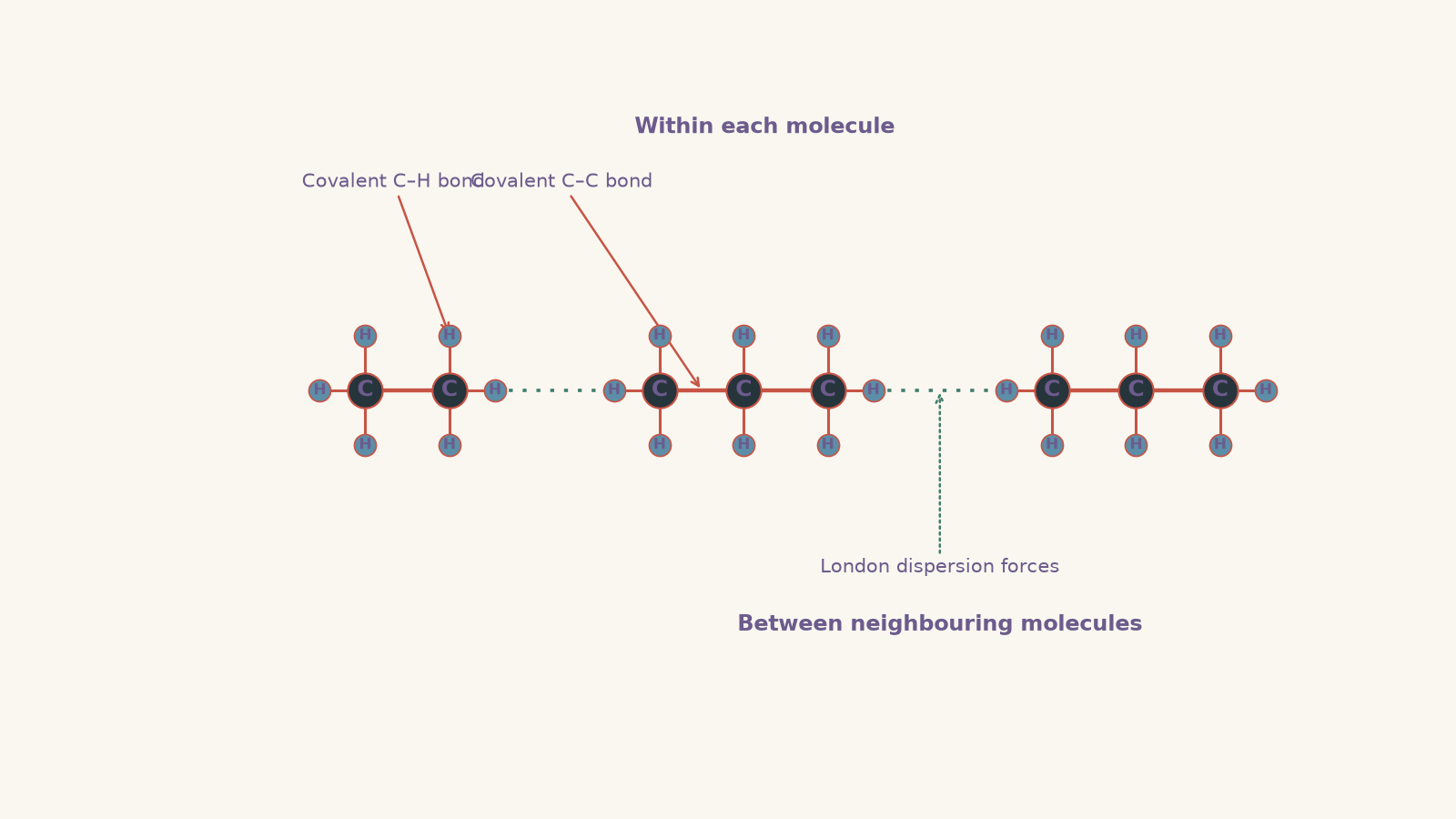
02What is actually bonded inside an alkane?
Alkanes are saturated hydrocarbons. They contain only carbon and hydrogen, with single covalent bonds between their atoms.
For an open-chain alkane, the general formula is \(\ce{C_nH_{2n+2}}\).
Methane is \(\ce{CH4}\), ethane is \(\ce{C2H6}\), propane is \(\ce{C3H8}\), and so on.
Carbon and hydrogen have reasonably similar electronegativities. A \(\ce{C-H}\) bond therefore has only a small bond polarity, while a \(\ce{C-C}\) bond is non-polar.
For HSC structure-property explanations, alkanes are treated as non-polar molecules. They don’t have the strong permanent dipoles found in many other organic molecules, and they cannot form hydrogen bonds with one another.
Their important intermolecular attraction is therefore the London dispersion force.
03Non-polar does not mean “no attraction”
This is a tempting mistake.
A student might reason that if an alkane is non-polar, one molecule should have no reason to attract another.
But electrons are constantly moving.
At one instant, the electrons in an alkane molecule may be distributed slightly more towards one side. That creates a temporary, or instantaneous, dipole. This temporary uneven charge can distort the electron cloud of a neighbouring molecule, producing an induced dipole.
The two temporary dipoles attract.
These attractions are called London dispersion forces.
Individually, they are weak. Across a large molecule with many electrons, however, their total effect can become substantial.
Why larger alkanes have stronger dispersion forces
Imagine methane and decane.
Decane has many more electrons and a much larger electron cloud. That larger cloud is more easily distorted, so stronger instantaneous and induced dipoles can develop.
Longer molecules can also make contact with neighbouring molecules over a greater area.
The result is stronger London dispersion forces between larger alkane molecules.
That gives us the main trend:
As alkane chain length increases, boiling point generally increases.
At the same time, volatility generally decreases because fewer molecules have enough energy to escape easily from the liquid.
Worked example: Why does decane boil at a much higher temperature than pentane?
Pentane, \(\ce{C5H12}\), boils at about \(36^\circ\text{C}\), while decane, \(\ce{C10H22}\), boils at about \(174^\circ\text{C}\). Explain the difference using bonding.
Step 1
Boiling separates whole molecules from one another. The \(\ce{C-C}\) and \(\ce{C-H}\) covalent bonds inside pentane and decane are not broken.
The relevant attractions are London dispersion forces between molecules.
Step 2
A decane molecule has more electrons and a larger electron cloud than a pentane molecule.
Its electron cloud is therefore more polarizable: it can develop stronger temporary dipoles.
Step 3
Decane molecules experience stronger London dispersion forces than pentane molecules.
More thermal energy is required to separate decane molecules into the gas phase.
Step 4
Decane therefore has the higher boiling point and the lower volatility.
The important idea is not that decane has “more covalent bonds to break”. Its covalent bonds remain intact during boiling.
04Molecular shape matters too
Suppose two alkanes have the same molecular formula. They therefore contain the same number of electrons.
Would you expect them to have exactly the same boiling point?
Not necessarily.
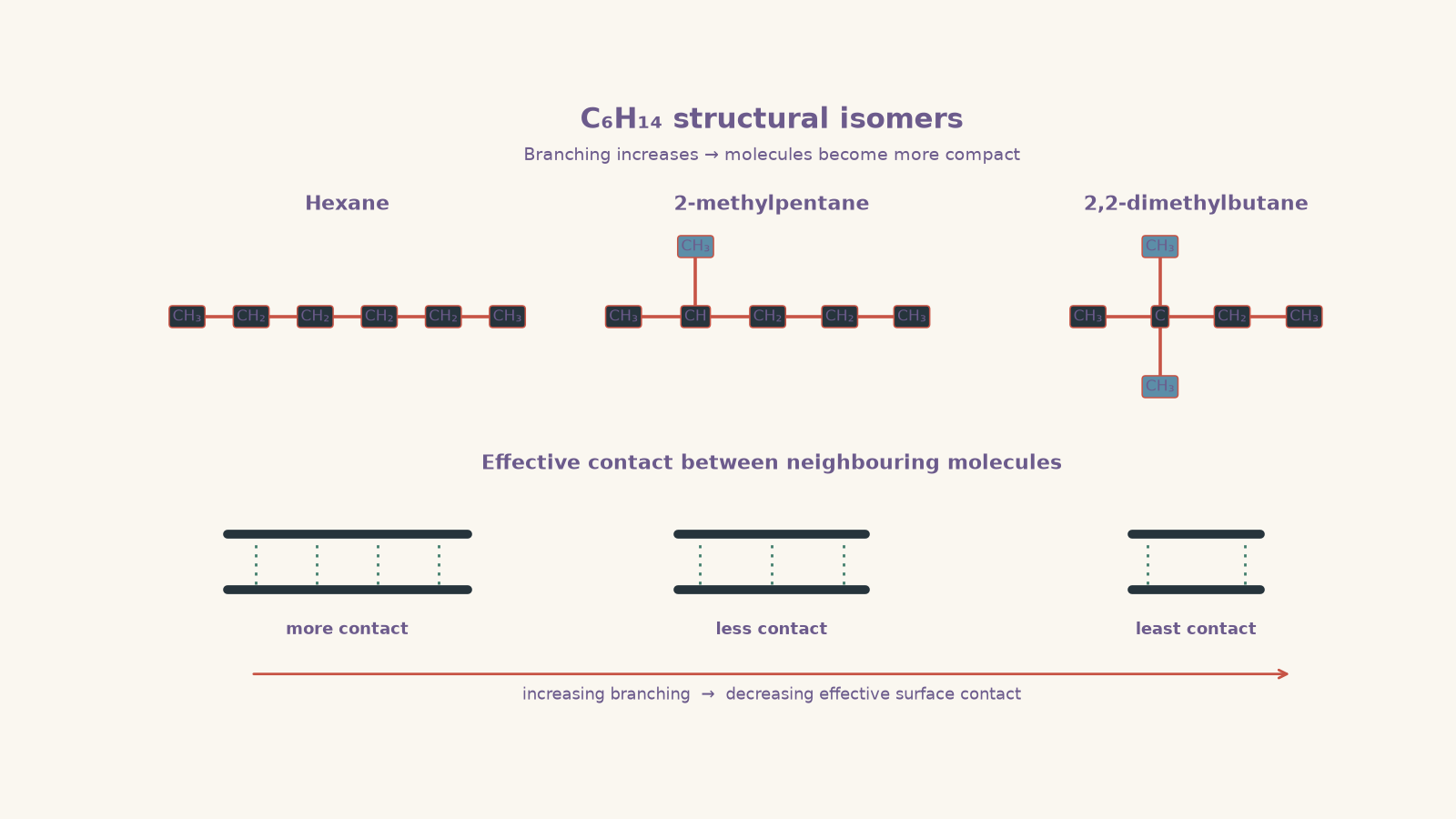
Consider three structural isomers of \(\ce{C6H14}\):
- hexane
- 2-methylpentane
- 2,2-dimethylbutane
They contain the same types and numbers of atoms, but their shapes are different.
A relatively straight molecule can make close contact with neighbouring molecules over more of its surface. A highly branched molecule is more compact, so the average contact between neighbouring molecules is reduced.
Less effective contact means weaker overall London dispersion forces.
So, for isomeric alkanes with the same molecular formula:
Greater branching generally lowers the boiling point.
Worked example: Rank three hexane isomers by boiling point
Predict the boiling-point order of hexane, 2-methylpentane, and 2,2-dimethylbutane.
Step 1
All three have the molecular formula \(\ce{C6H14}\).
They therefore have the same molar mass and the same total number of electrons. Simply saying “the larger molecule has stronger dispersion forces” cannot distinguish them.
Step 2
Hexane is the least branched and has the most extended shape.
2-methylpentane is more compact.
2,2-dimethylbutane is the most highly branched and most compact.
Step 3
The more extended hexane molecules can make more effective surface contact with one another. Their overall London dispersion attractions are therefore stronger.
The compact 2,2-dimethylbutane molecules have less effective intermolecular contact.
Step 4
The expected order is:
\[
\text{hexane} > \text{2-methylpentane} > \text{2,2-dimethylbutane}
\]
Their boiling points are approximately \(69^\circ\text{C}\), \(60^\circ\text{C}\), and \(50^\circ\text{C}\), respectively.
So branching has changed a physical property even though the molecular formula has not changed.
05Why alkanes do not mix well with water
Pour hexane into water and the two liquids form separate layers.
A common shortcut is “like dissolves like”. That’s useful, but it isn’t much of an explanation.
To understand solubility properly, think about what must happen during mixing.
Water molecules attract each other strongly through hydrogen bonding. For an alkane to dissolve, some of those water-water attractions must be disrupted to make space for alkane molecules.
What replaces them?
Only relatively weak attractions between water and the non-polar alkane.
That exchange is not favourable enough for substantial mixing. The alkane molecules therefore tend to remain together rather than disperse throughout the water.
This is why alkanes have very low solubility in water.
They mix much more readily with other non-polar substances because the intermolecular attractions being replaced are more similar in strength.
“Like dissolves like” is therefore a useful result, but the deeper idea is:
Dissolving depends on whether the new solute-solvent attractions can compensate for the attractions disrupted in the original substances.
06Boiling point, volatility, and viscosity are connected
These properties can sound like separate facts to memorise. They are mostly different consequences of the same intermolecular forces.
As alkane molecules become longer, London dispersion forces generally become stronger.
That tends to produce:
| Increasing alkane chain length | Reason |
|---|---|
| Higher boiling point | More energy is needed to separate molecules |
| Lower volatility | Fewer molecules escape easily into the gas phase |
| Higher viscosity | Molecules resist flowing past one another more strongly |
| Greater tendency to be liquid or solid at room temperature | Stronger attractions make condensed phases more stable |
Long hydrocarbon chains can also interfere with each other’s movement, which contributes to their greater viscosity.
Don’t imagine literal knots. “Entanglement” is a model for the way long chains restrict one another’s motion.
This is why small alkanes such as methane, ethane, propane, and butane are gases under ordinary conditions, while intermediate members are liquids and much larger hydrocarbons can be waxy solids.
07Melting point needs a little more care
It is tempting to extend the boiling-point rule directly:
“Stronger dispersion forces mean both higher boiling points and higher melting points.”
There is some truth in that. Across a homologous series, melting point tends to rise overall as molecular size increases.
But melting points are much less smooth than boiling points.
Why?
A liquid is already disordered. Boiling mainly depends on how strongly molecules attract one another in the liquid.
A solid is different. Its molecules must fit into an ordered crystal structure. Molecular symmetry and packing can therefore have a major effect on how stable the solid is.
Two isomers can have similar intermolecular forces in a broad sense but very different abilities to pack into a crystal.
So the useful HSC rule is:
- boiling-point trends are strongly linked to molecular size and branching;
- melting-point trends also depend strongly on solid-state packing.
That extra condition stops you from forcing every melting-point result into the same simple model.
08Why alkanes are relatively unreactive
Intermolecular forces explain many physical properties, but they do not explain why an alkane undergoes a chemical reaction.
For that, we return to intramolecular bonding.
Alkanes contain strong \(\ce{C-C}\) and \(\ce{C-H}\) covalent bonds. They also lack strongly polar functional groups that could provide obvious sites for attack by many reagents.
This makes alkanes relatively unreactive under ordinary conditions.
“Relatively unreactive” does not mean “cannot react”.
For example, methane undergoes complete combustion:
\[
\ce{CH4 + 2O2 -> CO2 + 2H2O}
\]
An initial input of energy is required to begin breaking bonds. Once the reaction is underway, forming the strong bonds in \(\ce{CO2}\) and \(\ce{H2O}\) releases more energy overall than is absorbed in breaking the reactant bonds.
That is why an alkane can be chemically stable enough to sit in a container, yet still burn vigorously once ignited.
For practical work, volatility and flammability also matter when deciding how organic substances should be stored and handled. tutorgum’s guide to safe handling and disposal of organic substances covers that laboratory context in more detail.
09A quick way to choose the right bonding explanation
When an HSC question asks you to explain an alkane property, first decide what is actually changing.
| Question is about… | Start by thinking about… |
|---|---|
| Boiling or evaporation | Intermolecular forces |
| Volatility | Intermolecular forces |
| Viscosity | Intermolecular forces and molecular shape/length |
| Solubility | Attractions before and after mixing |
| Difference between structural isomers | Molecular shape and intermolecular contact |
| Melting | Intermolecular forces plus crystal packing |
| Chemical reaction or stability | Intramolecular covalent bonds |
| Electrical conductivity | Presence or absence of mobile charged particles |
That first decision prevents one of the most common errors: discussing the strength of \(\ce{C-C}\) covalent bonds in a question about boiling point.
10The misconception to remove completely
Suppose an exam asks:
“Explain why octane has a higher boiling point than pentane.”
A weak response might say:
“Octane has more bonds, so more energy is needed to break them.”
The first half is true. Octane does contain more covalent bonds.
The second half is wrong because those bonds are not being broken.
A better response follows this chain:
- both substances are non-polar alkanes;
- their main intermolecular attractions are London dispersion forces;
- octane has more electrons and a larger, more polarizable electron cloud;
- octane therefore experiences stronger dispersion forces;
- more energy is required to separate its molecules;
- octane has the higher boiling point.
Notice that every sentence does one job. That’s the structure you want in an HSC explanation.
11Questions and solutions
Question 1
Pentane, \(\ce{C5H12}\), and octane, \(\ce{C8H18}\), are both straight-chain alkanes.
Which substance would be expected to have:
a. the higher boiling point?
b. the greater volatility?
Explain both answers using intermolecular forces.
Solution 1
Octane has the higher boiling point, while pentane has the greater volatility.
Both molecules are non-polar alkanes, so their significant intermolecular attractions are London dispersion forces.
Octane contains more electrons and has a larger, more polarizable electron cloud than pentane. It can therefore form stronger instantaneous and induced dipoles, producing stronger dispersion forces between octane molecules.
More energy is required to separate octane molecules into the gas phase, so octane has the higher boiling point.
Pentane’s weaker intermolecular attractions allow its molecules to escape from the liquid more easily at a given temperature, so pentane is more volatile.
The tempting mistake is to say octane’s higher boiling point is caused by having more covalent bonds. Boiling does not break its \(\ce{C-C}\) or \(\ce{C-H}\) bonds; it overcomes attractions between molecules.
Question 2
Hexane, 2-methylpentane, and 2,2-dimethylbutane all have the molecular formula \(\ce{C6H14}\).
a. Rank them from highest to lowest expected boiling point.
b. Explain why saying “the molecule with the most electrons has the highest boiling point” cannot answer this question.
Solution 2
The expected boiling-point order is hexane \(>\) 2-methylpentane \(>\) 2,2-dimethylbutane.
All three molecules have the same molecular formula, \(\ce{C6H14}\), so they contain the same number of electrons and have the same molar mass. Electron number alone therefore cannot distinguish them.
The important difference is molecular shape.
Hexane is the least branched and has the most extended structure. Its molecules can make more effective surface contact with neighbouring molecules, strengthening the total London dispersion attraction.
2-methylpentane is more compact, while 2,2-dimethylbutane is the most highly branched and compact. Their intermolecular contact is progressively reduced.
The tempting route is to look for a difference in molecular size because chain length normally explains alkane boiling trends. Here that variable has been deliberately held constant. Once molecular formula is fixed, branching becomes the useful comparison.
Question 3
Pentane, \(\ce{C5H12}\), has a molar mass of about \(72.2\ \text{g mol}^{-1}\). Butan-1-ol, \(\ce{C4H9OH}\), has a similar molar mass of about \(74.1\ \text{g mol}^{-1}\).
Pentane boils at about \(36^\circ\text{C}\), whereas butan-1-ol boils at about \(118^\circ\text{C}\).
Explain why their boiling points differ so greatly despite their similar molar masses. Then explain why butan-1-ol interacts much more strongly with water than pentane does.
Solution 3
Butan-1-ol has the much higher boiling point because its molecules can form hydrogen bonds, while pentane molecules rely mainly on weaker London dispersion forces.
The similar molar masses mean the molecules have electron clouds of roughly comparable overall size. If dispersion forces were the only important interaction, their boiling points would be much closer.
Pentane is non-polar and has no functional group capable of hydrogen bonding.
Butan-1-ol contains a polar \(\ce{O-H}\) group. The strongly electronegative oxygen atom creates a large bond dipole, and neighbouring butan-1-ol molecules can form hydrogen bonds through their \(\ce{O-H}\) groups.
These attractions require considerably more energy to overcome, so butan-1-ol boils at a much higher temperature.
The same \(\ce{O-H}\) group allows butan-1-ol to form hydrogen bonds with water molecules. Pentane cannot provide comparable attractions and therefore has very low water solubility.
The tempting route is to compare only molar mass. Molar mass is useful when the molecules being compared have the same major type of intermolecular force. Here the type of attraction changes, so that difference dominates the comparison.
Question 4
A liquid mixture contains equal amounts of hexane and 2,2-dimethylbutane. Both substances have the molecular formula \(\ce{C6H14}\).
Their normal boiling points are approximately:
- hexane: \(69^\circ\text{C}\)
- 2,2-dimethylbutane: \(50^\circ\text{C}\)
The mixture is heated until part of it vaporises. That vapour is removed and condensed.
a. Which alkane would be enriched in the condensed vapour?
b. Explain the result from molecular structure all the way through to the separation process.
c. A student says the vapour should contain the two substances in the original 1:1 ratio because they have the same molecular formula. Explain the flaw.
Assume the two liquids form a mixture in which the lower-boiling component has the greater tendency to enter the vapour phase.
Solution 4
The condensed vapour would be enriched in 2,2-dimethylbutane.
Both molecules have the formula \(\ce{C6H14}\), so differences in electron count and molar mass cannot explain their different boiling points.
2,2-dimethylbutane is much more highly branched than hexane. Its compact shape gives less effective contact between neighbouring molecules, producing weaker overall London dispersion attractions.
Because less energy is required for 2,2-dimethylbutane molecules to escape from the liquid, it has the lower boiling point and, at the same temperature, the greater tendency to enter the vapour phase.
The vapour above the heated mixture is therefore richer in 2,2-dimethylbutane than the original liquid. Condensing that vapour produces a liquid fraction enriched in the same lower-boiling component.
Repeated vaporisation and condensation can increase the separation. This is the physical basis behind fractional distillation.
The 1:1 argument fails because equal molecular formula does not imply equal intermolecular attraction. The student has correctly noticed that the two molecules contain the same atoms, but has ignored molecular shape. Their different structures produce different boiling points, so the two substances do not enter the vapour phase equally readily.
The full reasoning chain is:
\[
\text{greater branching}
\rightarrow
\text{less effective molecular contact}
\rightarrow
\text{weaker dispersion forces}
\rightarrow
\text{lower boiling point}
\rightarrow
\text{greater tendency to vaporise}
\rightarrow
\text{enrichment in the vapour fraction}
\]
Question 5
The table shows approximate melting and boiling points for three isomers of \(\ce{C5H12}\).
| Alkane | Melting point | Boiling point |
|---|---|---|
| pentane | \(-130^\circ\text{C}\) | \(36^\circ\text{C}\) |
| 2-methylbutane | \(-160^\circ\text{C}\) | \(28^\circ\text{C}\) |
| 2,2-dimethylpropane | \(-17^\circ\text{C}\) | \(10^\circ\text{C}\) |
A student argues:
“2,2-dimethylpropane has the weakest intermolecular attractions because it has the lowest boiling point. It must therefore also have the lowest melting point.”
a. Use the data to test this claim.
b. State the physical state of each substance at \(-20^\circ\text{C}\).
c. Explain how 2,2-dimethylpropane can have both the lowest boiling point and the highest melting point of the three.
d. What does this show about using intermolecular-force arguments to predict melting points of structural isomers?
Solution 5
The student’s claim is incorrect: 2,2-dimethylpropane has the lowest boiling point but the highest melting point of the three isomers.
For part a, its boiling point of about \(10^\circ\text{C}\) is consistent with its highly branched, compact shape. Compared with the less branched isomers, its molecules have less effective contact in the liquid, so the overall London dispersion attraction is weaker and the boiling point is lower.
But its melting point is approximately \(-17^\circ\text{C}\), far higher than pentane’s \(-130^\circ\text{C}\) and 2-methylbutane’s \(-160^\circ\text{C}\).
For part b, compare \(-20^\circ\text{C}\) with each melting and boiling point.
Pentane satisfies
\[
-130^\circ\text{C} < -20^\circ\text{C} < 36^\circ\text{C},
\]
so it is liquid.
For 2-methylbutane,
\[
-160^\circ\text{C} < -20^\circ\text{C} < 28^\circ\text{C},
\]
so it is also liquid.
For 2,2-dimethylpropane,
\[
-20^\circ\text{C} < -17^\circ\text{C},
\]
so the temperature is below its melting point and it is solid.
The surprising result is therefore that the most highly branched isomer is solid at \(-20^\circ\text{C}\), while the other two are liquids.
For part c, boiling and melting are not controlled by exactly the same structural requirement.
Boiling involves separating molecules from a disordered liquid. The compact shape of 2,2-dimethylpropane reduces effective intermolecular contact in that liquid, which helps explain its low boiling point.
Melting begins from an ordered solid. The stability of that solid depends not only on the general strength of intermolecular forces but also on how efficiently the molecules can arrange themselves in a crystal.
2,2-dimethylpropane is unusually compact and highly symmetrical. That symmetry allows its molecules to pack efficiently into an ordered solid structure, stabilising the crystal and raising its melting point.
For part d, intermolecular-force reasoning remains necessary, but a simple rule such as “more branching means weaker attractions, therefore lower melting point” is incomplete for structural isomers. Solid-state packing and molecular symmetry can change the melting-point order.
The tempting route is to treat melting as simply “boiling in reverse” and apply the same branching rule mechanically. The missing constraint is that a solid has an ordered lattice. Once crystal packing is included, the apparently contradictory data can be explained.
This is the larger lesson from alkane bonding: structure affects properties through more than one level. Covalent bonds determine what each molecule is, intermolecular forces determine how molecules attract one another, and, for solids, the way those molecules pack adds another layer. That same structure-property reasoning becomes especially useful when you compare alkanes with alkenes, alcohols, and other organic families whose functional groups introduce new intermolecular forces and new chemical reactions.