
Hydrocarbons: Environmental, Economic and Sociocultural Impacts
Learn how to evaluate the environmental, economic, and sociocultural trade-offs of obtaining and using hydrocarbons for HSC Chemistry.
Suppose a new natural gas project can lower energy prices, create regional jobs, and reduce reliance on imported fuel. The same project clears habitat, risks methane leakage, uses water, and may affect land with cultural significance.
Is the project good or bad?
That question is deliberately impossible to answer from one fact. A strong HSC evaluation has to ask a harder question: good or bad for what purpose, compared with what alternative, over what time, and for whom?
Hydrocarbons are useful precisely because their chemistry makes them valuable fuels and raw materials. That usefulness brings environmental costs, economic benefits, and sociocultural consequences that are connected rather than separate. The skill is not memorising three lists. It is tracing those connections and making a justified judgement.
01Start with why we use hydrocarbons at all
Picture petrol sitting in a car’s fuel tank. It is compact, easy to transport, and stores a large amount of chemical energy. When it burns, that energy can be transferred quickly enough to move a vehicle weighing more than a tonne.
Hydrocarbons are compounds containing only carbon and hydrogen. Common examples include methane, \(\ce{CH4}\), the main hydrocarbon in natural gas, and longer-chain molecules found in crude oil.
Their carbon-carbon and carbon-hydrogen covalent bonds help give different hydrocarbons useful physical and chemical properties. If you need a refresher on how structure links to properties, see Bonding in Alkanes: Properties Explained for HSC Chemistry.
When a hydrocarbon undergoes complete combustion, it reacts with oxygen to form carbon dioxide and water.
For methane:
\[ \ce{CH4 + 2O2 -> CO2 + 2H2O} \]
For octane, \(\ce{C8H18}\), which is often used as a simplified model for petrol:
\[ \ce{2C8H18 + 25O2 -> 16CO2 + 18H2O} \]
These reactions are exothermic. Chemical energy is released because the products contain bonds that are collectively more stable than the bonds in the reactants.
That gives us the first half of the hydrocarbon story: they are useful because they can store and release energy conveniently.
The second half is sitting in the equations. Every carbon atom in a completely combusted hydrocarbon ends up in \(\ce{CO2}\).
02What does it mean to evaluate a hydrocarbon?
A weak response says:
Hydrocarbons are bad for the environment but good for the economy.
That isn’t really an evaluation. It is two statements standing next to each other.
A proper evaluation follows the hydrocarbon through its whole life cycle and weighs competing effects.
| Stage | Questions to ask |
|---|---|
| Obtaining | How is the hydrocarbon extracted? What happens to land, water, ecosystems, communities, and workers? |
| Processing | How much energy and infrastructure are needed to make the resource usable? |
| Transport | Is it moved by pipeline, ship, road, or rail? What are the leakage and spill risks? |
| Use | Is it burned for energy or used as a chemical feedstock? What products and emissions are produced? |
| End of life | If it becomes a material such as plastic, what happens when that product is discarded? |
There is another layer too. You need to compare the hydrocarbon with the realistic alternative.
Imagine a hospital needs reliable backup electricity. Saying “diesel generators produce emissions” is relevant, but incomplete. The evaluation changes if the alternative is a battery system, another fossil fuel, an unreliable electricity supply, or no backup at all.
The comparison matters.
03Environmental implications begin before combustion
Students often jump straight to carbon dioxide. \(\ce{CO2}\) matters enormously, but extraction and transport can also produce significant environmental effects.
Extraction can disturb land and water
Crude oil and natural gas may be obtained through wells drilled into underground deposits. Some gas resources require hydraulic fracturing, where fluid is injected at high pressure to create or extend fractures in rock.
Possible environmental effects include:
- habitat clearing and fragmentation,
- disturbance of soils,
- water use,
- contamination risks if fluids, wastewater, or hydrocarbons are poorly contained,
- noise, roads, pipelines, and other infrastructure,
- accidental releases, and
- disruption of marine ecosystems where offshore extraction occurs.
The correct claim is not that every extraction project causes every impact. Location, geology, regulation, engineering, and operating practice all matter.
That distinction is important in an evaluation. A risk is not automatically the same thing as an observed consequence.
Methane leakage changes the natural gas picture
Natural gas is often described as a “cleaner” fossil fuel because burning methane generally releases less carbon dioxide for a given amount of energy than burning many heavier hydrocarbon fuels.
That statement is useful, but incomplete.
Methane itself is a greenhouse gas. If methane escapes during extraction, processing, or transport, the climate impact of the fuel is greater than a comparison based only on the combustion equation suggests.
So what should you predict?
If two fuels are compared only by the \(\ce{CO2}\) coming out of the burner, natural gas may look strongly preferable. If substantial upstream methane leakage is included, its advantage becomes smaller.
The important idea is the system boundary: which parts of the fuel’s life cycle are included in your comparison?
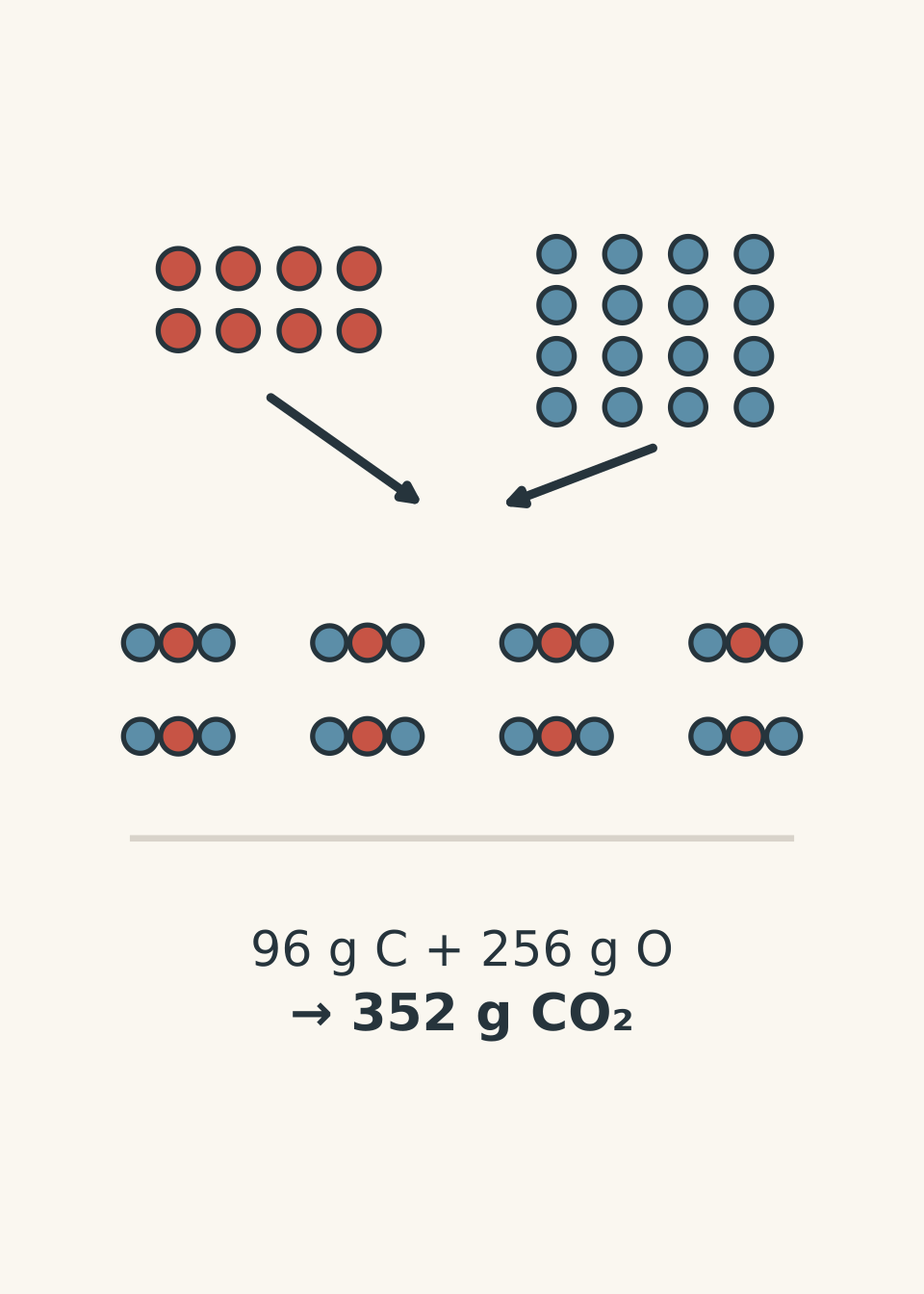
Worked example: How much carbon dioxide forms from octane?
A sample contains \(11.4\ \text{kg}\) of octane, \(\ce{C8H18}\). Assume complete combustion. Calculate the mass of carbon dioxide produced.
Use \(M(\ce{C8H18}) = 114\ \text{g mol}^{-1}\) and \(M(\ce{CO2}) = 44.0\ \text{g mol}^{-1}\).
Step 1
\[ \ce{2C8H18 + 25O2 -> 16CO2 + 18H2O} \]
The mole ratio is therefore:
\[ 1\text{ mol }\ce{C8H18}:8\text{ mol }\ce{CO2} \]
Step 2
\[ n(\ce{C8H18}) = \frac{m}{M} = \frac{11\,400\ \text{g}}{114\ \text{g mol}^{-1}} = 100\ \text{mol} \]
Here, \(n\) is amount in moles, \(m\) is mass, and \(M\) is molar mass.
Step 3
\[ n(\ce{CO2}) = 100\times 8 = 800\ \text{mol} \]
Step 4
\[ m(\ce{CO2}) = nM = 800\ \text{mol}\times44.0\ \text{g mol}^{-1} = 35\,200\ \text{g} = 35.2\ \text{kg} \]
The complete combustion of \(11.4\ \text{kg}\) of octane produces \(35.2\ \text{kg}\) of \(\ce{CO2}\).
The result may look strange: how can the carbon dioxide weigh much more than the original fuel?
Most of the extra mass comes from oxygen in the atmosphere. Combustion does not create mass from nowhere. Oxygen atoms are added to the carbon from the fuel.
Combustion also affects local air quality
Complete combustion is an ideal model.
Real combustion systems may also produce pollutants, particularly when combustion is incomplete or when high temperatures allow other reactions to occur.
Incomplete combustion can produce carbon monoxide:
\[ \ce{2CH4 + 3O2 -> 2CO + 4H2O} \]
Carbon monoxide is toxic because it interferes with the blood’s ability to transport oxygen.
Incomplete combustion can also produce particulate matter, including soot. High-temperature combustion in air can contribute to nitrogen oxide formation, even though the nitrogen did not originally come from the hydrocarbon.
This creates an important distinction:
- greenhouse-gas emissions mainly concern climate effects over large spatial and time scales,
- pollutants such as carbon monoxide, nitrogen oxides, and particulates can have more immediate effects on local air quality and human health.
An evaluation should not squash all of these into the vague phrase “air pollution”.
04Oil spills show why the location of an impact matters
Suppose two operations each accidentally release the same mass of hydrocarbon.
One release occurs inside a well-designed secondary containment system at an industrial site. The other reaches a coastal wetland.
Same mass. Very different consequence.
Hydrocarbons can spread across water surfaces, enter sediments, coat organisms, and expose living things to harmful organic compounds. Clean-up can be difficult because an oil spill is not one pure substance sitting neatly in one place.
Its effect depends on factors such as:
- the chemical composition of the released material,
- the quantity released,
- the sensitivity of the ecosystem,
- currents and weather,
- how quickly the release is contained, and
- how persistent different components are.
This is why chemical handling, storage, and disposal matter as well as the combustion reaction itself. The principles overlap with those in Safe Handling and Disposal of Organic Substances for HSC Chemistry.
05Economic benefits are real, but so are economic costs
Now imagine a country stopped using hydrocarbons tomorrow morning.
Transport, freight, aviation, agriculture, manufacturing, mining, chemical production, heating, and electricity systems in many places would be disrupted. Hydrocarbons are deeply embedded in existing infrastructure.
That creates genuine economic benefits.
Hydrocarbons provide concentrated, transportable energy
Liquid hydrocarbons are especially convenient for vehicles because they combine high energy storage with relatively easy transport and refuelling.
Existing pipelines, storage tanks, refineries, engines, ports, and service stations also have economic value. Replacing an established system requires new equipment and investment.
For some applications, alternatives already work well. For others, changing technology is more difficult or expensive.
So “replace hydrocarbons” is not one economic decision. It is thousands of different decisions.
Extraction can produce income and employment
Hydrocarbon industries can generate:
- jobs,
- export income,
- government tax or royalty revenue,
- regional infrastructure,
- investment, and
- domestic energy supplies.
These benefits can matter greatly to communities and governments.
But ask who receives them.
A project could produce substantial national export revenue while imposing noise, traffic, environmental risk, or higher housing pressure on one local community. A national economic gain does not mean every person affected is economically better off.
External costs can be missing from the market price
Suppose a litre of fuel is sold for a certain price. That price may capture extraction, refining, transport, wages, taxes, and company profit.
It may not fully represent every cost associated with pollution, ecosystem damage, greenhouse-gas emissions, accidents, or long-term clean-up.
Economists call a cost imposed on people who were not directly part of the transaction an external cost or negative externality.
This matters chemically because the reaction products do not disappear just because they were not included on the receipt.
Price volatility and finite resources create another trade-off
Oil and gas prices can change when supply, demand, conflict, transport routes, regulation, or global production change.
Heavy dependence on one fuel can therefore expose households, businesses, and governments to price shocks.
There is also a long-term investment issue. Infrastructure designed to operate for decades may become less valuable if technology, regulation, or demand changes before the end of its expected life.
That possibility is sometimes described as a risk of stranded assets.
06Sociocultural impacts ask who experiences the change
“Sociocultural” can sound annoyingly vague. Make it concrete.
It refers to effects on people, communities, ways of life, cultural practices, relationships with land and water, health, access to services, and the distribution of benefits and harms.
Energy access can support daily life
Reliable and affordable fuels can make possible:
- transport,
- heating,
- cooking,
- electricity generation,
- emergency services,
- freight, and
- access to work, education, and healthcare.
That is a sociocultural impact as well as an economic one. A transport fuel is not merely a commodity when someone depends on it to reach medical care or work.
Extraction can change communities
A large project can alter a region through new jobs, workers, roads, accommodation demand, industrial activity, and changes in local business.
Some people may welcome those changes. Others may experience disruption, increased costs, pressure on local services, or changes to industries such as farming, tourism, or fishing.
You cannot honestly evaluate the sociocultural effect by pretending “the community” has one opinion.
Different people can face different consequences.
Cultural heritage and Country may be affected
Resource development can affect places with cultural, spiritual, archaeological, and historical significance.
For Aboriginal and Torres Strait Islander peoples, impacts on Country can involve more than ownership of a parcel of land. Land and water may be connected with cultural responsibilities, identity, heritage, knowledge, and ongoing community practices.
That means an evaluation cannot reduce the issue to “jobs versus environment”. Questions of consultation, rights, access, cultural heritage, and who has authority in decision-making can be consequential.
The same physical disturbance may therefore carry environmental, economic, and sociocultural effects at once.
07The three categories overlap
Consider an oil spill that damages a commercial fishing area.
Its environmental effect is damage to marine organisms and habitats.
Its economic effect might include lost fishing income and clean-up costs.
Its sociocultural effect could include disruption to a community whose identity, diet, recreation, or cultural practices are closely connected with that coast.
These are not three separate events. They are three ways of examining the same event.

That is why good HSC evaluations make connections rather than writing three unrelated paragraphs.
08Worked example: Should a town support a new gas project?
A proposed gas development is expected to employ 350 people during construction and 90 people during long-term operation. It would provide domestic gas and government revenue. The project would also require new access roads, use groundwater, create a risk of methane leakage, and operate near farming land and sites of cultural significance.
Evaluate the proposal.
Step 1
The project provides an energy resource and creates economic activity. That means there are legitimate benefits to weigh rather than dismiss.
Step 2
The 350 construction jobs are temporary, while the 90 operating jobs continue for longer. Treating all 440 positions as permanent would exaggerate the employment benefit.
The infrastructure and environmental effects may also continue for much longer than construction.
Step 3
Possible impacts include land disturbance from roads and wells, groundwater risks, methane emissions during extraction and processing, and \(\ce{CO2}\) emissions if the gas is later combusted.
The project could reduce some impacts if it replaces a more emissions-intensive fuel, but that depends on what it actually displaces and on leakage throughout the gas supply chain.
Step 4
Government revenue or lower energy costs may be spread widely. Land disturbance, traffic, groundwater risk, or effects on culturally significant places may be concentrated locally.
That uneven distribution is itself part of the evaluation.
Step 5
The project cannot be judged from the employment figure alone. Its justification would be stronger if evidence showed low leakage, well-controlled groundwater risk, meaningful protection of cultural heritage, genuine engagement with affected communities, and a clear advantage over realistic energy alternatives.
If those conditions were not met, broad economic benefits would not automatically outweigh concentrated and potentially long-lasting environmental and sociocultural harm.
Notice what the evaluation did not do. It did not invent a numerical score for things that cannot reasonably be reduced to one number.
09A better decision rule than “advantages versus disadvantages”
When you are asked to evaluate hydrocarbons, use five tests.
Compare the whole life cycle
Do not start the system at the petrol pump and finish it at the exhaust pipe.
Include extraction, processing, transport, use, and relevant end-of-life effects.
Compare realistic alternatives
A hydrocarbon is not evaluated against “nothing”.
Ask what would replace it and what impacts that alternative has.
Compare impacts per useful outcome
A fuel that produces less \(\ce{CO2}\) per mole is not automatically the better fuel.
One mole of different fuels can release very different amounts of energy.
For fuel comparisons, a useful basis might be emissions per unit of useful energy rather than emissions per mole of fuel.
Ask who receives the benefits and costs
A large total benefit can coexist with severe harm to a smaller group.
That does not automatically decide the outcome, but it must be recognised.
Consider time and reversibility
Some impacts end quickly when a project stops. Others can persist.
Temporary construction noise is not equivalent to permanent destruction of cultural heritage. A short-lived employment increase is not equivalent to an income source lasting decades.
Duration and reversibility affect the weight you give an impact.
10Worked example: Comparing two fuels fairly
A simplified electricity generator can use either methane or octane.
Use the following data:
| Fuel | Energy released by complete combustion | Generator efficiency |
|---|---|---|
| Methane, \(\ce{CH4}\) | \(890\ \text{kJ mol}^{-1}\) | \(40\%\) |
| Octane, \(\ce{C8H18}\) | \(5470\ \text{kJ mol}^{-1}\) | \(35\%\) |
Compare the mass of \(\ce{CO2}\) produced when each system delivers \(1000\ \text{MJ}\) of electrical energy. Ignore upstream emissions.
Step 1
Efficiency is:
\[ \text{efficiency} = \frac{\text{useful energy output}}{\text{energy input}} \]
For methane:
\[ E_{\text{in}} = \frac{1000\ \text{MJ}}{0.40} = 2500\ \text{MJ} = 2.50\times10^6\ \text{kJ} \]
For octane:
\[ E_{\text{in}} = \frac{1000\ \text{MJ}}{0.35} = 2857\ \text{MJ} = 2.857\times10^6\ \text{kJ} \]
Step 2
\[ n(\ce{CH4}) = \frac{2.50\times10^6\ \text{kJ}} {890\ \text{kJ mol}^{-1}} = 2.81\times10^3\ \text{mol} \]
From
\[ \ce{CH4 + 2O2 -> CO2 + 2H2O} \]
one mole of methane produces one mole of carbon dioxide.
Therefore:
\[ n(\ce{CO2}) = 2.81\times10^3\ \text{mol} \]
and
\[ m(\ce{CO2}) = 2.81\times10^3\ \text{mol}\times44.0\ \text{g mol}^{-1} = 1.24\times10^5\ \text{g} = 124\ \text{kg} \]
Step 3
\[ n(\ce{C8H18}) = \frac{2.857\times10^6\ \text{kJ}} {5470\ \text{kJ mol}^{-1}} = 522\ \text{mol} \]
From
\[ \ce{2C8H18 + 25O2 -> 16CO2 + 18H2O} \]
one mole of octane produces eight moles of carbon dioxide.
So:
\[ n(\ce{CO2}) = 522\times8 = 4176\ \text{mol} \]
and
\[ m(\ce{CO2}) = 4176\ \text{mol}\times44.0\ \text{g mol}^{-1} = 1.84\times10^5\ \text{g} = 184\ \text{kg} \]
Step 4
For these data, methane produces about \(124\ \text{kg}\) of \(\ce{CO2}\) while octane produces about \(184\ \text{kg}\) for the same \(1000\ \text{MJ}\) of electrical energy.
Methane therefore gives the lower combustion \(\ce{CO2}\) emission in this comparison.
But the phrase “ignore upstream emissions” is doing serious work. If methane leaks during extraction and transport, the full climate comparison changes. A life-cycle evaluation would have to include that information.
11The most tempting misconception: one advantage does not settle the evaluation
A student might write:
Natural gas releases less carbon dioxide than petrol, so natural gas has less environmental impact.
The first part can be true under an appropriate comparison. The conclusion is too broad.
Environmental impact includes more than combustion \(\ce{CO2}\). It can include methane leakage, habitat disturbance, water use, local pollution, and infrastructure.
Likewise:
Hydrocarbons create jobs, so their economic impact is positive.
Again, incomplete. Employment is one economic effect. Fuel prices, export revenue, clean-up costs, infrastructure investment, external costs, price volatility, and effects on other industries may also matter.
The word evaluate should make you suspicious of any conclusion reached from a single variable.
12Questions and solutions
Question 1
Liquefied petroleum gas, or LPG, contains hydrocarbons such as propane. Propane undergoes complete combustion according to:
\[ \ce{C3H8 + 5O2 -> 3CO2 + 4H2O} \]
A household uses \(4.40\ \text{kg}\) of propane.
Calculate the mass of carbon dioxide produced by complete combustion. Then identify one environmental implication and one sociocultural benefit of using LPG as a household fuel.
Use \(M(\ce{C3H8}) = 44.0\ \text{g mol}^{-1}\) and \(M(\ce{CO2}) = 44.0\ \text{g mol}^{-1}\).
Solution 1
Complete combustion produces \(13.2\ \text{kg}\) of \(\ce{CO2}\). This contributes to greenhouse-gas emissions, while access to a controllable household fuel can support reliable cooking or heating.
First, calculate the amount of propane:
\[ n(\ce{C3H8}) = \frac{4400\ \text{g}} {44.0\ \text{g mol}^{-1}} = 100\ \text{mol} \]
The equation shows that one mole of propane produces three moles of carbon dioxide:
\[ n(\ce{CO2}) = 100\times3 = 300\ \text{mol} \]
Therefore:
\[ m(\ce{CO2}) = 300\ \text{mol}\times44.0\ \text{g mol}^{-1} = 13\,200\ \text{g} = 13.2\ \text{kg} \]
The environmental implication is that the carbon in the propane becomes \(\ce{CO2}\), contributing to atmospheric greenhouse-gas emissions.
A sociocultural benefit is that a portable fuel can provide accessible cooking or heating, particularly where another reliable energy supply is unavailable.
The tempting mistake is to call LPG simply “good” or “bad”. The chemical emission and the useful service it provides are both relevant. An evaluation would compare those effects with the realistic alternative energy source.
Question 2
Two fuels are being considered for a remote generator.
Fuel A is methane. Fuel B is represented by octane.
The generator requires \(5000\ \text{MJ}\) of chemical energy over a particular period.
Use these combustion energy values:
- methane: \(890\ \text{kJ mol}^{-1}\),
- octane: \(5470\ \text{kJ mol}^{-1}\).
Calculate the mass of \(\ce{CO2}\) produced by each fuel under complete combustion.
Then explain why choosing the fuel with the lower calculated \(\ce{CO2}\) emission is not, by itself, a complete environmental evaluation.
Solution 2
Methane produces about \(247\ \text{kg}\) of \(\ce{CO2}\), while octane produces about \(322\ \text{kg}\). Methane therefore has the lower combustion \(\ce{CO2}\) emission for the required chemical energy, but that alone does not prove it has the lower total environmental impact.
For methane:
\[ n(\ce{CH4}) = \frac{5.00\times10^6\ \text{kJ}} {890\ \text{kJ mol}^{-1}} = 5.62\times10^3\ \text{mol} \]
The combustion equation is:
\[ \ce{CH4 + 2O2 -> CO2 + 2H2O} \]
The mole ratio of methane to carbon dioxide is \(1:1\), so:
\[ m(\ce{CO2}) = 5.62\times10^3\ \text{mol} \times44.0\ \text{g mol}^{-1} = 2.47\times10^5\ \text{g} = 247\ \text{kg} \]
For octane:
\[ n(\ce{C8H18}) = \frac{5.00\times10^6\ \text{kJ}} {5470\ \text{kJ mol}^{-1}} = 914\ \text{mol} \]
One mole of octane produces eight moles of carbon dioxide:
\[ n(\ce{CO2}) = 914\times8 = 7312\ \text{mol} \]
Therefore:
\[ m(\ce{CO2}) = 7312\ \text{mol} \times44.0\ \text{g mol}^{-1} = 3.22\times10^5\ \text{g} = 322\ \text{kg} \]
The tempting route is to stop here and declare methane environmentally superior.
The calculation only measures \(\ce{CO2}\) from complete combustion. A full comparison would also consider methane leakage, extraction methods, water and land impacts, processing, transport, local pollutants, and the sensitivity of the environments involved.
The calculation supports one part of the judgement. It does not supply the whole judgement.
Question 3
A coastal region is considering an offshore oil project.
The project is predicted to:
- provide significant export income,
- employ local workers,
- reduce dependence on imported oil,
- require new port infrastructure,
- create a low-probability risk of a major spill,
- increase routine greenhouse-gas emissions, and
- operate near commercial fishing grounds and an area of cultural significance to a local Aboriginal community.
A government report argues:
“The project should proceed because the probability of a major spill is low.”
Evaluate this reasoning.
Solution 3
The reasoning is inadequate because a low probability of one environmental event does not establish that the project’s total benefits outweigh its environmental, economic, and sociocultural costs.
A complete evaluation would first recognise the genuine benefits. Export income, employment, and reduced reliance on imports may improve economic activity and energy security.
However, the report focuses on only one risk: a major spill. Routine impacts still occur even if no major accident happens. These may include greenhouse-gas emissions, marine disturbance, port development, and ongoing industrial activity.
The consequence of a low-probability event also matters. Risk cannot be assessed from probability alone. A rare event with severe and difficult-to-reverse consequences can remain important.
There are also linked economic effects. A major spill could damage commercial fishing, creating an environmental impact and an economic loss at the same time.
The sociocultural issue cannot be reduced to a financial figure either. If infrastructure or a spill affects a place of cultural significance, the consequence may involve heritage, access, cultural practice, and relationships with Country.
The tempting argument is: “low probability means unimportant”. The missing constraint is the magnitude and reversibility of the consequence, plus the fact that the spill is only one part of the project’s impact.
A defensible decision would need to compare the project’s full life-cycle effects with realistic alternatives and show how environmental safeguards, cultural heritage, affected communities, economic gains, and residual risks were weighed. The quoted statement does not do that.
Question 4
A gas-fired power station is considering carbon capture equipment.
Without carbon capture, producing a fixed amount of electricity requires \(100\) arbitrary units of natural gas. Combustion of this gas creates \(100\) units of climate impact from \(\ce{CO2}\). Extraction and transport create an additional \(8\) units of climate impact, mainly from methane leakage.
The carbon capture system removes \(90\%\) of the power station’s combustion \(\ce{CO2}\). However, operating the equipment requires extra energy, so the station must burn \(25\%\) more gas to produce the same amount of electricity.
Assume upstream impacts increase directly in proportion to the amount of gas consumed.
A company states:
“Because the capture equipment removes 90% of combustion carbon dioxide, the climate impact of the electricity falls by 90%.”
Determine whether the statement is correct. Calculate the percentage reduction in the total climate-impact indicator and identify one environmental trade-off that remains even after carbon capture is installed.
Solution 4
The statement is incorrect. Under the given assumptions, the total climate-impact indicator falls by about \(79\%\), not \(90\%\), and the increased gas consumption also increases upstream extraction and transport impacts.
Without carbon capture, the total indicator is:
\[ 100+8=108\text{ units} \]
With carbon capture, the station burns \(25\%\) more gas:
\[ 100\times1.25=125\text{ gas units} \]
Before capture, combustion therefore creates:
\[ 125\text{ climate-impact units} \]
The equipment captures \(90\%\), leaving \(10\%\):
\[ 125\times0.10=12.5\text{ units} \]
Upstream impacts also rise by \(25\%\):
\[ 8\times1.25=10\text{ units} \]
The new total is:
\[ 12.5+10=22.5\text{ units} \]
The reduction is:
\[ 108-22.5=85.5\text{ units} \]
Therefore:
\[ \text{percentage reduction} = \frac{85.5}{108}\times100 = 79.2\% \]
So the total indicator falls by about \(79\%\).
The tempting route is to see “90% capture” and apply that percentage to the entire system.
The exact constraint that breaks that reasoning is the system boundary. The \(90\%\) figure applies only to combustion \(\ce{CO2}\) at the power station. It does not remove upstream methane emissions, and the energy penalty means more gas must be extracted, processed, transported, and burned.
An additional environmental trade-off is therefore increased upstream activity. Even though the climate indicator falls substantially, using \(25\%\) more gas could increase land disturbance, water use, leakage risk, and other extraction-related impacts.
Carbon capture can strongly reduce one part of the impact without making the hydrocarbon life cycle impact-free.
Question 5
A state currently consumes \(100\) units of natural gas each year, all produced from a domestic gas field.
Each unit of domestically produced gas causes:
- \(2\) units of upstream environmental impact,
- \(5\) units of economic benefit within the state, and
- \(1\) unit of local land-and-water disturbance.
The government proposes closing the domestic field. Gas demand will initially remain at \(100\) units because homes and industries cannot change equipment immediately.
The replacement gas would be imported. Each imported unit causes:
- \(3\) units of upstream environmental impact outside the state,
- \(0.5\) units of additional transport impact,
- \(1\) unit of economic benefit within the state, and
- no disturbance at the closed domestic field.
Combustion emissions are identical in the two cases and can therefore be excluded from the comparison.
The government announces:
“Closing the field reduces the environmental impact of the state’s gas consumption because the local extraction impacts disappear.”
Evaluate this claim using the data. Your response must distinguish local impact from total life-cycle impact and discuss one economic and one sociocultural implication.
Solution 5
The claim is misleading. Closing the field eliminates the stated local extraction disturbance, but total upstream and transport environmental impact rises from \(200\) to \(350\) units while gas consumption remains unchanged. The policy relocates part of the environmental burden rather than eliminating it.
With domestic production, total upstream environmental impact is:
\[ 100\times2=200\text{ units} \]
Local land-and-water disturbance is:
\[ 100\times1=100\text{ units} \]
With imported gas, the upstream impact is:
\[ 100\times3=300\text{ units} \]
Transport adds:
\[ 100\times0.5=50\text{ units} \]
So total upstream and transport impact becomes:
\[ 300+50=350\text{ units} \]
The total measured environmental impact therefore increases by:
\[ 350-200=150\text{ units} \]
However, disturbance at the domestic extraction site falls from \(100\) units to zero.
Both statements can therefore be true at once:
- local extraction impact inside the state decreases,
- total life-cycle environmental impact associated with its gas consumption increases.
That is the central hinge of the question.
The tempting answer is that closing an extraction site must reduce environmental impact because the visible wells, roads, and local disturbance disappear. The missing constraint is that demand has not disappeared. The gas is now produced somewhere else and transported further.
The economic effect is also uneven. Domestic economic benefit initially equals:
\[ 100\times5=500\text{ units} \]
After switching to imports:
\[ 100\times1=100\text{ units} \]
So the state’s measured economic benefit falls by \(400\) units. That may correspond to losses in local employment, business activity, or government revenue, depending on what the economic-benefit measure represents.
A sociocultural evaluation must go beyond that total. Communities near the closed field may benefit from reduced industrial traffic, noise, land disturbance, or pressure on water resources. If culturally significant Country had been affected, removing extraction could also carry benefits that are poorly represented by a simple numerical environmental score.
At the same time, workers and families connected with the domestic industry may experience employment changes and disruption. The imported gas may also impose environmental or sociocultural costs on communities in the producing region outside the state.
The government’s statement therefore confuses a local improvement with a whole-system improvement.
Under the conditions given, the defensible conclusion is that closing the field reduces domestic extraction disturbance but increases the measured total life-cycle environmental impact while demand remains fixed. A larger reduction in total impact would require changing the demand, the replacement source, or both.
That boundary question is one of the most useful habits to carry into the next part of organic chemistry and environmental analysis: whenever a material or fuel seems to “disappear” from one stage of a system, track where the carbon, energy demand, waste, and impacts actually go.