
Einstein’s Two Postulates of Special Relativity Explained
Learn what Einstein’s two postulates mean, why light speed is constant for inertial observers, and how experiments support special relativity.
A spacecraft flies past Earth at \(0.80c\), where \(c\) is the speed of light in a vacuum. The pilot switches on a laser pointing forwards.
What speed should someone on Earth measure for the laser pulse?
Ordinary velocity addition suggests \(c+0.80c=1.80c\). That prediction feels completely reasonable. If you throw a ball forwards from a moving car, the road observer measures the car’s speed plus the ball’s speed relative to the car.
Light refuses to behave that way.
The Earth observer measures the pulse travelling at \(c\). The pilot also measures it travelling at \(c\). Einstein’s special theory of relativity begins by accepting results like this and asking a harder question: what must our ideas about space and time be like if both observers are right?
01First, get the reference frame right
A reference frame is a system of rulers, clocks, and coordinates used to describe where and when events happen.
Imagine sitting inside a train travelling in a straight line at constant speed. You can measure the position of your bag relative to the carriage, time how long a ball takes to roll along the floor, or measure the speed of a light pulse. Someone standing beside the railway can describe the same events using a different set of positions and times.
An inertial frame is a reference frame that is not accelerating. It is either at rest or moving at constant velocity.
A train cruising at constant velocity is approximately an inertial frame. A train that is braking, turning, or speeding up is not an inertial frame during that acceleration.
This matters because Einstein’s two postulates apply directly to inertial frames.
02Postulate 1: there is no preferred inertial frame
Einstein’s first postulate is:
The laws of physics have the same form in every inertial reference frame.
Suppose you’re sealed inside a smooth-moving spacecraft with no windows. The spacecraft has stopped accelerating and is travelling at constant velocity.
Could you do an experiment entirely inside the spacecraft and discover your spacecraft’s absolute velocity through space?
According to the first postulate, no.
You might drop a ball, measure electric forces, observe a chemical reaction, or run an optical experiment. Your results obey the same physical laws as they would in any other inertial frame.
This doesn’t mean every observer measures the same position, time, momentum, or energy. They often don’t. It means no inertial observer gets a special set of physical laws.
Before Einstein, this idea already worked very well for Newtonian mechanics. If a train moves smoothly at constant speed, a ball tossed vertically still comes back to your hand. You don’t need to add a mysterious extra force because the train is moving relative to the ground.
Einstein’s important move was to demand the same principle for all physics, including electromagnetism and light.
03Postulate 2: every inertial observer measures the same light speed
Einstein’s second postulate is:
The speed of light in a vacuum has the same value \(c\) for every inertial observer, regardless of the motion of the light source or observer.
The exact value of \(c\) is
\[ c=299\,792\,458\ \text{m s}^{-1}, \]
although HSC calculations usually use
\[ c=3.00\times10^8\ \text{m s}^{-1}. \]
That second postulate is much stranger than it first looks.
Imagine an airport moving walkway. You throw a ping-pong ball forwards at \(10\ \text{m s}^{-1}\) relative to yourself while the walkway moves at \(2\ \text{m s}^{-1}\). Someone standing beside the walkway would expect the ball to move at about \(12\ \text{m s}^{-1}\).
Now imagine the ridiculous version: no matter how quickly the walkway moves, everyone somehow measures the ping-pong ball travelling at exactly \(10\ \text{m s}^{-1}\).
That’s roughly the puzzle light creates.
The analogy breaks because real ping-pong balls obey ordinary low-speed velocity addition. Light does not. To preserve the same value of \(c\), the relationships between different observers’ measurements of distance and time have to change.
| Idea | What it says | What it does not say |
|---|---|---|
| First postulate | All inertial frames use the same laws of physics. | All observers must obtain identical numerical measurements. |
| Second postulate | Every inertial observer measures vacuum light travelling at \(c\). | Speeds must still add using \(u'=u-v\). |
| Both together | No inertial frame is the special “true” frame for light. | Space and time must behave exactly as they do in Newtonian mechanics. |
Worked example: A spacecraft fires a laser
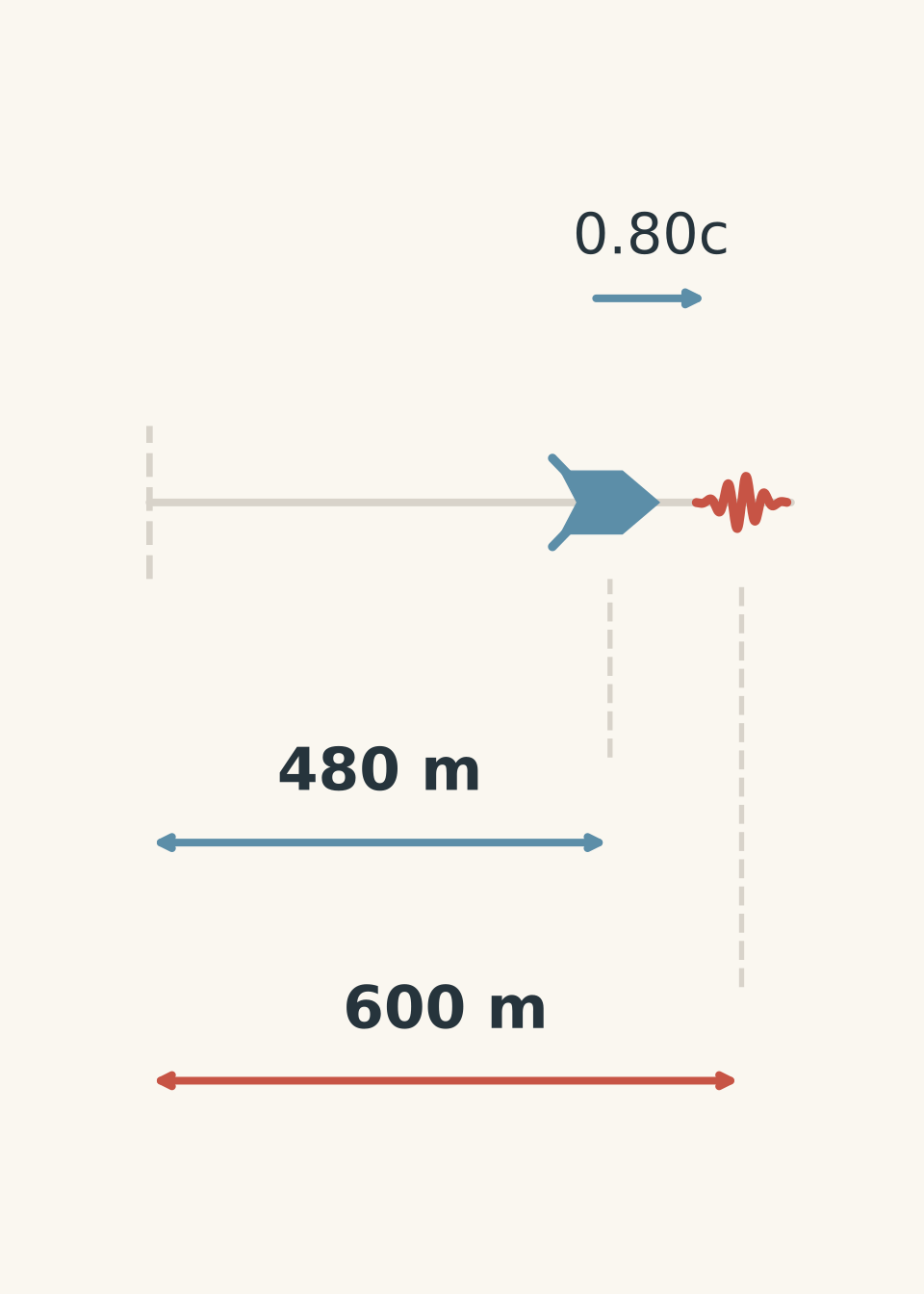
A spacecraft moves past Earth at \(0.80c\). At the instant it passes an Earth observer, it sends a laser pulse forwards. Find the positions of the spacecraft and pulse \(2.0\ \mu\text{s}\) later in the Earth frame, and find their separation.
Step 1
The spacecraft speed is
\[ v=0.80c. \]
The second postulate says that the light pulse travels at \(c\), not \(c+0.80c\).
Step 2
The time is
\[ t=2.0\ \mu\text{s}=2.0\times10^{-6}\ \text{s}. \]
Using \(d=vt\),
\[ d_{\text{light}} =(3.00\times10^8)(2.0\times10^{-6}) =600\ \text{m}. \]
Step 3
\[ d_{\text{ship}} =(0.80)(3.00\times10^8)(2.0\times10^{-6}) =480\ \text{m}. \]
Step 4
\[ \Delta d=600-480=120\ \text{m}. \]
So, after \(2.0\ \mu\text{s}\), the laser is \(120\ \text{m}\) ahead of the spacecraft in the Earth frame.
There is a subtle point here. In the Earth frame, the gap between the spacecraft and light grows at
\[ c-0.80c=0.20c. \]
That does not mean the spacecraft pilot measures the light speed as \(0.20c\). The pilot uses the spacecraft’s own rulers and synchronised clocks and still measures the light travelling at \(c\).
Treating \(0.20c\) as the pilot’s measured light speed would quietly sneak Newtonian velocity addition back into a situation where it does not apply.
04Why ordinary velocity addition cannot survive
Suppose two inertial frames use the classical Galilean transformation
\[ x'=x-vt, \]
with
\[ t'=t. \]
Here, \(v\) is the velocity of frame \(S'\) relative to frame \(S\).
Imagine a light pulse travelling in the \(+x\) direction. In frame \(S\),
\[ x=ct. \]
Substituting this into the Galilean transformation gives
\[ x'=ct-vt=(c-v)t. \]
Because \(t'=t\),
\[ \frac{x'}{t'}=c-v. \]
So Galilean transformations predict that the second observer measures a light speed of \(c-v\).
But Einstein’s second postulate says the second observer must measure \(c\).
You can’t keep both statements.
Which idea should be abandoned: constant light speed, or the Newtonian assumption that space and time transform according to \(x'=x-vt\) and \(t'=t\)?
Experiment points towards constant \(c\). That means the relationship between the coordinates of different inertial observers has to be changed instead.
This is where the Lorentz transformations eventually enter. They allow different observers to disagree about lengths, time intervals, and simultaneity while still agreeing that light travels at \(c\).
05Why physicists were already suspicious of a preferred light frame
In the nineteenth century, Maxwell’s equations described light as an electromagnetic wave travelling at a definite speed.
Waves usually have a medium. Sound has air. Water waves have water. It therefore seemed natural to suggest that light travelled through an invisible medium called the luminiferous ether.
If the ether existed and provided a preferred rest frame, Earth should usually be moving through it.
That would create an “ether wind”. Light sent along Earth’s motion through the ether should then behave differently from light sent across that motion.
That prediction gave physicists something testable.
06Michelson and Morley: look for the ether wind
Michelson and Morley’s 1887 experiment used an interferometer.
A light beam first reached a beam splitter. The splitter sent part of the light along one arm of the apparatus and the rest along a perpendicular arm. Mirrors reflected both beams back. The returning beams then recombined and produced an interference pattern.
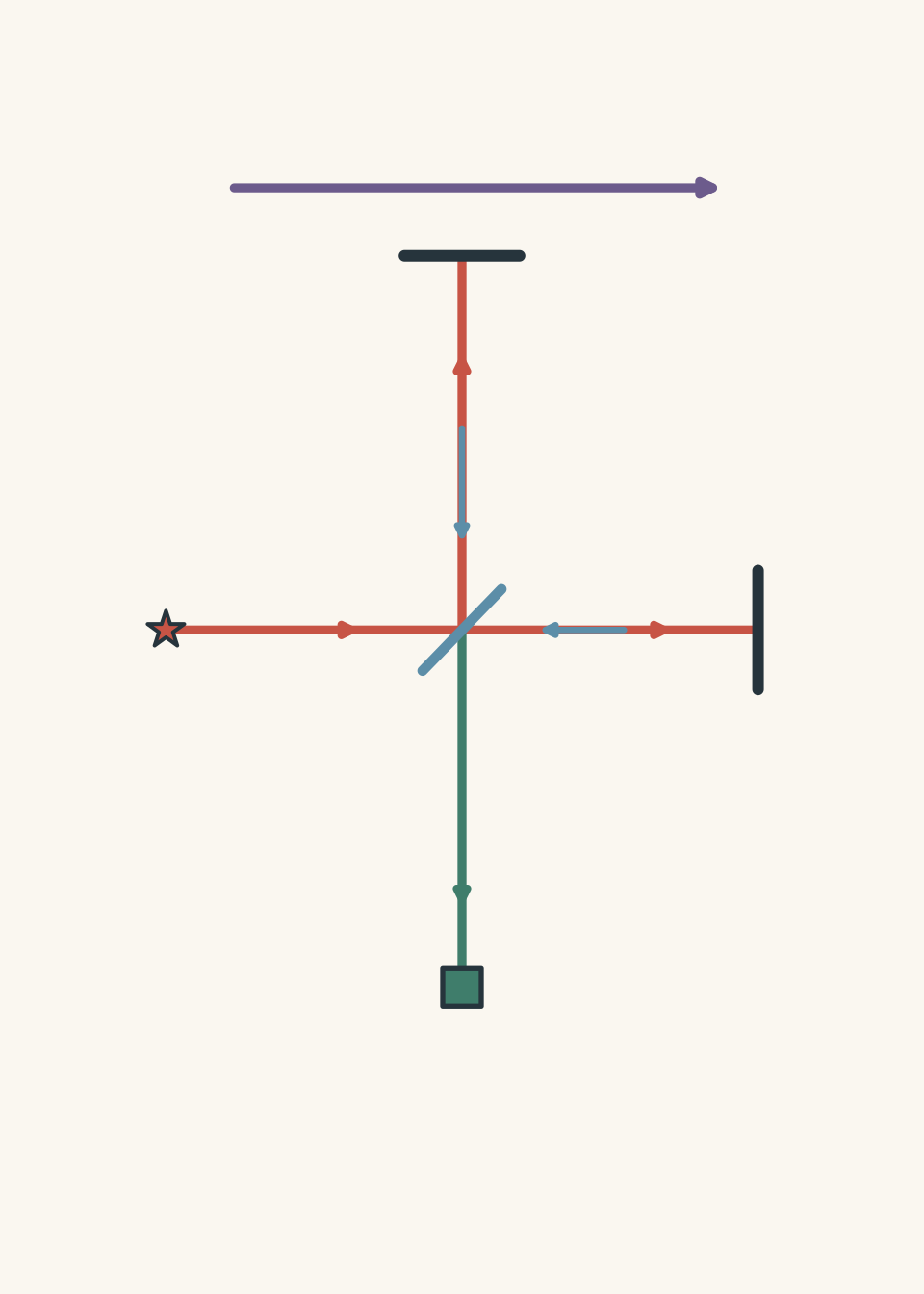
Under a simple stationary-ether model, imagine one arm lies parallel to Earth’s motion through the ether.
The light travelling along that arm would have to travel partly “upwind” and partly “downwind”. The perpendicular beam would have a different round-trip time.
Rotate the apparatus by \(90^\circ\), and the roles of the arms swap.
The prediction was therefore clear: rotating the apparatus should change the relative arrival times of the beams and shift the interference fringes.
The expected shift was not observed.
That null result was a serious problem for the simple stationary-ether model.
It did not, by itself, prove Einstein’s special relativity. Michelson and Morley’s experiment occurred before Einstein’s 1905 theory, and other explanations were proposed. Lorentz and FitzGerald, for example, suggested that motion through the ether might physically contract objects in the direction of motion.
Einstein’s approach was more fundamental: stop treating the ether frame as special and instead require the laws of physics, including electromagnetism, to work consistently in every inertial frame.
Worked example: What fringe shift would an ether model predict?
Consider a simplified Michelson interferometer with two perpendicular arms of length \(L=10.0\ \text{m}\). Suppose Earth moves through a stationary ether at \(v=3.00\times10^4\ \text{m s}^{-1}\). The light has wavelength \(\lambda=500\ \text{nm}\).
Estimate the fringe shift expected when the apparatus is rotated through \(90^\circ\).
Step 1
On the outward trip, the effective speed would be \(c-v\). On the return trip, it would be \(c+v\).
Therefore,
\[ t_{\parallel} =\frac{L}{c-v}+\frac{L}{c+v} =\frac{2Lc}{c^2-v^2}. \]
Step 2
For the perpendicular arm, the light must follow a diagonal path through the ether in order to reach a mirror moving sideways with the apparatus. The predicted round-trip time is
\[ t_{\perp} =\frac{2L}{\sqrt{c^2-v^2}}. \]
Because \(v\ll c\), the difference between these times is approximately
\[ \Delta t\approx\frac{Lv^2}{c^3}. \]
Substituting,
\[ \Delta t \approx \frac{(10.0)(3.00\times10^4)^2} {(3.00\times10^8)^3} =3.33\times10^{-16}\ \text{s}. \]
Step 3
\[ \Delta s=c\Delta t =(3.00\times10^8)(3.33\times10^{-16}) =1.00\times10^{-7}\ \text{m}. \]
The wavelength is
\[ \lambda=500\ \text{nm}=5.00\times10^{-7}\ \text{m}. \]
So, in one orientation,
\[ \frac{\Delta s}{\lambda} =\frac{1.00\times10^{-7}}{5.00\times10^{-7}} =0.20. \]
The paths swap roles after a \(90^\circ\) rotation, so the path difference changes from roughly \(+\Delta s\) to \(-\Delta s\). The total change is therefore \(2\Delta s\).
The predicted fringe shift is
\[ N=\frac{2\Delta s}{\lambda}=0.40. \]
The ether model therefore predicts a shift of about \(0.40\) of a fringe for this simplified apparatus.
The important point is not the particular number. The model predicts an orientation-dependent effect. A sufficiently sensitive null result tells you that the model producing that prediction is wrong or incomplete.
07What evidence supports Einstein’s postulates?
No single experiment places a giant “Einstein was right” stamp on both postulates. Physics doesn’t work quite that neatly.
Instead, different experiments attack different consequences of a preferred frame or a variable light speed. Together, they strongly support Lorentz invariance: the structure of physics required by special relativity.
| Evidence | What is being tested | Why it matters |
|---|---|---|
| Michelson-Morley experiment | Whether light’s round-trip behaviour changes with apparatus orientation relative to Earth’s supposed motion through an ether | The expected stationary-ether fringe shift was not found |
| Kennedy-Thorndike-type experiments | Whether optical behaviour depends on the laboratory’s changing speed through a preferred frame | Results are consistent with no detectable preferred inertial frame |
| Ives-Stilwell-type experiments | Frequency shifts from rapidly moving particles | Results agree with relativistic Doppler and time-dilation predictions |
| Fast-particle and decay experiments | Behaviour of particles moving at speeds close to \(c\) | Lifetimes, momentum, and energy follow relativistic rather than Newtonian relations |
| Modern resonator and atomic-clock tests | Tiny possible effects caused by orientation or motion relative to a preferred frame | No confirmed violation of Lorentz symmetry has appeared within experimental sensitivity |
The first postulate is especially broad. You cannot perform one experiment that checks every law of physics in every possible inertial frame.
Instead, physicists test consequences. If some inertial frames really were preferred, carefully chosen experiments could reveal changes in physical behaviour as laboratories change speed or orientation. Such effects have been searched for extensively.
The second postulate is similarly supported by a network of optical, electromagnetic, particle, and timing experiments. Michelson-Morley is historically important, but it should not be treated as the whole evidential case.
08The tempting misconceptions
A common first reaction is: “Michelson-Morley showed that the ether doesn’t exist, so it proved Einstein’s two postulates.”
That’s too strong.
The experiment ruled out the simple ether-wind prediction it was designed to test. Other models could be constructed to explain the null result. Special relativity became compelling because the two postulates produce one consistent framework that explains not only that experiment, but many other observations as well.
Another tempting claim is: “If every observer measures the same \(c\), they must also agree about when events happen.”
Almost the opposite is true.
If two observers moving relative to each other must both measure the same light speed, they cannot generally agree on all distances and time intervals while also keeping Newtonian ideas of universal simultaneity. Their measurements of space and time must be related differently.
There is one more distinction worth keeping clean. Suppose a light pulse chases a spacecraft moving at \(0.80c\). In Earth’s frame, the distance between them grows at \(0.20c\). That is a rate of change of separation calculated in the Earth frame. It is not what an observer on the spacecraft measures as the local speed of the light.
Mixing measurements from different frames is one of the fastest ways to get a relativity question wrong.
09Questions and solutions
Question 1
A probe travels past Earth at \(0.50c\) and emits a laser pulse forwards.
State Einstein’s two postulates of special relativity. What speed is measured for the laser pulse by:
a. an observer on Earth, and
b. an observer travelling with the probe?
Explain why the probe’s motion does not change either answer.
Solution 1
Both observers measure the light travelling at \(c=3.00\times10^8\ \text{m s}^{-1}\).
Einstein’s first postulate states that the laws of physics have the same form in every inertial reference frame. Neither Earth nor the constantly moving probe is a preferred inertial frame.
The second postulate states that every inertial observer measures the same speed \(c\) for light in a vacuum, independent of the motion of the source or observer.
Therefore,
\[ v_{\text{light, Earth}}=c \]
and
\[ v_{\text{light, probe}}=c. \]
A tempting Newtonian calculation would give the Earth observer
\[ c+0.50c=1.50c. \]
That uses ordinary Galilean velocity addition. Special relativity does not use that rule for light, because doing so would contradict the second postulate.
Question 2
Spacecraft A and B pass the same point at the same instant. Relative to Earth, A travels in the \(+x\) direction at \(0.70c\), while B travels in the same direction at \(0.20c\).
At that instant, A emits a laser pulse in the \(+x\) direction.
a. What speed does Earth measure for the laser pulse?
b. At what rate does the distance between the laser pulse and spacecraft B increase in the Earth frame?
c. What speed does an observer on B measure for the laser pulse?
d. Explain why your answers to parts b and c are different without contradicting special relativity.
Solution 2
Earth measures the light speed as \(c\), the Earth-frame gap between the light and B grows at \(0.80c\), and B itself measures the light speed as \(c\).
For part a, the second postulate gives
\[ v_{\text{light}}=c. \]
A’s speed of \(0.70c\) is irrelevant to the emitted light’s speed in the Earth frame. It is a deliberate distraction.
For part b, both positions are being measured using Earth coordinates. The light moves at \(c\), while B moves at \(0.20c\), so
\[ \frac{\Delta x}{\Delta t} =c-0.20c =0.80c. \]
Numerically,
\[ 0.80c =(0.80)(3.00\times10^8) =2.40\times10^8\ \text{m s}^{-1}. \]
For part c, B is also an inertial observer. The second postulate therefore requires B to measure
\[ v'_{\text{light}}=c. \]
The tempting route is to say, “Earth calculates the gap closing or opening at \(0.80c\), so B must measure \(0.80c\).” That quietly assumes that a rate calculated from Earth’s coordinates is automatically a speed measured using B’s rulers and clocks.
It isn’t.
Earth’s \(0.80c\) is the rate at which two Earth-frame positions separate. B’s measurement of the light speed requires B’s own spatial coordinates and synchronised clocks. Special relativity changes the relationship between those coordinate systems, so the two calculations do not have to give the same number.
Question 3
A simplified Michelson interferometer has perpendicular arms of length \(L=5.0\ \text{m}\). Light of wavelength \(600\ \text{nm}\) is used.
A stationary-ether model predicts that Earth moves through the ether at \(v=3.0\times10^4\ \text{m s}^{-1}\). For \(v\ll c\), the predicted fringe shift after rotating the apparatus through \(90^\circ\) is approximately
\[ N\approx\frac{2Lv^2}{\lambda c^2}. \]
a. Calculate the predicted fringe shift.
b. Suppose no such shift is detected within the instrument’s sensitivity. Explain what conclusion can reasonably be drawn.
c. Evaluate the statement, “A null Michelson-Morley result proves both of Einstein’s postulates.”
Solution 3
The model predicts a shift of about \(0.17\) fringes, and a reliable null result counts against that stationary-ether model but does not, by itself, logically prove both Einstein postulates.
For part a,
\[ L=5.0\ \text{m}, \qquad v=3.0\times10^4\ \text{m s}^{-1}, \]
\[ \lambda=600\ \text{nm} =6.00\times10^{-7}\ \text{m}, \]
and
\[ c=3.00\times10^8\ \text{m s}^{-1}. \]
Substituting,
\[ N \approx \frac{2(5.0)(3.0\times10^4)^2} {(6.00\times10^{-7})(3.00\times10^8)^2}. \]
Therefore,
\[ N = \frac{9.0\times10^9} {5.40\times10^{10}} \approx0.167. \]
So,
\[ N\approx0.17\ \text{fringes}. \]
For part b, the stationary-ether model has made a measurable prediction: changing the apparatus orientation should cause a fringe shift. If an experiment sensitive to a \(0.17\)-fringe shift repeatedly finds no shift, the model is inconsistent with the observation.
The important reasoning is not simply “nothing happened”. It is that something specific was predicted and was absent.
For part c, saying the experiment proves both Einstein postulates goes too far. Michelson-Morley directly tests an orientation-dependent ether-wind prediction. A null result undermines that particular model.
It does not individually test every law of physics in every inertial frame, as the first postulate concerns, nor does one interferometer result logically establish every aspect of the second postulate.
Historically, alternative explanations such as Lorentz-FitzGerald contraction could also reproduce the null result. Special relativity gains its strength from explaining this result together with many other optical, electromagnetic, timing, and particle experiments using one consistent framework.
Question 4
Two inertial frames \(S\) and \(S'\) move relative to one another at constant velocity \(v\) in the \(+x\) direction.
Suppose you try to keep the classical Galilean relationships
\[ x'=x-vt \]
and
\[ t'=t. \]
At \(t=0\), a light pulse leaves the common origin. Frame \(S\) measures the pulse travelling in the \(+x\) direction at \(c\), so
\[ x=ct. \]
a. Use the Galilean equations to find the light speed predicted in \(S'\).
b. Identify exactly which Einstein postulate this contradicts.
c. A student argues that we could fix the problem by declaring \(S\) to be the “real” stationary frame in which light travels at \(c\). Explain why this also creates a problem for Einstein’s framework.
d. What broad feature of the classical transformation must therefore change?
Solution 4
The Galilean transformation predicts a light speed of \(c-v\) in \(S'\), so it cannot coexist with Einstein’s two postulates unless \(v=0\). Declaring one frame to be the real stationary frame would then violate the first postulate.
For part a,
\[ x'=x-vt. \]
Since
\[ x=ct, \]
we obtain
\[ x'=ct-vt=(c-v)t. \]
Because Galilean relativity assumes
\[ t'=t, \]
the speed in \(S'\) would be
\[ u' =\frac{x'}{t'} =\frac{(c-v)t}{t} =c-v. \]
For part b, this contradicts Einstein’s second postulate. An inertial observer in \(S'\) must measure the vacuum light speed as \(c\), not \(c-v\).
For part c, declaring \(S\) to be the one true rest frame appears to rescue the value \(c\) in that frame, but it introduces a preferred inertial frame.
Observers could then, in principle, perform experiments to determine their velocity relative to that special frame. The laws or measured optical behaviour would distinguish \(S\) from other inertial frames.
That conflicts with the first postulate, which says no inertial frame receives special physical status.
The tempting route is to keep absolute time, ordinary velocity addition, and both Einstein postulates. The equations show that all three cannot survive together.
For part d, the relationship between the space and time coordinates must change. In particular, the assumption
\[ t'=t \]
cannot remain universally valid alongside the simple Galilean position transformation.
Special relativity replaces the Galilean transformations with Lorentz transformations. Space and time both participate, allowing every inertial observer to obtain \(c\) for light.
Question 5
A long spacecraft travels in the \(+x\) direction at \(0.60c\) relative to a space station.
At \(t=0\) in the station frame, the midpoint of the spacecraft passes the station at \(x=0\). At that instant, the front and rear detectors are located at
\[ x_{\text{front}}=+240\ \text{m} \]
and
\[ x_{\text{rear}}=-240\ \text{m} \]
in the station frame.
A lamp at the spacecraft’s midpoint emits two light pulses simultaneously, one forwards and one backwards. Each end detector immediately emits a green light signal towards the station when struck.
a. Calculate the station-frame time at which the backward pulse reaches the rear detector.
b. Calculate the station-frame time at which the forward pulse reaches the front detector.
c. Find the positions of the two detector events in the station frame.
d. Determine when the two green signals subsequently reach the station at \(x=0\).
e. In the spacecraft’s own inertial frame, must the original pulses reach the front and rear simultaneously? Explain how that can be consistent with your station-frame calculations.
f. A student claims that one detector event must physically cause the other because the station says they happen at different times. Test that claim using the separation of the two detector events.
Solution 5
The station says the rear detector is hit at \(0.50\ \mu\text{s}\) and the front detector at \(2.0\ \mu\text{s}\), while the spacecraft frame says the two detector events are simultaneous. There is no contradiction: simultaneity for spatially separated events is frame-dependent, and neither detector event can cause the other.
For part a, the backward-moving light has station-frame position
\[ x_{\text{light}}=-ct. \]
The rear detector begins at \(-240\ \text{m}\) and moves forwards at \(0.60c\), so
\[ x_{\text{rear}}=-240+0.60ct. \]
The light reaches the detector when the positions are equal:
\[ -ct=-240+0.60ct. \]
Therefore,
\[ 1.60ct=240. \]
So,
\[ t_{\text{rear}} =\frac{240}{1.60(3.00\times10^8)} =5.00\times10^{-7}\ \text{s}. \]
Thus,
\[ t_{\text{rear}}=0.50\ \mu\text{s}. \]
For part b, the forward pulse has position
\[ x_{\text{light}}=ct, \]
while the front detector has position
\[ x_{\text{front}}=240+0.60ct. \]
Setting them equal,
\[ ct=240+0.60ct. \]
Hence,
\[ 0.40ct=240 \]
and
\[ t_{\text{front}} =\frac{240}{0.40(3.00\times10^8)} =2.00\times10^{-6}\ \text{s}. \]
Therefore,
\[ t_{\text{front}}=2.0\ \mu\text{s}. \]
The station says the rear is hit first.
The tempting but incorrect argument is: “Both light pulses travel at \(c\), so they must arrive together.” Equal speeds only guarantee equal travel times if the relevant distances behave symmetrically in that frame. In the station frame, the rear detector moves towards the backward pulse while the front detector moves away from the forward pulse.
For part c, the rear event occurs on the backward light ray, so
\[ x_{\text{rear event}} =-ct =-(3.00\times10^8)(0.50\times10^{-6}) =-150\ \text{m}. \]
The front event occurs at
\[ x_{\text{front event}} =ct =(3.00\times10^8)(2.0\times10^{-6}) =600\ \text{m}. \]
So the events are
\[ (t,x)_{\text{rear}} =(0.50\ \mu\text{s},-150\ \text{m}) \]
and
\[ (t,x)_{\text{front}} =(2.0\ \mu\text{s},600\ \text{m}). \]
For part d, the green signal from the rear event must travel \(150\ \text{m}\) to reach the station.
Its travel time is
\[ \Delta t =\frac{150}{3.00\times10^8} =0.50\ \mu\text{s}. \]
It was emitted at \(0.50\ \mu\text{s}\), so it reaches the station at
\[ t=1.00\ \mu\text{s}. \]
The front green signal starts \(600\ \text{m}\) from the station. Its travel time is
\[ \Delta t =\frac{600}{3.00\times10^8} =2.00\ \mu\text{s}. \]
It was emitted at \(2.00\ \mu\text{s}\), so it arrives at
\[ t=4.00\ \mu\text{s}. \]
The station therefore receives the rear report first as well.
For part e, the two detector events are simultaneous in the spacecraft frame.
In that frame, the spacecraft is stationary. The lamp is at its midpoint, so the front and rear detectors are fixed at equal distances from it. The two pulses are emitted together, and the spacecraft observer measures both travelling at \(c\).
Equal distance divided by equal speed gives equal travel time.
The surprising part is therefore unavoidable:
- spacecraft frame: the end detectors are struck simultaneously;
- station frame: the rear detector is struck first.
This isn’t an optical illusion caused merely by how long information takes to reach someone’s eyes. We already calculated the actual event coordinates in the station frame before considering the green return signals.
The exact assumption that fails is universal simultaneity. Two separated events that are simultaneous in one inertial frame do not have to be simultaneous in another.
For part f, neither detector event can cause the other.
The spatial separation between the events in the station frame is
\[ \Delta x =600-(-150) =750\ \text{m}. \]
Their time separation is
\[ \Delta t =2.0-0.50 =1.5\ \mu\text{s}. \]
During \(1.5\ \mu\text{s}\), even light can travel only
\[ c\Delta t =(3.00\times10^8)(1.5\times10^{-6}) =450\ \text{m}. \]
But the events are \(750\ \text{m}\) apart.
No signal travelling at or below \(c\) could get from the rear event to the front event during the available \(1.5\ \mu\text{s}\). Therefore, the rear event cannot cause the front event.
That is why another inertial frame can disagree about their timing without creating a cause-before-effect paradox.
10What the two postulates force us to learn next
Einstein’s postulates are simple to state. Their consequences are not.
If all inertial frames must obey the same physical laws, and all must measure light travelling at \(c\), then observers moving relative to one another cannot share Newton’s universal ideas of distance and time.
The next step is to work out exactly how those measurements change. Relativity of simultaneity comes first conceptually. From the same structure follow time dilation, length contraction, and the Lorentz factor
\[ \gamma=\frac{1}{\sqrt{1-\frac{v^2}{c^2}}}. \]
Those effects aren’t extra patches added to save the two postulates. They are what the two postulates require once you insist that different inertial observers describe the same physical events consistently.