
Time Dilation in HSC Physics: Using the Lorentz Factor
Learn how to identify proper time, calculate moving-clock intervals with the Lorentz factor, and avoid common time dilation mistakes.
Two identical clocks are synchronised. One stays on Earth. The other flies past at \(0.80c\), where \(c\) is the speed of light. If the travelling clock records \(6.0\) s, what should the Earth clock record: less than \(6.0\) s, exactly \(6.0\) s, or more?
Classical physics says both clocks should agree. Special relativity says the Earth interval is longer: \(10.0\) s. The travelling clock is not faulty, and nothing has happened to its mechanism. The disagreement comes from something deeper: observers in relative motion do not measure the same time interval between events.
01Why a moving clock can tick more slowly
Imagine a very simple clock made from two mirrors. A pulse of light bounces between them. Each round trip is one tick.
If you move beside the clock, the light goes straight up and down. Now imagine watching the same clock fly past you horizontally. Predict the path of the light from your point of view.
It cannot still travel straight up and down. While the light moves towards the upper mirror, the whole clock moves sideways. You therefore see the light follow a diagonal path.
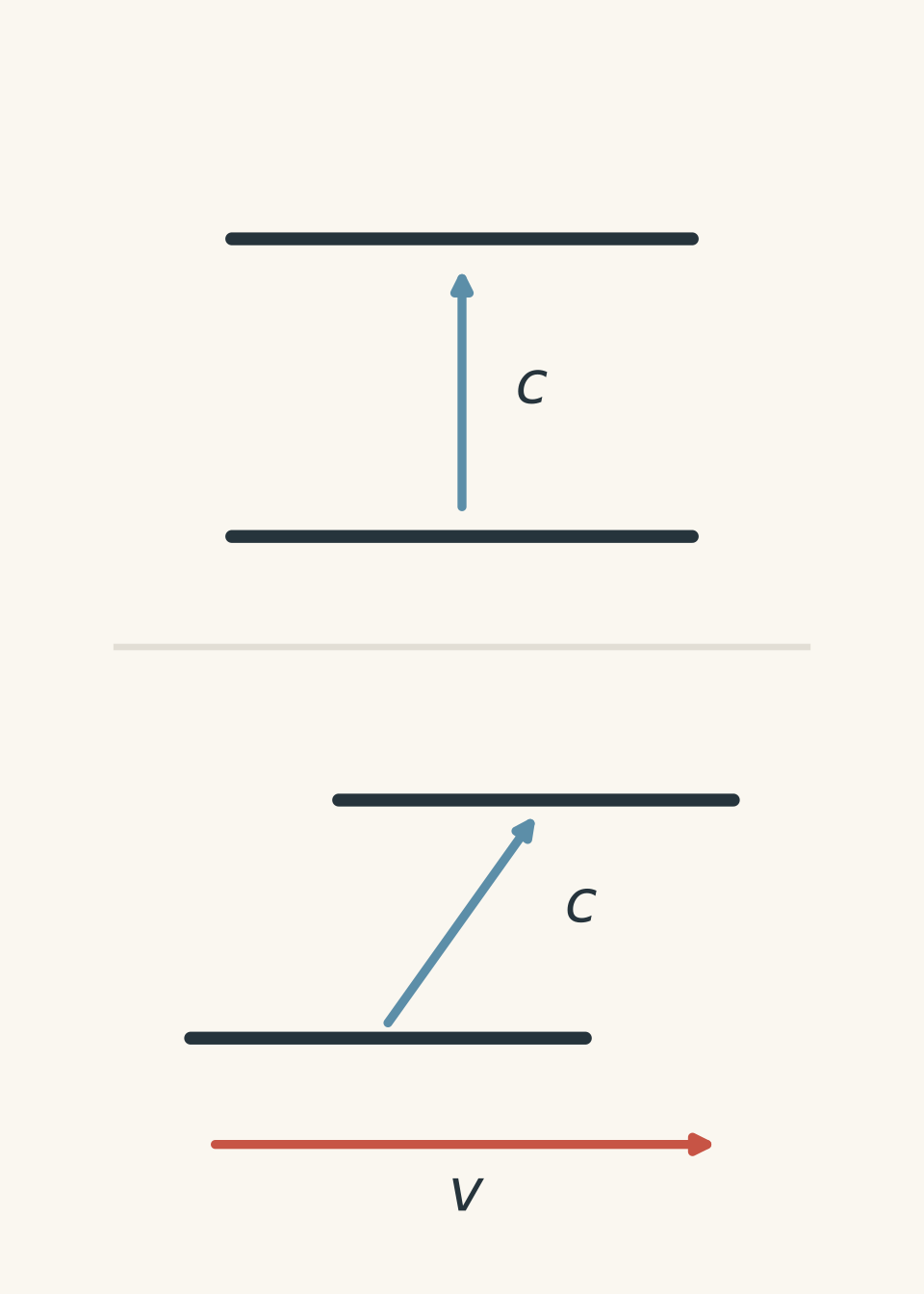
That creates the problem. The moving observer sees the light travel a longer distance between ticks, but Einstein’s second postulate says every inertial observer measures the same speed of light, \(c\).
Longer distance at the same speed means more time.
That is the basic physical picture behind time dilation.
There is one important limit to this model. Real clocks do not all work by bouncing light between mirrors. The light clock is a thought experiment that makes the geometry visible. Time dilation applies to the passage of time itself, so an ideal atomic clock, a biological process, and the decay of an unstable particle all show the same relativistic effect.
Turning the picture into an equation
Let the time for one complete tick measured beside the clock be \(\Delta t_0\).
During half a tick, the light travels from one mirror to the other. If the mirror separation is \(L\),
\[ L=\frac{c\Delta t_0}{2} \]
Now watch the clock move past at speed \(v\). You measure a longer tick interval, \(\Delta t\).
During half a tick:
- the clock moves horizontally by \(\frac{v\Delta t}{2}\),
- the light travels along the diagonal by \(\frac{c\Delta t}{2}\),
- the vertical separation is still \(L=\frac{c\Delta t_0}{2}\).
These three lengths form a right-angled triangle. Pythagoras gives
\[ \left(\frac{c\Delta t}{2}\right)^2 = \left(\frac{v\Delta t}{2}\right)^2 + \left(\frac{c\Delta t_0}{2}\right)^2 \]
Cancel the common factors and rearrange:
\[ c^2\Delta t^2 = v^2\Delta t^2+c^2\Delta t_0^2 \]
\[ \Delta t^2\left(1-\frac{v^2}{c^2}\right) = \Delta t_0^2 \]
so
\[ \Delta t = \frac{\Delta t_0}{\sqrt{1-\frac{v^2}{c^2}}} \]
The awkward-looking factor appears so often in relativity that it gets its own name.
02The Lorentz factor
The Lorentz factor is
\[ \gamma=\frac{1}{\sqrt{1-\frac{v^2}{c^2}}} \]
where:
- \(\gamma\) is the Lorentz factor and has no units,
- \(v\) is the relative speed between the clock and observer,
- \(c\) is the speed of light, \(3.00\times10^8\) m s\(^{-1}\).
Time dilation then becomes much cleaner:
\[ \Delta t=\gamma\Delta t_0 \]
The meanings of the two time intervals matter more than the algebra.
\(\Delta t_0\) is the proper time. It is measured by a clock that is present at both events. The two events occur at the same position in that clock’s reference frame.
\(\Delta t\) is the dilated time measured in a frame in which that clock is moving.
Because \(\gamma\geq1\),
\[ \Delta t\geq\Delta t_0 \]
So proper time is the shorter interval in an ordinary time-dilation calculation.
How large is \(\gamma\)?
| Speed | Lorentz factor \(\gamma\) |
|---|---|
| \(0\) | \(1.00\) |
| \(0.60c\) | \(1.25\) |
| \(0.80c\) | \(1.67\) |
| \(0.90c\) | \(2.29\) |
| \(0.95c\) | \(3.20\) |
| \(0.99c\) | \(7.09\) |
At ordinary speeds, \(\gamma\) is extremely close to \(1\), so time dilation is tiny. It becomes large only when \(v\) is a substantial fraction of \(c\).
Notice how quickly the effect grows near the speed of light. Going from \(0.60c\) to \(0.80c\) does not simply increase the time-dilation effect by one-third. The relationship is not linear.
03The real skill: identify the proper time
Most time-dilation errors are not calculator errors. They happen one line earlier, when the wrong interval is labelled \(\Delta t_0\).
Think in terms of events. An event is something happening at a particular place and time.
Suppose an astronaut presses a stopwatch at departure and stops the same stopwatch on arrival. That one stopwatch is present at both events. Its reading is the proper time.
An Earth observer may assign the departure and arrival different Earth positions. Earth therefore measures a dilated interval.
A useful decision rule is:
| Situation | What to do |
|---|---|
| One clock is physically present at both events | Its reading is \(\Delta t_0\) |
| An observer sees that clock move between the events | That observer measures \(\Delta t\) |
| You know \(\Delta t_0\) and want \(\Delta t\) | Multiply by \(\gamma\) |
| You know \(\Delta t\) and want the moving clock’s reading | Divide by \(\gamma\) |
Avoid memorising phrases such as “moving time” and “stationary time”. Motion is relative. Name the frames instead: Earth frame, spacecraft frame, laboratory frame, and so on.
Worked example: A spacecraft clock
A spacecraft moves past Earth at \(0.80c\). A clock on the spacecraft records \(6.00\) s between two flashes produced inside the spacecraft. Calculate the interval between the flashes measured in the Earth frame.
Step 1
The same spacecraft clock is present at both flashes, so
\[ \Delta t_0=6.00\text{ s} \]
Earth sees that clock moving.
Step 2
\[ \gamma = \frac{1}{\sqrt{1-(0.80)^2}} = \frac{1}{\sqrt{0.36}} = 1.667 \]
We can use \(0.80\) directly because \(v/c=0.80\).
Step 3
\[ \Delta t = \gamma\Delta t_0 = 1.667(6.00) = 10.0\text{ s} \]
Earth therefore measures \(10.0\) s between the events.
The result means that while \(10.0\) s passes on Earth, the moving spacecraft clock accumulates only \(6.00\) s between these particular events.
04What if the speed changes?
The equation \(\Delta t=\gamma\Delta t_0\) assumes one constant relative speed for the interval being considered.
If a spacecraft changes speed, its Lorentz factor changes too. You cannot normally find one average speed, calculate one \(\gamma\), and use that for the entire trip.
Instead, split the motion into sections over which the speed is constant, calculate the proper time for each section, then add them.
Worked example: Two stages of a journey
In Earth’s frame, a spacecraft travels for \(4.00\) h at \(0.95c\), then for another \(3.00\) h at \(0.80c\). Assume the time spent changing speed is negligible. Calculate the total time recorded by a clock on the spacecraft.
Step 1
For \(v=0.95c\),
\[ \gamma_1 = \frac{1}{\sqrt{1-(0.95)^2}} = 3.203 \]
Earth’s \(4.00\) h is the dilated interval, so the spacecraft’s proper time is
\[ \Delta t_{0,1} = \frac{\Delta t_1}{\gamma_1} = \frac{4.00}{3.203} = 1.25\text{ h} \]
Step 2
\[ \gamma_2 = \frac{1}{\sqrt{1-(0.80)^2}} = 1.667 \]
Therefore,
\[ \Delta t_{0,2} = \frac{3.00}{1.667} = 1.80\text{ h} \]
Step 3
\[ \Delta t_{0,\text{total}} = 1.25+1.80 = 3.05\text{ h} \]
The spacecraft clock records \(3.05\) h while Earth records \(7.00\) h.
The important point is not just that the spacecraft experiences less time. The amount of time dilation changes from one stage to the next because \(\gamma\) depends non-linearly on speed.
05The tempting misconception: “the moving clock is the slow clock”
Suppose you are on Earth and a spacecraft passes at constant velocity. You say the spacecraft clock is moving, so you measure it running slowly.
But the astronaut can describe Earth as moving in the opposite direction. The astronaut can therefore say Earth clocks are running slowly.
That sounds contradictory only if you assume there must be one objectively stationary frame. Special relativity does not give you one. For constant-velocity inertial observers, neither frame is privileged.
The subtle part is how distant clocks are compared. Observers moving relative to each other do not agree about which events at separated locations are simultaneous. That difference in simultaneity is what allows each inertial observer to measure the other’s moving clocks as slow without producing a logical contradiction.
This matters whenever a problem involves a spacecraft turning around and eventually reuniting with Earth. At reunion, the two clocks are side by side again, so their readings can be compared directly. The traveller has changed inertial frames during the journey, while Earth can be treated as remaining in one inertial frame. You cannot simply apply the sentence “Earth’s clock runs slow” across the traveller’s entire outbound-and-return trip as though the traveller used one inertial frame throughout.
06Quick checks before trusting an answer
A few tests catch most mistakes.
If \(v=0\), then \(\gamma=1\). The clocks must agree.
If your calculated \(\gamma\) is less than \(1\), something has gone wrong. You may have calculated \(\sqrt{1-v^2/c^2}\) rather than its reciprocal.
The dilated interval must be at least as large as the proper interval:
\[ \Delta t\geq\Delta t_0 \]
If the speed is given as \(0.92c\), do not unnecessarily substitute \(v=2.76\times10^8\) m s\(^{-1}\). Since
\[ \frac{v}{c}=0.92 \]
you can use \(0.92\) directly inside the Lorentz factor.
Finally, ask what your number means. Saying “\(8.4\) s” is not enough. Say which observer measures \(8.4\) s and which two events that interval connects.
07Questions and solutions
Question 1
A spacecraft moves at \(0.60c\) relative to Earth. An onboard clock measures \(4.00\) s between two events occurring inside the spacecraft.
Calculate the time interval between these events measured from Earth.
Solution 1
Earth measures \(5.00\) s between the events.
The spacecraft clock is present at both events, so its \(4.00\) s reading is the proper time:
\[ \Delta t_0=4.00\text{ s} \]
For \(v=0.60c\),
\[ \gamma = \frac{1}{\sqrt{1-(0.60)^2}} = \frac{1}{0.80} = 1.25 \]
Therefore,
\[ \Delta t = \gamma\Delta t_0 = 1.25(4.00) = 5.00\text{ s} \]
The tempting mistake is to divide by \(\gamma\). That would make Earth’s interval shorter than the proper time. Earth sees the spacecraft clock moving, so Earth measures the dilated, longer interval.
Question 2
An unstable particle moves through a laboratory at \(0.96c\). Laboratory instruments measure \(12.0\,\mu\text{s}\) between the particle’s creation and decay.
Calculate:
a. the particle’s proper lifetime
b. the distance travelled by the particle in the laboratory frame.
Use \(c=3.00\times10^8\) m s\(^{-1}\).
Solution 2
The particle’s proper lifetime is \(3.36\,\mu\text{s}\), and it travels \(3.46\) km in the laboratory frame.
For the Lorentz factor,
\[ \gamma = \frac{1}{\sqrt{1-(0.96)^2}} = \frac{1}{\sqrt{0.0784}} = 3.571 \]
The particle itself is present at its creation and decay, so its lifetime is the proper time. The laboratory’s \(12.0\,\mu\text{s}\) is the dilated interval.
For part a,
\[ \Delta t_0 = \frac{\Delta t}{\gamma} = \frac{12.0\,\mu\text{s}}{3.571} = 3.36\,\mu\text{s} \]
For part b, the distance must be calculated using quantities from the same frame. The laboratory measures both \(v=0.96c\) and \(\Delta t=12.0\,\mu\text{s}\).
\[ d=v\Delta t \]
\[ d = (0.96)(3.00\times10^8)(12.0\times10^{-6}) = 3.46\times10^3\text{ m} \]
\[ d=3.46\text{ km} \]
The tempting route is to use the particle’s \(3.36\,\mu\text{s}\) proper lifetime in \(d=vt\) while keeping the laboratory velocity \(0.96c\). That mixes measurements from different frames. The laboratory distance requires the laboratory time.
Question 3
A spacecraft travels at constant speed relative to Earth. Earth clocks record \(10.0\) h between departure and arrival, while the spacecraft clock records \(8.50\) h.
Calculate the spacecraft’s speed as a fraction of \(c\).
Explain why saying “the spacecraft loses \(15\%\) of Earth’s time, so its speed must be \(0.15c\)” is incorrect.
Solution 3
The spacecraft travels at approximately \(0.527c\), and the \(15\%\) time difference cannot be converted directly into a percentage of the speed of light.
The spacecraft clock travels with the departure-to-arrival events, so
\[ \Delta t_0=8.50\text{ h} \]
while Earth measures
\[ \Delta t=10.0\text{ h} \]
From
\[ \Delta t=\gamma\Delta t_0 \]
the Lorentz factor is
\[ \gamma = \frac{10.0}{8.50} = 1.176 \]
Now use
\[ \gamma = \frac{1}{\sqrt{1-\frac{v^2}{c^2}}} \]
Taking the reciprocal,
\[ \sqrt{1-\frac{v^2}{c^2}} = \frac{1}{1.176} = 0.850 \]
Squaring,
\[ 1-\frac{v^2}{c^2}=0.850^2=0.7225 \]
so
\[ \frac{v^2}{c^2}=0.2775 \]
and
\[ \frac{v}{c} = \sqrt{0.2775} = 0.527 \]
Therefore,
\[ v=0.527c \]
The tempting argument treats time dilation as though it were directly proportional to speed. It is not. The speed appears inside
\[ \sqrt{1-\frac{v^2}{c^2}} \]
so a \(15\%\) difference in elapsed time does not imply \(v=0.15c\).
Question 4
Three identical clocks begin together on Earth.
Clock A immediately leaves Earth at \(0.80c\). It travels for \(5.00\) years according to Earth clocks, instantly reverses direction, then returns at \(0.80c\) for another \(5.00\) Earth years.
Clock B remains on Earth for the first \(4.00\) years. It then travels away at \(0.96c\) for \(3.00\) Earth years, instantly reverses direction, and returns at \(0.96c\) for another \(3.00\) Earth years.
Clock C remains on Earth throughout.
Assume the turnarounds take negligible time.
a. How much time has elapsed on each clock when all three are reunited?
b. Clock B has a lower average path speed over the full \(10.0\) Earth years than Clock A. Does this mean B must record more time than A? Explain.
Solution 4
At reunion, Clock A reads \(6.00\) years, Clock B reads \(5.68\) years, and Clock C reads \(10.0\) years. Clock B records less time than A despite having the lower average path speed.
Clock C remains on Earth, so
\[ \Delta t_C=10.0\text{ y} \]
For Clock A, \(v=0.80c\), giving
\[ \gamma_A = \frac{1}{\sqrt{1-(0.80)^2}} = 1.667 \]
Earth measures \(10.0\) years of motion in total, so A records
\[ \Delta t_A = \frac{10.0}{1.667} = 6.00\text{ y} \]
Clock B first spends \(4.00\) years at rest with Earth. During that section, it also accumulates \(4.00\) years.
For its high-speed motion,
\[ \gamma_B = \frac{1}{\sqrt{1-(0.96)^2}} = 3.571 \]
Earth measures \(6.00\) years for B’s outbound-and-return motion, so B accumulates
\[ \Delta t_{B,\text{moving}} = \frac{6.00}{3.571} = 1.68\text{ y} \]
Its total is therefore
\[ \Delta t_B = 4.00+1.68 = 5.68\text{ y} \]
So,
\[ \Delta t_B<\Delta t_A<\Delta t_C \]
The surprising part is Clock B. Over the full \(10.0\) Earth years, B moves for only six years, so its average path speed is
\[ \frac{(0.96c)(6.00)}{10.0}=0.576c \]
which is lower than A’s \(0.80c\).
It is tempting to conclude that the lower average speed must cause less time dilation. The problem is that \(\gamma\) is non-linear. Six years at \(0.96c\) cannot be replaced by ten years at an average speed of \(0.576c\).
Elapsed proper time depends on how the motion is distributed through the journey, not just on one average speed. B’s highly relativistic section produces enough time dilation for B to accumulate less total time than A.
Question 5
A spacecraft leaves Earth for a star \(4.00\) light-years away in the Earth frame. It travels at \(0.80c\), turns around immediately on reaching the star, and returns at \(0.80c\).
An Earth observer calculates that \(10.0\) years pass on Earth and \(6.00\) years pass on the spacecraft.
A student objects:
“On the outward trip the astronaut can say Earth is moving, so Earth’s clocks run slowly. The same is true on the return trip. Earth should therefore have aged less than the astronaut, not more.”
Resolve the apparent contradiction. Your explanation should state the elapsed times, explain why reciprocal time dilation is valid during uniform motion, and identify what changes at the turnaround.
Solution 5
Earth ages \(10.0\) years and the astronaut ages \(6.00\) years; there is no contradiction because the astronaut changes inertial frames at the turnaround, so the outward and return descriptions cannot be joined while keeping the same definition of distant simultaneity.
First check the Earth-frame calculation.
Each one-way distance is \(4.00\) light-years, and the speed is \(0.80c\). Because light travels one light-year per year,
\[ t_{\text{one way}} = \frac{4.00\text{ ly}}{0.80\text{ ly y}^{-1}} = 5.00\text{ y} \]
Earth therefore records
\[ \Delta t_{\text{Earth}}=10.0\text{ y} \]
At \(0.80c\),
\[ \gamma=1.667 \]
so the astronaut records
\[ \Delta t_{\text{ship}} = \frac{10.0}{1.667} = 6.00\text{ y} \]
The student’s first statement is not the mistake. During the outward constant-velocity section, the astronaut may treat the spacecraft as stationary and Earth as moving. In that inertial frame, Earth clocks are time-dilated.
The same reciprocal description works during the constant-velocity return section.
The mistake is treating the outward spacecraft frame and the return spacecraft frame as one unchanged inertial frame. They are not. The spacecraft reverses velocity, so the astronaut switches from one inertial frame to another.
That switch changes which distant Earth events the astronaut considers simultaneous with the turnaround. In special relativity, observers in relative motion do not generally agree about simultaneity at separated locations.
This is the missing interaction in the student’s argument. Saying “Earth clocks run slowly” during each constant-speed leg is not enough to calculate Earth’s total elapsed time unless the change of inertial frame at the turnaround is also handled.
It is also tempting to say that acceleration itself somehow makes the spacecraft clock suddenly lose four years. That is not the right explanation. The turnaround could be made very brief and the final difference would remain close to the same value. What matters is the complete path through spacetime: Earth follows one inertial path between departure and reunion, while the spacecraft follows an outward path and then a different inward path.
At reunion the clocks are finally at the same location again, so there is no issue about distant simultaneity. They can simply be placed beside each other and compared:
\[ 10.0\text{ y on Earth},\qquad 6.00\text{ y on the spacecraft} \]
08What time dilation allows you to understand next
Once you can identify proper time and use the Lorentz factor confidently, length contraction becomes much easier to interpret. The same journey can be described in two consistent ways: Earth measures a long distance and a dilated travel time, while the traveller measures a shorter proper time and a contracted distance.
The next important idea is therefore not another formula. It is simultaneity. Time dilation, length contraction, and disagreements about which separated events happen “at the same time” are not three unrelated tricks. They are different consequences of the same requirement: every inertial observer must measure the same speed of light.