
Length Contraction in HSC Physics: Proper Length and Calculations
Learn how to identify proper length, calculate relativistic length contraction, and avoid common frame-of-reference mistakes in HSC Physics.
A spacecraft is 100 m long when it is sitting beside you. It accelerates away and later passes Earth at \(0.80c\). What length should an Earth observer measure: 100 m, more than 100 m, or less?
The Earth observer measures only 60 m.
Nothing has been crushed. The crew still measures the spacecraft as 100 m long. The difference comes from a surprisingly important rule about measuring length: to measure a moving object’s length, you must record the positions of its front and back at the same time in your frame. Different inertial frames do not always agree about which distant events are simultaneous.
That is the idea behind length contraction.
01What does it actually mean to measure a moving length?
Suppose a 100 m spacecraft flies past two markers on Earth.
If the spacecraft were stationary, measuring its length would be easy. Put one marker beside the tail, another beside the nose, and measure the separation.
For a moving spacecraft, you cannot mark the tail’s position now and the nose’s position a second later. The spacecraft has moved during that second. You need the positions of both ends at the same instant according to clocks in your frame.
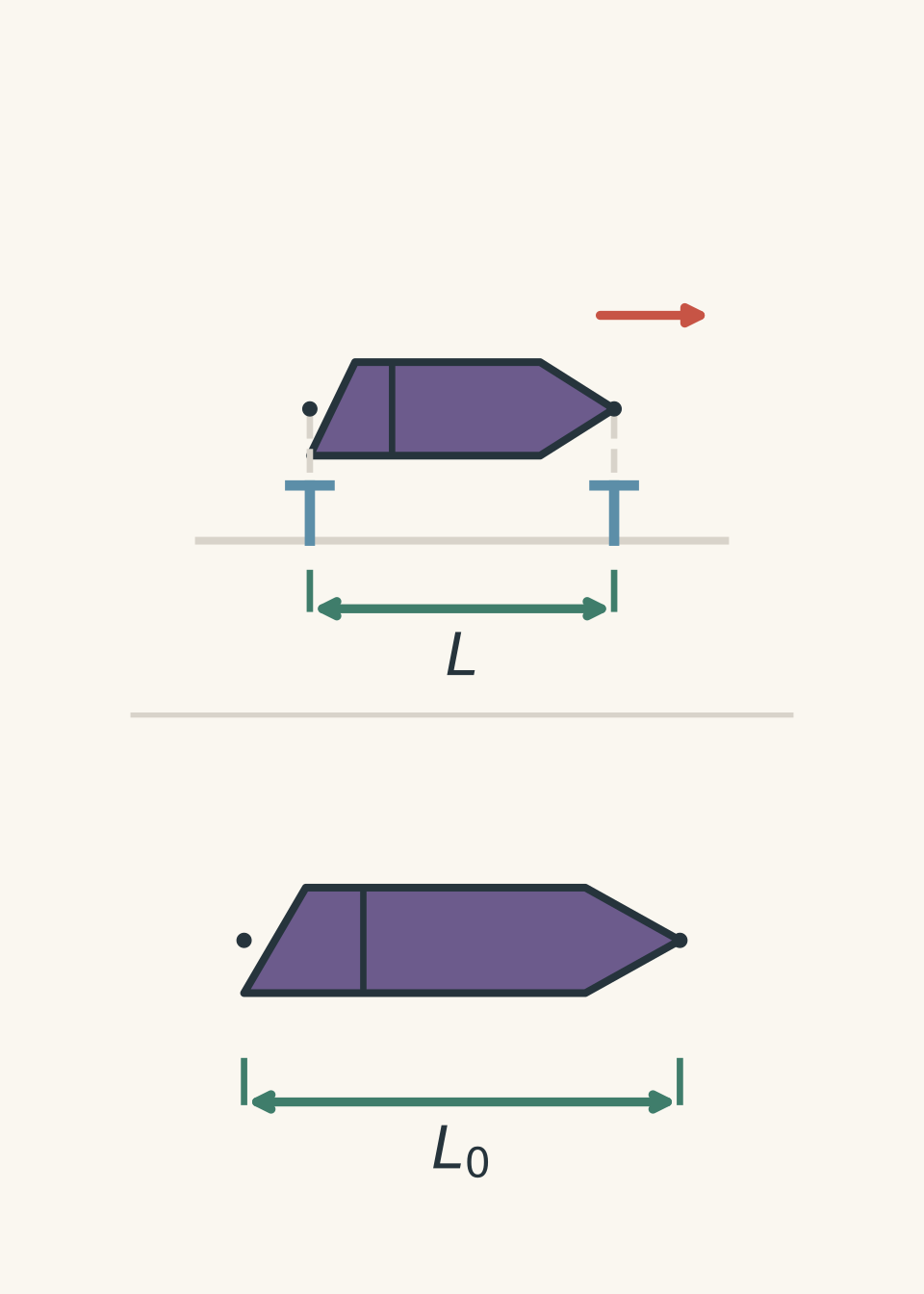
Here’s a useful way to picture it. Imagine two friends standing beside a very fast train. One marks where the back of the train is, while the other marks where the front is. For their result to represent the train’s length, the two marks must be made simultaneously in their frame.
At ordinary speeds, everyone effectively agrees about simultaneity, so this detail feels pointless. At speeds close to the speed of light, it isn’t.
That is where the analogy breaks: this is not merely a problem with human reaction time or badly synchronised stopwatches. Special relativity says that observers moving relative to one another can genuinely disagree about whether spatially separated events happened at the same time.
02Proper length: find the frame where the endpoints are at rest
The most important skill in HSC length-contraction questions is often not using the equation. It is deciding which length is the proper length.
The proper length, \(L_0\), is the length measured in the frame where the two endpoints being measured are at rest.
For a spacecraft, its proper length is measured by observers travelling with the spacecraft.
For the distance between Earth and a distant star, the proper length is measured in a frame where Earth and that star are both at rest.
That second case catches students surprisingly often. Proper length does not mean “the length measured on Earth”. It does not belong to one special observer. It depends on what pair of endpoints you are measuring.
A reliable decision rule is:
| Ask yourself | What it tells you |
|---|---|
| What are the two endpoints? | Defines the length being measured |
| In which frame are both endpoints at rest? | That frame measures \(L_0\) |
| Does another observer see those endpoints moving? | That observer measures a contracted length |
| Is the length parallel to the relative motion? | Length contraction applies to that dimension |
The proper length is sometimes called the rest length. That name is useful because it reminds you what to look for.
03The length-contraction equation
If an object has proper length \(L_0\) and moves parallel to its length at speed \(v\) relative to an observer, that observer measures
\[ L=L_0\sqrt{1-\frac{v^2}{c^2}} \]
where:
- \(L\) is the contracted length measured in the frame where the object is moving,
- \(L_0\) is the proper length,
- \(v\) is the relative speed between the object and the observer, and
- \(c\) is the speed of light, approximately \(3.00\times10^8\text{ m s}^{-1}\).
You may also write the equation using the Lorentz factor,
\[ \gamma=\frac{1}{\sqrt{1-\frac{v^2}{c^2}}} \]
so that
\[ L=\frac{L_0}{\gamma}. \]
Because \(\gamma\geq1\), the moving length \(L\) is always less than or equal to the proper length \(L_0\).
The same Lorentz factor appears in time dilation. That is not a coincidence. Length contraction and time dilation are both consequences of how space and time coordinates change between inertial frames.
Worked example: How long does a moving spacecraft appear?
A spacecraft has a proper length of \(12.0\text{ m}\). It passes an observer at \(0.60c\), moving parallel to its length. Calculate the length measured by the observer.
Step 1
The spacecraft is 12.0 m long in its own rest frame, so
\[ L_0=12.0\text{ m}. \]
The observer sees the spacecraft moving, so the observer measures \(L\).
Step 2
Here,
\[ v=0.60c. \]
Therefore,
\[ \gamma =\frac{1}{\sqrt{1-(0.60)^2}} =\frac{1}{\sqrt{0.64}} =1.25. \]
Step 3
\[ L=\frac{L_0}{\gamma} =\frac{12.0}{1.25} =9.60\text{ m}. \]
The observer therefore measures the spacecraft as \(9.60\text{ m}\) long.
The crew does not measure their own spacecraft as 9.60 m. In the spacecraft frame it is at rest, so its length remains its proper length of 12.0 m.
04Length contraction can apply to a journey as well as an object
Now suppose Earth and a distant station are 8.0 light-years apart and are stationary relative to one another.
A spacecraft travels from Earth to the station at \(0.80c\).
Before calculating anything, predict what the crew measures for the Earth-station distance. Is 8.0 light-years the proper length, or is the crew’s measurement the proper length?
Earth and the station are both at rest in the Earth-station frame. So 8.0 light-years is the proper length. In the spacecraft frame, Earth and the station are moving backwards, so their separation is contracted.
Worked example: How far away is the destination to the crew?
Earth and a space station are \(8.0\) light-years apart in their common rest frame. A spacecraft travels between them at \(0.80c\). Calculate the Earth-station distance measured by the crew.
Step 1
Because Earth and the station are both at rest in the same frame,
\[ L_0=8.0\text{ ly}. \]
Step 2
\[ \gamma =\frac{1}{\sqrt{1-(0.80)^2}} =\frac{1}{\sqrt{0.36}} =1.67. \]
Step 3
\[ L=\frac{8.0}{1.67}=4.8\text{ ly}. \]
The crew measures the Earth-station separation as \(4.8\) light-years.
That result also helps explain how the crew can experience a shorter travel time without measuring the spacecraft’s speed as greater than \(c\). In their frame, the destination really is closer.
At \(0.80c\), the crew’s travel time between these locations is
\[ t=\frac{4.8\text{ ly}}{0.80c}=6.0\text{ years}, \]
while the Earth-frame journey takes
\[ t=\frac{8.0\text{ ly}}{0.80c}=10\text{ years}. \]
The different distance and time measurements fit together consistently.
05What is actually contracting?
A common picture is that the moving object has somehow been physically squashed by the speed.
That is misleading.
If you are sitting inside a spacecraft travelling smoothly at \(0.80c\) relative to Earth, your ruler has not become mysteriously shorter to you. Your desk, spacecraft, ruler, and body are all at rest in your frame. Local measurements behave normally.
Earth observers measure your spacecraft as contracted because their measurement uses Earth-frame simultaneity.
You, meanwhile, measure Earth-frame distances as contracted.
Neither observer gets to say, “Mine is the real length because I’m actually stationary.” Uniform motion is relative. What is special is the frame in which the particular pair of endpoints is at rest.
There is one more restriction: ordinary length contraction acts only along the direction of relative motion. A 2.0 m vertical antenna on a spacecraft moving horizontally does not become vertically shorter because of length contraction.
06The most tempting mistake: choosing \(L_0\) from the wording
Consider this statement:
An observer measures a moving spacecraft to be 18 m long.
Is 18 m the proper length?
No. The clue is the word “moving”. If the spacecraft is moving relative to that observer, the observer is measuring a contracted length \(L\).
Now consider:
A spacecraft is 30 m long in its own rest frame.
That 30 m is \(L_0\).
Do not decide based on which number appears first, which observer is on Earth, or which measurement sounds more official. Decide by asking whether the two endpoints are at rest in the measuring frame.
07Why simultaneity is hiding inside the equation
Suppose Earth wants to measure a spacecraft’s length.
Earth observers must find:
- the position of the tail at some Earth-frame time \(t\), and
- the position of the nose at that same Earth-frame time \(t\).
The distance between those positions is the Earth-frame length.
The spacecraft crew also measures its nose and tail simultaneously, but “simultaneously” now means at the same spacecraft-frame time.
Special relativity says those two definitions of simultaneous are not generally equivalent.
This becomes essential in problems involving a long spacecraft and a short tunnel. One frame can say the spacecraft fits completely inside at one instant, while the spacecraft frame says there was never an instant when the entire spacecraft was inside. The disagreement is not about where the objects are. It is about which separated events count as happening at the same time.
That sounds strange because it is strange. But it is a precise consequence of special relativity, not a loophole in the length-contraction equation.
08Questions and solutions
Question 1
A scientific probe has a proper length of \(40.0\text{ m}\). It passes an Earth observer at \(0.60c\), moving parallel to its length.
Calculate the length of the probe measured by the Earth observer, and identify which of the two lengths is the proper length.
Solution 1
The Earth observer measures \(32.0\text{ m}\), while \(40.0\text{ m}\) is the proper length.
The probe is at rest in its own frame, so
\[ L_0=40.0\text{ m}. \]
For \(v=0.60c\),
\[ \gamma =\frac{1}{\sqrt{1-(0.60)^2}} =1.25. \]
Therefore,
\[ L=\frac{L_0}{\gamma} =\frac{40.0}{1.25} =32.0\text{ m}. \]
The tempting mistake is to call 32.0 m the proper length because that is what the Earth observer “directly measures”. Proper length is not defined by how direct a measurement feels. It is defined as the length measured in the frame where the endpoints are at rest.
Question 2
A spacecraft has a proper length of \(1.50\text{ km}\). An observer measures its length parallel to its motion as \(0.900\text{ km}\).
Calculate the spacecraft’s speed as a fraction of \(c\).
A student argues that \(0.900\text{ km}\) should be called the proper length because it is the length recorded by the observer’s measuring equipment. Explain the error.
Solution 2
The spacecraft is moving at \(0.800c\), and \(1.50\text{ km}\), not \(0.900\text{ km}\), is its proper length.
Use
\[ L=L_0\sqrt{1-\frac{v^2}{c^2}}. \]
Substituting \(L=0.900\text{ km}\) and \(L_0=1.50\text{ km}\),
\[ 0.900 =1.50\sqrt{1-\frac{v^2}{c^2}}. \]
Divide by \(1.50\):
\[ 0.600 =\sqrt{1-\frac{v^2}{c^2}}. \]
Squaring both sides gives
\[ 0.360 =1-\frac{v^2}{c^2}. \]
Therefore,
\[ \frac{v^2}{c^2}=0.640 \]
and
\[ \frac{v}{c}=0.800. \]
Hence,
\[ v=0.800c. \]
The student’s argument confuses “measured length” with “proper length”. Both lengths are valid measurements in their respective frames. The proper length is specifically the measurement made in the spacecraft’s rest frame, where its nose and tail are stationary.
Question 3
Earth and a relay station are \(12.0\) light-years apart and are at rest relative to one another. A spacecraft of proper length \(50.0\text{ m}\) travels from Earth towards the station at \(0.80c\).
Calculate:
(a) the Earth-station distance measured by the spacecraft crew,
(b) the spacecraft’s length measured from Earth, and
(c) explain why the proper length in part (a) belongs to the Earth-station frame, while the proper length in part (b) belongs to the spacecraft frame.
Solution 3
The crew measures the Earth-station distance as \(7.20\text{ ly}\), Earth measures the spacecraft as \(30.0\text{ m}\), and the two proper lengths belong to different frames because they refer to different pairs of endpoints.
At \(0.80c\),
\[ \gamma =\frac{1}{\sqrt{1-(0.80)^2}} =\frac{1}{0.600} =1.67. \]
For part (a), Earth and the relay station are both at rest in their common frame. Their separation of \(12.0\text{ ly}\) is therefore the proper length:
\[ L_0=12.0\text{ ly}. \]
The spacecraft crew sees both locations moving, so
\[ L=\frac{12.0}{1.67}=7.20\text{ ly}. \]
For part (b), the spacecraft itself is at rest in the crew’s frame, so its proper length is
\[ L_0=50.0\text{ m}. \]
Earth sees the spacecraft moving:
\[ L=\frac{50.0}{1.67}=30.0\text{ m}. \]
The trap is to look for one frame that is somehow “the proper frame” for the entire problem. There is no such rule.
For the Earth-station separation, the relevant endpoints are Earth and the station. They are at rest in the Earth-station frame.
For the spacecraft length, the relevant endpoints are its nose and tail. They are at rest in the spacecraft frame.
Proper length belongs to a particular pair of endpoints, not automatically to a particular observer.
Question 4
Two small spacecraft, A and B, travel together past Earth at \(0.60c\). They remain at rest relative to one another.
At one instant in the Earth frame, observers record the separation between corresponding points on A and B as \(240\text{ m}\).
Each spacecraft also carries a \(20.0\text{ m}\) boom aligned with the direction of motion, where 20.0 m is the boom’s proper length.
(a) Is \(240\text{ m}\) the proper separation between A and B?
(b) Calculate their proper separation.
(c) Calculate the boom length measured from Earth.
(d) Explain why the fact that the Earth observers measured the positions of A and B simultaneously does not make their \(240\text{ m}\) measurement a proper length.
Solution 4
The proper separation is \(300\text{ m}\), each boom is measured from Earth as \(16.0\text{ m}\), and the \(240\text{ m}\) separation is not proper because A and B are moving in the Earth frame.
For \(v=0.60c\),
\[ \gamma =\frac{1}{\sqrt{1-(0.60)^2}} =1.25. \]
For parts (a) and (b), A and B are at rest relative to each other. They therefore share a frame in which both endpoints of the separation are stationary.
That common spacecraft frame measures the proper separation.
Earth sees the separation contracted, so
\[ L=\frac{L_0}{\gamma}. \]
Hence,
\[ L_0=\gamma L =(1.25)(240) =300\text{ m}. \]
For part (c), each boom has proper length
\[ L_0=20.0\text{ m}. \]
Earth therefore measures
\[ L=\frac{20.0}{1.25} =16.0\text{ m}. \]
The tempting route in part (d) is to reason that a valid length measurement requires simultaneous endpoint positions, so any simultaneous measurement must be a proper length.
The first part is correct. The conclusion is not.
Earth observers do need simultaneous Earth-frame positions to measure the Earth-frame separation. That makes \(240\text{ m}\) a valid length in the Earth frame.
But proper length has an additional requirement: the endpoints must be at rest in that measuring frame. A and B are moving relative to Earth, so their Earth-frame separation is contracted.
In the common rest frame of A and B, their separation is 300 m.
Question 5
A tunnel has a proper length of \(70.0\text{ m}\). A spacecraft has a proper length of \(100\text{ m}\) and travels through the tunnel at \(0.80c\).
In the tunnel frame, an operator arranges for the entrance door and exit door to close simultaneously for a very brief instant when the spacecraft is centred in the tunnel, then immediately reopen.
Assume the doors do not strike the spacecraft.
(a) Calculate the spacecraft’s length in the tunnel frame. Does it fit completely inside the tunnel at one tunnel-frame instant?
(b) Calculate the tunnel’s length in the spacecraft frame. Does the crew ever measure the entire 100 m spacecraft as being inside the tunnel at one spacecraft-frame instant?
(c) A student argues that parts (a) and (b) contradict each other: “Either the whole spacecraft is inside the tunnel at once, or it isn’t.” Identify the hidden assumption in that argument.
(d) In the spacecraft frame, can the two door-closing events be simultaneous? Explain what must change between the frames for both descriptions to be consistent.
Solution 5
The spacecraft is \(60.0\text{ m}\) long in the tunnel frame and therefore fits inside the 70.0 m tunnel at one tunnel-frame instant, but the crew measures the tunnel as only \(42.0\text{ m}\) long and never says the entire 100 m spacecraft is inside it at one spacecraft-frame instant. There is no contradiction because the two frames disagree about simultaneity.
At \(0.80c\),
\[ \gamma =\frac{1}{\sqrt{1-(0.80)^2}} =1.67. \]
For part (a), the spacecraft’s proper length is \(100\text{ m}\). The tunnel frame sees it moving, so
\[ L=\frac{100}{1.67} =60.0\text{ m}. \]
The tunnel is 70.0 m long in its own rest frame. Therefore, at the chosen tunnel-frame instant, the 60.0 m spacecraft can be completely inside, leaving a total of 10.0 m between its ends and the two doors.
For part (b), reverse the viewpoint.
The tunnel’s proper length is
\[ L_0=70.0\text{ m}. \]
The spacecraft crew sees the tunnel moving, so the crew measures
\[ L=\frac{70.0}{1.67} =42.0\text{ m}. \]
The spacecraft remains 100 m long in its own frame. A 42.0 m tunnel cannot contain the entire 100 m spacecraft at one spacecraft-frame instant.
The tempting conclusion in part (c) is that the phrase “at once” must mean the same thing in both frames.
That is the hidden assumption.
The tunnel observer’s statement is more precisely:
At one tunnel-frame time, both ends of the spacecraft lie between the two doors.
The crew’s statement concerns positions measured at one spacecraft-frame time. Those are different sets of simultaneous events.
For part (d), the two door closures cannot also be simultaneous in the spacecraft frame. If they were, both frames would agree on the simultaneity of two spatially separated events despite their relative motion, which is exactly what special relativity does not allow in this situation.
In the spacecraft frame, the exit-door event occurs before the entrance-door event. The crew therefore does not describe both doors as closing at the same spacecraft-frame instant around the entire ship.
This is the key constraint that resolves the apparent paradox. Length contraction on its own can make the two descriptions look incompatible. Relativity of simultaneity is what makes them fit together.
09What length contraction lets you understand next
Length contraction is easiest to use when you stop treating \(L_0\) as “the bigger number” and instead ask one physical question: which frame has the two endpoints at rest?
Once that is clear, the calculation is usually short.
The deeper step is recognising why different frames can consistently assign different lengths. A length measurement is not only about space. It also contains a statement about which endpoint positions were measured at the same time.
That connection between length and simultaneity leads directly into the broader structure of special relativity. It also explains why length contraction and time dilation must appear together rather than as two unrelated formulas.