
How Soap Structure Explains Micelles and Cleaning Action
Learn how the hydrophilic head and hydrophobic tail of soap molecules drive micelle formation, grease removal, and interactions with water. Includes worked examples and challenging HSC-style questions.
Put a greasy spoon under running water and most of the grease stays put. The water can hit it hard, move around it, and even carry away loose food, but the oily film clings on.
Now predict what changes when you add soap. Does the soap chemically react with the grease and destroy it?
Usually, no. The main trick is physical rather than chemical. A soap particle has one part that interacts well with water and another part that interacts well with oil. That split personality lets soap sit at the boundary between substances that normally avoid mixing, break grease into tiny dispersed regions, and keep those regions suspended long enough to rinse them away.
01One soap particle has two very different parts
A typical soap is the sodium or potassium salt of a long-chain carboxylic acid. Sodium stearate, for example, can be represented as
\[ \ce{CH3(CH2)16COO^- Na+} \]
In water, the sodium ion and stearate ion separate:
\[ \ce{CH3(CH2)16COONa -> CH3(CH2)16COO^- + Na+} \]
The part doing most of the cleaning is the long stearate ion.
It has two regions with very different properties.
| Part of soap ion | Structure | Main property | What it interacts with |
|---|---|---|---|
| Hydrophilic head | \(\ce{-COO^-}\) | Ionic and strongly attracted to water | Water molecules |
| Hydrophobic tail | Long hydrocarbon chain | Non-polar | Oils, fats, and other non-polar substances |
The \(\mathrm{Na}^{+}\) ion is a counterion. It helps make sodium soap electrically neutral overall, but it is not the part that buries itself in grease.
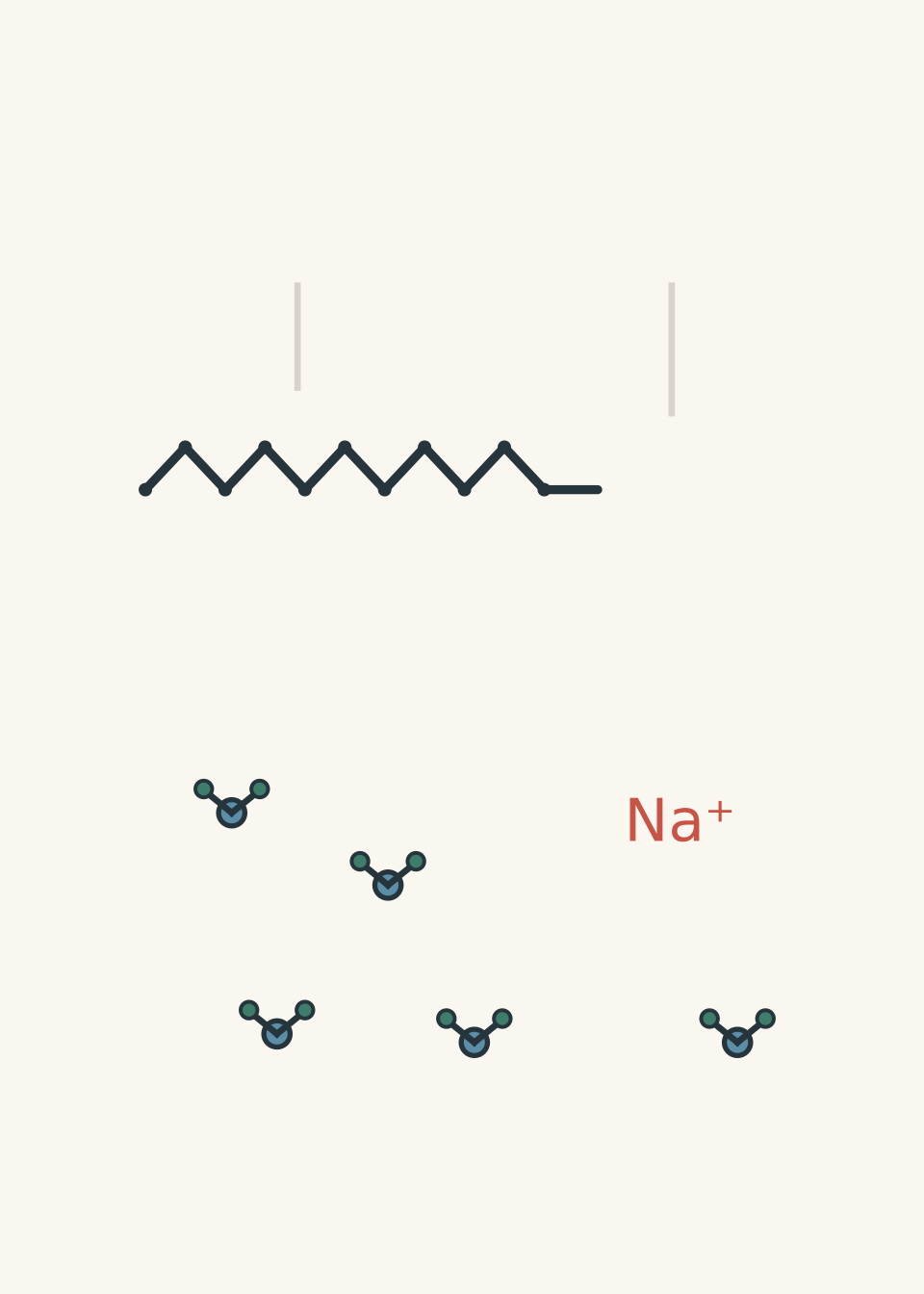
Why does the head like water?
Water molecules are polar. Their hydrogen atoms have a partial positive charge, while the oxygen atom has a partial negative charge. The negatively charged \(\ce{COO^-}\) head therefore experiences strong ion-dipole attractions with nearby water molecules.
The hydrocarbon tail is different. Its \(\ce{C-C}\) and \(\ce{C-H}\) bonds are essentially non-polar, so it cannot replace the strong interactions that water molecules normally make with one another.
That does not mean water literally pushes the tail away with a special “hydrophobic force”. The more precise idea is that arrangements exposing a large non-polar surface to water are unfavourable. Soap molecules can reduce that contact by grouping their hydrocarbon tails together.
This is the beginning of micelle formation.
02Why oil and water need soap in the first place
Imagine a drop of cooking oil sitting in water. Predict what happens if you shake the mixture hard for ten seconds and then leave it on the bench.
For a short time, the oil breaks into small droplets, so the mixture may look cloudy. Soon, those droplets collide, join together, and form a separate oil layer again.
The problem is not that oil and water are incapable of touching. They obviously can touch at their boundary. The problem is that maintaining a large oil-water interface is unfavourable.
Water molecules interact strongly with other water molecules through hydrogen bonding. Oil molecules mainly interact through dispersion forces. When a non-polar oil surface is placed in water, the interactions at that boundary are less favourable than the interactions within the separate liquids.
So the system tends to reduce the amount of boundary between them. Small oil droplets merge into larger droplets because one large droplet has less total surface area than many tiny ones containing the same amount of oil.
Soap interferes with that process.
A soap ion is a bit like the one person at a painfully awkward party who can talk comfortably to two groups that refuse to speak to each other. The hydrocarbon tail stays with the oil, while the charged head stays with the water.
The analogy breaks because molecules are not choosing friends. The orientation comes from intermolecular forces and the energetics of the whole system.
03How soap molecules form micelles
Put enough soap into water and the ions do not simply float around independently.
Their hydrocarbon tails tend to cluster together, away from the surrounding water, while the charged carboxylate heads remain exposed to the water.
The resulting structure is called a micelle.
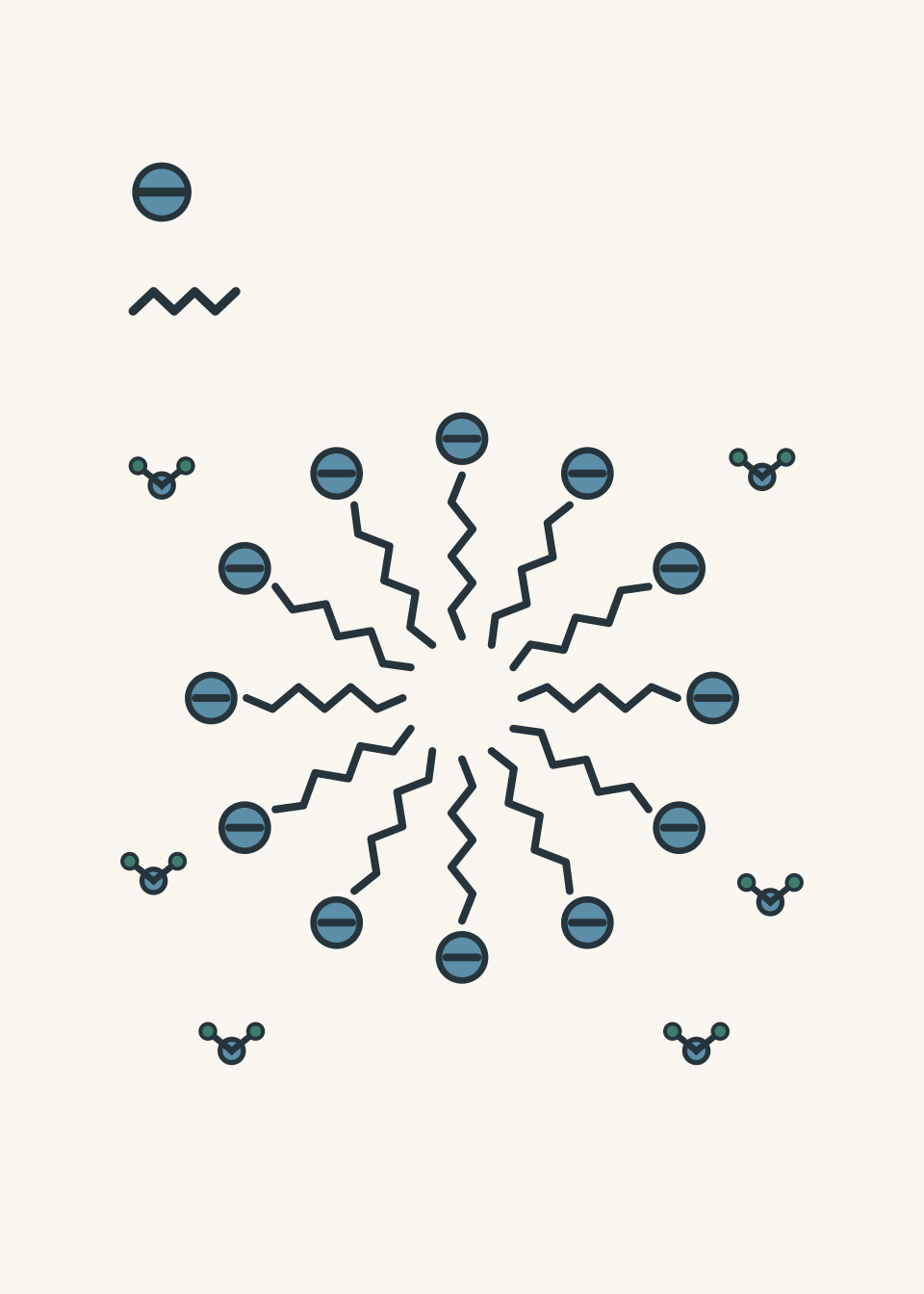
The important orientation is:
- hydrophobic tails point towards the non-polar interior;
- hydrophilic \(\ce{COO^-}\) heads point outwards into the water.
A micelle is not a rigid little ball with permanently assigned molecules. Soap ions continually leave and join micelles. The structures are dynamic.
There is also a useful extra layer of precision. Micelles become important only once enough soap is present. Below a particular concentration, called the critical micelle concentration, or CMC, a much larger fraction of the soap exists as individual ions or at interfaces. Above it, adding more soap favours micelle formation.
You generally do not need to calculate the CMC in HSC Chemistry, but the idea matters: simply having a few soap ions present is not the same as having enough dissolved soap for effective micelle formation.
Worked example: Which way does soap arrange itself?
A drop of vegetable oil is surrounded by water containing sodium stearate. Explain how the stearate ions arrange themselves at the oil-water boundary and why this arrangement is stable.
Step 1
The long hydrocarbon chain is non-polar, while the \(\ce{COO^-}\) group is ionic and hydrophilic.
Step 2
The hydrocarbon tail can make dispersion-force interactions with the non-polar oil. The charged head interacts strongly with polar water through ion-dipole attractions.
Step 3
The tail points into the oil, while the \(\ce{COO^-}\) head remains in the water.
Step 4
A layer of soap ions can therefore cover the oil-water interface. This reduces the energetic cost of maintaining that interface and helps keep small oil droplets dispersed.
The result is not that oil has suddenly become polar. Soap has created an interface where each end of the surfactant can remain in a chemically suitable environment.
04How soap actually removes grease
Suppose grease is stuck to a plate. Adding soap does several related jobs.
First, soap accumulates at interfaces. Its tails can enter the grease while its heads remain in the surrounding water.
Second, soap lowers the interfacial tension between the water and grease. This makes it easier for water, assisted by rubbing or agitation, to spread around the grease and break it into smaller droplets.
Third, the surfaces of those droplets become coated in soap. The hydrocarbon tails point into the grease and the charged heads face the water.
Those outward-facing heads matter. Nearby coated droplets have negatively charged surfaces, so electrostatic repulsion helps prevent them from simply colliding and joining back into one large grease layer. Their hydrated ionic surfaces also interact well with the surrounding water.
The dispersed oil can then be carried away with the wash water.
There are two related pictures worth keeping separate.
For relatively small amounts of non-polar material, oily molecules can become incorporated into the non-polar interior of micelles.
For a larger grease droplet, it is often more accurate to picture soap coating the surface of the droplet rather than imagining the entire droplet squeezed into one tiny micelle.
Both processes rely on the same molecular structure: non-polar tails towards oil, ionic heads towards water.
A common misconception: soap makes oil dissolve in water
A cloudy mixture of oil, soap, and water can look as though the oil has dissolved.
Usually, that is not what has happened.
In a true solution, individual solute particles are dispersed at the molecular or ionic level. During washing, much of the grease is instead present as microscopic droplets stabilised by soap. This is an emulsion.
Some oily molecules may also be solubilised inside micelles, but saying “soap makes oil dissolve in water” hides the most important mechanism.
A better statement is:
Soap allows non-polar material to remain dispersed in water by placing hydrophobic tails towards the oil and hydrophilic heads towards the surrounding water.
05Why hard water makes soap less effective
Suppose you use exactly the same amount of soap in two buckets. One contains distilled water. The other contains significant concentrations of \(\mathrm{Ca}^{2+}\) and \(\mathrm{Mg}^{2+}\).
Would you expect the same cleaning action?
No.
Calcium and magnesium ions react with carboxylate soap ions to form poorly soluble salts. For calcium,
\[ \ce{2RCOO^- + Ca^2+ -> (RCOO)2Ca(s)} \]
Here, \(R\) represents the long hydrocarbon part of the soap ion.
The solid calcium soap may appear as a grey or curdy deposit often called soap scum.
This causes two problems at once. Dissolved soap ions are removed from the water, and fewer surfactant particles remain available to coat grease or form micelles.
Notice the stoichiometry. One \(\mathrm{Ca}^{2+}\) ion removes two soap anions because the calcium ion has a \(2+\) charge.
The same basic problem occurs with \(\mathrm{Mg}^{2+}\).
Worked example: How much soap is lost in hard water?
A \(250.0\text{ mL}\) sample of hard water contains \(\mathrm{Ca}^{2+}\) at a concentration of \(2.00\times10^{-3}\text{ mol L}^{-1}\). Sodium stearate, \(\ce{C17H35COONa}\), has a molar mass of \(306.5\text{ g mol}^{-1}\).
Assuming the calcium ions precipitate completely as calcium stearate, calculate the minimum mass of sodium stearate made unavailable for cleaning.
Step 1
Use
\[ n=cV \]
where \(n\) is amount in moles, \(c\) is concentration in \(\text{mol L}^{-1}\), and \(V\) is volume in litres.
\[ n(\mathrm{Ca}^{2+}) =(2.00\times10^{-3})(0.2500) =5.00\times10^{-4}\text{ mol} \]
Step 2
\[ \ce{2RCOO^- + Ca^2+ -> (RCOO)2Ca(s)} \]
Two moles of soap anions are removed for every mole of \(\mathrm{Ca}^{2+}\).
\[ n(\text{sodium stearate}) =2(5.00\times10^{-4}) =1.00\times10^{-3}\text{ mol} \]
Step 3
Using \(m=nM\), where \(m\) is mass and \(M\) is molar mass,
\[ \begin{aligned} m &=(1.00\times10^{-3})(306.5)\\ &=0.3065\text{ g} \end{aligned} \]
So approximately \(0.307\text{ g}\) of sodium stearate is made unavailable.
That does not mean the remaining soap will automatically clean effectively. There must still be enough dissolved surfactant to coat the oily material and, where relevant, form micelles. The calculation tells us how much soap the hard-water ions have removed before the cleaning process even gets going.
06The hydrophilic head can also be destroyed by acid
The carboxylate group \(\ce{RCOO^-}\) is strongly hydrophilic partly because it carries a full negative charge.
What happens if enough acid is added?
The carboxylate ion accepts a proton:
\[ \ce{RCOO^- + H+ -> RCOOH} \]
The product is a neutral long-chain carboxylic acid.
Its \(\ce{-COOH}\) group is still polar, but it is much less strongly attracted to water than the ionic \(\ce{-COO^-}\) group. Long-chain fatty acids are therefore much less water-soluble than their sodium or potassium salts.
So acidifying a soap solution can cause the active surfactant to disappear from solution as fatty acid.
This is another reason not to memorise “soap has a polar end and a non-polar end” and stop there. The charge on the head group is chemically important. Change the head, and you change the behaviour of the whole molecule.
07A compact model of soap cleaning
| Observation | Molecular explanation |
|---|---|
| Oil separates from pure water | Maintaining a large oil-water interface is unfavourable |
| Soap gathers at the oil-water boundary | Tail interacts with oil while the ionic head interacts with water |
| Shaking gives smaller, more persistent oil droplets | Soap lowers interfacial tension and coats the new surfaces |
| Droplets remain dispersed for longer | Hydrated, similarly charged heads help prevent coalescence |
| Micelles form when enough soap is present | Hydrocarbon tails cluster away from water while ionic heads remain exposed |
| Soap performs poorly in hard water | \(\mathrm{Ca}^{2+}\) and \(\mathrm{Mg}^{2+}\) form poorly soluble carboxylate salts |
| Acid can reduce soap action | \(\ce{RCOO^-}\) is converted to less soluble \(\ce{RCOOH}\) |
08Questions and solutions
Question 1
Sodium stearate has the structure \(\ce{CH3(CH2)16COO^- Na+}\).
A stearate ion sits at the boundary between cooking oil and water.
State which part of the ion points towards the oil and which part remains in the water. Explain the intermolecular interactions responsible.
Solution 1
The hydrocarbon chain points towards the oil, while the \(\ce{COO^-}\) head remains in the water.
The long \(\ce{CH3(CH2)16-}\) chain is non-polar, so it interacts favourably with non-polar oil molecules mainly through dispersion forces.
The \(\ce{COO^-}\) group is negatively charged. It is strongly hydrated by polar water molecules through ion-dipole attractions.
The tempting mistake is to treat the whole soap particle as either “polar” or “non-polar”. Its cleaning action exists precisely because different parts of the same ion prefer different environments.
The \(\mathrm{Na}^{+}\) counterion remains hydrated in the aqueous phase and is not the section that enters the oil.
Question 2
Two test tubes each contain \(10\text{ mL}\) of water and \(1\text{ mL}\) of vegetable oil.
Tube A contains no soap. Tube B contains a suitable concentration of sodium soap. Both tubes are shaken equally and then left undisturbed.
Tube B remains cloudy for much longer than Tube A.
A student concludes, “The oil has dissolved in Tube B.”
Evaluate the student’s conclusion and explain the observation at the molecular level.
Solution 2
The student’s conclusion is mostly incorrect: the persistent cloudiness mainly indicates that oil has been dispersed as small stabilised droplets, not that all the oil has formed a true molecular solution.
Shaking initially breaks the oil into small droplets in both tubes. This greatly increases the total oil-water interfacial area.
In Tube A, there is nothing to stabilise that extra interface. The droplets collide and coalesce, reducing their total surface area until a separate oil layer reforms.
In Tube B, soap ions accumulate at the oil-water boundaries. Their hydrocarbon tails enter the oil, while their charged carboxylate heads remain in the water. Soap also lowers the interfacial tension, making the smaller droplets easier to produce.
Once coated, the droplets have hydrated, negatively charged surfaces. Repulsion between these surfaces helps slow their coalescence, so the emulsion remains cloudy for longer.
Some oil molecules may also enter the non-polar interiors of micelles, but this does not justify saying that all the oil has simply “dissolved in water”.
The key distinction is between dissolving and dispersing.
Question 3
A \(300.0\text{ mL}\) sample of hard water contains:
\[ [\mathrm{Ca}^{2+}]=1.20\times10^{-3}\text{ mol L}^{-1} \]
and
\[ [\mathrm{Mg}^{2+}]=0.800\times10^{-3}\text{ mol L}^{-1} \]
A student adds \(0.500\text{ g}\) of sodium stearate. Its molar mass is \(306.5\text{ g mol}^{-1}\).
Assume both \(\mathrm{Ca}^{2+}\) and \(\mathrm{Mg}^{2+}\) precipitate completely with stearate ions in a \(1:2\) ratio of metal ions to stearate ions.
Calculate the mass of sodium stearate equivalent that remains available in solution after precipitation. Compare the expected cleaning action with the same \(0.500\text{ g}\) of soap added to distilled water.
Solution 3
Approximately \(0.132\text{ g}\) of sodium stearate equivalent remains available, so the soap should clean substantially less effectively than the same mass used in distilled water.
First find the amount of each hard-water ion.
For calcium,
\[ \begin{aligned} n(\mathrm{Ca}^{2+}) &=cV\\ &=(1.20\times10^{-3})(0.3000)\\ &=3.60\times10^{-4}\text{ mol} \end{aligned} \]
For magnesium,
\[ \begin{aligned} n(\mathrm{Mg}^{2+}) &=(0.800\times10^{-3})(0.3000)\\ &=2.40\times10^{-4}\text{ mol} \end{aligned} \]
The total amount of divalent ions is
\[ 3.60\times10^{-4}+2.40\times10^{-4} =6.00\times10^{-4}\text{ mol} \]
Each mole of divalent ions removes two moles of stearate ions, so
\[ n(\text{stearate removed}) =2(6.00\times10^{-4}) =1.20\times10^{-3}\text{ mol} \]
Now find the initial amount of sodium stearate:
\[ \begin{aligned} n(\text{initial soap}) &=\frac{m}{M}\\ &=\frac{0.500}{306.5}\\ &=1.63\times10^{-3}\text{ mol} \end{aligned} \]
The amount remaining is therefore
\[ \begin{aligned} n(\text{remaining}) &=1.63\times10^{-3}-1.20\times10^{-3}\\ &=4.31\times10^{-4}\text{ mol} \end{aligned} \]
Convert this back to mass:
\[ \begin{aligned} m &=nM\\ &=(4.31\times10^{-4})(306.5)\\ &=0.132\text{ g} \end{aligned} \]
Only about \(26\%\) of the original sodium stearate equivalent remains available.
In distilled water, there would be no \(\mathrm{Ca}^{2+}\) or \(\mathrm{Mg}^{2+}\) to remove the soap this way, so close to the full \(0.500\text{ g}\) could remain available for surface activity and micelle formation.
The tempting mistake is to think hard water merely “slows down” soap. It chemically removes soap ions from solution by precipitation.
Question 4
A washing mixture initially contains \(2.00\text{ mmol}\) of dissolved stearate ions and enough oil for the soap to form a stable dispersion.
It is then exposed to \(0.500\text{ mmol}\) of \(\mathrm{Ca}^{2+}\). Assume calcium stearate precipitates completely according to
\[ \ce{2RCOO^- + Ca^2+ -> (RCOO)2Ca(s)} \]
After that precipitation is complete, enough hydrochloric acid is added to protonate \(0.600\text{ mmol}\) of the stearate ions that are still dissolved:
\[ \ce{RCOO^- + H+ -> RCOOH} \]
Finally, \(0.600\text{ mmol}\) of \(\ce{OH^-}\) is added, which completely converts that fatty acid back to stearate:
\[ \ce{RCOOH + OH^- -> RCOO^- + H2O} \]
Assume the added hydroxide does not alter the calcium stearate precipitate.
Determine the amount of dissolved stearate present after each stage. Explain how the cleaning ability would change through the sequence, and explain why the final addition of hydroxide does not restore the mixture to its original cleaning capacity.
Solution 4
The dissolved stearate falls from \(2.00\text{ mmol}\) to \(1.00\text{ mmol}\), then to \(0.400\text{ mmol}\), and finally returns to \(1.00\text{ mmol}\); the original \(2.00\text{ mmol}\) cleaning capacity is not restored because half of the original stearate remains trapped in insoluble calcium stearate.
Start with the calcium reaction.
Each \(1\text{ mol}\) of \(\mathrm{Ca}^{2+}\) removes \(2\text{ mol}\) of stearate:
\[ n(\text{stearate precipitated}) =2(0.500) =1.00\text{ mmol} \]
So after the hard-water reaction,
\[ 2.00-1.00=1.00\text{ mmol} \]
of dissolved stearate remains.
Cleaning ability should fall because only half of the original surfactant remains in solution.
Next, the acid protonates \(0.600\text{ mmol}\):
\[ 1.00-0.600=0.400\text{ mmol} \]
of charged stearate remains.
This further damages cleaning action. The neutral long-chain fatty acid \(\ce{RCOOH}\) is much less water-soluble and does not provide the strongly hydrated ionic head required for normal soap behaviour.
Finally, \(0.600\text{ mmol}\) of hydroxide converts the \(0.600\text{ mmol}\) of fatty acid back into stearate, so the dissolved amount becomes
\[ 0.400+0.600=1.00\text{ mmol} \]
again.
The hydroxide therefore reverses the damage caused by the acid, under the assumptions given, but it does not reverse the earlier calcium precipitation.
That distinction is the main hinge of the problem. Two different processes have removed active soap:
- protonation changed dissolved stearate into fatty acid, and this change can be reversed by adding base;
- calcium converted stearate into an insoluble salt, and the question states that this precipitate remains unchanged.
Reversing one chemical change does not automatically reverse the other.
Question 5
A \(100.0\text{ mL}\) washing mixture contains \(1.20\text{ mmol}\) of dissolved sodium stearate and a small amount of oil.
At this temperature and for this particular mixture, assume significant micelle formation requires at least \(0.500\text{ mmol}\) of stearate to remain dissolved. Treat that value as a sharp threshold for this question.
Micelles have already formed when \(0.400\text{ mmol}\) of \(\ce{CaCl2}\) is added.
Assume:
- calcium stearate precipitation is complete;
- no other calcium reactions occur;
- the oil does not chemically react;
- the system is given enough time to reach its final state.
A student argues:
“The micelles formed before the calcium was added. Calcium can only react with free stearate ions, so the soap inside the existing micelles should be protected. The micelles should survive.”
Evaluate this argument. Predict the final amount of dissolved stearate, the fate of the micelles, and the likely behaviour of the oil. Would adding the calcium chloride before the soap, rather than afterwards, change the final result under the assumptions given?
Solution 5
The student’s argument is incorrect: \(0.400\text{ mmol}\) of \(\mathrm{Ca}^{2+}\) ultimately removes \(0.800\text{ mmol}\) of stearate, leaving only \(0.400\text{ mmol}\) dissolved, so the mixture falls below the stated micelle threshold and the micelles cannot survive at equilibrium.
The calcium reaction is
\[ \ce{2RCOO^- + Ca^2+ -> (RCOO)2Ca(s)} \]
Therefore,
\[ n(\text{stearate removed}) =2(0.400) =0.800\text{ mmol} \]
The amount left in solution is
\[ 1.20-0.800=0.400\text{ mmol} \]
The question states that significant micelle formation requires at least \(0.500\text{ mmol}\) to remain dissolved. Since
\[ 0.400\text{ mmol}<0.500\text{ mmol}, \]
the final mixture cannot sustain the original micelles.
The deeper issue is why the pre-existing micelles do not protect their soap molecules.
Micelles are dynamic structures. Soap ions continually move between micelles and the surrounding solution. They are not sealed capsules containing permanently trapped surfactant.
As free stearate ions are removed from solution by calcium precipitation, the balance between individual stearate ions and micelles shifts. Existing micelles release stearate ions into the surrounding water. Those ions can then also encounter \(\mathrm{Ca}^{2+}\) and precipitate.
This continues until the stoichiometric calcium demand has been satisfied and only \(0.400\text{ mmol}\) of dissolved stearate remains.
Once the concentration falls below the stated micelle threshold, the micelles disassemble rather than remaining as protected leftovers.
The oil should consequently become less stable as a dispersion. With fewer dissolved soap ions available to coat oil-water interfaces, oil droplets are more likely to collide and coalesce. A more obvious separate oil layer may develop, while insoluble calcium soap appears as precipitate or scum.
Adding the calcium chloride before the soap would not change the final equilibrium result under the assumptions given. The same \(0.400\text{ mmol}\) of \(\mathrm{Ca}^{2+}\) is still able to remove \(0.800\text{ mmol}\) of stearate, leaving \(0.400\text{ mmol}\).
The route to that final state would look different. If calcium were present first, much of the added soap would precipitate before substantial micelles could form. If calcium were added afterwards, existing micelles would progressively disassemble as stearate was removed.
But the final stoichiometric constraint is the same.
That is the trap: forming a micelle changes how soap molecules are organised, not their chemical identity. The carboxylate heads are still carboxylate ions, and the micelles remain in dynamic exchange with the surrounding solution.
09What this structure lets you understand next
Once you can connect the \(\ce{RCOO^-}\) head and hydrocarbon tail to soap’s behaviour, several other HSC Chemistry ideas stop looking like separate facts.
Saponification makes sense because hydrolysing fats and oils under basic conditions produces long-chain carboxylate salts with exactly the amphiphilic structure needed for soap. Hard-water behaviour follows from the chemistry of the ionic head. Acidification changes that same head and therefore changes solubility. Micelles follow from the conflict between a water-loving ionic region and a water-avoiding hydrocarbon region.
The useful next comparison is with synthetic detergents. They solve the same oil-water problem using a similar hydrophilic-head/hydrophobic-tail design, but changing the head group changes how the surfactant behaves around ions such as \(\mathrm{Ca}^{2+}\) and \(\mathrm{Mg}^{2+}\).