
Muon Evidence for Time Dilation: HSC Physics Explained
Understand why cosmic muons can reach Earth's surface despite their short proper lifetime. Learn how time dilation, length contraction, and reference frames give consistent predictions.
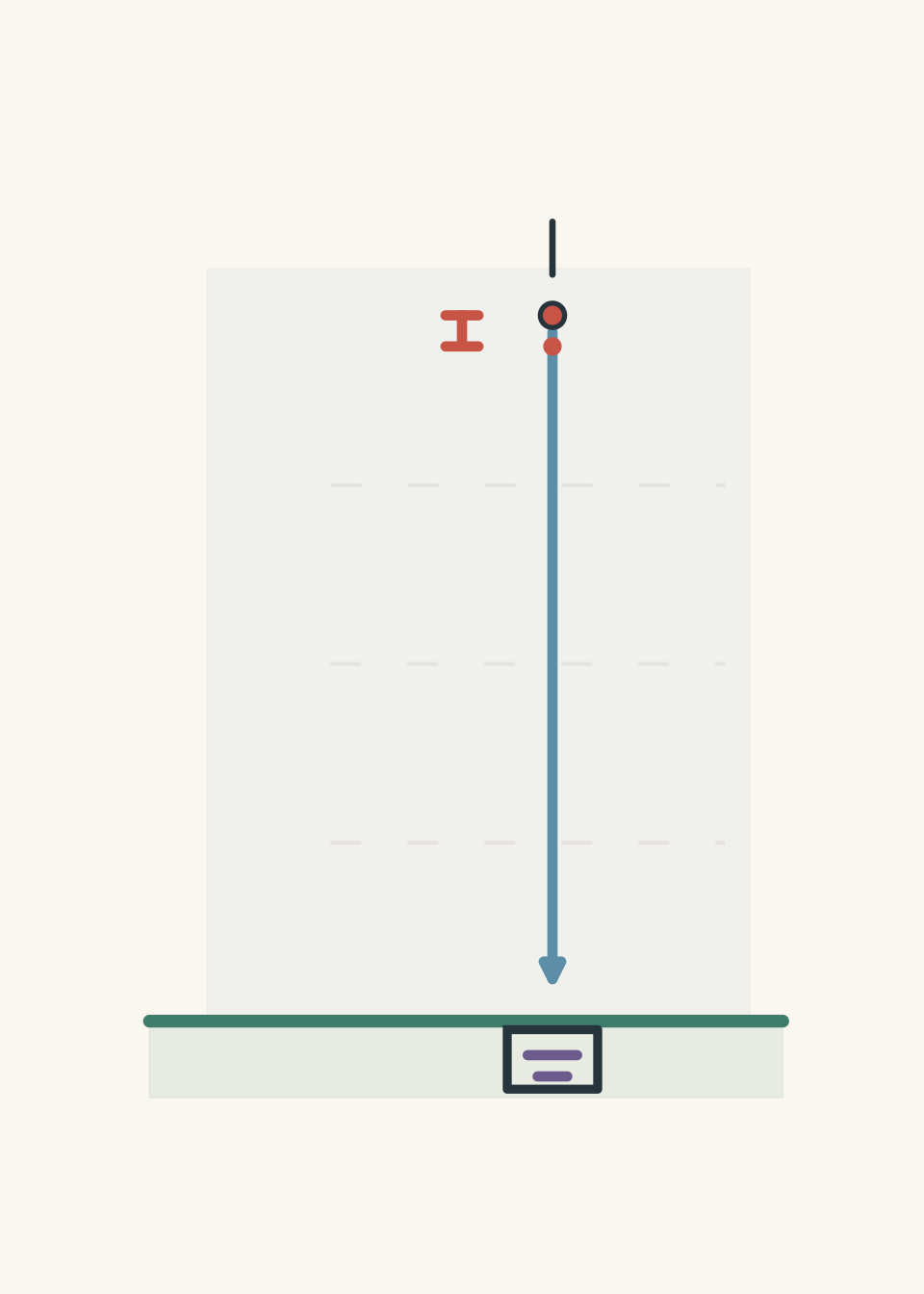
Imagine a muon is created 15 km above a detector and heads almost straight down at nearly the speed of light. Its mean lifetime at rest is only about \(2.20\ \mu\text{s}\). At the speed of light, \(2.20\ \mu\text{s}\) corresponds to only about 660 m of travel.
So predict what should happen. Should the muon decay thousands of metres before it reaches the detector?
Classically, yes. But muons produced after cosmic rays strike Earth’s atmosphere are detected at the surface. Charged pions created in atmospheric particle showers can decay into muons, and those muons can continue down to ground level.
The missing idea is time dilation.
01Why the classical prediction fails
Start by pretending relativity does not exist.
Take the muon’s mean lifetime as
\[ \tau_0 = 2.20\times10^{-6}\ \text{s} \]
and suppose it travels almost at the speed of light,
\[ c = 3.00\times10^8\ \text{m s}^{-1}. \]
The distance travelled in one mean lifetime would be approximately
\[ d=c\tau_0 =(3.00\times10^8)(2.20\times10^{-6}) =660\ \text{m}. \]
That is nowhere near 15 km.
A 15 km journey at almost \(c\) instead takes roughly
\[ t=\frac{15\,000}{3.00\times10^8} =5.00\times10^{-5}\ \text{s} =50.0\ \mu\text{s}. \]
That is more than twenty times the muon’s mean lifetime at rest.
There is one important precision here. A mean lifetime is not an expiry timer. A muon does not hit \(2.20\ \mu\text{s}\) and instantly disappear. Decay is random, so some muons decay earlier and some much later.
That means finding one unusually long-lived muon would not, by itself, demonstrate relativity. The important observation is that far more fast muons survive long journeys through the atmosphere than the classical model predicts.
02Give the muon a tiny wristwatch
Picture an absurdly small wristwatch travelling with the muon.
The watch starts when the muon is produced. If the muon later decays, the time measured by that travelling watch is the muon’s own elapsed time.
In the muon’s reference frame, nothing strange happens to this watch. Its mean lifetime is still about \(2.20\ \mu\text{s}\). The muon does not feel itself living in slow motion.
An observer on Earth, however, measures a longer time between the muon’s production and decay.
That is time dilation.
The wristwatch picture is useful because it keeps track of which clock measures the shortest time. It breaks down if you imagine that something physically jams or slows the moving watch. Relativistic time dilation is not caused by friction, forces, or a faulty clock.
03From the picture to the equation
The size of the relativistic effect is described by the Lorentz factor,
\[ \gamma=\frac{1}{\sqrt{1-\frac{v^2}{c^2}}}, \]
where:
- \(\gamma\) is the Lorentz factor and has no unit,
- \(v\) is the relative speed between the two reference frames, in metres per second,
- \(c\) is the speed of light, \(3.00\times10^8\ \text{m s}^{-1}\).
For time dilation,
\[ \Delta t=\gamma\Delta t_0, \]
where:
- \(\Delta t_0\) is the proper time, measured in the frame where the two events happen at the same position,
- \(\Delta t\) is the longer time measured in a frame in which those events occur at different positions.
For the muon’s production and decay, the muon is present at both events. Its own frame therefore measures the proper lifetime.
If its mean proper lifetime is \(\tau_0\), an Earth observer measures the mean lifetime
\[ \tau=\gamma\tau_0. \]
The key point is not simply that \(v\) is “close to \(c\)”. The Lorentz factor grows very rapidly when \(v\) becomes extremely close to \(c\).
| Speed | Approximate \(\gamma\) |
|---|---|
| \(0.80c\) | 1.67 |
| \(0.98c\) | 5.03 |
| \(0.995c\) | 10.0 |
| \(0.998c\) | 15.8 |
| \(0.9999c\) | 70.7 |
Going from \(0.98c\) to \(0.9999c\) looks like a small change in speed. It is not a small change in relativistic behaviour.
If the Lorentz factor still feels like the part most likely to go wrong in a calculation, the method is developed further in Time Dilation in HSC Physics: Using the Lorentz Factor.
Worked example: How far can a \(0.995c\) muon travel?
A muon has a mean proper lifetime of \(2.20\ \mu\text{s}\) and moves at \(0.995c\) relative to Earth. Calculate its Lorentz factor, its mean lifetime in Earth’s frame, and the mean distance it travels in that frame. Assume its speed remains constant.
Step 1
Here,
\[ \frac{v}{c}=0.995. \]
Therefore,
\[ \gamma =\frac{1}{\sqrt{1-(0.995)^2}} =10.0. \]
More precisely, \(\gamma=10.01\).
Step 2
The proper mean lifetime is
\[ \tau_0=2.20\ \mu\text{s}. \]
Earth therefore measures
\[ \tau=\gamma\tau_0 =(10.01)(2.20\ \mu\text{s}) =22.0\ \mu\text{s}. \]
Step 3
The speed is
\[ v=0.995(3.00\times10^8) =2.985\times10^8\ \text{m s}^{-1}. \]
So
\[ d=v\tau =(2.985\times10^8)(22.0\times10^{-6}) =6.58\times10^3\ \text{m}. \]
Thus,
\[ d=6.58\ \text{km}. \]
The result means that the same muon whose classical mean travel distance would be only about \(657\ \text{m}\) has a relativistic mean travel distance of about \(6.58\ \text{km}\) in Earth’s frame.
The muon has not changed its own \(2.20\ \mu\text{s}\) mean lifetime. Earth measures a longer lifetime because the muon is moving relative to Earth.
04But what does the muon say happened?
Now there seems to be a problem.
From Earth, the explanation is:
The atmosphere has its ordinary height, but the moving muon’s lifetime is dilated.
From the muon, its own lifetime is not dilated. So why can it still reach the ground?
The distance through the atmosphere is shorter.
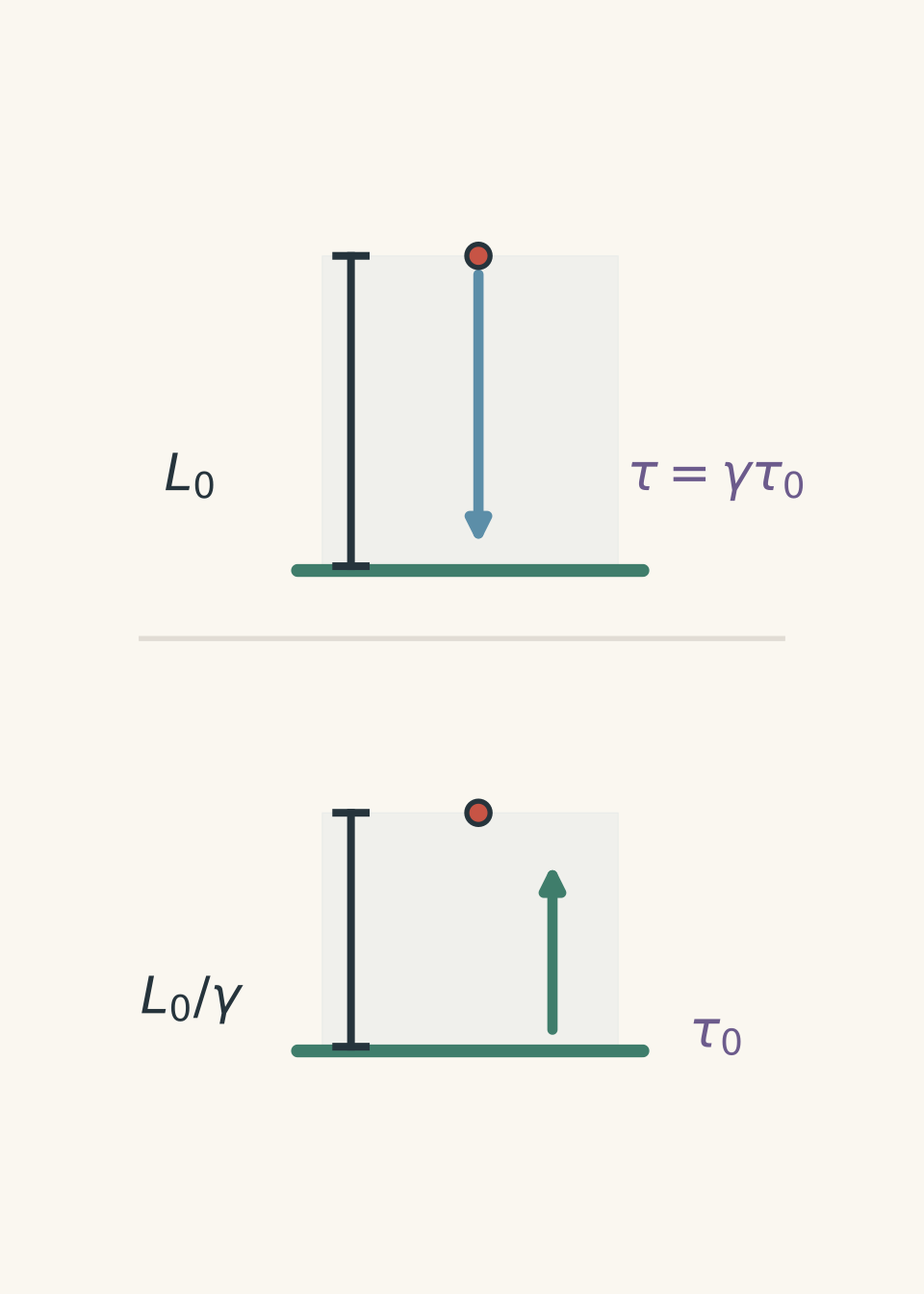
In Earth’s reference frame, the production altitude and the ground are stationary relative to each other. Earth therefore measures their proper separation, \(L_0\).
In the muon’s frame, Earth and its atmosphere rush upwards at nearly \(c\). Their separation is length-contracted:
\[ L=\frac{L_0}{\gamma}, \]
where \(L_0\) is the proper length and \(L\) is the contracted length.
This is not a second bonus that you multiply by the time-dilation bonus. It is the same relativistic journey described from a different reference frame.
Worked example: A 10 km journey seen from both frames
A muon is produced 10.0 km above a detector and travels directly towards it at \(0.998c\). Assume constant speed and suppose the muon survives to reach the detector. Compare the journey in Earth’s frame and the muon’s frame.
Step 1
\[ \gamma =\frac{1}{\sqrt{1-(0.998)^2}} =15.8. \]
Step 2
Earth measures the full distance
\[ L_0=10.0\ \text{km}=1.00\times10^4\ \text{m}. \]
The travel time is
\[ t =\frac{L_0}{v} =\frac{1.00\times10^4} {0.998(3.00\times10^8)} =3.34\times10^{-5}\ \text{s}. \]
So,
\[ t=33.4\ \mu\text{s}. \]
That looks much longer than \(2.20\ \mu\text{s}\), but Earth also measures a dilated mean lifetime:
\[ \tau =\gamma\tau_0 =(15.8)(2.20) =34.8\ \mu\text{s}. \]
The journey therefore takes
\[ \frac{33.4}{34.8}=0.960 \]
of one Earth-frame mean lifetime.
Step 3
The muon measures the atmosphere’s 10.0 km separation as contracted:
\[ L=\frac{L_0}{\gamma} =\frac{10.0\ \text{km}}{15.8} =0.632\ \text{km}. \]
So the moving detector only has to travel about
\[ 632\ \text{m} \]
towards the muon.
The time for that journey in the muon’s frame is
\[ t_0 =\frac{632} {0.998(3.00\times10^8)} =2.11\times10^{-6}\ \text{s} =2.11\ \mu\text{s}. \]
The muon’s own mean lifetime remains \(2.20\ \mu\text{s}\), so the trip takes
\[ \frac{2.11}{2.20}=0.960 \]
of one mean lifetime.
Step 4
Both observers agree on the physically important result: the journey represents about \(0.960\) of a mean proper lifetime.
They disagree about the distance and elapsed coordinate time because those quantities depend on the reference frame.
If you want to develop this second description further, see Length Contraction in HSC Physics: Proper Length and Calculations.
05Keep the reference frames separate
This is where otherwise good relativity answers often fall apart.
| Quantity | Earth’s frame | Muon’s frame |
|---|---|---|
| Muon | Moving | At rest |
| Atmosphere and detector | At rest | Moving |
| Muon mean lifetime | \(\gamma\tau_0\) | \(\tau_0\) |
| Atmospheric distance | Proper length \(L_0\) | Contracted length \(L_0/\gamma\) |
| Explanation for reaching ground | Time dilation | Length contraction |
Do not take the shortened distance from the muon’s frame and compare it with the dilated lifetime from Earth’s frame. That mixes two different coordinate systems.
A useful HSC decision rule is:
- Decide whose reference frame you are using.
- Identify the proper quantity.
- Calculate \(\gamma\) using the relative speed.
- Transform only the quantities that need transforming.
- Keep every distance and time in a calculation in the same reference frame.
06Three tempting misconceptions
“The muon experiences time slowing down”
No.
The muon’s own clock always behaves normally. In its own frame, its mean lifetime is \(2.20\ \mu\text{s}\).
An Earth observer measures the moving muon’s lifetime to be longer.
“Time dilation and length contraction both help the same muon reach Earth”
Not in a single calculation.
Earth explains the result using a dilated muon lifetime. The muon explains the same result using a contracted atmospheric distance.
Using both effects together while keeping the same frame double-counts the transformation.
“A \(2.20\ \mu\text{s}\) lifetime means no muon can survive longer than \(2.20\ \mu\text{s}\)”
Also no.
The lifetime is a statistical mean. Individual muons have different decay times.
This matters when describing the evidence. The existence of one long-lived muon is weak evidence. The measured survival rate of a large population is much more useful because the classical and relativistic models predict very different numbers.
07Why cosmic muons are evidence for time dilation
A useful scientific test needs competing predictions.
The non-relativistic model predicts that fast muons should experience the same short lifetime of about \(2.20\ \mu\text{s}\) in Earth’s frame. Most should therefore decay after travelling distances of order hundreds of metres.
Special relativity predicts something different. As \(v\) approaches \(c\), \(\gamma\) becomes large, so the Earth-frame lifetime becomes
\[ \tau=\gamma\tau_0. \]
The predicted survival rate through kilometres of atmosphere rises dramatically.
Muon-counting experiments can therefore place detectors at different altitudes and compare how many muons survive between them. There is a complication: faster muons have larger \(\gamma\), so simply counting every muon at two locations would mix together populations with different speeds.
One experiment described by CERN Courier handled that problem by using steel and scintillation detectors to select comparable muons at a mountain site and a much lower site. Without time dilation, the predicted decrease in the chosen muon population was about a factor of four. Including time dilation predicted a much smaller factor of about 1.3, and the observed rate matched the relativistic prediction.
That is much stronger than saying, “We found a muon at the bottom.”
The argument is:
- measure a population,
- make a classical prediction,
- make a relativistic prediction,
- control important variables such as speed,
- compare the predictions with observation.
The relativistic model gets the survival behaviour right.
08Questions and solutions
Question 1
A muon travels at \(0.980c\) relative to Earth. Its mean proper lifetime is \(2.20\ \mu\text{s}\).
Calculate:
(a) its Lorentz factor,
(b) its mean lifetime measured from Earth, and
(c) its mean distance travelled in Earth’s frame, assuming constant speed.
Solution 1
The muon’s Lorentz factor is \(5.03\), its Earth-frame mean lifetime is \(11.1\ \mu\text{s}\), and its mean travel distance is \(3.25\ \text{km}\).
For part (a),
\[ \gamma =\frac{1}{\sqrt{1-(0.980)^2}} =5.03. \]
For part (b), the proper mean lifetime is
\[ \tau_0=2.20\ \mu\text{s}. \]
Therefore,
\[ \tau =\gamma\tau_0 =(5.03)(2.20\ \mu\text{s}) =11.1\ \mu\text{s}. \]
For part (c),
\[ v=0.980(3.00\times10^8) =2.94\times10^8\ \text{m s}^{-1}. \]
Hence,
\[ d=v\tau =(2.94\times10^8)(11.1\times10^{-6}) =3.25\times10^3\ \text{m} =3.25\ \text{km}. \]
A tempting mistake is to use the \(2.20\ \mu\text{s}\) proper lifetime directly with an Earth-frame distance. The muon is moving in Earth’s frame, so its Earth-frame lifetime must first be dilated.
Question 2
A muon is created 6.00 km above a detector and travels vertically downwards at \(0.995c\). Its mean proper lifetime is \(2.20\ \mu\text{s}\).
(a) Calculate the mean distance predicted if time dilation is ignored.
(b) Calculate its relativistic mean travel distance in Earth’s frame.
(c) The relativistic mean distance is greater than the 6.00 km journey. Does this mean every such muon reaches the detector? Explain.
Assume the speed remains constant.
Solution 2
Ignoring relativity gives a mean distance of \(657\ \text{m}\), special relativity gives \(6.58\ \text{km}\), and neither value guarantees that an individual muon will travel that distance.
For part (a),
\[ d_{\text{classical}} =v\tau_0. \]
The speed is
\[ v=0.995(3.00\times10^8) =2.985\times10^8\ \text{m s}^{-1}. \]
Therefore,
\[ d_{\text{classical}} =(2.985\times10^8)(2.20\times10^{-6}) =656.7\ \text{m}. \]
So,
\[ d_{\text{classical}}=657\ \text{m}. \]
For part (b),
\[ \gamma =\frac{1}{\sqrt{1-(0.995)^2}} =10.01. \]
The Earth-frame mean lifetime is
\[ \tau =(10.01)(2.20\ \mu\text{s}) =22.0\ \mu\text{s}. \]
Thus,
\[ d_{\text{relativistic}} =(2.985\times10^8)(22.0\times10^{-6}) =6.58\times10^3\ \text{m}. \]
Therefore,
\[ d_{\text{relativistic}}=6.58\ \text{km}. \]
For part (c), no. The \(6.58\ \text{km}\) value is a mean decay distance under the constant-speed model, not a fixed range.
Some muons decay before reaching 6.00 km, while others survive beyond 6.58 km.
The tempting interpretation is to treat a mean lifetime like a battery that goes flat at one exact instant. Particle decay is probabilistic, so the prediction concerns a population rather than an exact death point for each muon.
Question 3
A muon is produced 10.0 km above Earth’s surface and travels downwards at \(0.998c\). Assume it survives until reaching the ground.
(a) Calculate the travel time measured in Earth’s frame.
(b) Calculate the mean muon lifetime measured in Earth’s frame.
(c) Calculate the atmospheric distance measured in the muon’s frame.
(d) Show that the journey uses the same fraction of one mean lifetime in both reference frames.
Solution 3
The journey takes \(33.4\ \mu\text{s}\) in Earth’s frame but only \(2.11\ \mu\text{s}\) of the muon’s proper time, and both descriptions give the same fraction, approximately \(0.960\), of one mean lifetime.
First calculate
\[ \gamma =\frac{1}{\sqrt{1-(0.998)^2}} =15.82. \]
For part (a),
\[ t_{\text{Earth}} =\frac{10.0\times10^3} {0.998(3.00\times10^8)} =3.34\times10^{-5}\ \text{s}. \]
Therefore,
\[ t_{\text{Earth}}=33.4\ \mu\text{s}. \]
For part (b),
\[ \tau_{\text{Earth}} =\gamma\tau_0 =(15.82)(2.20\ \mu\text{s}) =34.8\ \mu\text{s}. \]
The Earth-frame journey therefore occupies
\[ \frac{t_{\text{Earth}}}{\tau_{\text{Earth}}} =\frac{33.4}{34.8} =0.960 \]
of one mean lifetime.
For part (c), Earth measures the proper atmospheric distance
\[ L_0=10.0\ \text{km}. \]
The muon measures
\[ L=\frac{L_0}{\gamma} =\frac{10.0}{15.82} =0.632\ \text{km}. \]
So,
\[ L=632\ \text{m}. \]
The travel time in the muon’s frame is consequently
\[ t_0 =\frac{632} {0.998(3.00\times10^8)} =2.11\ \mu\text{s}. \]
For part (d), the muon’s own mean lifetime is still \(2.20\ \mu\text{s}\), giving
\[ \frac{t_0}{\tau_0} =\frac{2.11}{2.20} =0.960. \]
The two ratios agree.
The tempting route is to ask which observer has the “real” time. Neither frame is privileged. Earth uses a longer journey time and a longer muon lifetime. The muon uses a shorter atmospheric distance and its ordinary proper lifetime. The complete predictions remain consistent.
Question 4
An idealised experiment produces \(1.00\times10^8\) identical muons 10.0 km above a detector. Every muon travels directly towards the detector at \(0.9999c\), and energy loss is ignored.
For this question, use
\[ N=N_0e^{-t/\tau}, \]
where \(N_0\) is the initial number of muons, \(N\) is the expected number remaining after elapsed time \(t\), \(\tau\) is the appropriate mean lifetime in the chosen reference frame, and \(e\) is the base of the natural exponential.
(a) Predict the number reaching the detector if relativity is ignored.
(b) Predict the number using special relativity.
(c) A student says, “Some particles can survive for many mean lifetimes anyway, so detecting cosmic muons at ground level tells us nothing about relativity.” Evaluate the claim using your calculations.
Solution 4
The classical model predicts only about \(26\) survivors from \(1.00\times10^8\) muons, while the relativistic model predicts about \(8.07\times10^7\). The student’s argument fails because the evidence comes from the survival rate of the population, not merely from the existence of an occasional long-lived muon.
The Earth-frame travel time is
\[ t =\frac{10.0\times10^3} {0.9999(3.00\times10^8)} =3.334\times10^{-5}\ \text{s}. \]
Thus,
\[ t=33.34\ \mu\text{s}. \]
For part (a), ignoring relativity means using
\[ \tau=2.20\ \mu\text{s}. \]
Therefore,
\[ N =(1.00\times10^8) e^{-33.34/2.20}. \]
The exponent is
\[ -\frac{33.34}{2.20}=-15.15. \]
Hence,
\[ N =(1.00\times10^8)e^{-15.15} \approx26. \]
The classical model does not predict literally zero survivors, which is exactly why “but one muon could get lucky” is not enough to settle the question.
For part (b),
\[ \gamma =\frac{1}{\sqrt{1-(0.9999)^2}} =70.71. \]
The Earth-frame mean lifetime is
\[ \tau =\gamma\tau_0 =(70.71)(2.20\ \mu\text{s}) =155.6\ \mu\text{s}. \]
Now
\[ N =(1.00\times10^8) e^{-33.34/155.6}. \]
Therefore,
\[ N =(1.00\times10^8)e^{-0.2143} \approx8.07\times10^7. \]
So about \(80.7\%\) survive this idealised journey.
For part (c), the decisive comparison is therefore approximately
\[ 26 \quad\text{versus}\quad 80\,700\,000. \]
Both models allow some survival. They predict radically different amounts of survival.
That is the constraint the student’s argument misses. A rare classical survivor cannot explain a population whose measured survival rate is close to a relativistic prediction.
Real atmospheric muons have a distribution of speeds, production heights, directions, and energy losses, so an actual experiment requires a more detailed model. Those complications do not rescue the classical prediction; they simply mean the experimental comparison must control or model those variables properly.
Question 5
A muon travels towards Earth at \(0.9999c\). In Earth’s frame, its production point is 12.0 km above a detector. Its mean proper lifetime is \(2.20\ \mu\text{s}\).
A student makes the following argument:
The atmosphere is length-contracted by \(\gamma\), and the muon’s lifetime is increased by \(\gamma\). I can therefore use the contracted distance \(L_0/\gamma\) and the dilated lifetime \(\gamma\tau_0\) together. Relativity helps twice.
(a) Explain precisely why this argument is invalid.
(b) Calculate the fraction of one mean lifetime used by the journey in Earth’s frame.
(c) Calculate the same fraction in the muon’s frame.
(d) Show what the student’s mixed-frame method would predict, and explain why the disagreement exposes the error.
Solution 5
The student’s method is invalid because it combines a distance measured in the muon’s frame with a lifetime measured in Earth’s frame. The correct journey occupies about \(25.7\%\) of one mean lifetime in either frame; the mixed-frame method incorrectly gives only about \(0.364\%\).
First,
\[ \gamma =\frac{1}{\sqrt{1-(0.9999)^2}} =70.71. \]
For part (a), the two valid descriptions are:
- Earth frame: use the full 12.0 km distance and the dilated lifetime \(\gamma\tau_0\).
- Muon frame: use the contracted distance \(L_0/\gamma\) and the proper lifetime \(\tau_0\).
There is no valid frame in which the atmospheric distance is \(L_0/\gamma\) while the muon’s lifetime is simultaneously \(\gamma\tau_0\).
For part (b), Earth’s travel time is
\[ t_{\text{Earth}} =\frac{12.0\times10^3} {0.9999(3.00\times10^8)} =4.0004\times10^{-5}\ \text{s}. \]
So,
\[ t_{\text{Earth}}=40.0\ \mu\text{s}. \]
Earth measures the mean lifetime
\[ \tau_{\text{Earth}} =(70.71)(2.20\ \mu\text{s}) =155.6\ \mu\text{s}. \]
The journey therefore occupies
\[ \frac{t_{\text{Earth}}}{\tau_{\text{Earth}}} =\frac{40.0}{155.6} =0.257. \]
So about \(25.7\%\) of one mean lifetime passes.
For part (c), the muon measures a contracted distance
\[ L =\frac{12.0\ \text{km}}{70.71} =0.1697\ \text{km} =169.7\ \text{m}. \]
The ground therefore takes
\[ t_0 =\frac{169.7} {0.9999(3.00\times10^8)} =5.657\times10^{-7}\ \text{s} \]
to reach the stationary muon.
Thus,
\[ t_0=0.5657\ \mu\text{s}. \]
The muon’s mean lifetime in its own frame is \(2.20\ \mu\text{s}\), so
\[ \frac{t_0}{\tau_0} =\frac{0.5657}{2.20} =0.257. \]
Again, about \(25.7\%\) of one mean lifetime passes.
For part (d), the student’s mixed calculation compares
\[ t_{\text{contracted}} =0.5657\ \mu\text{s} \]
with
\[ \tau_{\text{dilated}} =155.6\ \mu\text{s}. \]
That gives
\[ \frac{0.5657}{155.6} =0.00364, \]
or only \(0.364\%\) of one mean lifetime.
The strange result is the warning sign. The same physical journey cannot represent \(25.7\%\) of a mean lifetime when calculated consistently, but \(0.364\%\) simply because two relativistic equations were multiplied together.
The fair-looking but wrong move was treating time dilation and length contraction as two independent mechanisms helping the muon. They are frame-dependent descriptions of the same spacetime relationship. Once a reference frame has been chosen, its distances and times must stay together.
09What this idea unlocks next
Muon survival is useful because it forces you to stop thinking of time dilation as “a moving clock equation” and start thinking in reference frames.
From Earth, the moving muon’s lifetime is dilated. From the muon, its lifetime is ordinary and the atmosphere is length-contracted. Both descriptions predict the same arrival and decay behaviour.
That frame bookkeeping is the next useful skill: identify proper time and proper length first, then decide whether the problem needs time dilation, length contraction, or both descriptions kept carefully separate.