
How to Construct Organic Synthesis Pathways for HSC Chemistry
Learn how to build single-step and multi-step organic synthesis flow charts by working backwards from the target compound and checking each reaction.
You are given but-2-ene and asked to make butan-2-one. You know both compounds have four carbons, but there is no sensible HSC reaction that turns a carbon-carbon double bond directly into a ketone in one jump. Something has to sit between them.
Before reading on, predict the missing compound. What functional group can be made from an alkene and then oxidised to a ketone?
It is a secondary alcohol: butan-2-ol. That small piece of thinking is the whole point of an organic synthesis pathway. You are not memorising a giant chain of names. You are finding a sequence of chemically possible changes, one arrow at a time.
01A reaction pathway is a map of legal chemical changes
Picture each functional group as a station on a train map. An alkene is one station, an alcohol is another, and a carboxylic acid is another. A reaction is the track connecting two stations.
You cannot simply draw an arrow between any two compounds because you want to get there. Each arrow needs a real reaction, with appropriate reagents and conditions.
The analogy is useful, but not exact. Real organic reactions can make mixtures, have incomplete yields, and depend on more detail than a simple flow chart shows. For HSC pathway questions, though, the map gives you a powerful first model.
There are three things to read from every arrow:
- what functional group changes,
- what reagent and conditions cause that change, and
- whether the carbon skeleton stays the same or two organic fragments are joined.
That last point becomes important once esters and amides enter the map.
02The reaction toolbox behind the flow chart
You do not need to memorise every possible organic reaction ever discovered. You need to recognise the reaction families that connect the compounds in your course.
| Starting compound | Product | Reaction type | Typical reagent and conditions | Main thing to notice |
|---|---|---|---|---|
| Alkane | Haloalkane | Substitution | \(\ce{Cl2}\) or \(\ce{Br2}\), UV light | A H atom is replaced by a halogen |
| Alkene | Alkane | Addition / hydrogenation | \(\ce{H2}\), Ni or Pt catalyst | The \(\ce{C=C}\) becomes \(\ce{C-C}\) |
| Alkene | Haloalkane | Addition | Hydrogen halide, \(\ce{HX}\) | H and X add across \(\ce{C=C}\) |
| Alkene | Dihaloalkane | Addition | \(\ce{X2}\) | One halogen adds to each carbon of the double bond |
| Alkene | Alcohol | Addition / hydration | Water with dilute acid catalyst, heat | H and OH add across \(\ce{C=C}\) |
| Alcohol | Alkene | Elimination / dehydration | Concentrated \(\ce{H2SO4}\), heat | \(\ce{H2O}\) is removed |
| Haloalkane | Alcohol | Substitution | Aqueous \(\ce{NaOH}\) or \(\ce{KOH}\), heat | Halogen is replaced by OH |
| Alcohol | Haloalkane | Substitution | Hydrogen halide, \(\ce{HX}\), suitable heating | OH is replaced by halogen |
| Primary alcohol | Aldehyde | Oxidation | Acidified oxidant, controlled heating, distil aldehyde as it forms | Oxidation must be stopped before the acid |
| Primary alcohol | Carboxylic acid | Oxidation | Excess acidified oxidant, reflux | Continued oxidation passes through the aldehyde stage |
| Secondary alcohol | Ketone | Oxidation | Acidified oxidant, heat | It does not continue to the corresponding carboxylic acid in the standard pathway |
| Carboxylic acid + alcohol | Ester + water | Condensation / esterification | Concentrated \(\ce{H2SO4}\) catalyst, heat under reflux | Two organic molecules join |
| Carboxylic acid + amine | Amide + water | Condensation | Heat | Two organic fragments join through an amide linkage |
A common oxidising agent for HSC equations is acidified potassium dichromate, \(\ce{K2Cr2O7/H+}\). Acidified permanganate can also act as an oxidant, but use the reagent and conditions appropriate to the reaction you are describing.
The table is not a licence to ignore structure. Saying “alcohol → oxidation product” is not enough. You must first decide whether the alcohol is primary, secondary, or tertiary.
03Primary, secondary, or tertiary changes the route
Consider these three alcohols:
- propan-1-ol is primary,
- propan-2-ol is secondary,
- 2-methylpropan-2-ol is tertiary.
A student might think, “They all contain \(\ce{-OH}\), so oxidising them should eventually give a carboxylic acid.”
That feels reasonable because the functional group looks similar. The carbon carrying the OH group, however, has a different number of carbon neighbours in each molecule.
For a primary alcohol:
\[ \ce{primary alcohol ->[oxidation] aldehyde ->[oxidation] carboxylic acid} \]
For a secondary alcohol:
\[ \ce{secondary alcohol ->[oxidation] ketone} \]
Under the standard HSC treatment, that ketone is the end of this simple oxidation branch.
A tertiary alcohol does not undergo the same straightforward oxidation because the carbon bearing the OH group has no hydrogen attached to it. Oxidising it further would require breaking carbon-carbon bonds, so you should not casually draw a normal “alcohol → carbonyl” arrow.
This distinction is one of the quickest ways to catch a bad reaction pathway.
04Build the pathway backwards before writing it forwards
Suppose the target is a carboxylic acid.
Instead of staring at the starting compound and asking, “What can I do to this?”, ask a more useful question:
What compound could produce a carboxylic acid in one familiar HSC reaction?
A primary alcohol can.
Then ask:
What could produce that primary alcohol?
Possibilities include a suitable haloalkane through substitution.
You have now worked backwards:
\[ \ce{carboxylic\ acid <- primary\ alcohol <- haloalkane} \]
This backwards planning is often called retrosynthetic thinking. The name sounds fancy; the method is not. Start at the destination and repeatedly ask what could have been there one reaction earlier.
Once you have a valid route, turn it around and present the final synthesis forwards.
A reliable five-step method
When you see a pathway question, use this order.
- Identify the functional group in the starting material.
- Identify the functional group in the target.
- Work backwards from the target to a plausible immediate precursor.
- Continue until you reach the given starting material.
- Write the final pathway forwards, adding the reagent and conditions to every arrow.
Then do two checks.
First, check the carbon skeleton. Addition, substitution, oxidation, hydration, and dehydration normally change bonds or functional groups without magically deleting a carbon atom.
Second, check the oxidation class. A secondary alcohol does not become an aldehyde just because an aldehyde would be convenient.
05Worked example: Make butan-2-one from but-2-ene
Construct a reaction pathway to synthesise butan-2-one, \(\ce{CH3COCH2CH3}\), from but-2-ene, \(\ce{CH3CH=CHCH3}\). State the intermediate, reaction types, reagents, and conditions.
Step 1
A ketone can be made by oxidising a secondary alcohol. The required alcohol is butan-2-ol.
So the last step must be:
\[ \ce{CH3CH(OH)CH2CH3 + [O] -> CH3COCH2CH3 + H2O} \]
Use an acidified oxidising agent such as \(\ce{K2Cr2O7/H+}\) and heat.
Step 2
But-2-ene can undergo hydration. Water adds across the carbon-carbon double bond to form butan-2-ol.
\[ \ce{CH3CH=CHCH3 + H2O -> CH3CH(OH)CH2CH3} \]
Use water with a dilute acid catalyst and heat.
Step 3
But-2-ene → butan-2-ol → butan-2-one
- first arrow: hydration, water with dilute acid catalyst and heat
- second arrow: oxidation, acidified \(\ce{K2Cr2O7}\) and heat
The important result is not just the name “butan-2-one”. The pathway works because hydration creates a secondary alcohol, and oxidation of a secondary alcohol creates a ketone.
A tempting wrong route would be but-2-ene → butanoic acid → butan-2-one. The problem is not that the arrow looks unusual. There is no standard reaction in this map that converts the alkene into that carboxylic acid while keeping the required structure.
06Branching pathways: sometimes one straight line cannot work
Now consider a stranger problem.
You have ethanol as your only organic starting material and want to make ethyl ethanoate.
Ethyl ethanoate is an ester. An ester needs two reactants:
- an alcohol, and
- a carboxylic acid.
For ethyl ethanoate, those reactants are ethanol and ethanoic acid.
So where does the ethanoic acid come from if ethanol is your only organic starting material?
From another portion of the ethanol.
This means the correct flow chart must branch. Some ethanol is retained as ethanol, while another portion is oxidised.
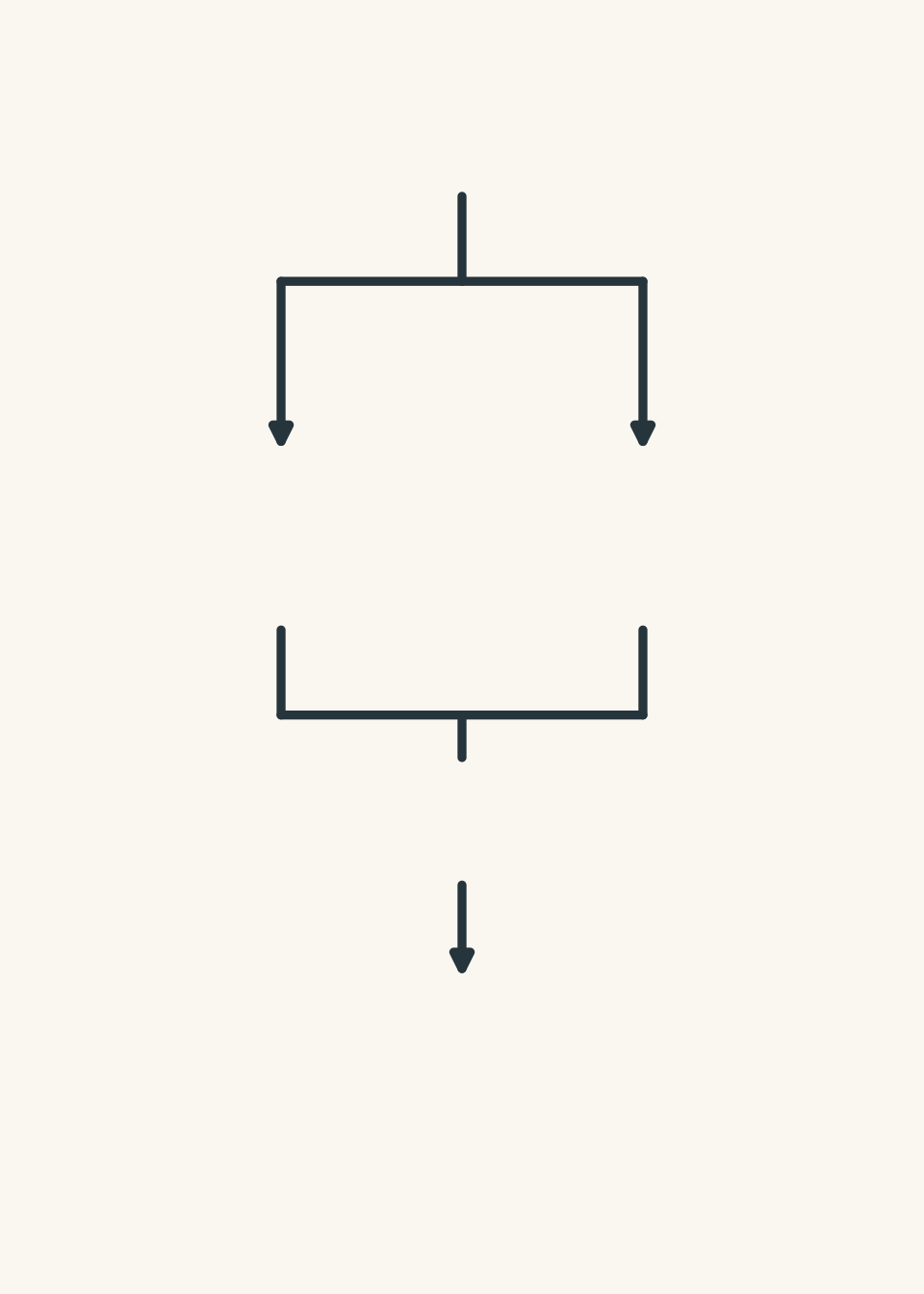
Worked example: Make ethyl ethanoate from ethanol only
Ethanol is the only organic starting material available. Construct a pathway for the synthesis of ethyl ethanoate.
Step 1
Ethyl ethanoate is formed from ethanol and ethanoic acid:
\[ \ce{CH3COOH + CH3CH2OH <=> CH3COOCH2CH3 + H2O} \]
The reaction is esterification. Use concentrated \(\ce{H2SO4}\) as an acid catalyst and heat under reflux.
Step 2
A primary alcohol can be oxidised to a carboxylic acid. Ethanol is a primary alcohol, so some of the ethanol can be oxidised:
\[ \ce{CH3CH2OH + 2[O] -> CH3COOH + H2O} \]
Use excess acidified oxidising agent and reflux so oxidation proceeds to ethanoic acid rather than stopping at ethanal.
Step 3
Keep another portion unchanged. You need it for the alcohol side of the esterification reaction.
Step 4
The pathway is:
- ethanol → ethanoic acid by oxidation,
- ethanol → retained as ethanol,
- ethanoic acid + ethanol → ethyl ethanoate by esterification.
The tempting mistake is to write ethanol → ethanoic acid → ethyl ethanoate as one straight chain. Ethanoic acid cannot become ethyl ethanoate by itself. The ester needs an alcohol as a second organic reactant.
That is why a pathway is not always a line.
07Conditions can decide which product you obtain
Knowing the reagent is sometimes only half the answer.
Take the oxidation of a primary alcohol. If you want an aldehyde, you need to stop the reaction before further oxidation occurs. The aldehyde is removed as it forms, commonly by distillation.
If instead you heat the mixture under reflux with excess oxidant, the aldehyde remains in contact with the oxidising agent and is oxidised further to the carboxylic acid.
So these are not equivalent arrows:
\[ \ce{primary\ alcohol -> aldehyde} \]
and
\[ \ce{primary\ alcohol -> carboxylic\ acid} \]
The starting functional group may be identical. The reaction conditions determine where you stop.
Reflux itself does not somehow “cause carboxylic acid”. Reflux allows prolonged heating without losing volatile material from the reaction mixture. Combined with sufficient oxidant, that allows continued oxidation.
08Three misconceptions that wreck otherwise good flow charts
“Every alcohol eventually oxidises to a carboxylic acid”
No. Primary alcohols can reach carboxylic acids. Secondary alcohols oxidise to ketones under the standard conditions you use in HSC pathways.
If you forget the primary/secondary distinction, an entire multi-step pathway can look neat while being chemically impossible.
“The number of carbons can never change”
That rule is useful, but too crude.
During reactions such as substitution, oxidation, hydration, and dehydration, the carbon skeleton normally stays intact.
But esterification joins two organic molecules. Ethanoic acid contains two carbon atoms and ethanol contains two, while ethyl ethanoate contains four.
Nothing mysterious happened. No individual carbon skeleton grew during oxidation. Two existing organic fragments were joined in the condensation reaction.
The same idea applies when an amide forms from a carboxylic acid and an amine.
“If I know the product, I can skip the intermediate”
Only if there is actually a one-step reaction connecting them.
A flow chart is not a summary of where you started and finished. The intermediates are the chemistry.
If alkene → alcohol → ketone is required, writing alkene → ketone hides the important reasoning and invents an unsupported reaction.
09Read ester names backwards when planning their synthesis
Ester names quietly tell you their two starting molecules.
Take propyl ethanoate.
- “propyl” comes from propan-1-ol,
- “ethanoate” comes from ethanoic acid.
So before drawing anything, disconnect the ester mentally:
\[ \ce{propyl\ ethanoate -> propan-1-ol + ethanoic\ acid} \]
Now ask where each reactant can come from.
This becomes especially useful when one of them must first be synthesised from a haloalkane, alkene, or another alcohol.
The trick is not really a trick. Ester nomenclature is telling you the retrosynthesis.
10What a strong flow chart should show
A good organic synthesis flow chart normally gives the examiner enough information to reconstruct your chemical reasoning.
For every step, include:
- the organic reactant,
- the organic product,
- the reagent,
- an important condition such as UV light, heat, distillation, or reflux where relevant, and
- the intermediate compound if the synthesis has more than one step.
You can also label the reaction type – oxidation, substitution, addition, elimination, or condensation – when the question asks for it or when doing so makes your reasoning clearer.
Do not cram balanced equations into every arrow unless the question asks for equations. A flow chart and a balanced equation do different jobs.
The flow chart shows the route. The equation shows the stoichiometry of an individual reaction.
11Questions and solutions
Question 1
Construct a reaction pathway to synthesise butanoic acid from 1-chlorobutane. Name the intermediate and state the reagent, conditions, and reaction type for each step.
Solution 1
The pathway is 1-chlorobutane → butan-1-ol → butanoic acid.
First, replace the chlorine atom with an OH group using aqueous \(\ce{NaOH}\) or \(\ce{KOH}\) and heat. This is a substitution reaction:
\[ \ce{CH3CH2CH2CH2Cl + OH^- -> CH3CH2CH2CH2OH + Cl^-} \]
The intermediate is butan-1-ol.
Butan-1-ol is a primary alcohol, so it can be oxidised to butanoic acid. Use excess acidified oxidising agent, such as acidified \(\ce{K2Cr2O7}\), and reflux:
\[ \ce{CH3CH2CH2CH2OH + 2[O] -> CH3CH2CH2COOH + H2O} \]
The complete flow chart is therefore:
1-chlorobutane → butan-1-ol → butanoic acid
- Step 1: aqueous \(\ce{NaOH}\), heat; substitution
- Step 2: excess acidified \(\ce{K2Cr2O7}\), reflux; oxidation
The tempting shortcut is to try to “oxidise” 1-chlorobutane directly to the acid. The oxidation rule you know applies to the alcohol functional group, so the haloalkane must first be converted into butan-1-ol.
Question 2
A student proposes the following synthesis:
butan-2-ol → butanal → butanoic acid
They intend to use an acidified oxidising agent for both steps.
Assess the proposed pathway. Give the actual oxidation product of butan-2-ol, and identify the alcohol isomer that could be used instead to produce butanoic acid.
Solution 2
The proposed pathway is incorrect: butan-2-ol oxidises to butan-2-one, not butanal.
Butan-2-ol is a secondary alcohol because the carbon carrying the OH group is bonded to two other carbon atoms.
Its oxidation is:
\[ \ce{CH3CH(OH)CH2CH3 + [O] -> CH3COCH2CH3 + H2O} \]
The product is butan-2-one, a ketone.
Under the standard HSC oxidation pathway, that ketone does not continue to butanoic acid without breaking and rearranging the carbon framework.
To produce butanoic acid, use the primary alcohol isomer butan-1-ol:
\[ \ce{CH3CH2CH2CH2OH + 2[O] -> CH3CH2CH2COOH + H2O} \]
Use excess acidified oxidant and reflux.
The tempting reasoning is that both starting compounds are “butanols”, so oxidation should produce the same acid. The exact constraint is the position of the OH group. Moving it from carbon 1 to carbon 2 changes the alcohol from primary to secondary, which changes the oxidation product from an aldehyde/carboxylic-acid pathway to a ketone.
Question 3
Propyl ethanoate is to be synthesised from 1-bromopropane and ethanoic acid.
Construct the complete pathway, including the intermediate, reagents, conditions, reaction types, and equations. A student suggests that the 1-bromopropane could simply be reacted directly with ethanoic acid instead. Explain why that is not the appropriate pathway using the reactions in this guide.
Solution 3
First convert 1-bromopropane into propan-1-ol, then esterify that alcohol with ethanoic acid.
The first step is substitution. Heat 1-bromopropane with aqueous \(\ce{NaOH}\) or \(\ce{KOH}\):
\[ \ce{CH3CH2CH2Br + OH^- -> CH3CH2CH2OH + Br^-} \]
The intermediate is propan-1-ol.
The esterification step is:
\[ \ce{CH3COOH + CH3CH2CH2OH <=> CH3COOCH2CH2CH3 + H2O} \]
Heat the alcohol and ethanoic acid under reflux with concentrated \(\ce{H2SO4}\) as the acid catalyst.
The flow chart is:
1-bromopropane → propan-1-ol → propyl ethanoate
with ethanoic acid entering at the second step.
The student’s direct route is tempting because the final ester contains both an ethanoate section and a propyl section, which are present in the two starting materials. But the standard reaction map used here does not contain a direct “haloalkane + carboxylic acid → ester” arrow. The propyl fragment must first be converted into the alcohol required for esterification.
Question 4
Propan-1-ol is the only organic starting material available. Inorganic reagents may be used without restriction.
Using only the standard reactions in this guide:
a. Determine whether propyl propanoate can be synthesised.
b. Determine whether ethyl propanoate can be synthesised.
For each substance, justify your answer using a pathway or by showing why no pathway can be constructed.
Solution 4
Propyl propanoate can be made from propan-1-ol alone, but ethyl propanoate cannot be made from propan-1-ol alone using this reaction set.
For propyl propanoate, split the propan-1-ol into two portions.
Keep one portion as propan-1-ol. Oxidise the other portion to propanoic acid:
\[ \ce{CH3CH2CH2OH + 2[O] -> CH3CH2COOH + H2O} \]
Use excess acidified oxidant and reflux.
Then esterify the propanoic acid with the retained propan-1-ol:
\[ \ce{CH3CH2COOH + CH3CH2CH2OH <=> CH3CH2COOCH2CH2CH3 + H2O} \]
So a valid pathway exists.
Ethyl propanoate is different. Its ester name tells us that it requires:
- ethanol for the ethyl part, and
- propanoic acid for the propanoate part.
Propan-1-ol can provide the propanoic acid by oxidation. The problem is the ethanol.
All of the ordinary addition, substitution, oxidation, hydration, and dehydration steps in this reaction map preserve the three-carbon skeleton of propan-1-ol. None turns a three-carbon molecule into the required two-carbon ethanol molecule.
Esterification can join organic fragments, but it does not solve this problem because the two required fragments must exist before they are joined.
The tempting statement is “carbon number cannot change, so even propyl propanoate is impossible because it has six carbons”. That is also wrong. Propyl propanoate forms by joining two three-carbon molecules. The real constraint is that the reaction map cannot shorten one three-carbon fragment into the two-carbon ethanol needed for ethyl propanoate.
Question 5
A synthesis starts with exactly \(1.00\ \text{mol}\) of ethanol as its only organic feedstock. The target is ethyl ethanoate.
Some ethanol must be retained for esterification, while the rest is sent through an oxidation process to make ethanoic acid.
Assume:
- oxidation of ethanol to ethanoic acid has an \(80.0\%\) yield,
- esterification has a \(75.0\%\) yield based on whichever reactant is limiting,
- ethanoic acid and ethanol react in a \(1:1\) mole ratio,
- unreacted substances are not recovered or recycled, and
- all reactions are perfectly selective apart from the stated yields.
What fraction of the original ethanol should be sent to oxidation to maximise the amount of ethyl ethanoate produced? Calculate the maximum amount of ester produced.
Solution 5
Send \(0.556\ \text{mol}\), or \(55.6\%\), of the original ethanol to oxidation. The maximum ester production is \(0.333\ \text{mol}\) of ethyl ethanoate.
Let \(x\) mol of the original \(1.00\ \text{mol}\) ethanol be sent to oxidation.
Because the oxidation yield is \(80.0\%\), the amount of ethanoic acid actually produced is:
\[ n(\ce{CH3COOH})=0.800x \]
The amount of ethanol deliberately retained for the esterification step is:
\[ n(\ce{CH3CH2OH})=1.00-x \]
Esterification uses ethanoic acid and ethanol in a \(1:1\) ratio:
\[ \ce{CH3COOH + CH3CH2OH <=> CH3COOCH2CH3 + H2O} \]
To maximise the amount that can react, neither organic reactant should be unnecessarily left in excess. Set their available amounts equal:
\[ 0.800x=1.00-x \]
Solving:
\[ 1.800x=1.00 \]
\[ x=0.5556\ \text{mol} \]
So the oxidation branch receives \(0.556\ \text{mol}\) ethanol.
It produces:
\[ n(\ce{CH3COOH})=(0.800)(0.5556)=0.4444\ \text{mol} \]
The ethanol retained is also:
\[ 1.00-0.5556=0.4444\ \text{mol} \]
Before accounting for the esterification yield, a maximum of \(0.4444\ \text{mol}\) ester could therefore form.
At \(75.0\%\) yield:
\[ n(\text{ethyl ethanoate})=(0.750)(0.4444)=0.3333\ \text{mol} \]
Therefore:
\[ n(\text{ethyl ethanoate})=0.333\ \text{mol} \]
A 50:50 split is tempting because the esterification equation has a \(1:1\) mole ratio. But that ignores the \(80.0\%\) yield on the oxidation branch. If \(0.500\ \text{mol}\) went down each branch, only \(0.400\ \text{mol}\) ethanoic acid would emerge from oxidation, while \(0.500\ \text{mol}\) ethanol would remain. The acid would become limiting.
The deeper idea is that a flow chart can carry quantities as well as compounds. Once different branches have different yields, the best split is not necessarily the stoichiometric split at the final reaction.
12What reaction pathways let you do next
Once you can construct a chemically valid pathway, the next question is no longer just “Can this product be made?”
You can start asking which route is better. A real synthesis may be judged by reagent availability, reaction conditions, safety, yield, purity, waste, cost, and the difficulty of separating the final product. A pathway that works on paper is only the first stage of chemical synthesis design.
The same organic structures also start linking to materials and cleaning chemistry. In particular, long-chain carboxylate ions behave very differently from ordinary small organic molecules in water; how soap structure explains micelles and cleaning action follows that connection.