
Cathode-Ray Evidence for Electrons: HSC Physics Explained
Learn how cathode-ray experiments showed that the rays carried negative charge and led to evidence for the electron as a subatomic particle.
A glowing patch appears on the glass at the far end of an almost-empty tube. Put a magnet beside the tube, and the patch moves.
What is actually travelling across the tube?
In the late nineteenth century, that was not obvious. The glow might have been caused by a wave travelling through some unseen medium. It might have been atoms or molecules knocked from the metal electrode. Or it might have been something more surprising: pieces of matter smaller than an atom.
Before reading on, make a prediction. If the mysterious cathode rays are genuinely streams of negatively charged particles, what should happen when they pass through an electric field?
They should accelerate towards the positive plate and away from the negative plate. That sounds like an easy test. Historically, it wasn’t. Early experiments seemed to show no electric deflection at all.
Understanding how physicists got past that failure is the important part of the story.
01What a cathode-ray tube actually does
Start with a sealed glass tube containing gas at very low pressure. Two metal electrodes sit inside the tube:
- the cathode, connected to the negative terminal of a high-voltage supply
- the anode, connected towards the positive terminal.
When a large potential difference is applied, something leaves the region near the cathode and travels through the tube. When it strikes certain materials or the glass wall, it produces fluorescence: a visible glow.
These were called cathode rays because they appeared to come from the cathode.
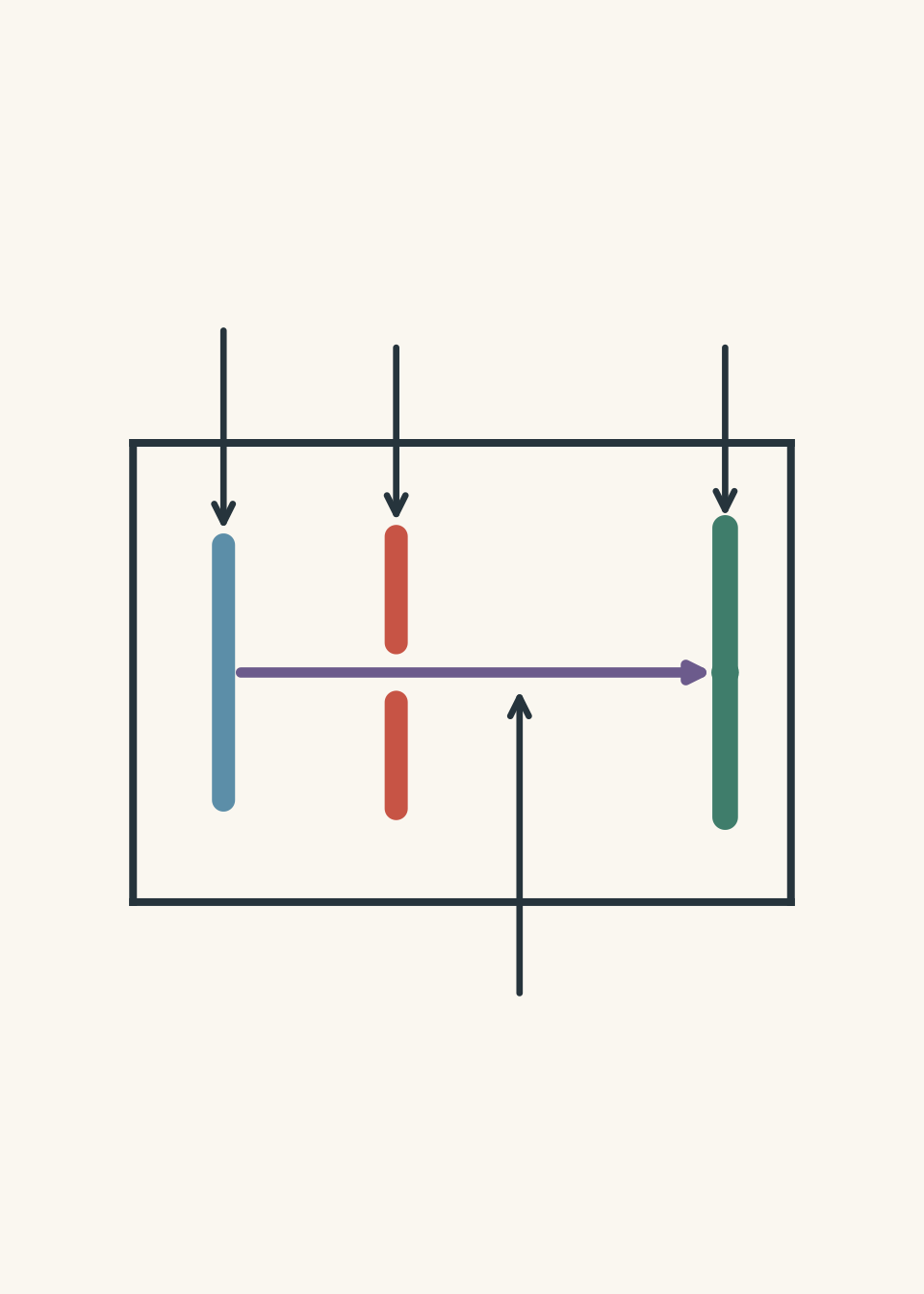
It helps to picture the fluorescent screen as a wall getting hit by invisible tennis balls. You can’t see the balls in flight, but the little flash where each one hits tells you where the beam went.
That analogy is useful for visualising the measurement. It does not yet tell us that the rays really are particles. A wave can also transfer energy and produce a detectable effect.
That was the experimental problem.
02Why physicists were unsure whether cathode rays were particles
By the 1890s, cathode rays had some awkward properties.
Magnetic fields could bend them. They could cause fluorescence. Experiments also suggested that they could pass through extremely thin materials. Different physicists therefore supported different interpretations of what the rays actually were. Niels Bohr Library & Archives
A particle explanation had an obvious prediction: if the particles carry electric charge, an electric field should deflect them.
But earlier attempts, including experiments associated with Heinrich Hertz, had failed to observe the expected electric deflection. That seemed to favour a wave-like interpretation. American Physical Society
So J. J. Thomson’s job was not simply to say, “The rays bend, therefore electrons exist.”
He had to answer several separate questions:
- Do cathode rays actually carry electric charge?
- Does that charge travel with the ray?
- Can an electric field deflect the rays as charged-particle physics predicts?
- Are the moving objects ordinary atoms or something much smaller?
- Does their behaviour depend on which material or gas is used?
The strength of Thomson’s case came from putting these pieces together.
03First problem: does the negative charge actually travel with the ray?
Jean Perrin had already produced evidence that cathode rays delivered negative charge. Thomson refined this idea.
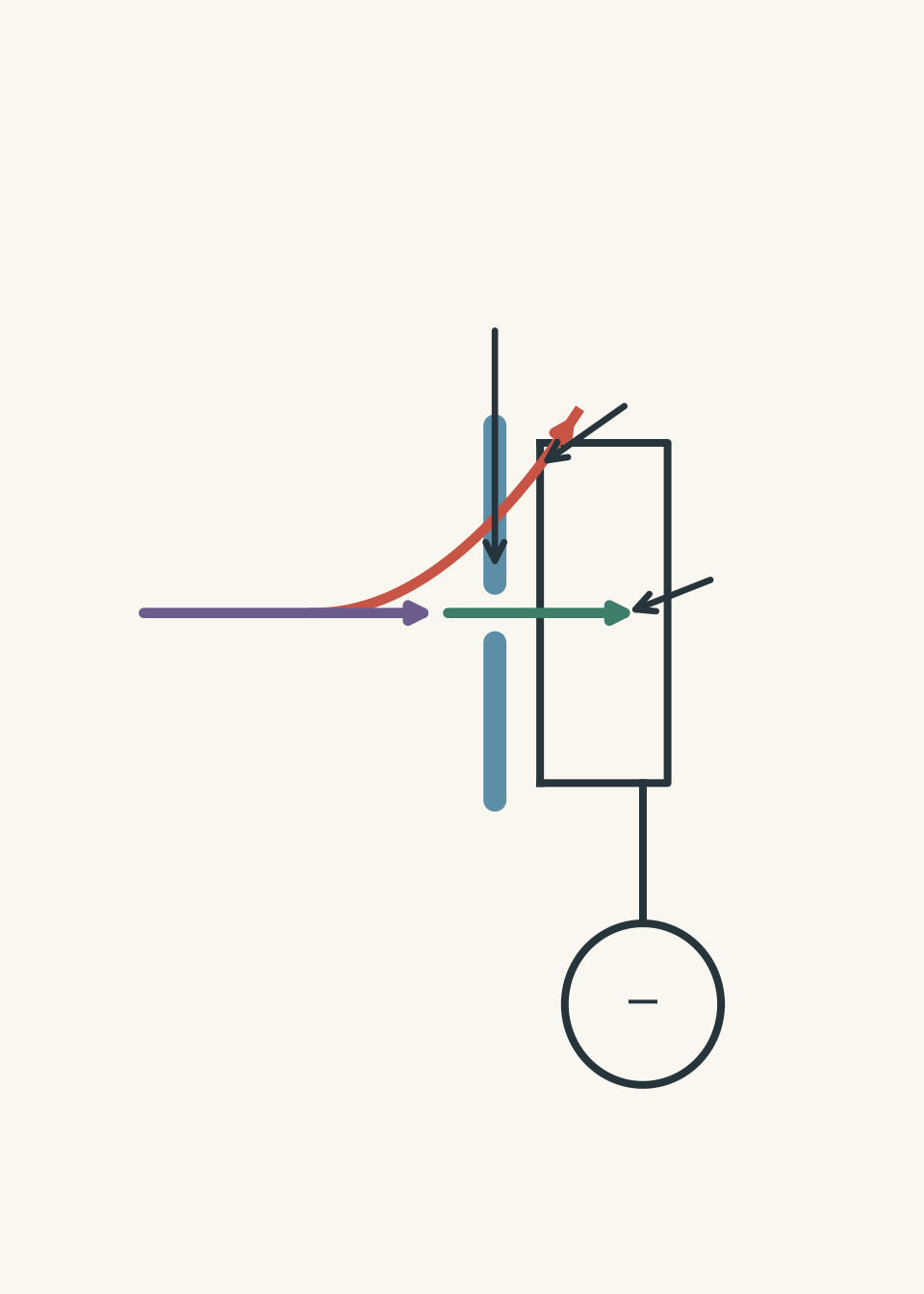
In one of Thomson’s 1897 arrangements, the cathode rays travelled into a larger part of the tube containing metal collecting cylinders connected to an electrometer, an instrument capable of detecting electric charge. A magnetic field could bend the rays so that they either entered the collector or missed it. Niels Bohr Library & Archives
Run the experiment mentally.
If the negative charge is unrelated to the cathode ray, steering the ray away from the collector should not necessarily steer the charge away as well.
But when the beam was directed into the collector, negative charge was detected. When the magnetic field bent the beam so that it missed the collector, very little charge reached it. Niels Bohr Library & Archives
The negative charge followed the ray.
That does not yet tell you the mass of whatever is moving, but it strongly links the cathode ray itself with moving negative charge.
04The harder problem: why hadn’t electric fields bent the rays?
Here is the apparent contradiction.
A magnetic field could deflect cathode rays. The rays carried negative charge. Yet earlier electric-field experiments had reported little or no deflection.
You might conclude that the particle model had failed.
Thomson instead questioned the experiment.
The hidden problem was the gas
A cathode-ray tube was not perfectly empty. Some gas remained inside.
Thomson argued that the cathode rays could ionise this remaining gas. Once the gas contained mobile charged particles, it became electrically conducting enough to interfere with the intended electric field.
Think of trying to keep two people angry at opposite ends of a room while twenty mutual friends keep walking between them and smoothing everything out. The electric plates are trying to maintain charge separation; the ionised gas gives charge a pathway to redistribute.
The analogy breaks because an electric field is not an emotion, and the ions obey electromagnetic forces rather than social pressure. The useful point is simply that mobile charge can weaken the field you were trying to establish.
Thomson therefore used a tube evacuated to a much lower pressure.
His apparatus had a cathode at one end. The rays passed through openings that produced a narrower beam, then travelled between two metal plates. A potential difference across those plates created an electric field. A scale at the far end allowed the beam’s displacement to be measured. Niels Bohr Library & Archives
Now make the prediction again.
If the beam consists of negative particles, which way should it bend?
Towards the positively charged plate.
That is what Thomson observed once the residual-gas problem had been sufficiently reduced. American Physical Society
This mattered for two reasons. The direction of the deflection showed that the moving charge was negative, and the existence of the deflection supported the idea that the rays behaved as charged particles rather than as an electrically neutral beam.
05What the electric field does to a cathode-ray particle
For a particle of charge \(q\) in an electric field \(E\),
\[ F_E=qE \]
where:
- \(F_E\) is the electric force in newtons, N
- \(q\) is the particle’s charge in coulombs, C
- \(E\) is the electric field strength in newtons per coulomb, N C\(^{-1}\).
For an electron, \(q\) is negative. The force therefore points opposite to the electric-field direction.
This gives an important HSC decision rule:
- electric field direction is defined as the direction of force on a positive charge
- a negative charge accelerates in the opposite direction.
The beam’s electric deflection therefore gives information about the sign of its charge.
Worked example: How large is the electric acceleration?
A cathode-ray electron enters a uniform electric field of \(2.0\times10^4\ \text{N C}^{-1}\). Using the modern values \(e=1.60\times10^{-19}\ \text{C}\) and \(m_e=9.11\times10^{-31}\ \text{kg}\), calculate the magnitude of its electric force and acceleration.
Step 1
Using \(F_E=qE\), and using \(e\) for the magnitude of the electron charge,
\[ F_E=eE =(1.60\times10^{-19})(2.0\times10^4) =3.2\times10^{-15}\ \text{N}. \]
Step 2
Since \(F=ma\),
\[ a=\frac{F}{m} =\frac{3.2\times10^{-15}}{9.11\times10^{-31}} =3.5\times10^{15}\ \text{m s}^{-2}. \]
So the acceleration has magnitude
\[ 3.5\times10^{15}\ \text{m s}^{-2}. \]
Because the particle is negative, this acceleration is towards the positive plate.
That enormous acceleration is possible because an electron has an extremely small mass. Notice, though, that this is a modern scale estimate using values established after Thomson’s experiments. Thomson did not begin in 1897 already knowing the electron’s charge and mass separately.
06Deflection was not enough: what kind of particle was it?
At this point, Thomson had strong evidence for moving negative particles.
But that still leaves a major possibility open.
Perhaps cathode rays were simply negatively charged atoms or molecules from the gas or the cathode.
To distinguish those ideas, Thomson needed information involving both charge and mass.
A charged particle in a magnetic field experiences a magnetic force. When its velocity is perpendicular to the field,
\[ F_B=|q|vB \]
where:
- \(F_B\) is the magnetic force in N
- \(|q|\) is the magnitude of the particle’s charge in C
- \(v\) is its speed in m s\(^{-1}\)
- \(B\) is the magnetic field strength in tesla, T.
Because the magnetic force is perpendicular to the particle’s velocity, it can bend the path rather than simply speeding the particle up along its direction of travel.
If the path becomes circular,
\[ F_B=\frac{mv^2}{r} \]
where \(m\) is the particle’s mass in kg and \(r\) is the radius of curvature in metres.
Combining the equations gives
\[ |q|vB=\frac{mv^2}{r}, \]
so
\[ \frac{|q|}{m}=\frac{v}{Br}. \]
This is the key idea. Deflection lets you investigate the particle’s charge-to-mass ratio.
Thomson’s experimental analysis was more complicated than the neat modern classroom treatment above. Historically, he measured cathode-ray deflection and energy-related quantities to obtain the mass-to-charge or charge-to-mass relationship. The important HSC-level conclusion is that electric and magnetic behaviour allowed him to compare how much charge the ray carried with the inertia of whatever was moving. American Physical Society
07A clean HSC model for measuring \(e/m\)
A useful modern reconstruction uses perpendicular electric and magnetic fields.
Suppose a particle travels through both fields and the electric and magnetic forces oppose each other.
If the beam goes straight,
\[ F_E=F_B. \]
Therefore,
\[ |q|E=|q|vB. \]
The charge cancels:
\[ v=\frac{E}{B}. \]
That gives the particle’s speed without needing to know either its mass or charge.
Then let the same particle move through a magnetic field alone. If its circular path has radius \(r\),
\[ \frac{|q|}{m}=\frac{v}{Br}. \]
Substituting \(v=E/B\),
\[ \frac{|q|}{m}=\frac{E}{B^2r}. \]
This is not a claim that Thomson’s 1897 apparatus was simply a modern textbook velocity selector. It is an HSC-friendly way to see the logic behind using electric and magnetic deflection to extract a charge-to-mass ratio.
Worked example: Finding the charge-to-mass ratio
A cathode-ray beam passes undeflected through perpendicular electric and magnetic fields of \(E=3.60\times10^4\ \text{N C}^{-1}\) and \(B=2.00\times10^{-3}\ \text{T}\). The electric field is then removed, and in the same magnetic field the beam follows a circular path of radius \(5.10\times10^{-2}\ \text{m}\).
Calculate the magnitude of the particles’ charge-to-mass ratio.
Step 1
The electric and magnetic forces balance:
\[ |q|E=|q|vB. \]
Hence,
\[ v=\frac{E}{B} =\frac{3.60\times10^4}{2.00\times10^{-3}} =1.80\times10^7\ \text{m s}^{-1}. \]
Step 2
For circular motion,
\[ |q|vB=\frac{mv^2}{r}. \]
Therefore,
\[ \frac{|q|}{m} =\frac{v}{Br} =\frac{1.80\times10^7} {(2.00\times10^{-3})(5.10\times10^{-2})} =1.76\times10^{11}\ \text{C kg}^{-1}. \]
So
\[ \boxed{\frac{|q|}{m}=1.76\times10^{11}\ \text{C kg}^{-1}}. \]
This is essentially the modern electron value.
The number is important because it is extremely large. For a given amount of charge, whatever is travelling in the cathode ray has remarkably little inertia.
08The result that made the atomic interpretation powerful
Suppose the cathode rays were ordinary atoms ripped from the cathode.
What would you expect if you replaced the cathode with a different material?
You would expect the particles’ properties to change.
Suppose instead they were particles made from the gas left inside the tube. Change the gas, and again you would expect the result to change.
Thomson tested cathode rays under different conditions. The charge-to-mass behaviour did not depend in the expected way on the gas in the tube or the material producing the rays. He obtained values dramatically different from those associated with known atomic ions. American Physical Society
The ratio was more than a thousand times larger in magnitude than the charge-to-mass ratio of a hydrogen ion. American Physical Society
There were two broad ways to explain that:
- the particles carried vastly more charge than ordinary ions, or
- they had vastly less mass for a comparable amount of charge.
Further evidence supported the second interpretation: cathode-ray particles were much lighter than atoms. Niels Bohr Library & Archives
That was the revolutionary step.
Atoms had generally been treated as the smallest units of ordinary matter. Cathode rays suggested that atoms themselves contained a smaller constituent.
09The chain of evidence
For HSC questions, avoid reducing the argument to one sentence such as “Thomson deflected cathode rays and discovered the electron”.
The reasoning is stronger when you separate each observation from what it establishes.
| Observation | What it supports | What it does not establish by itself |
|---|---|---|
| Cathode rays produce fluorescence | Something transfers energy across the tube | Whether it is a particle or wave |
| A magnetic field bends the ray | The ray responds to magnetic conditions | The sign of charge by itself without field and motion directions |
| Negative charge arrives where the ray arrives | Negative charge is associated with the cathode ray | The particle’s mass |
| A sufficiently evacuated tube allows electric deflection | The ray behaves like moving electric charge | That the particle is universal |
| Deflection is towards the positive plate | The moving charge is negative | Its separate charge or mass |
| Charge-to-mass behaviour is similar with different gases and cathodes | The same kind of constituent appears across different matter | The exact electron charge |
| \(|q|/m\) is enormously larger than for known ions | The carriers are far lighter than ordinary atoms if their charge is of comparable scale | The value of \(q\) and \(m\) separately |
The last distinction causes a lot of exam mistakes.
Thomson measured a ratio. A ratio alone cannot tell you both quantities separately.
If
\[ \frac{|q|}{m}=1.76\times10^{11}\ \text{C kg}^{-1}, \]
you cannot conclude from that equation alone that you know \(|q|\) or \(m\).
You need another independent measurement.
10What Thomson could conclude, and what came later
Thomson called the cathode-ray particles corpuscles. The word electron had already been introduced in an electrical context before Thomson’s 1897 work and was later applied to these particles. American Physical Society
Historically, Thomson argued that his corpuscles were components of atoms. That was a much stronger claim than simply saying cathode rays contain negative charge. Niels Bohr Library & Archives
Modern hindsight tells us that this central idea was correct: electrons are constituents of atoms.
Other parts of Thomson’s early atomic picture were not correct. In particular, later experiments showed that an atom’s positive charge is not smoothly distributed throughout its volume.
This is worth remembering because experiments do not normally reveal an entire theory in one go. They rule out some models, constrain others, and leave new questions.
Cathode-ray evidence gave physicists a negatively charged subatomic particle. It did not yet reveal the structure of the rest of the atom.
11Why Millikan’s experiment was the natural next step
Once Thomson had measured the electron’s charge-to-mass ratio, the obvious missing information was one of those quantities separately.
Suppose you know
\[ \frac{e}{m}. \]
If another experiment measures \(e\), you can rearrange to find the mass:
\[ m=\frac{e}{e/m}. \]
That is why measurements of the elementary charge became so important.
Robert Millikan’s later oil-drop work measured electric charge on individual droplets and provided much stronger evidence for a fundamental unit of charge. Combined with the electron charge-to-mass ratio, this allowed the electron’s tiny mass to be determined. American Physical Society
The experimental sequence is therefore:
\[ \text{cathode-ray deflection} \rightarrow \frac{e}{m} \rightarrow \text{independent measurement of }e \rightarrow m_e. \]
And once atoms clearly contained negative electrons, another question became unavoidable:
Where is the positive charge that makes ordinary matter electrically neutral?
That is the question that leads into Rutherford scattering and the nuclear model of the atom.
12Questions and solutions
Question 1
A cathode-ray beam travels horizontally to the right through a uniform electric field directed vertically downward.
State the direction in which the beam deflects and explain what this indicates about the particles in the beam.
Solution 1
The beam deflects upward, indicating that the particles carry negative charge.
The electric field direction is defined as the direction of force on a positive test charge. A positive particle would therefore experience a downward force.
For a negative charge,
\[ \vec F=q\vec E, \]
and \(q<0\), so the force is opposite to the electric field. The cathode-ray particles therefore accelerate upward.
A tempting mistake is to draw the particle moving in the electric-field direction automatically. That rule only applies directly to positive charge. The observed opposite deflection is evidence that the cathode-ray particles are negatively charged.
Question 2
A beam of negatively charged particles travels at \(2.40\times10^7\ \text{m s}^{-1}\) perpendicular to a magnetic field of \(1.50\times10^{-3}\ \text{T}\). Its path has radius \(9.10\times10^{-2}\ \text{m}\).
Calculate the magnitude of the particles’ charge-to-mass ratio.
Explain why this measurement does not, by itself, give the particle’s charge or mass separately.
Solution 2
The magnitude of the charge-to-mass ratio is approximately \(1.76\times10^{11}\ \text{C kg}^{-1}\), but the individual values of charge and mass cannot be found from this measurement alone.
For circular motion, the magnetic force supplies the centripetal force:
\[ |q|vB=\frac{mv^2}{r}. \]
Cancelling one factor of \(v\),
\[ \frac{|q|}{m}=\frac{v}{Br}. \]
Substitute the values:
\[ \frac{|q|}{m} = \frac{2.40\times10^7} {(1.50\times10^{-3})(9.10\times10^{-2})} = 1.76\times10^{11}\ \text{C kg}^{-1}. \]
So,
\[ \frac{|q|}{m}\approx1.76\times10^{11}\ \text{C kg}^{-1}. \]
The tempting route is to interpret this large number as directly giving either a very small mass or a very large charge. It does neither on its own. Many different pairs of \(q\) and \(m\) can produce the same ratio.
An independent measurement of either \(q\) or \(m\) is required before the other can be calculated.
Question 3
Early experiments found that cathode rays could be bent magnetically but appeared not to deflect when an electric field was applied. A student argues:
“That observation disproves the idea that cathode rays are charged particles.”
Explain why this conclusion was reasonable from the first observation but ultimately incorrect. Include Thomson’s experimental revision and its result.
Solution 3
The conclusion was reasonable as an initial interpretation, but it was incorrect because the experiment was not actually producing the intended electric-field conditions around the cathode ray.
A charged particle should experience an electric force,
\[ F_E=qE. \]
If a genuine electric field crossed the beam and no deflection occurred, that would create a serious problem for the charged-particle model.
The hidden complication was the residual gas inside the tube. Cathode rays could ionise this gas, creating mobile charges. The resulting conductivity interfered with the electric field between the deflection plates.
Thomson therefore improved the evacuation of the tube so that much less gas remained. Under these conditions, an electric field did deflect the cathode rays, with the direction corresponding to negative charge. American Physical Society
The tempting route is to treat “no observed deflection” as identical to “no electric force exists”. That ignores the experimental control: before using a null result to reject a model, you must check whether the independent variable – here, a suitable electric field across the beam – was actually present.
The revised experiment therefore supported rather than rejected the negatively charged particle model.
Question 4
Two models are proposed for cathode rays.
Model A: The rays are negatively charged atoms knocked out of the cathode material.
Model B: The rays are a common negatively charged constituent found inside many different atoms.
An experimenter changes both the cathode material and the low-pressure gas in the tube. For every combination, the measured magnitude of the charge-to-mass ratio remains approximately the same and is much larger than the charge-to-mass ratio of any known atomic ion.
Evaluate the two models. Your answer must explain why neither observation, taken alone, is as strong as the two together.
Solution 4
Model B is much more strongly supported because the combination of a constant charge-to-mass ratio and its unusually large magnitude is difficult to reconcile with ordinary negatively charged atoms.
First consider the constant ratio.
If Model A were correct, changing the cathode from one element to another should normally change the mass of the emitted atoms. Unless their charges changed in exactly the compensating way each time, their \(|q|/m\) values should also change.
Instead, approximately the same \(|q|/m\) is obtained from different materials. That suggests the beam contains the same type of particle regardless of the material used.
However, this observation alone is not complete proof. In principle, someone could propose a more complicated model in which different atoms happen to produce carriers with matching charge-to-mass ratios.
Now consider the enormous magnitude of \(|q|/m\). Compared with ordinary ions, the carriers have far more charge per unit mass. If their charge is of roughly atomic scale, their mass must be far below an atomic mass.
Again, this result alone leaves another possibility: perhaps the carrier has an ordinary atomic mass but an enormous charge.
The two observations constrain each other. The same unusually large \(|q|/m\) repeatedly appears despite changing the source material and gas. A universal, very low-mass constituent of atoms is therefore a much simpler and better-supported explanation.
The tempting route is to say “same ratio means same particle” as though a ratio uniquely identifies an object. Strictly, it does not. The conclusion becomes powerful because the invariance is combined with the extreme value of the ratio and the other evidence that the rays transport negative charge.
Question 5
A researcher investigates an unknown beam in an evacuated tube and obtains four results.
- The beam deposits negative charge on a collector.
- When a magnetic field bends the visible beam away from the collector, the negative charge arriving at the collector almost disappears.
- The beam deflects towards the positive plate when it passes through a transverse electric field.
- Different source materials produce the same measured value of \(|q|/m\).
A second researcher proposes a rival explanation:
“The visible beam itself is an electrically neutral wave. It knocks negative particles off the collector when it arrives, so the measured negative charge does not prove that negative particles travelled through the tube.”
Using all four observations, determine whether this rival model remains viable. Be precise about which observation creates the strongest difficulty for it.
Solution 5
The rival model is not consistent with the full set of observations. The strongest difficulty is that the negative charge follows the magnetically deflected beam through space rather than merely appearing when a neutral wave reaches the collector.
Observation 1 alone is not enough to defeat the rival model. A neutral beam might, in principle, interact with a surface and cause charge separation there. Detecting negative charge at the collector does not automatically prove that this negative charge crossed the tube as part of the beam.
Observation 2 changes the situation. When the beam is magnetically redirected so that it misses the collector, the negative charge reaching that collector largely disappears. When the beam is directed into it, negative charge arrives.
The spatial path of the charge therefore tracks the path of the ray. This is difficult to explain as a surface effect produced only after a neutral wave reaches the collector.
Observation 3 adds an independent constraint. An electric field deflects the travelling beam towards the positive plate. For a particle,
\[ \vec F=q\vec E, \]
so this direction corresponds to \(q<0\). The negative character is therefore observed through the beam’s motion before it reaches the collecting surface, not merely through an effect at the collector.
Observation 4 makes the explanation broader still. The same \(|q|/m\) from different source materials suggests that the moving negative carrier is not an accidental fragment peculiar to one cathode. It behaves like a common constituent.
The tempting response is to choose Observation 3 alone: “electric deflection proves it is a negative particle.” Electric deflection certainly provides strong evidence, but a sufficiently flexible alternative model might still try to invent some other field-sensitive process.
The deeper experimental argument comes from the observations constraining one another. The beam’s path and negative charge move together, its direction of electric deflection has the sign expected for negative charge, its magnetic behaviour permits a consistent charge-to-mass measurement, and that ratio persists when the source material changes.
That linked evidence is why cathode rays became evidence for a universal negatively charged subatomic particle rather than merely an unexplained glow inside a tube.