
Rutherford’s Nuclear Atomic Model: HSC Physics Explained
Learn how alpha-particle scattering led to Rutherford's nuclear model, what the model successfully explained, and why it still left major problems unresolved.
A beam of fast alpha particles is fired at a sheet of gold only a few hundred atoms thick. If positive charge is spread smoothly through each atom, almost every alpha particle should pass through with only a gentle nudge. Instead, a tiny fraction turn through enormous angles. Some nearly come back towards the source.
What sort of atom can do that?
Before reading on, make a prediction. To reverse a fast, positively charged alpha particle, would you rather spread the atom’s positive charge across the whole atom, or concentrate it into one tiny region?
Concentrating it wins. A large change in direction needs a very strong force acting over a very short distance. That simple point forced Ernest Rutherford to replace the existing picture of the atom with a radically different one: nearly all the atom’s positive charge, and most of its mass, are concentrated in a tiny nucleus.
01The problem with the atomic model before Rutherford
By the early 1900s, experiments with cathode rays had provided strong evidence that atoms contain negatively charged electrons. If you need that part of the story refreshed, see Cathode-Ray Evidence for Electrons: HSC Physics Explained.
That created a new problem. Ordinary matter is electrically neutral, so if an atom contains negative electrons, it must also contain positive charge somewhere.
J. J. Thomson proposed a model in which the atom’s positive charge was spread through a roughly spherical region, with electrons embedded within it. The exact food analogy is historically less important than the physics: positive charge was diffuse rather than concentrated.
That model made a testable prediction.
An alpha particle has a positive charge of \(+2e\), where \(e\) is the elementary charge. As it passes through an atom, it is repelled by positive charge and attracted by electrons. But electrons are much lighter than alpha particles, and the positive charge in Thomson’s model is spread out.
So what should happen to a fast alpha particle passing through a thin metal foil?
It might be deflected slightly, perhaps after many small interactions. A huge, sudden turn should be extremely unlikely.
That prediction could be tested.
02The Geiger-Marsden scattering experiment
Rutherford’s nuclear model grew from scattering experiments carried out by Hans Geiger and Ernest Marsden under Rutherford’s direction. The full experimental story is covered in The Geiger-Marsden Experiment: HSC Physics Explained, but the essential apparatus is worth picturing here because the model only makes sense if you understand what was measured.
Start at the source.
A radioactive source emitted alpha particles. A collimating arrangement restricted them to a narrow beam. That beam travelled towards an extremely thin metal foil, commonly associated with gold in the famous version of the experiment.
Around the foil was a detecting screen coated with zinc sulfide. When an alpha particle struck the screen, it produced a tiny flash of light called a scintillation. By observing flashes at different positions, Geiger and Marsden could infer how much the particles had been deflected.
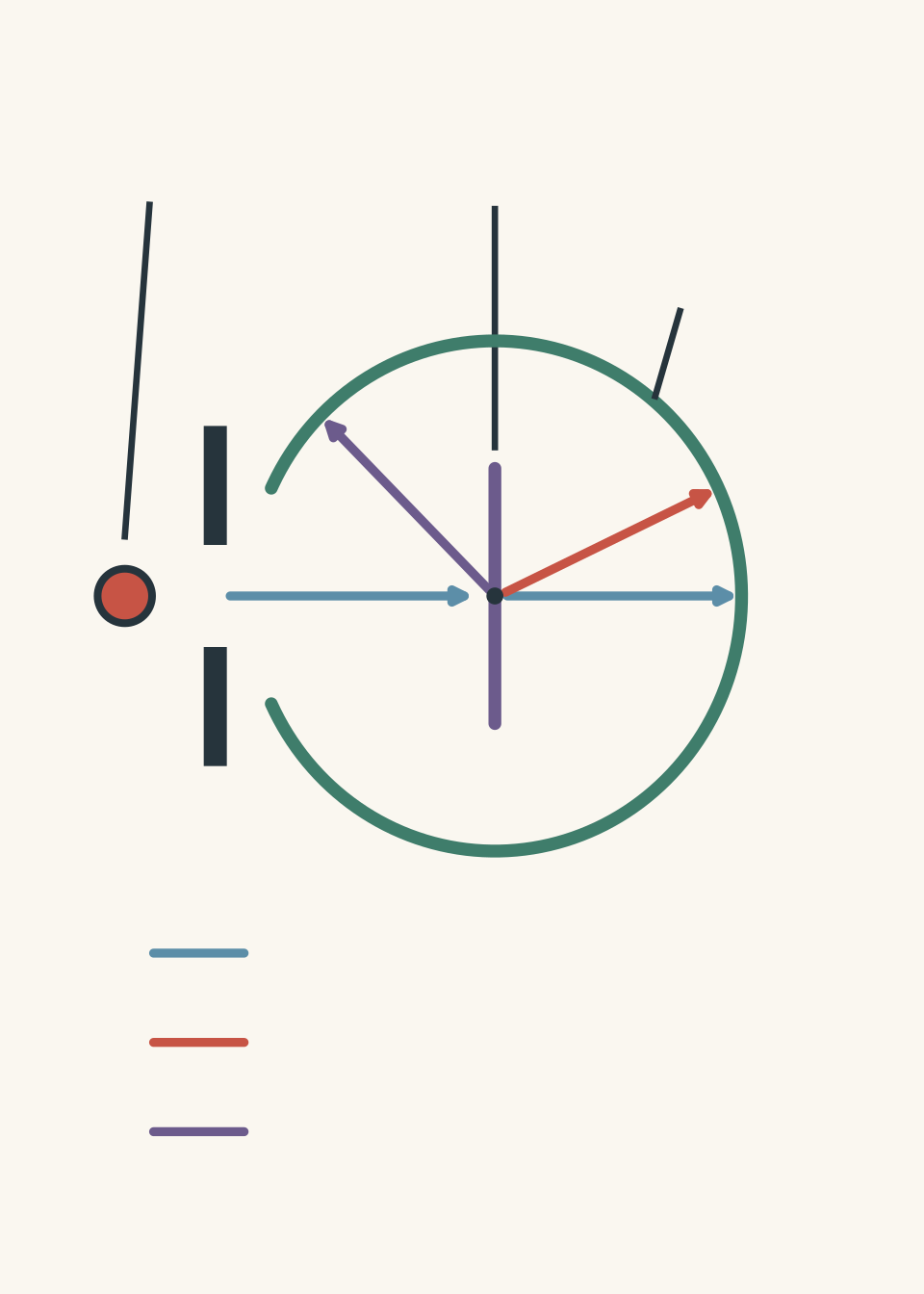
Now make the prediction before looking at the result.
If Thomson’s diffuse-positive-charge model is basically correct, where should most flashes appear?
Mostly close to the forward direction. That part was indeed observed.
But the important evidence was not what most particles did. It was what a very small number did.
03The observation that changed the model
Most alpha particles travelled straight through the foil or were deflected by only small angles.
A much smaller number were scattered through large angles.
A tiny fraction were scattered backwards.
That combination matters.
The first observation tells us that atoms cannot be solid lumps of matter. If they were, alpha particles would constantly smash into something substantial.
Instead, most particles passed through almost unaffected. The natural conclusion is that most of an atom’s volume is empty space.
The rare large deflections tell us something different. Somewhere inside the atom there must be a region capable of exerting a very large electrostatic force.
Because alpha particles are positively charged, a strong repulsive deflection requires concentrated positive charge.
Rutherford therefore proposed that the atom contains a very small, positively charged nucleus surrounded by electrons.
04Rutherford’s nuclear atomic model
The basic model has three important features:
| Feature | Rutherford’s conclusion | Evidence behind it |
|---|---|---|
| Most of the atom is empty space | The nucleus occupies only a tiny fraction of the atom’s volume | Most alpha particles passed through the foil with little deflection |
| Positive charge is concentrated | Positive charge is located in a small central nucleus | Some positive alpha particles suffered very large repulsive deflections |
| Most atomic mass is concentrated centrally | The nucleus contains most of the atom’s mass | A light, diffuse structure could not strongly redirect a massive, fast alpha particle in the observed way |
Be careful with the phrase “empty space”. It doesn’t mean literally nothing exists outside the nucleus. Electrons are there. It means that the dense central region occupies an extremely small fraction of the atom’s total volume.
A rough mental picture is useful. Imagine the atom enlarged until its nucleus is the size of a pea. The electrons would be vastly farther away than the edge of the pea. The precise scale depends on the atom, so don’t treat the analogy as a measurement.
And unlike a tiny solar system, electrons in real atoms are not classical planets travelling in neatly defined Newtonian orbits. That limitation becomes crucial later.
05Why concentrated charge can cause a huge deflection
Suppose an alpha particle heads almost directly towards the nucleus.
Both the alpha particle and the nucleus are positively charged, so the electric force is repulsive. Coulomb’s law gives the magnitude of that force:
\[ F=\frac{kq_1q_2}{r^2} \]
where:
- \(F\) is the electrostatic force in newtons,
- \(k=8.99\times10^9\ \text{N m}^2\text{C}^{-2}\) is Coulomb’s constant,
- \(q_1\) and \(q_2\) are the two charges in coulombs, and
- \(r\) is their separation in metres.
Notice the \(1/r^2\) dependence. If the alpha particle gets ten times closer, the electric force becomes \(100\) times stronger.
This is why concentrating positive charge matters so much.
If the same positive charge were spread over an entire atom, an approaching alpha particle would feel different parts of that charge in different directions. The overall force would be comparatively gentle.
A tiny nucleus allows an alpha particle that passes very close to experience an intense force over a short time. Its momentum can therefore change direction dramatically.
The analogy is a little like trying to avoid a group of people spread across a football field compared with discovering that all of them have somehow formed one very angry scrum directly in your path. Same total number of people, very different encounter.
The analogy breaks because electrostatic forces act without physical contact. The alpha particle does not need to “hit” the nucleus like a ball hitting a wall.
06Worked example: why do closer alpha particles deflect more?
An alpha particle passes a nucleus at a minimum separation of \(4.0\times10^{-14}\ \text{m}\). Another otherwise identical alpha particle passes at \(8.0\times10^{-14}\ \text{m}\). Compare the electrostatic forces on the particles at those distances.
Step 1
For the same two charges,
\[ F\propto\frac{1}{r^2} \]
Step 2
Let \(F_1\) correspond to \(r_1=4.0\times10^{-14}\ \text{m}\), and \(F_2\) correspond to \(r_2=8.0\times10^{-14}\ \text{m}\).
\[ \frac{F_1}{F_2} = \frac{r_2^2}{r_1^2} = \left(\frac{8.0\times10^{-14}}{4.0\times10^{-14}}\right)^2 = 2^2 = 4 \]
Step 3
The first alpha particle experiences a force four times as large at its closest point.
That does not automatically mean its scattering angle is exactly four times larger. The final angle depends on the whole path of the particle, not just the maximum force. But it explains why particles passing especially close to the nucleus can undergo unusually large deflections.
07Estimating how close an alpha particle can get
For a head-on approach, there is a particularly useful idea.
An alpha particle begins with kinetic energy. As it approaches the positive nucleus, it slows because it is moving against an increasing electrostatic repulsion. Its kinetic energy is converted into electric potential energy.
At the distance of closest approach in an ideal head-on collision, the alpha particle momentarily has zero speed before moving back out.
So, ignoring nuclear forces and recoil of the nucleus,
\[ E_k=E_{\text{electric}} \]
For point charges,
\[ E_{\text{electric}}=\frac{kq_1q_2}{r} \]
This gives
\[ E_k=\frac{kq_1q_2}{r_{\min}} \]
where \(r_{\min}\) is the minimum separation.
This is more than a calculation trick. If an alpha particle gets extremely close before electrostatic repulsion stops it, then the positive charge of the atom must be concentrated within a region at least that small.
Worked example: estimate the closest approach to a gold nucleus
An alpha particle with kinetic energy \(7.7\ \text{MeV}\) travels directly towards a gold nucleus. Estimate its minimum distance from the nucleus. Assume the gold nucleus remains stationary, the interaction is purely electrostatic, and the gold nucleus has charge \(+79e\).
Use \(e=1.60\times10^{-19}\ \text{C}\), \(k=8.99\times10^9\ \text{N m}^2\text{C}^{-2}\), and \(1\ \text{eV}=1.60\times10^{-19}\ \text{J}\).
Step 1
\[ \begin{aligned} E_k &=7.7\times10^6\ \text{eV}\times1.60\times10^{-19}\ \text{J/eV}\\ &=1.232\times10^{-12}\ \text{J} \end{aligned} \]
Step 2
The alpha particle has charge
\[ q_\alpha=+2e \]
and the gold nucleus has charge
\[ q_{\text{Au}}=+79e \]
Step 3
\[ E_k=\frac{kq_\alpha q_{\text{Au}}}{r_{\min}} \]
so
\[ r_{\min}=\frac{k(2e)(79e)}{E_k} \]
Step 4
\[ \begin{aligned} r_{\min} &= \frac{(8.99\times10^9)(2)(79)(1.60\times10^{-19})^2} {1.232\times10^{-12}}\\ &\approx2.95\times10^{-14}\ \text{m} \end{aligned} \]
So the estimated distance of closest approach is
\[ r_{\min}\approx3.0\times10^{-14}\ \text{m}. \]
Step 5
The alpha particle can approach to only a few tens of femtometres before electrostatic repulsion stops its inward motion in this simplified model.
That is vastly smaller than an atomic radius, which is typically around \(10^{-10}\ \text{m}\). The calculation therefore supports the idea that the atom’s positive charge occupies only a tiny central region.
It does not directly give the exact physical radius of the gold nucleus. The alpha particle turns around before necessarily touching the nucleus.
08What Rutherford’s model successfully explained
Rutherford’s model was powerful because one structural idea explained two apparently different observations.
Most alpha particles barely deflect
If the nucleus is tiny compared with the whole atom, most incoming alpha particles will not pass close to one.
They therefore experience only modest net forces and continue roughly forwards.
This explains why straight-through transmission was common rather than surprising.
Rare particles scatter through large angles
A particle aimed close to a nucleus encounters a much stronger repulsive electric field.
Its trajectory can bend sharply, including through angles greater than \(90^\circ\).
The rarity also makes sense. The nucleus is tiny, so an alpha particle has to pass through a very small target region for this to happen.
Backscattering no longer requires a bizarre coincidence
In a diffuse-charge model, reversing a fast alpha particle would require many small deflections to somehow combine in almost the same direction.
That is not impossible in a loose verbal sense, but the observed frequency of large-angle scattering did not match what that model predicted.
A concentrated nucleus gives a direct physical mechanism: one close encounter can produce a large change in momentum.
09Rutherford scattering was evidence for a model, not a photograph of an atom
This distinction is important in HSC Physics.
Nobody looked through the apparatus and saw a nucleus.
The observation was a pattern of alpha-particle scattering. Scientists then compared that pattern with predictions from competing models.
The reasoning is:
\[ \text{atomic model} \rightarrow \text{predicted forces} \rightarrow \text{predicted trajectories} \rightarrow \text{measured scattering} \]
If the prediction disagrees with the measured pattern, the model has a problem.
If it matches, the model gains support.
That does not make the model eternally final. A model can succeed brilliantly in one experiment and still fail somewhere else.
Rutherford’s did.
10The first major problem: why don’t electrons fall into the nucleus?
Picture Rutherford’s atom using classical physics. A positive nucleus sits in the centre, while negative electrons move around it.
Because opposite charges attract, the electric force can provide a centripetal force that bends an electron’s path.
So far, that sounds plausible.
But there is a serious problem from classical electromagnetism.
An electron travelling in a curved path is accelerating because its velocity is continually changing direction. According to classical electromagnetic theory, an accelerating charge radiates electromagnetic energy.
If the electron loses energy, its orbit should shrink.
As it loses still more energy, it should spiral towards the nucleus.
The atom should collapse.
Stable atoms clearly do not behave that way.
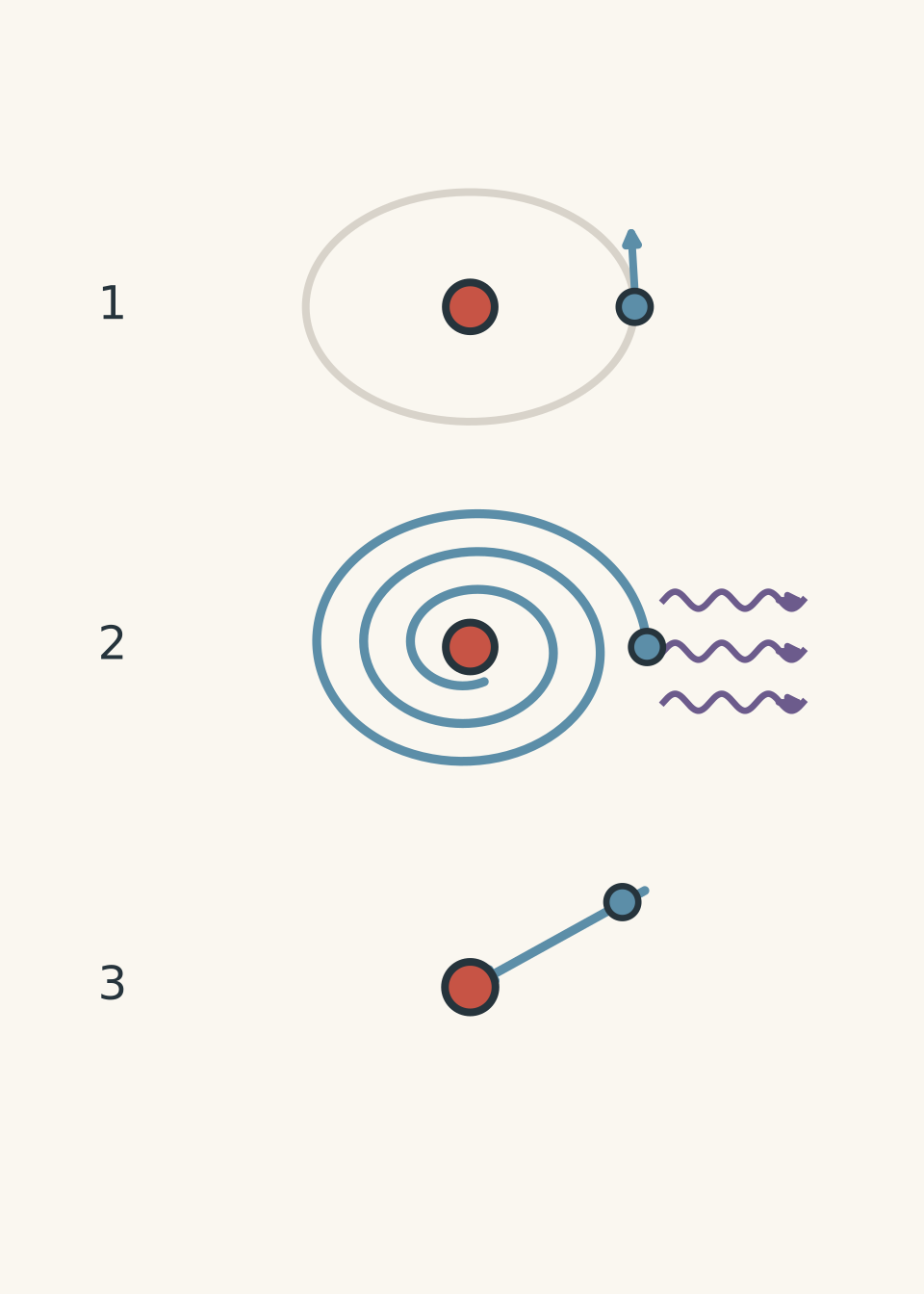
This is not a small missing detail. It means Rutherford’s model could not explain one of the most basic observations about matter: atoms persist.
A student sometimes responds, “Couldn’t the electron just keep moving fast enough?”
No. In the classical model, faster circular motion still involves acceleration. The problem is not simply that the electron might be too slow. The problem is that an accelerating charged particle radiates energy.
11The second major problem: atomic line spectra
There was another clue that Rutherford’s model could not explain.
When low-pressure gases are excited, they do not emit every possible wavelength of light. Instead, each element produces particular spectral lines.
For hydrogen, for example, visible emission occurs only at specific wavelengths.
Why is that awkward for a classical Rutherford atom?
A classical orbiting electron could, in principle, lose energy continuously. That suggests a continuous range of possible emitted frequencies as the orbit changes.
But atomic spectra contain discrete lines.
The measured light was telling physicists that atomic energy changes are not arbitrary.
Rutherford’s nuclear model had no mechanism that restricted electrons to particular energies.
That was the next problem a successful atomic model had to solve.
12What the Rutherford model did not tell us
It helps to separate what the model established from what later physics added.
| Question | Rutherford nuclear model |
|---|---|
| Is positive charge spread across the whole atom? | No. It is concentrated in a tiny nucleus. |
| Is most of the atom’s volume occupied by the nucleus? | No. The nucleus is extremely small compared with the atom. |
| Where is most of the atom’s mass? | Concentrated in the nucleus. |
| Why are atoms stable? | Not successfully explained. |
| Why do atoms emit discrete spectral lines? | Not successfully explained. |
| What allowed electron energies are possible? | Not specified. |
| What is the full internal structure of the nucleus? | Not resolved by the original model. |
This is why saying “Rutherford discovered the modern atom” is too loose.
He established the nuclear structure of the atom. The later quantum description of electrons required further changes.
13Why the model was still a major success
A scientific model does not need to explain everything to be useful.
Rutherford’s model answered a specific experimental problem extremely well: how could atoms produce the observed pattern of alpha-particle scattering?
It replaced diffuse positive charge with a concentrated nucleus and correctly connected microscopic structure to measurable trajectories.
Its failures then became productive.
Once the nucleus was accepted, the central question shifted. Physicists no longer mainly needed to ask, “Where is the positive charge?” They needed to ask, “How can electrons exist around that nucleus without behaving as classical electrodynamics predicts?”
That is the problem that leads naturally towards Bohr’s atomic model and, later, quantum mechanics.
14Questions and solutions
Question 1
In a Geiger-Marsden-style experiment, most alpha particles pass through a thin metal foil with little or no deflection, while a small number are deflected through large angles.
Explain how these two observations support Rutherford’s nuclear model.
Solution 1
The observations support a model in which most of the atom is empty space and its positive charge is concentrated in a tiny nucleus.
Most alpha particles pass through with little deflection because they do not travel close enough to a nucleus to experience a large electrostatic force.
The rare large-angle deflections occur when a positively charged alpha particle passes close to the concentrated positive charge of a nucleus. The strong electrostatic repulsion produces a large change in the alpha particle’s momentum.
A tempting explanation is that large deflections are caused by collisions with electrons. That does not work well because electrons are extremely light compared with alpha particles and cannot account for the observed strong backscattering. The concentrated positive nucleus is the important interaction.
Question 2
A \(6.0\ \text{MeV}\) alpha particle approaches a nucleus head-on. The nucleus has charge \(+50e\).
Estimate the distance of closest approach. Assume the nucleus remains stationary and that only electrostatic forces act.
Use \(e=1.60\times10^{-19}\ \text{C}\), \(k=8.99\times10^9\ \text{N m}^2\text{C}^{-2}\), and \(1\ \text{eV}=1.60\times10^{-19}\ \text{J}\).
Then predict what happens to the closest approach if the alpha particle’s kinetic energy is doubled.
Solution 2
The closest approach is approximately \(2.4\times10^{-14}\ \text{m}\), and doubling the kinetic energy halves this distance.
At the turning point of an ideal head-on approach, the initial kinetic energy has been converted into electric potential energy:
\[ E_k=\frac{kq_\alpha q_N}{r_{\min}} \]
The alpha particle has charge \(q_\alpha=2e\), while the nucleus has charge \(q_N=50e\).
First convert the kinetic energy:
\[ \begin{aligned} E_k &=6.0\times10^6\times1.60\times10^{-19}\\ &=9.60\times10^{-13}\ \text{J} \end{aligned} \]
Now calculate:
\[ \begin{aligned} r_{\min} &=\frac{k(2e)(50e)}{E_k}\\ &=\frac{(8.99\times10^9)(100)(1.60\times10^{-19})^2} {9.60\times10^{-13}}\\ &\approx2.40\times10^{-14}\ \text{m} \end{aligned} \]
So
\[ r_{\min}\approx2.4\times10^{-14}\ \text{m}. \]
If the kinetic energy doubles,
\[ r_{\min}=\frac{kq_\alpha q_N}{E_k} \]
shows that \(r_{\min}\propto1/E_k\). Therefore the new closest approach is approximately
\[ 1.2\times10^{-14}\ \text{m}. \]
A tempting prediction is that doubling the energy should reduce the distance by a factor of \(\sqrt{2}\), because inverse-square relationships often appear in electrostatics. That would confuse force with potential energy. The electrostatic potential energy here varies as \(1/r\), not \(1/r^2\).
Question 3
Two thin foils contain atoms with nuclei of different charge. Foil A has nuclei of charge \(+40e\), while Foil B has nuclei of charge \(+80e\). Identical alpha particles are fired through both foils under otherwise comparable conditions.
A student claims:
“Foil B should produce exactly twice the scattering angle for every alpha particle because its nuclear charge is twice as large.”
Assess the claim.
Solution 3
The claim is incorrect. The larger nuclear charge in Foil B produces stronger electrostatic interactions, so large deflections become more likely for comparable trajectories, but individual scattering angles are not simply doubled.
The electrostatic force is
\[ F=\frac{kq_\alpha q_N}{r^2}. \]
At the same separation \(r\), doubling the nuclear charge \(q_N\) does double the instantaneous force.
However, a scattering angle depends on the alpha particle’s entire trajectory. As the force changes, the path changes, which then changes the particle’s separation from the nucleus and the direction of the force at later times.
The interaction is therefore not a single fixed force acting for a fixed time.
There is another important variable: the impact parameter, meaning how far to the side of the nucleus the particle would have travelled if it had not been deflected. Two alpha particles with different impact parameters can undergo very different scattering even when the nuclear charge is identical.
The tempting route is to see \(F\propto q_N\) and transfer that proportionality directly to the final angle. The exact constraint is that the angle comes from the accumulated change in momentum along a curved trajectory, not from one snapshot of the force.
Question 4
Suppose a hypothetical atom has the following properties:
- all its positive charge is concentrated in a tiny central nucleus,
- electrons move around the nucleus according to classical mechanics and classical electromagnetism, and
- the atom is initially in a stable-looking circular configuration.
A student argues that Rutherford scattering has already proved this model is correct because it correctly predicts a small nucleus.
Explain why the conclusion does not follow. Your answer must use both alpha-particle scattering and electromagnetic radiation.
Solution 4
Rutherford scattering strongly supports a concentrated positive nucleus, but it does not establish that a classical orbiting-electron model is a complete description of the atom.
The scattering experiment mainly probes how alpha particles respond to the distribution of positive charge and mass inside the atom. A tiny positive nucleus successfully explains the observed rare, large-angle deflections.
That evidence says much less about the detailed behaviour of the electrons.
Under classical electromagnetism, an electron in circular motion is accelerating because the direction of its velocity changes. An accelerating electric charge radiates electromagnetic energy.
The electron would therefore lose energy. Its orbit could not remain at a constant radius. It should spiral inward towards the nucleus.
So the same model can pass one experimental test and fail another physical requirement.
The tempting route is to treat experimental support as all-or-nothing: if one prediction succeeds, every part of the model must be right. Scientific testing is more specific than that. The Geiger-Marsden results strongly constrain the distribution of positive charge, but they do not prove a classical theory of electron motion.
This is precisely why Rutherford’s nuclear model was an important step rather than the final atomic theory.
Question 5
Consider two proposed models of an atom.
Model X has a tiny positive nucleus and classical electrons that may orbit at any radius and any energy.
Model Y also has a tiny positive nucleus, but electrons can occupy only certain allowed energy states.
An alpha-scattering experiment gives identical results for both models within the precision of the apparatus.
A separate experiment shows that the atom emits light at only four sharply defined wavelengths after excitation.
A student concludes:
“Because alpha scattering cannot distinguish X from Y, there is no experimental reason to prefer Y.”
Evaluate this conclusion. Then explain what would happen to your reasoning if the emission experiment instead showed a smooth continuous spectrum.
Solution 5
The conclusion is false. Alpha scattering may fail to distinguish Model X from Model Y, but the discrete emission spectrum provides independent evidence that favours Model Y.
Both models contain the same feature most relevant to Rutherford scattering: a tiny, concentrated positive nucleus. It is therefore entirely possible for both to predict essentially the same alpha-particle trajectories.
But they differ in their treatment of electron energies.
Model X allows a continuous range of electron energies. On its own, that offers no natural reason for the atom to emit only four sharply defined photon energies.
Model Y restricts electrons to particular energy states. If an electron changes from an initial state of energy \(E_i\) to a lower state of energy \(E_f\), the emitted photon can have energy
\[ E_\gamma=E_i-E_f. \]
Because only certain initial and final energies are allowed, only certain energy differences occur. Using
\[ E_\gamma=hf, \]
where \(E_\gamma\) is photon energy in joules, \(h\) is Planck’s constant in joule seconds, and \(f\) is frequency in hertz, particular energy differences correspond to particular frequencies and therefore particular wavelengths.
The key reasoning is that experiments constrain different parts of a model. Alpha scattering tests nuclear charge distribution especially well. Spectroscopy tests atomic energy structure especially well. A model must face all relevant evidence, not just the experiment on which it performs best.
The tempting route is to say, “The scattering results are equal, so the models are equally good.” That ignores the second constraint.
If the emission experiment instead produced a genuinely smooth continuous spectrum, that specific observation would no longer favour discrete energy states in the same way. We would need to reconsider what mechanism produced the radiation and compare both models with the complete evidence.
Even then, Rutherford scattering would still support the common nuclear feature of both models. It would not suddenly establish Model X’s classical electrons.
That is the deeper lesson from Rutherford’s atomic model: one experiment can force a major structural change without answering every question about the system. Once the nucleus was established, the unresolved behaviour of electrons became the next problem, leading directly to quantised atomic models and the development of quantum physics.