
Resistive Heating in HSC Physics: Power and Energy
Learn how electric current produces resistive heating, and how to calculate electrical power and energy using the right circuit relationships.
A heater coil glows hot while the wires carrying current to it stay relatively cool. Yet if the coil and wires are in series, the same current passes through all of them. So why does most of the heating happen in the coil?
Before reading on, make a prediction. If the current through a resistor doubles, does its heating power double as well?
It actually becomes four times larger, provided the resistance stays constant. Understanding why gives you the main idea behind resistive heating.
01Where the electrical energy goes
In a metal, current is carried by mobile electrons. If you need a refresher on what current actually measures, see Current as Charge Flow Rate.
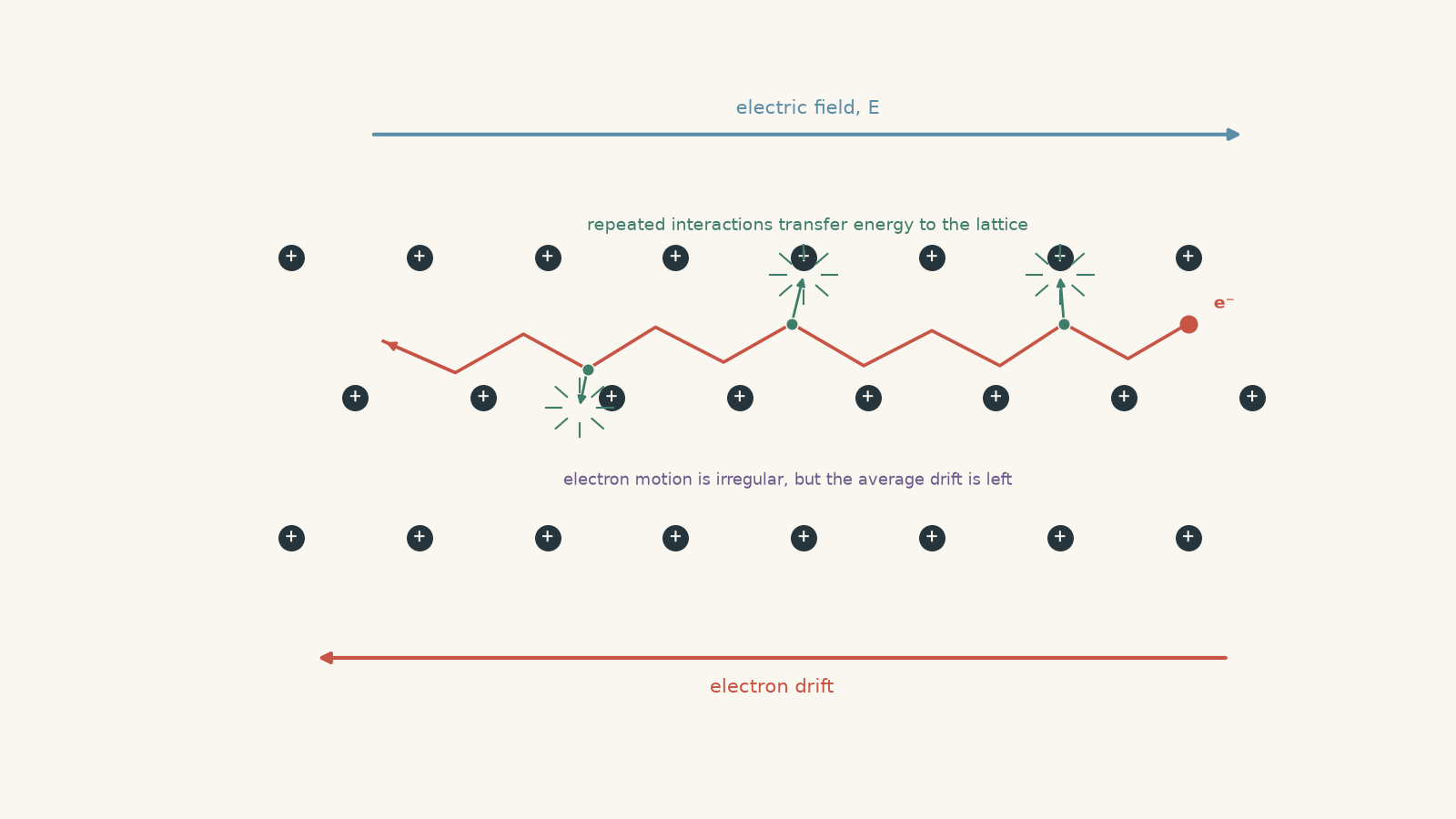
When a potential difference is applied across a metal conductor, an electric field acts on the electrons. The field transfers energy to them. The electrons repeatedly interact with the metal lattice, transferring energy to the material.
At the microscopic level, the picture is roughly:
- The electric field does work on charge carriers.
- The charge carriers interact with the lattice.
- Energy is transferred to the lattice.
- The random microscopic motion of the material increases.
- The conductor’s temperature can rise.
This conversion of electrical energy into thermal energy is resistive heating, also called Joule heating.
A useful picture is someone trying to walk through a crowded school corridor. They keep getting pushed along, bumping into people, and transferring energy to the crowd. The moving person represents a charge carrier, while the crowd represents the metal lattice.
The analogy has limits. Electrons aren’t tiny students literally bouncing down a wire in straight lines. They already have rapid microscopic motion, and their small average motion caused by the electric field is called drift. The important idea is the transfer of electrical energy to the material.
02Heating is about energy, not “using up” current
A common mistake is to imagine that current enters a resistor, gets partly “used up” to make heat, then leaves as a smaller current.
That isn’t what happens.
In a steady series circuit, charge cannot continuously pile up inside the resistor. The same rate of charge flow enters and leaves. What changes is the energy carried per unit charge.
As charge moves through the resistor, electrical potential energy is transferred to thermal energy. That is why there is a potential difference across the resistor even though the current entering and leaving it is the same.
So resistive heating consumes electrical energy, not electric charge.
03Power tells us how quickly heating occurs
Suppose a resistor converts 600 J of electrical energy into thermal energy in 10 s. A second resistor converts the same 600 J in 2 s.
They transfer the same total energy, but the second resistor heats at a much greater rate.
That rate is power:
\[
P = \frac{E}{t}
\]
where:
- \(P\) is power in watts (W),
- \(E\) is energy transferred in joules (J),
- \(t\) is time in seconds (s).
Since \(1\text{ W} = 1\text{ J s}^{-1}\), a 50 W resistor transfers 50 J of energy each second.
For an electrical component,
\[
P = VI
\]
where:
- \(V\) is the potential difference across the component in volts (V),
- \(I\) is the current through it in amperes (A).
This equation has a useful physical meaning. Potential difference tells you the energy transferred per coulomb, while current tells you how many coulombs pass each second. Multiply them, and you get energy transferred per second.
For a fuller treatment of this relationship, see Electrical Power in HSC Physics.
04Why resistance matters
For a resistor that obeys Ohm’s law,
\[
V = IR
\]
where \(R\) is resistance in ohms (\(\Omega\)).
Substituting \(V = IR\) into \(P = VI\) gives
\[
P = I^2R
\]
This equation is especially useful when you know the current and resistance.
Alternatively, using
\[
I = \frac{V}{R}
\]
in \(P = VI\) gives
\[
P = \frac{V^2}{R}
\]
This form is useful when you know the potential difference and resistance.
So the three power relationships are:
| What you know | Useful equation |
|---|---|
| \(V\) and \(I\) | \(P = VI\) |
| \(I\) and \(R\) | \(P = I^2R\) |
| \(V\) and \(R\) | \(P = \frac{V^2}{R}\) |
There is a trap here.
From \(P = I^2R\), increasing resistance increases power if current is held constant.
But from \(P = V^2/R\), increasing resistance decreases power if voltage is held constant.
Those statements aren’t contradictory. The circuit conditions are different.
Whenever someone says, “A higher resistance produces more heating,” your next thought should be: what is being held constant?
05Why doubling the current gives four times the heating power
Return to the prediction from the beginning.
For a resistor whose resistance remains constant,
\[
P = I^2R
\]
If the original current is \(I\),
\[
P_1 = I^2R
\]
If the current doubles to \(2I\),
\[
P_2 = (2I)^2R = 4I^2R
\]
Therefore,
\[
P_2 = 4P_1
\]
Doubling the current gives four times the heating power.
This square relationship is why unexpectedly large currents can cause serious heating in conductors.
Worked example: Heating a resistance wire
A \(6.0\,\Omega\) heating wire carries a current of \(2.5\,\text{A}\) for \(4.0\) minutes. Calculate its heating power and the electrical energy converted to thermal energy.
Step 1
\[
P = I^2R
\]
Step 2
\[
P = (2.5)^2(6.0) = 37.5\,\text{W}
\]
So the wire converts electrical energy to thermal energy at \(37.5\,\text{J}\) each second.
Step 3
\[
t = 4.0 \times 60 = 240\,\text{s}
\]
Step 4
From
\[
P = \frac{E}{t}
\]
we obtain
\[
E = Pt
\]
Therefore,
\[
E = 37.5 \times 240 = 9000\,\text{J}
\]
or
\[
E = 9.0\,\text{kJ}
\]
The heating wire converts \(9.0\,\text{kJ}\) of electrical energy into thermal energy during the four minutes.
06Energy transferred by resistive heating
If power is constant, the electrical energy converted over a time \(t\) is
\[
E = Pt
\]
Combining this with the electrical power equations gives
\[
E = VIt
\]
and, for a resistor described by \(V = IR\),
\[
E = I^2Rt
\]
or
\[
E = \frac{V^2t}{R}
\]
The equation you choose should match the quantities you actually know.
A useful habit is to check the units before calculating. For example,
\[
I^2Rt = \text{A}^2 \cdot \Omega \cdot \text{s}
\]
Since \(\text{A}^2\Omega = \text{W}\), this becomes
\[
\text{W}\cdot\text{s} = \text{J}
\]
which is an energy unit.
07Higher resistance does not automatically mean more power
Imagine two separate heating elements connected one at a time to the same ideal voltage supply.
Element A has resistance \(4\,\Omega\).
Element B has resistance \(12\,\Omega\).
Which one produces more heating power?
It is tempting to say the \(12\,\Omega\) element because “more resistance means more heating”. But the supply voltage is fixed, so the useful equation is
\[
P = \frac{V^2}{R}
\]
The lower-resistance element has the greater power.
Why? Increasing the resistance reduces the current. Under a fixed voltage, that reduction in current outweighs the effect of the larger resistance.
The key decision isn’t simply “large \(R\) or small \(R\)?” It is deciding what electrical quantity is fixed by the circuit.
Worked example: A heater whose resistance changes as it warms
A heating element is connected to a constant \(18\,\text{V}\) supply. Its resistance is \(6.0\,\Omega\) when initially cool and rises to \(9.0\,\Omega\) when hot. Calculate its electrical power at each resistance.
Step 1
The voltage remains \(18\,\text{V}\), so use
\[
P = \frac{V^2}{R}
\]
Step 2
\[
P_{\text{cool}} = \frac{18^2}{6.0}
= \frac{324}{6.0}
= 54\,\text{W}
\]
Step 3
\[
P_{\text{hot}} = \frac{18^2}{9.0}
= \frac{324}{9.0}
= 36\,\text{W}
\]
Step 4
The resistance increased, but the power decreased from \(54\,\text{W}\) to \(36\,\text{W}\).
That happens because the voltage, rather than the current, was held constant. The increased resistance caused the current to fall.
This example also shows why you should be careful about assuming that a real heating element has exactly the same resistance at every temperature.
08Power is not the same thing as temperature
Another common shortcut is:
More electrical power means a higher temperature.
Not necessarily.
Power tells you the rate at which electrical energy is being converted. Temperature depends on what happens to that energy after it enters the object.
The resulting temperature change can depend on:
- the object’s mass,
- its material,
- how quickly it loses thermal energy to the surroundings,
- its surface area,
- how long the current flows.
A thin wire may become extremely hot with modest total power because there is little material to heat. A much larger object could receive more power but remain at a lower temperature because it has greater thermal mass or loses heat quickly.
So distinguish carefully between:
- electrical heating power, measured in watts, and
- temperature, measured in degrees Celsius or kelvin.
The first helps determine the second, but they are not interchangeable.
09Choosing the right equation
Don’t memorise \(P = VI\), \(P = I^2R\), and \(P = V^2/R\) as three unrelated formulas.
Start with the physical situation.
If you know \(V\) and \(I\):
\[
P = VI
\]
If the resistor’s current and resistance are known:
\[
P = I^2R
\]
If the voltage across the resistor and its resistance are known:
\[
P = \frac{V^2}{R}
\]
For energy over a time interval, calculate
\[
E = Pt
\]
and make sure time is in seconds if you want energy in joules.
The more important habit is noticing what stays constant when something changes. That prevents most of the difficult mistakes in resistive-heating questions.
10Questions and solutions
Question 1
A \(15\,\Omega\) resistor carries a current of \(0.80\,\text{A}\) for \(3.0\) minutes.
Calculate:
a. the electrical power converted to thermal energy
b. the total energy transferred during the \(3.0\) minutes.
Solution 1
The resistor dissipates \(9.6\,\text{W}\) and converts \(1.7\times10^3\,\text{J}\), or about \(1.7\,\text{kJ}\), of electrical energy into thermal energy.
For part a, the current and resistance are known, so
\[
P = I^2R
\]
Substituting,
\[
P = (0.80)^2(15)
= 0.64(15)
= 9.6\,\text{W}
\]
For part b, first convert the time to seconds:
\[
t = 3.0\times60 = 180\,\text{s}
\]
Then use
\[
E = Pt
\]
so
\[
E = 9.6\times180
= 1728\,\text{J}
\]
To two significant figures,
\[
E = 1.7\times10^3\,\text{J}
\]
The resistor therefore converts about \(1.7\,\text{kJ}\) of electrical energy into thermal energy.
Question 2
A heating element with resistance \(8.0\,\Omega\) is connected across a \(12\,\text{V}\) supply for \(5.0\) minutes.
Calculate the current, power, and electrical energy converted to thermal energy.
Solution 2
The current is \(1.5\,\text{A}\), the power is \(18\,\text{W}\), and the energy transferred is \(5.4\,\text{kJ}\).
First calculate the current using
\[
V = IR
\]
so
\[
I = \frac{V}{R}
= \frac{12}{8.0}
= 1.5\,\text{A}
\]
The power is
\[
P = VI
\]
Therefore,
\[
P = 12(1.5)
= 18\,\text{W}
\]
Now convert the time:
\[
t = 5.0\times60 = 300\,\text{s}
\]
The energy transferred is
\[
E = Pt
= 18(300)
= 5400\,\text{J}
\]
Therefore,
\[
E = 5.4\,\text{kJ}
\]
The heating element converts electrical energy at \(18\,\text{J}\) each second and transfers \(5.4\,\text{kJ}\) over the five minutes.
Question 3
A \(4.0\,\Omega\) resistor and a \(12\,\Omega\) resistor are connected in series to an ideal \(16\,\text{V}\) supply.
Calculate the heating power of each resistor and identify which resistor converts electrical energy to thermal energy more rapidly.
Solution 3
The \(4.0\,\Omega\) resistor dissipates \(4.0\,\text{W}\), while the \(12\,\Omega\) resistor dissipates \(12\,\text{W}\), so the \(12\,\Omega\) resistor converts energy more rapidly.
Because the resistors are in series, they carry the same current.
The total resistance is
\[
R_{\text{total}} = 4.0 + 12 = 16\,\Omega
\]
The circuit current is
\[
I = \frac{V}{R_{\text{total}}}
= \frac{16}{16}
= 1.0\,\text{A}
\]
For the \(4.0\,\Omega\) resistor,
\[
P_4 = I^2R
= (1.0)^2(4.0)
= 4.0\,\text{W}
\]
For the \(12\,\Omega\) resistor,
\[
P_{12} = I^2R
= (1.0)^2(12)
= 12\,\text{W}
\]
The larger resistance produces more heating power here because the same current passes through both resistors.
A tempting mistake is to apply \(P = V^2/R\) using \(16\,\text{V}\) for each resistor. Neither resistor has the full \(16\,\text{V}\) across it. The supply voltage is shared between the two series components.
Question 4
The same \(4.0\,\Omega\) and \(12\,\Omega\) resistors from Question 3 are now connected separately, one at a time, directly across the same ideal \(16\,\text{V}\) supply.
Which resistor now has the greater heating power? Calculate both powers and explain why the result appears to reverse compared with Question 3.
Solution 4
The \(4.0\,\Omega\) resistor now has the greater heating power: \(64\,\text{W}\), compared with about \(21\,\text{W}\) for the \(12\,\Omega\) resistor.
Each resistor now has the same potential difference of \(16\,\text{V}\) across it.
Therefore, use
\[
P = \frac{V^2}{R}
\]
For the \(4.0\,\Omega\) resistor,
\[
P_4 = \frac{16^2}{4.0}
= \frac{256}{4.0}
= 64\,\text{W}
\]
For the \(12\,\Omega\) resistor,
\[
P_{12} = \frac{16^2}{12}
\approx 21.3\,\text{W}
\]
so
\[
P_{12} \approx 21\,\text{W}
\]
There is no contradiction with Question 3.
In Question 3, the resistors were in series and therefore had the same current. Under constant current,
\[
P = I^2R
\]
so the larger resistance had greater power.
In this question, each resistor has the same voltage. Under constant voltage,
\[
P = \frac{V^2}{R}
\]
so the smaller resistance has greater power.
The trap is treating “higher resistance means more heating” as a universal rule. It isn’t. You must identify what the circuit holds constant.
Question 5
An ideal \(12\,\text{V}\) supply is connected to a \(4.0\,\Omega\) resistor and a load resistor in series.
Student A replaces the load with a \(2.0\,\Omega\) resistor. Student B replaces it with an \(8.0\,\Omega\) resistor.
A student argues that the \(8.0\,\Omega\) load must produce more heating power because \(P = I^2R\). Another argues that the \(2.0\,\Omega\) load must produce more heating power because \(P = V^2/R\).
Calculate the power in each load and explain what both arguments have missed.
Solution 5
Both load resistors dissipate the same power, \(8.0\,\text{W}\). Both arguments fail because neither the current nor the voltage across the load stays the same when the load resistance changes.
For the \(2.0\,\Omega\) load, the total circuit resistance is
\[
R_{\text{total}} = 4.0 + 2.0 = 6.0\,\Omega
\]
so the circuit current is
\[
I = \frac{12}{6.0}
= 2.0\,\text{A}
\]
The power in the \(2.0\,\Omega\) load is
\[
P = I^2R
= (2.0)^2(2.0)
= 8.0\,\text{W}
\]
For the \(8.0\,\Omega\) load, the total resistance becomes
\[
R_{\text{total}} = 4.0 + 8.0 = 12\,\Omega
\]
so the current is
\[
I = \frac{12}{12}
= 1.0\,\text{A}
\]
The load power is therefore
\[
P = I^2R
= (1.0)^2(8.0)
= 8.0\,\text{W}
\]
The two loads have different resistances, currents, and voltage drops, yet both dissipate \(8.0\,\text{W}\).
The first student’s use of \(P = I^2R\) quietly assumes that the current can be compared as though it were unchanged. It isn’t. Increasing the load resistance reduces the current through the entire series circuit.
The second student’s use of \(P = V^2/R\) quietly assumes that each load has the same voltage across it. It doesn’t. The \(12\,\text{V}\) supply voltage is shared between the load and the \(4.0\,\Omega\) resistor.
This is the deeper lesson behind resistive-heating calculations: an equation is only useful when you understand which quantities the circuit actually fixes.
11What this lets you understand next
Resistive heating connects microscopic charge motion to something you can measure directly: energy and power.
Once you can move confidently between
\[
P = VI,\qquad P = I^2R,\qquad P = \frac{V^2}{R}
\]
and
\[
E = Pt,
\]
you can analyse why different components in series or parallel dissipate different powers, why heating elements behave differently as their resistance changes, and why the phrase “higher resistance means more heating” is incomplete without knowing the rest of the circuit.