
Centripetal Force: How to Identify the Real Force in HSC Physics
Learn how to use the centripetal force equation, identify which real force provides the inward net force, and avoid common circular-motion mistakes.
A car rounds a flat corner at a steady 15 m/s. Its speedometer does not move, so it is tempting to say there is no acceleration and therefore no net force. But if there were really no net force, the car would keep travelling in a straight line.
Before reading on, predict the direction of the net force while the car is turning left. Forward? Backward? Outward? Inward?
It must point inward, towards the centre of the circular path. That inward net force is what we call the centripetal force.
The important word there is net. Centripetal force is not a mysterious extra force that appears whenever something travels in a circle. It is the name we give to the combined inward effect of real forces such as friction, tension, gravity, or a normal force.
01Why circular motion needs a force
Imagine rolling a ball across a perfectly smooth floor. With no horizontal force acting, it travels in a straight line.
Now imagine you want the ball to follow a circle. You have to keep changing the direction of its velocity. That means the ball is accelerating even if its speed stays constant.
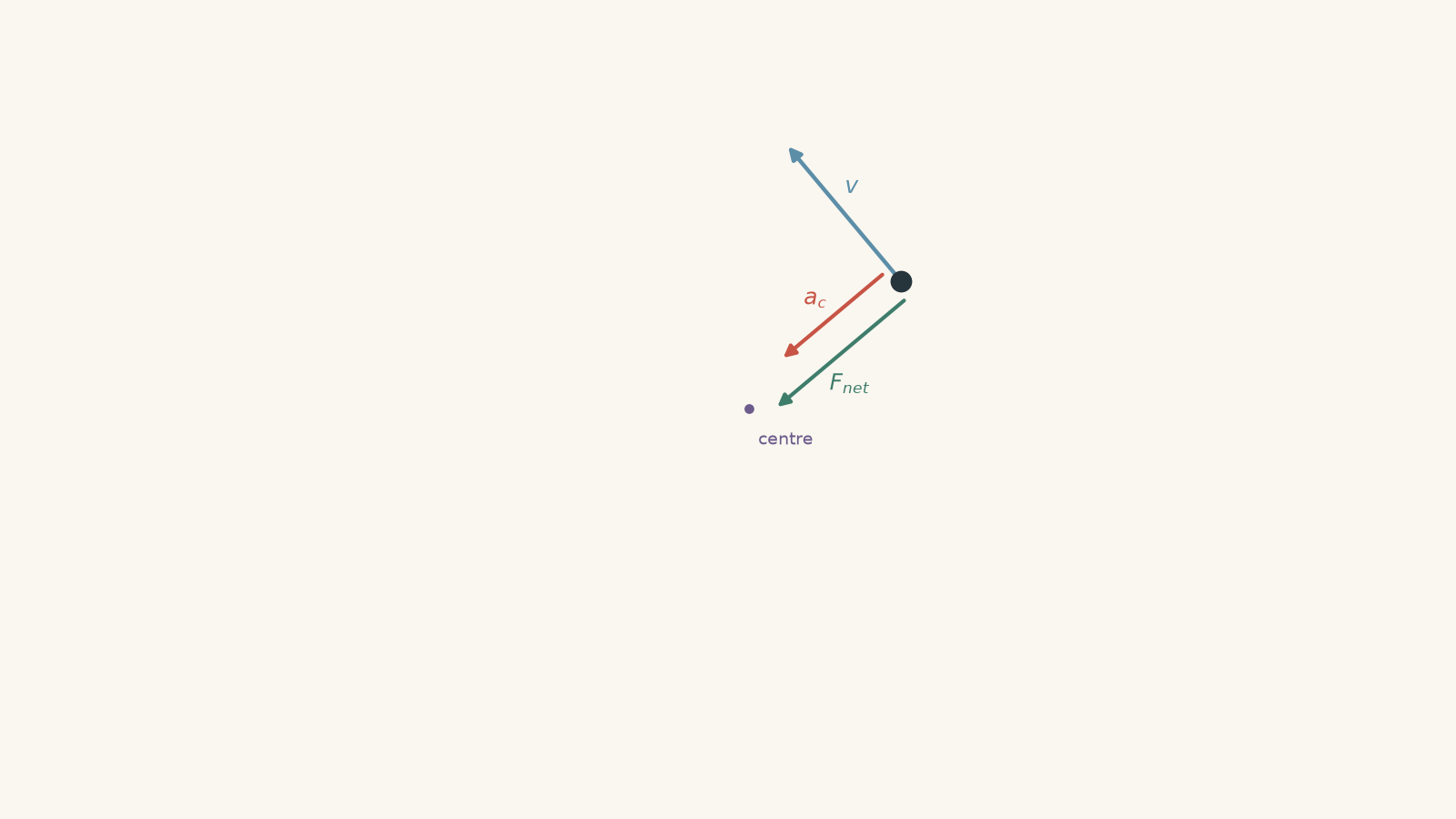
At every point:
- velocity is tangent to the circle;
- centripetal acceleration points towards the centre;
- the net force causing that acceleration also points towards the centre.
If the inward force suddenly disappears, the object does not shoot radially outwards. It continues in the direction it was already moving: along the tangent to the circle.
That follows directly from Newton’s first law.
If you want to strengthen the acceleration part of this picture first, see Centripetal Acceleration: Why It Points Inward in HSC Physics.
02From centripetal acceleration to centripetal force
For an object travelling at speed \(v\) in a circle of radius \(r\), its centripetal acceleration has magnitude
\[ a_c=\frac{v^2}{r} \]
where:
- \(a_c\) is the centripetal acceleration in \(\text{m s}^{-2}\),
- \(v\) is the speed in \(\text{m s}^{-1}\),
- \(r\) is the radius of the circular path in metres.
Newton’s second law tells us that
\[ F_{\text{net}}=ma \]
so the required net inward force is
\[ F_c=\frac{mv^2}{r} \]
where \(F_c\) is the centripetal force in newtons and \(m\) is the object’s mass in kilograms.
A more precise way to write the same idea is
\[ \sum F_{\text{inward}}=\frac{mv^2}{r} \]
That notation is often more useful in HSC questions because it reminds you that several real forces may contribute to the inward net force.
03Centripetal force is a job, not a new force
Think of “centripetal force” as a job description.
If someone says, “the person holding the door open”, that does not tell you whether the person is your friend, a teacher, or somebody awkwardly trapped there while ten people walk through without saying thanks. It tells you the job they are doing.
“Centripetal force” works the same way. The job is:
produce a net force towards the centre of the circular path.
The actual force doing that job depends on the situation.
The analogy stops there. Real forces are vectors, so their directions and components have to be added mathematically.
| Situation | Real force or forces providing the inward net force |
|---|---|
| Car turning on a flat road | Static friction |
| Satellite in circular orbit | Gravity |
| Ball swung horizontally on a string | Tension, or a component of tension |
| Roller-coaster car at the bottom of a loop | Normal force and gravity combine to give the net inward force |
| Object on a rotating platform | Usually static friction |
This is one of the most important decision rules in circular-motion questions:
- Find the centre of the circular path.
- Decide which direction is inward at the instant shown.
- Draw the real forces.
- Resolve those real forces in the inward direction.
- Set their net inward value equal to \(\frac{mv^2}{r}\).
Do not draw a separate arrow labelled “centripetal force” if you have already drawn the real forces. You would be counting the same physical effect twice.
Worked example: A car turning on a flat road
A \(900\text{ kg}\) car travels around a flat circular bend of radius \(35\text{ m}\) at \(14\text{ m s}^{-1}\). Calculate the horizontal force required to keep the car moving in the circle, and identify the force that supplies it.
Step 1
The required net force points horizontally towards the centre of the bend. On a flat road, the force that can act sideways on the tyres is static friction.
Step 2
\[ F_c=\frac{mv^2}{r} =\frac{(900)(14^2)}{35} =5040\text{ N} \]
Step 3
The road exerts a static friction force of
\[ 5.04\times10^3\text{ N} \]
towards the centre of the bend.
Notice that “centripetal force” and “friction force” are not two different forces here. The friction force is the centripetal force.
04What the equation tells you before you calculate
The equation
\[ F_c=\frac{mv^2}{r} \]
contains several useful predictions.
If the mass doubles while \(v\) and \(r\) stay fixed, the required force doubles.
If the radius doubles while \(m\) and \(v\) stay fixed, the required force halves.
Speed is more dramatic. If the speed doubles,
\[ F_c\propto v^2 \]
so the required force becomes four times as large.
That is one reason taking a bend at 100 km/h is not merely “twice as demanding” as taking the same bend at 50 km/h. In the simple circular-motion model, the required sideways force is four times as large.
05When more than one force acts radially
Here is where many centripetal-force questions become interesting.
Consider a ball on a string moving through the bottom of a vertical circle. At that instant, the centre of the circle is above the ball.
Predict which force is larger: the string tension or the required centripetal force.
The tension must actually be larger.
Why? Tension points upwards, towards the centre, but weight points downwards, away from the centre. Their difference produces the required inward net force.
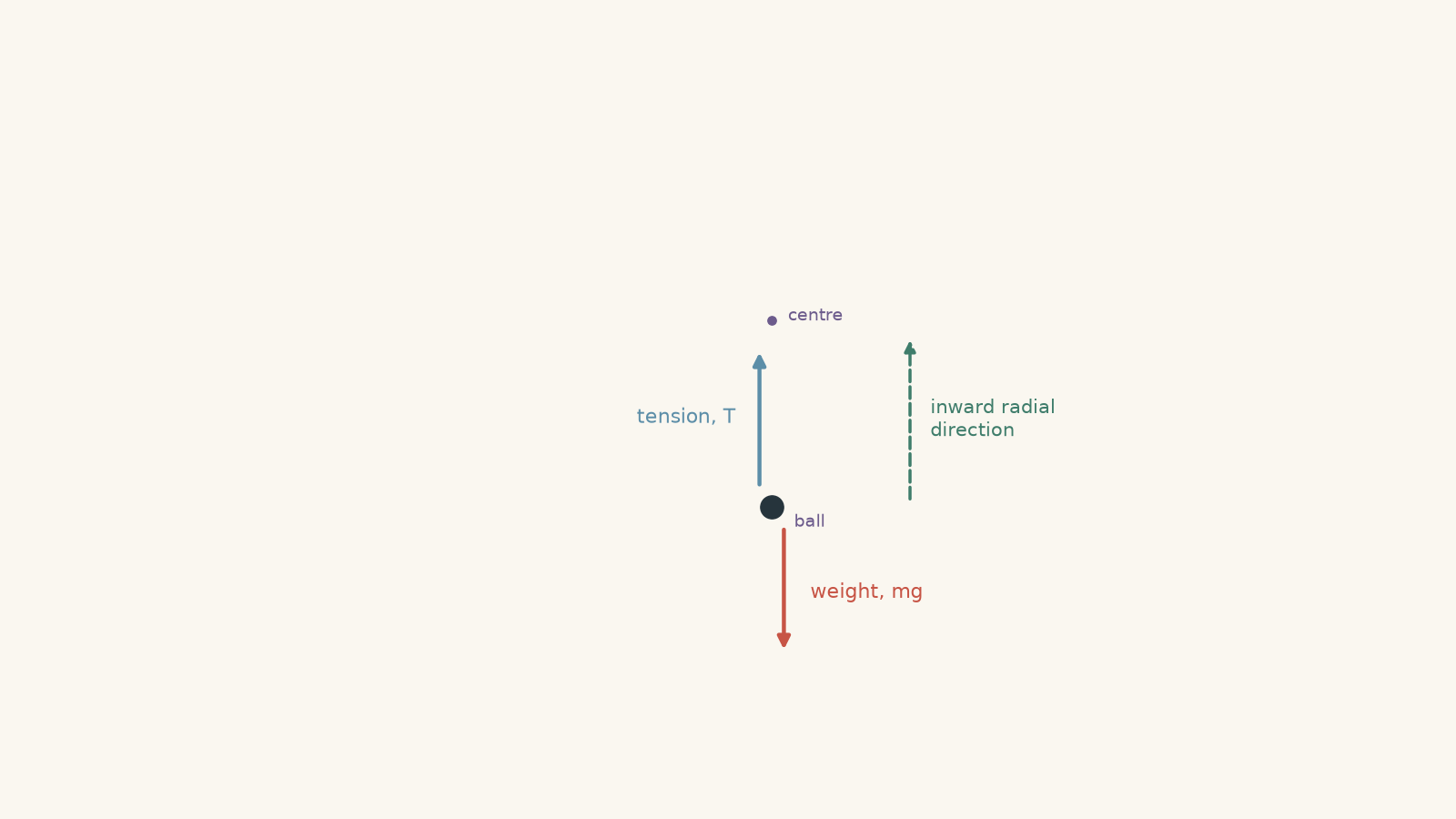
Taking inward as positive,
\[ T-mg=\frac{mv^2}{r} \]
so
\[ T=\frac{mv^2}{r}+mg \]
The tension itself is therefore not equal to the centripetal force.
Worked example: Tension at the bottom of a vertical circle
A \(0.50\text{ kg}\) ball moves through the bottom of a vertical circle of radius \(0.80\text{ m}\) at \(6.0\text{ m s}^{-1}\). Calculate the tension in the string. Use \(g=9.8\text{ m s}^{-2}\).
Step 1
At the bottom of the circle, inward is upwards.
Tension acts upwards, while weight acts downwards.
Step 2
\[ T-mg=\frac{mv^2}{r} \]
Step 3
\[ T-(0.50)(9.8) =\frac{(0.50)(6.0^2)}{0.80} \]
The required net inward force is
\[ \frac{(0.50)(36)}{0.80}=22.5\text{ N} \]
and the weight is
\[ mg=(0.50)(9.8)=4.9\text{ N} \]
Therefore,
\[ T=22.5+4.9=27.4\text{ N} \]
Step 4
The tension is \(27.4\text{ N}\), even though the required centripetal force is only \(22.5\text{ N}\).
The extra \(4.9\text{ N}\) is needed to overcome the ball’s downward weight before there can be a net force of \(22.5\text{ N}\) upwards.
06The direction changes around a vertical circle
Do not memorise one formula such as \(T-mg=\frac{mv^2}{r}\) and use it everywhere.
The forces stay physically the same, but the direction towards the centre changes as the object moves.
For a ball on a string:
| Position | Inward direction | Radial equation |
|---|---|---|
| Bottom | Up | \(T-mg=\frac{mv^2}{r}\) |
| Top | Down | \(T+mg=\frac{mv^2}{r}\) |
| Side | Horizontal | Tension and the radial component of other forces must be considered |
At the top, gravity helps provide the centripetal force. At the bottom, gravity opposes it.
That is why identifying “inward” before writing an equation is safer than trying to remember a collection of separate formulas.
07The most tempting mistakes
Mistake 1: Adding a separate centripetal-force arrow
Suppose a car turns because of friction. A common free-body diagram shows friction pointing inward and then adds another inward arrow labelled \(F_c\).
That double-counts the force.
The correct statement is
\[ F_{\text{friction}}=\frac{mv^2}{r} \]
when friction is the only horizontal force.
Mistake 2: Thinking constant speed means zero acceleration
Acceleration means change in velocity, not just change in speed.
Velocity includes direction. An object moving at constant speed around a circle is continually changing direction, so it is continually accelerating.
Mistake 3: Assuming \(F_c\) must be one individual force
Sometimes one force supplies the whole inward force. Sometimes several forces combine.
At the top of a vertical circle, for example,
\[ mg+T=\frac{mv^2}{r} \]
if both weight and tension point towards the centre.
Mistake 4: Saying the object is thrown outwards when the force disappears
If a string breaks, the object leaves along the tangent at that instant.
An outward radial path would require the velocity itself to point radially outward just before the string broke. It does not.
08Questions and solutions
Question 1
A \(1500\text{ kg}\) car travels at \(12\text{ m s}^{-1}\) around a flat circular bend of radius \(60\text{ m}\).
Calculate the centripetal force required and identify the real force that provides it.
Solution 1
The required centripetal force is \(3.60\times10^3\text{ N}\) towards the centre, supplied by static friction between the tyres and the road.
The required net inward force is
\[ F_c=\frac{mv^2}{r} \]
Substituting,
\[ F_c =\frac{(1500)(12^2)}{60} =\frac{(1500)(144)}{60} =3600\text{ N} \]
So,
\[ F_c=3.60\times10^3\text{ N} \]
On a flat road, neither weight nor the normal force has a horizontal component. Static friction therefore supplies the horizontal inward force.
The tempting mistake is to say that friction and centripetal force both act inward. They are not two separate forces here. Static friction is providing the required centripetal force.
Question 2
A \(0.25\text{ kg}\) ball on a string moves through the top of a vertical circle of radius \(0.75\text{ m}\) at \(4.5\text{ m s}^{-1}\).
Calculate the tension in the string. If the string breaks at that instant, state the ball’s initial direction of motion after the break. Use \(g=9.8\text{ m s}^{-2}\).
Solution 2
The tension is \(4.30\text{ N}\), and immediately after the string breaks the ball moves horizontally along the tangent to the circle.
At the top of the circle, inward is downwards. Both tension and weight point towards the centre.
Therefore,
\[ T+mg=\frac{mv^2}{r} \]
The required centripetal force is
\[ \frac{mv^2}{r} = \frac{(0.25)(4.5^2)}{0.75} = 6.75\text{ N} \]
The ball’s weight is
\[ mg=(0.25)(9.8)=2.45\text{ N} \]
Hence,
\[ T+2.45=6.75 \]
so
\[ T=4.30\text{ N} \]
A student might set \(T=\frac{mv^2}{r}\), giving \(6.75\text{ N}\). That misses the contribution of gravity. At the top, gravity already provides \(2.45\text{ N}\) of the required inward force.
If the string breaks, the tension disappears. The ball’s velocity does not suddenly rotate outwards. Its instantaneous velocity is tangent to the circle, which at the top is horizontal. Gravity then curves the subsequent path downwards.
Question 3
A car travels around a flat circular road of radius \(50\text{ m}\). The coefficient of static friction between the tyres and the road is \(0.55\).
Calculate the maximum speed at which the car can travel without slipping. Explain why the car’s mass does not affect this maximum speed. Use \(g=9.8\text{ m s}^{-2}\).
Solution 3
The maximum speed is approximately \(16.4\text{ m s}^{-1}\), and the mass does not affect it because both the maximum available friction and the required centripetal force are proportional to mass.
At the limiting speed, static friction has reached its maximum value:
\[ F_{\text{friction,max}}=\mu_sN \]
On a flat road,
\[ N=mg \]
so
\[ F_{\text{friction,max}}=\mu_smg \]
At the maximum speed, this provides the required centripetal force:
\[ \mu_smg=\frac{mv^2}{r} \]
Cancel \(m\):
\[ \mu_sg=\frac{v^2}{r} \]
Therefore,
\[ v=\sqrt{\mu_sgr} \]
Substituting,
\[ v =\sqrt{(0.55)(9.8)(50)} =\sqrt{269.5} \approx16.4\text{ m s}^{-1} \]
The mass cancels because a heavier car requires a larger inward force, but it also has a proportionally larger normal force and therefore a proportionally larger maximum static friction force in this model.
A common trap is to write \(F_{\text{friction}}=\mu_sN\) for every turn. Static friction is only equal to \(\mu_sN\) when it is at its limiting value. At a slower speed, the required friction force is smaller.
Question 4
A \(0.20\text{ kg}\) mass is attached to a \(1.00\text{ m}\) string and moves as a conical pendulum. It completes one horizontal revolution every \(1.50\text{ s}\).
The string makes an angle \(\theta\) with the vertical.
Calculate:
a. the angle \(\theta\);
b. the radius of the circular path;
c. the speed of the mass;
d. the tension in the string.
A second bob with twice the mass is then attached to a string of the same length and made to rotate with the same period. Determine whether its angle will be larger, smaller, or unchanged.
Use \(g=9.8\text{ m s}^{-2}\).
Solution 4
The angle is approximately \(56.1^\circ\), the circular radius is \(0.830\text{ m}\), the speed is \(3.48\text{ m s}^{-1}\), and the tension is \(3.51\text{ N}\). Doubling the mass does not change the angle if the period and string length remain unchanged.
The difficult part is recognising that the whole tension is not the centripetal force.
The vertical component of tension balances weight:
\[ T\cos\theta=mg \]
The horizontal component supplies the centripetal force:
\[ T\sin\theta=\frac{mv^2}{r} \]
The angular speed is
\[ \omega=\frac{2\pi}{P} \]
where \(P=1.50\text{ s}\). Therefore,
\[ \omega = \frac{2\pi}{1.50} \approx4.19\text{ rad s}^{-1} \]
Because
\[ v=\omega r \]
the horizontal force equation can be written as
\[ T\sin\theta=m\omega^2r \]
The radius of the horizontal circle is
\[ r=L\sin\theta \]
where \(L=1.00\text{ m}\). Therefore,
\[ T\sin\theta = m\omega^2L\sin\theta \]
For the non-zero angle shown, \(\sin\theta\) cancels:
\[ T=m\omega^2L \]
Using the vertical equation,
\[ m\omega^2L\cos\theta=mg \]
Cancel \(m\):
\[ \cos\theta=\frac{g}{\omega^2L} \]
Substituting,
\[ \cos\theta = \frac{9.8}{(4.19)^2(1.00)} \approx0.558 \]
so
\[ \theta\approx56.1^\circ \]
The radius is
\[ r=L\sin\theta =(1.00)\sin56.1^\circ \approx0.830\text{ m} \]
The speed is
\[ v=\omega r =(4.19)(0.830) \approx3.48\text{ m s}^{-1} \]
The tension can be found from
\[ T\cos\theta=mg \]
so
\[ T = \frac{(0.20)(9.8)}{\cos56.1^\circ} \approx3.51\text{ N} \]
For the second bob,
\[ \cos\theta=\frac{g}{\omega^2L} \]
contains no mass. Since its period is unchanged, \(\omega\) is unchanged, and \(L\) is also unchanged. Its angle is therefore still approximately \(56.1^\circ\).
The tempting route is to treat \(T=\frac{mv^2}{r}\). That would ignore the fact that tension also needs a vertical component to balance weight. Only the horizontal component of tension is centripetal.
Question 5
A roller-coaster car travels on the inside of a frictionless vertical circular loop of radius \(12.0\text{ m}\).
At the bottom of the loop, the normal force exerted by the track on the car is \(5mg\), where \(m\) is the car’s mass.
Let \(\theta\) be the angle measured around the loop from the bottom, so \(\theta=0^\circ\) at the bottom and \(\theta=180^\circ\) at the top.
Determine:
a. the car’s speed at the bottom;
b. whether the car remains in contact with the track all the way to the top;
c. if it loses contact, the value of \(\theta\) at which this happens and its speed at that instant;
d. why continuing the circular-motion calculation beyond that point can produce a mathematically possible but physically impossible result.
Use \(g=9.8\text{ m s}^{-2}\).
Solution 5
The car’s bottom speed is about \(21.7\text{ m s}^{-1}\), it loses contact before reaching the top, detachment occurs at approximately \(132^\circ\) from the bottom, and its speed at detachment is about \(8.85\text{ m s}^{-1}\). Beyond that point, a calculation that requires a negative normal force is physically impossible because the track cannot pull the car towards itself.
At the bottom, inward is upwards. The normal force points upwards and weight points downwards, so
\[ N-mg=\frac{mv_b^2}{r} \]
Given \(N=5mg\),
\[ 5mg-mg=\frac{mv_b^2}{r} \]
Therefore,
\[ 4mg=\frac{mv_b^2}{r} \]
Cancel \(m\):
\[ v_b^2=4gr \]
Substituting \(g=9.8\text{ m s}^{-2}\) and \(r=12.0\text{ m}\),
\[ v_b = \sqrt{4(9.8)(12.0)} \approx21.7\text{ m s}^{-1} \]
Now consider the car at an angle \(\theta\).
Its height above the bottom is
\[ h=r(1-\cos\theta) \]
Because the track is frictionless, mechanical energy is conserved:
\[ \frac12mv_b^2 = \frac12mv^2+mgh \]
Substituting \(v_b^2=4gr\) and \(h=r(1-\cos\theta)\),
\[ \frac12m(4gr) = \frac12mv^2 + mgr(1-\cos\theta) \]
After simplifying,
\[ v^2=2gr(1+\cos\theta) \]
Now apply Newton’s second law in the inward radial direction.
At angle \(\theta\), the radial equation is
\[ N-mg\cos\theta=\frac{mv^2}{r} \]
The car loses contact at the exact instant the normal force falls to zero. A contact force can push the car, but it cannot become negative and pull the car back towards the track.
Set \(N=0\):
\[ -mg\cos\theta=\frac{mv^2}{r} \]
so
\[ v^2=-gr\cos\theta \]
At detachment, this must also satisfy the energy result
\[ v^2=2gr(1+\cos\theta) \]
Therefore,
\[ 2gr(1+\cos\theta)=-gr\cos\theta \]
Cancel \(gr\):
\[ 2(1+\cos\theta)=-\cos\theta \]
Hence,
\[ 2+3\cos\theta=0 \]
and
\[ \cos\theta=-\frac23 \]
Therefore,
\[ \theta=\cos^{-1}\left(-\frac23\right)\approx131.8^\circ \]
So the car loses contact at approximately
\[ 132^\circ \]
from the bottom, before reaching the top.
Its speed at detachment satisfies
\[ v^2=-gr\cos\theta \]
so
\[ v^2 = -(9.8)(12.0)\left(-\frac23\right) =78.4\text{ m}^2\text{s}^{-2} \]
Therefore,
\[ v\approx8.85\text{ m s}^{-1} \]
The subtle point is what happens next.
If you blindly keep forcing the car to follow the circular path in your equations, the calculated normal force eventually becomes negative. The algebra itself has not malfunctioned. The model has.
A normal force is a contact force. The track can push on the car, but it cannot pull the car inward once the car has separated from it. The condition \(N=0\) is therefore a physical boundary.
After detachment, the car no longer follows the circular track. Its velocity is tangent to the loop at the instant of separation, and gravity determines its subsequent projectile motion.
That is the deeper lesson behind centripetal-force problems: \(\frac{mv^2}{r}\) tells you the net inward force required if the object is following that circular path. You still have to check whether the real forces available can actually supply it.
09What this idea unlocks next
Once you are comfortable replacing the vague phrase “centripetal force” with
\[ \sum F_{\text{inward}}=\frac{mv^2}{r}, \]
more difficult circular-motion problems become much more systematic.
The next step is combining that radial force equation with other physics: conservation of energy in vertical circles, friction limits on bends, gravitational force in orbits, and the condition \(N=0\) or \(T=0\) when contact or a string constraint is about to fail. The calculation is usually not the hardest part. The real skill is deciding which actual forces can point towards the centre, and whether they are physically capable of supplying the required inward force.