
Aircraft in a Crosswind: Heading, Ground Track and Wind
Learn how air velocity and wind velocity combine to determine an aircraft's ground track. Includes worked HSC Physics examples, common misconceptions, and challenging practice.
An aircraft points due east, its engine holds a steady speed through the air, and yet someone watching from the ground sees it drift north-east.
Nothing has pushed the aircraft’s nose around. So how can it travel in a different direction from the one it is pointing?
Before reading on, make a prediction. Suppose the aircraft moves east through the surrounding air at \(80\text{ m s}^{-1}\), while the wind carries that air north at \(20\text{ m s}^{-1}\). Does someone on the ground see the aircraft moving east, north, or somewhere between the two?
Somewhere between. The aircraft has one velocity relative to the air, while the moving air itself has another velocity relative to the ground. The ground observer sees the combination.
That one idea explains the difference between an aircraft’s heading and its ground track.
01Start with two motions happening at once
Picture yourself walking straight across a moving walkway at an airport.
Relative to the walkway, you move directly sideways. But the walkway itself carries you forwards. Someone standing on the stationary floor sees you move diagonally.
An aircraft in wind works the same way:
- the aircraft moves relative to the surrounding air
- the air moves relative to the ground
- therefore, the aircraft moves relative to the ground with a velocity that combines both motions
The analogy is useful because it separates the two motions. It breaks down because real aircraft can change their speed and direction, while an airport walkway usually has a fixed motion. For HSC vector problems, though, the basic addition idea is exactly what we need.
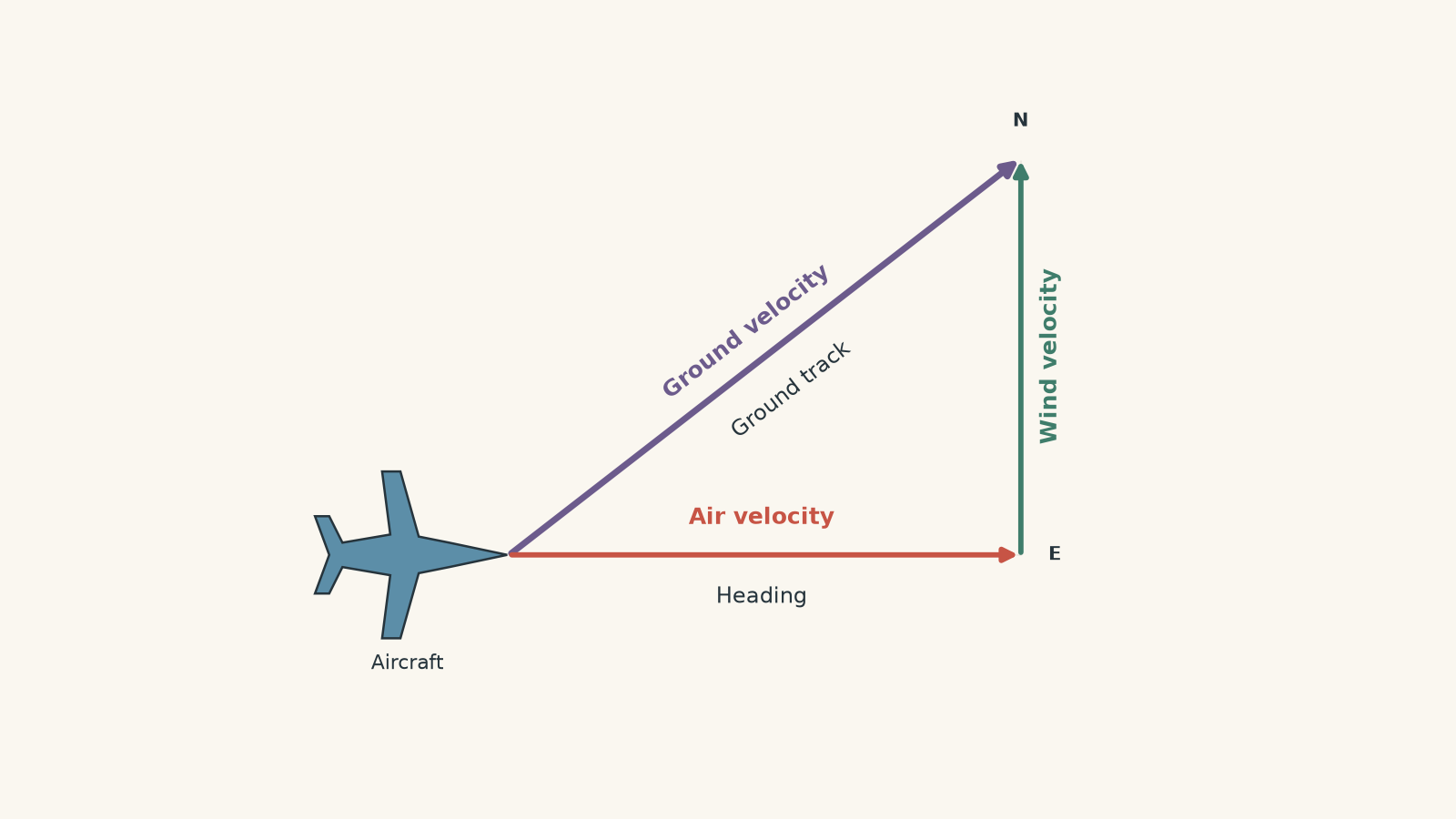
We can write the relationship as
\[
\vec v_{PG}=\vec v_{PA}+\vec v_{AG}
\]
where:
- \(\vec v_{PG}\) is the velocity of the plane relative to the ground
- \(\vec v_{PA}\) is the velocity of the plane relative to the air
- \(\vec v_{AG}\) is the velocity of the air relative to the ground, which is the wind velocity
The subscripts are worth reading literally. \(PG\) means “plane relative to ground”. \(PA\) means “plane relative to air”. \(AG\) means “air relative to ground”.
This is a vector equation. Directions matter just as much as magnitudes.
02Heading and ground track are not the same thing
The heading is the direction the aircraft points.
In the simplified HSC model, the aircraft’s velocity relative to the air, \(\vec v_{PA}\), is in the heading direction.
The ground track is the direction the aircraft actually moves across Earth’s surface. It is the direction of \(\vec v_{PG}\).
With no wind,
\[
\vec v_{AG}=0
\]
so
\[
\vec v_{PG}=\vec v_{PA}
\]
and heading and ground track are the same.
With a crosswind, they generally aren’t.
This distinction is easy to miss because in many earlier mechanics questions an object’s direction of motion is simply the direction it is travelling. Here we have to ask: travelling relative to what?
That phrase, “relative to”, is doing most of the physics.
03Worked example: What path does an eastbound aircraft actually follow?
An aircraft has a velocity of \(80\text{ m s}^{-1}\) due east relative to the air. The wind velocity is \(20\text{ m s}^{-1}\) due north. Find the aircraft’s ground speed and the direction of its ground track.
Step 1
The plane’s velocity relative to the air is
\[
\vec v_{PA}=80\text{ m s}^{-1}\text{ east}
\]
and the wind velocity is
\[
\vec v_{AG}=20\text{ m s}^{-1}\text{ north}.
\]
Because east and north are perpendicular, these vectors form the two shorter sides of a right-angled triangle.
Step 2
Using Pythagoras,
\[
\begin{aligned}
v_{PG}
&=\sqrt{(80)^2+(20)^2}\\
&=\sqrt{6800}\\
&=82.5\text{ m s}^{-1}.
\end{aligned}
\]
Step 3
Let \(\theta\) be the angle north of east.
\[
\begin{aligned}
\tan\theta&=\frac{20}{80}\\
\theta&=\tan^{-1}(0.25)\\
&=14.0^\circ.
\end{aligned}
\]
So the aircraft’s ground velocity is approximately
\[
\boxed{82.5\text{ m s}^{-1}\text{ at }14.0^\circ\text{ north of east}}.
\]
The aircraft is still heading east, because that is where its nose and air velocity point. Its ground track is \(14.0^\circ\) north of east because the moving air carries it north while it flies east through that air.
Notice something slightly surprising: the ground speed is greater than the aircraft’s \(80\text{ m s}^{-1}\) airspeed. The crosswind has added another velocity component, so the magnitude of the resultant is larger.
04Why pilots point into a crosswind
Suppose the aircraft in the previous example actually needs to follow an eastward ground track.
Pointing east won’t work. The northerly wind component will cause drift.
What should the pilot do?
A tempting prediction is that the aircraft should point south-east, and that’s correct. It must have a southward component of air velocity that exactly cancels the northward wind velocity.
This is called wind correction.
The important idea is not “turn against the wind” as a memorised rule. The exact requirement is
\[
\text{sideways aircraft velocity component}+\text{sideways wind velocity}=0.
\]
If those components cancel, the resultant ground velocity has no sideways component.
Imagine arranging a slightly awkward first date where one person keeps wandering north while the other keeps pulling the conversation south. If those tendencies are equal and opposite, the pair can somehow keep moving east. The analogy represents vector components cancelling. It stops being useful once we start asking why either person is walking like that.
05Worked example: What heading keeps the aircraft on an eastward track?
An aircraft has an airspeed of \(100\text{ m s}^{-1}\). A wind blows north at \(30\text{ m s}^{-1}\). The pilot wants the aircraft’s ground track to be due east. Find the required heading and the resulting ground speed.
Step 1
The wind contributes \(30\text{ m s}^{-1}\) north.
For the resultant ground velocity to be due east, the aircraft’s velocity relative to the air must therefore have a component of
\[
30\text{ m s}^{-1}
\]
south.
Let \(\theta\) be the angle that the aircraft must head south of east.
Its total airspeed is \(100\text{ m s}^{-1}\), so
\[
100\sin\theta=30.
\]
Step 2
\[
\begin{aligned}
\sin\theta&=\frac{30}{100}\\
\theta&=\sin^{-1}(0.30)\\
&=17.5^\circ.
\end{aligned}
\]
The required heading is therefore
\[
\boxed{17.5^\circ\text{ south of east}}.
\]
Step 3
The aircraft’s eastward component is
\[
\begin{aligned}
v_{\text{east}}
&=100\cos(17.5^\circ)\\
&=95.4\text{ m s}^{-1}.
\end{aligned}
\]
The wind has no east-west component, so this is also the aircraft’s ground speed.
Therefore,
\[
\boxed{v_{PG}=95.4\text{ m s}^{-1}\text{ due east}}.
\]
The pilot points \(17.5^\circ\) south of east, but the aircraft travels due east across the ground.
There is also an important trade-off here. Some of the aircraft’s fixed \(100\text{ m s}^{-1}\) airspeed has been used to cancel the crosswind, leaving only \(95.4\text{ m s}^{-1}\) available in the eastward direction.
06Components make crosswind problems much easier
For simple perpendicular vectors, a triangle is often enough. For less convenient directions, resolve each velocity into components.
Choose positive \(x\) as east and positive \(y\) as north.
Then
\[
v_{PG,x}=v_{PA,x}+v_{AG,x}
\]
and
\[
v_{PG,y}=v_{PA,y}+v_{AG,y}.
\]
Once the resultant components are known, its magnitude is
\[
v_{PG}=\sqrt{v_{PG,x}^{\,2}+v_{PG,y}^{\,2}}
\]
and its direction can be found using trigonometry.
For example, if
\[
v_{PG,x}=70\text{ m s}^{-1}
\]
and
\[
v_{PG,y}=25\text{ m s}^{-1},
\]
then
\[
v_{PG}=\sqrt{70^2+25^2}=74.3\text{ m s}^{-1}.
\]
The angle north of east is
\[
\theta=\tan^{-1}\left(\frac{25}{70}\right)=19.7^\circ.
\]
So the velocity is \(74.3\text{ m s}^{-1}\) at \(19.7^\circ\) north of east.
The main decision is always the same: resolve the velocities relative to the same coordinate directions, then add matching components.
07Be careful with the direction of the wind
In a physics calculation, a wind velocity vector must describe the direction the air is actually moving.
So if the air moves north at \(20\text{ m s}^{-1}\), then
\[
\vec v_{AG}=20\text{ m s}^{-1}\text{ north}.
\]
Everyday and meteorological wind descriptions can use the direction the wind comes from. For example, a “southerly” wind generally comes from the south and moves towards the north.
That wording can create an avoidable sign error.
In an HSC calculation, translate the description into an actual vector before doing any mathematics:
Which way is the air moving?
Once you know that, draw the arrow in that direction.
08The most common misconception: the wind pushes the plane sideways
Saying “the wind pushes the plane north” can sometimes help you picture the result, but it isn’t the cleanest model for these relative-velocity questions.
The equation
\[
\vec v_{PG}=\vec v_{PA}+\vec v_{AG}
\]
is about velocities measured in different reference frames. It isn’t a force equation.
That distinction matters because velocity and force answer different questions.
A velocity calculation tells you how the aircraft’s motion relative to the air combines with the air’s motion relative to the ground.
A force calculation would involve quantities such as lift, drag, thrust, acceleration, and Newton’s laws. Those are important for understanding how an aircraft establishes or changes its velocity, but they are not required just to convert air velocity into ground velocity.
So don’t automatically draw a “wind force” and try to use \(F=ma\). If the problem gives velocities and asks about heading, track, or ground speed, it is usually a vector addition problem.
09A useful limiting case
Suppose an aircraft has an airspeed of \(50\text{ m s}^{-1}\), and a crosswind moves north at \(60\text{ m s}^{-1}\). Can the pilot choose a heading that produces a ground track due east?
Predict before calculating.
To travel due east, the aircraft would need a southward air-velocity component of \(60\text{ m s}^{-1}\) to cancel the wind.
But the aircraft’s entire airspeed is only \(50\text{ m s}^{-1}\).
No component of a \(50\text{ m s}^{-1}\) vector can have magnitude \(60\text{ m s}^{-1}\).
So it is impossible.
Mathematically, we would need
\[
50\sin\theta=60,
\]
which gives
\[
\sin\theta=1.2.
\]
There is no real angle with a sine greater than 1.
This is more than a calculator error. It has a physical meaning: the aircraft cannot generate enough sideways air velocity to cancel the wind.
That is exactly the kind of limiting-case reasoning that turns vector calculations into physics.
10A reliable method for HSC questions
When you see an aircraft and wind question, use this sequence:
State the reference frames. Identify the aircraft’s velocity relative to the air and the air’s velocity relative to the ground.
Write the vector relationship.
\[
\vec v_{PG}=\vec v_{PA}+\vec v_{AG}
\]
Choose coordinates. East-west and north-south are usually convenient.
Resolve angled vectors into components.
Add components with signs. South and west components will be negative if north and east are positive.
Find the magnitude and direction of the resultant if required.
Interpret the direction. Say explicitly whether it is the heading or the ground track.
The last step prevents a surprisingly common mistake: getting the triangle right and then naming the wrong angle.
11Questions and solutions
Question 1
An aircraft points due north and travels at \(90\text{ m s}^{-1}\) relative to the air. The wind moves east at \(40\text{ m s}^{-1}\).
Find the aircraft’s ground speed and ground-track direction.
Solution 1
The aircraft travels at approximately \(\boxed{98.5\text{ m s}^{-1}}\), on a ground track \(\boxed{24.0^\circ\text{ east of north}}\).
The aircraft’s air velocity and the wind velocity are perpendicular:
\[
v_{PA}=90\text{ m s}^{-1}\text{ north}
\]
and
\[
v_{AG}=40\text{ m s}^{-1}\text{ east}.
\]
Using
\[
\vec v_{PG}=\vec v_{PA}+\vec v_{AG},
\]
the magnitude of the ground velocity is
\[
\begin{aligned}
v_{PG}
&=\sqrt{90^2+40^2}\\
&=\sqrt{9700}\\
&=98.5\text{ m s}^{-1}.
\end{aligned}
\]
Let \(\theta\) be the angle east of north. Then
\[
\begin{aligned}
\tan\theta&=\frac{40}{90}\\
\theta&=\tan^{-1}\left(\frac{40}{90}\right)\\
&=24.0^\circ.
\end{aligned}
\]
The aircraft’s heading remains due north, but its ground track is \(24.0^\circ\) east of north. The trap is to assume that the direction the aircraft points must also be the direction it moves relative to the ground.
Question 2
An aircraft has an airspeed of \(150\text{ m s}^{-1}\). A wind moves west at \(45\text{ m s}^{-1}\). The pilot wants a ground track due north.
Find:
a. the required heading, expressed as an angle east of north
b. the resulting ground speed.
Solution 2
The required heading is \(\boxed{17.5^\circ\text{ east of north}}\), and the resulting ground speed is approximately \(\boxed{143\text{ m s}^{-1}}\).
For a due-north ground track, the aircraft’s east-west ground-velocity component must be zero.
The wind contributes
\[
45\text{ m s}^{-1}\text{ west}.
\]
The aircraft must therefore provide an equal component,
\[
45\text{ m s}^{-1}\text{ east}.
\]
Let \(\theta\) be the aircraft’s heading angle east of north. With an airspeed of \(150\text{ m s}^{-1}\),
\[
\begin{aligned}
150\sin\theta&=45\\
\sin\theta&=0.300\\
\theta&=17.5^\circ.
\end{aligned}
\]
For part a,
\[
\boxed{\theta=17.5^\circ\text{ east of north}}.
\]
The northward component of the aircraft’s air velocity is
\[
\begin{aligned}
v_{\text{north}}
&=150\cos(17.5^\circ)\\
&=143\text{ m s}^{-1}.
\end{aligned}
\]
The wind has no north-south component, so
\[
\boxed{v_{PG}=143\text{ m s}^{-1}\text{ north}}.
\]
The ground speed is less than the airspeed because part of the aircraft’s air velocity is being used to cancel the sideways wind.
Question 3
An aircraft has an airspeed of \(120\text{ m s}^{-1}\) and is heading \(20^\circ\) north of east. At the same time, the wind velocity is \(35\text{ m s}^{-1}\) due south.
Determine the aircraft’s ground velocity, giving both its speed and direction.
Solution 3
The aircraft’s ground velocity is approximately \(\boxed{113\text{ m s}^{-1}}\) at \(\boxed{2.5^\circ\text{ south of east}}\).
Take east as positive \(x\) and north as positive \(y\).
The aircraft’s velocity relative to the air has components
\[
\begin{aligned}
v_{PA,x}&=120\cos20^\circ\\
&=112.8\text{ m s}^{-1},
\end{aligned}
\]
and
\[
\begin{aligned}
v_{PA,y}&=120\sin20^\circ\\
&=41.0\text{ m s}^{-1}.
\end{aligned}
\]
The wind velocity is due south, so
\[
v_{AG,x}=0
\]
and
\[
v_{AG,y}=-35\text{ m s}^{-1}.
\]
Adding matching components,
\[
\begin{aligned}
v_{PG,x}&=112.8+0\\
&=112.8\text{ m s}^{-1},
\end{aligned}
\]
and
\[
\begin{aligned}
v_{PG,y}&=41.0-35\\
&=6.0\text{ m s}^{-1}.
\end{aligned}
\]
This result is actually still slightly north of east, not south. Therefore the correct direction is found from
\[
\begin{aligned}
\theta
&=\tan^{-1}\left(\frac{6.0}{112.8}\right)\\
&=3.0^\circ.
\end{aligned}
\]
The ground speed is
\[
\begin{aligned}
v_{PG}
&=\sqrt{112.8^2+6.0^2}\\
&=113.0\text{ m s}^{-1}.
\end{aligned}
\]
Therefore,
\[
\boxed{v_{PG}\approx113\text{ m s}^{-1}\text{ at }3.0^\circ\text{ north of east}}.
\]
The important reasoning is in the signs. The aircraft’s heading gives it a \(41.0\text{ m s}^{-1}\) northward component, while the wind removes only \(35\text{ m s}^{-1}\) of that. A quick sketch or component check prevents the tempting but incorrect conclusion that any southerly wind must make the ground track point south of east.
Question 4
An aircraft can maintain an airspeed of \(70\text{ m s}^{-1}\). It needs to travel along a ground track due east. The wind moves due north.
For each wind speed below, determine whether a due-east ground track is possible. If it is possible, find the required heading.
a. \(42\text{ m s}^{-1}\)
b. \(70\text{ m s}^{-1}\)
c. \(75\text{ m s}^{-1}\)
Explain the physical reason for any case in which eastward travel is impossible.
Solution 4
A due-east track is possible in part a, produces a limiting zero-eastward-speed case in part b, and is impossible in part c.
For a due-east ground track, the aircraft must produce a southward air-velocity component equal in magnitude to the northward wind velocity.
For part a,
\[
70\sin\theta=42.
\]
Therefore,
\[
\begin{aligned}
\sin\theta&=0.600\\
\theta&=36.9^\circ.
\end{aligned}
\]
So the aircraft must head
\[
\boxed{36.9^\circ\text{ south of east}}.
\]
Its eastward ground speed would be
\[
\begin{aligned}
v_{PG}
&=70\cos36.9^\circ\\
&=56.0\text{ m s}^{-1}.
\end{aligned}
\]
For part b,
\[
70\sin\theta=70,
\]
so
\[
\sin\theta=1
\]
and
\[
\theta=90^\circ.
\]
The aircraft would have to point due south. Its entire \(70\text{ m s}^{-1}\) airspeed would be used to cancel the \(70\text{ m s}^{-1}\) northward wind.
Its eastward component would therefore be
\[
70\cos90^\circ=0.
\]
So its resultant ground velocity would be zero. It can avoid drifting north, but it cannot actually make progress east. This is the limiting case.
For part c, cancelling the wind would require
\[
70\sin\theta=75,
\]
or
\[
\sin\theta=\frac{75}{70}=1.07.
\]
No real angle satisfies this condition.
Therefore, a due-east ground track is
\[
\boxed{\text{impossible when the wind speed is }75\text{ m s}^{-1}}.
\]
The physical reason is that the aircraft would need a southward velocity component greater than its total \(70\text{ m s}^{-1}\) airspeed. No component of a vector can exceed the magnitude of that vector.
The subtle point is part b. Merely being able to cancel the sideways wind isn’t enough to guarantee useful travel along the desired track. At the exact limiting wind speed, nothing remains for forward motion.
Question 5
Two students analyse the same situation.
An aircraft has a velocity of \(100\text{ m s}^{-1}\) due east relative to the air. The wind moves north at \(25\text{ m s}^{-1}\).
Student A says:
“The aircraft must accelerate north because its ground velocity has a northward component.”
Student B says:
“The aircraft can have a constant northward component of ground velocity without having a northward acceleration.”
Which student is correct? Explain how the aircraft can move north-east at constant velocity even though its heading remains east.
Solution 5
\(\boxed{\text{Student B is correct.}}\)
A northward velocity component does not automatically require a northward acceleration.
The aircraft’s ground velocity is
\[
\vec v_{PG}=\vec v_{PA}+\vec v_{AG}.
\]
If both the aircraft’s air velocity and the wind velocity remain constant, then their vector sum is also constant.
The components are
\[
v_{PG,x}=100\text{ m s}^{-1}
\]
and
\[
v_{PG,y}=25\text{ m s}^{-1}.
\]
So the aircraft moves with a constant north-east ground velocity. Its acceleration relative to the ground is therefore
\[
\boxed{\vec a=0}.
\]
The heading can remain east because heading describes the direction of \(\vec v_{PA}\), the aircraft’s velocity relative to the surrounding air. The moving air itself carries the aircraft north relative to the ground.
Student A’s mistake is to confuse velocity with acceleration. An object does not need a force in the direction of every component of its velocity. Acceleration is required only when velocity changes.
12Where this idea leads next
Crosswind problems are one example of relative velocity, where different observers can measure different velocities for the same object.
Once you are comfortable reading an equation such as
\[
\vec v_{PG}=\vec v_{PA}+\vec v_{AG},
\]
the same reasoning can be used for boats crossing currents, people walking inside moving vehicles, and other motion viewed from different reference frames.
The useful habit is to stop asking only, “What is its velocity?” and instead ask, “Its velocity relative to what?”
That is the question that separates the aircraft’s heading from its actual track over the ground.