
Relativistic Momentum: How HSC Physics Explains the Speed Limit
Learn how the relativistic momentum equation changes at high speeds, and why a massive particle can approach but never reach the speed of light.
Suppose a proton is already travelling at \(0.90c\). You push it until it reaches \(0.99c\). Its speed has increased by only \(0.09c\), so you might expect its momentum to increase by roughly the same proportion.
It doesn’t. Its relativistic momentum rises from about \(2.06mc\) to \(7.02mc\), more than tripling. So what is changing, and why doesn’t continued acceleration eventually push the proton past \(c\)?
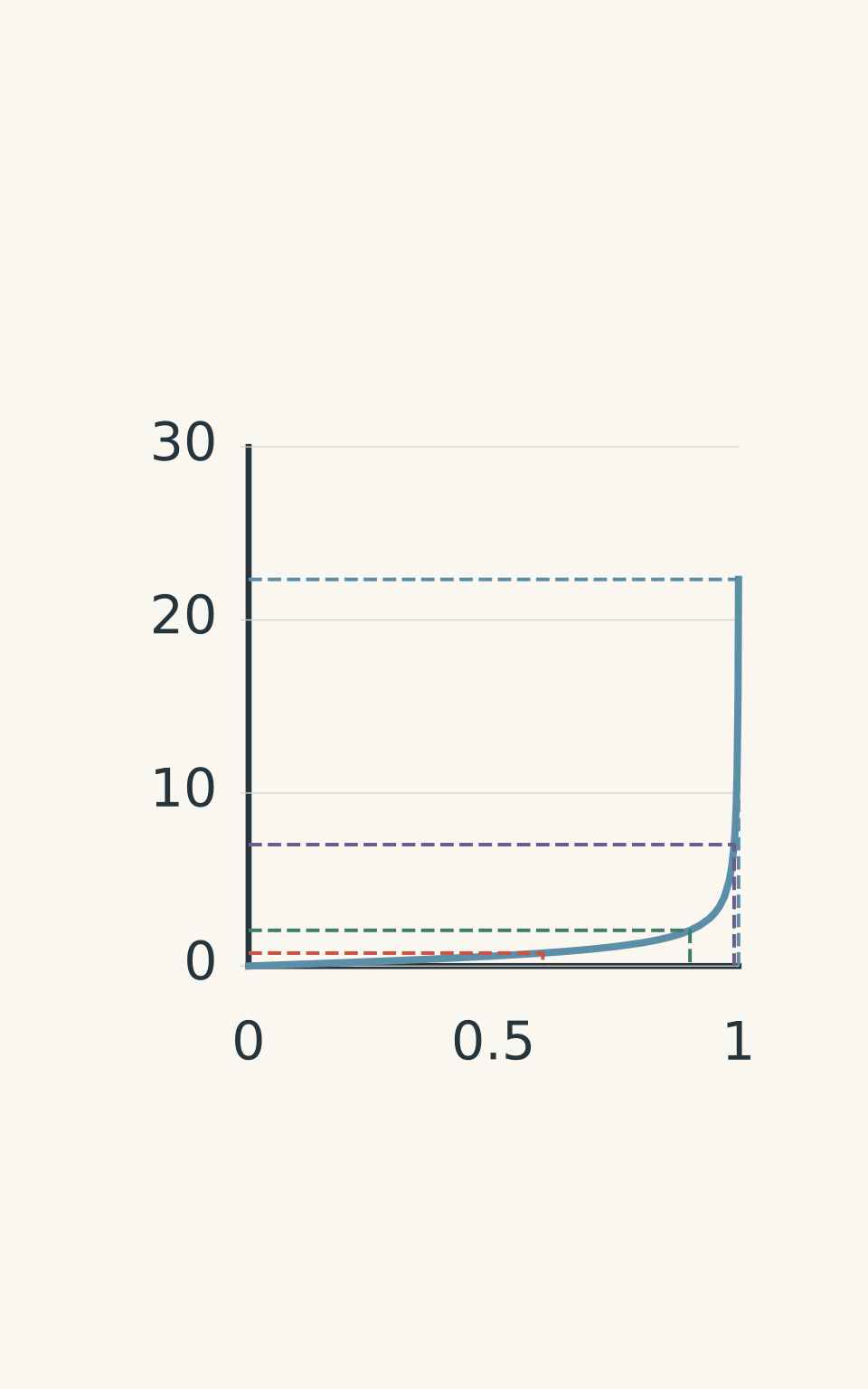
- Relativistic momentum
- 0.60
- 0.90
- 0.99
- 0.999
01Why \(p=mv\) stops being enough
The familiar momentum equation
\[ p=mv \]
works extremely well at ordinary speeds. Momentum \(p\) increases in direct proportion to velocity \(v\).
If a car doubles its speed, for example, its Newtonian momentum doubles.
But special relativity changes this relationship when the speed becomes a significant fraction of the speed of light. The HSC Physics formulae sheet includes the relativistic momentum relationship in its special-relativity section. (educationstandards.nsw.edu.au)
Before looking at the equation, make a prediction:
If an object is travelling at \(0.90c\), and you keep applying a force in the direction of motion, what should happen to its speed?
The tempting answer is that the speed should keep increasing at the same rate. That would be true if \(F=ma\) with a constant mass gave us the whole story.
It isn’t the whole story at relativistic speeds.
The better starting point is that force changes momentum. For a constant force over a time interval,
\[ \Delta p=F\Delta t \]
So you can keep adding momentum. The unusual part is what happens when that momentum is converted into speed.
02The relativistic momentum equation
For an object with rest mass \(m\), moving at speed \(v\),
\[ p = \frac{mv} {\sqrt{1-\frac{v^2}{c^2}}} \]
Here:
- \(p\) is relativistic momentum in \(\mathrm{kg\,m\,s^{-1}}\)
- \(m\) is the object’s rest mass in kg
- \(v\) is its speed in \(\mathrm{m\,s^{-1}}\)
- \(c\) is the speed of light in a vacuum, \(3.00\times10^8\ \mathrm{m\,s^{-1}}\)
NESA often writes the rest mass as \(m_0\). We will use \(m\) here to keep the algebra less cluttered.
The extra factor is sometimes written using the Lorentz factor, \(\gamma\):
\[ \gamma = \frac{1} {\sqrt{1-\frac{v^2}{c^2}}} \]
so that
\[ p=\gamma mv \]
The important point is that \(\gamma\) is not constant. It grows rapidly as \(v\) approaches \(c\).
A useful mental model
Imagine a very strange speed dial. At low speeds, turning the dial a little gives you a noticeable increase in speed. Near the red line at \(c\), each extra push gives you less and less extra speed.
The “extra difficulty” in this analogy is represented by the Lorentz factor \(\gamma\).
The analogy breaks here: relativity does not involve a physical brake or a machine resisting the object. The curve comes from the structure of special relativity. The momentum equation is one consequence of that structure.
03Reading the equation without getting lost
Look at
\[ p = \frac{mv} {\sqrt{1-\frac{v^2}{c^2}}} \]
There are two competing effects as \(v\) increases.
First, the numerator \(mv\) increases.
Second, the denominator gets smaller because \(v^2/c^2\) gets closer to 1.
So momentum increases faster than speed.
That is the key idea.
At \(v=0.60c\),
\[ \gamma = \frac{1}{\sqrt{1-0.60^2}} = 1.25 \]
At \(v=0.90c\),
\[ \gamma = \frac{1}{\sqrt{1-0.90^2}} \approx2.29 \]
At \(v=0.99c\),
\[ \gamma \approx7.09 \]
So relativity barely changes \(p=mv\) at low speeds, but the correction becomes enormous near \(c\).
| Speed | \(\gamma\) | \(p/(mc)\) |
|---|---|---|
| \(0.60c\) | 1.25 | 0.750 |
| \(0.90c\) | 2.29 | 2.06 |
| \(0.99c\) | 7.09 | 7.02 |
| \(0.999c\) | 22.4 | 22.3 |
The quantity \(p/(mc)\) is dimensionless, so it is a convenient way to compare momenta without choosing a particular particle.
Worked example: Find the momentum of a proton at \(0.60c\)
A proton has a rest mass of \(1.67\times10^{-27}\ \mathrm{kg}\) and moves at \(0.60c\). Calculate its relativistic momentum.
Step 1
\[ v = 0.60(3.00\times10^8) \]
\[ v = 1.80\times10^8\ \mathrm{m\,s^{-1}} \]
Step 2
\[ \sqrt{1-\frac{v^2}{c^2}} = \sqrt{1-0.60^2} \]
\[ =0.800 \]
Step 3
\[ p = \frac{(1.67\times10^{-27}) (1.80\times10^8)} {0.800} \]
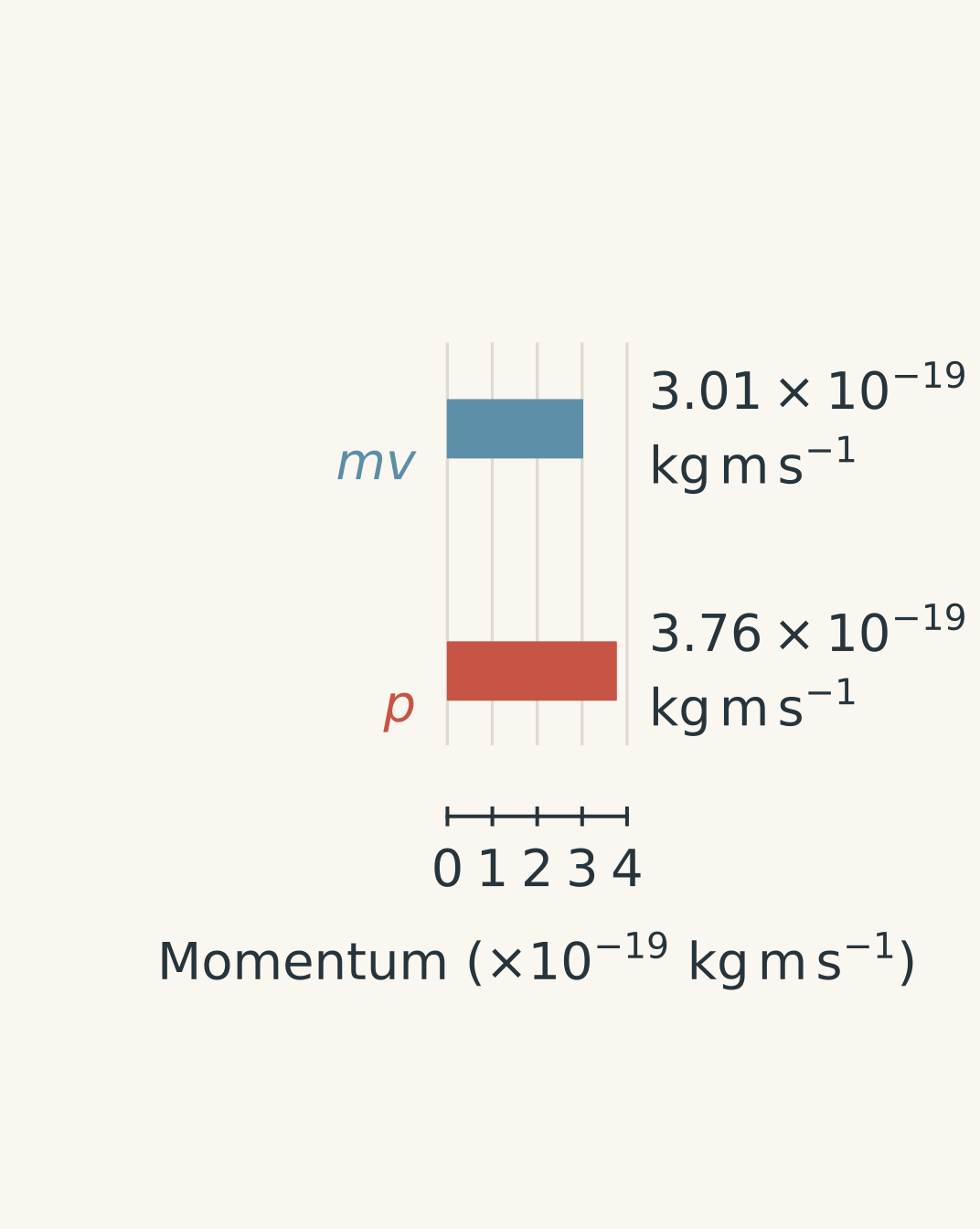
\[ p = 3.76\times10^{-19} \ \mathrm{kg\,m\,s^{-1}} \]
Step 4
The relativistic momentum is
\[ \boxed{3.76\times10^{-19}\ \mathrm{kg\,m\,s^{-1}}} \]
If you had incorrectly used \(p=mv\), you would get \(3.01\times10^{-19}\ \mathrm{kg\,m\,s^{-1}}\). At \(0.60c\), the classical calculation is already about 20% lower than the relativistic result.
04What if the momentum is given instead?
HSC questions can run the equation backwards.
It is useful to define
\[ \beta=\frac{v}{c} \]
Then the momentum equation becomes
\[ \frac{p}{mc} = \frac{\beta} {\sqrt{1-\beta^2}} \]
Rearranging gives
\[ \beta = \frac{p} {\sqrt{p^2+m^2c^2}} \]
and therefore
\[ v = c\frac{p} {\sqrt{p^2+m^2c^2}} \]
You don’t need to memorise this rearranged version if you can derive it, but it is a very useful way to check whether a calculated speed makes physical sense.
Worked example: Find the speed from momentum
A proton has a rest mass of \(1.67\times10^{-27}\ \mathrm{kg}\) and a relativistic momentum of \(4.00\times10^{-19}\ \mathrm{kg\,m\,s^{-1}}\). Find its speed as a fraction of \(c\).
Step 1
\[ \frac{p}{mc} = \frac{4.00\times10^{-19}} {(1.67\times10^{-27})(3.00\times10^8)} \]
\[ \frac{p}{mc} = 0.798 \]
Step 2
\[ 0.798 = \frac{\beta} {\sqrt{1-\beta^2}} \]
Square both sides:
\[ 0.637 = \frac{\beta^2} {1-\beta^2} \]
Step 3
\[ 0.637(1-\beta^2)=\beta^2 \]
\[ 0.637=1.637\beta^2 \]
\[ \beta^2=0.389 \]
so
\[ \beta=0.624 \]
Step 4
\[ v=0.624c \]
\[ v = 0.624(3.00\times10^8) \]
\[ v = 1.87\times10^8\ \mathrm{m\,s^{-1}} \]
The speed is therefore
\[ \boxed{0.624c} \]
or
\[ \boxed{1.87\times10^8\ \mathrm{m\,s^{-1}}} \]
The tempting mistake would be \(p=mv\), giving a result greater than \(c\). The relativistic equation prevents that because momentum is no longer directly proportional to speed.
05Why \(c\) is the speed limit
Now we can answer the original puzzle.
Take the relativistic momentum equation:
\[ p = \frac{mv} {\sqrt{1-\frac{v^2}{c^2}}} \]
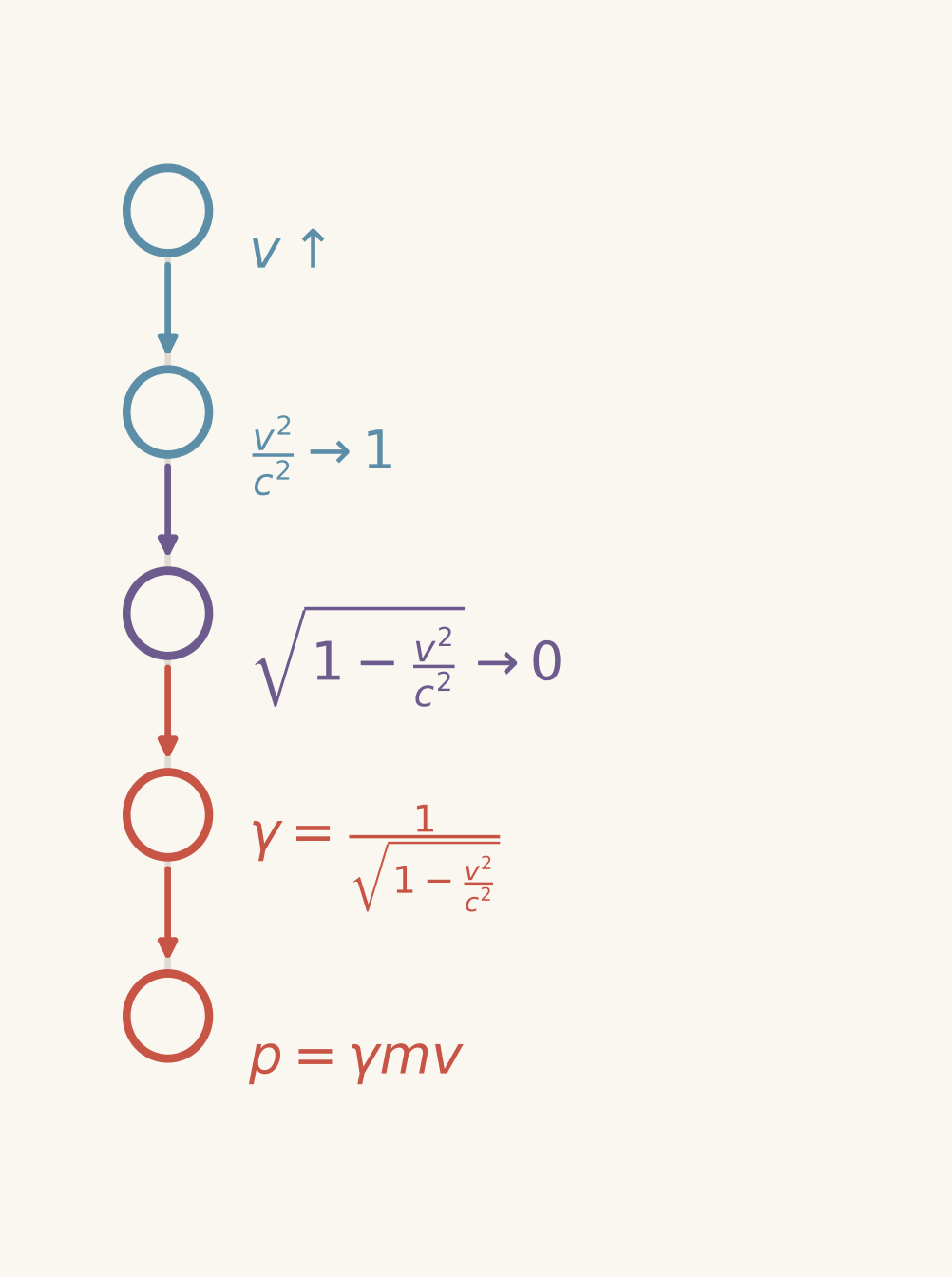
Imagine \(v\) getting closer and closer to \(c\).
As \(v\rightarrow c\),
\[ \frac{v^2}{c^2}\rightarrow1 \]
so
\[ 1-\frac{v^2}{c^2}\rightarrow0 \]
The denominator therefore approaches zero.
A non-zero numerator divided by a number approaching zero becomes arbitrarily large. In other words,
\[ p\rightarrow\infty \]
as
\[ v\rightarrow c \]
This is a mathematical limit. It does not mean a massive particle actually reaches \(c\) and suddenly has infinite momentum. The equation tells us that getting all the way to \(c\) would require unbounded momentum.
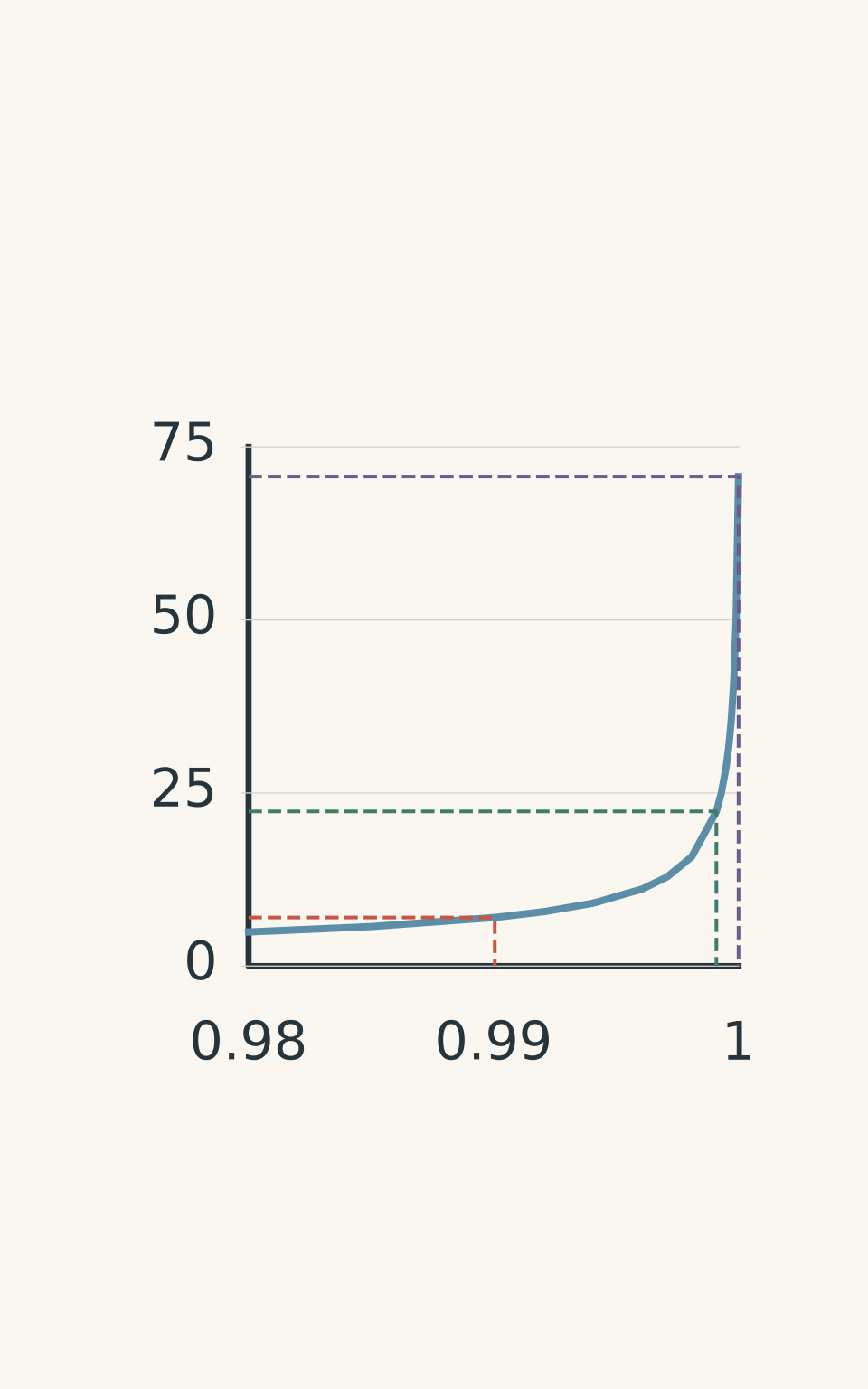
- Relativistic momentum
- 0.99c: 7.02
- 0.999c: 22.3
- 0.9999c: 70.7
Notice how extreme the numbers become:
| Speed | Momentum \(p/(mc)\) |
|---|---|
| \(0.90c\) | 2.06 |
| \(0.99c\) | 7.02 |
| \(0.999c\) | 22.3 |
| \(0.9999c\) | 70.7 |
Going from \(0.90c\) to \(0.99c\) requires an additional \(4.95mc\) of momentum.
Going from \(0.99c\) to \(0.999c\) requires an additional \(15.3mc\).
The extra speed is getting smaller, but the required momentum is getting much larger.
That is the speed limit.
The important distinction: force can keep acting
A common explanation says, “As the particle gets close to \(c\), the force gets weaker.”
That’s not the right idea.
A constant net force can continue acting. The relationship
\[ \Delta p=F\Delta t \]
says that a finite force acting for a finite time produces a finite change in momentum.
The problem is that the same increase in momentum produces less and less increase in speed near \(c\).
So:
- at low speeds, constant force gives approximately constant acceleration;
- at relativistic speeds, constant force gives constant momentum increase, not constant speed increase;
- the speed keeps increasing, but approaches \(c\) rather than passing it.
This is why the statement “constant force means constant acceleration” needs care. The Newtonian result \(F=ma\) with constant \(m\) is built around \(p=mv\). At relativistic speeds, the more fundamental relationship is that force changes momentum.
The other tempting misconception: “The mass increases”
For these HSC calculations, don’t say that the particle’s rest mass increases.
The \(m\) in
\[ p = \frac{mv} {\sqrt{1-\frac{v^2}{c^2}}} \]
is the rest mass, and it stays constant.
The rapidly increasing factor is
\[ \gamma = \frac{1} {\sqrt{1-\frac{v^2}{c^2}}} \]
So the clean HSC explanation is:
As the speed of a massive particle approaches \(c\), the Lorentz factor increases without bound, causing its relativistic momentum to increase without bound. Therefore, reaching \(c\) would require infinite momentum, so a massive particle cannot be accelerated to the speed of light.
06A quick HSC decision rule
When you see a relativistic momentum question, use this sequence:
| If the question gives… | Your move |
|---|---|
| A speed such as \(0.80c\) | Use \(p=\frac{mv}{\sqrt{1-v^2/c^2}}\) |
| A momentum and asks for speed | Rearrange for \(v\), or use \(\beta=\frac{p}{\sqrt{p^2+m^2c^2}}\) |
| A force acting for a time | First use \(\Delta p=F\Delta t\), then convert momentum to speed |
| A question about the speed limit | Explain the denominator approaching zero and \(p\rightarrow\infty\) |
| A comparison with \(p=mv\) | Explain that the Lorentz factor makes relativistic momentum larger than \(mv\) |
A few quick checks can catch mistakes:
- Momentum should have units of \(\mathrm{kg\,m\,s^{-1}}\).
- For a massive object moving at a non-zero relativistic speed, relativistic momentum \(p\) is greater than classical momentum \(mv\).
- As \(v\) gets small compared with \(c\), the relativistic equation approaches \(p=mv\).
- A massive particle always has a speed \(v\) less than \(c\).
- \(p\) itself is not limited to \(mc\). It can be much larger than \(mc\).
07Questions and solutions
Assume all motion is one-dimensional, the rest mass is constant, and quoted momenta and speeds refer to the same inertial frame.
Question 1
A proton has a rest mass of \(1.67\times10^{-27}\ \mathrm{kg}\) and moves at \(0.80c\). Calculate its relativistic momentum.
Solution 1
The proton’s relativistic momentum is \(\boxed{6.68\times10^{-19}\ \mathrm{kg\,m\,s^{-1}}}\). The important step is using the relativistic equation rather than \(p=mv\).
Step 1: Calculate the speed.
\[ v=0.80(3.00\times10^8) \]
\[ v=2.40\times10^8\ \mathrm{m\,s^{-1}} \]
Step 2: Calculate the denominator.
\[ \sqrt{1-\frac{v^2}{c^2}} = \sqrt{1-0.80^2} \]
\[ =0.600 \]
Step 3: Calculate momentum.
\[ p = \frac{(1.67\times10^{-27})(2.40\times10^8)} {0.600} \]
\[ p = 6.68\times10^{-19} \ \mathrm{kg\,m\,s^{-1}} \]
So,
\[ \boxed{p=6.68\times10^{-19}\ \mathrm{kg\,m\,s^{-1}}} \]
The classical value would be smaller because \(p=mv\) misses the relativistic correction factor.
Question 2
An electron has a rest mass of \(9.11\times10^{-31}\ \mathrm{kg}\) and moves at \(0.95c\).
Calculate:
- its classical momentum using \(p=mv\);
- its relativistic momentum;
- the percentage by which the classical value is lower than the relativistic value.
Solution 2
The classical momentum is \(\boxed{2.60\times10^{-22}\ \mathrm{kg\,m\,s^{-1}}}\), while the relativistic momentum is \(\boxed{8.31\times10^{-22}\ \mathrm{kg\,m\,s^{-1}}}\). The classical result is about \(\boxed{68.8\%}\) lower than the relativistic result.
First calculate the speed:
\[ v=0.95(3.00\times10^8) \]
\[ v=2.85\times10^8\ \mathrm{m\,s^{-1}} \]
The classical momentum is
\[ p_{\mathrm{classical}} = mv \]
\[ p_{\mathrm{classical}} = (9.11\times10^{-31})(2.85\times10^8) \]
\[ p_{\mathrm{classical}} = 2.60\times10^{-22} \ \mathrm{kg\,m\,s^{-1}} \]
For relativistic momentum,
\[ p_{\mathrm{rel}} = \frac{mv} {\sqrt{1-0.95^2}} \]
\[ p_{\mathrm{rel}} = \frac{2.60\times10^{-22}} {\sqrt{0.0975}} \]
\[ p_{\mathrm{rel}} = 8.31\times10^{-22} \ \mathrm{kg\,m\,s^{-1}} \]
Now calculate the percentage by which the classical value is lower:
\[ \frac{p_{\mathrm{rel}}-p_{\mathrm{classical}}} {p_{\mathrm{rel}}} \times100 \]
\[ = \frac{8.31-2.60}{8.31} \times100 \]
\[ =68.8\% \]
The trap is to see \(0.95c\) and assume \(p=mv\) is still close enough. At \(0.95c\), the Lorentz factor is about \(3.20\), so the correction is substantial.
Question 3
A spacecraft has a rest mass of \(500\ \mathrm{kg}\). Its speed increases from \(0.80c\) to \(0.95c\).
Calculate the change in its relativistic momentum.
A student instead calculates
\[ \Delta p=m\Delta v \]
and obtains \(2.25\times10^{10}\ \mathrm{kg\,m\,s^{-1}}\). Explain why this result is incorrect.
Solution 3
The correct change in momentum is \(\boxed{2.56\times10^{11}\ \mathrm{kg\,m\,s^{-1}}}\), not \(2.25\times10^{10}\ \mathrm{kg\,m\,s^{-1}}\). The mistake is treating the change in relativistic momentum as though momentum were still directly proportional to speed.
Calculate the momentum at \(0.80c\):
\[ p_1 = \frac{(500)(0.80c)} {\sqrt{1-0.80^2}} \]
\[ p_1 = 2.00\times10^{11} \ \mathrm{kg\,m\,s^{-1}} \]
Now calculate the momentum at \(0.95c\):
\[ p_2 = \frac{(500)(0.95c)} {\sqrt{1-0.95^2}} \]
\[ p_2 = 4.56\times10^{11} \ \mathrm{kg\,m\,s^{-1}} \]
Therefore,
\[ \Delta p=p_2-p_1 \]
\[ \Delta p = 4.56\times10^{11} - 2.00\times10^{11} \]
\[ \boxed{\Delta p = 2.56\times10^{11} \ \mathrm{kg\,m\,s^{-1}}} \]
The student’s calculation uses
\[ \Delta p=m(v_2-v_1) \]
which assumes \(p=mv\) throughout the change. That assumption fails at these speeds.
Notice something important: the speed only changes from \(0.80c\) to \(0.95c\), but the momentum more than doubles. This is exactly the behaviour the relativistic equation predicts.
Question 4
A particle is travelling at \(0.90c\). Its relativistic momentum is increased by \(50\%\), with the momentum change in the same direction as its motion.
What is the particle’s new speed?
A student predicts \(1.35c\) because the momentum increased by \(50\%\). Explain the error.
Solution 4
The new speed is \(\boxed{0.952c}\), not \(1.35c\). A \(50\%\) increase in momentum does not produce a \(50\%\) increase in speed because the relationship between \(p\) and \(v\) is nonlinear at relativistic speeds.
At \(0.90c\),
\[ \frac{p_i}{mc} = \frac{0.90}{\sqrt{1-0.90^2}} \]
\[ \frac{p_i}{mc} = 2.065 \]
The new momentum is \(1.50p_i\), so
\[ \frac{p_f}{mc} = 1.50(2.065) \]
\[ \frac{p_f}{mc} = 3.097 \]
Now use
\[ \beta = \frac{p/(mc)} {\sqrt{1+\left[p/(mc)\right]^2}} \]
Therefore,
\[ \beta_f = \frac{3.097} {\sqrt{1+3.097^2}} \]
\[ \beta_f = 0.952 \]
So,
\[ \boxed{v_f=0.952c} \]
The student’s \(1.35c\) prediction comes from treating momentum and speed as directly proportional. That works for \(p=mv\), but not for relativistic momentum.
The result also shows why \(c\) is a speed limit. A huge increase in momentum can produce only a modest increase in speed once the particle is already close to \(c\).
Question 5
A particle of rest mass \(m\) starts from rest. A constant net force \(F\) acts in the direction of its motion.
Define \(t_*\) as the time for which
\[ Ft_*=mc \]
Answer all parts:
- Derive an expression for the particle’s speed \(v\) after a time \(t\).
- Find its speed at \(t=t_*\).
- Find its speed at \(t=2t_*\).
- Explain why doubling the time does not double the speed.
- Determine what happens to the speed as \(t\) becomes arbitrarily large.
Solution 5
The particle’s speed is
\[ \boxed{ v(t) = \frac{cFt} {\sqrt{m^2c^2+F^2t^2}} } \]
It has speed \(\boxed{0.707c}\) at \(t_*\), speed \(\boxed{0.894c}\) at \(2t_*\), and approaches \(c\) without reaching it at any finite time. The crucial constraint is that a constant force gives a constant rate of change of momentum, not a constant rate of change of speed.
Because the particle starts from rest,
\[ p_0=0 \]
For a constant force,
\[ \Delta p=F t \]
so
\[ p=Ft \]
Now use relativistic momentum:
\[ Ft = \frac{mv} {\sqrt{1-\frac{v^2}{c^2}}} \]
Squaring both sides gives
\[ F^2t^2 = \frac{m^2v^2} {1-\frac{v^2}{c^2}} \]
Rearranging,
\[ F^2t^2 \left(1-\frac{v^2}{c^2}\right) = m^2v^2 \]
so
\[ F^2t^2 = v^2 \left( m^2+\frac{F^2t^2}{c^2} \right) \]
Therefore,
\[ v^2 = \frac{c^2F^2t^2} {m^2c^2+F^2t^2} \]
and hence
\[ \boxed{ v(t) = \frac{cFt} {\sqrt{m^2c^2+F^2t^2}} } \]
Now use the definition \(Ft_*=mc\).
At \(t=t_*\),
\[ Ft_*=mc \]
so
\[ v = \frac{cmc} {\sqrt{m^2c^2+m^2c^2}} \]
\[ v = \frac{c}{\sqrt2} \]
\[ \boxed{v=0.707c} \]
At \(t=2t_*\),
\[ F(2t_*)=2mc \]
so
\[ v = \frac{2mc^2} {\sqrt{m^2c^2+4m^2c^2}} \]
\[ v = \frac{2c}{\sqrt5} \]
\[ \boxed{v=0.894c} \]
So doubling the time does double the momentum:
\[ p:mc\rightarrow2mc \]
but it does not double the speed:
\[ 0.707c\rightarrow0.894c \]
The tempting Newtonian route is to write \(F=ma\), conclude that \(a=F/m\) is constant, and then use \(v=Ft/m\). That predicts the speed will eventually exceed \(c\).
The exact constraint that prevents this is the relativistic momentum equation. The force keeps increasing \(p\), but \(p\) and \(v\) are no longer proportional.
For very large \(t\), the \(F^2t^2\) term dominates the denominator:
\[ v \approx \frac{cFt}{Ft} \]
so
\[ v\rightarrow c \]
but for every finite \(t\),
\[ m^2c^2+F^2t^2>F^2t^2 \]
which means
\[ v<c \]
for every finite time.
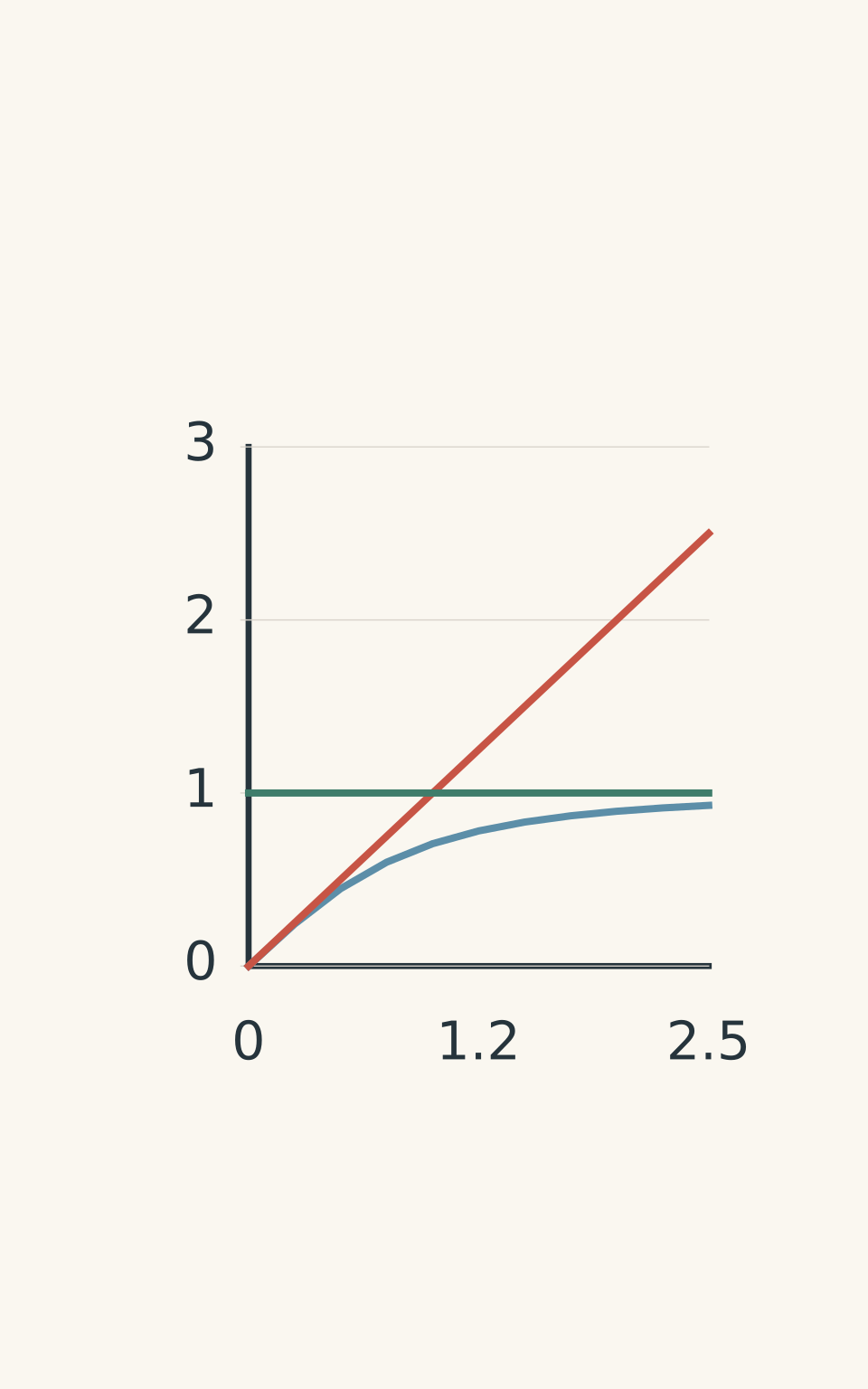
- Relativistic
- Newtonian prediction
- v = c (asymptote)
This is the deeper point: constant force does not smash through the speed limit. It keeps adding momentum, while the corresponding increases in speed become progressively smaller.
08What this lets you understand next
Relativistic momentum gives you the first half of the particle-accelerator picture: a particle can keep gaining momentum while its speed creeps closer and closer to \(c\).
The next useful step is seeing how this prediction is tested experimentally. In How Particle Accelerators Test Relativity: HSC Physics, the momentum behaviour becomes evidence you can actually connect to measurements.