
Charged and Neutral Objects: Attraction, Repulsion and Induction
Learn why charged objects attract or repel, and how a charged object can attract a neutral one through induced charge separation.
Rub a balloon on your hair and hold it near a wall. The balloon can stick, even though the wall started electrically neutral.
That seems wrong at first. If the wall has zero net charge, why should an electric force act on it?
Before reading on, make a prediction. Suppose the balloon is negatively charged. Does it somehow make the wall positively charged overall?
No. The wall can remain neutral and still be attracted. The key is that neutral does not mean “contains no charges”. It means the positive and negative charges balance overall. A nearby charged object can make those charges separate slightly, producing an attractive force.
That process is called induced charge separation.
01Start with the simpler case: two charged objects
There are two types of electric charge:
- positive charge
- negative charge
The basic interaction is:
| Objects | Force |
|---|---|
| positive and positive | repel |
| negative and negative | repel |
| positive and negative | attract |
So like charges repel and unlike charges attract.
You can picture two negatively charged objects as two people on a very awkward first date who both keep sliding their chairs backwards. Each experiences a force away from the other. Positive and negative charges do the opposite and move towards each other.
The dating analogy stops there. Electric charges do not make decisions, and the force has a precise mathematical dependence on charge and distance.
For two point charges, the magnitude of the electrostatic force is given by Coulomb’s law:
\[ F = k\frac{|q_1q_2|}{r^2} \]
where:
- \(F\) is the electrostatic force magnitude, measured in newtons (\(\text{N}\))
- \(k\) is Coulomb’s constant, \(8.99\times10^9\ \text{N m}^2\text{C}^{-2}\)
- \(q_1\) and \(q_2\) are the charges, measured in coulombs (\(\text{C}\))
- \(r\) is the distance between the charges, measured in metres (\(\text{m}\))
The absolute value signs tell us that this equation gives the magnitude of the force. You decide the direction separately from the signs of the charges.
A useful detail is the \(r^2\) in the denominator. Doubling the separation does not halve the force. It reduces the force to one-quarter.
Worked example: What force acts between two charged spheres?
Two small spheres carry charges of \(+3.0\ \mu\text{C}\) and \(-2.0\ \mu\text{C}\). Their centres are \(0.40\ \text{m}\) apart. Calculate the electrostatic force between them and state whether it is attractive or repulsive.
Step 1
The prefix micro, \(\mu\), means \(10^{-6}\).
\[ q_1 = 3.0\times10^{-6}\ \text{C} \]
\[ q_2 = -2.0\times10^{-6}\ \text{C} \]
Step 2
\[ \begin{aligned} F &= k\frac{|q_1q_2|}{r^2}\\ &=(8.99\times10^9) \frac{|(3.0\times10^{-6})(-2.0\times10^{-6})|}{(0.40)^2}\\ &=0.337\ \text{N} \end{aligned} \]
To two significant figures,
\[ F=0.34\ \text{N} \]
Step 3
One charge is positive and the other is negative, so the charges attract.
The force is therefore \(0.34\ \text{N}\), attractive. Each sphere experiences a force of this magnitude towards the other sphere.
02So why can a charged object attract a neutral one?
Imagine a neutral metal sphere.
It contains positive and negative charge in equal total amounts. In a metal, some electrons are able to move through the material, while the positively charged atomic nuclei remain fixed in the solid structure.
Now bring a negatively charged rod close to the sphere.
Predict what the mobile electrons in the sphere will do.
They are repelled by the negatively charged rod, so they move slightly towards the far side of the sphere.
The result is:
- the side nearest the rod has a shortage of electrons, so it becomes relatively positive
- the far side has an excess of electrons, so it becomes relatively negative
- the sphere still has zero net charge overall
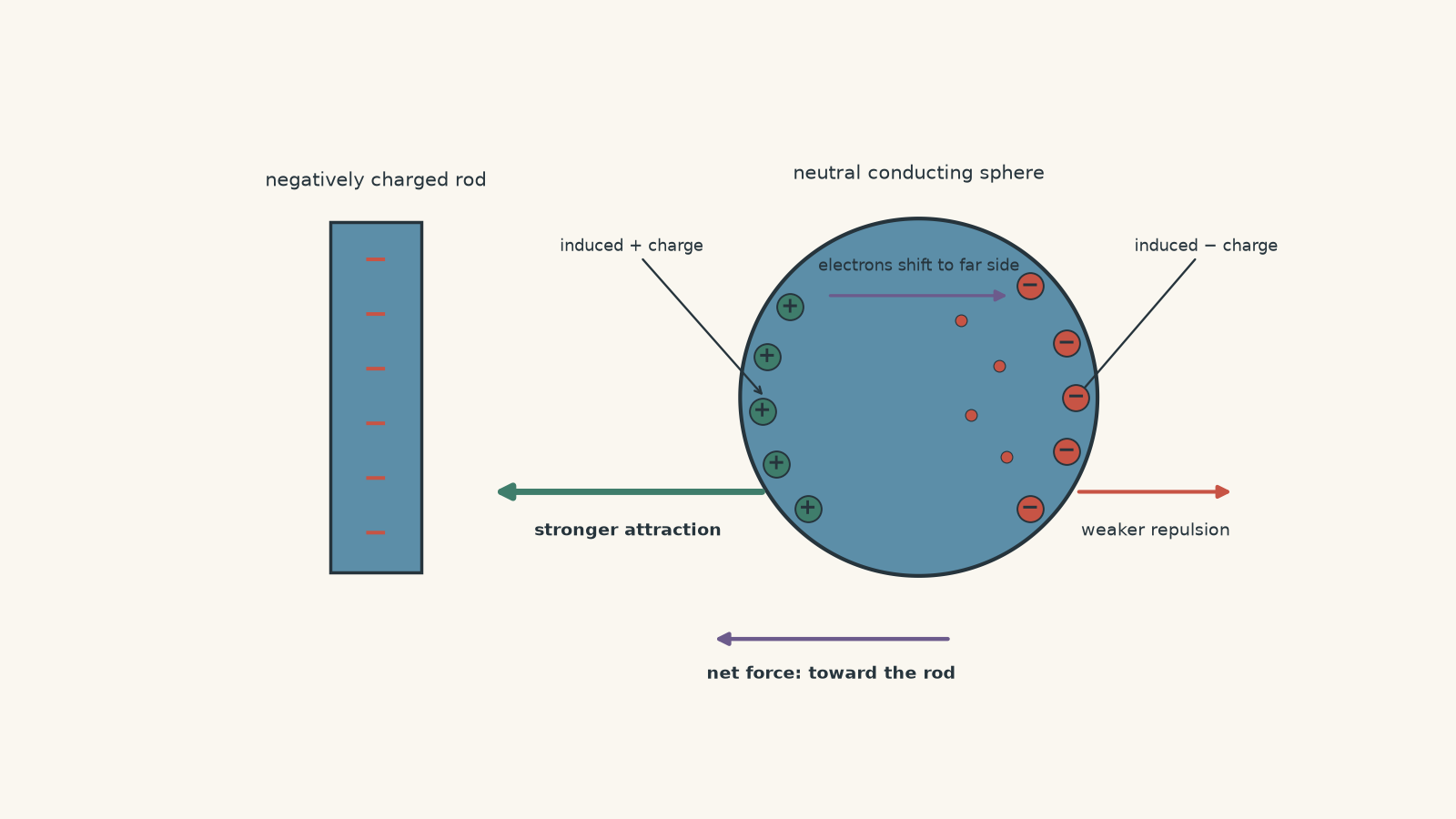
The charges have not disappeared or been created. They have been redistributed.
This is induced charge separation.
03Why doesn’t the attraction and repulsion cancel?
This is the crucial part.
The negatively charged rod attracts the induced positive region on the near side of the sphere. It also repels the induced negative region on the far side.
You might predict that these forces should cancel because the sphere contains equal positive and negative charge.
They do not cancel, because the two regions are at different distances from the rod.
Coulomb’s law contains \(1/r^2\). The nearer interaction is stronger.
So:
- the attraction to the nearer opposite charge is relatively strong
- the repulsion from the farther like charge is relatively weak
The result is a net force towards the charged object.
This gives an important HSC rule:
A charged object can attract a neutral object by inducing charge separation in it.
Notice what the rule does not say. The neutral object does not need to gain a net charge.
Worked example: Why is the net force attractive?
A simplified neutral object is modelled as two small regions carrying charges \(+1.0\ \mu\text{C}\) and \(-1.0\ \mu\text{C}\). A separate charge of \(-2.0\ \mu\text{C}\) lies \(0.20\ \text{m}\) from the positive region and \(0.30\ \text{m}\) from the negative region. The three regions lie along one straight line.
Calculate the force on each part of the neutral object and determine the net force.
Step 1
\[ \begin{aligned} F_{\text{near}} &=k\frac{|q_1q_2|}{r^2}\\ &=(8.99\times10^9) \frac{(2.0\times10^{-6})(1.0\times10^{-6})}{(0.20)^2}\\ &=0.450\ \text{N} \end{aligned} \]
This force is attractive, so it acts towards the external negative charge.
Step 2
\[ \begin{aligned} F_{\text{far}} &=(8.99\times10^9) \frac{(2.0\times10^{-6})(1.0\times10^{-6})}{(0.30)^2}\\ &=0.200\ \text{N} \end{aligned} \]
This force is repulsive, so it acts away from the external negative charge.
Step 3
Taking the direction towards the external charge as positive,
\[ \begin{aligned} F_{\text{net}} &=0.450-0.200\\ &=0.250\ \text{N} \end{aligned} \]
The net force is therefore \(0.25\ \text{N}\) towards the charged object.
This simplified calculation captures the main physics. The opposite charge is closer, so its attractive force is stronger than the repulsion from the farther like charge.
A real object contains enormous numbers of charges rather than two neat charge regions, so this two-charge model is not an exact description. It is a useful model for understanding why charge separation produces a net attraction.
04Conductors and insulators both respond, but not in the same way
Induced charge separation is easiest to picture in a conductor because electrons can move through the material.
In a metal sphere near a negative rod, mobile electrons can move across the sphere. That creates a noticeable separation between induced positive and negative regions.
An insulator is different. Charges cannot move freely through the whole object.
That does not mean an insulator cannot be attracted by a charged object.
Within its atoms or molecules, positive and negative charge can shift slightly relative to each other. The distribution becomes polarised. The side of each atom or molecule closer to the charged object can become slightly more opposite in charge, while the farther side becomes slightly more like-charged.
The individual shifts are tiny, but across many atoms or molecules they can produce a measurable attraction.
This helps explain why a charged balloon can stick to an electrically neutral wall. The wall does not have to become positively charged overall. Its charge distribution is slightly rearranged.
05The sign of the charged object changes the separation, not the final attraction
Suppose we replace the negative rod with a positively charged rod.
What changes?
Electrons in a nearby conductor are now attracted towards the rod rather than repelled from it. The near surface becomes relatively negative, and the far surface relatively positive.
So the induced pattern reverses.
But the result is still a net attraction:
- opposite charge is induced closer to the external charge
- like charge is left farther away
- the closer attractive interaction is stronger
This means either a positively charged object or a negatively charged object can attract a neutral object.
That fact gives you a useful diagnostic rule.
If object A attracts object B, you cannot immediately conclude that A and B have opposite net charges. One object could be charged while the other is neutral.
Repulsion gives stronger information.
06Attraction does not prove opposite charge
This is one of the easiest electrostatics mistakes to make.
Suppose two objects move towards each other.
A student might reason:
They attract, so one must be positive and the other negative.
That is only one possibility.
Attraction can occur in at least these situations:
| Object A | Object B | Possible interaction |
|---|---|---|
| positive | negative | attraction |
| negative | positive | attraction |
| positive | neutral | attraction after induced charge separation |
| negative | neutral | attraction after induced charge separation |
So attraction alone does not tell you both charge states.
Repulsion is more decisive. If two isolated objects repel electrostatically, each must have a net charge of the same sign under the usual HSC electrostatics model. A neutral object can be polarised by a nearby charged object, but that polarisation produces attraction rather than repulsion.
A compact way to remember it is:
Repulsion can identify like charge. Attraction cannot, by itself, identify opposite charge.
07Distance matters twice in induced attraction
There is a subtle point hiding inside induced charge separation.
As a charged object approaches a neutral conductor, two things can strengthen the interaction:
- the electric field becomes stronger, causing greater charge separation
- the separated charges are closer to the external charge, increasing the electrostatic forces
So the real behaviour of a conductor can be more complicated than our simple fixed-charge model.
You are not normally expected to calculate the full distribution of induced surface charge in HSC Physics. What matters is the physical reasoning:
the external electric field redistributes charge, and the uneven distances produce a net attraction.
08A useful force diagram
Suppose a positive rod sits to the left of a neutral conducting sphere.
The sphere becomes polarised:
- negative charge is induced on the left side
- positive charge is induced on the right side
The rod attracts the nearer negative charges to the left. It repels the farther positive charges to the right.
Both forces act on the sphere, but the leftward attraction is stronger.
So the sphere accelerates towards the rod if it is free to move.
Be careful when drawing this. The net force does not arise because there is “more negative charge” than positive charge in the sphere. The sphere remains neutral overall. The difference comes from distance and distribution, not unequal total amounts of positive and negative charge.
09Questions and solutions
Question 1
A positively charged plastic rod is brought close to an initially neutral metal sphere without touching it.
Describe how the charge in the sphere changes and state the direction of the net electrostatic force on the sphere.
Solution 1
The sphere remains neutral overall, but electrons move towards the rod, and the sphere experiences a net force towards the rod.
Because the rod is positively charged, mobile electrons in the metal are attracted towards the side nearest the rod. This makes the near surface relatively negative and leaves the far surface relatively positive.
The total negative and positive charge still balance, so the sphere has not gained a net charge.
The attraction between the rod and the nearer negative region is stronger than the repulsion between the rod and the farther positive region because electrostatic force decreases with \(r^2\). The resulting net force is therefore towards the rod.
Question 2
Two small spheres have charges \(+4.0\ \mu\text{C}\) and \(+6.0\ \mu\text{C}\), with their centres separated by \(0.50\ \text{m}\).
Calculate the magnitude and direction of the electrostatic force on each sphere.
Solution 2
Each sphere experiences a force of \(0.86\ \text{N}\), directed away from the other sphere.
Both charges are positive, so the interaction is repulsive.
Convert the charges to coulombs:
\[ q_1=4.0\times10^{-6}\ \text{C} \]
\[ q_2=6.0\times10^{-6}\ \text{C} \]
Using Coulomb’s law,
\[ \begin{aligned} F &=k\frac{|q_1q_2|}{r^2}\\ &=(8.99\times10^9) \frac{(4.0\times10^{-6})(6.0\times10^{-6})}{(0.50)^2}\\ &=0.863\ \text{N} \end{aligned} \]
Therefore,
\[ F\approx0.86\ \text{N} \]
The forces have equal magnitude and opposite direction. Each sphere is pushed away from the other. This is also consistent with Newton’s third law.
Question 3
A student suspends a small object from an insulating thread. A negatively charged rod is brought near the object, and the object moves towards the rod.
The student concludes that the suspended object must be positively charged.
Explain why this conclusion is not justified. State two possible initial charge states of the suspended object that are consistent with the observation.
Solution 3
The conclusion is not justified because attraction can occur either between opposite net charges or between a charged object and a neutral object.
One possibility is that the suspended object is positively charged. It would then be attracted directly to the negatively charged rod because opposite charges attract.
A second possibility is that the object is neutral. The rod could induce charge separation within it. Negative charge would be pushed slightly farther from the rod, leaving relatively positive charge closer to the rod. The closer attraction would then exceed the farther repulsion.
Therefore, the observation is consistent with the object being positively charged or neutral.
The tempting mistake is to treat attraction as proof of opposite charge. It is not.
Question 4
A simplified neutral object contains two separated charge regions, \(+2.0\ \mu\text{C}\) and \(-2.0\ \mu\text{C}\). A positive external charge of \(+3.0\ \mu\text{C}\) is located along the same line.
The negative region of the neutral object is \(0.15\ \text{m}\) from the external charge, while the positive region is \(0.25\ \text{m}\) away.
Calculate the net electrostatic force on the neutral object.
Solution 4
The net force is approximately \(1.6\ \text{N}\) towards the external positive charge.
The nearer negative region is attracted to the external positive charge.
Its force magnitude is
\[ \begin{aligned} F_{\text{attract}} &=(8.99\times10^9) \frac{(3.0\times10^{-6})(2.0\times10^{-6})}{(0.15)^2}\\ &=2.40\ \text{N} \end{aligned} \]
The farther positive region is repelled.
Its force magnitude is
\[ \begin{aligned} F_{\text{repel}} &=(8.99\times10^9) \frac{(3.0\times10^{-6})(2.0\times10^{-6})}{(0.25)^2}\\ &=0.863\ \text{N} \end{aligned} \]
The forces act in opposite directions, so the net force is
\[ \begin{aligned} F_{\text{net}} &=2.40-0.863\\ &=1.53\ \text{N} \end{aligned} \]
To two significant figures,
\[ F_{\text{net}}=1.5\ \text{N} \]
The direction is towards the external charge.
The object has equal positive and negative charge overall, but the forces do not cancel because those charges are at different distances from the external charge.
Question 5
Two identical neutral conducting spheres, A and B, are placed separately on insulating stands.
A negatively charged rod is held near sphere A without touching it. No charged object is brought near sphere B.
A student says, “Sphere A is now negatively charged because the negative rod has affected its electrons.”
Evaluate this statement. Compare the net charge and charge distribution of spheres A and B.
Solution 5
The statement is incorrect. Sphere A can have a changed charge distribution without acquiring a negative net charge. Both spheres remain neutral overall.
Before the rod approaches, sphere A contains equal total positive and negative charge distributed so that there is no large-scale separation.
When the negative rod approaches, mobile electrons in sphere A are repelled towards the side farther from the rod. The near side therefore becomes relatively positive and the far side relatively negative.
However, no charge has been transferred to or from sphere A. Its total positive and negative charges still balance, so
\[ q_{\text{net,A}}=0. \]
Sphere B is also neutral:
\[ q_{\text{net,B}}=0. \]
The difference is their charge distributions. Sphere A is polarised by the rod, while sphere B has no comparable externally induced separation.
The student’s mistake is confusing movement of charge within an object with transfer of net charge into the object.
Question 6
A positively charged rod attracts a small suspended sphere. A second test shows that the sphere is also attracted when a negatively charged rod is brought near it from the same distance.
A student claims that the results are impossible because an object cannot be attracted to both signs of charge.
Explain a physically reasonable charge state for the sphere that is consistent with both observations. Then explain why simply observing attraction to both rods does not mean the two forces must have exactly the same magnitude.
Solution 6
The sphere can be electrically neutral, with each rod producing induced charge separation and therefore attraction. The two attractive forces do not have to be identical because the amount and geometry of polarisation can depend on the surrounding conditions.
When the positive rod approaches a neutral sphere, negative charge shifts closer to it and positive charge shifts farther away. The nearer attraction is stronger than the farther repulsion, producing a net attractive force.
When the negative rod approaches, the separation reverses. Positive charge is effectively closer and negative charge farther away, again producing a net attraction.
So a neutral sphere can be attracted to either sign of external charge.
It would be tempting to argue that reversing the sign of the rod must automatically produce an identical force. In a perfectly symmetric ideal model, with equal charge magnitudes and otherwise identical conditions, that symmetry may give equal force magnitudes.
But the observation that both interactions are attractive does not by itself establish those conditions. The rods might carry different charge magnitudes, their shapes could produce different electric fields, or the sphere might not respond in an exactly symmetric way.
The important evidence is therefore the direction of the interaction: attraction to both signs is consistent with a neutral, polarisable object.
10Where this idea leads next
Induced charge separation is really an example of an electric field changing the distribution of charge in matter.
That gives you the next useful step in electrostatics. Instead of thinking only about pairs of objects pulling or pushing each other, you can describe the electric field that a charge creates throughout the space around it. A second charge placed in that field then experiences a force.
That field model makes it much easier to analyse several charges at once, understand electric field diagrams, and later connect electrostatic forces to electric potential and energy.