
Electric Current in Metals: Charge Carriers and Drift
Learn how electrons move through metals, why conventional current points the opposite way, and how drift velocity relates to electric current.
Close a switch and a lamp can respond almost immediately. It is tempting to picture electrons shooting out of the battery, racing through the wire, and arriving at the lamp.
But that picture creates a problem. The electrons in a metal actually drift along the wire surprisingly slowly.
So predict this before reading on: if the electrons themselves move slowly, how can a circuit respond so quickly?
The answer is that electrons are already present throughout the wire. Closing the switch establishes an electric field through the circuit very quickly, and that field causes electrons all along the conductor to begin drifting. The fast response of the circuit and the slow drift of individual electrons are two different things.
01What is actually moving inside a metal?
A metal contains a lattice of positive ion cores. Some electrons are delocalised, meaning they are not tied to one particular atom and can move through the metal.
These mobile electrons are the metal’s charge carriers.
Even when there is no current, the electrons are not sitting still. Their microscopic motion is disordered, with motion in many directions. Because there is no preferred direction, there is no net movement of charge through the wire.
Picture a pinball machine full of balls already ricocheting around. If the machine is level, the balls move in every direction without collectively heading anywhere. Tilt the machine slightly, and the paths are still messy, but there is now an overall drift downhill.
The balls represent conduction electrons, and the tilt represents the effect of an electric field. The analogy has limits: electrons are quantum particles, not tiny classical balls, and their behaviour in a real metal is more complicated than literal pinball collisions. But the distinction between rapid disordered motion and a small net drift is useful.
When a potential difference is applied across a metal, an electric field exists within the conductor. The field exerts forces on the conduction electrons. Their motion remains complicated, but they now gain a small average velocity in one direction. This is called their drift velocity.
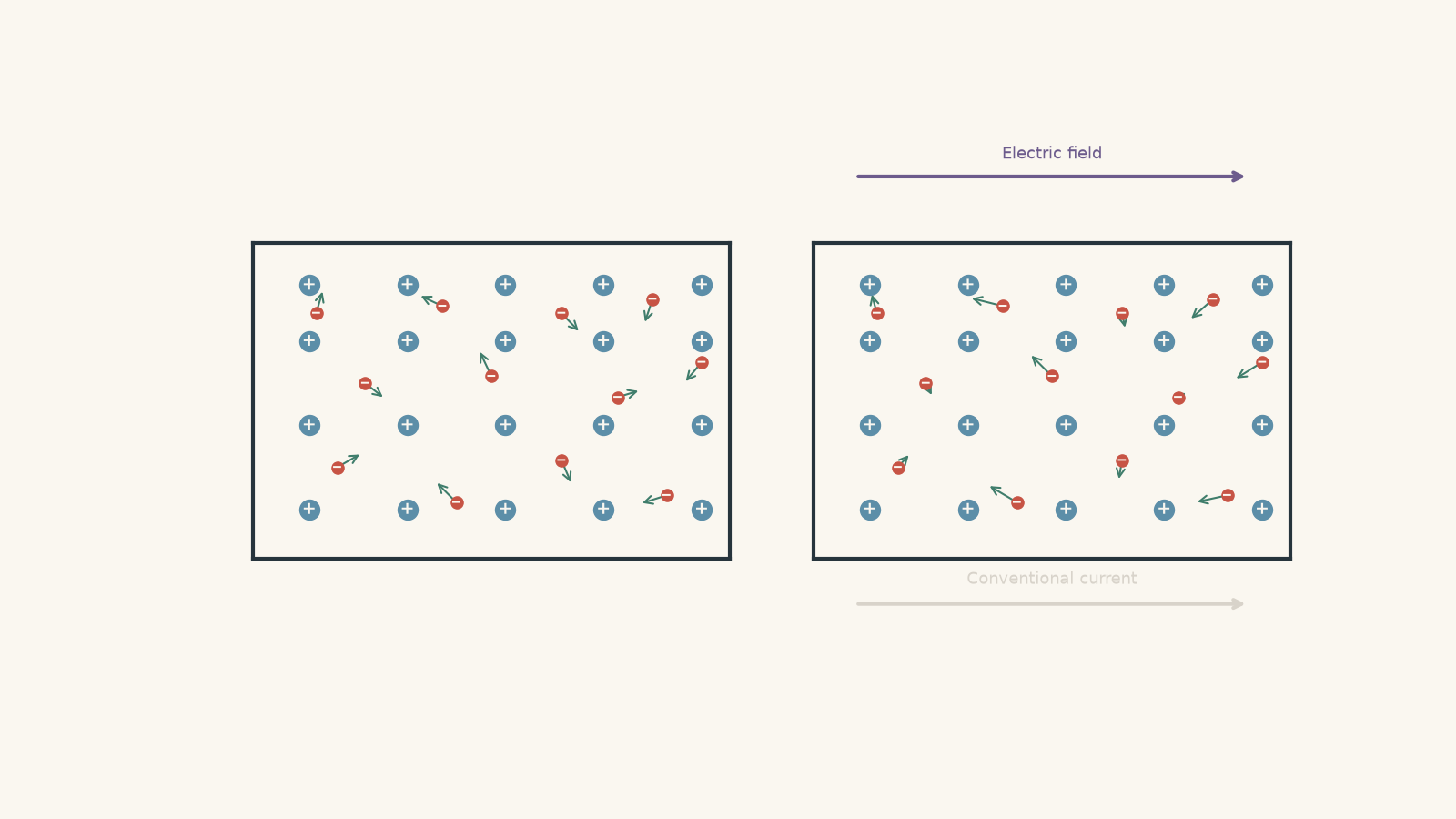
02Current measures charge flow, not electron speed
Electric current tells us how quickly electric charge passes through a cross-section of a conductor.
If an amount of charge \(Q\) passes a cross-section in a time interval \(\Delta t\), the average current is
\[ I = \frac{Q}{\Delta t} \]
where:
- \(I\) is current in amperes (A),
- \(Q\) is the magnitude of charge transferred in coulombs (C), and
- \(\Delta t\) is the time interval in seconds (s).
One ampere therefore means one coulomb of charge passing a cross-section each second:
\[ 1\ \mathrm{A} = 1\ \mathrm{C\,s^{-1}} \]
Notice what is not in this definition: the speed of one electron.
A large current means a large amount of charge is crossing the chosen cross-section each second. That could happen because there are enormous numbers of mobile electrons, even if their average drift speed is small.
Worked example: Finding current from charge flow
A charge of \(4.8\ \mathrm{C}\) passes through a cross-section of a wire in \(0.60\ \mathrm{s}\). Calculate the average current.
Step 1
\[ I = \frac{Q}{\Delta t} \]
Step 2
\[ I = \frac{4.8\ \mathrm{C}}{0.60\ \mathrm{s}} = 8.0\ \mathrm{C\,s^{-1}} \]
Step 3
\[ I = 8.0\ \mathrm{A} \]
A current of \(8.0\ \mathrm{A}\) means \(8.0\ \mathrm{C}\) of charge passes that cross-section each second.
It does not mean individual electrons are travelling at \(8.0\ \mathrm{m\,s^{-1}}\). Amperes measure charge per second, not distance per second.
03Why do electrons move opposite to conventional current?
Here is the part that causes a lot of avoidable mistakes.
Conventional current is defined to point in the direction that positive charge would move.
Electrons are negatively charged. The force on a charge in an electric field is
\[ F = qE \]
where \(F\) is the force, \(q\) is the charge, and \(E\) is the electric field strength.
For an electron,
\[ q = -e \]
where \(e = 1.60 \times 10^{-19}\ \mathrm{C}\) is the magnitude of the charge on one electron.
Because the electron’s charge is negative, its force is opposite to the electric field. Its net drift is therefore opposite to the direction of conventional current in a metal.
So if a circuit diagram shows:
conventional current \(\rightarrow\)
then, in a metal wire:
electron drift \(\leftarrow\)
This isn’t saying the conventional-current arrow is “wrong”. It is a defined direction that lets us describe circuits consistently. The actual charge carriers in a metal simply happen to be negative.
Through the external part of a simple DC circuit, conventional current goes from the positive terminal of the source towards the negative terminal. The conduction electrons drift the other way.
04Connecting electron drift to current
We can now connect the microscopic picture of moving electrons to the current measured by an ammeter.
Imagine a wire with cross-sectional area \(A\). Suppose it contains \(n\) mobile electrons per cubic metre, and those electrons have an average drift speed \(v_d\).
During a time interval \(\Delta t\), their average drift distance is
\[ v_d\Delta t \]
The volume of wire corresponding to that distance is therefore
\[ A v_d\Delta t \]
If there are \(n\) mobile electrons per cubic metre, the number of electrons in that volume is
\[ n A v_d\Delta t \]
Each electron has charge magnitude \(e\), so the magnitude of charge passing the cross-section is
\[ Q = n e A v_d\Delta t \]
Using \(I=Q/\Delta t\),
\[ I = n e A v_d \]
where:
| Symbol | Meaning | Unit |
|---|---|---|
| \(I\) | current magnitude | A |
| \(n\) | number of mobile electrons per unit volume | \(\mathrm{m^{-3}}\) |
| \(e\) | magnitude of electron charge, \(1.60\times10^{-19}\) | C |
| \(A\) | cross-sectional area of the wire | \(\mathrm{m^2}\) |
| \(v_d\) | electron drift speed | \(\mathrm{m\,s^{-1}}\) |
This equation is a classical model. Real electrical conduction in metals ultimately requires quantum physics for a complete description. For HSC-level reasoning, however, it gives an excellent link between individual charge carriers and measurable current.
It also reveals something important. A tiny drift speed can still produce a substantial current because \(n\), the number of available electrons per cubic metre, is enormous.
Worked example: How slowly are the electrons drifting?
A metal wire carries a current of \(1.5\ \mathrm{A}\). Its cross-sectional area is \(0.80\ \mathrm{mm^2}\), and it contains \(8.5\times10^{28}\) conduction electrons per cubic metre. Calculate the electron drift speed. Conventional current is to the right. State the direction of electron drift.
Step 1
Since
\[ 1\ \mathrm{mm^2}=1.0\times10^{-6}\ \mathrm{m^2} \]
the area is
\[ A=0.80\times10^{-6}\ \mathrm{m^2} \]
Step 2
From
\[ I=neAv_d \]
we get
\[ v_d=\frac{I}{neA} \]
Step 3
\[ v_d= \frac{1.5} {(8.5\times10^{28})(1.60\times10^{-19})(0.80\times10^{-6})} \]
\[ v_d=1.38\times10^{-4}\ \mathrm{m\,s^{-1}} \]
Step 4
Because \(1\ \mathrm{m}=1000\ \mathrm{mm}\),
\[ v_d=0.138\ \mathrm{mm\,s^{-1}} \]
So the electrons drift at only about \(0.14\ \mathrm{mm\,s^{-1}}\).
Because conventional current is to the right, the negatively charged electrons drift to the left.
That slow result is not a contradiction. When the circuit is completed, electrons already exist beside the lamp, inside the connecting wires, and throughout the rest of the conducting path. The electric field causes these local electrons to respond. The circuit does not have to wait for one particular electron to travel all the way from the battery.
05Current is not “used up”
Suppose a current of \(0.50\ \mathrm{A}\) enters a resistor in a single-loop circuit. What current should leave the resistor?
A tempting prediction is something smaller, perhaps \(0.30\ \mathrm{A}\), because the resistor has “used some electricity”.
That would create a serious problem. If \(0.50\ \mathrm{C}\) entered the resistor each second but only \(0.30\ \mathrm{C}\) left, charge would accumulate inside it at \(0.20\ \mathrm{C}\) every second.
That does not describe a normal circuit in steady operation.
In a steady single-loop circuit, the same current enters and leaves the resistor. Charge is conserved.
The resistor transfers energy, not electron charge. The electrons still have the same elementary charge magnitude \(e\) after passing through the component.
So the better distinction is:
Current describes the rate of charge flow. A component can transfer energy without consuming the charge carriers.
This becomes especially important later when analysing series and parallel circuits.
06Do electrons accelerate continuously through the whole wire?
An electric field exerts a force on each conduction electron, so you might predict that the electrons should accelerate faster and faster for as long as the voltage remains connected.
That prediction would make sense for an isolated electron in an otherwise empty region.
A metal is different. The electron’s motion is continually affected by the material. In the classical model, interactions with the lattice interrupt the acceleration produced by the electric field. Rather than accelerating without limit, the population of conduction electrons reaches a small average drift velocity.
This microscopic behaviour is connected to electrical resistance. A stronger electric field can produce a greater drift response, while the structure and temperature of the material affect how readily charge carriers move.
That is the bridge from charge-carrier motion to resistance and Ohm’s law.
07Questions and solutions
Question 1
Conventional current in a copper wire is directed from left to right. In which direction is the average drift of the conduction electrons? Explain your answer.
Solution 1
The electrons drift from right to left, opposite to the conventional current.
Conventional current is defined as the direction in which positive charge would move. Copper’s mobile charge carriers are electrons, which have negative charge.
The electric force on the electrons is therefore opposite to the direction that a positive charge would experience. Their net drift is opposite to the conventional-current arrow.
Their individual microscopic motion is still complicated. “Drift from right to left” refers to the average motion of the electron population.
Question 2
A total charge of \(6.0\ \mathrm{C}\) passes a point in a wire during \(2.5\ \mathrm{s}\). Calculate the average current.
Solution 2
The average current is \(2.4\ \mathrm{A}\).
Current is the rate at which charge passes a cross-section:
\[ I=\frac{Q}{\Delta t} \]
Substituting,
\[ I=\frac{6.0\ \mathrm{C}}{2.5\ \mathrm{s}} =2.4\ \mathrm{C\,s^{-1}} =2.4\ \mathrm{A} \]
This means an average of \(2.4\ \mathrm{C}\) of charge passes the chosen cross-section each second.
Question 3
A wire carries a steady conventional current of \(0.40\ \mathrm{A}\) towards the south for \(75\ \mathrm{s}\).
Calculate the magnitude of charge that passes a cross-section during this time, estimate the number of electrons corresponding to this amount of charge, and state the direction of electron drift.
Use \(e=1.60\times10^{-19}\ \mathrm{C}\).
Solution 3
A charge magnitude of \(30\ \mathrm{C}\), corresponding to about \(1.9\times10^{20}\) electrons, passes the cross-section, and the electrons drift north.
First use
\[ I=\frac{Q}{\Delta t} \]
so
\[ Q=I\Delta t \]
Substituting,
\[ Q=(0.40\ \mathrm{A})(75\ \mathrm{s}) =30\ \mathrm{C} \]
The number of electrons \(N\) is found from
\[ Q=Ne \]
Therefore,
\[ N=\frac{Q}{e} =\frac{30}{1.60\times10^{-19}} =1.875\times10^{20} \]
To two significant figures,
\[ N=1.9\times10^{20}\ \text{electrons} \]
Conventional current is south, so the negatively charged electrons drift north.
The enormous number of electrons involved helps explain how an ordinary current can exist even when individual electrons have a very small drift speed.
Question 4
A metal contains \(9.0\times10^{28}\) conduction electrons per cubic metre. A wire made from this metal has a cross-sectional area of \(0.50\ \mathrm{mm^2}\), and its electrons have an average drift speed of \(2.0\times10^{-4}\ \mathrm{m\,s^{-1}}\) towards the west.
Calculate the magnitude of the current, find the charge magnitude passing a cross-section in \(30\ \mathrm{s}\), and state the conventional-current direction.
Use \(e=1.60\times10^{-19}\ \mathrm{C}\).
Solution 4
The current is \(1.44\ \mathrm{A}\), \(43.2\ \mathrm{C}\) of charge passes the cross-section in \(30\ \mathrm{s}\), and conventional current is towards the east.
First convert the area:
\[ A=0.50\ \mathrm{mm^2} =0.50\times10^{-6}\ \mathrm{m^2} \]
Use the microscopic current equation:
\[ I=neAv_d \]
Substituting,
\[ I=(9.0\times10^{28})(1.60\times10^{-19}) (0.50\times10^{-6})(2.0\times10^{-4}) \]
\[ I=1.44\ \mathrm{A} \]
Now use
\[ Q=I\Delta t \]
so
\[ Q=(1.44\ \mathrm{A})(30\ \mathrm{s}) =43.2\ \mathrm{C} \]
The electrons drift west. Because they are negatively charged, conventional current points in the opposite direction, towards the east.
Question 5
Two wires are made from the same metal and carry the same steady current. Wire B has twice the cross-sectional area of wire A.
A student argues that the electrons in wire B should drift faster because “there is more room for them to move”.
Compare the drift speeds in the two wires and explain the flaw in the student’s reasoning.
Solution 5
The electron drift speed in wire B is half the drift speed in wire A, provided both wires carry the same current.
For a metal,
\[ I=neAv_d \]
Both wires are made from the same material, so we treat \(n\) and \(e\) as unchanged. The question also tells us that \(I\) is the same.
Rearranging,
\[ v_d=\frac{I}{neA} \]
Therefore, under these conditions,
\[ v_d\propto\frac{1}{A} \]
If wire B has
\[ A_B=2A_A \]
then
\[ v_{d,B}=\frac{1}{2}v_{d,A} \]
The student’s “more room means faster” idea misses what current is measuring. A wider wire contains more available charge carriers across its cross-section. For the same amount of charge to pass each second, each carrier can have a smaller average drift speed.
There is also an important hidden assumption here. This comparison works because the question explicitly states that the two wires carry the same current. If instead the wires were connected under some other fixed condition, such as the same potential difference, changing the area could also change the current. You would need to analyse that situation separately.
Question 6
A resistor is connected in a steady single-loop DC circuit. An ammeter immediately before the resistor reads \(0.80\ \mathrm{A}\).
Student A says an ammeter immediately after the resistor should read less than \(0.80\ \mathrm{A}\) because the resistor uses up some current.
Student B says the second ammeter should read \(0.80\ \mathrm{A}\), but only because each electron loses some of its electric charge while passing through the resistor.
Evaluate both explanations.
Solution 6
The second ammeter also reads \(0.80\ \mathrm{A}\), but both students’ explanations contain an error.
Student A is wrong because charge is not continually consumed by the resistor. In a steady single-loop circuit, charge cannot continuously pile up inside the resistor, so the rate at which charge enters must equal the rate at which charge leaves.
The current is therefore
\[ I_{\text{before}}=I_{\text{after}}=0.80\ \mathrm{A} \]
Student B gets the current value right but gives the wrong reason. An electron does not emerge with a smaller elementary charge. Its charge remains
\[ q=-1.60\times10^{-19}\ \mathrm{C} \]
The resistor transfers electrical energy to other forms, commonly thermal energy. It does not gradually shave charge off electrons like a tiny electrical cheese grater.
The key distinction is between charge flow and energy transfer.
Question 7
A battery, switch, lamp, and several metres of metal wire form a circuit. When the switch is closed, the lamp responds too quickly for a person to notice any delay.
A student concludes: “That proves the electrons must travel from the battery to the lamp extremely quickly.”
Explain why the observation does not support that conclusion.
Solution 7
The rapid response of the lamp does not show that individual electrons travel rapidly from the battery to the lamp.
Electrons are already present throughout the metal wires and inside the conducting parts of the lamp. When the switch is closed, an electromagnetic disturbance establishes the electric field through the circuit very quickly.
Electrons throughout the circuit then begin responding to that local electric field. Their average drift speed can remain very small.
The student’s mistake is treating two different processes as if they were the same:
the rapid establishment of the electrical conditions around the circuit, and the much slower net drift of individual charge carriers.
This distinction is what makes the next part of circuit physics make sense. Once an electric field produces electron drift, the next question is what controls how much current that field produces? That leads directly to resistance, resistivity, the effects of a metal’s lattice, and the relationship \(V=IR\).