
Mass-energy equivalence in stars: HSC Physics explained
Learn how stars convert a small amount of mass into huge amounts of energy through nuclear fusion. This guide explains the link between stellar mass loss and energy output.
A star can shine for billions of years, but where does all that energy come from?
A simple prediction causes a problem. If the Sun were a giant burning object like a fire on Earth, it would run out of fuel in only a few thousand years. Yet the Sun has existed for about 4.6 billion years and continues producing enormous amounts of energy.
So what is being converted into light and heat?
Try to predict this: if a star starts with a certain mass, should it have exactly the same mass after producing energy for millions of years?
The surprising answer is no. A tiny amount of the star’s mass disappears. That missing mass becomes energy.
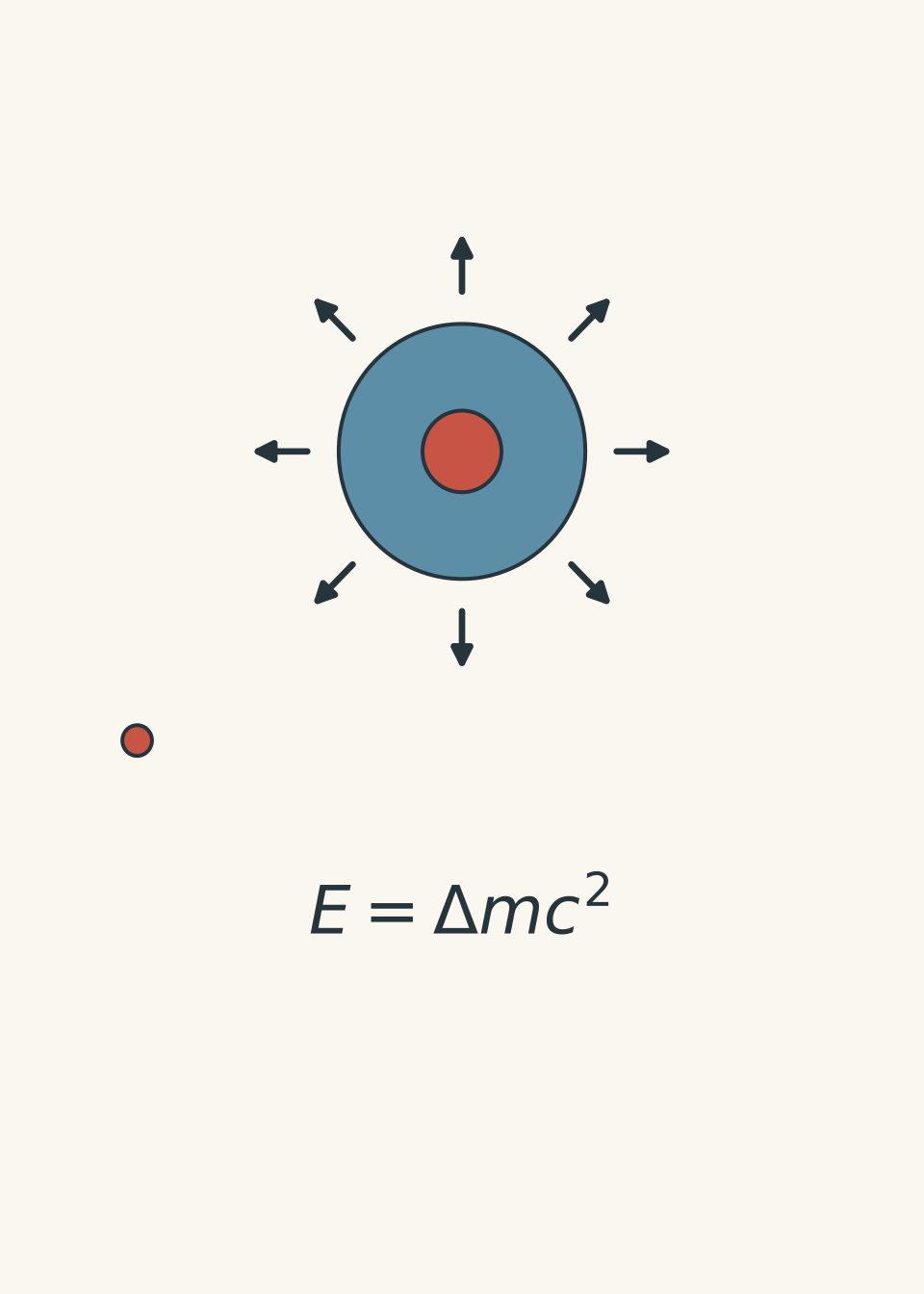
01The puzzle: how can a star release energy without burning?
When we say a star “burns”, it does not mean chemical burning like wood or petrol. Chemical reactions rearrange atoms, but the nuclei of the atoms stay the same. The energy released is relatively small.
Stars produce energy through nuclear fusion. In the core of a star like the Sun, hydrogen nuclei combine to form helium. You can explore the details of this process in the guides on the proton-proton chain and the CNO cycle.
A student might predict:
“If four hydrogen nuclei combine into one helium nucleus, the mass should be conserved exactly. Matter cannot just vanish.”
That prediction feels reasonable because mass is conserved in most everyday situations. However, nuclear reactions are different. The total amount of mass and energy is conserved together, but some of the original mass can become energy.
This is the idea behind mass-energy equivalence.
02Building the idea: a mass difference becomes energy
Imagine four people carrying a heavy bag up a hill. At the top, they have the same people and the same bag, but they have transferred energy into the environment through heat and sound.
Fusion is not exactly like this, but the idea helps: something that was stored in one form can appear in another form.
For nuclear fusion:
- Hydrogen nuclei start with a certain total mass.
- A helium nucleus is formed with slightly less mass.
- The missing mass appears as energy.
The difference is extremely small, but stars contain an enormous number of reactions happening every second.
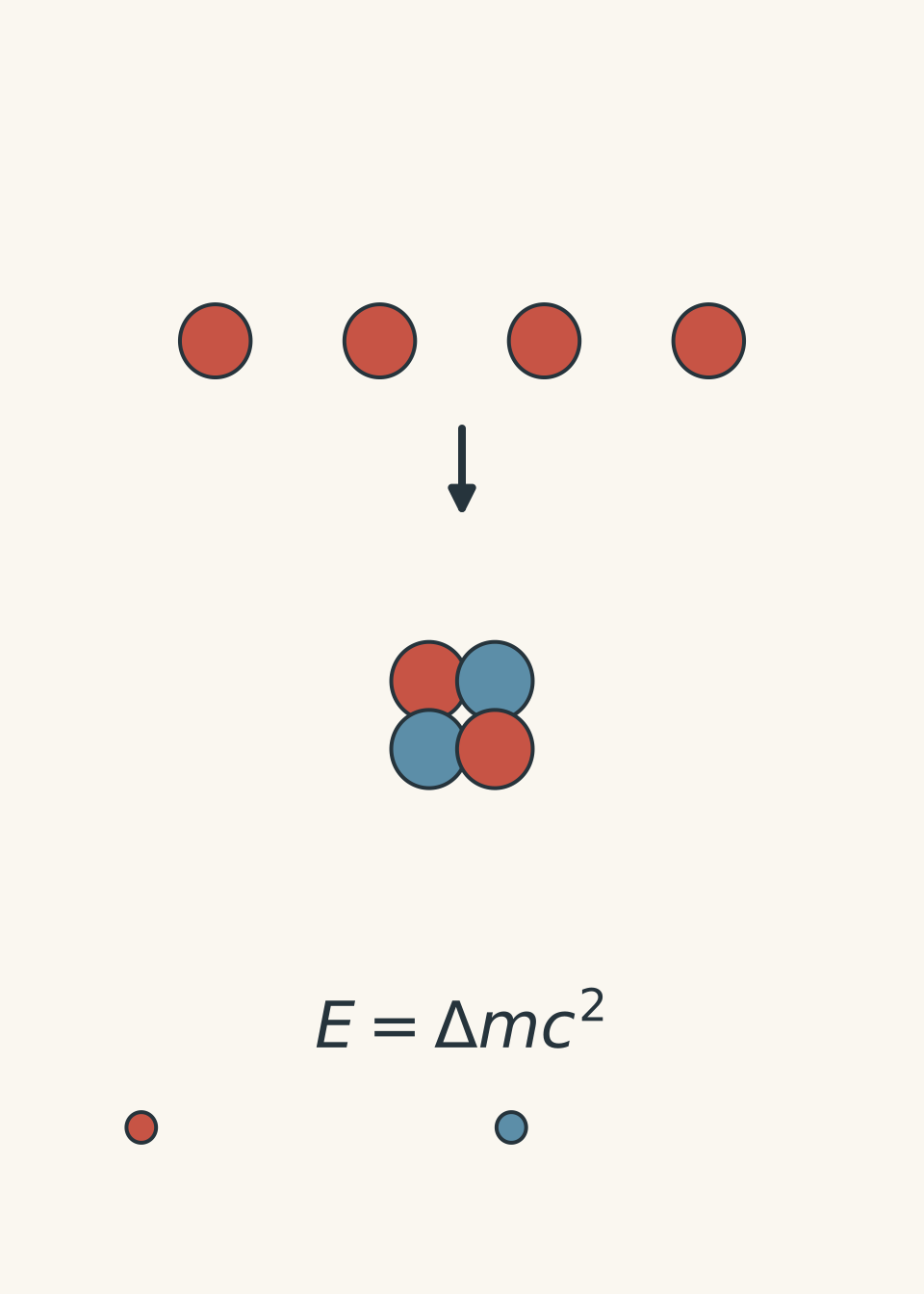
The exact relationship between mass and energy is:
\[ E = mc^2 \]
where:
- \(E\) is energy measured in joules (J),
- \(m\) is mass converted into energy measured in kilograms (kg),
- \(c\) is the speed of light in a vacuum, \(3.00 \times 10^8 \text{ m s}^{-1}\).
The equation says that even a small mass can produce a huge amount of energy because \(c^2\) is a very large number:
\[ c^2 = (3.00 \times 10^8)^2 \]
\[ c^2 = 9.00 \times 10^{16} \text{ m}^2\text{s}^{-2} \]
That means 1 kg of converted mass corresponds to:
\[ E = (1)(9.00 \times 10^{16}) \]
\[ E = 9.00 \times 10^{16}\text{ J} \]
This is an enormous amount of energy.
03The first model is useful, but incomplete
A common simplified explanation is:
“Stars lose mass because fusion turns mass directly into energy.”
That is useful, but it needs more precision.
The star does not lose most of its mass. The vast majority of the hydrogen becomes helium and remains inside the star. Only a small fraction of the mass difference becomes energy.
For the Sun, roughly 4 million tonnes of mass are converted into energy every second. That sounds impossible until you compare it with the Sun’s total mass, which is about \(2.0 \times 10^{30}\) kg.
The Sun is not disappearing quickly. It is converting a tiny fraction of its mass into energy while maintaining its structure through gravity and pressure.
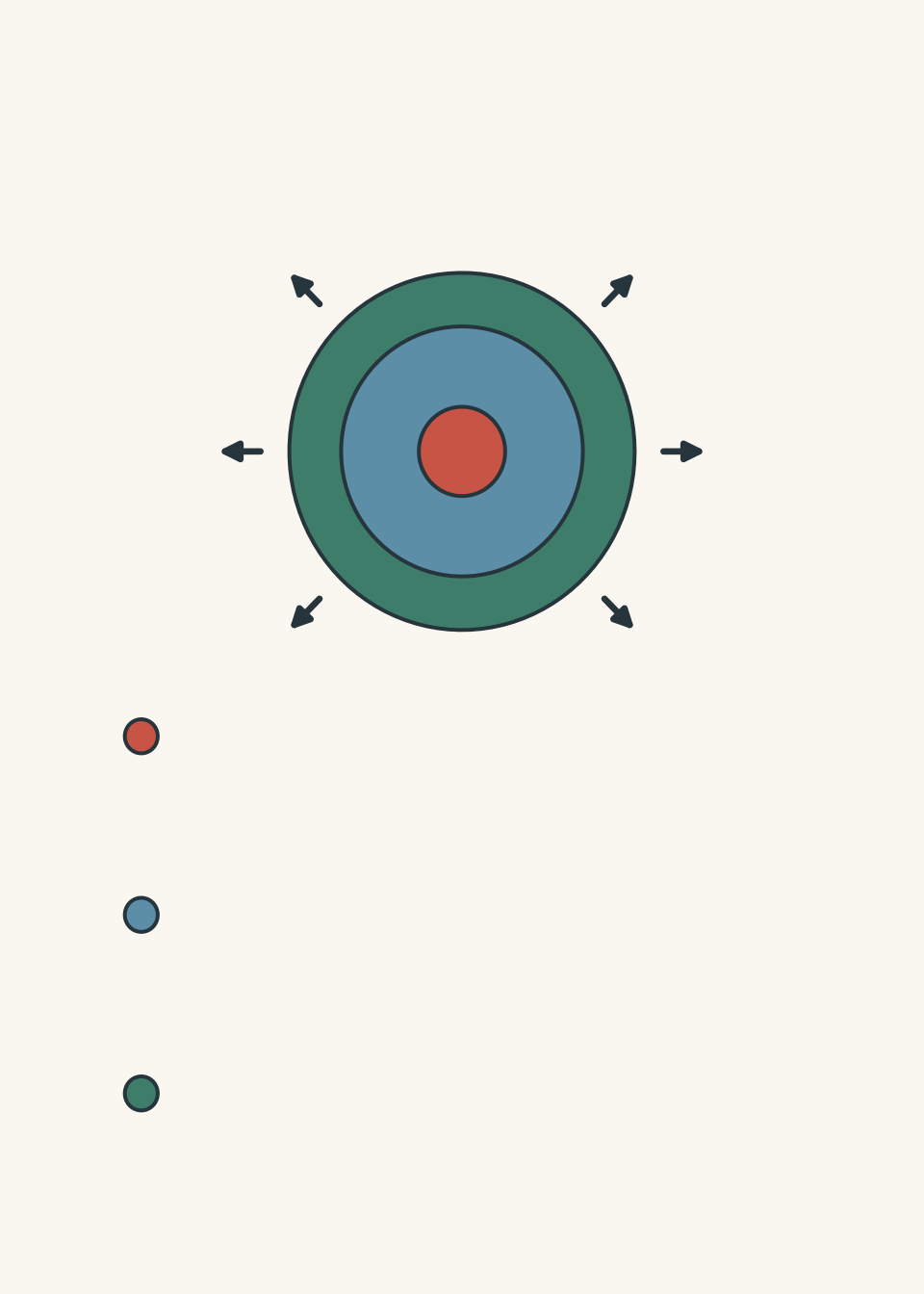
04Connecting mass loss to a star’s brightness
A star’s brightness is described by its luminosity, which is the rate at which it releases energy.
If a star releases energy at a constant rate, the mass converted each second can be found by rearranging:
\[ E = mc^2 \]
into:
\[ m = \frac{E}{c^2} \]
For a star:
- \(E\) is the energy released,
- \(m\) is the mass converted,
- \(c\) is the speed of light.
The larger the luminosity, the greater the amount of mass converted each second.
This creates a useful link between observations and nuclear physics. Astronomers can measure a star’s brightness, estimate its energy output, and determine how much mass is being converted.
This connects with other ways we classify stars, such as their spectra and their position on the Hertzsprung-Russell diagram.
05Worked example: mass converted from energy output
Worked example: A star releases \(3.6 \times 10^{26}\) J of energy each second. How much mass is converted into energy each second?
Step 1
The relationship is:
\[ E = mc^2 \]
Rearrange to make mass the subject:
\[ m = \frac{E}{c^2} \]
Step 2
The energy released is:
\[ E = 3.6 \times 10^{26}\text{ J} \]
and:
\[ c = 3.00 \times 10^8\text{ m s}^{-1} \]
Therefore:
\[ m = \frac{3.6 \times 10^{26}}{(3.00 \times 10^8)^2} \]
Step 3
\[ m = \frac{3.6 \times 10^{26}}{9.00 \times 10^{16}} \]
\[ m = 4.0 \times 10^9\text{ kg} \]
Step 4
The star converts:
\[ 4.0 \times 10^9\text{ kg} \]
of mass into energy every second.
This is \(4.0\) million tonnes per second. The number is huge, but it is still a tiny fraction of the star’s total mass.
06Why does the mass disappear?
At the centre of a star, hydrogen nuclei are pushed close together by enormous gravitational pressure.
Normally, positively charged protons repel each other. They need extremely high temperatures and pressures to get close enough for the strong nuclear force to bind them together.
When fusion occurs, the final helium nucleus has less mass than the starting hydrogen nuclei. The difference is released as:
- kinetic energy of particles,
- radiation,
- energy that eventually escapes as starlight.
The energy does not appear from nowhere. It comes from the change in the system’s mass.
07Worked example: comparing two stars
Worked example: Star A has a luminosity of \(8.0 \times 10^{26}\) W. Star B has a luminosity of \(2.0 \times 10^{26}\) W. Which star converts mass into energy faster, and by what factor?
Step 1
A watt is a joule per second:
\[ 1\text{ W} = 1\text{ J s}^{-1} \]
So luminosity tells us the energy released every second.
Step 2
Star A releases:
\[ 8.0 \times 10^{26}\text{ J s}^{-1} \]
Star B releases:
\[ 2.0 \times 10^{26}\text{ J s}^{-1} \]
The ratio is:
\[ \frac{8.0 \times 10^{26}}{2.0 \times 10^{26}} = 4 \]
Step 3
Because:
\[ m = \frac{E}{c^2} \]
and \(c\) is the same for both stars, a star producing four times more energy must convert four times more mass each second.
Step 4
Star A converts mass into energy four times faster than Star B.
The important idea is that luminosity is not just “how bright a star looks”. It tells us how quickly the star is transforming mass into energy.
08The tempting misconception: “More massive stars simply have more fuel”
It is tempting to think a larger star should live longer because it has more hydrogen available.
But massive stars also have much stronger gravity. This compresses their cores more, increasing temperature and pressure. Their fusion reactions run much faster.
So a massive star can have more fuel but use it at a much greater rate.
A useful comparison is two cars with larger fuel tanks. A truck may carry more fuel than a small car, but if it burns fuel much faster, it can still run out sooner.
The analogy breaks because stars are not machines with fixed fuel tanks. Their structure changes as fusion changes the core, and gravity constantly affects the balance.

09Why mass-energy equivalence matters for stellar evolution
Mass-energy equivalence explains the energy source of stars, but it also helps explain what happens when stars change.
As hydrogen in the core is used up, the balance between gravity and internal pressure changes. The star can move into different stages of its life.
The amount of mass a star begins with strongly influences its lifetime and final stages. This is why astronomers use tools such as the Hertzsprung-Russell diagram to compare stars and understand their evolution.
The key chain of reasoning is:
- Fusion changes hydrogen into helium.
- The helium nucleus has slightly less mass than the original hydrogen.
- The missing mass becomes energy.
- That energy supports the star and leaves as radiation.
- Measuring the radiation lets us infer what is happening inside the star.
10Questions and solutions
Question 1
The Sun releases approximately \(3.8 \times 10^{26}\) J of energy each second. Calculate the mass converted into energy each second.
Use \(c = 3.00 \times 10^8\text{ m s}^{-1}\).
Solution 1
The mass converted each second is approximately \(4.2 \times 10^9\) kg.
The governing relationship is:
\[ E = mc^2 \]
Rearrange:
\[ m = \frac{E}{c^2} \]
Substitute:
\[ m = \frac{3.8 \times 10^{26}}{(3.00 \times 10^8)^2} \]
\[ m = \frac{3.8 \times 10^{26}}{9.00 \times 10^{16}} \]
\[ m = 4.2 \times 10^9\text{ kg} \]
The tempting mistake is to think the Sun loses this much total material every second. It is actually the mass difference converted into energy, while almost all fusion products remain inside the star.
Question 2
A star doubles its energy output while its composition and fusion process remain unchanged. Explain how its rate of mass conversion changes.
Solution 2
The star’s mass conversion rate doubles.
The reason is that:
\[ m = \frac{E}{c^2} \]
For the same value of \(c\), mass converted is directly proportional to energy released. If the star releases twice as much energy each second, twice as much mass must be converted each second.
A common mistake is to think the star has become twice as massive and therefore loses mass faster because of its size. The relevant factor here is energy output, not simply the star’s current mass.
Question 3
Two stars have the same total mass. Star X converts mass into energy at twice the rate of Star Y. Predict which star will have the shorter lifetime if both begin with the same amount of usable hydrogen fuel.
Solution 3
Star X will have the shorter lifetime.
Although both stars contain the same amount of fuel, Star X uses that fuel faster. Its higher energy output means it converts mass into energy at a greater rate.
The tempting route is to focus only on the amount of fuel available. However, lifetime depends on both fuel supply and fuel consumption rate.
A simplified relationship is:
\[ \text{lifetime} \propto \frac{\text{fuel supply}}{\text{power output}} \]
Since Star X has the larger denominator, it reaches the end of its hydrogen supply sooner.
Question 4
A student says:
“Because the Sun loses millions of tonnes of mass every second, its gravity must be getting much weaker every day, causing planets to drift away rapidly.”
Evaluate this claim.
Solution 4
The claim is incorrect because the Sun’s lost mass is an extremely small fraction of its total mass.
The Sun converts about \(4 \times 10^9\) kg of mass into energy each second, but its total mass is about \(2 \times 10^{30}\) kg.
The fractional loss per second is approximately:
\[ \frac{4 \times 10^9}{2 \times 10^{30}} \]
\[ = 2 \times 10^{-21} \]
This is an incredibly small fraction.
The student’s reasoning uses a true observation but exaggerates its effect. The number of tonnes sounds large to humans, but stellar systems involve masses on a completely different scale. The Sun’s gravity changes extremely slowly because the lost mass is tiny compared with the Sun’s total mass.
Question 5
Two identical stars are formed at the same time with the same initial mass. Star A begins with a slightly hotter core because of a small difference in its internal conditions. A student predicts:
“Star A will always stay ahead of Star B because it starts hotter, so it must always be brighter and evolve faster.”
Assess this prediction.
Solution 5
The prediction is not necessarily correct because the relationship between core conditions, fusion rate, and stellar evolution is a feedback system.
A hotter core initially increases fusion rate. This means Star A produces more energy, increasing internal pressure. The extra pressure can cause the star to expand slightly, changing the balance between gravity, temperature, and density in the core.
The tempting route is to assume temperature only moves in one direction: hotter core means faster fusion forever. However, stars respond to changes in energy production. Their structure adjusts.
The final outcome depends on the details of how the star readjusts. In general, small initial differences can lead to different evolutionary paths, but the statement that Star A must always remain brighter is too strong.
The important constraint is that a star is not a passive fuel tank. Gravity, pressure, temperature, fusion rate, and mass conversion are connected. A change in one part can alter the whole system.
Understanding this balance is the next step towards explaining why stars move across the Hertzsprung-Russell diagram and why their lifetimes depend so strongly on mass.