
The CNO Cycle: Hydrogen Fusion in Hot Stars Explained
Learn how the CNO cycle uses carbon, nitrogen, and oxygen as catalysts to fuse hydrogen into helium, why temperature matters, and how to solve related HSC Physics questions.
A star can fuse hydrogen into helium without carbon. So why do some stars run hydrogen fusion through carbon, nitrogen, and oxygen first?
Here is the puzzle. At the end of the process, the carbon nucleus is back where it started. It has changed into nitrogen and oxygen along the way, but it hasn’t been permanently consumed. Meanwhile, four hydrogen nuclei have effectively disappeared and one helium nucleus has appeared.
Before reading on, predict what carbon is doing. Is it a fuel, a product, or something else?
It is a catalyst. The carbon nucleus gives hydrogen fusion another reaction pathway, but it is regenerated at the end of the cycle. That idea is the key to understanding the carbon-nitrogen-oxygen, or CNO, cycle.
01What problem does the CNO cycle solve?
Hydrogen nuclei are protons. Protons are positively charged, so they repel each other electrically.
Fusion requires nuclei to get extremely close together before the attractive strong nuclear force can bind them. In a stellar core, enormous temperatures give nuclei high kinetic energies, and quantum tunnelling gives some collisions a chance to overcome the Coulomb barrier even when the particles do not classically have enough energy.
There are two important ways a main-sequence star can turn hydrogen into helium:
- the proton-proton chain, in which the process begins with proton-proton interactions
- the CNO cycle, in which carbon, nitrogen, and oxygen nuclei provide a catalytic pathway
Both have essentially the same overall job: convert hydrogen into helium and release energy. In hotter stellar cores, the CNO pathway becomes much more important because its reaction rate is extremely sensitive to temperature. The exact balance also depends on the amount of carbon, nitrogen, and oxygen available. OpenStax
So this is not a choice the star makes. The conditions in its core determine which reactions occur often enough to matter.
02The first mental model: a reusable nuclear scaffold
Picture a carbon-12 nucleus sitting in a hot stellar core.
A proton collides with it and sticks. That changes the nucleus. Another transformation occurs, another proton is captured, and the nucleus keeps moving through a sequence of carbon, nitrogen, and oxygen isotopes.
Eventually, after four protons have entered the sequence, a helium-4 nucleus is released and carbon-12 appears again.
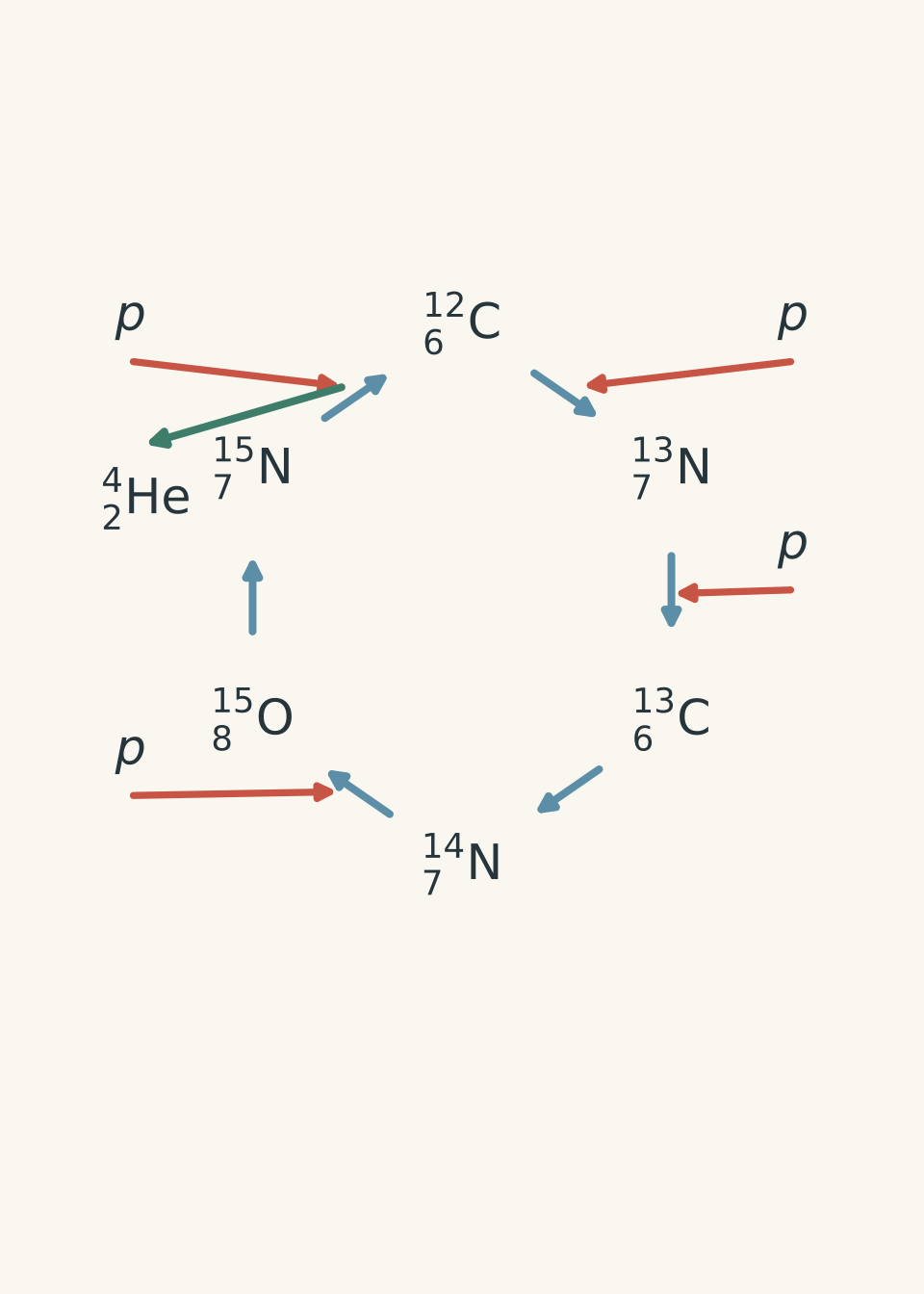
A slightly silly analogy is a friend who keeps organising dates for other people. During each setup they get dragged into the conversation, introduced to someone else, and temporarily become part of the chaos, but at the end they are still single and ready to organise another one.
Carbon plays roughly that organisational role. It participates in the individual reactions but is regenerated overall.
The analogy breaks in an important way: a catalyst in the CNO cycle is not merely standing nearby arranging collisions. Its nucleus actually changes identity several times before returning to its initial form.
03The six main reactions
Now we can make the model precise.
The main CNO-I cycle proceeds through six reactions.
1. Carbon-12 captures a proton
\[ {}^{12}_{6}\mathrm{C}+{}^{1}_{1}\mathrm{H} \rightarrow {}^{13}_{7}\mathrm{N}+\gamma \]
A carbon-12 nucleus captures a proton.
Check the numbers. The mass number increases from \(12\) to \(13\), and the atomic number increases from \(6\) to \(7\). Carbon has therefore become nitrogen.
A gamma-ray photon, \(\gamma\), carries away energy.
2. Nitrogen-13 undergoes beta-plus decay
\[ {}^{13}_{7}\mathrm{N} \rightarrow {}^{13}_{6}\mathrm{C}+e^+ +\nu_e \]
Nitrogen-13 is unstable. One of its protons effectively changes into a neutron through the weak interaction.
The products include:
- carbon-13,
- a positron \(e^+\), the antimatter counterpart of an electron, and
- an electron neutrino \(\nu_e\).
Notice what happened to the nucleon numbers. The mass number remains \(13\), because the total number of protons and neutrons is unchanged. The atomic number falls from \(7\) to \(6\).
3. Carbon-13 captures another proton
\[ {}^{13}_{6}\mathrm{C}+{}^{1}_{1}\mathrm{H} \rightarrow {}^{14}_{7}\mathrm{N}+\gamma \]
A second proton has now entered the cycle.
4. Nitrogen-14 captures a third proton
\[ {}^{14}_{7}\mathrm{N}+{}^{1}_{1}\mathrm{H} \rightarrow {}^{15}_{8}\mathrm{O}+\gamma \]
This produces oxygen-15.
This particular proton-capture step is relatively slow and acts as the main bottleneck in the ordinary CNO-I cycle. That matters because material can accumulate as nitrogen-14 while waiting for this reaction.
5. Oxygen-15 undergoes beta-plus decay
\[ {}^{15}_{8}\mathrm{O} \rightarrow {}^{15}_{7}\mathrm{N}+e^+ +\nu_e \]
Again, the mass number stays constant while the atomic number falls by one.
6. Nitrogen-15 captures the fourth proton
\[ {}^{15}_{7}\mathrm{N}+{}^{1}_{1}\mathrm{H} \rightarrow {}^{12}_{6}\mathrm{C}+{}^{4}_{2}\mathrm{He} \]
This is the satisfying bit.
The helium-4 nucleus leaves, while carbon-12 returns.
The cycle can now begin again.
04Why carbon counts as a catalyst
Look only at what enters and leaves one complete cycle.
Four protons enter. Carbon-12 appears at both the start and the end, so when we add all six nuclear equations together, it cancels.
The same happens to the intermediate carbon, nitrogen, and oxygen nuclei.
The net result is approximately
\[ 4{}^{1}_{1}\mathrm{H} \rightarrow {}^{4}_{2}\mathrm{He} +2e^+ +2\nu_e +\text{energy} \]
The energy released per completed hydrogen-to-helium conversion is about \(26.7\ \mathrm{MeV}\), although some of that energy is carried away by neutrinos rather than heating the star. Western University Physics
This gives us a useful decision rule:
If a nucleus appears during a reaction pathway but is regenerated when the complete sequence is added together, it can be acting as a catalyst.
Carbon is therefore not the main fuel of the CNO cycle.
Hydrogen is.
This is the most common misconception to avoid. Seeing carbon, nitrogen, and oxygen throughout the equations makes it tempting to say that the star is “fusing carbon”. It isn’t, at least not in the sense meant here. Carbon fusion is a different process that occurs under much more extreme conditions in later stages of stellar evolution.
05Where does the released energy come from?
The catalyst explains the pathway. It does not provide the energy.
The energy comes from the difference between the total rest mass before and after the net reaction.
The final products have slightly less rest mass than the initial particles. That mass difference, called the mass defect \(\Delta m\), corresponds to released energy through
\[ E=\Delta mc^2 \]
where:
- \(E\) is the energy released, in joules,
- \(\Delta m\) is the decrease in mass, in kilograms, and
- \(c\) is the speed of light, approximately \(3.00\times10^8\ \mathrm{m\,s^{-1}}\).
Another useful conversion is
\[ 1\ \mathrm{u}=931.5\ \mathrm{MeV}/c^2 \]
where \(\mathrm{u}\) is the unified atomic mass unit.
The wording “mass is converted into energy” can sometimes make this sound as though a chunk of matter simply vanishes. A better model is that the bound final system has a lower rest energy than the original system. The difference emerges as radiation and particle kinetic energy.
Worked example: Energy released from a mass defect
A completed hydrogen-fusion cycle has a mass defect of \(0.0287\ \mathrm{u}\). Calculate the energy released in megaelectronvolts.
Step 1
\[ 1\ \mathrm{u}=931.5\ \mathrm{MeV}/c^2 \]
A mass defect of \(0.0287\ \mathrm{u}\) therefore corresponds to
\[ E=(0.0287)(931.5)\ \mathrm{MeV} \]
Step 2
\[ E=26.7\ \mathrm{MeV} \]
Step 3
About \(26.7\ \mathrm{MeV}\) of energy becomes available from one net conversion of four hydrogen nuclei into one helium-4 nucleus.
The carbon catalyst does not supply that energy. If the catalyst completes another cycle, another four hydrogen nuclei can undergo essentially the same net transformation.
06Why does temperature matter so much?
Here is another prediction worth making.
Suppose two stars have the same amount of hydrogen and the same amount of carbon, nitrogen, and oxygen. One has a slightly hotter core.
Would you expect the CNO fusion rate to increase a little, or a lot?
A lot.
The reason begins with electric repulsion.
A proton approaching carbon has charge \(+e\). A carbon nucleus has charge \(+6e\). Their electrostatic repulsion is therefore much stronger than the repulsion between two protons.
That sounds like bad news for CNO fusion, and at relatively low stellar temperatures it is. Few particles have conditions favourable enough for proton capture by the heavier nuclei.
But increasing the temperature changes the high-energy part of the particle distribution and greatly increases the probability of successful nuclear reactions. Because CNO reactions must deal with comparatively large Coulomb barriers, their rate responds very strongly to temperature.
This is why the CNO cycle contributes relatively little to the Sun’s present energy production but becomes much more important in hotter, more massive main-sequence stars. OpenStax
There is an important qualification, though:
High temperature alone does not guarantee a large CNO rate.
The star also needs carbon, nitrogen, or oxygen nuclei to run the catalytic cycle. No catalysts means no ordinary CNO cycle, no matter how enthusiastic the protons are.
07CNO versus the proton-proton chain
The two pathways are easier to compare once you stop thinking of them as different final reactions.
| Feature | Proton-proton chain | CNO cycle |
|---|---|---|
| Main fuel | Hydrogen | Hydrogen |
| Net major product | Helium-4 | Helium-4 |
| Requires C, N, or O nuclei | No | Yes |
| Acts strongly in | Cooler main-sequence cores | Hotter main-sequence cores |
| Temperature sensitivity | Lower | Much higher |
| Catalyst regenerated | Not in the same CNO sense | Yes |
Both pathways convert hydrogen into helium.
Their importance inside a particular star depends on reaction rates, which depend on conditions including temperature, density, composition, and the available nuclei.
That distinction becomes useful when you interpret stellar observations. A star’s spectrum can tell us about its surface composition and temperature, but you need a physical model to connect those observations to processes occurring deep inside the core. If you need to refresh that link, see Classifying Stars with Stellar Spectra.
Worked example: How many CNO cycles are required?
Suppose a stellar region produces power at \(4.0\times10^{25}\ \mathrm{W}\) entirely through CNO hydrogen fusion. Assume each completed cycle releases \(26.7\ \mathrm{MeV}\). Estimate the number of completed cycles per second.
Use
\[ 1\ \mathrm{eV}=1.602\times10^{-19}\ \mathrm{J} \]
Step 1
Since \(1\ \mathrm{MeV}=10^6\ \mathrm{eV}\),
\[ \begin{aligned} E_{\text{cycle}} &=(26.7\times10^6)(1.602\times10^{-19})\\ &=4.28\times10^{-12}\ \mathrm{J} \end{aligned} \]
Step 2
Power is
\[ P=\frac{E}{t} \]
If \(N\) cycles occur each second,
\[ P=NE_{\text{cycle}} \]
so
\[ N=\frac{P}{E_{\text{cycle}}} \]
Step 3
\[ \begin{aligned} N &=\frac{4.0\times10^{25}\ \mathrm{J\,s^{-1}}} {4.28\times10^{-12}\ \mathrm{J}}\\ &=9.3\times10^{36}\ \mathrm{s^{-1}} \end{aligned} \]
About \(9.3\times10^{36}\) complete CNO cycles would be required each second.
Each cycle consumes a net total of four protons, so the corresponding proton consumption rate would be about
\[ 4(9.3\times10^{36}) =3.7\times10^{37}\ \text{protons per second}. \]
A spectacular reaction rate does not mean the carbon catalyst is being consumed at that same rate. A catalyst can participate repeatedly.
08What should you actually remember?
Don’t try to memorise the six reactions as six unrelated lines.
Track what is happening.
The catalyst moves through
\[ {}^{12}\mathrm{C} \rightarrow {}^{13}\mathrm{N} \rightarrow {}^{13}\mathrm{C} \rightarrow {}^{14}\mathrm{N} \rightarrow {}^{15}\mathrm{O} \rightarrow {}^{15}\mathrm{N} \rightarrow {}^{12}\mathrm{C}. \]
Four proton captures occur.
Two beta-plus decays occur.
One helium-4 nucleus is released.
The original carbon-12 nucleus is regenerated.
So the conceptual skeleton is:
\[ \text{four hydrogen nuclei} \longrightarrow \text{one helium-4 nucleus}+\text{energy}, \]
with carbon, nitrogen, and oxygen providing the pathway.
If you can reconstruct that logic, you are in a much better position than if you have simply memorised six arrows.
09Questions and solutions
Question 1
A student writes:
“The CNO cycle converts carbon and hydrogen into helium, so carbon is one of the fuels.”
Explain why this statement is incorrect. State the net change produced by a complete CNO cycle.
Solution 1
Carbon is acting as a catalyst, not as the net fuel.
The student has noticed correctly that carbon participates in individual reactions, but has missed what happens when the complete sequence is considered. Carbon-12 is present at the beginning and is regenerated at the end.
The intermediate C, N, and O nuclei therefore cancel when the reaction equations are added.
The net reaction is approximately
\[ 4{}^{1}_{1}\mathrm{H} \rightarrow {}^{4}_{2}\mathrm{He} +2e^+ +2\nu_e +\text{energy}. \]
The important principle is that the net reaction, rather than any one intermediate step, tells us what is actually consumed.
Hydrogen is consumed. Helium is produced. The carbon catalyst can participate in another cycle.
Question 2
A particular CNO cycle releases \(26.7\ \mathrm{MeV}\).
Calculate the energy released by \(2.50\times10^{20}\) completed cycles. Give your answer in joules.
Use \(1\ \mathrm{eV}=1.602\times10^{-19}\ \mathrm{J}\).
Then state how many hydrogen nuclei are consumed.
Solution 2
The cycles release approximately \(1.07\times10^9\ \mathrm{J}\), and consume \(1.00\times10^{21}\) hydrogen nuclei.
First convert the energy of one cycle:
\[ \begin{aligned} E_{\text{cycle}} &=(26.7\times10^6\ \mathrm{eV})(1.602\times10^{-19}\ \mathrm{J/eV})\\ &=4.28\times10^{-12}\ \mathrm{J}. \end{aligned} \]
For \(2.50\times10^{20}\) cycles,
\[ \begin{aligned} E_{\text{total}} &=(2.50\times10^{20})(4.28\times10^{-12}\ \mathrm{J})\\ &=1.07\times10^9\ \mathrm{J}. \end{aligned} \]
Each completed cycle consumes a net total of four hydrogen nuclei, so
\[ N_{\mathrm{H}} =4(2.50\times10^{20}) =1.00\times10^{21}. \]
The tempting mistake is to count the catalyst as another consumed nucleus. Carbon participates in every cycle, but there is no net loss of carbon-12 after a complete idealised cycle.
Question 3
In the main CNO cycle, suppose the reaction
\[ {}^{14}_{7}\mathrm{N}+{}^{1}_{1}\mathrm{H} \rightarrow {}^{15}_{8}\mathrm{O}+\gamma \]
is much slower than the other proton-capture reactions.
After the cycle has been running for a long time, predict whether relatively large amounts of nitrogen-14 or oxygen-15 should be present in the reacting region. Explain your reasoning.
Solution 3
Relatively more nitrogen-14 should accumulate.
A nucleus moving through the CNO cycle eventually reaches nitrogen-14. To continue, it must capture a proton through the stated reaction.
If that step is slow, nuclei arrive at nitrogen-14 faster than they leave it. The situation resembles cars reaching a road bottleneck: the important clue is not where cars move fastest, but where they spend the most time waiting.
So the abundance of an intermediate species can become large precisely because its next reaction is slow.
Oxygen-15 is produced only after the bottleneck has been passed and then undergoes beta-plus decay:
\[ {}^{15}_{8}\mathrm{O} \rightarrow {}^{15}_{7}\mathrm{N}+e^++\nu_e. \]
The tempting prediction is that the slow reaction should produce very little nitrogen-14 because “slow means uncommon”. That reverses the logic. Nitrogen-14 is the material waiting to undergo the slow reaction, so a slow destruction rate allows it to build up.
This is also why identifying the slowest step in a reaction sequence can tell us about both the overall reaction rate and the relative abundances of intermediate nuclei.
Question 4
Two stellar cores, A and B, contain equal hydrogen densities.
For this question, use the simplified models
\[ R_{\mathrm{pp}}\propto T^4 \]
and
\[ R_{\mathrm{CNO}}\propto X_{\mathrm{CNO}}T^{18}, \]
where \(R_{\mathrm{pp}}\) and \(R_{\mathrm{CNO}}\) are reaction-rate measures, \(T\) is temperature, and \(X_{\mathrm{CNO}}\) represents the abundance of CNO catalysts.
Core B has a temperature \(10\%\) greater than core A but only one-quarter of its CNO abundance.
Calculate the factors by which the pp and CNO rates change from A to B. Which pathway is favoured more strongly by the change in conditions?
Solution 4
The pp rate increases by a factor of about \(1.46\), while the CNO rate increases by a factor of about \(1.39\). Under these particular conditions, the change therefore does not favour CNO relative to pp; the loss of catalysts almost cancels the CNO temperature advantage.
For the proton-proton model,
\[ \frac{R_{\mathrm{pp,B}}}{R_{\mathrm{pp,A}}} =(1.10)^4 =1.46. \]
So the pp rate is about \(46\%\) higher.
For the CNO model, both temperature and catalyst abundance matter:
\[ \frac{R_{\mathrm{CNO,B}}}{R_{\mathrm{CNO,A}}} =\frac{1}{4}(1.10)^{18}. \]
Calculating,
\[ (1.10)^{18}\approx5.56, \]
so
\[ \frac{R_{\mathrm{CNO,B}}}{R_{\mathrm{CNO,A}}} =\frac{5.56}{4} \approx1.39. \]
Thus the CNO rate is about \(39\%\) higher.
The tempting argument is simply: “CNO has the larger temperature exponent, so B must favour CNO more strongly.” That would be correct if the compositions were unchanged.
They are not.
Core B has only one-quarter as many CNO catalysts in this simplified model. Its increased temperature strongly helps CNO reactions, but its lower catalyst abundance pushes in the opposite direction.
This exposes an important limitation of the shortcut “hotter stars use the CNO cycle”. Temperature is extremely important, but composition matters as well.
Question 5
Consider two otherwise identical hot stellar cores.
Core X initially contains a small number of carbon-12 nuclei. Core Y initially contains hydrogen and helium but absolutely no carbon, nitrogen, or oxygen.
The temperature is high enough that, if CNO nuclei are present, CNO reactions occur rapidly. Assume for this question that no other nuclear process can create carbon, nitrogen, or oxygen.
A student makes three claims:
- Core Y will eventually begin the CNO cycle because sufficiently energetic protons can create the required carbon catalyst.
- Core X can produce more helium nuclei through the CNO cycle than the number of carbon-12 nuclei it originally contained.
- Adding twice as much carbon-12 to Core X must double the energy released by each completed CNO cycle.
Assess all three claims. Your explanation must distinguish reaction rate from energy released per completed cycle.
Solution 5
Claims 1 and 3 are incorrect, while Claim 2 is correct.
For Claim 1, high temperature can increase the probability of reactions that are physically available, but it does not remove the need for the required nuclei.
Under the stated assumption, Core Y contains no C, N, or O and no other reaction is allowed to create them. The normal CNO cycle therefore has no nucleus with which to begin:
\[ {}^{12}_{6}\mathrm{C}+{}^{1}_{1}\mathrm{H} \rightarrow {}^{13}_{7}\mathrm{N}+\gamma. \]
No amount of temperature dependence changes the fact that the required carbon-12 reactant is absent. Claim 1 is therefore false.
For Claim 2, carbon-12 is regenerated:
\[ {}^{15}_{7}\mathrm{N}+{}^{1}_{1}\mathrm{H} \rightarrow {}^{12}_{6}\mathrm{C}+{}^{4}_{2}\mathrm{He}. \]
The same catalyst nucleus can therefore complete another cycle. One carbon-12 nucleus is not limited to producing one helium nucleus. Given enough hydrogen and time, it can participate repeatedly, so Core X can produce vastly more helium nuclei than its initial number of carbon nuclei.
Claim 2 is therefore true.
For Claim 3, the net reaction of each completed cycle remains approximately
\[ 4{}^{1}_{1}\mathrm{H} \rightarrow {}^{4}_{2}\mathrm{He}+2e^++2\nu_e+\text{energy}. \]
The energy released by one completed cycle is determined by the mass-energy difference between the net initial and final states. Adding more catalyst does not double that mass difference.
More carbon may allow more cycles to proceed per unit time if catalyst availability is limiting. That can increase the power output:
\[ P=\frac{\Delta E}{\Delta t}. \]
But it does not imply twice as much energy from each individual hydrogen-to-helium conversion.
Claim 3 is therefore false.
The hinge in this question is separating three ideas that sound similar but are not:
- temperature affects reaction probability,
- catalyst abundance can affect reaction rate, and
- mass defect determines the energy available from each net fusion reaction.
A hotter core cannot run a pathway whose required nuclei do not exist. A catalyst can be reused. And increasing the amount of catalyst can alter how quickly energy is produced without changing the fundamental energy released by converting four hydrogen nuclei into helium.
That distinction leads naturally into stellar evolution: once you understand which fusion pathway dominates under particular core conditions, you can connect a star’s mass, central temperature, composition, luminosity, and lifetime rather than treating “hydrogen fusion” as a single identical process in every star.