
Contact Forces and Field Forces in HSC Physics
Learn how to classify contact and field forces, identify which object exerts each force, and avoid common force-diagram mistakes.
Put a textbook on a desk. It stays still. That sounds simple, until you ask: what forces are actually acting on the book, and which objects are exerting them?
You might say gravity pulls the book down and the desk pushes it up. Good. Now lift the book with your hand. Has gravity disappeared? Of course not. The book still interacts with Earth, but the desk no longer interacts with the book.
That gives us the useful distinction. Some forces require the objects to be touching. Others act even when the objects are separated.
Before naming them formally, make a prediction. A magnet is held a few centimetres above a steel paperclip. The paperclip jumps upwards before the magnet touches it. Is the magnetic force a contact force?
No. The force exists while there is still a gap. That makes it a field force.
01The first question to ask: what is interacting with what?
A force isn’t something an object simply “has”. A force is an interaction between two objects.
When you identify a force, try to complete this sentence:
The force on ___ exerted by ___.
For the textbook on the desk:
- Earth exerts a gravitational force on the book.
- The desk exerts a normal force on the book.
This wording prevents a very common mistake. Students often list force names without identifying their source. Writing “normal force” is less useful than writing “normal force on the book exerted by the desk”.
You can think of a force as a message that always needs both a sender and a receiver. “I got a text” tells you something happened, but “I got a text from Mia” tells you where it came from. Forces work the same way: identify the object experiencing the force and the object causing the interaction.
The analogy breaks down because forces aren’t literal messages travelling between objects. It is only a way to remember that every force represents an interaction.
02Contact forces need physical contact
A contact force acts when two objects are touching.
Common HSC examples include:
| Contact force | Interaction that causes it |
|---|---|
| Normal force | A surface pushes on an object touching it |
| Friction | Two surfaces resist relative sliding, or the tendency to slide |
| Tension | A stretched rope, string, or cable pulls on an attached object |
| Air resistance | Air molecules interact with a moving object |
| Drag | A fluid interacts with an object moving through it |
| Applied force | One object directly pushes or pulls another |
Suppose you lean against a wall. Your shoulder pushes on the wall, and the wall pushes back on your shoulder. The wall does not need muscles to “push”. The force comes from interactions between the atoms in the two surfaces.
At the microscopic level, many contact forces ultimately involve electromagnetic interactions between charged particles. For HSC force classification, however, we call them contact forces because the objects are in physical contact at the macroscopic scale.
Normal force is a surface force
The word normal here doesn’t mean ordinary. In mathematics and physics, normal means perpendicular.
A normal force therefore acts perpendicular to the surface producing it.
If a book sits on a horizontal table, the table’s normal force is vertical.
If a block rests on a ramp, the normal force is not vertical. It points perpendicular to the ramp.
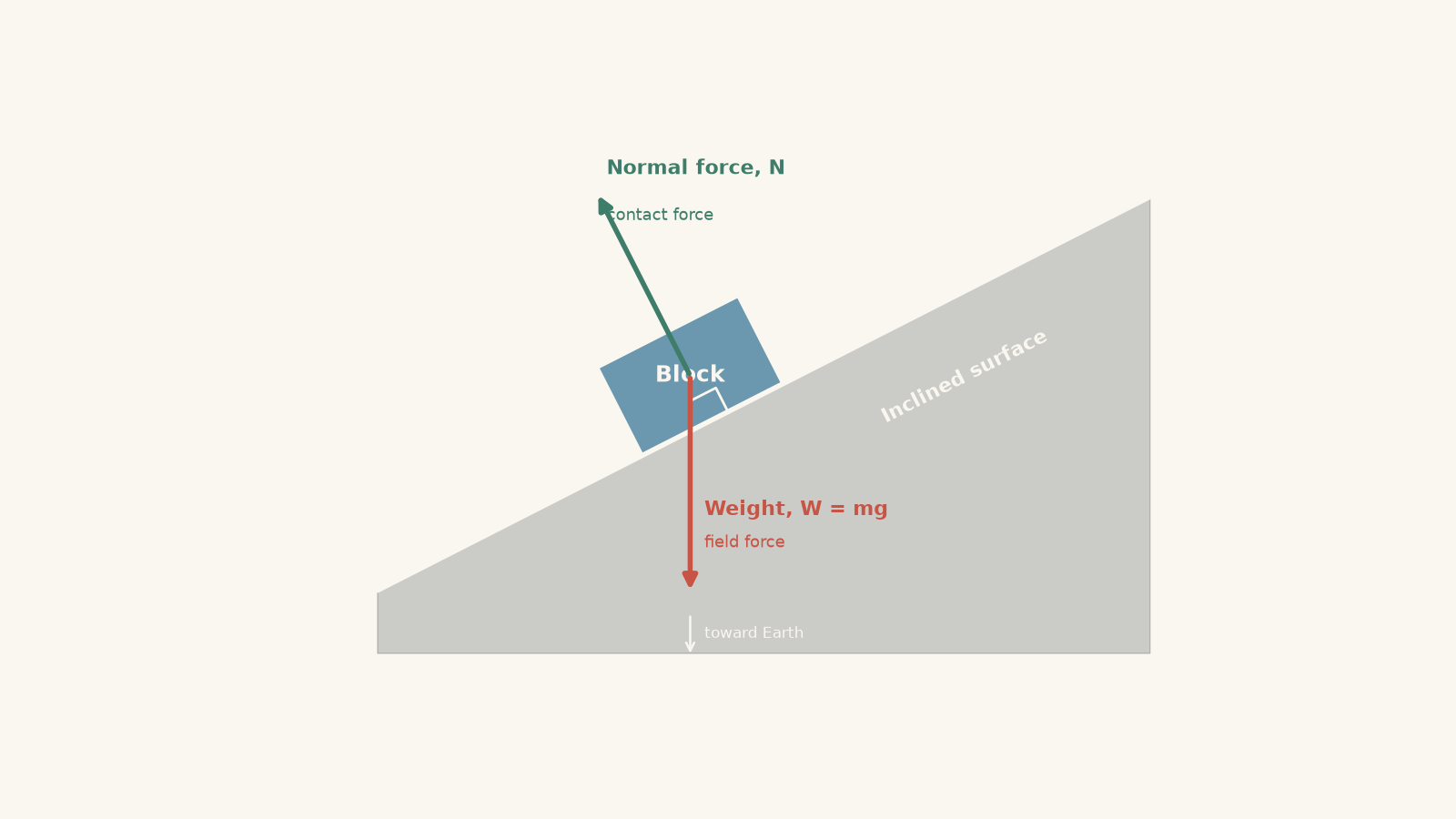
This is why memorising “normal force points up” causes trouble. It only points straight up when the relevant surface is horizontal.
Friction acts along the contact surface
Friction acts parallel to the surfaces in contact.
A tempting rule is:
Friction always points opposite to motion.
That rule is too crude.
Friction opposes relative sliding, or the tendency for relative sliding, between contacting surfaces.
Imagine walking forwards. Your foot pushes backwards on the ground. Static friction from the ground pushes your foot forwards. So the friction force on you can point in the same direction as your overall motion.
The direction of friction depends on what the surfaces are trying to do relative to each other, not simply on which way the whole object is moving.
Tension comes from a stretched connector
A rope attached to a crate can pull the crate, but it cannot push it.
The force exerted by the rope on the crate is called tension. Its direction is along the rope, away from the object being pulled.
Be careful with the source. If a person pulls a crate using a rope, the force directly acting on the crate is usually exerted by the rope, not by the person’s hand.
The person interacts with the rope. The rope interacts with the crate.
That distinction becomes important when drawing force diagrams.
03Field forces can act across a gap
Now return to the paperclip and magnet. There is no physical contact, yet the paperclip accelerates.
A field force can act between objects that are not touching.
The three field interactions most important in HSC Physics are:
| Field force | Objects involved |
|---|---|
| Gravitational | Objects with mass |
| Electric | Electrically charged objects |
| Magnetic | Magnets, magnetic materials, and moving charges or currents |
The word field gives us a way to describe how an object can experience a force at its location without direct contact with the source.
For example, Earth produces a gravitational field around itself. A book placed in that field experiences a gravitational force.
At this stage, the important classification rule is simple:
If the interacting objects must be touching, classify the force as a contact force. If the interaction can occur across a separation, classify it as a field force.
That rule is useful, but it needs one refinement. A field force can still act when the objects happen to be touching. Classification depends on the type of interaction, not merely on whether there is currently a gap.
A book sitting on Earth is still experiencing a gravitational field force even though, indirectly through the floor and table, it is supported by contact forces.
04Weight is the gravitational force exerted by Earth
Students sometimes treat “weight” as a property sitting inside an object. It is better to identify the interaction.
Near Earth’s surface, an object’s weight is the gravitational force exerted by Earth on the object.
Its magnitude is
\[ F_g = mg \]
where \(F_g\) is gravitational force in newtons (N), \(m\) is mass in kilograms (kg), and \(g\) is gravitational field strength in newtons per kilogram (N kg\(^{-1}\)).
Near Earth’s surface, \(g\) is approximately \(9.8\text{ N kg}^{-1}\).
Mass and weight are therefore not the same thing. Mass describes how much inertia an object has. Weight is a force arising from gravitational interaction.
Worked example: What forces act on a stationary laptop?
A \(1.6\text{ kg}\) laptop rests motionless on a horizontal desk. Identify the forces acting on the laptop, classify each as contact or field, and determine their magnitudes.
Step 1
Earth interacts gravitationally with the laptop. The desk is in contact with the laptop.
So there are two forces:
- gravitational force on the laptop exerted by Earth,
- normal force on the laptop exerted by the desk.
Step 2
Gravity is a field force.
The normal force is a contact force.
Step 3
\[ F_g = mg = (1.6\text{ kg})(9.8\text{ N kg}^{-1}) = 15.68\text{ N} \]
So the gravitational force is approximately \(16\text{ N}\) downward.
Step 4
The laptop is stationary, so its acceleration is zero. The resultant force must therefore be zero.
The upward normal force must balance the downward gravitational force:
\[ F_N = 15.68\text{ N} \approx 16\text{ N} \]
The desk exerts a normal force of about \(16\text{ N}\) upward on the laptop.
The important point is not just that there are “two equal forces”. They are two different interactions with two different sources.
05Don’t invent a force because an object is moving
Suppose a hockey puck slides to the right across nearly frictionless ice.
What force pushes it forwards once it has left the player’s stick?
The answer can be none.
This feels strange if you carry the everyday idea that motion needs a continuing push. Newton’s first law says otherwise. A force is required to change velocity, not to maintain constant velocity.
Once the stick is no longer touching the puck, the stick no longer exerts a contact force on it.
The puck can continue moving forwards because of its inertia.
On Earth it still experiences gravitational force from Earth and a normal force from the ice. If resistance is small enough to ignore, there may be no horizontal force at all.
This gives you a powerful test when identifying forces:
Do not draw a force simply because an object is moving in that direction. Find an actual interacting object that could exert it.
If you cannot name the source, the force is suspicious.
06A force diagram should contain only forces acting on the chosen object
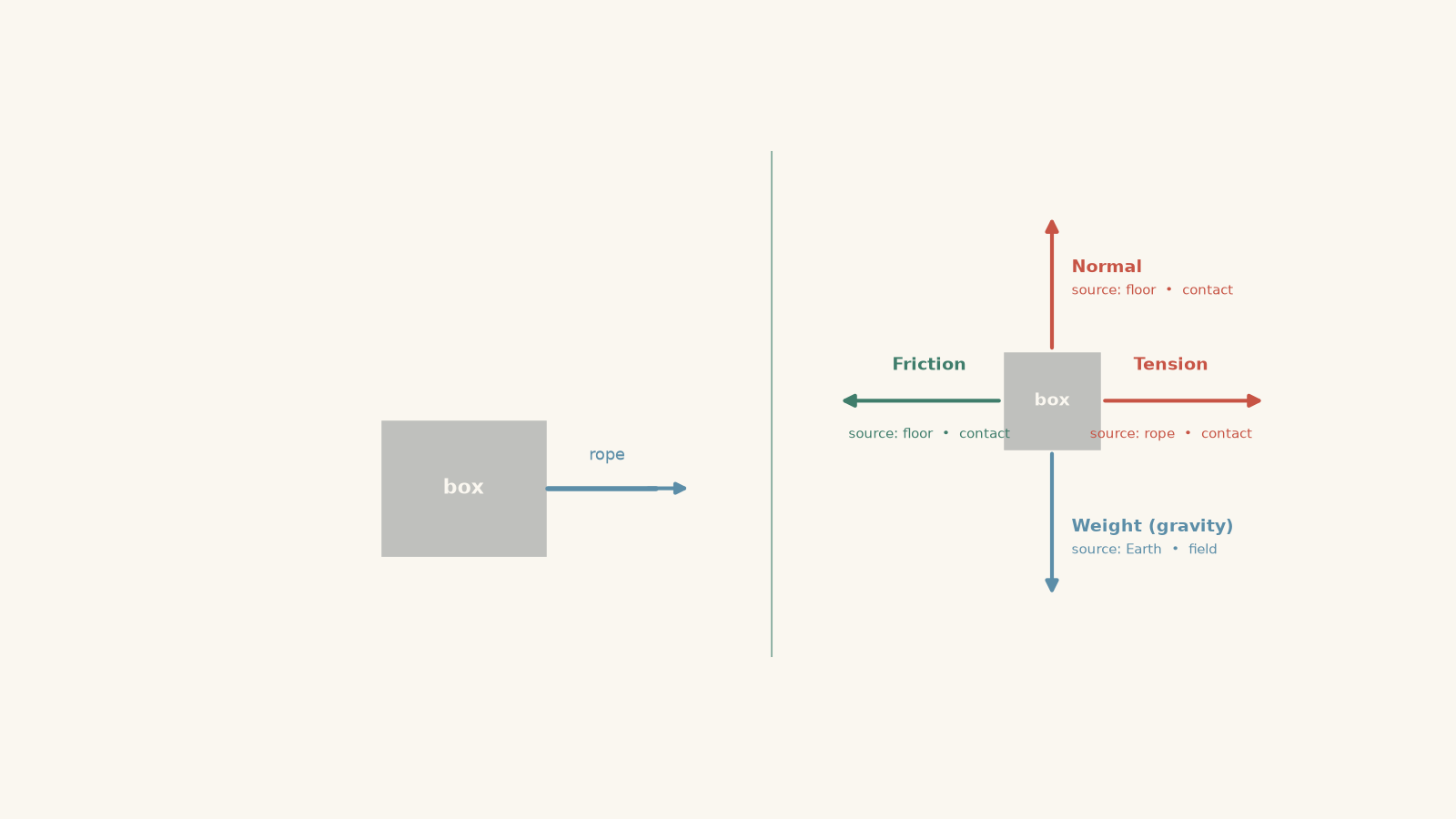
Consider a box being pulled across a rough floor by a rope.
Before reading on, predict the forces you would draw on the box.
You should identify four interactions:
- Earth exerts gravitational force downward.
- The floor exerts a normal force on the box.
- The floor exerts friction on the box.
- The rope exerts tension on the box.
Notice what is missing. The box may exert forces on Earth, the floor, and the rope, but those forces do not belong on a force diagram for the box.
A free-body diagram isolates one object and shows only the external forces acting on that object.
A useful naming format is
\[ F_{\text{source on object}} \]
For example, \(F_{\text{Earth on box}}\) means the force exerted by Earth on the box.
You do not need to use that notation every time, but thinking in that form makes force identification much more reliable.
Worked example: A suspended sign pulled sideways
A sign of mass \(8.0\text{ kg}\) hangs from a vertical cable. A person pulls the sign horizontally using a second rope, and the sign remains stationary. Identify each force acting on the sign, classify it as contact or field, and find the magnitude of the vertical cable’s tension.
Step 1
The sign interacts with:
- Earth,
- the vertical cable,
- the horizontal rope.
There is no floor or wall touching the sign, so there is no normal force from either.
Step 2
Earth exerts gravitational force on the sign. This is a field force.
The vertical cable exerts tension on the sign. This is a contact force.
The horizontal rope also exerts tension on the sign. This is a contact force.
Step 3
\[ F_g = mg = (8.0\text{ kg})(9.8\text{ N kg}^{-1}) = 78.4\text{ N} \]
Step 4
The horizontal rope has no vertical component because it is horizontal. The sign is stationary, so the vertical forces must balance.
Therefore,
\[ F_{\text{vertical cable}} = 78.4\text{ N} \]
The vertical cable exerts a tension of \(78.4\text{ N}\) upward.
This example shows why identifying the source and direction of each force comes before calculation. If you invent a normal force or call the person’s pull a direct force on the sign, the diagram is already wrong before any mathematics begins.
07Contact versus field is not the same as push versus pull
It is tempting to sort forces using everyday language: contact forces “push”, while field forces “pull”.
That does not work.
A rope produces a contact force and pulls.
A normal force produces a contact force and usually pushes.
Gravity attracts.
Electric forces can attract or repel.
Magnetic interactions can also produce attraction or repulsion depending on the system.
So use the interaction, not the everyday verb:
Does this type of force require physical contact between the interacting objects?
If yes, it is a contact force. If no, it is a field force.
08A reliable force-identification method
When a force question becomes messy, use the same sequence every time:
- Choose the object you are analysing. Do not mix forces acting on different objects.
- List the objects interacting with it. Look for Earth, surfaces, ropes, fluids, magnets, charges, and other objects in contact.
- Name the force produced by each interaction. For example, Earth gives gravitational force, a surface may give normal force and friction, and a rope gives tension.
- Classify the interaction. Decide whether it is a contact force or a field force.
- Check the source. Complete the phrase “force on ___ exerted by ___”.
- Only then use Newton’s laws. The force diagram tells you what belongs in the equation.
This method is safer than memorising collections of arrows because it still works in unfamiliar situations.
09Questions and solutions
Question 1
A mug sits motionless on a horizontal table. Identify all forces acting on the mug, state which object exerts each force, and classify each force as contact or field.
Solution 1
Two forces act on the mug: gravitational force from Earth and normal force from the table.
Earth exerts a gravitational force downward on the mug. Gravity is a field force because gravitational interaction does not require physical contact.
The table exerts a normal force upward on the mug. The normal force is a contact force because it exists due to contact between the mug and the table.
Because the mug is stationary, its acceleration is zero, so these two forces have equal magnitude and opposite direction.
A common mistake is to add a separate “weight force” and “gravity force”. They are not two different forces here. The mug’s weight is the gravitational force exerted on it by Earth.
Question 2
A cyclist is moving forwards along a level road without skidding. At one instant, the rear tyre pushes backwards on the road. What horizontal force does the road exert on the rear tyre, what type of force is it, and why can it point in the same direction as the cyclist’s motion?
Solution 2
The road exerts a forward static friction force on the rear tyre, and it is a contact force.
The tyre pushes backwards on the road at their point of contact. The road exerts a corresponding force forwards on the tyre.
This force is static friction because the tyre is rolling without sliding at the contact point.
Friction does not automatically oppose the motion of the entire object. It opposes relative slipping, or the tendency to slip, between the surfaces. Here, the tyre would tend to push backwards across the road, so the friction force exerted by the road on the tyre points forwards.
The tempting mistake is to say, “The cyclist is moving forwards, so friction must point backwards.” That rule fails because it ignores the interaction between the two surfaces.
Question 3
A \(3.5\text{ kg}\) parcel hangs motionless from a light vertical rope inside a stationary lift. Identify the forces acting on the parcel, classify each force, and calculate the tension in the rope. Use \(g = 9.8\text{ N kg}^{-1}\).
Solution 3
The parcel experiences a \(34.3\text{ N}\) gravitational force downward and a \(34.3\text{ N}\) tension force upward. Gravity is a field force, while tension is a contact force.
Earth exerts the gravitational force:
\[ F_g = mg = (3.5\text{ kg})(9.8\text{ N kg}^{-1}) = 34.3\text{ N} \]
The rope exerts tension upward on the parcel.
Because the parcel is stationary, its acceleration is zero. Therefore the resultant force is zero:
\[ F_T - F_g = 0 \]
so
\[ F_T = 34.3\text{ N} \]
The result means the rope’s upward pull exactly balances Earth’s downward gravitational force.
There is no normal force on the parcel because it is not resting against a surface. The fact that the parcel is inside a lift does not automatically mean “the lift” exerts a force on it. Only objects actually interacting with the parcel belong in its force diagram.
Question 4
A small steel ball hangs from a string. A strong magnet is brought near the ball without touching it, causing the string to tilt towards the magnet. A student says, “The magnetic force must be a contact force because the ball eventually moves closer and might touch the magnet.”
Is the student correct? Identify the forces acting on the ball before it touches the magnet and classify each one.
Solution 4
The student is incorrect. The magnetic force is a field force because it acts while the magnet and ball are separated.
Before the ball touches the magnet, three forces can act on it:
- Earth exerts gravitational force downward. This is a field force.
- The string exerts tension along the string. This is a contact force.
- The magnet exerts a magnetic force towards the magnet. This is a field force.
The classification depends on the nature of the interaction, not on what might happen later. The observation that the ball begins accelerating while there is still a gap is direct evidence that physical contact is not required for the magnetic interaction.
If the ball later touches the magnet, an additional contact force may arise between their surfaces. That does not turn the magnetic interaction itself into a contact force.
Question 5
A spacecraft far from planets fires its engine for several seconds and then switches the engine off. Ignore gravitational forces from distant objects and collisions with particles.
After the engine is switched off, the spacecraft continues moving to the right at constant velocity.
A student draws a rightward “motion force” on the spacecraft because it is still travelling to the right. Explain whether that force should appear. Then identify what this situation reveals about the relationship between forces and motion.
Solution 5
The rightward “motion force” should not appear because, after the engine is switched off, there is no identified object exerting that force on the spacecraft.
While the engine is operating, expelled material interacts with the spacecraft and produces thrust. Once that interaction no longer produces thrust, there is no reason to keep a forward force on the diagram merely because the spacecraft remains in motion.
With the stated assumptions, the resultant force after shutdown is zero:
\[ \sum F = 0 \]
Newton’s first law then predicts constant velocity. The spacecraft continues travelling to the right without needing a continuing rightward force.
The trap is confusing velocity with force. A force is associated with acceleration, which means a change in velocity. An object can have a non-zero velocity while the resultant force on it is zero.
This is why identifying the object that exerts each force is more than a labelling exercise. It prevents you from inventing forces to match the motion you see.
Once you can reliably identify contact and field forces and name their sources, the next step is to combine those forces into a resultant force. That is where force diagrams connect directly to Newton’s laws: the interactions tell you which forces exist, and the resultant of those forces tells you how the object’s velocity will change.