
Leptons: How to Identify Them and Distinguish Hadrons
Learn how the six leptons differ from hadrons, why quark content matters, and how to classify particles in HSC Physics reactions.
A proton and an electron can both sit inside an atom, both have mass, and both can carry electric charge. It is tempting to treat them as two versions of the same kind of particle. They are not. The proton is a hadron, built from quarks, while the electron is a lepton, an elementary particle. Once you can spot that distinction, particle reactions become much easier to predict.
01The key distinction: elementary or composite?
Start with a simple mental model.
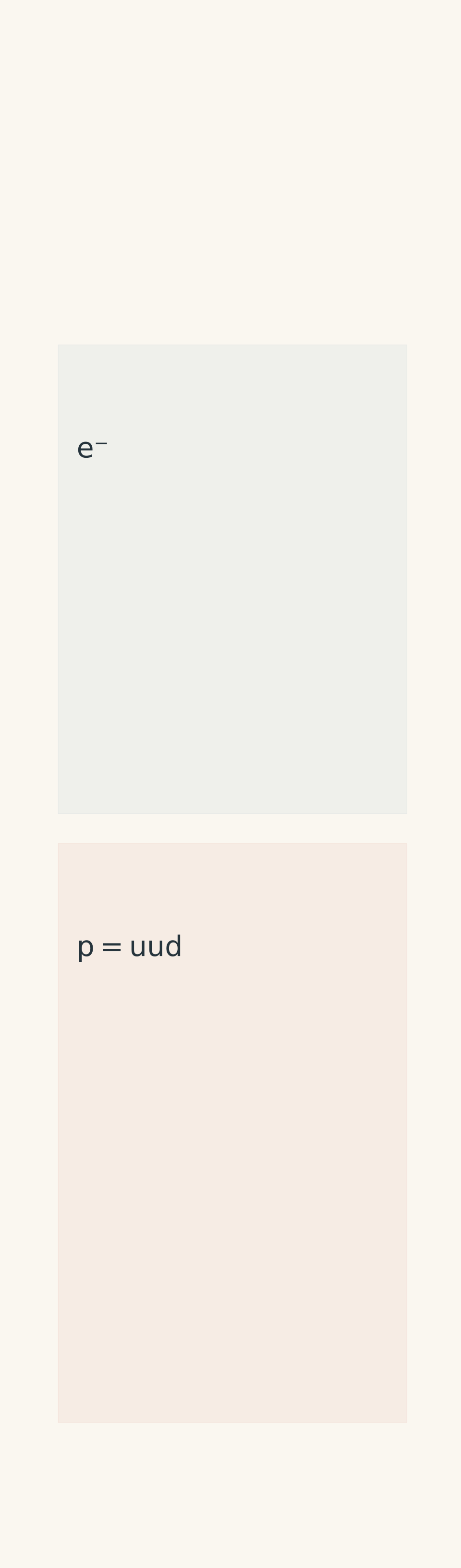
Think of the Standard Model’s matter particles as having two basic groups: quarks and leptons. Quarks can bind together to form larger composite particles called hadrons. Leptons do not form hadrons because they do not experience the strong interaction. CERN
A slightly silly way to remember it is:
- Leptons arrive solo.
- Hadrons arrive as quark group projects.
The analogy breaks down if you take it literally, of course. Particles are not making social arrangements. The useful part is the idea of composition.
The two groups
| Particle type | What it is | Examples | Strong interaction? |
|---|---|---|---|
| Lepton | Elementary matter particle | \(e^-\), \(\mu^-\), \(\tau^-\), neutrinos | No |
| Hadron | Composite particle containing quarks | proton, neutron, pion, kaon | Yes |
The fastest classification rule is therefore:
If it is made from quarks, it is a hadron. If it is one of the fundamental leptons, it is a lepton.
For the HSC, the familiar hadrons split into two groups:
- Baryons contain three quarks. The proton is \(uud\), and the neutron is \(udd\).
- Mesons contain a quark and an antiquark, such as a pion.
So a proton is not an elementary particle. It has internal structure.
A lepton, such as an electron, has no quark constituents in the Standard Model.

If you want to build the quark side of this picture in more detail, see Quarks and Hadrons: How Protons, Neutrons and Mesons Form.
02The lepton family
There are six leptons, arranged in three generations. Each generation contains one charged lepton and its associated neutrino. CERN
| Generation | Charged lepton | Neutrino |
|---|---|---|
| 1st | electron, \(e^-\) | electron neutrino, \(\nu_e\) |
| 2nd | muon, \(\mu^-\) | muon neutrino, \(\nu_\mu\) |
| 3rd | tau, \(\tau^-\) | tau neutrino, \(\nu_\tau\) |
The charged leptons all have electric charge \(-1\). Their antiparticles have charge \(+1\):
- \(e^+\): positron
- \(\mu^+\): antimuon
- \(\tau^+\): antitau
The neutrinos are electrically neutral. Their antiparticles are antineutrinos, written with a bar:
- \(\bar{\nu}_e\): electron antineutrino
- \(\bar{\nu}_\mu\): muon antineutrino
- \(\bar{\nu}_\tau\): tau antineutrino
Notice something important: being neutral does not mean being a hadron.
A neutron is neutral and is a hadron.
A neutrino is neutral and is a lepton.
So electric charge is not the classification test.

What makes the generations different?
The electron, muon, and tau have the same electric charge and belong to the same particle family, but they have different masses. The muon is much heavier than the electron, and the tau is heavier again. The neutrinos are extremely light compared with the charged leptons. CERN
The generations are therefore not three unrelated families. They are three versions of the same basic lepton pattern.
For HSC questions, it is useful to recognise the pairing:
\[ e^- \leftrightarrow \nu_e \]
\[ \mu^- \leftrightarrow \nu_\mu \]
\[ \tau^- \leftrightarrow \nu_\tau \]
That pairing becomes especially useful when you analyse weak interactions.
03The interaction test
The strongest way to distinguish leptons from hadrons is not their mass or charge. It is their relationship with the strong interaction.
Leptons do not experience the strong interaction.
Hadrons do.
The other interactions then add some detail.
| Particle | Strong | Electromagnetic | Weak |
|---|---|---|---|
| Electron \(e^-\) | No | Yes | Yes |
| Electron neutrino \(\nu_e\) | No | No | Yes |
| Proton \(p\) | Yes | Yes | Yes |
| Neutron \(n\) | Yes | No | Yes |
The table contains two easy traps.
First, a charged particle is not automatically a hadron. An electron is charged but is a lepton.
Second, a neutral particle is not automatically a neutrino. A neutron is neutral but is a hadron.
The electromagnetic interaction depends on electric charge. The strong interaction depends on quark content. These are different questions.

Why does the strong interaction matter?
Inside a proton, the quarks are held together by the strong interaction. The same basic interaction is responsible for the strong behaviour of hadrons.
A lepton has no quark constituents, so it does not take part in the strong interaction.
This is why a muon and a pion can both have charge \(-1\), yet behave very differently when they encounter matter.
The muon is a lepton.
The pion is a hadron.
Their equal charge tells you almost nothing about their particle family.
04A useful extra tool: lepton number
When you start looking at particle reactions, classification becomes even more powerful if you track lepton number.
For HSC-style bookkeeping, assign:
- \(L=+1\) to a lepton,
- \(L=-1\) to an antilepton,
- \(L=0\) to particles that are not leptons.
For example:
\[ L(e^-)=+1 \]
\[ L(e^+)=-1 \]
\[ L(\nu_\mu)=+1 \]
\[ L(\bar{\nu}_\mu)=-1 \]
A useful reaction should balance the total lepton number.
This is particularly helpful when a neutrino appears to be “missing” from a decay.
05Worked example: classify a muon
A particle is identified as a negatively charged muon, \(\mu^-\). Classify it and state which of the three Standard Model interactions it can participate in.
Step 1
A muon is one of the six leptons. Therefore, \(\mu^-\) is a lepton.
Step 2
The muon has charge \(-1\), so it can participate in the electromagnetic interaction.
Step 3
All leptons can participate in weak interactions, so the muon can also interact weakly.
Step 4
Leptons do not experience the strong interaction.
Therefore, a muon is a lepton that participates in the electromagnetic and weak interactions, but not the strong interaction.
The important point is that its charge does not make it a hadron.
06Worked example: why beta decay produces a lepton
Consider beta-minus decay of a neutron:
\[ n \rightarrow p + e^- + \bar{\nu}_e \]
Classify each particle and explain why this is a weak interaction.
Step 1
The neutron and proton are baryons, so they are both hadrons.
Step 2
The electron \(e^-\) is a lepton.
The electron antineutrino \(\bar{\nu}_e\) is also a lepton.
So the reaction changes from a hadron to another hadron while producing two leptons.
Step 3
The neutron has charge \(0\).
The final particles have charges
\[ +1-1+0=0 \]
so electric charge is conserved.
Step 4
The neutron has \(L=0\).
On the right,
\[ L(e^-)=+1 \]
and
\[ L(\bar{\nu}_e)=-1 \]
so the total is also zero.
Step 5
At the quark level, one of the neutron’s down quarks changes into an up quark. This is a weak-interaction process. The leptons are created during the process; they were not hiding inside the neutron.
So the reaction demonstrates something important:
A hadron can decay and produce leptons. That does not make the original hadron a lepton.

07Hadrons can produce leptons too
This is where the distinction gets interesting.
Consider negative pion decay:
\[ \pi^- \rightarrow \mu^- + \bar{\nu}_\mu \]
The pion is a hadron because it is a quark-antiquark composite.
The muon and antineutrino are leptons.
So a hadron can decay into leptons.
The reverse-looking situation can also happen. A tau lepton can decay into a charged pion and a tau neutrino:
\[ \tau^- \rightarrow \pi^- + \nu_\tau \]
Now the parent is a lepton, but one of its products is a hadron. Tau decays can produce pions and neutrinos, illustrating that the particle family of the parent is not determined by the family of its decay products. CERN
This gives you a very useful rule:
Classify the particle you are asked about, not the particles it happens to decay into.

08What this looks like in a detector
There is another tempting mistake: trying to classify particles just from their tracks.
A charged lepton can leave a track.
A charged hadron can also leave a track.
A magnetic field can bend both because the magnetic force acts on electric charge. The direction of bending tells you the sign of the charge, not whether the particle is a lepton or a hadron.
Neutrinos are different. They have no electric charge, so they do not leave an ordinary charged-particle track. They interact so weakly that most pass straight through matter without interacting. CERN
This is why neutrinos are usually detected indirectly.
For example, an electron neutrino can interact with a neutron and produce an electron and proton:
\[ \nu_e+n\rightarrow e^-+p \]
The incoming neutrino leaves no visible track, but the charged products can be detected.
In a real particle detector, identifying a particle therefore involves combining several clues: its charge, track curvature, energy deposition, and how it interacts with detector material. A single clue rarely tells you everything.

09The misconception to remove
A student might memorise:
“Leptons are weak particles and hadrons are strong particles.”
That is too crude.
A better statement is:
- Leptons do not experience the strong interaction.
- Hadrons do experience the strong interaction.
- Charged leptons also experience the electromagnetic interaction.
- Neutrinos are electrically neutral, so they do not experience the electromagnetic interaction.
- Hadrons can also participate in electromagnetic and weak interactions, depending on the particle and process.
So “strong versus weak” is not a choice between two exclusive labels.
The weak interaction is also not what makes something a lepton. It is simply one interaction that leptons can participate in.
A quick classification checklist
When an unfamiliar particle appears in an HSC question, work through this:
Is it one of \(e\), \(\mu\), \(\tau\), or a neutrino?
→ It is a lepton.Does it contain quarks?
→ It is a hadron.Is it a proton or neutron?
→ It is a baryon, so it is a hadron.Is it a pion or kaon?
→ It is a meson, so it is a hadron.Is it neutral?
→ Don’t classify it yet. Both neutrinos and some hadrons are neutral.Is it charged?
→ Don’t classify it yet. Both charged leptons and many hadrons are charged.Does a reaction contain a neutrino or antineutrino?
→ Think about the weak interaction and lepton-number bookkeeping.
The classification should come from the particle’s structure and interaction properties, not from one superficial feature.
10Questions and solutions
Question 1
Classify each of the following as a lepton, hadron, or neither:
\[ e^-,\quad \nu_e,\quad p,\quad n,\quad \pi^+,\quad \gamma \]
Give one reason for each classification.
Solution 1
The electron and electron neutrino are leptons, the proton, neutron, and pion are hadrons, and the photon is neither because it is a force-carrier boson.
- \(e^-\): lepton, because it is a fundamental charged lepton.
- \(\nu_e\): lepton, because it is an electron neutrino.
- \(p\): hadron, because it is a baryon made from three quarks, \(uud\).
- \(n\): hadron, because it is a baryon made from three quarks, \(udd\).
- \(\pi^+\): hadron, because it is a meson made from a quark and an antiquark.
- \(\gamma\): neither, because the photon is a gauge boson that carries the electromagnetic interaction.
The tempting mistake is to classify the neutron as a lepton because it is neutral. Neutrality does not determine the family. The neutron is still a hadron because of its quark structure.
Question 2
A neutron undergoes the reaction
\[ n\rightarrow p+e^-+X \]
where \(X\) is electrically neutral.
Identify \(X\) and explain why the reaction is a weak interaction. Use both electric charge and lepton number in your reasoning.
Solution 2
\(X\) is an electron antineutrino, \(\bar{\nu}_e\), and the reaction is a weak interaction.
The complete reaction is
\[ n\rightarrow p+e^-+\bar{\nu}_e \]
First consider charge. The neutron has charge \(0\), while the final particles have
\[ +1-1+0=0 \]
so the charge balances even before we identify \(X\).
That alone is not enough. A photon could also be neutral, so charge conservation cannot distinguish \(X\) from a photon.
Now use lepton number. The neutron and proton have \(L=0\). The electron has \(L=+1\). Therefore another particle with \(L=-1\) is required to keep the total at zero. The electron antineutrino has exactly this lepton number.
The process is weak because the neutron’s quark content changes from \(udd\) to \(uud\), with a lepton pair produced as part of the transformation.
The trap is trying to identify the missing particle from charge alone. Charge conservation narrows the possibilities; lepton-number conservation identifies the antineutrino.
Question 3
An electron \(e^-\) and a negative pion \(\pi^-\) both have electric charge \(-1\). They enter the same magnetic field and bend in the same direction.
A student concludes that they must therefore belong to the same particle family.
Explain why this conclusion is wrong. Include the quark composition and charge of the pion, and state which of the two particles can participate in the strong interaction.
Solution 3
The electron is a lepton, while the negative pion is a hadron, even though both have charge \(-1\).
The electron is elementary and has no quark constituents.
The negative pion has the quark composition
\[ \pi^- = d\bar{u} \]
The down quark has charge \(-1/3\), while the anti-up quark has charge \(-2/3\). Therefore,
\[ -\frac{1}{3}-\frac{2}{3}=-1 \]
which gives the pion its total charge of \(-1\).
Because the pion contains quarks, it is a hadron and experiences the strong interaction. The electron is a lepton and does not.
The magnetic field does not contradict this. A magnetic field bends charged particles according to their charge and motion. It does not ask, “Are you a lepton or a hadron?” Therefore, two particles can bend in the same direction while belonging to completely different families.
The tempting route is to use the observed curvature as the classification rule. The exact constraint is that charge determines the magnetic response, while quark content determines whether the particle is a hadron.
Question 4
An electron neutrino enters a detector and interacts with a neutron according to
\[ \nu_e+n\rightarrow e^-+p \]
Classify all four particles. Identify the interaction involved, and explain why the incoming neutrino can be difficult to detect directly while the electron can leave a visible track.
Solution 4
The neutrino and electron are leptons, the neutron and proton are hadrons, and the reaction is a weak interaction.
The classification is:
- \(\nu_e\): lepton
- \(n\): hadron
- \(e^-\): lepton
- \(p\): hadron
The neutrino is electrically neutral and does not experience the strong interaction. It also does not experience the electromagnetic interaction, so it does not produce the ordinary charged-particle track associated with electromagnetic ionisation in a detector.
The electron has charge \(-1\), so it can interact electromagnetically with matter and leave a visible track.
The reaction is weak because the neutron changes into a proton while an electron and electron neutrino participate in the process.
A useful experimental clue is therefore that a neutrino may enter invisibly and then produce a charged lepton at an interaction point. This indirect detection method is central to neutrino experiments. CERN
The trap is saying, “No track means no particle.” The neutrino is still there; it simply interacts too weakly and has no electric charge to produce the usual track.
Question 5
Consider the two decays:
\[ \pi^-\rightarrow\mu^-+\bar{\nu}_\mu \]
and
\[ \tau^-\rightarrow\pi^-+\nu_\tau \]
A student argues:
“The first parent must be a lepton because its products are leptons, while the second parent must be a hadron because one of its products is a hadron.”
Determine the family of each parent, identify the interaction responsible for each decay, and use lepton number to show why the student’s reasoning fails.
Finally, an unknown negatively charged matter particle \(Z^-\) is observed to decay as
\[ Z^-\rightarrow\mu^-+\bar{\nu}_\mu \]
with no other particles missing. Can \(Z^-\) be a lepton? Explain your conclusion.
Solution 5
The pion is a hadron, the tau is a lepton, both decays are weak interactions, and \(Z^-\) cannot be a lepton under the stated HSC-style lepton-number rules; it must therefore be a hadron.
Start with the first decay:
\[ \pi^-\rightarrow\mu^-+\bar{\nu}_\mu \]
The pion is a hadron because it is a quark-antiquark composite.
The muon is a lepton, and the antimuon neutrino is also a lepton.
Now check lepton number. The pion has
\[ L=0 \]
because it is not a lepton. On the right,
\[ L(\mu^-)=+1 \]
and
\[ L(\bar{\nu}_\mu)=-1 \]
so
\[ +1-1=0 \]
Lepton number balances. The decay is weak because the hadron is transforming into leptons through a weak process.
Now consider the second decay:
\[ \tau^-\rightarrow\pi^-+\nu_\tau \]
The tau is a lepton, so initially
\[ L=+1 \]
The pion has
\[ L=0 \]
and the tau neutrino has
\[ L=+1 \]
so the final total is also \(+1\).
Again, the lepton number balances, and the decay is weak.
This gives the key idea: particle family is not something that must be preserved from parent to daughter. A hadron can decay into leptons, and a lepton can decay into a hadron plus a lepton. The interaction determines what transformations are allowed.
Now examine the unknown \(Z^-\):
\[ Z^-\rightarrow\mu^-+\bar{\nu}_\mu \]
The final-state lepton number is
\[ +1-1=0 \]
If \(Z^-\) were a negatively charged lepton, it would have \(L=+1\). The reaction would then change the total lepton number from \(+1\) to \(0\), contradicting the stated conservation rule.
Therefore \(Z^-\) cannot be a lepton.
Under the question’s assumption that \(Z^-\) is a matter particle, the remaining possibility is that it is a hadron. Its exact hadron type cannot be identified from this decay alone, but its family can.
The deeper trap is to look at the visible daughter \(\mu^-\) and think the parent must “belong with” it. That is not how particle classification works. The parent is classified by its own structure and conserved quantities, not by the identity of the particle it produces.
The useful next step is to connect this distinction to the full Standard Model: once you can separate leptons, quarks, and hadrons, you can start using the exchange bosons to explain how those particles interact and transform.