
Variables That Affect Electrostatic Force in HSC Physics
Learn how charge magnitude, separation, and the surrounding medium change electrostatic force, with clear reasoning, worked examples, and HSC-style practice.
Two tiny charged spheres repel each other with a force of \(0.40\ \text{N}\). You double the charge on one sphere, move the spheres twice as far apart, and place them in an insulating liquid.
Will the force become larger or smaller?
It is tempting to reach straight for Coulomb’s law. But the faster HSC Physics skill is to reason about the variables first. One change makes the force stronger, another makes it weaker, and the medium can weaken it again. If you can predict the direction and rough size of those changes before touching the calculator, electrostatics becomes much harder to get wrong.
01Start with the physical picture
Imagine two positively charged spheres sitting near each other.
Each sphere experiences a repulsive force because of the other sphere. If you increase either charge, the electrical interaction becomes stronger. If you move the spheres apart, the interaction becomes weaker.
Before we make that precise, predict this:
If the distance between the charges doubles, would you expect the force to halve?
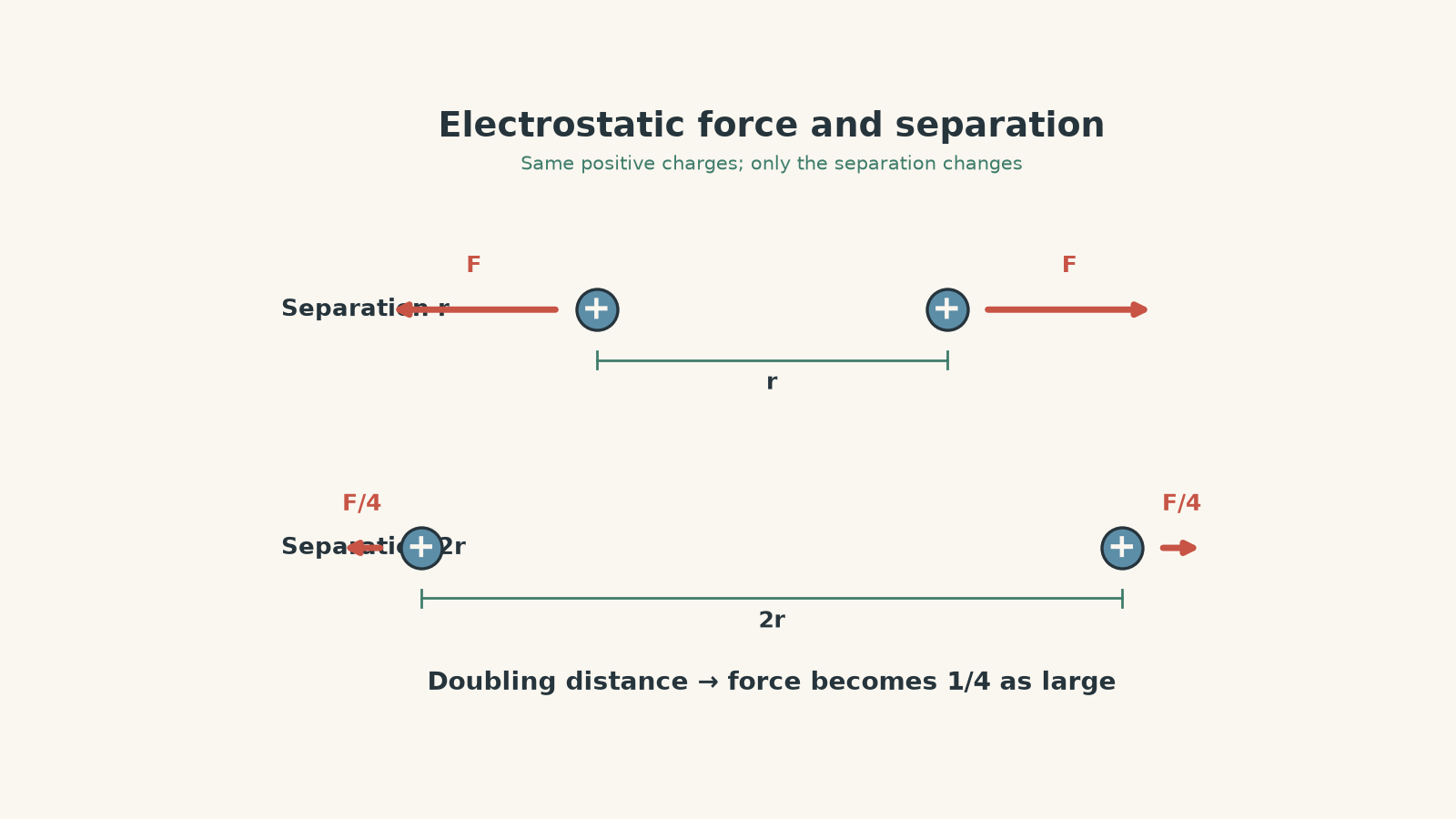
That sounds reasonable. Twice as far away, half as much force. But electrostatic force falls away faster than that. Doubling the separation reduces the force to one quarter.
That inverse-square behaviour is one of the most important ideas in this topic.
02The three things to check before calculating
For two point charges, the magnitude of the electrostatic force depends mainly on:
| Change | Effect on force magnitude |
|---|---|
| Increase either charge magnitude | Force increases |
| Increase both charge magnitudes | Force increases according to their product |
| Increase separation | Force decreases with the square of separation |
| Use a medium with greater permittivity | Force decreases |
There is one more question that is separate from force magnitude:
- like charges repel
- unlike charges attract
So the signs of the charges determine the direction of the force, while the magnitudes of the charges help determine how large that force is.
03Charge magnitude: more charge means a stronger interaction
Suppose two objects have charge magnitudes \(q_1\) and \(q_2\).
The electrostatic force is proportional to their product:
\[ F \propto |q_1q_2| \]
Here:
- \(F\) is the magnitude of the electrostatic force, measured in newtons (\(\text{N}\))
- \(q_1\) and \(q_2\) are the charges, measured in coulombs (\(\text{C}\))
The absolute value signs remind us that we are talking about force magnitude, which cannot be negative.
If one charge doubles while everything else stays constant,
\[ F_{\text{new}} = 2F_{\text{old}} \]
If both charges double,
\[ F_{\text{new}} = 2 \times 2F_{\text{old}} = 4F_{\text{old}} \]
This is worth noticing. Students sometimes hear “double the charges” and automatically answer “double the force”. But there are two charge factors in Coulomb’s law. If both change, both matter.
Worked example: What happens when both charges triple?
Two point charges exert an electrostatic force of \(0.60\ \text{N}\) on each other. Their separation and surrounding medium remain unchanged. The magnitude of each charge is tripled. Find the new force.
Step 1
Both \(q_1\) and \(q_2\) are multiplied by 3. The distance and medium do not change.
Step 2
Because \(F \propto |q_1q_2|\),
\[ F_{\text{new}} = 3 \times 3 \times F_{\text{old}} = 9(0.60\ \text{N}) = 5.4\ \text{N} \]
Step 3
The force becomes \(5.4\ \text{N}\), which is nine times the original force. Tripling both charges does not triple the force because their effects multiply.
04Separation: why distance matters so strongly
For point charges, electrostatic force is inversely proportional to the square of their separation:
\[ F \propto \frac{1}{r^2} \]
where \(r\) is the distance between the charges, measured from centre to centre.
That means:
- \(r \rightarrow 2r\) gives \(F \rightarrow \frac{1}{4}F\)
- \(r \rightarrow 3r\) gives \(F \rightarrow \frac{1}{9}F\)
- \(r \rightarrow \frac{1}{2}r\) gives \(F \rightarrow 4F\)
A useful way to picture this is to imagine the influence of a point charge spreading through three-dimensional space. At a greater distance, that influence is distributed over a much larger spherical area. Since the area of a sphere grows as \(r^2\), the electric field of an isolated point charge falls as \(1/r^2\).
That picture is useful, but it is not itself the mathematical proof of Coulomb’s law. It is a way to understand why inverse-square behaviour makes physical sense.
The common distance mistake
Suppose the separation increases by 50%.
A student might calculate
\[ F_{\text{new}} = \frac{F_{\text{old}}}{1.5} \]
because the objects are 1.5 times farther apart.
But the square matters:
\[ F_{\text{new}} = \frac{F_{\text{old}}}{(1.5)^2} = \frac{F_{\text{old}}}{2.25} \]
So the force is about \(44\%\) of its original value, not \(67\%\).
Whenever distance changes, one useful habit is to say to yourself: square the distance factor.
05The medium: why the material between charges matters
So far, we have pictured charges in a vacuum or approximately in air.
Put the charges inside another material and something else happens. Molecules in the material can respond to the electric field. In many insulating materials, positive and negative charge within the molecules shift slightly in opposite directions. This is called polarisation.
The resulting polarisation produces an electric effect that partially opposes the field created by the original charges. The force between the charges is therefore reduced compared with the force in a vacuum.
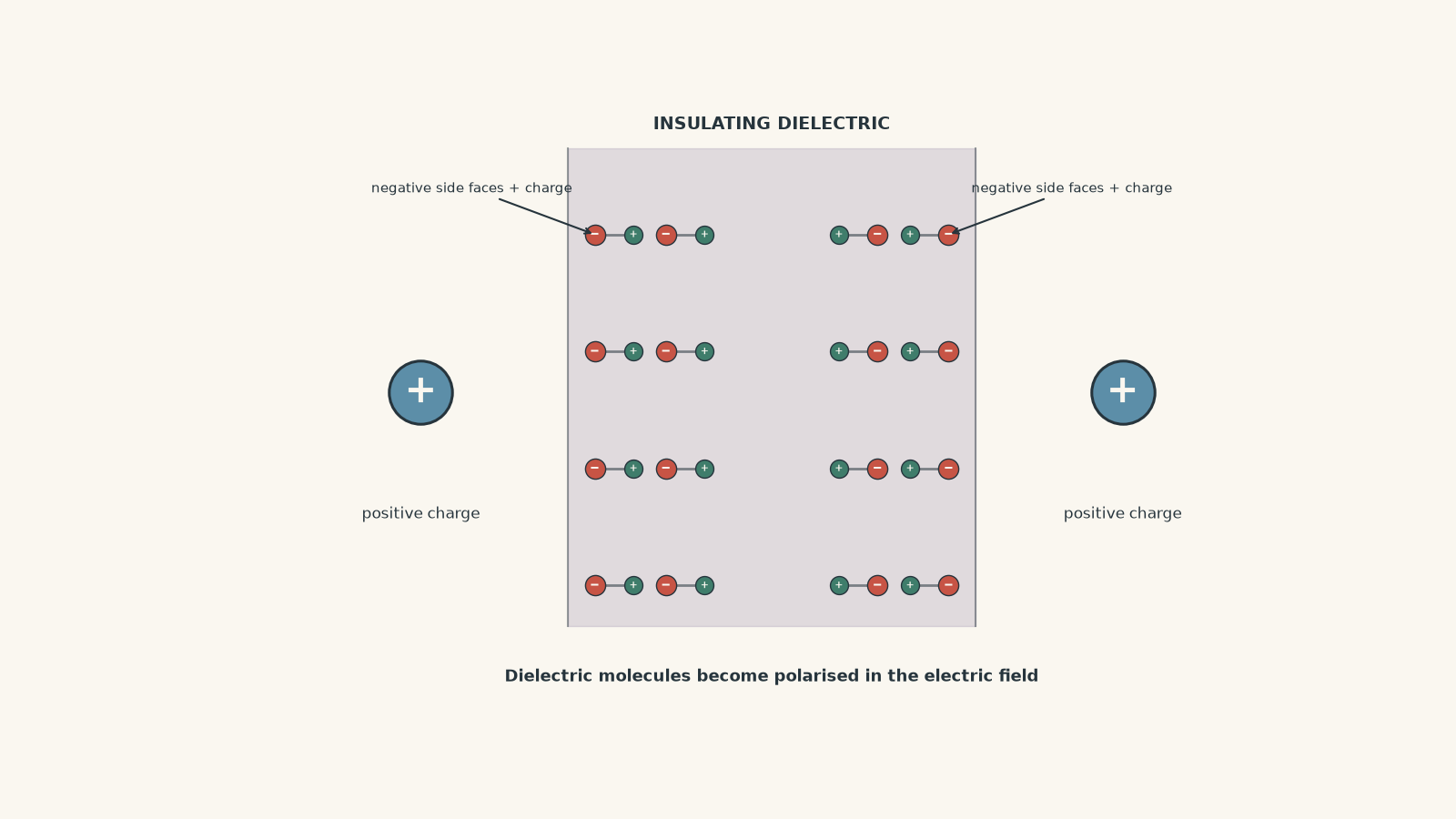
You can picture the dielectric as a friend stepping between two people who are intensely staring at each other and making the interaction slightly less dramatic. The friend does not remove either person’s existence, and the original charges have not changed. The material simply changes the electric field within the region.
That analogy has limits. Real dielectric behaviour comes from the electrical response of atoms and molecules, not social awkwardness.
06Coulomb’s law brings the variables together
For two point charges in vacuum, the magnitude of the electrostatic force is
\[ F = k\frac{|q_1q_2|}{r^2} \]
where:
- \(F\) is force magnitude in newtons (\(\text{N}\))
- \(q_1\) and \(q_2\) are the charges in coulombs (\(\text{C}\))
- \(r\) is the separation between the charges in metres (\(\text{m}\))
- \(k\) is Coulomb’s constant, approximately \(8.99\times10^9\ \text{N m}^2\text{C}^{-2}\)
For air, using the vacuum value of \(k\) is normally an excellent approximation at HSC level.
A more general form is
\[ F = \frac{1}{4\pi\varepsilon}\frac{|q_1q_2|}{r^2} \]
where \(\varepsilon\) is the permittivity of the medium.
For many materials,
\[ \varepsilon = \varepsilon_r\varepsilon_0 \]
where:
- \(\varepsilon_0\) is the permittivity of free space
- \(\varepsilon_r\) is the relative permittivity of the material
Since
\[ k = \frac{1}{4\pi\varepsilon_0}, \]
the force in a simple dielectric model can also be written as
\[ F = \frac{k}{\varepsilon_r}\frac{|q_1q_2|}{r^2} \]
So if \(\varepsilon_r = 4\), the electrostatic force is one quarter of its vacuum value, provided the other variables remain unchanged.
This model assumes the charges are effectively point charges in a uniform material whose electrical response can be described by a single permittivity. Real materials and charge distributions can be more complicated.
07Predict first, calculate second
Suppose an HSC question changes several variables at once.
Do not immediately substitute numbers. Write the force as a set of proportional factors:
\[ F \propto \frac{|q_1q_2|}{\varepsilon_r r^2} \]
Then compare the new situation with the old one.
If
\[ q_1 \rightarrow aq_1,\qquad q_2 \rightarrow bq_2,\qquad r \rightarrow cr,\qquad \varepsilon_r \rightarrow d\varepsilon_r, \]
then
\[ \frac{F_{\text{new}}}{F_{\text{old}}} = \frac{ab}{dc^2} \]
This ratio method is often quicker than performing two full Coulomb’s law calculations.
It also exposes mistakes. If your reasoning predicts a weaker force but your calculator gives a larger one, something has probably gone wrong.
Worked example: Charges, distance, and medium all change
Two small charged objects in air exert a force of \(0.80\ \text{N}\) on each other. The first charge is doubled, the second charge is tripled, their separation is doubled, and they are placed in a medium with relative permittivity \(\varepsilon_r = 3\). Find the new force.
Step 1
Doubling and tripling the charges make the force stronger.
Doubling the distance makes it weaker by a factor of \(2^2 = 4\).
The dielectric makes it weaker by another factor of 3.
So we should not assume the force increases just because both charges increased.
Step 2
\[ \frac{F_{\text{new}}}{F_{\text{old}}} = \frac{2\times3}{3\times2^2} = \frac{6}{12} = \frac{1}{2} \]
Step 3
\[ F_{\text{new}} = \frac{1}{2}(0.80\ \text{N}) = 0.40\ \text{N} \]
Step 4
The new force is \(0.40\ \text{N}\), half the original force. The sixfold increase caused by the charges is outweighed by a twelvefold reduction caused by distance and the medium together.
08Direction is not the same thing as magnitude
Consider these two pairs:
- \(+2\ \mu\text{C}\) and \(+5\ \mu\text{C}\)
- \(+2\ \mu\text{C}\) and \(-5\ \mu\text{C}\)
At the same separation in the same medium, both pairs have the same force magnitude because
\[ |(+2)(+5)| = |(+2)(-5)| \]
But the directions differ.
The first pair repels because the charges have the same sign. The second pair attracts because they have opposite signs.
A negative value of \(q_1q_2\) does not mean there is a “negative amount of force”. It tells you something about the direction of the interaction when you are using a signed or vector treatment.
09Equal forces do not require equal charges
There is another tempting mistake.
Suppose a \(+1\ \mu\text{C}\) charge interacts with a \(+6\ \mu\text{C}\) charge. Does the larger charge exert six times as much force on the smaller charge?
No.
Coulomb’s law gives one interaction magnitude:
\[ F = k\frac{|q_1q_2|}{r^2} \]
Each charge experiences a force of the same magnitude and opposite direction.
This is consistent with Newton’s third law.
The \(+6\ \mu\text{C}\) charge produces a stronger electric field than the \(+1\ \mu\text{C}\) charge at the same distance, but the smaller charge responding to that stronger field also has a smaller charge magnitude. The two force calculations produce equal magnitudes.
10A useful decision rule
When a question asks how electrostatic force changes, check the variables in this order:
- Charge: What happens to \(|q_1q_2|\)?
- Distance: What happens to \(r^2\)?
- Medium: Has the permittivity changed?
- Direction: Are the charges like or unlike?
- Model: Can the objects reasonably be treated as point charges, or spherical charges observed from outside?
Only then decide whether a full Coulomb’s law calculation is necessary.
11Questions and solutions
Question 1
Two positive point charges remain in air. The magnitude of one charge is doubled while the other charge and their separation remain unchanged.
By what factor does the electrostatic force change, and does the interaction remain attractive or repulsive?
Solution 1
The force doubles, and the interaction remains repulsive.
Coulomb’s law gives
\[ F \propto |q_1q_2| \]
so doubling one charge gives
\[ F_{\text{new}} = 2F_{\text{old}}. \]
Both charges are still positive, so their signs have not changed. Like charges repel.
The important distinction is that charge magnitude affects the size of the force, while charge sign determines whether the interaction is attractive or repulsive.
Question 2
Two point charges exert a force of \(1.8\ \text{N}\) on each other in air. Their separation is increased to three times its original value while the charges remain unchanged.
Calculate the new force.
Solution 2
The new force is \(0.20\ \text{N}\).
Electrostatic force varies inversely with the square of separation:
\[ F \propto \frac{1}{r^2}. \]
Tripling the separation therefore reduces the force by a factor of \(3^2 = 9\):
\[ F_{\text{new}} = \frac{1.8\ \text{N}}{9} = 0.20\ \text{N}. \]
The force becomes one ninth of its original value. A common mistake is to divide by 3 rather than by \(3^2\).
Question 3
Two small charged spheres in air have charges \(+3.0\ \mu\text{C}\) and \(-8.0\ \mu\text{C}\). Their centres are \(0.40\ \text{m}\) apart.
Calculate the magnitude of the electrostatic force and state whether it is attractive or repulsive.
Solution 3
The force magnitude is approximately \(1.35\ \text{N}\), and the interaction is attractive.
First convert the microcoulomb values to coulombs:
\[ q_1 = 3.0\times10^{-6}\ \text{C}, \qquad q_2 = 8.0\times10^{-6}\ \text{C}. \]
Using Coulomb’s law,
\[ \begin{aligned} F &= k\frac{|q_1q_2|}{r^2}\\ &=(8.99\times10^9) \frac{(3.0\times10^{-6})(8.0\times10^{-6})} {(0.40)^2}\\ &\approx 1.35\ \text{N}. \end{aligned} \]
The charges have opposite signs, so they attract.
Notice that the negative sign on the second charge was not inserted to produce a negative force magnitude. We used the charge magnitudes to calculate \(F\), then used the signs to determine the direction.
Question 4
Two point charges initially exert a force \(F\) on each other in air. Each charge is doubled.
A student says that the separation must also be doubled if the force is to remain unchanged.
Is the student correct? Justify your answer quantitatively.
Solution 4
Yes. Doubling both charges and doubling the separation leaves the force unchanged.
Doubling both charges changes the numerator of Coulomb’s law by
\[ 2\times2 = 4. \]
Doubling the separation changes the denominator by
\[ 2^2 = 4. \]
Therefore,
\[ \frac{F_{\text{new}}}{F_{\text{old}}} = \frac{4}{4} = 1. \]
So \(F_{\text{new}} = F_{\text{old}}\).
The tempting mistake is to reason that doubling both charges gives “twice as much electrostatic effect”. It actually gives four times the force before the distance change is considered.
Question 5
Two point charges are initially separated by \(r\) in air. The magnitude of the first charge is tripled and the magnitude of the second is halved. The charges are then placed \(25\%\) farther apart.
Assuming the medium remains effectively unchanged, determine the new force as a fraction of the original force.
Solution 5
The new force is \(0.96\) times the original force, so it is slightly smaller.
The charge product changes by
\[ 3\times\frac{1}{2} = \frac{3}{2}. \]
A \(25\%\) increase in separation means
\[ r_{\text{new}} = 1.25r. \]
Because distance is squared,
\[ \frac{F_{\text{new}}}{F_{\text{old}}} = \frac{3/2}{(1.25)^2}. \]
Therefore,
\[ \begin{aligned} \frac{F_{\text{new}}}{F_{\text{old}}} &= \frac{1.5}{1.5625}\\ &=0.96. \end{aligned} \]
Hence
\[ F_{\text{new}} = 0.96F_{\text{old}}. \]
This is a useful example of why intuition alone can become unreliable when several variables change. The increased charge product almost cancels the effect of the greater separation, but not quite.
Question 6
Two point charges exert a force \(F\) on each other in air. They are then placed in a uniform insulating medium with relative permittivity \(\varepsilon_r = 5\).
At the same time, their separation is reduced to half its original value.
Without calculating from the individual charge values, determine the new force in terms of \(F\).
A student argues that the force must decrease because “dielectrics weaken electrostatic forces”. Explain the flaw in this reasoning.
Solution 6
The new force is \(\frac{4}{5}F\), so it decreases slightly.
The dielectric reduces the force by a factor of 5:
\[ F \rightarrow \frac{F}{5}. \]
Halving the separation increases the force by a factor of
\[ \frac{1}{(1/2)^2}=4. \]
Combining both effects,
\[ F_{\text{new}} = \frac{4}{5}F. \]
The student’s statement about the dielectric is correct when all other variables are held constant, but that condition is not satisfied here. The separation also changes, and reducing it greatly strengthens the interaction.
This is the broader lesson: statements such as “increasing distance decreases force” or “a dielectric reduces force” describe the effect of one variable while the others are fixed. When several variables change together, their effects must be combined.
12What this prepares you for
Once you can reason confidently about \(q_1\), \(q_2\), \(r\), and the medium, Coulomb’s law stops being just a substitution formula.
The same thinking carries directly into electric fields. Instead of asking for the force between two particular charges, you can ask what electrical influence exists at a point in space before a second charge is even placed there. That shift from force between charges to field around a charge is the next useful step.