
Controlled and Uncontrolled Chain Reactions: HSC Physics Guide
Learn how the multiplication factor kkk determines whether a nuclear chain reaction dies away, stays steady, or rapidly grows. Includes worked examples and challenging HSC-style questions.
Suppose two nuclear systems start with exactly the same number of fissions. In one, each generation produces about the same number of fissions as the previous generation. In the other, just 5% more neutrons successfully continue the chain each generation.
Which one is more concerning?
The second one. That small difference gets multiplied again and again. The first system can sit at steady power, while the second can rapidly increase its fission rate.
The whole problem of controlling a nuclear chain reaction comes down to one question: how many fissions does one generation produce in the next?

01Start with the chain, not the reactor
Nuclear fission is the splitting of a heavy nucleus after it absorbs a neutron. A fission event releases energy and usually several neutrons.
One possible simplified fission equation is
\[ {}^{235}_{92}\mathrm{U} +{}^{1}_{0}\mathrm{n} \rightarrow {}^{141}_{56}\mathrm{Ba} +{}^{92}_{36}\mathrm{Kr} +3{}^{1}_{0}\mathrm{n} +\text{energy} \]
The exact fission products can vary, so don’t treat this particular pair of products as universal. The important feature here is the new neutrons.
Those neutrons can go on to hit other fissile nuclei and cause more fissions. Those fissions release more neutrons, which can cause still more fissions.
That sequence is a nuclear chain reaction.
If the fission equation itself is rusty, it is worth revisiting tutorgum’s nuclear fission guide.
One fission does not automatically make a chain reaction
A fission can happen and then the chain can stop.
For example, imagine three neutrons are released. One might escape the reactor, one might be absorbed by another material, and only one might cause another fission.
So don’t make this prediction:
“Three neutrons came out, so the chain reaction multiplies by three.”
That is the tempting mistake. What matters is not how many neutrons are released, but how many successfully continue the chain.
Think of it like a relay race. Several runners might start moving, but only the runners who successfully hand a baton to the next runner keep the race going. The analogy breaks down because neutron behaviour is probabilistic and depends on things such as neutron energy, geometry, absorption, and the materials present.
02The multiplication factor \(k\)
Let \(F_n\) be the number of fissions in generation \(n\).
In a simplified generation model,
\[ F_{n+1}=kF_n \]
where \(k\) is the effective multiplication factor.
So \(k\) tells you how the chain changes from one generation to the next.
- \(k<1\): fewer fissions occur in each generation, so the chain dies away.
- \(k=1\): each generation produces the same number of fissions, so the chain is steady.
- \(k>1\): each generation produces more fissions, so the chain grows.

These conditions have names:
| Condition | \(k\) | Fission rate | Reactor power |
|---|---|---|---|
| Subcritical | \(k<1\) | Decreases | Decreases |
| Critical | \(k=1\) | Constant | Constant |
| Supercritical | \(k>1\) | Increases | Increases |
Here, critical does not mean “dangerous”. It means the chain reaction is self-sustaining at a constant rate.
Worked example: classify a chain reaction
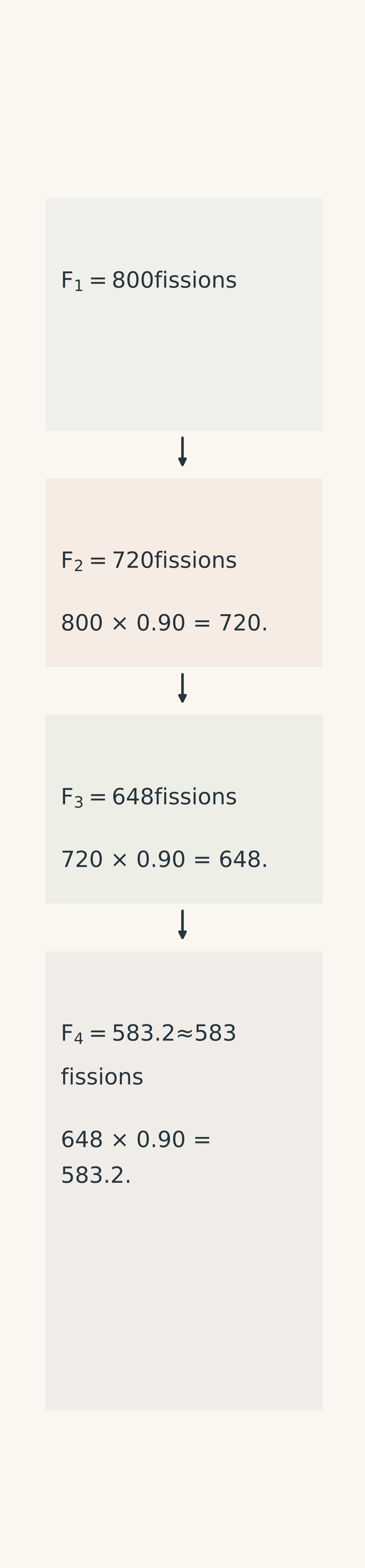
A simplified chain begins with 800 fissions in generation 1. There are 720 fissions in generation 2. Assume the same conditions continue.
Find \(k\), predict the number of fissions in generations 3 and 4, and classify the chain.
Step 1
\[ k=\frac{F_2}{F_1} =\frac{720}{800} =0.90 \]
So each generation produces 90% as many fissions as the previous one.
Step 2
\[ F_3=kF_2 =0.90(720) =648 \]
Step 3
\[ F_4=kF_3 =0.90(648) =583.2 \]
So there are about 583 fissions in generation 4.
Step 4
Since \(k=0.90<1\), the chain is subcritical.
The important physical result is that the chain is dying away. It hasn’t stopped immediately, but fewer and fewer fissions occur in each generation.
03How a reactor keeps \(k\) near 1
A power reactor does not try to stop fission completely. It needs a sustained fission reaction so that a large, steady amount of heat can be produced.
The trick is to control the number of neutrons that successfully continue the chain.
A simplified reactor contains four important ideas:
- Fuel contains fissile nuclei that can undergo fission.
- Moderator slows down fast neutrons, increasing their likelihood of causing further fission in a thermal reactor.
- Control rods absorb neutrons, reducing the number available to continue the chain.
- Coolant carries thermal energy away from the reactor core.
The roles of fuel, moderator, and control rods working together to produce a controlled nuclear reaction have been explicitly assessed in NESA HSC Physics marking guidance.

The control rods are the key part of the comparison between controlled and rapidly multiplying chains.
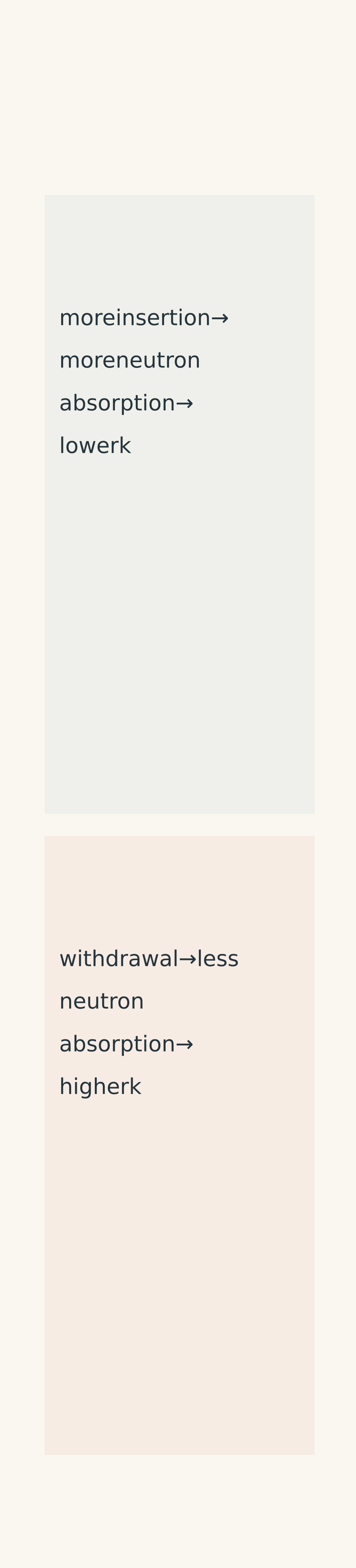
Insert the rods further:
\[ \text{more neutron absorption} \rightarrow \text{fewer neutrons continue} \rightarrow \text{lower }k \]
Withdraw the rods:
\[ \text{less neutron absorption} \rightarrow \text{more neutrons continue} \rightarrow \text{higher }k \]
So the rods do not directly act as a “fission switch”. They change the probability that neutrons remain available to cause further fissions.
Why not absorb as many neutrons as possible?
Because then \(k\) would become less than 1, and the chain would die away.
A reactor producing steady power needs approximately
\[ k=1 \]
The aim is therefore the right amount of neutron absorption, not the maximum amount.
The moderator can seem confusing here because it has almost the opposite effect to a control rod in the simplified HSC model. Slowing neutrons down can make them more likely to cause fission, while control rods remove neutrons from the chain.
The coolant has a different main job in this model: it removes the heat produced by the fission reactions. Don’t automatically describe the coolant as the thing that controls the chain.
04Controlled does not mean “fission stays at one exact number”
This is an important distinction.
A reactor operating at steady power has \(k\approx1\), so the fission rate stays approximately constant.
But if operators want the power to increase, the chain can temporarily become slightly supercritical. More fissions occur, the power rises, and the reactor can then be brought back towards \(k=1\).
For a power decrease, the chain can temporarily become subcritical.
So controlled describes the ability to manage the chain, not the claim that \(k\) is permanently frozen at exactly 1.
There is another subtle point: \(k=1\) does not tell you the absolute power.
A system with a million fissions per second and a system with a trillion fissions per second could both have \(k=1\). In both cases, the number of fissions stays steady. The difference is the size of that steady fission rate.
That means:
\(k\) tells you whether the fission rate is changing. It does not, by itself, tell you what the fission rate is.
This distinction becomes very useful in harder questions.
Worked example: what does a control-rod adjustment actually do?
A reactor has \(k=1.06\). A control-rod adjustment causes 5% of the neutrons that would otherwise produce next-generation fissions to be absorbed.
Initially, there are \(2.00\times10^5\) fissions in one generation. Assume the 5% reduction acts directly on the multiplication factor and all other conditions remain unchanged.
Find the new \(k\), the number of fissions in the next two generations, and classify the chain.
Step 1
\[ 1-0.05=0.95 \]
So 95% of the previous continuation remains.
Step 2
\[ k_{\text{new}} =1.06(0.95) =1.007 \]
Notice that the new \(k\) is not 0.95. The original chain already had a multiplication factor of 1.06, so the control-rod effect reduces that value by 5%.
Step 3
\[ F_2=(1.007)(2.00\times10^5) \]
\[ F_2=2.014\times10^5 \]
So there are about \(2.01\times10^5\) fissions.
Step 4
\[ F_3=(1.007)(2.014\times10^5) \]
\[ F_3=2.0281\times10^5 \]
So there are about \(2.03\times10^5\) fissions.
Step 5
Since
\[ k=1.007>1 \]
the chain is still supercritical.
The rods have moved the reactor much closer to steady operation, but not quite to \(k=1\).
Also, saying “the power is 0.7% higher” would be misleading. The \(1.007\) means the next generation has 0.7% more fissions than the current generation in this simplified model. It does not say that the reactor’s absolute power is 0.7% of some fixed reference value.
05Why a rapidly multiplying chain grows so fast
If the same \(k\) applies for every generation, repeated multiplication gives
\[ F_n=F_0k^n \]
where \(F_0\) is the starting number of fissions and \(n\) is the number of generations.
This is why a small difference from \(k=1\) can matter enormously.
For example, suppose \(k=1.20\). Starting with 100 fissions:
\[ 100\rightarrow120\rightarrow144\rightarrow173\rightarrow208 \]
The increase is not adding 20 fissions each time. It is multiplying the previous generation by 1.20 each time.
That is the signature of a rapidly multiplying chain.
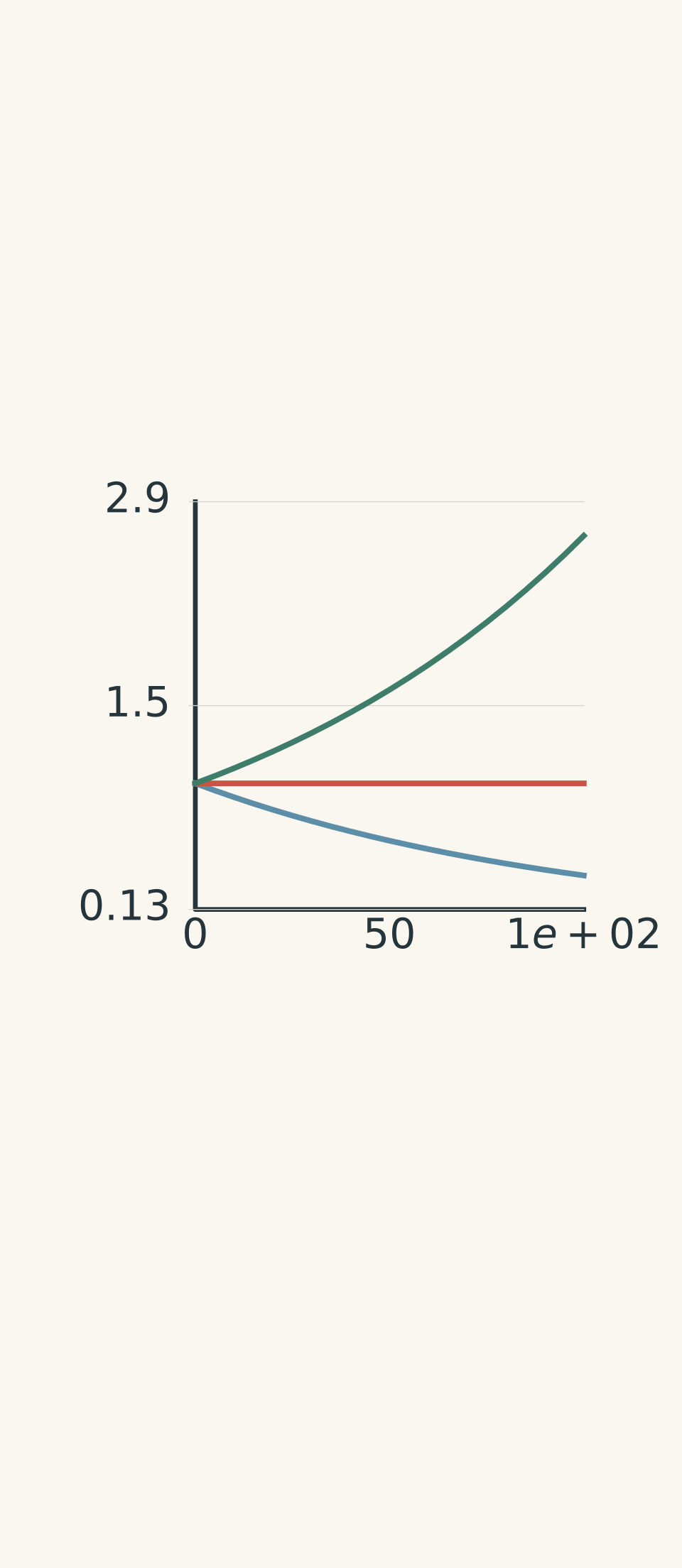
A particularly useful comparison is \(k=0.99\) versus \(k=1.01\).
After 100 generations,
\[ (0.99)^{100}\approx0.366 \]
but
\[ (1.01)^{100}\approx2.70 \]
So a 1% difference from criticality has produced a factor of about 7.39 between the two systems.
The exact generation time depends on the physical system, so don’t turn this simple calculation into a claim about how many seconds a real reactor takes to change power. The point is the repeated multiplication.
06Controlled reactor versus rapidly multiplying chain
| Feature | Controlled reactor at steady power | Rapidly multiplying chain |
|---|---|---|
| Multiplication factor | \(k\approx1\) | \(k>1\) |
| Next generation | About the same size | Larger |
| Fission rate | Approximately constant | Increasing |
| Power | Approximately constant | Increasing |
| Neutron absorption | Adjusted to maintain the desired chain | Not keeping the chain at the desired steady level |
| Main physical idea | Sustain the reaction without runaway growth | Allow the neutron population to multiply rapidly |
One phrase is worth remembering:
A controlled chain reaction is not a reaction with no fission. It is a reaction whose multiplication is kept at the required level.
For a steady reactor, that level is approximately \(k=1\).
07The exam decision rule
When a chain-reaction question gives you numbers, work through these questions in order:
- What is being counted? Neutrons released are not necessarily the same as neutrons that cause the next fissions.
- What is \(k\)? In a simple generation model, use \(k=F_{n+1}/F_n\).
- Is \(k\) below, equal to, or above 1?
- What happens to the fission rate? It falls, stays steady, or rises.
- What are the control rods doing? More absorption lowers \(k\); less absorption raises \(k\).
- Are you being asked about power or about \(k\)? Power depends on the number of fissions per unit time. \(k\) tells you how that number changes.
For an uncontrolled, rapidly multiplying chain, the central condition is \(k>1\). A suitable amount and arrangement of fissile material must allow enough neutrons to remain available to produce further fissions. The idea of a critical mass refers to the amount of fissile material needed for a self-sustaining chain under specified conditions; it is not one universal mass because geometry and neutron losses matter.
08Questions and solutions
Question 1
A simplified chain reaction produces 600 fissions in generation 1 and 480 fissions in generation 2.
Calculate \(k\), state whether the chain is subcritical, critical, or supercritical, and calculate the number of fissions expected in generation 3 if the same conditions continue.
Solution 1
The chain is subcritical, with \(k=0.80\), and generation 3 contains 384 fissions.
Step 1: Calculate the multiplication factor.
\[ k=\frac{F_2}{F_1} =\frac{480}{600} =0.80 \]
Step 2: Classify the chain.
Because
\[ k=0.80<1 \]
the chain is subcritical. Each generation is smaller than the one before it.
Step 3: Calculate generation 3.
\[ F_3=kF_2 \]
\[ F_3=(0.80)(480) =384 \]
The tempting mistake is to describe 480 as “80% less” than 600. It is actually 80% of 600, meaning a 20% decrease each generation.
Question 2
A reactor is initially operating with \(k=1.06\). Control rods are adjusted so that 5% of the neutrons that would otherwise produce next-generation fissions are absorbed.
The reactor initially has \(2.00\times10^5\) fissions per generation.
Calculate:
- the new value of \(k\),
- the number of fissions in the next two generations, and
- whether the chain is still multiplying.
A student claims that because the new \(k\) is 1.007, the reactor power must be 0.7% higher than before. Explain why this interpretation is incomplete.
Solution 2
The new multiplication factor is \(k=1.007\), the chain is still supercritical, and the next two generations contain approximately \(2.01\times10^5\) and \(2.03\times10^5\) fissions.
Step 1: Find the fraction of neutrons that remains available.
\[ 1-0.05=0.95 \]
Step 2: Apply this reduction to the original multiplication factor.
\[ k_{\text{new}}=(1.06)(0.95) \]
\[ k_{\text{new}}=1.007 \]
Step 3: Calculate the next generation.
\[ F_2=(1.007)(2.00\times10^5) \]
\[ F_2=2.014\times10^5 \]
Step 4: Calculate the following generation.
\[ F_3=(1.007)(2.014\times10^5) \]
\[ F_3=2.0281\times10^5 \]
So \(F_3\approx2.03\times10^5\) fissions.
Step 5: Interpret \(k\).
Since
\[ 1.007>1 \]
the chain is still supercritical, although it is much closer to critical than it was initially.
The student’s statement about power is incomplete because \(k=1.007\) describes the ratio between successive generations. It does not specify the absolute fission rate. If the reactor has 200,000 fissions in the current generation, the next generation has 200,000 multiplied by 1.007 in this simplified model. \(k\) is a measure of multiplication, not a direct power reading.
Question 3
A student says:
“A nuclear reactor is only controlled when the control rods absorb most of the neutrons. If fewer neutrons are available, the reactor is safer.”
Explain why this statement is incorrect. In your response, distinguish the roles of the fuel, moderator, control rods, and coolant, and explain what condition is required for steady reactor power.
Solution 3
The statement is incorrect because a reactor operating at steady power needs a self-sustaining chain with \(k\approx1\), not a chain that is as far below critical as possible.
The fuel contains nuclei capable of undergoing fission. When fission occurs, energy and neutrons are released.
The moderator slows the fast neutrons produced by fission. In a thermal reactor, this increases the likelihood that the neutrons will cause further fissions.
The control rods absorb neutrons. Inserting them further reduces the number of neutrons available to continue the chain, lowering \(k\). Withdrawing them has the opposite effect.
The coolant removes thermal energy from the core so that the heat can be transferred elsewhere. Its main role in the simplified HSC model is heat removal rather than directly setting the chain multiplication.
If the rods absorbed too many neutrons, \(k\) would fall below 1 and the fission rate would decrease. If too few neutrons were absorbed, \(k\) could rise above 1 and the fission rate would increase.
Therefore, at steady power, the desired condition is approximately
\[ k=1 \]
The trap is confusing neutron absorption with control. Absorbing neutrons is one way to control the chain, but the correct amount of absorption is what matters.
Question 4
Two systems begin with the same fission rate of 1,000 fissions per generation.
System A has \(k=0.99\).
System B has \(k=1.01\).
Assuming the same multiplication factor applies for 100 generations, calculate the fission rate of each system after 100 generations and determine how many times larger System B’s fission rate is than System A’s.
Explain why the small difference between the two values of \(k\) produces such a large difference.
Solution 4
After 100 generations, System A has about 366 fissions per generation, while System B has about \(2.70\times10^3\) fissions per generation. System B is about 7.39 times larger than System A.
For repeated generations,
\[ F_n=F_0k^n \]
Step 1: Calculate System A.
\[ F_A=1000(0.99)^{100} \]
\[ F_A\approx1000(0.366) \]
\[ F_A\approx366 \]
So System A is subcritical and its fission rate has fallen.
Step 2: Calculate System B.
\[ F_B=1000(1.01)^{100} \]
\[ F_B\approx1000(2.705) \]
\[ F_B\approx2705 \]
So System B is supercritical and its fission rate has increased.
Step 3: Compare the two.
\[ \frac{F_B}{F_A} = \frac{2705}{366} \approx7.39 \]
The difference is large because the 1% change is applied repeatedly. A value slightly below 1 is repeatedly reducing the fission population, while a value slightly above 1 is repeatedly increasing it.
The tempting route is to think “0.99 and 1.01 are almost the same, so the final results should be almost the same”. That ignores the exponent. A small difference in \(k\) becomes consequential when it is multiplied over many generations.
Question 5
Two identical simplified reactor cores begin with the same fission rate, \(F_0\).
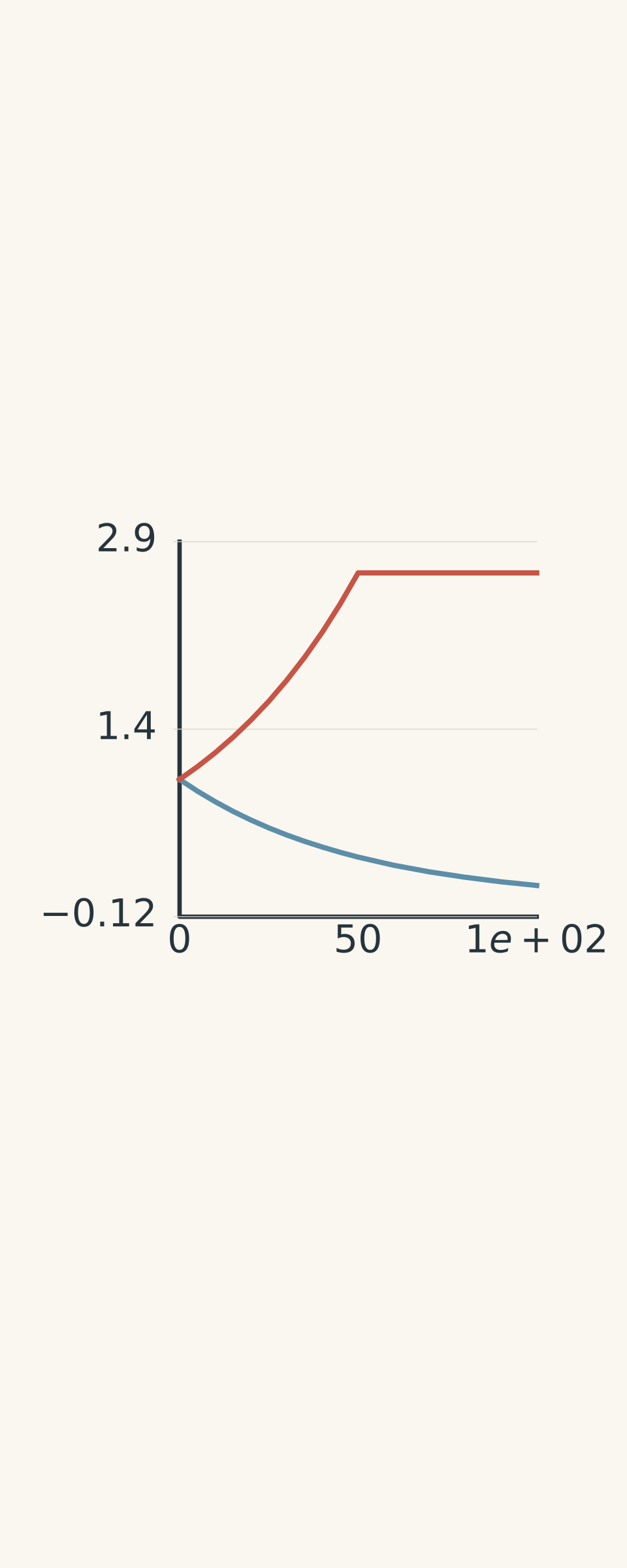
Core A is held at \(k=0.98\) for 50 generations.
Core B is held at \(k=1.02\) for 50 generations.
After those 50 generations, Core B’s control rods are adjusted so that its multiplication factor becomes exactly \(k=1.00\).
Assume the generation interval and energy released per fission remain unchanged, and ignore other feedback effects.
- Compare the fission rates of A and B after the first 50 generations.
- Does changing Core B to \(k=1.00\) immediately return its fission rate to \(F_0\)?
- If not, what must happen for Core B to return to \(F_0\) and then remain there?
Solution 5
After 50 generations, Core A is at about \(0.364F_0\), while Core B is at about \(2.69F_0\). Changing Core B to \(k=1.00\) does not return it to \(F_0\); it holds the new, higher fission rate steady.
Step 1: Calculate Core A after 50 generations.
\[ F_A=F_0(0.98)^{50} \]
\[ F_A\approx0.364F_0 \]
Core A has fallen to about 36.4% of its original fission rate because \(k<1\).
Step 2: Calculate Core B after 50 generations.
\[ F_B=F_0(1.02)^{50} \]
\[ F_B\approx2.69F_0 \]
Core B now has about 2.69 times its original fission rate.
The two cores therefore differ by roughly
\[ \frac{2.69}{0.364}\approx7.39 \]
even though their starting conditions were identical.
Step 3: Apply the change to \(k=1.00\).
Once Core B has
\[ k=1.00 \]
the next generation contains the same number of fissions as the current generation.
So the chain stays at approximately
\[ 2.69F_0 \]
per generation.
It does not jump back down to \(F_0\).
This is the key hinge in the problem. A student might confidently think “critical means normal power”, but criticality is about the change in fission rate, not its absolute value.
Here, \(k=1\) means:
“Keep the current fission rate steady.”
It does not mean:
“Return the fission rate to its original value.”
Step 4: Determine what would be needed to return to \(F_0\).
Core B must first be made subcritical, so that
\[ k<1 \]
for long enough for its fission rate to fall from \(2.69F_0\) back towards \(F_0\).
Only once the fission rate reaches the desired level should the system be brought to
\[ k=1 \]
to hold that level steady.
So the sequence is:
\[ k>1 \rightarrow \text{fission rate rises} \]
then
\[ k<1 \rightarrow \text{fission rate falls} \]
then
\[ k=1 \rightarrow \text{fission rate stays steady} \]
That is the conceptual difference between controlling a chain reaction and merely making it critical.
Once \(k\) and the fission rate are separate ideas in your head, the next useful connection is energy: each fission releases energy because the products have a lower total mass than the original system. That leads directly into mass defect and nuclear binding energy.