
Gravity as Centripetal Force in Circular Orbits for HSC Physics
Learn how gravity provides the centripetal force for circular orbits, and use the relationship to calculate orbital speed and period.
A satellite is being pulled towards Earth the whole time it is in orbit. So why doesn’t it simply fall straight down?
Imagine giving the satellite a sideways velocity. Gravity pulls it downwards, but while it falls, it also travels sideways. If it is moving at exactly the right speed, Earth’s curved surface drops away beneath it at the same rate. The satellite keeps falling without reaching the ground.
Now make a prediction. If we move the satellite into a lower circular orbit, should it move faster or slower?
A smaller orbit has a shorter distance to travel, so slower might sound reasonable. Gravity is stronger closer to Earth, though. Once we connect gravity to circular motion, we will find that the lower satellite must actually move faster.
01Gravity bends an orbit
Start with something easier to picture: a ball being swung in a horizontal circle on a string.
If the string suddenly breaks, the ball does not continue curving. It moves off in the direction it was travelling at that instant, along a tangent to the circle. The string’s tension had been continually changing the direction of the ball’s velocity.
A satellite behaves similarly, except there is no string. Gravity supplies the inward force.
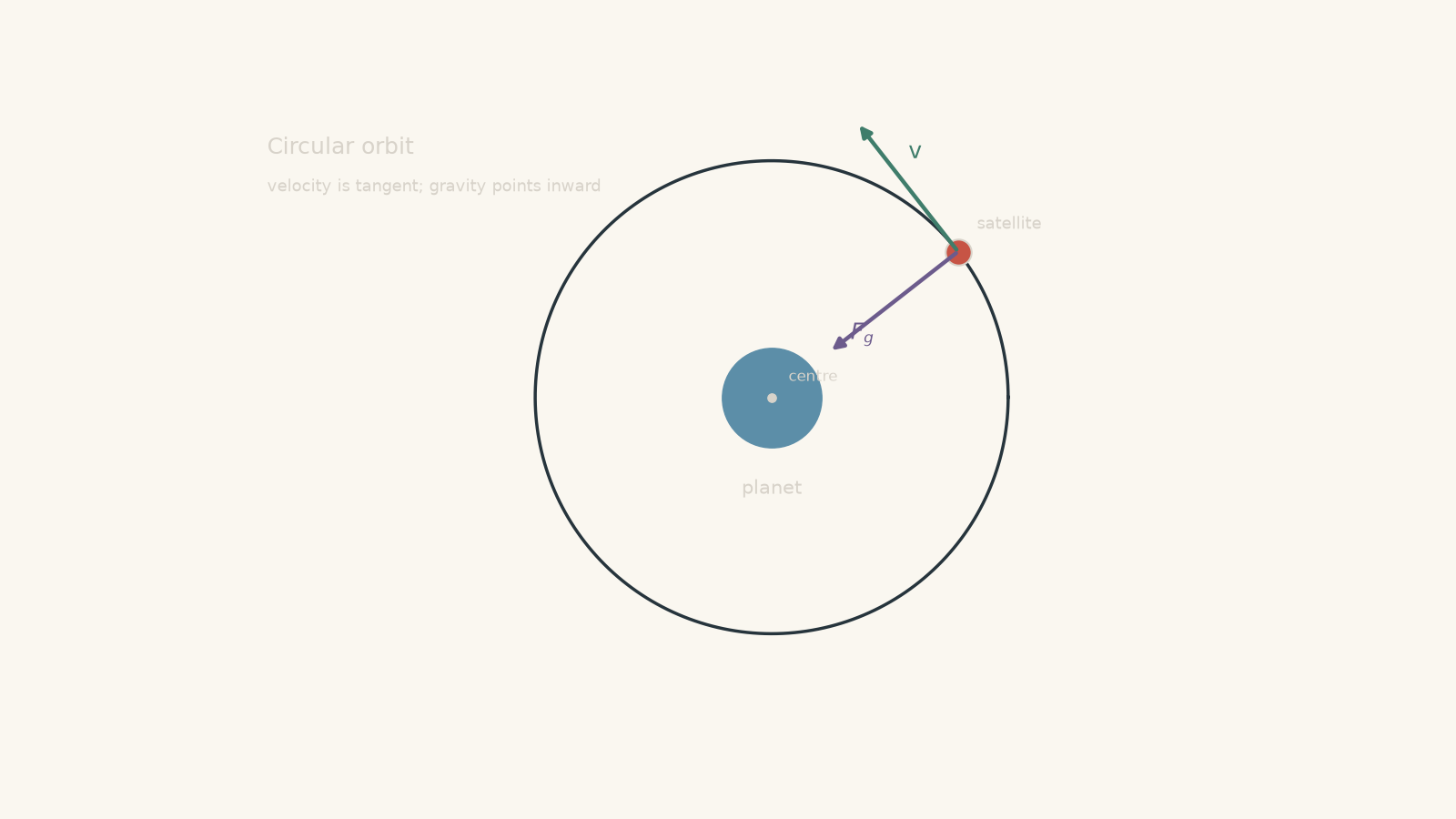
This requires one useful reminder from circular motion. An object can have constant speed and still accelerate. Velocity includes direction, so continuously changing the direction of the velocity means there is an acceleration.
For uniform circular motion, that acceleration points towards the centre of the circle and has magnitude
\[ a_c=\frac{v^2}{r} \]
where:
- \(a_c\) is the centripetal acceleration in \(\text{m s}^{-2}\),
- \(v\) is the object’s speed in \(\text{m s}^{-1}\), and
- \(r\) is the radius of the circular path in metres.
The net inward force required is therefore
\[ F_c=ma_c=\frac{mv^2}{r} \]
where \(m\) is the mass of the orbiting object in kilograms.
02Centripetal force is not an extra force
This is the most important conceptual point in the topic.
“Centripetal force” is not a new type of force sitting beside gravity. It is the name we give to the net force directed towards the centre of a circular path.
Think of “centripetal force” as a job title. If Alex is the captain of a team, you would not count “Alex” and “the captain” as two different people. In a simple satellite orbit, gravity is the actual force, and “centripetal force” describes the job gravity is doing.
The analogy stops there, of course. Forces are vectors, not people with suspiciously important LinkedIn titles.
For a satellite in a circular orbit, gravity is the net inward force. So we can write
\[ F_g=F_c \]
This does not mean two opposite forces are balanced and the net force is zero. They are two descriptions of the same inward force.
03Equating gravity and centripetal force
Newton’s law of universal gravitation gives the gravitational force between a central body of mass \(M\) and an orbiting object of mass \(m\):
\[ F_g=\frac{GMm}{r^2} \]
Here:
- \(G=6.67\times10^{-11}\ \text{N m}^2\text{kg}^{-2}\) is the universal gravitational constant,
- \(M\) is the mass of the central body in kilograms,
- \(m\) is the mass of the satellite in kilograms, and
- \(r\) is the centre-to-centre separation in metres.
If that equation is unfamiliar, it is worth refreshing Newton’s Law of Universal Gravitation first.
For a circular orbit, gravity supplies exactly the force needed to continually turn the satellite:
\[ \frac{GMm}{r^2}=\frac{mv^2}{r} \]
Cancel \(m\) from both sides, then cancel one factor of \(r\):
\[ \frac{GM}{r}=v^2 \]
Therefore,
\[ v=\sqrt{\frac{GM}{r}} \]
This is the circular orbital speed.
Three consequences are worth noticing before doing any calculations.
First, the satellite’s mass has disappeared. A 500 kg satellite and a 1000 kg satellite at the same orbital radius around the same planet require the same circular orbital speed.
That does not mean gravity exerts the same force on both satellites. The heavier satellite feels twice the gravitational force, but it also has twice the inertia. Both effects scale with \(m\), so the required speed is unchanged.
Second, increasing the central mass \(M\) increases orbital speed.
Third, increasing orbital radius \(r\) decreases orbital speed.
That resolves our opening prediction. A lower circular orbit requires a greater speed:
\[ v\propto\frac{1}{\sqrt r} \]
04Do not confuse orbital radius with altitude
Suppose a satellite is 400 km above Earth’s surface.
You cannot substitute \(400\ \text{km}\) for \(r\).
The gravitational equation uses the distance from Earth’s centre, so
\[ r=R_E+h \]
where \(R_E\) is Earth’s radius and \(h\) is the satellite’s altitude above the surface.
This is a very common source of otherwise avoidable errors.
Worked example: A satellite 400 km above Earth
A satellite is in a circular orbit \(400\ \text{km}\) above Earth’s surface. Take Earth’s radius as \(6.37\times10^6\ \text{m}\) and Earth’s mass as \(5.97\times10^{24}\ \text{kg}\). Calculate the satellite’s orbital speed and orbital period.
Step 1
Convert the altitude first:
\[ 400\ \text{km}=4.00\times10^5\ \text{m} \]
Therefore,
\[ r=6.37\times10^6+4.00\times10^5 =6.77\times10^6\ \text{m} \]
Step 2
\[ v=\sqrt{\frac{GM}{r}} \]
Substituting,
\[ v= \sqrt{ \frac{(6.67\times10^{-11})(5.97\times10^{24})} {6.77\times10^6} } =7.67\times10^3\ \text{m s}^{-1} \]
So the satellite travels at about
\[ v=7.67\ \text{km s}^{-1} \]
Step 3
One complete orbit has length \(2\pi r\), so
\[ T=\frac{2\pi r}{v} \]
Hence,
\[ T= \frac{2\pi(6.77\times10^6)} {7.67\times10^3} =5.55\times10^3\ \text{s} \]
Converting to minutes,
\[ T=\frac{5.55\times10^3}{60}=92.4\ \text{min} \]
The result means the satellite is continually falling around Earth at about \(7.67\ \text{km s}^{-1}\), completing one circular orbit roughly every 92 minutes.
05Orbital period comes from the same force equation
For one circular orbit, the satellite travels a distance equal to the circumference:
\[ 2\pi r \]
If \(T\) is the orbital period in seconds, then
\[ v=\frac{2\pi r}{T} \]
But we already know
\[ v=\sqrt{\frac{GM}{r}} \]
Equating these expressions gives
\[ \frac{2\pi r}{T}=\sqrt{\frac{GM}{r}} \]
Squaring and rearranging produces
\[ T^2=\frac{4\pi^2r^3}{GM} \]
or
\[ T=2\pi\sqrt{\frac{r^3}{GM}} \]
For objects orbiting the same central mass,
\[ T^2\propto r^3 \]
This is the circular-orbit form of the relationship behind Kepler’s Three Laws of Planetary Motion.
Notice something slightly strange. Higher satellites move more slowly, yet they take much longer to complete an orbit. That is because they have two things working against them: their speed is smaller, and the circumference of their orbit is larger.
A useful summary is:
| Quantity | Circular-orbit relationship | What happens as \(r\) increases? |
|---|---|---|
| Orbital speed | \(v=\sqrt{GM/r}\) | Decreases |
| Gravitational acceleration | \(g=GM/r^2\) | Decreases |
| Orbital period | \(T=2\pi\sqrt{r^3/(GM)}\) | Increases |
| Satellite mass \(m\) | Cancels from \(v\) and \(T\) | Does not set the circular speed or period |
Worked example: Finding a planet’s mass from an orbit
A moon follows a circular orbit of radius \(2.40\times10^7\ \text{m}\) around a planet. Its orbital period is \(5.00\ \text{h}\). Calculate the mass of the planet and the gravitational field strength at the moon’s orbit.
Step 1
\[ T=5.00\times3600=1.80\times10^4\ \text{s} \]
Step 2
Starting with
\[ T^2=\frac{4\pi^2r^3}{GM} \]
gives
\[ M=\frac{4\pi^2r^3}{GT^2} \]
Step 3
\[ M= \frac{ 4\pi^2(2.40\times10^7)^3 }{ (6.67\times10^{-11})(1.80\times10^4)^2 } =2.53\times10^{25}\ \text{kg} \]
So the planet’s mass is
\[ M=2.53\times10^{25}\ \text{kg} \]
Step 4
At radius \(r\),
\[ g=\frac{GM}{r^2} \]
Therefore,
\[ g= \frac{ (6.67\times10^{-11})(2.53\times10^{25}) }{ (2.40\times10^7)^2 } =2.92\ \text{m s}^{-2} \]
The moon’s orbit has therefore allowed us to measure the planet’s mass without putting the planet on an extremely inconvenient set of bathroom scales.
More importantly, it shows what orbital data really tell us. The moon’s path reveals the strength of the gravitational field producing its centripetal acceleration.
06Why orbiting objects can feel weightless
A common prediction is that astronauts float because there is no gravity in orbit.
But without gravity, there would be no curved orbit. A spacecraft with no forces acting on it would travel approximately in a straight line.
Astronauts float because the spacecraft and everything inside it are accelerating towards Earth together. They are all in free fall.
The floor therefore does not need to provide the normal force that supports a person standing on Earth’s surface. It is the absence of that supporting contact force, rather than the absence of gravity, that creates the familiar feeling of weightlessness.
07Where \(F_g=F_c\) stops working
The equation
\[ \frac{GMm}{r^2}=\frac{mv^2}{r} \]
is powerful, but it has assumptions hiding inside it.
The orbit must be circular
In an elliptical orbit, the satellite’s distance from the central body changes, and its speed changes.
Gravity still controls the motion, but you cannot simply use
\[ \frac{GMm}{r^2}=\frac{mv^2}{r} \]
with \(r\) equal to the planet-satellite separation and expect the circular-orbit result to work everywhere.
For a circular orbit, the gravitational force is perpendicular to the instantaneous velocity and changes its direction without changing its speed. In an elliptical orbit, gravity generally has a component along or against the motion as well, so the speed changes.
The central body is usually treated as fixed
For a small satellite orbiting a massive planet, this is an excellent approximation.
Strictly, however, gravity pulls the planet towards the satellite too. Both bodies orbit their common centre of mass.
When the satellite’s mass is tiny compared with the planet’s, the centre of mass lies extremely close to the planet’s centre, so treating the planet as fixed gives practically the same result.
If the two masses are comparable, that approximation fails. Question 5 below explores exactly what changes.
Other forces must be negligible
Atmospheric drag, thrust, and gravitational forces from other bodies can disturb an orbit.
The simple model assumes gravity from one central body provides essentially the entire inward force.
08Questions and solutions
Question 1
A \(500\ \text{kg}\) satellite travels in a circular orbit of radius \(8.00\times10^6\ \text{m}\) around a planet of mass \(6.00\times10^{24}\ \text{kg}\).
Calculate the satellite’s orbital speed. State what would happen to the required orbital speed if the satellite were replaced by a \(1000\ \text{kg}\) satellite at the same radius.
Use \(G=6.67\times10^{-11}\ \text{N m}^2\text{kg}^{-2}\).
Solution 1
The orbital speed is \(7.07\times10^3\ \text{m s}^{-1}\), and replacing the satellite with a \(1000\ \text{kg}\) satellite would not change the required circular orbital speed.
Gravity provides the centripetal force:
\[ \frac{GMm}{r^2}=\frac{mv^2}{r} \]
The satellite mass \(m\) cancels:
\[ v=\sqrt{\frac{GM}{r}} \]
Substituting,
\[ v= \sqrt{ \frac{ (6.67\times10^{-11})(6.00\times10^{24}) }{ 8.00\times10^6 } } =7.07\times10^3\ \text{m s}^{-1} \]
A tempting argument is that the heavier satellite feels a stronger gravitational force and must therefore move faster. It does feel a stronger force, but its inertia is greater by exactly the same factor. Its gravitational acceleration, and therefore the circular speed required at this radius, remain unchanged.
Question 2
A moon moves in a circular orbit of radius \(3.60\times10^8\ \text{m}\) around a planet. Its orbital period is \(2.40\times10^6\ \text{s}\).
Calculate:
(a) the mass of the planet, and
(b) the gravitational field strength at the moon’s orbital radius.
Use \(G=6.67\times10^{-11}\ \text{N m}^2\text{kg}^{-2}\).
Solution 2
The planet’s mass is \(4.79\times10^{24}\ \text{kg}\), and the gravitational field strength at the moon is \(2.47\times10^{-3}\ \text{m s}^{-2}\).
For a circular orbit,
\[ T^2=\frac{4\pi^2r^3}{GM} \]
so
\[ M=\frac{4\pi^2r^3}{GT^2} \]
Substituting,
\[ M= \frac{ 4\pi^2(3.60\times10^8)^3 }{ (6.67\times10^{-11})(2.40\times10^6)^2 } =4.79\times10^{24}\ \text{kg} \]
For part (b),
\[ g=\frac{GM}{r^2} \]
so
\[ g= \frac{ (6.67\times10^{-11})(4.79\times10^{24}) }{ (3.60\times10^8)^2 } =2.47\times10^{-3}\ \text{m s}^{-2} \]
The field strength is small because the moon is far from the planet, even though the planet itself is very massive.
A common wrong turn is to search for the moon’s mass before calculating the planet’s mass. It is not required. The orbit tells us the moon’s gravitational acceleration, and its own mass cancels from the circular-motion equation.
Question 3
Satellites A and B follow circular orbits around the same planet.
Satellite B has four times the mass of satellite A. Its orbital period is eight times the period of A.
Determine:
(a) the ratio \(r_B/r_A\) of their orbital radii,
(b) the ratio \(v_B/v_A\) of their orbital speeds, and
(c) the ratio \(F_B/F_A\) of the gravitational forces acting on them.
Solution 3
The ratios are
\[ \frac{r_B}{r_A}=4,\qquad \frac{v_B}{v_A}=\frac12,\qquad \frac{F_B}{F_A}=\frac14 \]
The important distinction is that satellite mass does not affect the required orbital speed or period at a given radius, but it does affect the gravitational force.
For satellites around the same planet,
\[ T^2\propto r^3 \]
Therefore,
\[ \left(\frac{T_B}{T_A}\right)^2 = \left(\frac{r_B}{r_A}\right)^3 \]
Since \(T_B/T_A=8\),
\[ 8^2= \left(\frac{r_B}{r_A}\right)^3 \]
so
\[ \frac{r_B}{r_A} =64^{1/3} =4 \]
For orbital speed,
\[ v\propto r^{-1/2} \]
Hence,
\[ \frac{v_B}{v_A} = \sqrt{\frac{r_A}{r_B}} = \sqrt{\frac14} =\frac12 \]
For gravitational force,
\[ F=\frac{GMm}{r^2} \]
so
\[ \frac{F_B}{F_A} = \frac{m_B}{m_A} \left(\frac{r_A}{r_B}\right)^2 \]
Substituting \(m_B/m_A=4\) and \(r_B/r_A=4\),
\[ \frac{F_B}{F_A} = 4\left(\frac14\right)^2 = 4\left(\frac1{16}\right) =\frac14 \]
The tempting mistake is to say, “Satellite mass cancels, so the masses do not matter anywhere.” Mass cancels when calculating the acceleration, orbital speed, or period. It does not cancel from the gravitational force itself.
Despite being four times as massive, B is four times farther from the planet. The inverse-square effect of that larger distance is strong enough that its gravitational force is only one-quarter of A’s.
Question 4
Planet X is spherical, has radius \(R\), and has mean density \(\rho\). A small satellite moves in a circular orbit just above its surface, so its orbital radius can be taken as \(R\).
(a) Show that its orbital period is
\[ T=\sqrt{\frac{3\pi}{G\rho}} \]
(b) Planet Y has twice the radius of X but exactly the same mean density. Compare the periods of satellites orbiting just above the surfaces of X and Y.
(c) Compare their orbital speeds, and explain how your answers to (b) and (c) can both be true.
Solution 4
The two satellites have the same orbital period, while the surface-skimming orbital speed around planet Y is twice that around planet X.
The surprising hinge is that making a same-density planet larger increases its mass as \(R^3\), not simply as \(R\).
For a sphere of radius \(R\),
\[ V=\frac43\pi R^3 \]
and because density is mass divided by volume,
\[ M=\rho V =\frac43\pi R^3\rho \]
For a circular orbit at radius \(R\),
\[ T^2=\frac{4\pi^2R^3}{GM} \]
Substituting \(M=\frac43\pi R^3\rho\),
\[ T^2 = \frac{ 4\pi^2R^3 }{ G\left(\frac43\pi R^3\rho\right) } \]
The \(R^3\) terms cancel:
\[ T^2=\frac{3\pi}{G\rho} \]
so
\[ T=\sqrt{\frac{3\pi}{G\rho}} \]
The period depends on density, not radius. Because X and Y have the same density,
\[ T_Y=T_X \]
Now consider orbital speed:
\[ v=\sqrt{\frac{GM}{R}} \]
Substituting \(M=\frac43\pi R^3\rho\),
\[ v= \sqrt{ \frac{ G\left(\frac43\pi R^3\rho\right) }{R} } \]
so
\[ v = R\sqrt{\frac43\pi G\rho} \]
At fixed density,
\[ v\propto R \]
Planet Y has twice the radius, so
\[ v_Y=2v_X \]
At first this can look inconsistent. How can one satellite move twice as fast but take the same time?
Its circular path is also twice as long:
\[ 2\pi(2R)=2(2\pi R) \]
It travels twice the distance at twice the speed, so the period is unchanged.
The tempting shortcut is to say that the larger planet has stronger gravity, so its period must automatically be shorter. Stronger gravity does increase the required orbital speed, but the satellite must also travel around a proportionally larger circumference. For equal-density planets, those effects cancel exactly.
Question 5
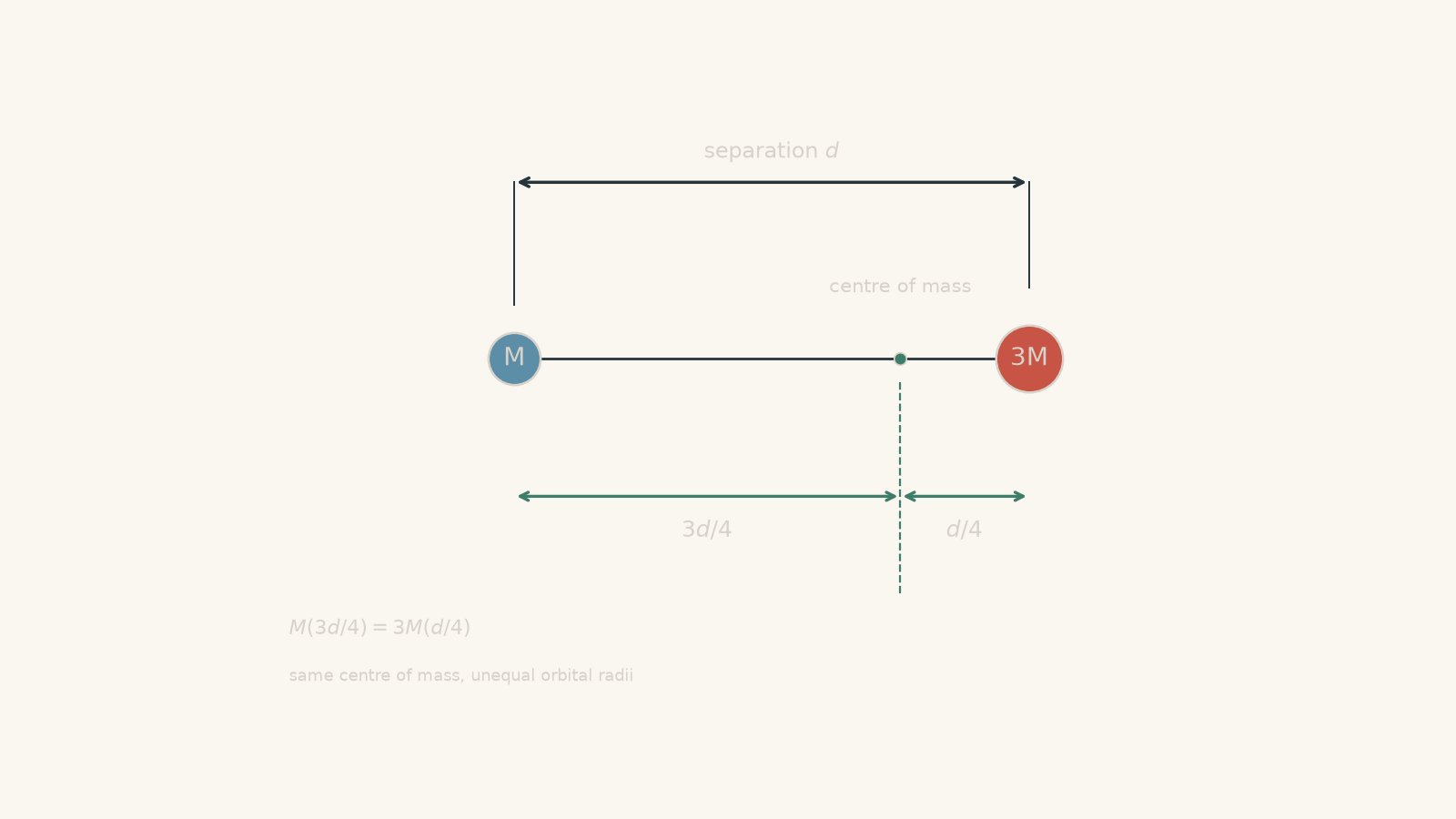
Two stars of masses \(M\) and \(3M\) are separated by a constant distance \(d\) and move in circular orbits around their common centre of mass.
Let their distances from the centre of mass be \(r_M\) and \(r_{3M}\). You are given that
\[ r_M+r_{3M}=d \]
and
\[ Mr_M=3Mr_{3M} \]
Both stars have the same orbital period \(T\).
(a) Find \(r_M\) and \(r_{3M}\).
(b) Derive an expression for their common orbital period in terms of \(M\), \(d\), and \(G\).
(c) Compare the stars’ orbital speeds and centripetal accelerations.
(d) A student treats the \(3M\) star as fixed and uses \(d\) as the circular-orbit radius of the \(M\) star. Explain precisely why this gives the wrong period.
Solution 5
The lighter star orbits at radius \(3d/4\), the heavier star at radius \(d/4\), and their common period is
\[ T=\pi\sqrt{\frac{d^3}{GM}} \]
The lighter star moves three times faster and has three times the centripetal acceleration of the heavier star.
The key constraint is that the distance determining gravitational force is the star-to-star separation \(d\), while the distance determining each star’s centripetal acceleration is its own radius about the centre of mass. Those are not the same distance.
From
\[ Mr_M=3Mr_{3M} \]
we get
\[ r_M=3r_{3M} \]
Together with
\[ r_M+r_{3M}=d \]
this gives
\[ 3r_{3M}+r_{3M}=d \]
so
\[ r_{3M}=\frac d4 \]
and therefore
\[ r_M=\frac{3d}{4} \]
Now consider the gravitational force between the stars:
\[ F_g=\frac{G(M)(3M)}{d^2} =\frac{3GM^2}{d^2} \]
Define the angular speed \(\omega\) by
\[ \omega=\frac{2\pi}{T} \]
For circular motion, the required centripetal force on the lighter star is
\[ F_c=M\omega^2r_M \]
Since \(r_M=3d/4\),
\[ F_c = M\omega^2\left(\frac{3d}{4}\right) \]
Gravity supplies that force, so
\[ \frac{3GM^2}{d^2} = M\omega^2\left(\frac{3d}{4}\right) \]
Cancelling common factors gives
\[ \omega^2=\frac{4GM}{d^3} \]
Since
\[ T=\frac{2\pi}{\omega} \]
we obtain
\[ T = 2\pi \sqrt{\frac{d^3}{4GM}} = \pi\sqrt{\frac{d^3}{GM}} \]
Both stars have the same angular speed because they remain on opposite sides of the same rotating line joining them.
Their tangential speeds are
\[ v=\omega r \]
so
\[ \frac{v_M}{v_{3M}} = \frac{r_M}{r_{3M}} = 3 \]
Thus,
\[ v_M=3v_{3M} \]
Their centripetal accelerations are
\[ a_c=\omega^2r \]
so similarly,
\[ \frac{a_M}{a_{3M}}=3 \]
This also agrees with Newton’s second law. The gravitational forces on the two stars have equal magnitude, but the lighter star has one-third the mass, so its acceleration is three times as large.
The student’s fixed-star calculation fails because it quietly assumes the \(3M\) star does not move.
If it really were fixed, the lighter star’s circular path would have radius \(d\). But in the actual two-star system, both bodies move. The lighter star’s centripetal radius is only
\[ \frac{3d}{4} \]
even though the gravitational separation remains \(d\).
Using one \(d\) for both jobs mixes up two different geometric distances.
This is also why the simple satellite result
\[ v=\sqrt{\frac{GM}{r}} \]
works so well when one mass is tiny compared with the other, but needs refinement when the two masses are comparable. In that case, neither body can honestly be treated as the motionless centre of the system.
09What this idea unlocks next
The central equation for a simple circular orbit is
\[ \frac{GMm}{r^2}=\frac{mv^2}{r} \]
but the important idea behind it is stronger than the equation itself: gravity is producing the inward acceleration that continuously bends the velocity into a circular path.
From that one connection, you can find orbital speeds, periods, central masses, and the circular form of Kepler’s third law. You can also see exactly why satellite mass cancels from the motion without disappearing from the gravitational force.
The next useful question is what changes when the orbit is not circular. Gravity still points towards the central body, but the object’s speed is no longer constant, and the distance controlling gravity is no longer a constant orbital radius. That is where the circular-force model gives way to Kepler’s laws and orbital energy.