
Velocity Change and Vector Subtraction for HSC Physics
Learn how to find changes in velocity using signed values, vector diagrams, and component subtraction. Includes worked examples, common misconceptions, and HSC-style practice.
A car is travelling east at 15 m/s. A few seconds later, it is travelling north at 15 m/s. The speedometer shows the same number both times.
So has its velocity changed?
Predict before reading on. It is tempting to say no because the speed stayed at 15 m/s. But velocity includes direction as well as speed. Turning north changes the velocity, even though its magnitude stays constant.
The useful question is not just “how fast is the object moving now?” It is:
What vector must be added to the initial velocity to turn it into the final velocity?
That vector is the change in velocity.
01Picture velocity as an arrow
A velocity vector can be pictured as an arrow.
- The arrow’s length represents the speed.
- The arrow’s direction represents the direction of motion.
A velocity of 10 m/s east could be represented by an arrow pointing east. A velocity of 10 m/s north has the same length, but points north.
That means two objects can have the same speed while having completely different velocities.
This gives us our first mental model:
The change in velocity is the arrow that takes you from the initial velocity arrow to the final velocity arrow.
This model is useful, but it needs one important condition. The initial and final velocity vectors must be compared from the same starting point.
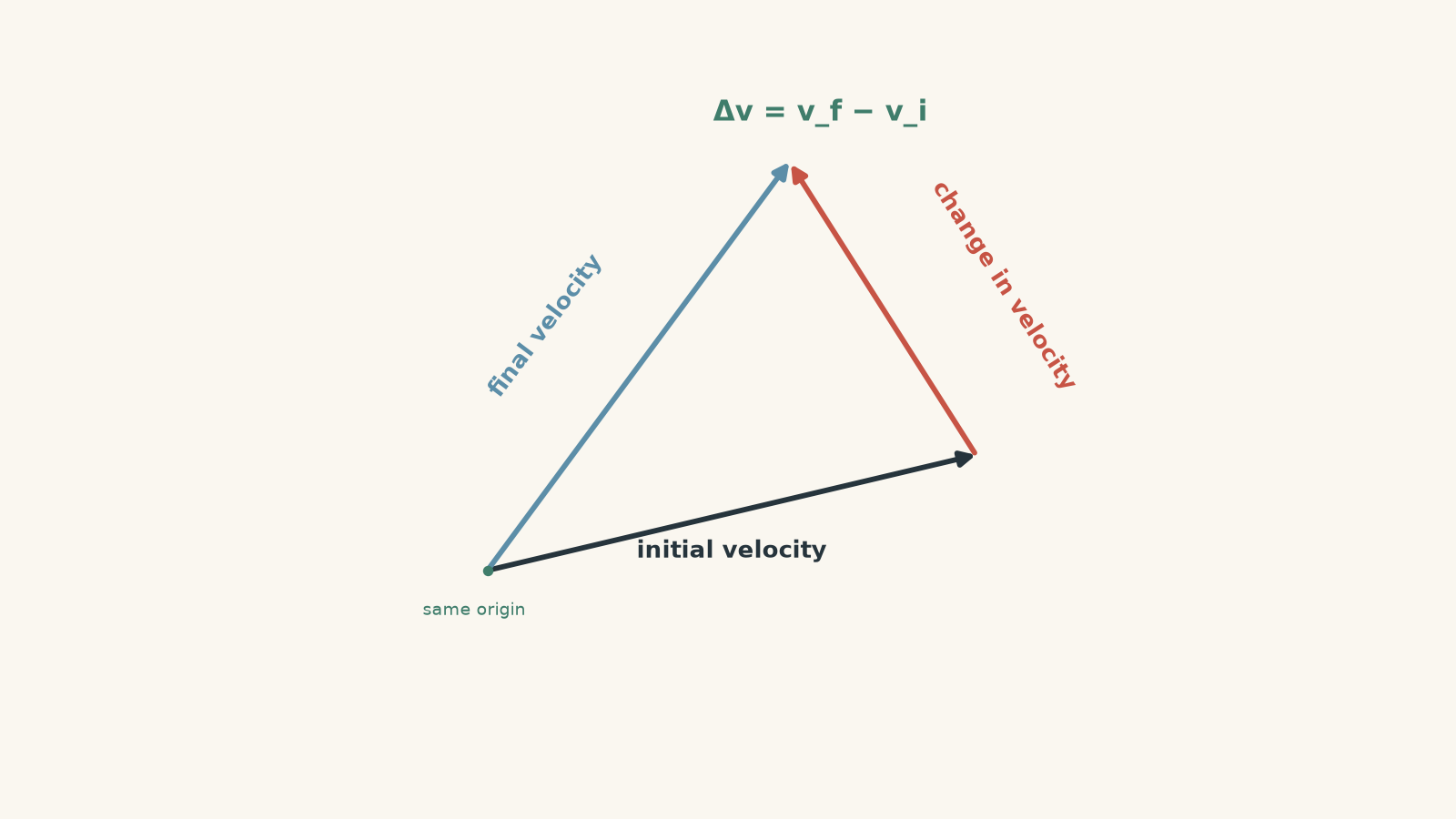
02The vector subtraction rule
We write initial velocity as \(\vec v_i\), where \(i\) means initial, and final velocity as \(\vec v_f\).
The change in velocity is
\[
\Delta \vec v = \vec v_f – \vec v_i
\]
Here:
- \(\Delta\) means “change in”
- \(\vec v\) means velocity
- \(\vec v_i\) is the initial velocity
- \(\vec v_f\) is the final velocity
The order matters.
It is always:
final minus initial
not initial minus final.
Why? Rearrange the equation:
\[
\vec v_f = \vec v_i + \Delta \vec v
\]
So \(\Delta \vec v\) is exactly the velocity vector that must be added to the initial velocity to produce the final velocity.
That is the physical meaning of the subtraction.
03One-dimensional motion: use signs for direction
If an object only moves along one straight line, vector subtraction becomes ordinary subtraction, provided you give opposite directions opposite signs.
For example, you might choose:
- east as positive
- west as negative
You could equally choose west as positive. Physics does not care which direction you choose. It only cares that you stay consistent.
Worked example: A cyclist slows while travelling east
A cyclist is initially travelling east at 12 m/s. The cyclist slows to 5.0 m/s east. Find the change in velocity.
Choose east as positive.
Step 1
\[
v_i = +12\text{ m/s}
\]
\[
v_f = +5.0\text{ m/s}
\]
Both are positive because both velocities point east.
Step 2
\[
\begin{aligned}
\Delta v &= v_f-v_i\\
&= (+5.0)-(+12)\\
&= -7.0\text{ m/s}
\end{aligned}
\]
Step 3
The negative sign means the change in velocity points west.
So,
\[
\boxed{\Delta v = 7.0\text{ m/s west}}
\]
Notice something slightly strange. The cyclist is still moving east, but the change in velocity points west.
That makes sense physically. To reduce an eastward velocity, the velocity needs to change in the westward direction.
04Reversing direction is where students often get caught
Suppose a trolley travels east at 8.0 m/s and then travels west at 6.0 m/s.
A common mistake is:
\[
8.0-6.0=2.0\text{ m/s}
\]
That calculation only subtracts the speeds. It has thrown away the directions.
Choose east as positive. Then
\[
v_i=+8.0\text{ m/s}, \qquad v_f=-6.0\text{ m/s}
\]
Therefore,
\[
\begin{aligned}
\Delta v &= v_f-v_i\\
&=(-6.0)-(+8.0)\\
&=-14.0\text{ m/s}
\end{aligned}
\]
The change in velocity is 14 m/s west.
Think about what the trolley had to do. It first had to remove 8 m/s of eastward velocity just to reach zero velocity, then gain another 6 m/s westward. The total velocity change is therefore 14 m/s towards the west.
This is why signed velocities matter.
05Vector subtraction on a diagram
In two dimensions, simply calling one direction positive and the other negative is no longer enough. The object might move north-east, south-west, or at any other angle.
The vector equation is still
\[
\Delta \vec v=\vec v_f-\vec v_i
\]
There are two useful graphical ways to understand the subtraction.
Method 1: Put both velocities tail-to-tail
Draw \(\vec v_i\) and \(\vec v_f\) from the same point.
Then draw an arrow:
from the tip of \(\vec v_i\) to the tip of \(\vec v_f\).
That arrow is \(\Delta\vec v\).
The direction is important. If you draw the arrow from final back to initial, you have found \(-\Delta\vec v\), the opposite vector.
Method 2: Turn subtraction into addition
Vector subtraction can always be rewritten as
\[
\Delta\vec v=\vec v_f+(-\vec v_i)
\]
The vector \(-\vec v_i\) has the same magnitude as \(\vec v_i\), but points in the opposite direction.
You can then use ordinary head-to-tail vector addition.
A slightly silly way to remember this is to imagine cancelling a dinner plan. Subtracting the original plan is not the same as pretending it never existed. You need an equal and opposite “undo the plan” vector. The analogy stops being useful once we start calculating components, but it captures why subtracting a vector reverses its direction.
06Scale diagrams can give a graphical answer
If a question asks for a graphical determination of velocity change, you can use a scale drawing.
For example, suppose the scale is:
1 cm represents 2 m/s
If your measured \(\Delta\vec v\) arrow is 4.5 cm long, its magnitude represents
\[
4.5\times2=9.0\text{ m/s}
\]
You would then measure its direction using the diagram.
A scale diagram is limited by how accurately you draw and measure it. Component calculations usually give a more precise numerical answer.
The diagram is still extremely useful because it shows what the subtraction actually means.
07Two-dimensional velocity changes: subtract components
Any two-dimensional velocity vector can be split into perpendicular components.
A convenient coordinate system is:
- east as positive \(x\)
- north as positive \(y\)
We can then write a velocity as
\[
\vec v=(v_x,v_y)
\]
where \(v_x\) is the east-west component and \(v_y\) is the north-south component.
To find the change in velocity, subtract corresponding components:
\[
\Delta v_x=v_{fx}-v_{ix}
\]
and
\[
\Delta v_y=v_{fy}-v_{iy}
\]
Therefore,
\[
\Delta\vec v=(\Delta v_x,\Delta v_y)
\]
Once you have those components, Pythagoras gives the magnitude:
\[
|\Delta\vec v|=\sqrt{(\Delta v_x)^2+(\Delta v_y)^2}
\]
The direction can then be found using trigonometry.
Worked example: A drone changes direction
A drone is initially moving at 6.0 m/s east. It later moves at 8.0 m/s north. Find the magnitude and direction of its change in velocity.
Take east as positive \(x\) and north as positive \(y\).
Step 1
The initial velocity is entirely eastward:
\[
\vec v_i=(6.0,0)\text{ m/s}
\]
The final velocity is entirely northward:
\[
\vec v_f=(0,8.0)\text{ m/s}
\]
Step 2
\[
\begin{aligned}
\Delta\vec v
&=\vec v_f-\vec v_i\\
&=(0,8.0)-(6.0,0)\\
&=(-6.0,8.0)\text{ m/s}
\end{aligned}
\]
The negative \(x\)-component means west. The positive \(y\)-component means north.
So the change in velocity points north-west.
Step 3
\[
\begin{aligned}
|\Delta\vec v|
&=\sqrt{(-6.0)^2+(8.0)^2}\\
&=\sqrt{36+64}\\
&=10\text{ m/s}
\end{aligned}
\]
Step 4
Using the angle north of west,
\[
\begin{aligned}
\tan\theta&=\frac{8.0}{6.0}\\
\theta&=\tan^{-1}\left(\frac{8.0}{6.0}\right)\\
&=53^\circ
\end{aligned}
\]
Therefore,
\[
\boxed{\Delta\vec v=10\text{ m/s at }53^\circ\text{ north of west}}
\]
This result does not mean the drone itself is travelling north-west. Its final velocity is north.
The north-west vector describes how its velocity had to change to get from the initial eastward velocity to the final northward velocity.
That distinction is one of the most important ideas in this topic.
08When a velocity is given using an angle
Sometimes the initial or final velocity is not conveniently horizontal or vertical.
Suppose an object moves at speed \(v\) at an angle \(\theta\) north of east.
Its components are
\[
v_x=v\cos\theta
\]
and
\[
v_y=v\sin\theta
\]
You can then subtract components exactly as before.
Worked example: A vehicle changes both speed and direction
A small vehicle initially travels east at 20 m/s. It later travels at 12 m/s at \(60^\circ\) north of east. Find its change in velocity.
Take east as positive \(x\) and north as positive \(y\).
Step 1
\[
\vec v_i=(20,0)\text{ m/s}
\]
Step 2
\[
\begin{aligned}
v_{fx}&=12\cos60^\circ=6.0\text{ m/s}\\
v_{fy}&=12\sin60^\circ=10.4\text{ m/s}
\end{aligned}
\]
So,
\[
\vec v_f=(6.0,10.4)\text{ m/s}
\]
Step 3
\[
\begin{aligned}
\Delta\vec v
&=\vec v_f-\vec v_i\\
&=(6.0,10.4)-(20,0)\\
&=(-14,10.4)\text{ m/s}
\end{aligned}
\]
Step 4
\[
\begin{aligned}
|\Delta\vec v|
&=\sqrt{(-14)^2+(10.4)^2}\\
&=\sqrt{304.2}\\
&=17.4\text{ m/s}
\end{aligned}
\]
Step 5
The vector has a westward component of 14 m/s and a northward component of 10.4 m/s.
\[
\begin{aligned}
\tan\theta&=\frac{10.4}{14}\\
\theta&=36.6^\circ
\end{aligned}
\]
Therefore,
\[
\boxed{\Delta\vec v=17.4\text{ m/s at }36.6^\circ\text{ north of west}}
\]
The final speed is only 12 m/s, yet the change in velocity is 17.4 m/s. There is no contradiction. Change in velocity compares two vectors. Its magnitude does not have to sit between the initial and final speeds.
09A useful decision rule
| Situation | Best approach |
|---|---|
| Motion is along one straight line | Choose a positive direction and subtract signed velocities |
| Initial and final velocities are given as components | Subtract \(x\)-components and \(y\)-components separately |
| A velocity is given by a magnitude and angle | Resolve it into components first |
| A graphical answer is requested | Draw both velocity vectors to scale and construct \(\Delta\vec v\) |
| You are unsure about the subtraction direction | Remember: the \(\Delta\vec v\) arrow goes from the tip of \(\vec v_i\) to the tip of \(\vec v_f\) |
10The most tempting misconception: change in speed is not change in velocity
Consider an object moving at 10 m/s east before turning and moving at 10 m/s north.
Its change in speed is
\[
10-10=0\text{ m/s}
\]
But its change in velocity is not zero.
Using components,
\[
\vec v_i=(10,0)\text{ m/s}
\]
and
\[
\vec v_f=(0,10)\text{ m/s}
\]
so
\[
\begin{aligned}
\Delta\vec v
&=(0,10)-(10,0)\\
&=(-10,10)\text{ m/s}
\end{aligned}
\]
Its magnitude is
\[
|\Delta\vec v|=\sqrt{(-10)^2+(10)^2}=14.1\text{ m/s}
\]
The speed stayed constant, but the velocity changed substantially because the direction changed.
This becomes especially important in circular motion, where an object’s speed can remain constant while its velocity changes continuously.
11Questions and solutions
Question 1
A scooter travels west at 4.0 m/s and speeds up until it is travelling west at 10 m/s. Find its change in velocity.
Solution 1
The change in velocity is 6.0 m/s west.
Choose east as positive, so west is negative.
\[
v_i=-4.0\text{ m/s},\qquad v_f=-10\text{ m/s}
\]
Using final minus initial,
\[
\begin{aligned}
\Delta v&=v_f-v_i\\
&=(-10)-(-4.0)\\
&=-6.0\text{ m/s}
\end{aligned}
\]
The negative sign means west.
Therefore,
\[
\boxed{\Delta v=6.0\text{ m/s west}}
\]
The scooter is already moving west, and its westward velocity becomes larger, so the change in velocity must also point west.
Question 2
A puck initially moves east at 7.0 m/s. After colliding with a barrier, it moves west at 3.0 m/s. Find its change in velocity.
Solution 2
The change in velocity is 10 m/s west.
Take east as positive.
\[
v_i=+7.0\text{ m/s},\qquad v_f=-3.0\text{ m/s}
\]
Then
\[
\begin{aligned}
\Delta v&=v_f-v_i\\
&=(-3.0)-(+7.0)\\
&=-10\text{ m/s}
\end{aligned}
\]
Therefore,
\[
\boxed{\Delta v=10\text{ m/s west}}
\]
The tempting mistake is to subtract the speeds and obtain 4.0 m/s. That ignores the reversal of direction. The puck must lose 7.0 m/s of eastward velocity and gain 3.0 m/s of westward velocity.
Question 3
A robot has an initial velocity of \((3.0,4.0)\) m/s, where positive \(x\) is east and positive \(y\) is north. Its final velocity is \((-1.0,8.0)\) m/s.
Find the magnitude and direction of its change in velocity.
Solution 3
The change in velocity has magnitude 5.7 m/s and points \(45^\circ\) north of west.
Subtract the initial components from the final components:
\[
\begin{aligned}
\Delta\vec v
&=\vec v_f-\vec v_i\\
&=(-1.0,8.0)-(3.0,4.0)\\
&=(-4.0,4.0)\text{ m/s}
\end{aligned}
\]
Its magnitude is
\[
\begin{aligned}
|\Delta\vec v|
&=\sqrt{(-4.0)^2+(4.0)^2}\\
&=\sqrt{32}\\
&=5.7\text{ m/s}
\end{aligned}
\]
The westward and northward components have equal magnitudes, so the direction is
\[
\theta=45^\circ
\]
north of west.
Therefore,
\[
\boxed{\Delta\vec v=5.7\text{ m/s at }45^\circ\text{ north of west}}
\]
The direction comes from the change in velocity components, not directly from the direction of either the initial or final velocity.
Question 4
A runner moves east at 5.0 m/s and later moves north at 5.0 m/s. A student says, “The runner’s velocity did not change because the speed stayed at 5.0 m/s.”
Evaluate the statement and calculate the magnitude of the velocity change.
Solution 4
The statement is incorrect. The runner’s velocity changes by 7.1 m/s, directed \(45^\circ\) north of west.
Velocity includes direction, so equal initial and final speeds do not imply equal velocities.
Using components,
\[
\vec v_i=(5.0,0)\text{ m/s}
\]
and
\[
\vec v_f=(0,5.0)\text{ m/s}
\]
Therefore,
\[
\begin{aligned}
\Delta\vec v
&=(0,5.0)-(5.0,0)\\
&=(-5.0,5.0)\text{ m/s}
\end{aligned}
\]
The magnitude is
\[
\begin{aligned}
|\Delta\vec v|
&=\sqrt{(-5.0)^2+(5.0)^2}\\
&=\sqrt{50}\\
&=7.1\text{ m/s}
\end{aligned}
\]
The equal westward and northward components give a direction of \(45^\circ\) north of west.
The student’s reasoning confuses change in speed, which is zero, with change in velocity, which is not.
Question 5
A drone begins an 8.0 s interval travelling east at 6.0 m/s. During the interval it follows a curved path, but at the end it is again travelling east at exactly 6.0 m/s.
Find its average acceleration over the 8.0 s interval. Can you conclude that its acceleration was zero throughout the interval?
Solution 5
The average acceleration is zero, but the drone’s acceleration was not necessarily zero throughout the interval.
The initial and final velocities are identical:
\[
\vec v_i=\vec v_f
\]
Therefore,
\[
\Delta\vec v=\vec v_f-\vec v_i=\vec 0
\]
Average acceleration is change in velocity divided by the elapsed time:
\[
\begin{aligned}
\vec a_{\text{avg}}
&=\frac{\Delta\vec v}{\Delta t}\\
&=\frac{\vec 0}{8.0\text{ s}}\\
&=\vec 0\text{ m/s}^2
\end{aligned}
\]
So,
\[
\boxed{\vec a_{\text{avg}}=0\text{ m/s}^2}
\]
However, this only compares the velocity at the beginning and end of the interval. The problem states that the drone follows a curved path, so its velocity direction must change during the journey. A changing velocity means acceleration occurs during at least part of the motion.
This is an important limitation of average quantities. Zero average acceleration does not prove zero acceleration at every instant.
Question 6
A vehicle travels at 15 m/s at \(30^\circ\) north of east. Two seconds later, its speed is still 15 m/s, but it is travelling at \(30^\circ\) north of west.
A student argues that because the speed and therefore the kinetic energy are unchanged, the average acceleration must be zero.
Determine the average acceleration and explain the flaw in the student’s argument.
Solution 6
The average acceleration is 13 m/s² west, so the student’s conclusion is incorrect.
Take east as positive \(x\) and north as positive \(y\).
For the initial velocity,
\[
\begin{aligned}
v_{ix}&=15\cos30^\circ=13.0\text{ m/s}\\
v_{iy}&=15\sin30^\circ=7.5\text{ m/s}
\end{aligned}
\]
so
\[
\vec v_i=(13.0,7.5)\text{ m/s}
\]
For the final velocity, the horizontal component points west while the vertical component still points north:
\[
\vec v_f=(-13.0,7.5)\text{ m/s}
\]
The change in velocity is
\[
\begin{aligned}
\Delta\vec v
&=\vec v_f-\vec v_i\\
&=(-13.0,7.5)-(13.0,7.5)\\
&=(-26.0,0)\text{ m/s}
\end{aligned}
\]
So the velocity change is 26.0 m/s west.
Average acceleration is
\[
\begin{aligned}
\vec a_{\text{avg}}
&=\frac{\Delta\vec v}{\Delta t}\\
&=\frac{(-26.0,0)\text{ m/s}}{2.0\text{ s}}\\
&=(-13.0,0)\text{ m/s}^2
\end{aligned}
\]
Therefore,
\[
\boxed{\vec a_{\text{avg}}=13\text{ m/s}^2\text{ west}}
\]
The student’s mistake is assuming that unchanged kinetic energy means unchanged velocity. Kinetic energy depends on speed, not direction. The vehicle’s speed is unchanged, so its kinetic energy is unchanged, but its velocity direction has changed substantially.
This is exactly why velocity change matters in circular and curved motion. Once you can find \(\Delta\vec v\), the next step is to divide it by the time interval to find average acceleration. From there, the same vector idea explains why an object moving at constant speed around a circle is still accelerating.