
Electric Fields from Charge Pairs and Dipoles: HSC Physics
Learn how to construct and interpret electric field patterns using superposition, symmetry, and vector addition. Includes worked examples, zero-field reasoning, and dipole field analysis.
Two charged particles sit a few centimetres apart. At a point between them, each charge creates an electric field. What happens there?
A tempting answer is that the two fields “meet” and interfere with each other. But electric fields don’t collide. Each charge creates its own field, and the fields simply add as vectors.
That one idea, superposition, lets you construct the field around pairs of charges, explain the shape of a dipole field, and locate points where the total field is zero.
Before going further, make a prediction. Put two equal positive charges side by side. At the exact midpoint, which way does the electric field point?
It doesn’t point anywhere. The two fields have equal magnitude and opposite directions, so the net electric field is zero.
Now replace one positive charge with an equal negative charge. At the midpoint, do the fields still cancel?
No. Both fields now point from the positive charge towards the negative charge, so they add.
That reversal is one of the most useful things to understand about paired charge fields.
01Start with the field from one charge
For a single point charge, the electric field has magnitude
\[ E=\frac{k|q|}{r^2} \]
where:
- \(E\) is the electric field strength in newtons per coulomb (\(\text{N C}^{-1}\)),
- \(k\) is Coulomb’s constant, \(8.99\times10^9\ \text{N m}^2\text{C}^{-2}\),
- \(q\) is the charge in coulombs (\(\text{C}\)), and
- \(r\) is the distance from the charge in metres (\(\text{m}\)).
The absolute value signs around \(q\) tell us that this equation gives the magnitude of the field. The sign of the charge determines its direction:
- away from a positive charge,
- towards a negative charge.
Picture a tiny positive test charge placed nearby. A positive source charge would repel it. A negative source charge would attract it. Electric field direction is defined as the direction of the force on that positive test charge.
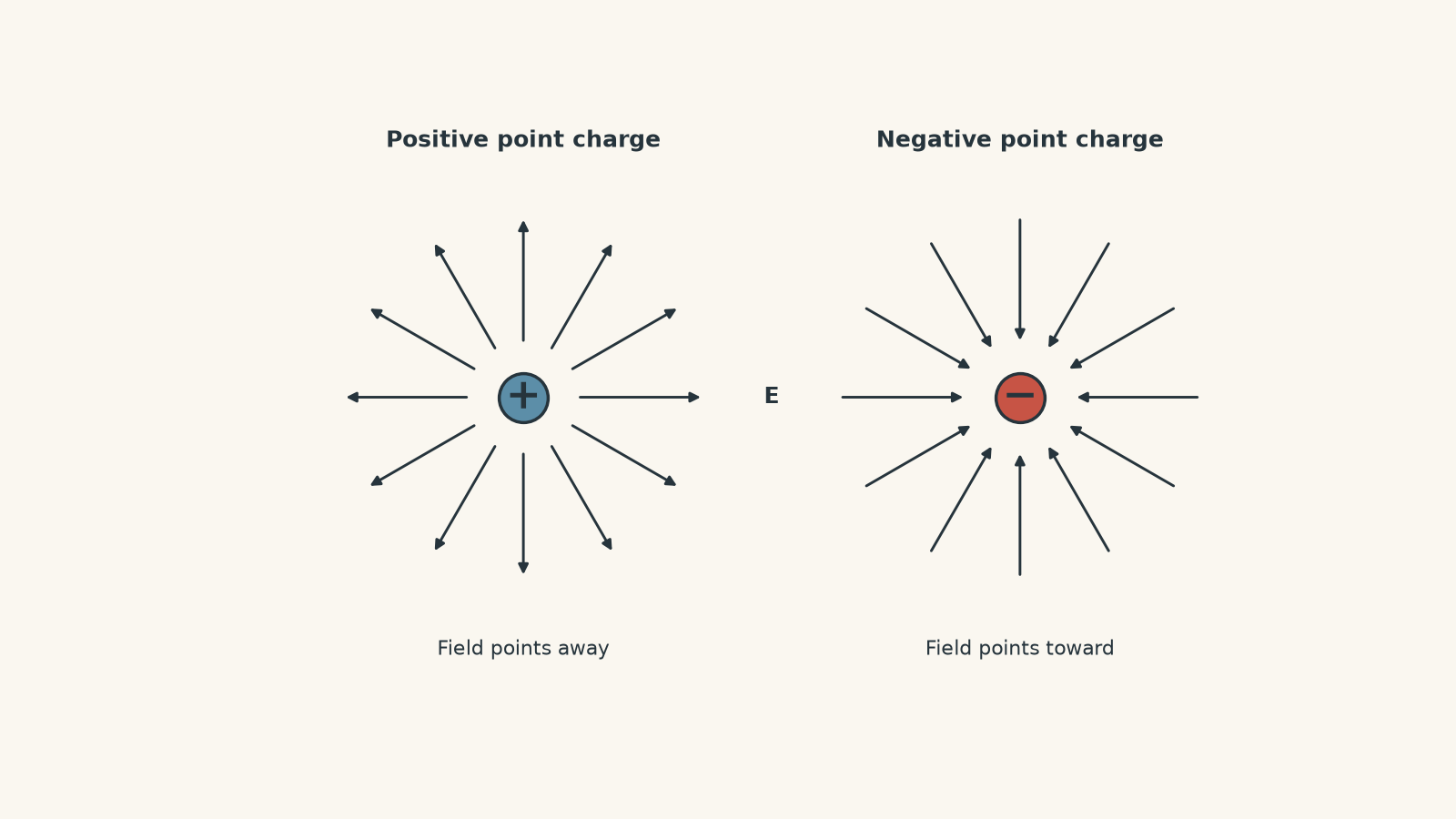
That picture is useful, but it is only the first layer. Once more than one charge is present, we must consider every field acting at the point.
02Superposition means vector addition
Suppose charge A creates an electric field \(\vec E_A\) at some point, while charge B creates \(\vec E_B\) at the same point.
The total field is
\[ \vec E_{\text{net}}=\vec E_A+\vec E_B \]
The arrows above the symbols matter. Electric field is a vector, so both magnitude and direction must be included.
This is not ordinary addition unless the fields happen to point in the same direction.
If two people pull opposite ends of your backpack with equal forces, you don’t add the two force magnitudes and declare the bag launches through the ceiling. Direction matters. Electric fields work the same way, although thankfully with less damaged stationery.
At any chosen point, a reliable method is:
- Find the field created by each charge separately.
- Work out the direction of each field at that point.
- Add the fields as vectors.
- Interpret the resulting direction and magnitude.
For points along the line joining two charges, the vectors usually point along one dimension, so you can add or subtract their magnitudes.
Away from that line, you may need to resolve the fields into perpendicular components.
03Two like charges
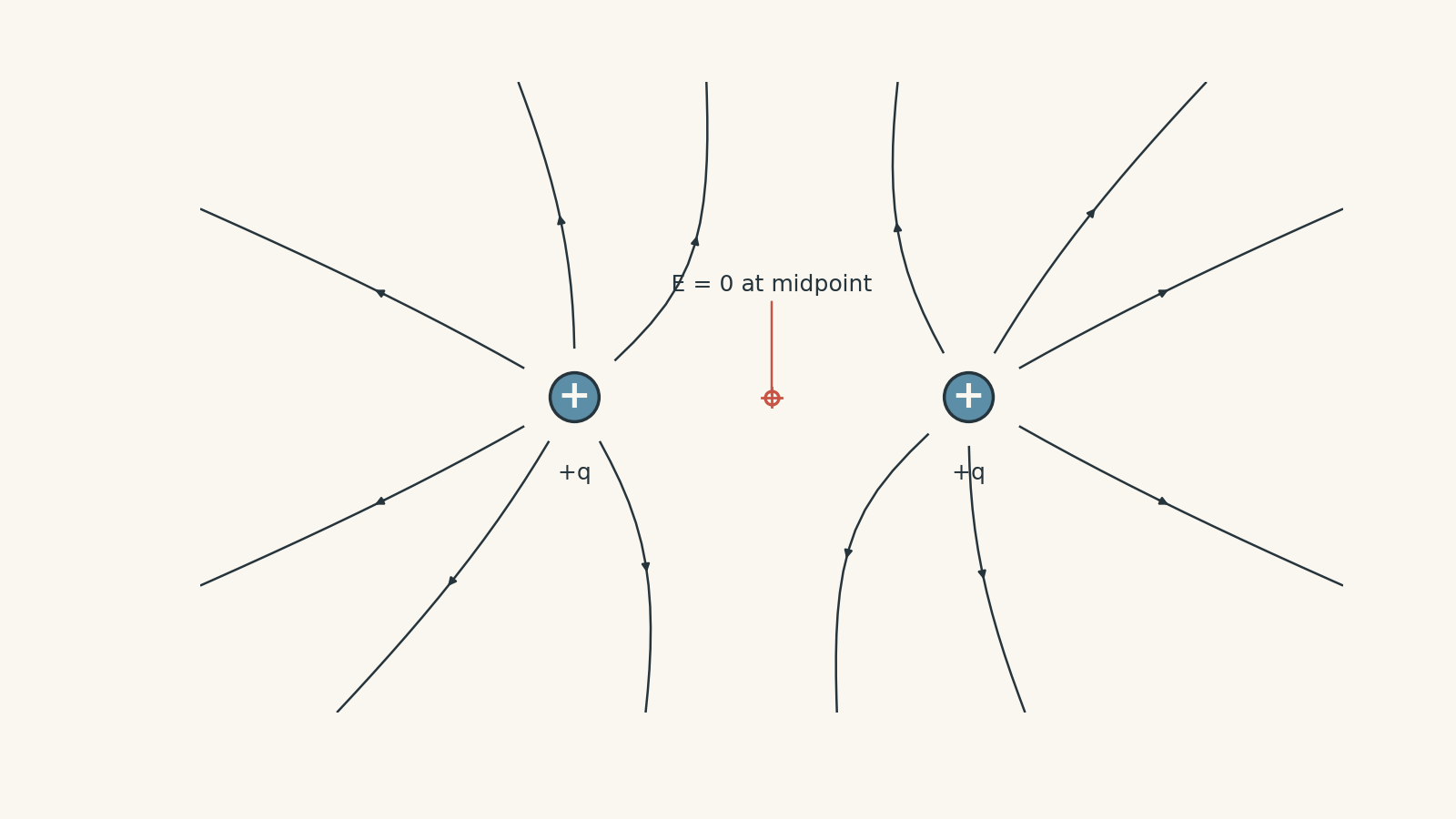
Consider two equal positive charges.
Near either charge, its own field dominates because electric field strength increases rapidly as distance decreases.
Between the charges, however, the fields point in opposite directions.
At the exact midpoint:
- the distances to the charges are equal,
- the charges have equal magnitude,
- the two field magnitudes are equal, and
- their directions are opposite.
Therefore,
\[ \vec E_{\text{net}}=0 \]
This does not mean there are no electric fields there. Each charge still creates a field. The two vectors simply sum to zero at that particular point.
Move slightly towards one charge and the cancellation disappears. Because \(E\) depends on \(1/r^2\), the nearer charge immediately produces the stronger field.
For two equal negative charges, the overall pattern is reversed in direction, but there is still a zero-field point at the midpoint.
Worked example: field at the midpoint of two positive charges
Two charges of \(+3.0\ \text{nC}\) are separated by \(0.40\ \text{m}\). Find the net electric field at their midpoint.
Step 1
The midpoint is
\[ r=\frac{0.40}{2}=0.20\ \text{m} \]
from each charge.
Step 2
Since \(3.0\ \text{nC}=3.0\times10^{-9}\ \text{C}\),
\[ E=\frac{k|q|}{r^2} =\frac{(8.99\times10^9)(3.0\times10^{-9})}{(0.20)^2} =6.74\times10^2\ \text{N C}^{-1} \]
Each charge therefore produces a field of about \(674\ \text{N C}^{-1}\).
Step 3
Both charges are positive, so each field points away from its source charge. At the midpoint, the two fields point directly opposite each other.
Therefore,
\[ E_{\text{net}}=674-674=0\ \text{N C}^{-1} \]
The net field is zero because two equal but opposite field vectors act at the midpoint. It is a cancellation point, not a place where the individual fields cease to exist.
04Two opposite charges
Now place a positive charge beside an equal negative charge.
Predict the direction of the field at the midpoint before reading on.
The field due to the positive charge points away from the positive charge. The field due to the negative charge points towards the negative charge.
Between the charges, those directions are the same.
So the fields add.
This is where students often make the wrong prediction. It feels reasonable to think that opposite charges should produce opposite fields and therefore cancel. But you must determine the direction of each field at the point being considered.
Between a positive and a negative charge, both field vectors point from positive towards negative.
05The electric dipole
A pair consisting of equal charges \(+q\) and \(-q\), separated by some distance, is called an electric dipole.
Its field pattern is different from the pattern around either isolated charge.
Field lines:
- begin on the positive charge,
- end on the negative charge,
- curve smoothly through the surrounding space, and
- are more closely packed where the field is stronger.
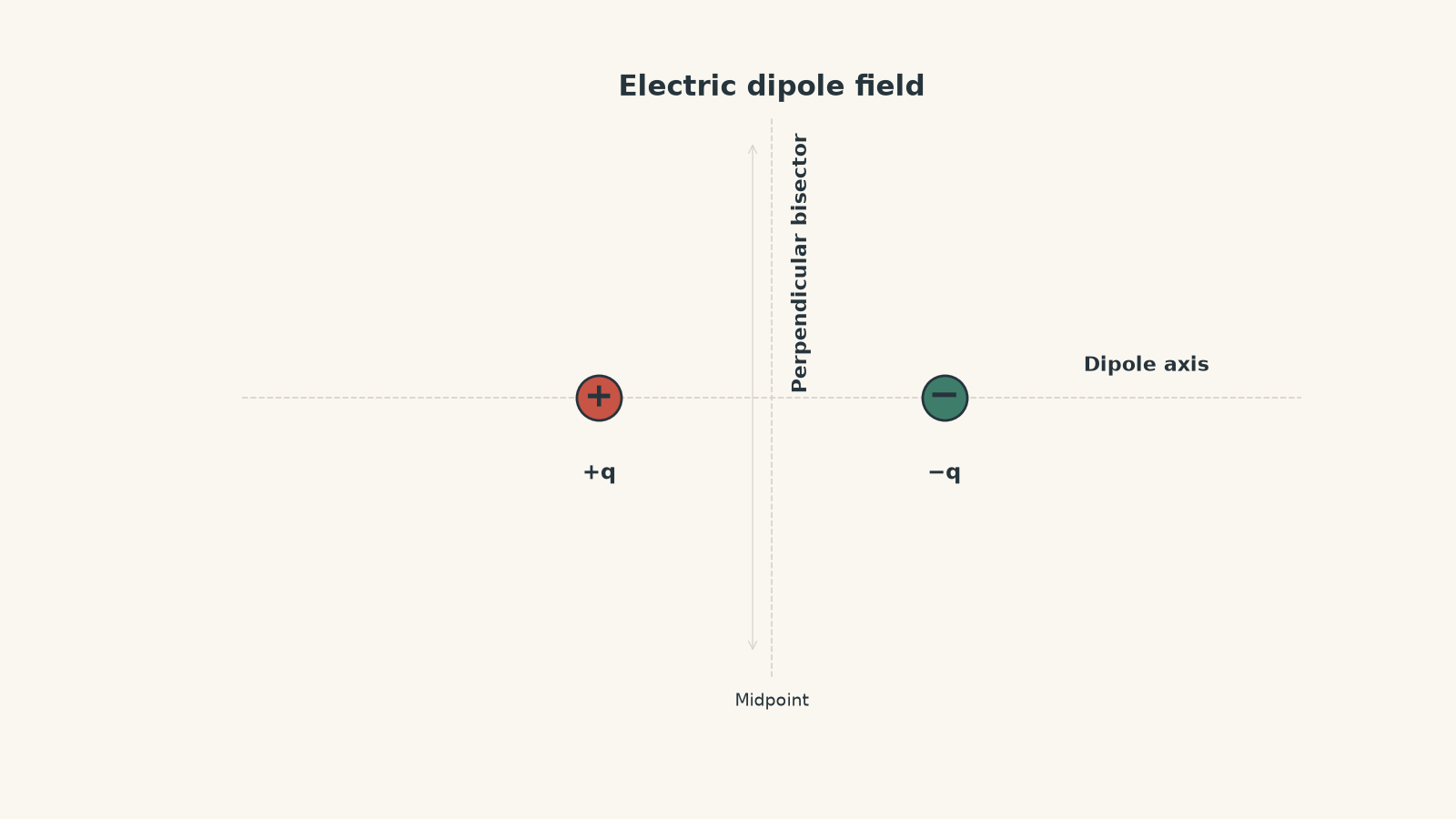
Field lines are a representation of the field. They are not physical strings sitting in space.
Three rules help when interpreting them:
| Feature | Meaning |
|---|---|
| Direction of a field line | Direction of \(\vec E\), from positive towards negative |
| Closer field lines | Stronger electric field |
| Tangent to a field line | Direction of the electric field at that point |
Field lines also never cross.
Why not? Imagine two lines crossing at one point. One line would claim the field points in one direction, while the other claims it points somewhere else. A vector at one point can have only one net direction.
The spacing of field lines is qualitative. A diagram showing twice as many drawn lines does not automatically prove that the field strength is exactly twice as large unless the diagram has been constructed with that quantitative meaning.
06A useful symmetry in a dipole field
Consider a point directly above the midpoint of an equal dipole.
Both charges are the same distance from the point, so they produce fields of equal magnitude.
Would those fields cancel?
Not completely.
The field from the positive charge points away from \(+q\). The field from the negative charge points towards \(-q\). Their vertical components are opposite and cancel, but their horizontal components both point from the positive side towards the negative side.
The net field therefore points parallel to the dipole axis, from \(+q\) towards \(-q\).
This is a good example of why “equal field magnitudes” does not automatically mean “zero net field”. The directions must be considered component by component.
Worked example: field above an electric dipole
A dipole consists of \(+4.0\ \text{nC}\) at \(x=-0.15\ \text{m}\) and \(-4.0\ \text{nC}\) at \(x=+0.15\ \text{m}\). Point P is \(0.20\ \text{m}\) directly above the midpoint. Find the net electric field at P.
Step 1
Each charge, the midpoint, and P form a right-angled triangle.
\[ r=\sqrt{(0.15)^2+(0.20)^2}=0.25\ \text{m} \]
Step 2
\[ E=\frac{k|q|}{r^2} =\frac{(8.99\times10^9)(4.0\times10^{-9})}{(0.25)^2} =5.75\times10^2\ \text{N C}^{-1} \]
So each charge produces a field of about \(575\ \text{N C}^{-1}\) at P.
Step 3
From the triangle,
\[ \frac{0.15}{0.25}=0.60 \]
so the horizontal component of each field is
\[ E_x=(575)(0.60)=345\ \text{N C}^{-1} \]
The vertical components have equal magnitude but opposite directions, so they cancel.
The horizontal components both point towards the negative charge.
Step 4
\[ E_{\text{net}}=345+345 =690\ \text{N C}^{-1} \]
The net electric field is therefore approximately
\[ \boxed{6.9\times10^2\ \text{N C}^{-1}} \]
directed horizontally from the positive charge towards the negative charge.
The important result is not just the number. Symmetry removed the vertical components, while superposition made the horizontal components reinforce each other.
07Constructing a field pattern without guessing
You are rarely expected to calculate the electric field at hundreds of locations. Instead, you use the behaviour of individual fields plus symmetry and superposition to construct the overall pattern.
For two charges, start with these decisions.
1. Mark the field direction close to each charge
Very close to one charge, that charge’s field usually dominates.
Field lines therefore:
- leave positive charges,
- enter negative charges.
2. Check what happens on the line between the charges
For like charges, the fields oppose each other between the charges.
For opposite charges, the fields point in the same direction between them.
3. Look for symmetry
Equal charges create symmetric patterns.
If two equal positive charges lie left and right of the origin, the pattern must be a mirror image across the perpendicular bisector.
Symmetry can also tell you which components cancel without calculating them individually.
4. Think about relative distance
Because
\[ E\propto \frac{1}{r^2}, \]
the closer charge can become much more influential.
Halving the distance makes the field four times as large.
5. Make field lines follow the net field
A field line at any point must be tangent to the resultant electric field there, not the field from only one charge.
That is why the lines bend.
You can think of each charge as trying to point an arrow its own preferred way. The final arrow is the vector sum of those suggestions. A field line follows the direction of that final arrow from point to point.
This mental model has a limit. The charges aren’t actually negotiating, and field lines do not physically move or bend. The analogy is only a way of picturing repeated vector addition throughout space.
08The most tempting misconception: opposite charges cancel between them
It is worth making this explicit.
Suppose \(+q\) is on the left and \(-q\) is on the right.
At a point between them:
- the field from \(+q\) points right, away from \(+q\),
- the field from \(-q\) also points right, towards \(-q\).
Therefore the net field points right.
For two equal positive charges:
- the left charge produces a rightward field between them,
- the right charge produces a leftward field between them.
Those can cancel.
So the useful rule is not “opposites cancel”.
The useful rule is:
Draw the direction of each field at the point first. Then add the vectors.
09Where can the net field be zero?
A zero-field point requires the field vectors to have:
- equal magnitudes, and
- opposite directions.
Both conditions are essential.
For equal like charges, this happens at the midpoint.
For unequal like charges, a zero-field point can still occur between them, but it is closer to the smaller charge.
Why closer to the smaller one?
A smaller charge produces a weaker field at the same distance. To match the field from the larger charge, you have to move closer to the smaller charge.
For equal opposite charges, there is no finite zero-field point on the line joining them. Between the charges, the two fields point the same way. Outside the pair, they oppose each other, but the nearer charge also has the appropriate magnitude advantage, so equality is not reached at a finite point.
For unequal opposite charges, however, a zero-field point may occur outside the pair. The direction test should come before any algebra.
That habit saves a lot of pointless equation solving.
10Questions and solutions
Question 1
Two identical positive charges of \(+2.0\ \text{nC}\) are separated by \(0.30\ \text{m}\). What is the net electric field at the midpoint between them? Explain your reasoning without relying only on symmetry.
Solution 1
The net electric field at the midpoint is \(\boxed{0\ \text{N C}^{-1}}\).
The midpoint is \(0.15\ \text{m}\) from each charge. Each charge therefore produces a field of
\[ E=\frac{k|q|}{r^2} =\frac{(8.99\times10^9)(2.0\times10^{-9})}{(0.15)^2} =7.99\times10^2\ \text{N C}^{-1} \]
So each field has magnitude about \(799\ \text{N C}^{-1}\).
Both charges are positive. The field from the left charge points away from it, towards the right. The field from the right charge also points away from it, towards the left.
The vectors are therefore equal and opposite:
\[ E_{\text{net}}=799-799=0\ \text{N C}^{-1} \]
The important point is that the individual electric fields are not zero. Their vector sum is zero.
Question 2
A \(+5.0\ \text{nC}\) charge and a \(-5.0\ \text{nC}\) charge are \(0.20\ \text{m}\) apart. Find the magnitude and direction of the electric field at the midpoint.
Solution 2
The net electric field is \(\boxed{8.99\times10^3\ \text{N C}^{-1}}\), directed from the positive charge towards the negative charge.
The midpoint is
\[ r=0.10\ \text{m} \]
from each charge.
Each charge produces
\[ E=\frac{k|q|}{r^2} =\frac{(8.99\times10^9)(5.0\times10^{-9})}{(0.10)^2} =4.495\times10^3\ \text{N C}^{-1} \]
At the midpoint, the field from the positive charge points away from the positive charge. The field from the negative charge points towards the negative charge.
These directions are the same, so the fields add:
\[ E_{\text{net}} =4.495\times10^3+4.495\times10^3 =8.99\times10^3\ \text{N C}^{-1} \]
A common mistake is to subtract the fields because the charges have opposite signs. The sign determines each field’s direction. It does not tell you to subtract the magnitudes automatically.
Question 3
A \(+1.0\ \text{nC}\) charge is located at \(x=0\), and a \(+4.0\ \text{nC}\) charge is located at \(x=0.30\ \text{m}\). Find the position between the charges where the net electric field is zero.
Solution 3
The zero-field point is \(\boxed{x=0.10\ \text{m}}\), which is closer to the smaller \(+1.0\ \text{nC}\) charge.
Let the zero-field point be a distance \(x\) from the \(+1.0\ \text{nC}\) charge.
Its distance from the \(+4.0\ \text{nC}\) charge is therefore
\[ 0.30-x \]
Between two positive charges, the fields point in opposite directions, so cancellation is possible. For the net field to be zero, their magnitudes must be equal:
\[ \frac{k(1.0\times10^{-9})}{x^2} = \frac{k(4.0\times10^{-9})}{(0.30-x)^2} \]
Cancel \(k\) and \(10^{-9}\):
\[ \frac{1}{x^2} = \frac{4}{(0.30-x)^2} \]
Taking the positive square root gives
\[ \frac{1}{x} = \frac{2}{0.30-x} \]
so
\[ 0.30-x=2x \]
and therefore
\[ 3x=0.30 \]
\[ x=0.10\ \text{m} \]
This location makes physical sense. The \(+1.0\ \text{nC}\) charge is weaker, so the cancellation point must be closer to it to make its field strong enough to match the field from the \(+4.0\ \text{nC}\) charge.
Question 4
A \(+9.0\ \text{nC}\) charge is located at \(x=0\), and a \(-1.0\ \text{nC}\) charge is located at \(x=0.40\ \text{m}\).
A student claims that the zero-field point must lie somewhere between the charges because the charges have opposite signs.
Determine whether the claim is correct, and find any finite point on the \(x\)-axis where the net electric field is zero.
Solution 4
The student’s claim is incorrect. The finite zero-field point is \(\boxed{x=0.60\ \text{m}}\), which lies to the right of the \(-1.0\ \text{nC}\) charge.
First consider the region between the charges.
The field from the positive charge points away from \(+9.0\ \text{nC}\), so it points to the right. The field from the negative charge points towards \(-1.0\ \text{nC}\), which is also to the right.
The fields therefore add between the charges. They cannot cancel there, no matter what their magnitudes are.
The zero-field point must be outside the pair. Because the negative charge has the smaller magnitude, we test the region to its right.
Let \(x\) be the position measured from the \(+9.0\ \text{nC}\) charge, with \(x>0.40\ \text{m}\).
The distances from the two charges are
\[ r_+=x \]
and
\[ r_-=x-0.40 \]
In this region, the positive charge produces a field to the right, while the negative charge produces a field to the left. Cancellation is therefore possible.
Set their magnitudes equal:
\[ \frac{k(9.0\times10^{-9})}{x^2} = \frac{k(1.0\times10^{-9})}{(x-0.40)^2} \]
Cancel the common factors:
\[ \frac{9}{x^2} = \frac{1}{(x-0.40)^2} \]
Taking the positive square root,
\[ \frac{3}{x} = \frac{1}{x-0.40} \]
Therefore,
\[ 3(x-0.40)=x \]
\[ 3x-1.20=x \]
\[ 2x=1.20 \]
\[ x=0.60\ \text{m} \]
The deeper lesson is that you should determine field directions before solving for magnitudes. Starting with algebra alone can produce a location in a region where cancellation is physically impossible.
Question 5
Two equal charges, \(+Q\) and \(-Q\), form a dipole. Point P lies on the perpendicular bisector of the line joining the charges.
A student argues: “P is equally far from both charges, so the two electric fields have equal magnitude and must cancel.”
Explain precisely what is wrong with this reasoning and state the direction of the net electric field at P.
Solution 5
The fields have equal magnitude, but they do not point in opposite directions, so they do not cancel completely. The net electric field at P points parallel to the dipole axis, from \(+Q\) towards \(-Q\).
Because P is equally distant from the two charges,
\[ E_+=E_-=\frac{kQ}{r^2} \]
where \(r\) is the distance from either charge to P.
However, equal magnitudes alone are not enough for cancellation.
At P, the field from \(+Q\) points away from the positive charge. The field from \(-Q\) points towards the negative charge.
If each vector is resolved into a component parallel to the dipole axis and a component perpendicular to it, the perpendicular components are equal and opposite, so they cancel.
The components parallel to the dipole axis point in the same direction, from positive towards negative, so they add.
The student’s hidden assumption is that equal field magnitudes must mean opposite field vectors. Superposition requires both magnitude and direction to be considered.
11What this prepares you for
Superposition turns a complicated field pattern into a sequence of manageable decisions: calculate each contribution, determine its direction, and add the vectors.
That same method extends beyond pairs of charges. With three or more charges, nothing fundamental changes. There are simply more vectors to add.
It also prepares you for an important distinction later in electrostatics. A point can have zero electric field even when its electric potential is not zero. Electric field is a vector, while electric potential is a scalar, so they combine in different ways. Understanding paired charge fields makes that distinction much easier to see.