
Banked Tracks: Normal Force and Design Speed in HSC Physics
Learn how banking redirects the normal force to provide centripetal force, how to derive the design-speed equation, and how friction changes the allowed speeds.
A car enters a bend on a flat road. If the tyres provide no sideways friction, the car cannot follow the bend. It keeps trying to move along the tangent instead.
Now tilt the road so the outside edge is higher. Could the car turn even if sideways friction vanished completely? Predict where the inward force could come from before reading on. There is only one contact force left apart from weight: the normal force from the road.
That is the point of a banked track. Tilting the road tilts the normal force, giving it a horizontal component towards the centre of the turn. But there is a catch: for a given radius and bank angle, only one speed gives a perfectly horizontal circular path without relying on friction.
01Why banking changes the normal force
On a flat road, the normal force \(N\) points vertically upwards. If there is no vertical acceleration, it simply balances the car’s weight \(mg\).
A banked road is different. The normal force is always perpendicular to the road surface, so tilting the road also tilts \(N\).
Picture a bouncer pushing you away from a wall. If the bouncer stands upright, the push is straight. If the bouncer leans while pushing, the same push now has both vertical and sideways parts. The normal force behaves similarly: banking gives one force components in two directions.
The analogy stops there. A normal force is not a person choosing a direction. Its direction is fixed by the surface, and its magnitude is determined by the car’s motion and the other forces.
Let the road be banked at an angle \(\theta\) above the horizontal. Because the normal force is perpendicular to the road, \(N\) is tilted by the same angle \(\theta\) away from the vertical.
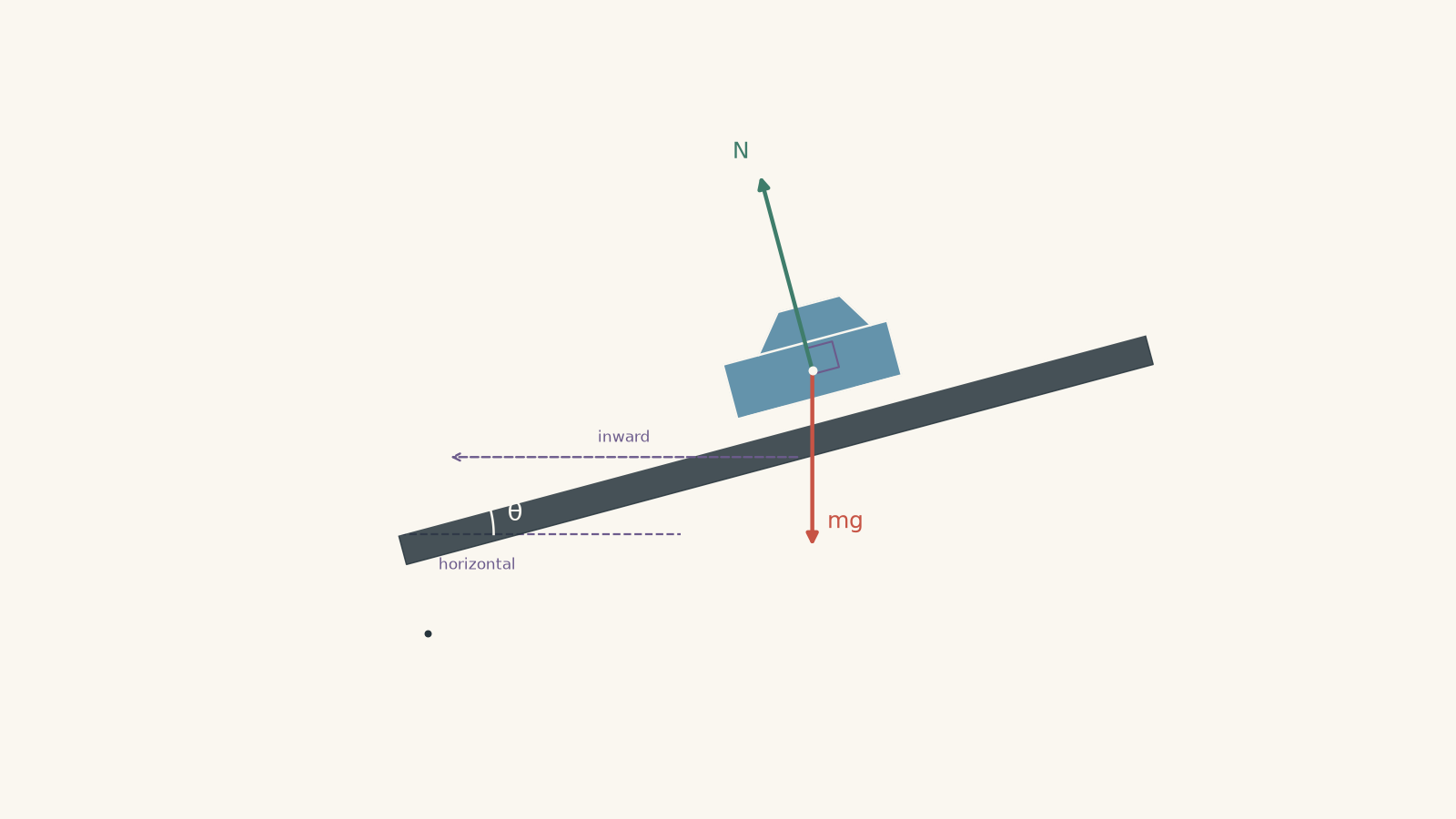
Resolve \(N\) into two components:
- \(N\cos\theta\) acts vertically upwards.
- \(N\sin\theta\) acts horizontally towards the centre of the circular path.
This second component is what can produce the required centripetal acceleration.
That wording matters. There is no separate force called “centripetal force” that appears in addition to \(N\). Centripetal force describes the net inward force required for circular motion. If that distinction is shaky, review how to identify the real force providing centripetal force.
02Building the design-speed equation
Suppose the car moves around a horizontal circle of radius \(r\), with no sideways friction.
Its vertical acceleration is zero, so the vertical forces must balance:
\[ N\cos\theta = mg \]
where:
- \(N\) is the normal force in newtons,
- \(\theta\) is the banking angle,
- \(m\) is the mass of the car in kilograms, and
- \(g\) is gravitational acceleration, approximately \(9.8\ \text{m s}^{-2}\).
Horizontally, the car needs an inward acceleration of
\[ a_c=\frac{v^2}{r} \]
so the required net inward force is
\[ F_c=\frac{mv^2}{r}. \]
The inward component of the normal force supplies this:
\[ N\sin\theta=\frac{mv^2}{r}. \]
We now have two equations describing the same normal force:
\[ N\cos\theta=mg \]
and
\[ N\sin\theta=\frac{mv^2}{r}. \]
Divide the second equation by the first:
\[ \frac{N\sin\theta}{N\cos\theta} = \frac{mv^2/r}{mg}. \]
The \(N\), \(m\), and several other distractions disappear:
\[ \tan\theta=\frac{v^2}{rg}. \]
Rearranging gives the frictionless design speed:
\[ v=\sqrt{rg\tan\theta}. \]
This is the key banked-track relationship.
Notice that mass has cancelled. A heavier car does not have a different ideal speed simply because it is heavier. It needs more centripetal force, but its larger weight also produces a proportionally larger normal force.
Worked example: Find the design speed
A frictionless banked curve has a radius of \(75\ \text{m}\) and is banked at \(12^\circ\). Find the speed at which a car can travel around the curve without relying on friction.
Step 1
\[ v=\sqrt{rg\tan\theta} \]
Here, \(r=75\ \text{m}\), \(g=9.8\ \text{m s}^{-2}\), and \(\theta=12^\circ\).
Step 2
\[ v = \sqrt{(75)(9.8)\tan12^\circ} = \sqrt{156.23} = 12.5\ \text{m s}^{-1}. \]
Step 3
The frictionless design speed is
\[ v=12.5\ \text{m s}^{-1}, \]
which is about \(45.0\ \text{km/h}\).
At this speed, the normal force has exactly the vertical component needed to balance weight and exactly the horizontal component needed for circular motion.
03Why there is only one frictionless speed
A tempting prediction is that any speed below the design speed should also work. After all, a slower car needs less centripetal force.
The problem is that the bank fixes the direction of the normal force.
The ratio of its inward component to its vertical component is
\[ \frac{N\sin\theta}{N\cos\theta}=\tan\theta. \]
That ratio cannot change unless the banking angle changes.
For a horizontal circular path, however, the required ratio is
\[ \frac{mv^2/r}{mg} = \frac{v^2}{rg}. \]
So the geometry of the road demands one ratio, while the car’s speed and radius demand another. They match only when
\[ \tan\theta=\frac{v^2}{rg}. \]
This is why the design speed is not merely a convenient speed. In the ideal frictionless model, it is the unique speed that allows that radius and banking angle to produce a horizontal circular path.
Worked example: Design the banking angle
A \(1200\ \text{kg}\) car must travel at \(14.0\ \text{m s}^{-1}\) around a curve of radius \(50.0\ \text{m}\) without relying on friction. Find the required banking angle and the normal force.
Step 1
Start with
\[ \tan\theta=\frac{v^2}{rg}. \]
Substitute:
\[ \tan\theta = \frac{(14.0)^2}{(50.0)(9.8)} = \frac{196}{490} = 0.400. \]
Therefore,
\[ \theta=\tan^{-1}(0.400)=21.8^\circ. \]
Step 2
\[ N\cos\theta=mg \]
so
\[ N = \frac{mg}{\cos\theta} = \frac{(1200)(9.8)}{\cos21.8^\circ} = 1.27\times10^4\ \text{N}. \]
Step 3
The required centripetal force is
\[ \frac{mv^2}{r} = \frac{(1200)(14.0)^2}{50.0} = 4704\ \text{N}. \]
The horizontal component of the calculated normal force is
\[ N\sin21.8^\circ \approx (1.27\times10^4)\sin21.8^\circ \approx 4.70\times10^3\ \text{N}. \]
The values agree.
Step 4
The normal force is greater than the weight \(mg=11760\ \text{N}\). It has to do two jobs at once: its vertical component supports the car, while its horizontal component accelerates the car towards the centre.
04What changes when the speed is wrong?
Real roads and tracks have friction, so cars are not restricted to one exact speed.
But before adding equations, predict the direction of friction.
Suppose the car is travelling more slowly than the frictionless design speed. Does friction point further inward or further outward?
At low speed, the car tends to move down the slope, towards the lower and inner side of the bank. Friction therefore acts up the slope, towards the higher and outer side.
At high speed, the opposite happens. The available inward effect from the frictionless normal-force geometry is not sufficient for the curvature required at that speed, so the car tends to move towards the outer, higher side. Friction acts down the slope, adding an inward component.
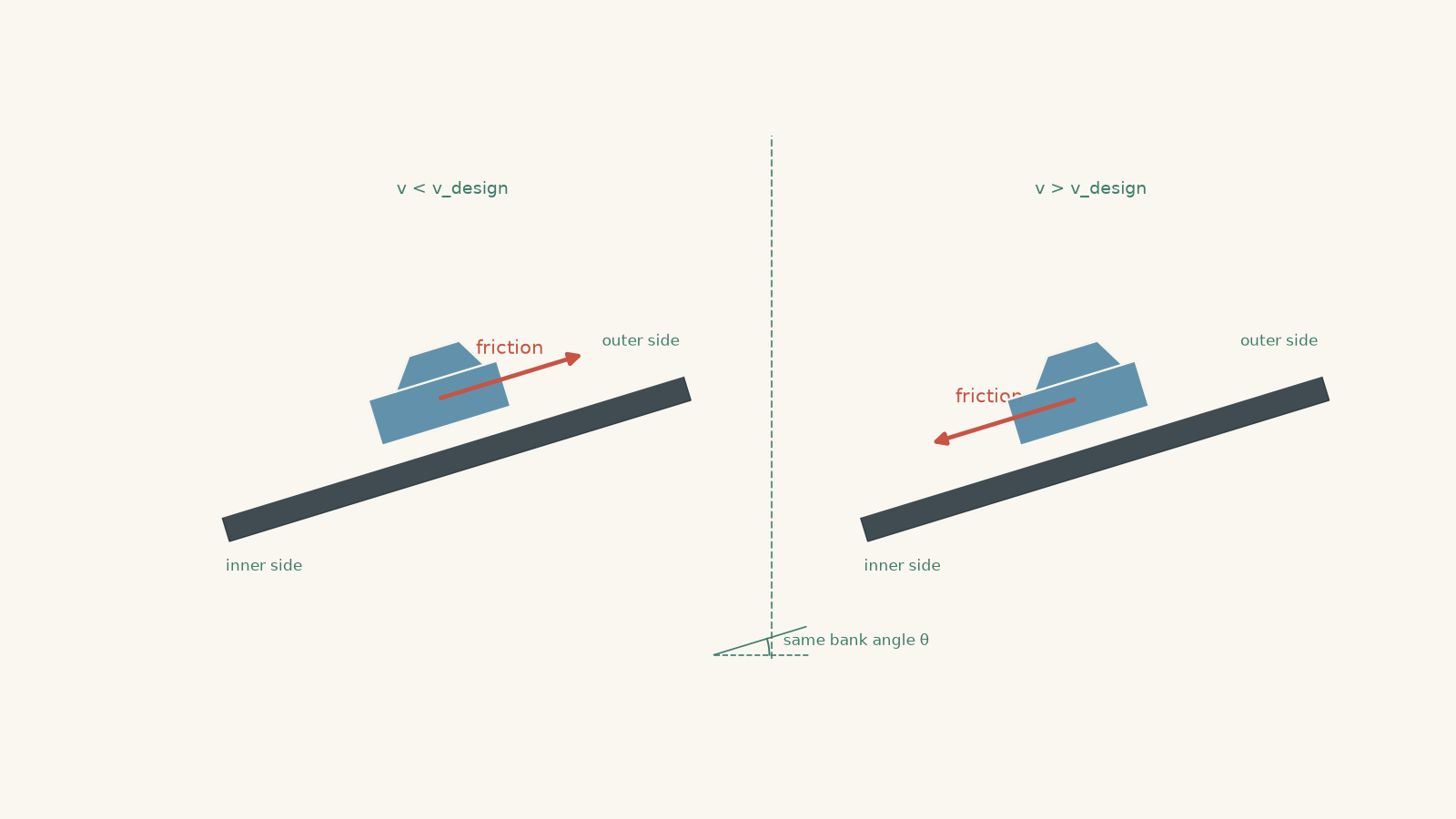
The three cases are:
| Speed | Sideways tendency relative to the bank | Direction of friction |
|---|---|---|
| \(v<v_{\text{design}}\) | Down the bank, towards the inside | Up the bank |
| \(v=v_{\text{design}}\) | No sideways tendency | Zero friction required |
| \(v>v_{\text{design}}\) | Up the bank, towards the outside | Down the bank |
Be careful with the language in the high-speed case. There is no mysterious real “outward force” acting on the car in an inertial frame. The car’s velocity wants to continue more nearly along a tangent unless enough inward force bends its path.
There is another important trap here: friction is not automatically \(f=\mu N\).
Static friction adjusts to whatever value is required, up to its maximum:
\[ f\leq\mu_sN. \]
Only when the tyres are just about to slip sideways can you set
\[ f=\mu_sN, \]
where \(\mu_s\) is the coefficient of static friction.
05Resolving friction on a bank
If the car is below the design speed, friction acts up the slope.
Its components are:
- \(f\cos\theta\) horizontally outward,
- \(f\sin\theta\) vertically upward.
The force equations become
\[ N\sin\theta-f\cos\theta=\frac{mv^2}{r} \]
and
\[ N\cos\theta+f\sin\theta=mg. \]
Above the design speed, friction acts down the slope. The signs reverse:
\[ N\sin\theta+f\cos\theta=\frac{mv^2}{r} \]
and
\[ N\cos\theta-f\sin\theta=mg. \]
You do not need to memorise four signs blindly. Draw the force in the direction that opposes the impending sideways slip, then resolve it.
That approach is much safer in an exam.
06What the ideal model leaves out
The design-speed equation
\[ v=\sqrt{rg\tan\theta} \]
is exact only for the model we built.
It assumes:
- the car follows a horizontal circle of fixed radius,
- there is no sideways friction,
- the road has one definite banking angle,
- the car can be treated as a particle for the force analysis, and
- vertical acceleration is zero.
Real vehicles also have suspension movement, tyre deformation, aerodynamic forces, changing road surfaces, and limits on tyre grip. Those details matter in engineering, but they do not change the central HSC idea: banking redirects the contact force so part of it can provide the required inward acceleration.
07Questions and solutions
Question 1
A curve of radius \(40.0\ \text{m}\) is banked at \(10.0^\circ\). Assume no friction.
Calculate the design speed.
Solution 1
The design speed is \(8.31\ \text{m s}^{-1}\), or about \(29.9\ \text{km/h}\).
For a frictionless banked curve,
\[ v=\sqrt{rg\tan\theta}. \]
Substituting \(r=40.0\ \text{m}\), \(g=9.8\ \text{m s}^{-2}\), and \(\theta=10.0^\circ\),
\[ v = \sqrt{(40.0)(9.8)\tan10.0^\circ} = \sqrt{69.1} = 8.31\ \text{m s}^{-1}. \]
The tempting mistake is to use \(mg\tan\theta\) as the speed expression because weight appears in the force diagram. Mass cancels when the vertical and horizontal equations are divided, so the design speed depends only on \(r\), \(g\), and \(\theta\).
Question 2
A \(950\ \text{kg}\) car moves around a frictionless banked curve of radius \(90.0\ \text{m}\). A force sensor indicates that the road exerts a normal force of \(9.92\ \text{kN}\) on the car.
Determine:
a. the banking angle, and
b. the speed of the car.
Solution 2
The banking angle is approximately \(20.2^\circ\), and the car’s speed is approximately \(18.0\ \text{m s}^{-1}\).
First use the vertical force balance. The car has no vertical acceleration, so
\[ N\cos\theta=mg. \]
Here,
\[ N=9.92\ \text{kN}=9920\ \text{N} \]
and
\[ mg=(950)(9.8)=9310\ \text{N}. \]
Therefore,
\[ \cos\theta = \frac{9310}{9920} = 0.9385, \]
so
\[ \theta=\cos^{-1}(0.9385)\approx20.2^\circ. \]
Now use the banked-track relationship:
\[ \tan\theta=\frac{v^2}{rg}. \]
Hence,
\[ v = \sqrt{rg\tan\theta} = \sqrt{(90.0)(9.8)\tan20.2^\circ} \approx 18.0\ \text{m s}^{-1}. \]
A tempting route is to assume \(N=mg\). That is true on a level surface with no other vertical-force geometry, but not here. The normal force must have both vertical and horizontal components, so its magnitude is larger than \(mg\).
Question 3
A \(1000\ \text{kg}\) car travels around a curve of radius \(70.0\ \text{m}\) banked at \(16.0^\circ\).
The car travels at \(75\%\) of the frictionless design speed but still follows the same horizontal circular path.
Determine:
a. the frictionless design speed,
b. the direction of the friction force, and
c. the minimum coefficient of static friction required.
Solution 3
The design speed is \(14.0\ \text{m s}^{-1}\), friction acts up the bank, and the minimum coefficient of static friction is approximately \(0.120\).
First find the design speed:
\[ v_d = \sqrt{rg\tan\theta} = \sqrt{(70.0)(9.8)\tan16.0^\circ} = 14.0\ \text{m s}^{-1}. \]
The actual speed is
\[ v=0.75v_d=(0.75)(14.0)=10.5\ \text{m s}^{-1}. \]
Because the car is travelling below the design speed, it would tend to slide down the bank. Static friction must therefore act up the bank.
Let \(f\) be the required friction force.
For friction acting up the slope,
\[ N\sin\theta-f\cos\theta=\frac{mv^2}{r} \]
and
\[ N\cos\theta+f\sin\theta=mg. \]
The required inward force is
\[ \frac{mv^2}{r} = \frac{(1000)(10.5)^2}{70.0} \approx 1.58\times10^3\ \text{N}. \]
Resolving the required resultant force along directions perpendicular and parallel to the bank gives
\[ N = \left(\frac{mv^2}{r}\right)\sin\theta + mg\cos\theta \approx 9.86\times10^3\ \text{N}, \]
and
\[ f = mg\sin\theta - \left(\frac{mv^2}{r}\right)\cos\theta \approx 1.18\times10^3\ \text{N}. \]
At the limiting value,
\[ f=\mu_sN. \]
Therefore,
\[ \mu_s = \frac{f}{N} = \frac{1.18\times10^3}{9.86\times10^3} \approx 0.120. \]
The subtle point is the direction. It is tempting to say that friction must point inward because circular motion requires an inward force. At this low speed, however, the banked normal force already provides too much inward component relative to what is required while supporting the car vertically. Friction points up the slope, giving an outward component that reduces the net inward force.
Question 4
A track has two concentric lanes with the same banking angle of \(20.0^\circ\).
The inner lane has radius \(50.0\ \text{m}\), and the outer lane has radius \(80.0\ \text{m}\).
Car A travels in the inner lane at its frictionless design speed. Car B travels in the outer lane and completes each revolution in exactly the same time as Car A.
a. Find Car A’s speed and lap time.
b. Find Car B’s speed.
c. Find the frictionless design speed for the outer lane.
d. Decide whether Car B can be frictionless, and determine the direction friction would need to act.
e. Show generally why two different radii with the same bank angle cannot both be frictionless if the cars also have the same lap time.
Solution 4
Car B cannot be frictionless. It is travelling faster than the outer lane’s design speed, so friction must act down the bank.
For Car A,
\[ v_A = \sqrt{r_1g\tan\theta} = \sqrt{(50.0)(9.8)\tan20.0^\circ} = 13.35\ \text{m s}^{-1}. \]
The circumference of the inner path is \(2\pi r_1\), so its period is
\[ T = \frac{2\pi r_1}{v_A} = \frac{2\pi(50.0)}{13.35} = 23.5\ \text{s}. \]
Car B has the same period but a larger radius. Its speed is therefore
\[ v_B = \frac{2\pi r_2}{T} = \frac{2\pi(80.0)}{23.5} = 21.4\ \text{m s}^{-1}. \]
The frictionless design speed at \(80.0\ \text{m}\) is
\[ v_{d,2} = \sqrt{(80.0)(9.8)\tan20.0^\circ} = 16.9\ \text{m s}^{-1}. \]
Since
\[ 21.4\ \text{m s}^{-1}>16.9\ \text{m s}^{-1}, \]
Car B is above its design speed. It tends to move towards the higher, outer side of the bank, so friction must act down the slope.
The deeper reason appears if we compare the scaling laws.
At one fixed bank angle,
\[ v_d=\sqrt{rg\tan\theta}, \]
so
\[ v_d\propto\sqrt r. \]
But if two cars have the same period,
\[ v=\frac{2\pi r}{T}, \]
so
\[ v\propto r. \]
Linear speed therefore increases with radius faster than the frictionless design speed does.
More formally, because Car A is at its design speed,
\[ v_A^2=r_1g\tan\theta. \]
Equal periods require
\[ \frac{v_B}{v_A}=\frac{r_2}{r_1}. \]
Meanwhile,
\[ \frac{v_{d,2}}{v_A} = \sqrt{\frac{r_2}{r_1}}. \]
Therefore,
\[ \frac{v_B}{v_{d,2}} = \sqrt{\frac{r_2}{r_1}}. \]
For any \(r_2>r_1\), this ratio exceeds \(1\).
The tempting assumption is that one banking angle corresponds to one lap time. It does not. The bank fixes the relationship between linear speed and radius, while equal lap times impose a different relationship. Those two constraints are incompatible at two different radii.
Question 5
A curve of radius \(60.0\ \text{m}\) is banked at \(15.0^\circ\). The coefficient of static friction between the tyres and road is \(0.300\).
A student argues:
“A banked curve with friction must always have both a minimum and a maximum speed.”
Investigate the claim.
a. Determine whether a stationary car can remain at rest on this bank without sliding.
b. Hence determine the true minimum allowable speed.
c. Calculate the maximum speed before the car begins to slide up the bank.
d. Explain why attempting to calculate a positive lower limiting speed can produce an apparently impossible negative value for \(v^2\).
Solution 5
The student’s claim is false for this curve: the minimum speed is \(0\), while the maximum speed is approximately \(19.1\ \text{m s}^{-1}\).
Start with the boundary case \(v=0\). This is the part that is easy to overlook.
If the car is stationary, gravity tends to make it slide down the bank. Static friction therefore acts up the bank.
Resolving forces perpendicular to the slope gives
\[ N=mg\cos\theta. \]
The friction required along the slope is
\[ f=mg\sin\theta. \]
Therefore the required friction ratio is
\[ \frac{f}{N} = \frac{mg\sin\theta}{mg\cos\theta} = \tan\theta. \]
For \(\theta=15.0^\circ\),
\[ \tan15.0^\circ=0.268. \]
The available coefficient is
\[ \mu_s=0.300. \]
Because
\[ 0.268<0.300, \]
static friction is strong enough to hold the car even when its speed is zero.
So the actual minimum speed is
\[ v_{\min}=0. \]
For the maximum speed, the car is about to slip up the bank. Friction therefore acts down the bank at its limiting magnitude
\[ f=\mu_sN. \]
The inward force equation is
\[ N\sin\theta+\mu_sN\cos\theta = \frac{mv^2}{r}, \]
while vertical equilibrium gives
\[ N\cos\theta-\mu_sN\sin\theta=mg. \]
Divide the first equation by the second:
\[ \frac{v^2}{rg} = \frac{\sin\theta+\mu_s\cos\theta} {\cos\theta-\mu_s\sin\theta}. \]
Therefore,
\[ v = \sqrt{ rg \left( \frac{\sin\theta+\mu_s\cos\theta} {\cos\theta-\mu_s\sin\theta} \right) }. \]
Substituting \(r=60.0\ \text{m}\), \(g=9.8\ \text{m s}^{-2}\), \(\theta=15.0^\circ\), and \(\mu_s=0.300\),
\[ v = \sqrt{ (60.0)(9.8) \left( \frac{\sin15.0^\circ+(0.300)\cos15.0^\circ} {\cos15.0^\circ-(0.300)\sin15.0^\circ} \right) } \]
\[ v\approx19.1\ \text{m s}^{-1}. \]
So
\[ v_{\max}\approx19.1\ \text{m s}^{-1}, \]
or about \(68.6\ \text{km/h}\).
Now for the strange part.
If you assume there must be a lower limiting speed where friction has already reached its maximum value up the slope, the equations lead to
\[ \frac{v_{\min}^2}{rg} = \frac{\sin\theta-\mu_s\cos\theta} {\cos\theta+\mu_s\sin\theta}. \]
Here,
\[ \sin15.0^\circ-(0.300)\cos15.0^\circ<0. \]
That would give \(v_{\min}^2<0\), which no real speed can satisfy.
The negative result is not a maths failure. It is evidence that the assumed physical situation does not exist.
The derivation assumed that, at the lower speed limit, friction had reached its maximum possible value. But at \(v=0\), the car only requires
\[ \frac{f}{N}=\tan15.0^\circ=0.268, \]
which is less than the available \(0.300\).
Static friction does not have to use its maximum value. It simply adjusts to the smaller value required. There is therefore no positive lower-speed boundary.
That is the useful hinge in the problem: a mathematically strange result can reveal that one of the physical assumptions used to construct the equation was wrong.
08What banked tracks connect to next
Banked curves bring three ideas together: force components, circular acceleration, and the relationship between speed and radius. Once the force picture is secure, changes in radius or lap time become much easier to analyse because you can combine
\[ a_c=\frac{v^2}{r} \]
with the appropriate contact forces instead of searching for a new formula each time.
The next useful step is to connect this force analysis with speed, radius, and period in uniform circular motion. That lets you move between a track’s geometry, its design speed, and the time taken to complete a lap.