
Specific Heat Capacity: Using Q = mcΔT in HSC Physics
Learn how specific heat capacity controls temperature change, how to use Q = mcΔT, and how to compare the thermal response of different materials.
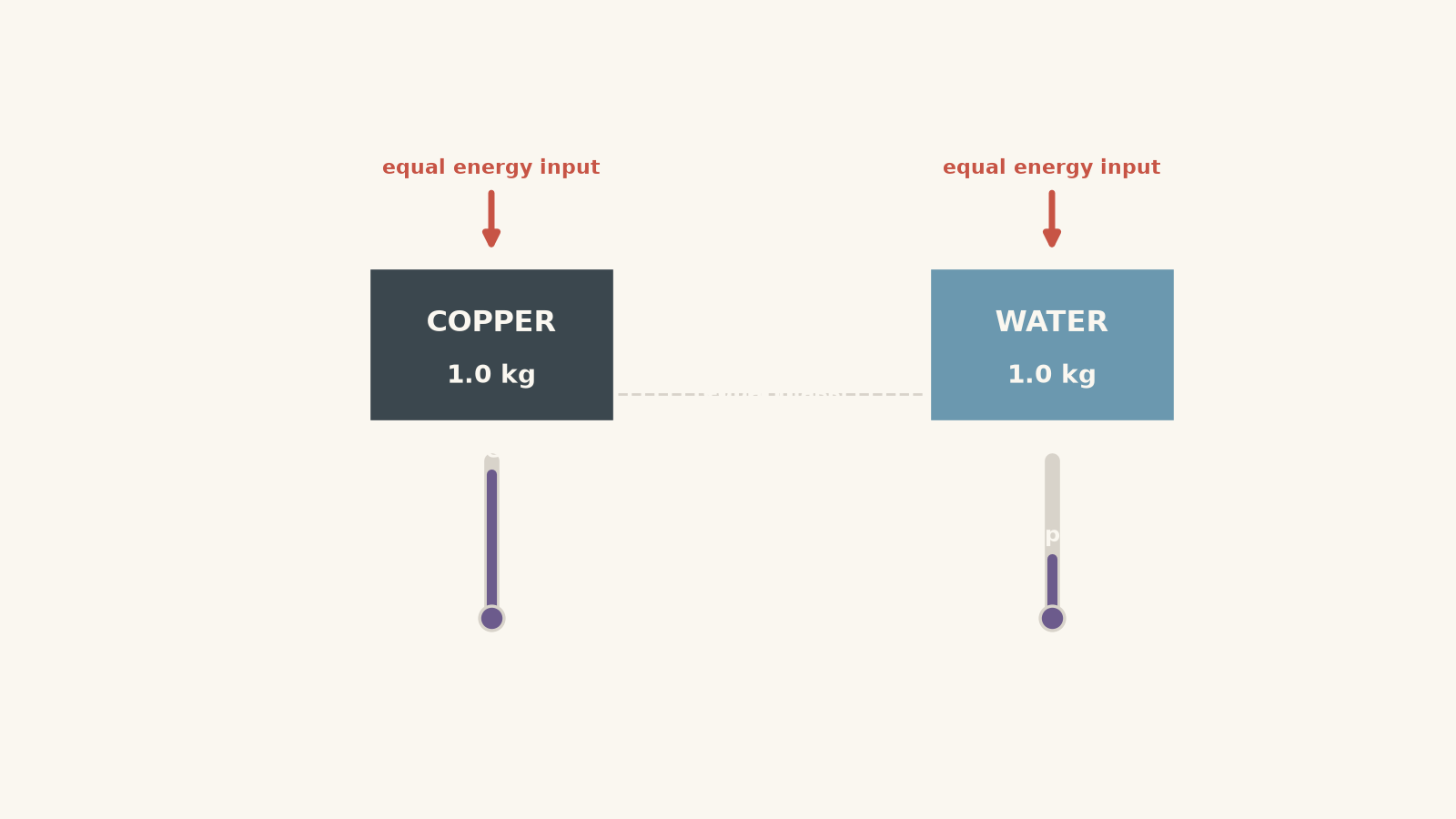
Put 500 g of copper and 500 g of water on identical heaters. Give each exactly the same amount of energy. Which one has the larger temperature rise?
It is tempting to think, “Same mass, same energy, so same temperature change.” But copper gets much hotter. The missing idea is that different materials need different amounts of energy to change temperature.
That difference is described by specific heat capacity.
01Start with the energy, not the formula
Imagine supplying 1000 J of thermal energy to a material. That energy increases the material’s internal energy. Usually, its temperature rises as a result.
But the size of the temperature rise depends on two things before we even worry about the type of material:
- how much material there is
- how much energy each kilogram needs for a \(1^\circ\text{C}\) temperature change
A large saucepan of water is harder to heat than a spoonful of water because there is more mass. But even when the masses are equal, different substances respond differently.
For example, approximate specific heat capacities are:
| Material | Specific heat capacity, \(c\) |
|---|---|
| Water | \(4180\ \text{J kg}^{-1}\,^\circ\text{C}^{-1}\) |
| Aluminium | \(900\ \text{J kg}^{-1}\,^\circ\text{C}^{-1}\) |
| Copper | \(390\ \text{J kg}^{-1}\,^\circ\text{C}^{-1}\) |
Water needs far more energy than copper to produce the same temperature change in the same mass.
Here is a useful way to picture that. Suppose each kilogram of material has to “pay” energy for every degree its temperature rises. Copper is fairly cheap. Water is expensive. Give both the same energy budget, and copper can afford a much larger temperature increase.
That picture is useful, but it is only an analogy. A material is not literally spending energy in fixed packets. Specific heat capacity describes how changes in internal energy relate to temperature under particular conditions.
02The equation \(Q = mc\Delta T\)
For heating or cooling without a change of state, the relationship is
\[
Q = mc\Delta T
\]
where:
- \(Q\) is the thermal energy transferred, in joules (J)
- \(m\) is the mass, in kilograms (kg)
- \(c\) is the specific heat capacity, in \(\text{J kg}^{-1}\,^\circ\text{C}^{-1}\)
- \(\Delta T\) is the temperature change, in degrees Celsius (\(^\circ\text{C}\))
The temperature change is
\[
\Delta T = T_{\text{final}} – T_{\text{initial}}
\]
A temperature difference of \(1^\circ\text{C}\) has the same size as a temperature difference of \(1\text{ K}\), so specific heat capacity can also be written in \(\text{J kg}^{-1}\text{K}^{-1}\).
What does \(c\) actually mean?
Suppose a substance has
\[
c = 900\ \text{J kg}^{-1}\,^\circ\text{C}^{-1}
\]
This means that approximately 900 J of energy is required to raise the temperature of 1 kg of that substance by \(1^\circ\text{C}\).
So for 1 kg:
- a \(1^\circ\text{C}\) rise requires 900 J
- a \(2^\circ\text{C}\) rise requires 1800 J
- a \(10^\circ\text{C}\) rise requires 9000 J
If you double the mass as well, you double the required energy again.
That is why \(m\), \(c\), and \(\Delta T\) are multiplied in \(Q = mc\Delta T\).
03Predicting which material heats up more
Rearrange the equation to make temperature change the subject:
\[
\Delta T = \frac{Q}{mc}
\]
Now imagine equal masses of copper and water receive the same energy.
Which quantity differs? Only \(c\).
Because \(c\) is in the denominator, a larger specific heat capacity gives a smaller temperature change.
So:
- low \(c\) means temperature changes relatively easily
- high \(c\) means more energy is needed for the same temperature change
This gives a quick comparison rule.
| Situation | Effect on \(\Delta T\) |
|---|---|
| Larger \(Q\) | Larger temperature change |
| Larger \(m\) | Smaller temperature change |
| Larger \(c\) | Smaller temperature change |
These comparisons assume the other quantities are unchanged.
Worked example: How much does aluminium warm up?
A \(0.50\ \text{kg}\) aluminium block receives \(18\,000\ \text{J}\) of thermal energy. Aluminium has a specific heat capacity of \(900\ \text{J kg}^{-1}\,^\circ\text{C}^{-1}\). Calculate its temperature increase.
Step 1
\[
Q = mc\Delta T
\]
We need \(\Delta T\), so rearrange:
\[
\Delta T = \frac{Q}{mc}
\]
Step 2
\[
\Delta T
= \frac{18\,000}{(0.50)(900)}
= \frac{18\,000}{450}
= 40^\circ\text{C}
\]
Step 3
The aluminium block’s temperature rises by
\[
\boxed{40^\circ\text{C}}
\]
Notice that this is a temperature change, not a final temperature. If the block started at \(22^\circ\text{C}\), its final temperature would be \(62^\circ\text{C}\).
04Comparing two materials directly
You do not always need to calculate both temperatures from scratch.
Suppose two objects receive the same thermal energy \(Q\) and have equal mass \(m\). Then
\[
\Delta T = \frac{Q}{mc}
\]
For those conditions, \(Q\) and \(m\) are the same for both objects. Therefore,
\[
\Delta T \propto \frac{1}{c}
\]
Temperature change is inversely proportional to specific heat capacity.
If one substance has twice the specific heat capacity of another, its temperature change will be half as large, provided the masses and energy transfers are equal.
Worked example: Copper versus water
A \(0.20\ \text{kg}\) copper sample and a \(0.20\ \text{kg}\) water sample each receive \(8.0\ \text{kJ}\) of thermal energy.
Use:
\[
c_{\text{copper}} = 390\ \text{J kg}^{-1}\,^\circ\text{C}^{-1}
\]
and
\[
c_{\text{water}} = 4180\ \text{J kg}^{-1}\,^\circ\text{C}^{-1}
\]
Calculate the temperature rise of each sample and compare their responses.
Step 1
\[
8.0\ \text{kJ} = 8000\ \text{J}
\]
Step 2
\[
\Delta T_{\text{Cu}}
= \frac{Q}{mc}
= \frac{8000}{(0.20)(390)}
= \frac{8000}{78}
\approx 103^\circ\text{C}
\]
Step 3
\[
\Delta T_{\text{water}}
= \frac{8000}{(0.20)(4180)}
= \frac{8000}{836}
\approx 9.57^\circ\text{C}
\]
Step 4
The same \(8000\ \text{J}\) causes approximately
\[
\boxed{\Delta T_{\text{Cu}} = 103^\circ\text{C}}
\]
and
\[
\boxed{\Delta T_{\text{water}} = 9.57^\circ\text{C}}
\]
Copper’s temperature changes far more because its specific heat capacity is much lower.
The calculation assumes that the supplied energy goes into changing the samples’ temperatures. In a real experiment, some energy could also heat the container and surroundings.
05A useful rearrangement for comparisons
Sometimes the question asks how much energy is needed rather than how much the temperature changes.
Then use the original form:
\[
Q = mc\Delta T
\]
Suppose two equal masses must undergo the same temperature rise. The material with the larger \(c\) needs more energy.
For example, because water’s specific heat capacity is more than ten times that of copper, heating equal masses of water and copper through the same temperature interval requires much more energy for the water.
The same relationship works for cooling. If an object loses thermal energy, its temperature falls. Using the sign convention
\[
\Delta T = T_{\text{final}} – T_{\text{initial}}
\]
a cooling object has \(\Delta T < 0\), so \(Q\) is also negative if energy gained by the object is defined as positive.
In many HSC calculations, you may instead work with the magnitude of the energy transferred and state separately that the energy was lost.
06The misconception: high specific heat capacity does not mean “hotter”
A common mistake is to read “high specific heat capacity” as “gets very hot”.
It means almost the opposite under equal heating conditions.
A substance with a high \(c\) needs more energy per kilogram for each degree of temperature change. If equal masses receive equal energy, the high-\(c\) substance has the smaller temperature rise.
Another tempting mistake is to confuse specific heat capacity with thermal conductivity.
They answer different questions:
- specific heat capacity tells you how much energy is associated with a temperature change
- thermal conductivity tells you how readily thermal energy is transferred through a material
A metal object can feel colder than a wooden object at the same temperature because metal transfers energy away from your hand more rapidly. That sensation alone does not tell you which material has the larger specific heat capacity.
07When \(Q = mc\Delta T\) is not enough
The equation is extremely useful, but it has limits.
It works straightforwardly when:
- the material remains in the same state
- its specific heat capacity can be treated as constant over the temperature range
- \(Q\) represents the thermal energy associated with the material’s temperature change
It is not the right equation by itself during a phase change.
For example, while ice is melting at its melting point, energy can enter without producing the temperature rise that \(Q = mc\Delta T\) would predict. That energy is involved in changing the state instead.
This is an important clue in harder problems: before using \(Q = mc\Delta T\), check that there actually is a temperature change within one state of matter.
08Questions and solutions
Question 1
A \(0.30\ \text{kg}\) glass object has a specific heat capacity of \(840\ \text{J kg}^{-1}\,^\circ\text{C}^{-1}\). It is heated from \(20^\circ\text{C}\) to \(45^\circ\text{C}\).
Calculate the thermal energy transferred to the glass.
Solution 1
The glass gains
\[
\boxed{6.3\times10^3\ \text{J}}
\]
of thermal energy.
The temperature change is
\[
\Delta T = 45 – 20 = 25^\circ\text{C}
\]
Using
\[
Q = mc\Delta T
\]
gives
\[
\begin{aligned}
Q &= (0.30)(840)(25)\\
&= 6300\ \text{J}
\end{aligned}
\]
So
\[
\boxed{Q = 6.3\ \text{kJ}}
\]
The energy is positive because the glass gains thermal energy and its temperature increases.
Question 2
Two \(0.40\ \text{kg}\) blocks receive the same \(12\,000\ \text{J}\) of energy.
Block A has \(c = 500\ \text{J kg}^{-1}\,^\circ\text{C}^{-1}\).
Block B has \(c = 1500\ \text{J kg}^{-1}\,^\circ\text{C}^{-1}\).
Without calculating both temperature changes first, predict which block has the larger temperature rise. Then calculate both rises.
Solution 2
Block A has the larger temperature rise because it has the smaller specific heat capacity.
For equal \(Q\) and equal \(m\),
\[
\Delta T = \frac{Q}{mc}
\]
so a larger \(c\) produces a smaller \(\Delta T\).
For Block A:
\[
\begin{aligned}
\Delta T_A
&= \frac{12\,000}{(0.40)(500)}\\
&= \frac{12\,000}{200}\\
&= 60^\circ\text{C}
\end{aligned}
\]
For Block B:
\[
\begin{aligned}
\Delta T_B
&= \frac{12\,000}{(0.40)(1500)}\\
&= \frac{12\,000}{600}\\
&= 20^\circ\text{C}
\end{aligned}
\]
Therefore,
\[
\boxed{\Delta T_A = 60^\circ\text{C},\qquad \Delta T_B = 20^\circ\text{C}}
\]
Block B has three times the specific heat capacity, so under these equal-mass, equal-energy conditions its temperature rise is one-third as large.
Question 3
A \(250\ \text{g}\) metal sample receives \(5.4\ \text{kJ}\) of energy and warms from \(18^\circ\text{C}\) to \(42^\circ\text{C}\).
Calculate its specific heat capacity.
Solution 3
The metal’s specific heat capacity is
\[
\boxed{900\ \text{J kg}^{-1}\,^\circ\text{C}^{-1}}
\]
First convert the mass and energy:
\[
250\ \text{g} = 0.250\ \text{kg}
\]
\[
5.4\ \text{kJ} = 5400\ \text{J}
\]
The temperature change is
\[
\Delta T = 42 – 18 = 24^\circ\text{C}
\]
Rearrange
\[
Q = mc\Delta T
\]
to give
\[
c = \frac{Q}{m\Delta T}
\]
Then
\[
\begin{aligned}
c
&= \frac{5400}{(0.250)(24)}\\
&= \frac{5400}{6.00}\\
&= 900\ \text{J kg}^{-1}\,^\circ\text{C}^{-1}
\end{aligned}
\]
The result means that approximately \(900\ \text{J}\) is required to increase the temperature of \(1\ \text{kg}\) of the metal by \(1^\circ\text{C}\).
Question 4
Sample X has twice the mass of Sample Y. Both are made from the same material and receive the same amount of thermal energy.
A student claims, “They are the same material, so they must have the same temperature rise.”
Is the student correct? Determine the relationship between their temperature changes.
Solution 4
The student is incorrect. Sample X has half the temperature rise of Sample Y.
Both samples have the same specific heat capacity \(c\), and both receive the same energy \(Q\). However, their masses are different.
Using
\[
\Delta T = \frac{Q}{mc}
\]
Sample X has
\[
m_X = 2m_Y
\]
so
\[
\Delta T_X
= \frac{Q}{(2m_Y)c}
= \frac{1}{2}\frac{Q}{m_Yc}
\]
Therefore,
\[
\boxed{\Delta T_X = \frac{1}{2}\Delta T_Y}
\]
The trap is focusing only on the material. Specific heat capacity is a property of the material, but the object’s total response also depends on its mass.
Question 5
Two objects start at the same temperature.
Object P has mass \(m\) and specific heat capacity \(c\).
Object R has mass \(2m\) and specific heat capacity \(\frac{c}{2}\).
Each object receives the same amount of thermal energy. A student predicts that R will warm less because it has twice the mass.
Determine which object has the larger temperature rise, or whether the rises are equal.
Solution 5
The two objects have the same temperature rise.
The relevant quantity is not mass by itself. It is the product \(mc\).
For P:
\[
m_Pc_P = mc
\]
For R:
\[
m_Rc_R = (2m)\left(\frac{c}{2}\right) = mc
\]
Using
\[
\Delta T = \frac{Q}{mc}
\]
both objects therefore have
\[
\boxed{\Delta T_P = \Delta T_R}
\]
The student’s reasoning notices the larger mass but misses the smaller specific heat capacity. Those two changes exactly cancel.
This is why comparison questions are safest when you examine the whole denominator, \(mc\), rather than deciding from mass or specific heat capacity alone.
Question 6
A heater transfers energy to a \(0.50\ \text{kg}\) substance. For the first few minutes, the substance’s temperature rises steadily. Later, energy continues to enter, but its measured temperature remains constant for a period.
A student continues using \(Q = mc\Delta T\) for that constant-temperature interval and concludes that no energy entered because \(\Delta T = 0\).
Explain what is wrong with this conclusion.
Solution 6
The conclusion is incorrect because \(Q = mc\Delta T\) does not describe all possible energy transfers.
If the temperature remains constant while energy continues to enter, a likely explanation is that the substance is undergoing a phase change. During that interval, the incoming energy changes the substance’s state rather than increasing its temperature.
Putting \(\Delta T = 0\) into
\[
Q = mc\Delta T
\]
would give \(Q=0\), but that only tells us that no energy is being accounted for as sensible heating through a temperature change. It does not prove that no energy is transferred at all.
The hidden assumption behind \(Q = mc\Delta T\) is that the energy transfer is associated with a temperature change while the material remains in the same phase.
That distinction leads directly to the next useful idea: latent heat. Once both \(Q = mc\Delta T\) and phase-change energy are understood, you can analyse heating curves and multi-stage thermal problems where a substance warms, changes state, and then warms again.