
Cars on Flat Circular Bends: Friction and Centripetal Force
Learn how static friction supplies the centripetal force that turns a car on a flat bend, and how to calculate grip limits and maximum speed.
Imagine a car entering a flat left-hand bend. The driver turns the steering wheel left, but suppose the road suddenly becomes perfectly frictionless. What happens?
A common prediction is that the car still turns a little because the wheels are pointing left. It does not. With no horizontal force from the road, the car keeps moving approximately along the straight-line tangent it already had.
That tells us what really turns a car on a flat road: not the steering wheel by itself, and not a mysterious extra force called “centripetal force”. The road pushes sideways on the tyres through friction. On a steady flat bend, that friction points towards the centre of the circular path.
01What actually turns the car?
Picture the car from above. Its velocity points along the road, tangent to the circle. A moment later, the car’s velocity points in a slightly different direction.
Changing velocity requires acceleration. For circular motion, that acceleration points towards the centre of the circle.
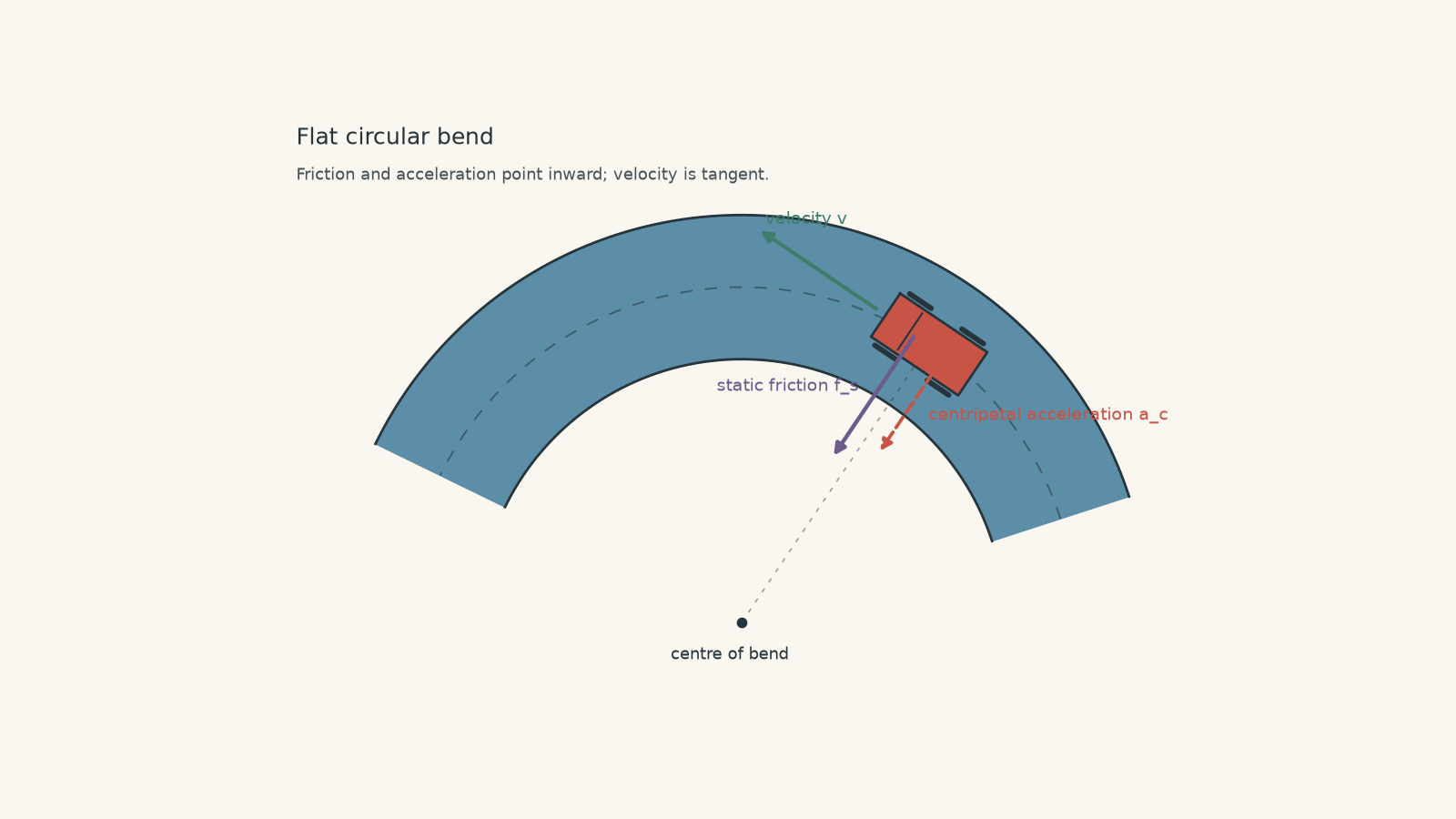
For uniform circular motion,
\[
a_c=\frac{v^2}{r}
\]
where:
- \(a_c\) is the centripetal acceleration in \(\text{m s}^{-2}\),
- \(v\) is the speed in \(\text{m s}^{-1}\), and
- \(r\) is the radius of the circular path in metres.
If you need a refresher on why this acceleration points inward even when the car’s speed is constant, see Centripetal Acceleration: Why It Points Inward in HSC Physics.
Newton’s second law then tells us that there must be a net inward force:
\[
F_{\text{net,inward}}=ma_c=\frac{mv^2}{r}
\]
But this equation does not name a new force. It only tells us how large the net inward force must be.
So what real force supplies it?
On a flat bend at constant speed, it is static friction between the tyres and the road.
\[
f_s=\frac{mv^2}{r}
\]
That is the central idea of this entire topic.
02Why is the friction static?
This can sound wrong at first. The car is moving, so shouldn’t the friction be kinetic?
Look closely at the contact between a rolling tyre and the road. If the tyre rolls without skidding, the small patch of rubber touching the road is momentarily at rest relative to the road.
There is no sliding at that contact point. That makes the friction static.
Static friction does not simply mean “the object is stationary”. It means the two surfaces are not sliding across each other where they touch.
This also explains another common mistake: friction does not always point opposite the car’s velocity.
On a steady bend, the car moves forwards while static friction acts sideways, towards the centre of the bend. Friction is opposing the tyre’s tendency to slip relative to the road, not automatically opposing the car’s overall motion.
A useful picture is a shopping trolley on an absurdly slippery supermarket floor. You can point its wheels wherever you like, but without enough sideways grip from the floor, the trolley does not obediently follow the direction the wheels are pointing. Steering sets up how the tyres interact with the road. The tyre-road force is what actually changes the motion.
The analogy has limits. A real tyre deforms, its contact patch is complicated, and its grip cannot be captured perfectly by a simple rigid-wheel model. For HSC Physics, though, modelling the sideways tyre force as static friction is the useful approximation.
03Friction has a maximum, not a fixed value
Here is probably the most important equation trap in this topic:
\[
f_s=\mu_sN
\]
is not generally true.
The correct relationship is
\[
f_s\leq \mu_sN
\]
where:
- \(f_s\) is the actual static friction force,
- \(\mu_s\) is the coefficient of static friction, and
- \(N\) is the normal force.
Static friction adjusts to whatever value is required, up to a maximum.
Think about a car travelling slowly around a huge bend. It does not need the tyres to use every bit of available grip. Friction supplies only the relatively small inward force required.
As the car travels faster, the required friction increases. Eventually the tyres may reach their maximum available static friction.
That is the point where the simple no-skid model reaches its limit.
04Finding the maximum speed on a flat bend
On a flat road, the car has no vertical acceleration. Its vertical forces balance:
\[
N=mg
\]
where \(m\) is the car’s mass and \(g\) is the gravitational field strength, approximately \(9.8\text{ m s}^{-2}\) near Earth’s surface.
The largest available static friction is therefore
\[
f_{s,\max}=\mu_smg
\]
The required inward force is
\[
f_{\text{required}}=\frac{mv^2}{r}
\]
For the tyres not to slip,
\[
\frac{mv^2}{r}\leq\mu_smg
\]
Cancel \(m\):
\[
\frac{v^2}{r}\leq\mu_sg
\]
At the maximum possible speed without slipping,
\[
v_{\max}=\sqrt{\mu_sgr}
\]
This gives several useful predictions before you touch a calculator.
| Change | Effect in the ideal HSC model |
|---|---|
| Increase \(v\) | Required friction increases as \(v^2\) |
| Increase \(r\) | Required friction decreases |
| Increase \(\mu_s\) | More grip is available |
| Increase \(m\) | Required friction and maximum friction both increase proportionally |
| Double \(\mu_s\) | \(v_{\max}\) increases by a factor of \(\sqrt{2}\), not 2 |
| Double \(r\) | \(v_{\max}\) increases by a factor of \(\sqrt{2}\) |
Notice the strange-looking result for mass. In this simplified model, a heavier car does not have a lower maximum cornering speed just because it is heavier.
A heavier car needs more centripetal force, but the greater normal force also increases the maximum available friction by the same factor. The mass cancels.
Real tyres are more complicated than this simple friction model, so do not turn that HSC result into a universal claim about actual vehicle engineering.
Worked example: Does this car have enough grip?
A \(1200\text{ kg}\) car travels at \(14\text{ m s}^{-1}\) around a flat circular bend of radius \(50\text{ m}\). The coefficient of static friction between the tyres and the road is \(0.55\). Determine the required friction force and whether the car can follow the bend without slipping.
Step 1
\[
a_c=\frac{v^2}{r}
=\frac{14^2}{50}
=3.92\text{ m s}^{-2}
\]
The car therefore needs an inward acceleration of \(3.92\text{ m s}^{-2}\).
Step 2
\[
f_s=ma_c
=(1200)(3.92)
=4704\text{ N}
\]
So the tyres must provide \(4.70\times10^3\text{ N}\) of static friction towards the centre.
Step 3
Because the road is flat,
\[
N=mg
\]
so
\[
f_{s,\max}=\mu_smg
=(0.55)(1200)(9.8)
=6468\text{ N}
\]
Step 4
\[
4704\text{ N}<6468\text{ N}
\]
The required friction is below the maximum available static friction, so the car can follow the bend without slipping according to this model.
The important detail is that the actual friction is \(4704\text{ N}\), not \(6468\text{ N}\). The larger number is only the maximum the road could provide before static friction fails.
Worked example: Find the maximum speed on a wet bend
A flat bend has a radius of \(75\text{ m}\). The coefficient of static friction is \(0.80\) on a dry road but falls to \(0.36\) when the road is wet. Find the maximum speed without slipping in each case.
Step 1
\[
v_{\max}=\sqrt{\mu_sgr}
\]
Step 2
\[
v_{\max}
=\sqrt{(0.80)(9.8)(75)}
=\sqrt{588}
=24.2\text{ m s}^{-1}
\]
Converting to kilometres per hour,
\[
24.2\times3.6=87.3\text{ km h}^{-1}
\]
Step 3
\[
v_{\max}
=\sqrt{(0.36)(9.8)(75)}
=\sqrt{264.6}
=16.3\text{ m s}^{-1}
\]
Therefore,
\[
16.3\times3.6=58.6\text{ km h}^{-1}
\]
The model predicts maximum speeds of about \(87\text{ km h}^{-1}\) when dry and \(59\text{ km h}^{-1}\) when wet.
Notice that the coefficient of friction fell from \(0.80\) to \(0.36\), a reduction of \(55\%\), but the maximum speed did not fall by \(55\%\). Speed depends on the square root of \(\mu_s\).
05There is no separate “centripetal force”
Suppose you draw a force diagram for the car and include these arrows:
- weight downward,
- normal force upward,
- friction inward, and
- “centripetal force” inward.
You have counted the inward force twice.
“Centripetal” describes what the net force is doing. It does not usually name an extra physical interaction.
For this flat, constant-speed bend,
\[
F_{\text{centripetal}}=f_s
\]
The same logic applies in other circular-motion problems, but the real force can change. Gravity might supply the centripetal force for an orbit. Tension might supply it for a ball moving in a circle on a string.
The useful question is always:
Which real force, or combination of real forces, points towards the centre?
That approach is developed further in Centripetal Force: How to Identify the Real Force in HSC Physics.
06What happens if the required friction is too large?
Suppose
\[
\frac{mv^2}{r}>\mu_smg
\]
The road cannot supply the required static friction.
It is tempting to say, “The car experiences an outward force and gets pushed outwards.” That is not the right model.
The problem is a lack of sufficient inward force.
The car’s inertia means it tends to continue approximately along its existing tangent while the road fails to bend its velocity inward quickly enough. Relative to the curved road, the car therefore moves towards the outside of the bend.
There is no need to invent a real outward force in an inertial reference frame.
Once the tyres are actually sliding, the situation also changes. Static friction no longer describes the tyre-road interaction in the same way, and you cannot automatically assume the car continues around the original radius. Simply replacing \(\mu_s\) with a kinetic-friction coefficient in
\[
\frac{mv^2}{r}=\mu mg
\]
and pretending the same circular path continues can give a physically misleading result.
07What if the car is also accelerating or braking?
So far, the car has moved around the bend at constant speed. That makes friction’s job simple: it only needs an inward component.
But suppose the driver accelerates while cornering.
Predict the direction of the friction force. Must it still point exactly towards the centre?
No.
If the driven tyres need a forward friction component to increase the car’s speed, while also needing an inward component to turn it, the total tyre-road friction force points somewhere between forwards and inwards.
Likewise, braking while cornering can require a backwards friction component as well as an inward one.
In the simplified model, if \(f_r\) is the radial friction component and \(f_t\) is the tangential friction component, then the total friction magnitude is
\[
f_s=\sqrt{f_r^2+f_t^2}
\]
and it must satisfy
\[
\sqrt{f_r^2+f_t^2}\leq\mu_sN
\]
For a flat road, dividing through by \(m\) gives a convenient acceleration form:
\[
\sqrt{\left(\frac{v^2}{r}\right)^2+a_t^2}\leq\mu_sg
\]
where \(a_t\) is the tangential acceleration.
This reveals an important idea: tyre grip is shared.
If the tyres are already using nearly all their available friction to turn the car, there is little friction left for hard braking or acceleration.
Real tyre behaviour is more complicated than this neat circular “friction budget”, particularly because of tyre deformation and load transfer. But the model captures the key HSC physics: the tyre-road friction force is one resultant force, not separate unlimited supplies of sideways and forwards friction.
08Four mistakes worth catching
“Friction equals \(\mu N\).”
Only at the limiting value. Before slipping, static friction adjusts up to \(f_{s,\max}=\mu_sN\).“Friction always acts opposite the car’s motion.”
Static friction opposes relative slipping at the tyre-road contact. On a steady bend, it acts sideways while the car moves forwards.“Centripetal force is an extra inward force.”
No. On this flat bend, static friction is the real force providing the required centripetal net force.“A skidding car is pushed outwards.”
In an inertial frame, the main problem is insufficient inward force. The car fails to curve as sharply as the road does.
09Questions and solutions
Question 1
A \(1000\text{ kg}\) car travels at a constant speed of \(18\text{ m s}^{-1}\) around a flat circular bend of radius \(90\text{ m}\).
Calculate:
a. the centripetal acceleration of the car, and
b. the friction force acting on the car.
State the direction of the friction force.
Solution 1
The centripetal acceleration is \(3.60\text{ m s}^{-2}\), and the road must exert \(3.60\times10^3\text{ N}\) of friction towards the centre of the bend.
For part a,
\[
a_c=\frac{v^2}{r}
=\frac{18^2}{90}
=\frac{324}{90}
=3.60\text{ m s}^{-2}
\]
For part b,
\[
f_s=ma_c
=(1000)(3.60)
=3600\text{ N}
\]
Therefore,
\[
f_s=3.60\times10^3\text{ N}
\]
directed horizontally towards the centre of the circular path.
A tempting mistake is to call \(3600\text{ N}\) the “centripetal force” and then add friction as another force. Here, friction is the physical force supplying the required centripetal net force.
Question 2
A \(1300\text{ kg}\) car approaches a flat bend of radius \(55\text{ m}\). The coefficient of static friction between the tyres and road is \(0.45\).
The car enters the bend at \(17\text{ m s}^{-1}\) without braking or accelerating.
a. Calculate the inward friction force required to maintain the circular path.
b. Calculate the maximum available static friction.
c. Determine whether the car can follow the bend without slipping.
d. Find the maximum speed predicted by the model.
e. A \(100\text{ kg}\) passenger gets into the car. Explain whether this changes the maximum speed in this ideal model.
Solution 2
The car cannot maintain the \(55\text{ m}\) radius at \(17\text{ m s}^{-1}\); the model gives a maximum speed of about \(15.6\text{ m s}^{-1}\), and adding the passenger does not change that limiting speed in the ideal model.
For part a, the required centripetal acceleration is
\[
a_c=\frac{v^2}{r}
=\frac{17^2}{55}
=5.25\text{ m s}^{-2}
\]
so the required friction is
\[
f_{\text{required}}
=ma_c
=(1300)(5.25)
\approx6.83\times10^3\text{ N}
\]
For part b,
\[
f_{s,\max}
=\mu_smg
=(0.45)(1300)(9.8)
=5.73\times10^3\text{ N}
\]
For part c,
\[
6.83\times10^3\text{ N}>5.73\times10^3\text{ N}
\]
so there is not enough static friction to supply the required inward force. The car cannot follow the specified circular path without slipping.
For part d,
\[
v_{\max}=\sqrt{\mu_sgr}
\]
so
\[
v_{\max}
=\sqrt{(0.45)(9.8)(55)}
=\sqrt{242.55}
=15.6\text{ m s}^{-1}
\]
which is about
\[
15.6\times3.6=56.1\text{ km h}^{-1}
\]
For part e, adding the passenger increases the required centripetal force because the total mass increases. However, it also increases the normal force and therefore increases the maximum available static friction by the same proportion:
\[
\frac{mv^2}{r}\leq\mu_smg
\]
The mass cancels, so \(v_{\max}\) is unchanged in this ideal model.
The tempting route is to argue that the heavier car must skid sooner because it needs a larger centripetal force. That considers only half the comparison. The heavier car also has a proportionally larger maximum friction force.
Question 3
A \(1400\text{ kg}\) car follows a flat circular bend of radius \(80\text{ m}\) at an instant when its speed is \(22\text{ m s}^{-1}\). At that instant, it is also accelerating forwards at \(2.0\text{ m s}^{-2}\).
The coefficient of static friction between the tyres and road is \(0.75\).
Assume the horizontal tyre-road friction force supplies both the radial and tangential acceleration.
a. Find the radial component of the friction force.
b. Find the tangential component.
c. Calculate the magnitude of the total friction force.
d. Determine whether the tyres can supply this force without slipping.
e. Explain why saying “friction must point towards the centre on a bend” is incomplete here.
Solution 3
The required total friction is about \(8.92\times10^3\text{ N}\), which is below the \(1.03\times10^4\text{ N}\) maximum, so the car can follow the bend while accelerating under this model.
For part a,
\[
a_r=\frac{v^2}{r}
=\frac{22^2}{80}
=6.05\text{ m s}^{-2}
\]
Therefore,
\[
f_r=ma_r
=(1400)(6.05)
=8470\text{ N}
\]
towards the centre.
For part b,
\[
f_t=ma_t
=(1400)(2.0)
=2800\text{ N}
\]
forwards.
The two components are perpendicular, so for part c,
\[
f_s
=\sqrt{f_r^2+f_t^2}
=\sqrt{8470^2+2800^2}
\approx8.92\times10^3\text{ N}
\]
For part d, the maximum static friction is
\[
f_{s,\max}
=\mu_smg
=(0.75)(1400)(9.8)
=1.029\times10^4\text{ N}
\]
Since
\[
8.92\times10^3\text{ N}<1.029\times10^4\text{ N}
\]
the required friction is available.
For part e, friction points exactly towards the centre only when it has no tangential job to do. Here, one component of friction turns the car while another accelerates it forwards. The resultant friction therefore points diagonally between the inward and forward directions.
The tempting route is to check only whether the radial force \(8470\text{ N}\) is smaller than the friction limit. That ignores the forward friction component. The limit applies to the magnitude of the total tyre-road friction force.
Question 4
A car is braking while following a flat circular bend of radius \(60\text{ m}\). Its tangential deceleration has magnitude \(3.0\text{ m s}^{-2}\), and the coefficient of static friction is \(0.70\).
Assume the tyre-road friction force supplies both the braking force and the inward force.
What is the greatest instantaneous speed at which the car can maintain this radius while braking at \(3.0\text{ m s}^{-2}\)?
Compare your result with the maximum speed if the car were travelling around the same bend at constant speed.
Solution 4
The greatest instantaneous speed while braking at \(3.0\text{ m s}^{-2}\) is about \(19.2\text{ m s}^{-1}\), lower than the constant-speed limit of about \(20.3\text{ m s}^{-1}\).
The maximum total acceleration that static friction can provide is
\[
a_{\text{friction,max}}=\mu_sg
=(0.70)(9.8)
=6.86\text{ m s}^{-2}
\]
One part of that friction budget is already being used for tangential braking:
\[
a_t=3.0\text{ m s}^{-2}
\]
The radial and tangential accelerations are perpendicular, so at the limiting condition,
\[
\sqrt{a_r^2+a_t^2}=6.86
\]
Therefore,
\[
a_r
=\sqrt{6.86^2-3.0^2}
=\sqrt{47.06-9.00}
=6.17\text{ m s}^{-2}
\]
For circular motion,
\[
a_r=\frac{v^2}{r}
\]
so
\[
\frac{v^2}{60}=6.17
\]
and
\[
v=\sqrt{(6.17)(60)}
=19.2\text{ m s}^{-1}
\]
For constant-speed cornering, there is no tangential friction requirement, so
\[
v_{\max}
=\sqrt{\mu_sgr}
=\sqrt{(0.70)(9.8)(60)}
=20.3\text{ m s}^{-1}
\]
Thus braking reduces the maximum instantaneous cornering speed from about \(20.3\text{ m s}^{-1}\) to \(19.2\text{ m s}^{-1}\).
The tempting argument is that braking should automatically make the car safer because its speed is decreasing. Eventually, the lower speed does reduce the required radial acceleration. But at the instant considered, braking itself also requires tyre friction. Some of the available grip must therefore be used backwards instead of inwards.
Question 5
A \(1000\text{ kg}\) car is moving around a flat circular test track of radius \(50\text{ m}\). The coefficient of static friction between its tyres and the road is \(0.60\).
The car initially travels at exactly the maximum constant speed possible without slipping.
At this instant, two possible experiments are considered:
- In experiment A, the driver applies the wheel brakes so that a \(500\text{ N}\) backwards tyre-road friction component would be required.
- In experiment B, the wheel brakes are not used. Instead, an aerodynamic drag device attached to the car produces a \(500\text{ N}\) backwards force through interaction with the air.
In both experiments, the car is required to keep following the same circular radius at the initial instant.
Which experiment can satisfy the stated conditions without exceeding the tyre-road static friction limit? Explain carefully. Assume the aerodynamic device does not change the normal force or coefficient of friction.
Solution 5
Experiment B can satisfy the stated conditions at the initial instant; experiment A cannot. The key is that the static-friction limit restricts the tyre-road friction force, not the magnitude of every horizontal force on the car combined.
Initially, the car is travelling at the maximum constant cornering speed, so its tyres are already using the full available static friction in the inward direction.
The maximum tyre-road static friction is
\[
f_{s,\max}
=\mu_smg
=(0.60)(1000)(9.8)
=5880\text{ N}
\]
Because the car is initially at the constant-speed cornering limit,
\[
f_r=5880\text{ N}
\]
inwards.
In experiment A, the tyres would also need to provide a \(500\text{ N}\) backwards friction component.
The required total tyre-road friction would therefore be
\[
f_s
=\sqrt{5880^2+500^2}
\approx5901\text{ N}
\]
But
\[
5901\text{ N}>5880\text{ N}
\]
so the tyres cannot provide both components while remaining within the assumed static-friction limit.
The car cannot simultaneously keep the specified radius and obtain that \(500\text{ N}\) braking component through the tyres at that instant.
Experiment B is different. The \(500\text{ N}\) backwards force comes from the interaction between the aerodynamic device and the air, not from tyre-road friction.
The tyres therefore still need to provide only the \(5880\text{ N}\) inward force at the initial instant:
\[
f_s=5880\text{ N}
\]
This is exactly at the static-friction limit, so the condition is possible in the ideal model. The separate aerodynamic force gives the car a backwards tangential acceleration.
A moment later, the car will be travelling slightly more slowly. If it continues along the same radius, its required inward force
\[
\frac{mv^2}{r}
\]
will then be smaller, so the tyres will no longer need their full friction capacity for cornering.
The tempting route is to calculate the resultant of the \(5880\text{ N}\) inward force and the \(500\text{ N}\) aerodynamic force and compare that total with \(\mu_smg\). That would incorrectly treat \(\mu_smg\) as a limit on the car’s total horizontal force.
It is not. It is a limit on the tyre-road static friction force.
That distinction is the deeper rule behind circular-motion force problems: first identify the acceleration required, then identify which real interactions can provide each component of force. On a flat constant-speed bend, friction does all the inward work. On a banked bend, the normal force can also contribute towards the centre, which changes the entire grip calculation.