
Latent Heat and Phase Changes: HSC Physics Explained
Learn why energy can be transferred during melting, boiling, freezing, and condensation without changing temperature. Includes clear models, worked calculations, misconceptions, and HSC-style practice.
Put an ice cube at \(0^\circ\text{C}\) into a warm room and give it energy. What happens to its temperature while it melts?
A tempting prediction is that the temperature must rise because energy is entering the ice. But while the ice is actually changing from solid water to liquid water, its temperature stays at about \(0^\circ\text{C}\).
So where does the energy go?
That is the problem latent heat solves. During a change of state, energy can enter or leave a substance without changing its temperature. The energy changes how its particles are arranged and how strongly they interact, rather than simply making their random motion faster.
01Temperature is not the same thing as internal energy
Before looking at latent heat, separate two ideas that are easy to mix up.
Temperature tells us about the random microscopic motion of particles. In the HSC model, a higher temperature corresponds to greater average kinetic energy of the particles.
Internal energy is broader. It includes:
- microscopic kinetic energy, associated with particle motion
- microscopic potential energy, associated with the positions and interactions of particles
This distinction explains why a substance can gain energy without getting hotter.
Imagine a crowded party where everyone is holding hands. Giving people more kinetic energy would make them jiggle around more vigorously. That is like increasing temperature.
But suppose instead you use the energy to pull people apart from one another. They may not move faster, but their arrangement changes. That is closer to what happens during melting or boiling.
The analogy has limits. Molecules aren’t people deliberately holding hands, and intermolecular forces aren’t literal hand grips. The useful part is simply that energy can change motion or arrangement.
02What happens during a phase change?
Consider ice at its melting point.
The water molecules in the solid are arranged in a relatively ordered structure. They vibrate, but they are held in place by intermolecular attractions.
Now transfer energy into the ice.
At first, you might expect the molecules to move faster and the temperature to rise. Instead, while melting occurs, much of the transferred energy is used to overcome intermolecular attractions sufficiently for the molecules to rearrange into the liquid state.
The average kinetic energy does not increase significantly during the phase change, so the temperature remains approximately constant.
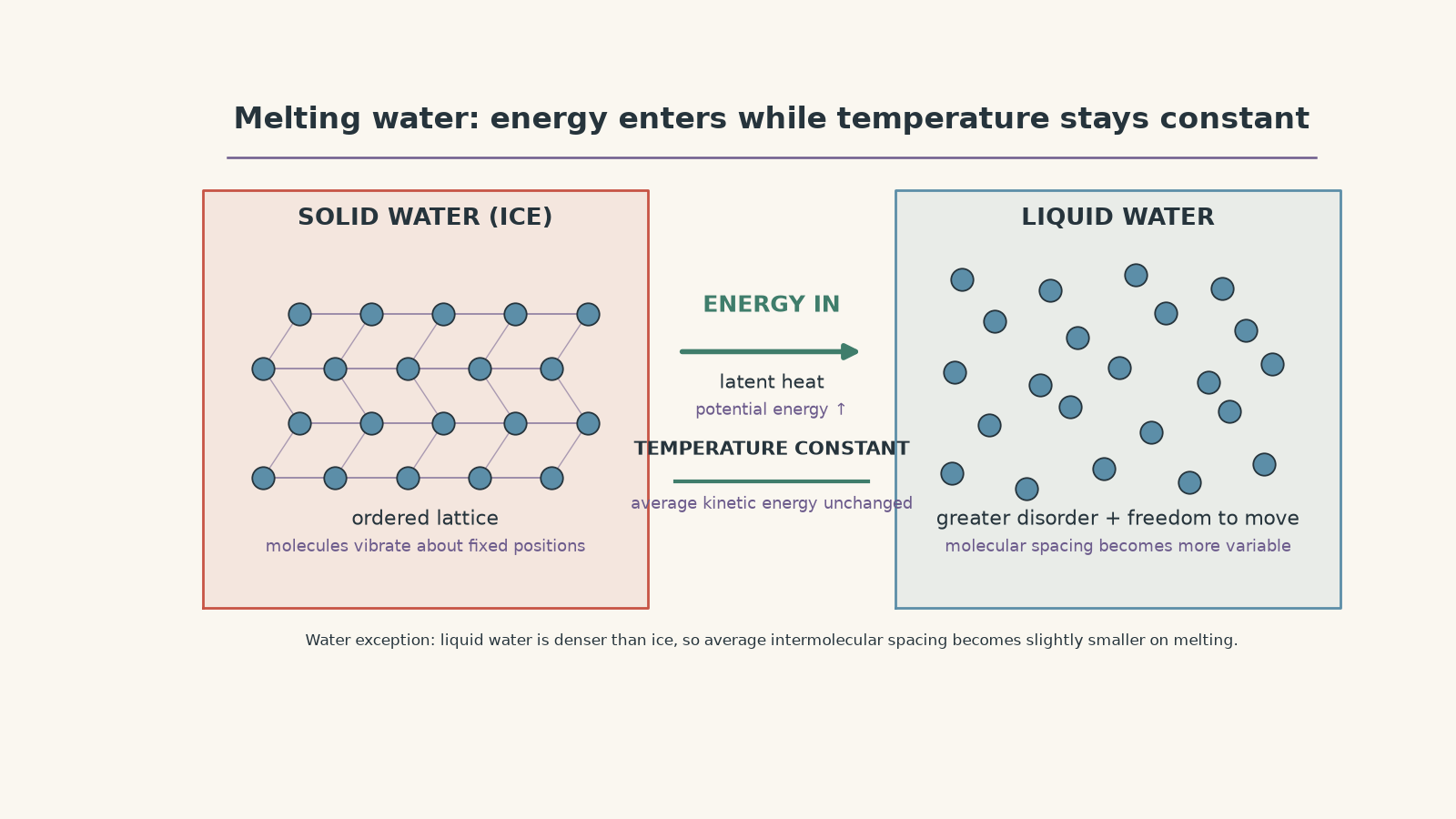
This is the key idea:
During a change of state at constant pressure, energy transfer can change the intermolecular potential energy of a substance without changing its temperature.
The reverse also happens. When a liquid freezes or a gas condenses, energy is transferred out of the substance as particles move into arrangements with lower intermolecular potential energy.
03Latent heat
The energy transferred during a phase change is called latent heat.
The word “latent” means hidden. The energy transfer is hidden from a thermometer because the temperature does not change during the idealised phase change.
For a mass \(m\) undergoing one complete phase change,
\[
Q = mL
\]
where:
- \(Q\) is the energy transferred, measured in joules (J)
- \(m\) is the mass undergoing the phase change, measured in kilograms (kg)
- \(L\) is the specific latent heat, measured in joules per kilogram (\(\text{J kg}^{-1}\))
Specific latent heat tells you how much energy is required to change the state of 1 kg of a substance without changing its temperature.
Two common types are:
| Phase change | Specific latent heat | What the energy does |
|---|---|---|
| solid \(\leftrightarrow\) liquid | specific latent heat of fusion, \(L_f\) | changes the solid-liquid arrangement |
| liquid \(\leftrightarrow\) gas | specific latent heat of vaporisation, \(L_v\) | separates particles much more strongly |
For water, useful approximate values are:
\[
L_f = 3.34 \times 10^5\ \text{J kg}^{-1}
\]
and
\[
L_v = 2.26 \times 10^6\ \text{J kg}^{-1}
\]
Notice that \(L_v\) is much larger than \(L_f\). Turning liquid water into gas requires much more energy per kilogram than melting ice.
Why?
During melting, the molecules remain fairly close together. During vaporisation, they become much more widely separated, so considerably more energy is needed to overcome intermolecular attractions.
Worked example: How much energy melts some ice?
A \(0.150\ \text{kg}\) block of ice is at \(0^\circ\text{C}\). Calculate the energy required to melt it completely. Use \(L_f = 3.34 \times 10^5\ \text{J kg}^{-1}\).
Step 1
The ice is already at its melting point, so there is no need to calculate a temperature increase. The energy is used only for the phase change.
Step 2
\[
Q = mL
\]
Step 3
\[
\begin{aligned}
Q &= (0.150)(3.34 \times 10^5)\\
&= 5.01 \times 10^4\ \text{J}
\end{aligned}
\]
Step 4
The ice requires
\[
\boxed{Q = 5.01 \times 10^4\ \text{J}}
\]
or \(50.1\ \text{kJ}\), to melt completely.
During this melting process, the water remains at approximately \(0^\circ\text{C}\). The transferred energy increases its internal energy by changing the molecular arrangement, not by raising its temperature.
04Why doesn’t \(Q = mc\Delta T\) work here?
You may already know the equation
\[
Q = mc\Delta T
\]
where \(c\) is the specific heat capacity.
That equation describes energy transfer associated with a temperature change within one state.
Latent heat describes energy transfer associated with a change of state.
That gives a useful decision rule:
| What is happening? | Equation |
|---|---|
| Temperature changes, but state stays the same | \(Q = mc\Delta T\) |
| State changes at constant temperature | \(Q = mL\) |
| Both occur | Split the process into separate stages |
Don’t try to force an entire heating process into one equation.
For example, heating ice below \(0^\circ\text{C}\), melting it, and then warming the liquid water requires three separate energy calculations. The physical process changes, so the equation changes too.
05A heating curve shows where the energy goes
Suppose energy is supplied steadily to a substance.
While it remains in one phase, its temperature rises. On a temperature-versus-energy graph, the line slopes upwards.
When it reaches a phase-change temperature, the graph becomes flat while the phase change occurs. Energy is still being added, but the temperature stays approximately constant.
Then, once the phase change is complete, continued energy transfer raises the temperature again.
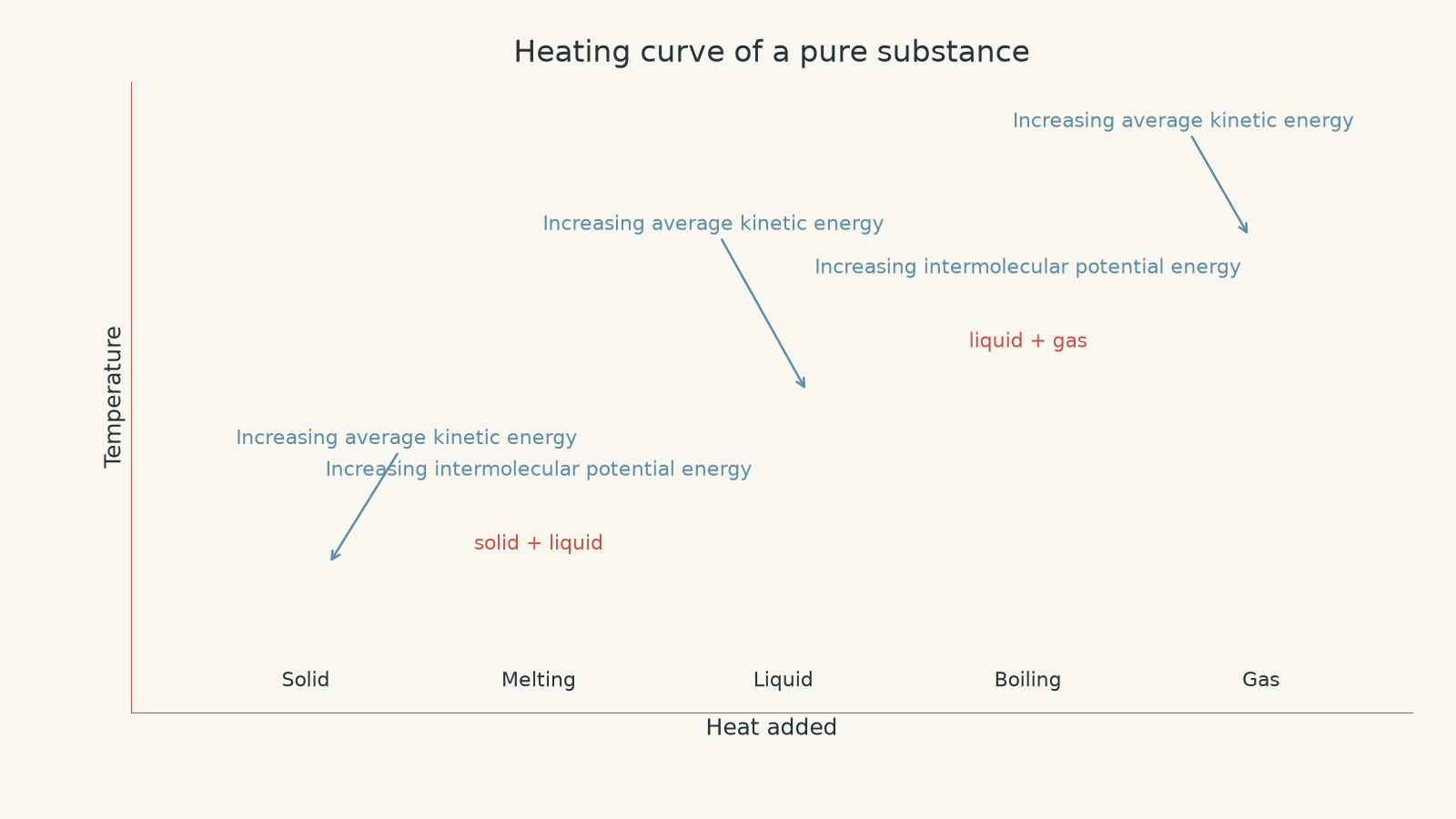
A flat section does not mean that nothing is happening.
In fact, a large amount of energy may be transferred while the graph is flat.
The flat section means only that the temperature is not changing.
Worked example: Heating, then melting
A \(0.200\ \text{kg}\) sample of ice begins at \(-10.0^\circ\text{C}\). It is heated until it has completely melted at \(0^\circ\text{C}\).
Use:
- specific heat capacity of ice \(c = 2.10 \times 10^3\ \text{J kg}^{-1}\text{K}^{-1}\)
- specific latent heat of fusion \(L_f = 3.34 \times 10^5\ \text{J kg}^{-1}\)
Calculate the total energy transferred.
Step 1
There are two stages:
- heat the solid ice from \(-10.0^\circ\text{C}\) to \(0^\circ\text{C}\)
- melt the ice at \(0^\circ\text{C}\)
Using only \(Q=mL\) would miss the first stage. Using only \(Q=mc\Delta T\) would miss the phase change.
Step 2
The temperature change is
\[
\Delta T = 0 – (-10.0) = 10.0\ \text{K}
\]
Therefore,
\[
\begin{aligned}
Q_1 &= mc\Delta T\\
&= (0.200)(2.10 \times 10^3)(10.0)\\
&= 4.20 \times 10^3\ \text{J}
\end{aligned}
\]
Step 3
\[
\begin{aligned}
Q_2 &= mL_f\\
&= (0.200)(3.34 \times 10^5)\\
&= 6.68 \times 10^4\ \text{J}
\end{aligned}
\]
Step 4
\[
\begin{aligned}
Q_{\text{total}} &= Q_1 + Q_2\\
&= 4.20 \times 10^3 + 6.68 \times 10^4\\
&= 7.10 \times 10^4\ \text{J}
\end{aligned}
\]
So,
\[
\boxed{Q_{\text{total}} = 7.10 \times 10^4\ \text{J}}
\]
About \(94\%\) of this energy is used for melting rather than for raising the ice from \(-10^\circ\text{C}\) to \(0^\circ\text{C}\). That comparison shows why phase changes can absorb large amounts of energy without producing a temperature rise.
06Constant temperature does not mean constant internal energy
This is the main misconception to remove.
A student sees a horizontal section on a heating curve and thinks:
“The temperature is constant, so the particles aren’t gaining energy.”
That sounds reasonable if temperature and internal energy are treated as the same quantity. They aren’t.
During melting or boiling:
- energy continues to enter the substance
- temperature remains approximately constant
- average kinetic energy remains approximately constant
- intermolecular potential energy increases
- total internal energy increases
During freezing or condensation, the direction reverses:
- energy leaves the substance
- temperature remains approximately constant
- intermolecular potential energy decreases
- total internal energy decreases
So two samples at the same temperature can have different internal energies if they are in different phases.
For example, \(1\ \text{kg}\) of steam at \(100^\circ\text{C}\) contains more internal energy than \(1\ \text{kg}\) of liquid water at \(100^\circ\text{C}\). Condensing the steam releases a large amount of energy even though the temperature can remain at \(100^\circ\text{C}\) during the phase change.
07Melting and boiling are not breaking molecules apart
Another tempting mistake is to say that latent heat “breaks the bonds inside the molecules”.
For an ordinary physical phase change, the molecules themselves remain chemically the same.
When water boils,
\[
\ce{H2O(l) -> H2O(g)}
\]
the \(\ce{O-H}\) covalent bonds within each water molecule are not broken. It is still \(\ce{H2O}\).
What changes is the spacing and organisation of the molecules, which involves overcoming intermolecular attractions between separate molecules.
This distinction matters because breaking intramolecular chemical bonds would describe a chemical change, not ordinary boiling.
08What determines how long a phase change takes?
If a heater supplies constant power \(P\), then
\[
P = \frac{Q}{t}
\]
where:
- \(P\) is power in watts (W), equivalent to joules per second
- \(Q\) is energy transferred in joules
- \(t\) is time in seconds
Since a phase change requires \(Q=mL\),
\[
t = \frac{mL}{P}
\]
for an ideal system in which all the heater’s energy reaches the substance.
This gives a useful prediction.
Two equal masses of water are heated by identical heaters. One mass is melting at \(0^\circ\text{C}\), and the other is boiling at \(100^\circ\text{C}\). Which phase change takes longer?
Boiling does, because the specific latent heat of vaporisation is much larger than the specific latent heat of fusion.
In a real experiment, some energy is also transferred to the container and surroundings. The simple calculation assumes those losses are negligible unless the question gives enough information to include them.
09Questions and solutions
Question 1
A \(0.0800\ \text{kg}\) piece of ice at \(0^\circ\text{C}\) melts completely. Use \(L_f = 3.34 \times 10^5\ \text{J kg}^{-1}\).
Calculate the energy transferred to the ice.
Solution 1
The ice requires \(\boxed{2.67 \times 10^4\ \text{J}}\) of energy to melt completely.
Because the ice is already at its melting point and only a phase change occurs, use
\[
Q=mL_f
\]
Substituting,
\[
\begin{aligned}
Q &= (0.0800)(3.34\times10^5)\\
&=2.672\times10^4\ \text{J}
\end{aligned}
\]
Therefore,
\[
\boxed{Q=2.67\times10^4\ \text{J}}
\]
The temperature remains approximately \(0^\circ\text{C}\) while the ice melts. The energy increases the internal energy by changing the molecular arrangement rather than increasing the temperature.
Question 2
A \(1.20\ \text{kW}\) heater supplies energy to \(0.500\ \text{kg}\) of water that is already boiling at \(100^\circ\text{C}\). Assume all energy from the heater is transferred to the water.
Use \(L_v = 2.26\times10^6\ \text{J kg}^{-1}\).
Calculate the time required to vaporise all the water.
Solution 2
The water takes approximately \(\boxed{942\ \text{s}}\), or \(\boxed{15.7\ \text{min}}\), to vaporise completely.
First calculate the energy required:
\[
\begin{aligned}
Q &= mL_v\\
&=(0.500)(2.26\times10^6)\\
&=1.13\times10^6\ \text{J}
\end{aligned}
\]
The heater power is
\[
1.20\ \text{kW}=1.20\times10^3\ \text{W}
\]
Using
\[
P=\frac{Q}{t}
\]
gives
\[
\begin{aligned}
t&=\frac{Q}{P}\\
&=\frac{1.13\times10^6}{1.20\times10^3}\\
&=9.42\times10^2\ \text{s}
\end{aligned}
\]
Therefore,
\[
\boxed{t=942\ \text{s}\approx15.7\ \text{min}}
\]
The calculation assumes perfect energy transfer. A real heater would generally take longer because some energy would heat the container and surrounding air.
Question 3
A student heats a pure substance at constant pressure using a heater that delivers energy at a steady rate. For four minutes, the measured temperature remains constant.
The student says, “The heater must have stopped transferring energy because the substance’s temperature isn’t increasing.”
Explain why this conclusion is not justified, and identify one observation that could support a different explanation.
Solution 3
The student’s conclusion is not justified because a substance can absorb energy at constant temperature while undergoing a phase change.
During melting or boiling, transferred energy can increase the intermolecular potential energy of the substance rather than increasing the average kinetic energy of its particles. The temperature can therefore remain constant even though energy continues to enter.
An observation supporting this explanation would be a visible change in the proportion of the two phases. For example, solid material could gradually disappear during melting, or liquid could gradually become vapour during boiling.
The trap is assuming that temperature measures total internal energy. It does not. A constant temperature tells us that the thermal motion associated with temperature is not increasing significantly, not that no energy transfer is occurring.
Question 4
Two insulated containers each hold \(0.100\ \text{kg}\) of water.
Container A holds liquid water at \(100^\circ\text{C}\).
Container B holds water vapour at \(100^\circ\text{C}\).
A student argues that the two samples must have the same internal energy because they have the same mass, substance, and temperature.
Evaluate the student’s reasoning.
Solution 4
Container B has greater internal energy, despite both samples having the same mass and temperature.
The equal temperatures indicate comparable average particle kinetic energy in the simplified HSC model. However, internal energy includes both microscopic kinetic energy and intermolecular potential energy.
The water vapour has much greater intermolecular potential energy because its molecules are far more separated than they are in the liquid.
If the vapour condenses at \(100^\circ\text{C}\), it transfers energy to the surroundings while remaining at approximately the same temperature during condensation:
\[
Q=mL_v
\]
For the \(0.100\ \text{kg}\) sample,
\[
\begin{aligned}
Q&=(0.100)(2.26\times10^6)\\
&=2.26\times10^5\ \text{J}
\end{aligned}
\]
So the vapour can release about
\[
\boxed{2.26\times10^5\ \text{J}}
\]
as it becomes liquid at the same temperature.
The student’s mistake is treating temperature as a complete measure of internal energy. Phase matters because the intermolecular potential-energy contribution is different.
Question 5
A heater supplies constant power to a sample that initially contains both ice and liquid water at \(0^\circ\text{C}\). After some time, all the ice has melted, but the thermometer has remained at \(0^\circ\text{C}\).
A student wants to calculate the energy supplied using \(Q=mc\Delta T\). Another student wants to use \(Q=mL_f\).
Explain which approach is appropriate. Then state one piece of information that must be known before a numerical value for the energy can be calculated.
Solution 5
The latent heat equation \(Q=mL_f\) is the appropriate model for the melting itself, but the mass \(m\) must be the mass of ice that actually melts, not automatically the total mass of ice plus liquid water.
The equation
\[
Q=mc\Delta T
\]
is not useful for the phase change because
\[
\Delta T=0
\]
would incorrectly give \(Q=0\). Energy is nevertheless required because the phase is changing.
Instead,
\[
Q=m_{\text{ice melted}}L_f
\]
The required missing information is therefore the initial mass of ice, or equivalent information that allows that mass to be determined.
The hidden assumption is important. If the container initially holds a mixture of ice and liquid water, only the ice undergoes fusion. Using the total water mass in \(Q=mL_f\) would overestimate the energy required.
10What latent heat lets you understand next
Latent heat gives you a more complete picture of thermal energy transfer. Temperature change is only one possible result of transferring energy. A substance can also use that energy to change its microscopic arrangement while its temperature stays constant.
That distinction becomes especially useful when analysing heating curves, cooling curves, calorimetry, and energy conservation. In those problems, the main skill is not memorising another equation. It is identifying what physical process is happening at each stage, then choosing the equation that matches it.