
Magnetisation of Ferromagnetic Materials: HSC Physics
Learn how magnetic domains align in ferromagnetic materials, why magnetisation can be induced, and why some materials retain magnetisation after a field is removed.
Bring the north pole of a magnet towards an ordinary iron nail. The nail is not a permanent magnet, yet it moves towards the magnet. Now flip the magnet around and bring its south pole towards the same nail. The nail is attracted again.
Predict what should happen if the nail really has no magnetic poles of its own. Why doesn’t one end of the magnet repel it?
The answer is that the magnet changes the nail. Its magnetic field rearranges the magnetic structure inside the iron, temporarily turning the nail into a magnet. To understand how that happens, we need to look inside a ferromagnetic material.
01Start with magnetic domains
Iron contains enormous numbers of atomic-scale magnetic moments, mainly associated with electrons. In a ferromagnetic material, interactions between neighbouring atoms make many of these moments line up together.
They don’t normally form one perfectly aligned block across the whole object. Instead, the material is divided into regions called magnetic domains.
Inside one domain, many magnetic moments point roughly the same way. A neighbouring domain may point in a different direction.
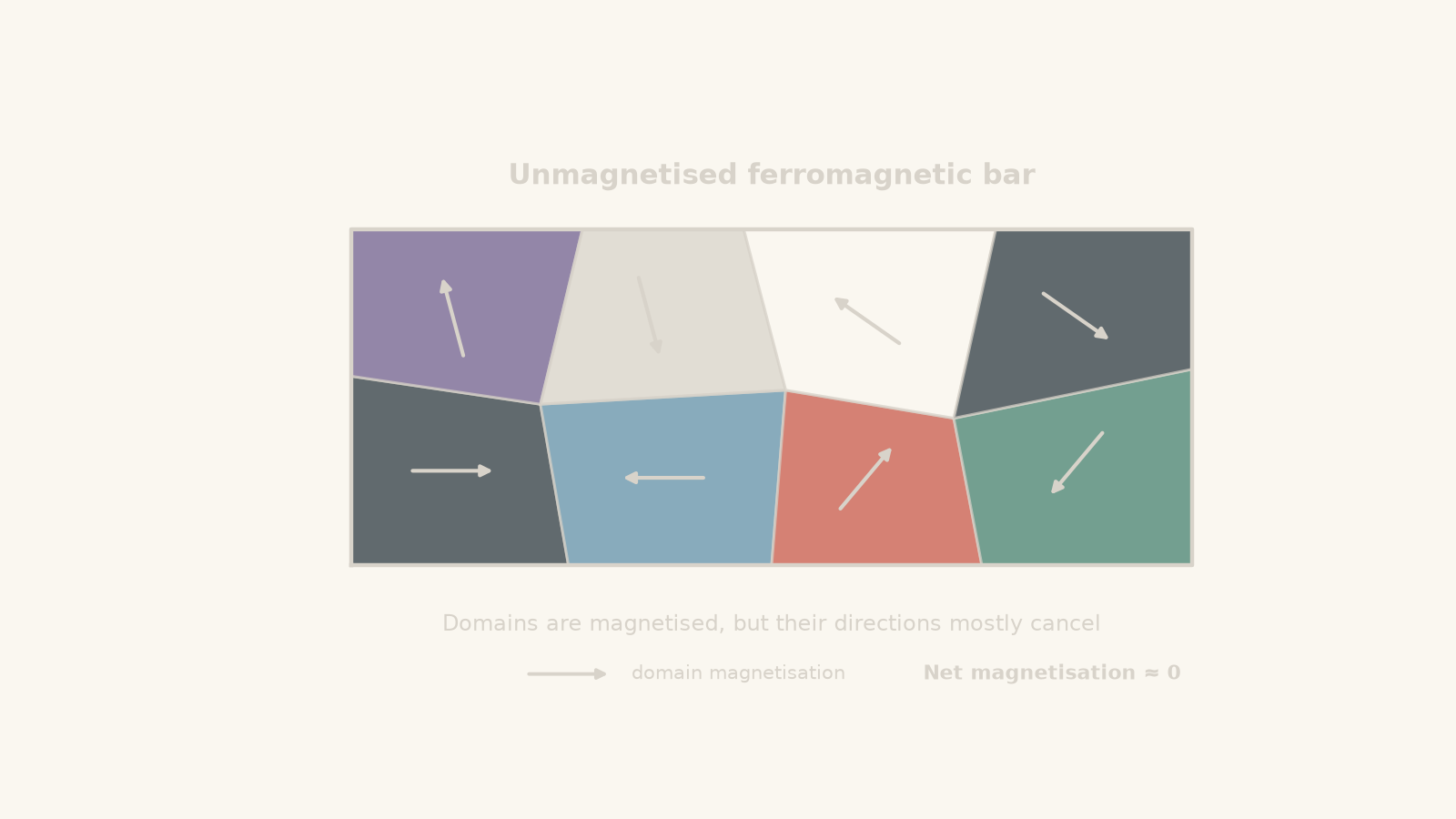
Picture several groups of friends at a party. Everyone inside each group is looking in roughly the same direction, but different groups are facing different parts of the room. From above, there is no strong overall direction to the crowd.
A magnetic domain is a little like one of those groups.
The analogy breaks at an important point. Domains are not tiny bar magnets floating around and physically swivelling as complete chunks. Their behaviour comes from the magnetic moments of electrons, and magnetisation can change through processes including movement of the boundaries between domains and rotation of the magnetisation within domains.
For HSC Physics, the useful mental model is:
- within a domain, many magnetic moments are aligned;
- different domains can point in different directions;
- their magnetic effects can largely cancel;
- an external magnetic field can change the balance between them.
That last point explains the nail.
02Unmagnetised does not mean magnetically empty
An unmagnetised piece of iron still contains magnetic domains.
“Unmagnetised” means that there is no substantial net alignment across the whole object. The magnetic effects of domains pointing in different directions mostly cancel.
This distinction is easy to miss.
An unmagnetised ferromagnetic object is not a material in which every atomic magnetic moment has somehow disappeared. The magnetic structure is still there. It simply has little overall direction.
A useful summary is:
| State | Domain behaviour | Overall effect |
|---|---|---|
| Unmagnetised | Domains point in many directions | Net magnetisation is small |
| Magnet being applied | Domains favouring the applied field grow or reorient | Net magnetisation develops |
| Field removed from a soft magnetic material | Much of the alignment is lost | Little magnetisation remains |
| Field removed from a hard magnetic material | Significant alignment can remain | Retained magnetisation produces a lasting field |
03What an external magnetic field does
Suppose an initially unmagnetised iron rod is placed in an external magnetic field pointing to the right.
Before the field is applied, domains point in several directions. Once the field is present, configurations aligned more closely with the applied field become energetically favourable.
At the HSC level, we can describe the result as domains becoming more strongly aligned with the external field.
More precisely, this can involve domain walls moving so that favourably oriented domains grow, as well as rotation of the magnetisation inside domains.
The result is a net magnetisation in the direction of the applied field.
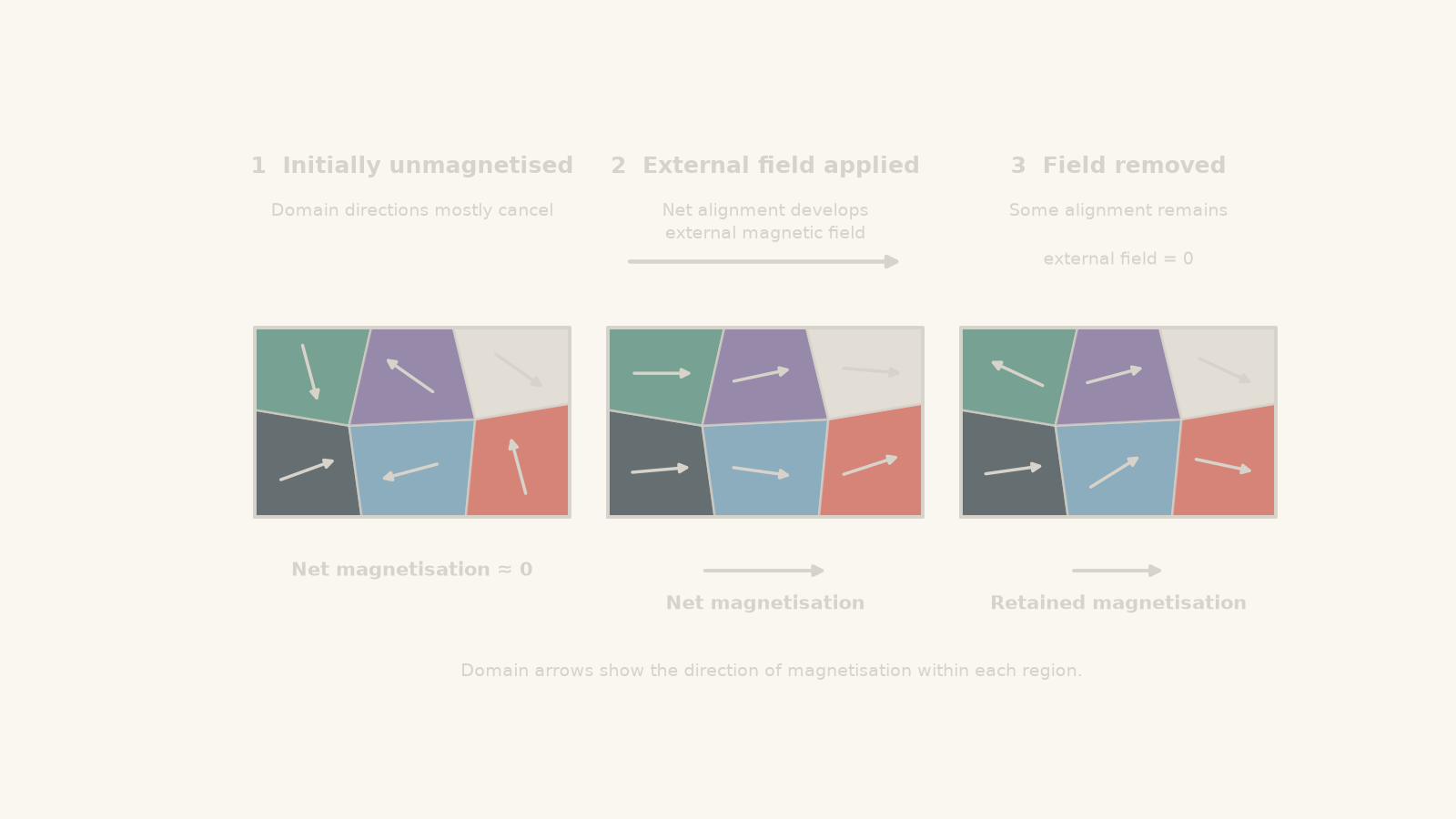
This process is called induced magnetisation when the magnetisation is produced by an external magnetic field.
Don’t confuse this use of “induced” with electromagnetic induction. No changing magnetic flux or induced emf is required here. We are talking about a magnetic field changing the magnetic state of a material.
04Why an unmagnetised piece of iron is attracted to either pole
Return to the nail.
Suppose the north pole of a permanent magnet approaches the nail. The field from the magnet causes the domains in the nail to rearrange.
The end nearest the north pole develops an effective south pole. The farther end develops an effective north pole.
Opposite poles are now closest together, so the nail is attracted.
Flip the permanent magnet around. The induced magnetisation in the nail also reverses. The end nearest the south pole becomes effectively north.
Again, the closest poles are opposite, so the nail is attracted.
This gives an important exam rule:
An unmagnetised ferromagnetic object can be attracted to either pole of a magnet because the applied field induces a favourable magnetisation in the object.
This is why attraction alone does not prove that an object was already a magnet.
Repulsion is much stronger evidence. An initially unmagnetised piece of soft iron does not have a fixed like pole waiting to repel your test magnet; its magnetisation rearranges in response to the applied field.
If you need to refresh how poles and fields relate, see Forces Between Magnets: Attraction, Repulsion and Fields.
Worked example: Why does the nail follow the magnet?
An unmagnetised iron nail lies on a smooth table. The north pole of a strong bar magnet is brought close to the nail’s left-hand end without touching it. Explain the magnetic changes in the nail and the resulting force.
Step 1
The nail is ferromagnetic but initially unmagnetised. It contains magnetic domains, but their effects largely cancel, so the nail has very little net magnetisation.
Step 2
The bar magnet produces a magnetic field through the nail. This changes the arrangement of domains so that the nail gains a net magnetisation.
Step 3
The nail’s left-hand end, which is nearest the magnet’s north pole, behaves like a south pole. Its right-hand end behaves like a north pole.
Step 4
The opposite poles at the closest ends attract. Therefore, the nail accelerates towards the magnet.
The key point is that the magnet does not merely exert a force on a pre-existing magnetic nail. It first changes the nail’s magnetisation, and that induced magnetisation creates the attractive interaction.
05What happens when the external field disappears?
Here’s the next prediction.
Suppose you place an iron rod and a steel rod separately inside the same strong magnetic field. Both become magnetised. You then switch the field off.
Must both rods return to their original unmagnetised states?
No.
Some ferromagnetic materials lose most of their net alignment when the applied field is removed. Others keep a substantial fraction of it.
The magnetisation remaining after the external field is removed is called retained magnetisation, or remanent magnetisation.
This is the basic distinction behind temporary and permanent magnets.
Soft magnetic materials
A soft magnetic material is relatively easy to magnetise and relatively easy to demagnetise.
Its domains respond readily to an external field, but much of the net alignment disappears when that field is removed.
Soft iron is the standard simplified example.
This makes soft magnetic materials useful where you want magnetism while a current is present, but little magnetisation afterwards. Electromagnet cores are an obvious case.
A current-carrying solenoid produces a magnetic field. Putting a suitable soft ferromagnetic core inside it greatly strengthens the magnetic response. You can review the field itself in Magnetic Field Inside a Solenoid: HSC Physics Explained.
Hard magnetic materials
A hard magnetic material resists changes to its magnetic state more strongly.
After being magnetised, significant domain alignment can remain when the external field is removed. The object therefore continues to produce its own magnetic field.
This is how a ferromagnetic material can become a permanent magnet.
“Hard” here refers to magnetic behaviour, not simply whether the material feels mechanically hard when you poke it.
06Why does some alignment remain?
The simple domain picture says that an external field encourages domains to align. But if that were the whole story, removing the field might seem as though it should restore the original arrangement immediately.
Real ferromagnetic materials have internal structures that can resist domain-wall motion. Defects, grain boundaries, and other features can make it difficult for the domain pattern to return to its previous state.
You can picture domain walls as trying to move across a rough floor rather than frictionless ice. The external field pushes them into new positions, but when the push disappears, some become stuck.
That analogy is useful for retained magnetisation, but it is not an exact mechanical model. Nothing is literally scraping along a floor. The “sticking” represents energy barriers inside the material.
The stronger these barriers are, the harder it is to reverse the magnetisation.
A measure of how resistant a magnetic material is to being demagnetised is its coercivity. Permanent-magnet materials generally have much greater coercivity than soft magnetic materials.
You don’t need to imagine that hard magnetic materials have “more domains” or “stronger little magnets”. The key difference is how readily their magnetic structure changes.
07Magnetisation has a memory
This leads to a surprisingly important result: the magnetic state of a ferromagnetic object can depend on its history.
Two identical pieces of magnetic material can experience the same field right now and still behave differently because they reached that field through different sequences of magnetisation.
Suppose a hard steel rod has been strongly magnetised towards the right. The external field is then removed. Significant rightward magnetisation remains.
Now apply a small field towards the left.
A student might predict that any leftward field instantly flips the magnetisation. It doesn’t. If the reverse field is too weak, it may only reduce the existing magnetisation rather than reverse it completely.
A sufficiently strong reverse field is required to overcome the material’s resistance to changing magnetic state.
This magnetic “memory” is part of the phenomenon called hysteresis.
For this guide, the main consequence is enough:
The final magnetisation depends not only on the field currently being applied, but also on what fields the material experienced earlier.
Worked example: What remains after the solenoid is switched off?
A soft iron rod and a hard steel rod are each placed inside the same solenoid. The current produces a strong magnetic field towards the right. After sufficient time, the current is switched off. Compare the magnetic state of the two rods.
Step 1
The solenoid’s magnetic field points towards the right. In both ferromagnetic rods, domain arrangements favouring rightward magnetisation grow or reorient.
Both rods therefore acquire net magnetisation towards the right.
Step 2
When the current becomes zero, the solenoid no longer supplies the strong magnetising field.
The two materials now behave differently.
Step 3
Its magnetic structure changes relatively easily. Much of the domain alignment produced by the solenoid disappears.
Its remaining net magnetisation is therefore small.
Step 4
Its domain structure is more resistant to change. A substantial amount of the rightward alignment remains after the applied field disappears.
The steel rod therefore retains a magnetic field and can behave as a permanent magnet.
Step 5
The steel rod was not magnetised because the solenoid somehow placed permanent north and south particles inside it. Both rods contained magnetic domains from the start.
The difference is how much of the induced alignment survives after the magnetising field is removed.
08Induced and retained magnetisation are not competing explanations
Students sometimes treat these as two completely different processes:
- induced magnetisation happens in iron;
- retained magnetisation happens in steel.
That is too crude.
Both involve changes to the magnetic domain structure.
“Induced magnetisation” describes magnetisation produced by an external field.
“Retained magnetisation” describes what remains after that external field has been removed.
A hard magnetic material can first acquire induced magnetisation and then retain much of it. A soft magnetic material can also be strongly magnetised while the field is present, but retain very little afterwards.
So ask two separate questions:
- What happens while the external field is applied?
- What remains after the field is removed?
That distinction fixes a lot of magnetic-domain questions.
09Reversing a field is not the same as demagnetising
Suppose a permanent steel magnet points to the right. You place it inside a solenoid and produce a strong magnetic field towards the left.
If the reverse field is strong enough, it can reverse the rod’s magnetisation.
Now switch the field off.
Have you demagnetised the rod?
Not necessarily. You may simply have produced a permanent magnet pointing the other way.
This is why demagnetisation is more subtle than “apply an opposite field”.
One method uses an alternating magnetic field whose magnitude is gradually reduced. The material is repeatedly magnetised in alternating directions, but each reversal becomes weaker. The remaining net alignment is progressively reduced until the material is left with little overall magnetisation.
The decreasing amplitude is crucial.
A large alternating field that is suddenly switched off can leave substantial magnetisation corresponding to the final part of the cycle.
10The tempting misconception: domains themselves are north and south poles
It is common to draw each domain with an arrow. That can make it look as though every domain is a tiny rigid bar magnet with a labelled north end and south end.
That picture is useful only up to a point.
The arrow represents the direction of the domain’s magnetisation. It helps us track the combined magnetic effect of many atomic magnetic moments.
When a material is magnetised, we are not sorting permanent microscopic north particles to one side and south particles to the other. The observable poles of the whole object arise from its overall magnetisation.
This also explains why cutting a bar magnet does not isolate a north pole from a south pole. Each piece has its own magnetisation and therefore develops its own north and south ends.
11Questions and solutions
Question 1
An initially unmagnetised iron rod is placed near the north pole of a bar magnet.
a. What magnetic pole is induced at the end of the rod nearest the bar magnet?
b. What force acts between the rod and the bar magnet?
c. What happens to most of the rod’s magnetisation if it is soft iron and the bar magnet is removed?
Solution 1
The end nearest the magnet becomes an effective south pole, so the rod is attracted towards the north pole. If the rod is soft iron, most of the induced magnetisation disappears when the external field is removed.
The iron initially contains domains whose magnetisations largely cancel. The bar magnet’s field changes the domain arrangement, giving the rod a net magnetisation.
The nearest end takes the opposite polarity to the nearby pole of the bar magnet, producing attraction.
The tempting mistake is to think that an unmagnetised rod cannot have poles induced in it because it “has no magnetism”. It does contain magnetic moments and domains; it simply begins with little net magnetisation.
Once the external field is removed, soft iron’s domain structure changes relatively easily, so the rod retains little of the induced alignment.
Question 2
Two identical-looking rods, X and Y, are available. X is unmagnetised soft iron. Y is hard steel that has already been strongly magnetised.
A student brings the north pole of a weak test magnet towards one end of X and observes attraction. The same test at one end of Y also gives attraction.
The student concludes that both rods are unmagnetised.
Explain why the evidence is insufficient, and describe a magnetic test that can distinguish the magnetised steel rod from the unmagnetised soft iron rod under the standard HSC domain model.
Solution 2
Attraction does not show that a rod is unmagnetised. The useful distinguishing observation is repulsion: test both ends of each rod with both poles of the weak test magnet. The already magnetised steel rod can produce repulsion between like poles, while the initially unmagnetised soft iron rod is expected to be attracted because its magnetisation is induced by the test field.
The student’s reasoning fails because attraction has two possible causes.
For X, the test magnet induces magnetisation in the soft iron. Whichever pole approaches, the near end of X develops the opposite polarity, so attraction occurs.
For Y, the rod already has retained magnetisation. If the north test pole happens to approach Y’s south end, attraction also occurs.
So an attractive force cannot tell us which mechanism produced it.
Repulsion is different. If the north pole of the test magnet is brought towards the north end of a sufficiently stable hard-steel magnet, like poles repel. Repeating the test at both ends and with both test poles reveals the fixed polarity of Y.
The tempting route is to use “attracts a magnet” as the definition of a magnet. That fails because ferromagnetic materials can be attracted through induced magnetisation even when they were initially unmagnetised.
The assumption here is that the test magnet is weak enough that it does not substantially reverse the retained magnetisation of Y.
Question 3
A hard steel rod is strongly magnetised so that its magnetisation points towards the right. The magnetising field is removed.
A second external field is then applied towards the left, but it is weaker than the field required to reverse most of the rod’s retained magnetisation. That weaker field is also removed.
A student argues:
“The last magnetic field pointed left, so the rod must now be a permanent magnet pointing left.”
Is the student necessarily correct? Explain the rod’s possible final state using magnetic domains and magnetic history.
Solution 3
No. Under the stated condition, the rod can remain magnetised towards the right, although its retained magnetisation may be weaker than before.
Initially, the strong rightward field creates a substantial net rightward domain alignment. Because the rod is hard steel, much of that alignment remains when the first field is removed.
The later leftward field favours magnetisation towards the left. It can move some domain walls or rotate some magnetisation away from the original direction.
However, the question states that this reverse field is too weak to reverse most of the retained magnetisation. Internal barriers resist the change.
After the weaker leftward field is removed, the rod may therefore still have a net rightward magnetisation:
\[
\text{original rightward remanence}
\;-\;
\text{partial reversal}
\;>\;
0
\]
The expression is conceptual rather than a numerical equation. It says that the reverse change was not large enough to overcome the existing net magnetisation.
The tempting route is to assume that a ferromagnetic material’s direction is determined only by the most recently applied field. That would ignore hysteresis. Hard magnetic materials have memory: their final state depends on their earlier magnetic state as well as the later field.
Question 4
A hard steel bar is strongly magnetised from left to right and then removed from the magnetising field.
It is cut exactly in half, producing pieces A and B. Piece A is left untouched. Piece B is subjected to a demagnetising treatment that leaves its domains with almost zero net alignment.
A student makes two claims:
- “Cutting the bar separates its original poles, so A should contain only the south pole and B only the north pole.”
- “After B is demagnetised, a permanent magnet should no longer exert a magnetic force on it.”
Determine what is wrong with each claim. Then predict how pieces A and B behave when the north pole of a permanent magnet is brought near them.
Solution 4
Both claims are wrong. After cutting, piece A remains a smaller magnet with both a south and north end, and piece B initially does too. After B is demagnetised, it has little retained magnetisation but can still be attracted to the permanent magnet through induced magnetisation.
Before cutting, the bar’s net magnetisation points from left to right.
Cutting it does not isolate magnetic poles. The magnetisation inside each remaining piece produces new magnetic poles at the freshly cut surfaces.
So each half becomes a complete magnet:
- A has its own south and north ends;
- B has its own south and north ends.
The first tempting argument treats north and south poles as separate substances stored at opposite ends. They are not. The poles are consequences of the object’s magnetisation.
Piece A is left magnetised. Bringing a north test pole near A can therefore give attraction or repulsion depending on which end of A is approached.
Piece B is then demagnetised. Its domains have very little net alignment, so it no longer acts as a strong permanent magnet.
But “not permanently magnetised” does not mean “unable to respond to a field”. B is still ferromagnetic.
When the north pole of the permanent magnet approaches B, the field induces magnetisation in B. Its near end becomes effectively south, giving an attractive force.
The second tempting argument confuses retained magnetisation with magnetic susceptibility. Demagnetisation removes the large net alignment; it does not stop the material’s domains from responding to a new external field.
Question 5
A hard steel rod begins strongly magnetised towards the right. It can be placed inside a solenoid that produces a magnetic field parallel to the rod.
Assume the field can be made strong enough in either direction to reverse the rod’s magnetisation.
Two procedures are proposed for “demagnetising” it.
Procedure A: Apply a strong alternating current for many cycles. Keep the field amplitude constant. During the final half-cycle the field points left. Switch the current suddenly to zero.
Procedure B: Apply an alternating current, but gradually reduce its amplitude over many cycles until the field approaches zero.
A student argues that both procedures must work because each exposes the rod to equal numbers of leftward and rightward fields, so the effects should cancel.
Compare the likely final magnetic state after each procedure. Explain why simply counting equal field directions gives the wrong prediction.
Solution 5
Procedure B is the genuine demagnetising process. Procedure A can leave substantial retained magnetisation, potentially towards the left under the stated conditions, because the rod’s final state depends on the sequence and magnitude of the applied fields rather than on an arithmetic count of leftward and rightward cycles.
In Procedure A, each large half-cycle is strong enough to drive the material substantially towards magnetisation in its own direction.
A rightward half-cycle tends to produce strong rightward magnetisation. The next leftward half-cycle tends to reverse it.
Because the amplitude never decreases, the rod is repeatedly driven between strongly magnetised states rather than progressively towards zero magnetisation.
The final strong half-cycle points left. If the current is then suddenly removed, hard steel can retain significant leftward magnetisation.
So
\[
\text{many equal positive and negative field cycles}
\not\Rightarrow
\text{zero final magnetisation}.
\]
The student’s cancellation argument would work for quantities that simply add independently. Ferromagnetic magnetisation does not behave that way because the material has hysteresis: the response at one moment depends on its previous magnetic state.
Procedure B changes that history deliberately.
At first, the alternating field is large enough to produce major rearrangements of the domain structure. Each reversal then has a smaller amplitude than the one before it.
The rod is therefore taken through progressively smaller magnetisation changes in alternating directions. The residual alignment becomes smaller and smaller until there is very little net magnetisation when the applied field reaches zero.
The crucial difference is not the number of leftward and rightward cycles. It is the decreasing amplitude.
That is the deeper lesson about ferromagnetic materials: knowing the applied magnetic field is sometimes not enough to predict their state. You also need to know their magnetic history.
That idea is the bridge to hysteresis curves, coercivity, and remanence. It also explains why the material chosen for an electromagnet core should behave very differently from the material chosen for a permanent magnet.