
Centripetal Acceleration: Why It Points Inward in HSC Physics
Understand why circular motion requires inward acceleration and how to use \ (a_c = v^2/r \ ). Includes worked examples, common misconceptions, and challenging HSC-style questions.
A car can move around a bend at a perfectly constant 15 m/s and still be accelerating. That sounds wrong at first. If the speedometer never changes, what exactly is changing?
Predict this before reading on: if the car is travelling east and then turns left so that it is travelling north, has its velocity changed even if its speed is still 15 m/s?
Yes. Velocity includes both magnitude and direction. The magnitude stayed at 15 m/s, but the direction changed from east to north. Any change in velocity means acceleration.
Circular motion is built around that idea. An object moving around a circle is continually changing the direction of its velocity, so it must be accelerating. That acceleration points towards the centre of the circle and has magnitude
\[ a_c=\frac{v^2}{r} \]
where \(a_c\) is centripetal acceleration in \(\text{m s}^{-2}\), \(v\) is the object’s instantaneous speed in \(\text{m s}^{-1}\), and \(r\) is the radius of the circular path in metres.
The formula is useful. Understanding why the acceleration points inward is more important.
01Constant speed does not mean constant velocity
Imagine a ball moving anticlockwise around a circular track.
At every instant, its velocity points along the tangent to the circle. In other words, the ball’s velocity points in the direction it would travel if the circular track suddenly vanished.
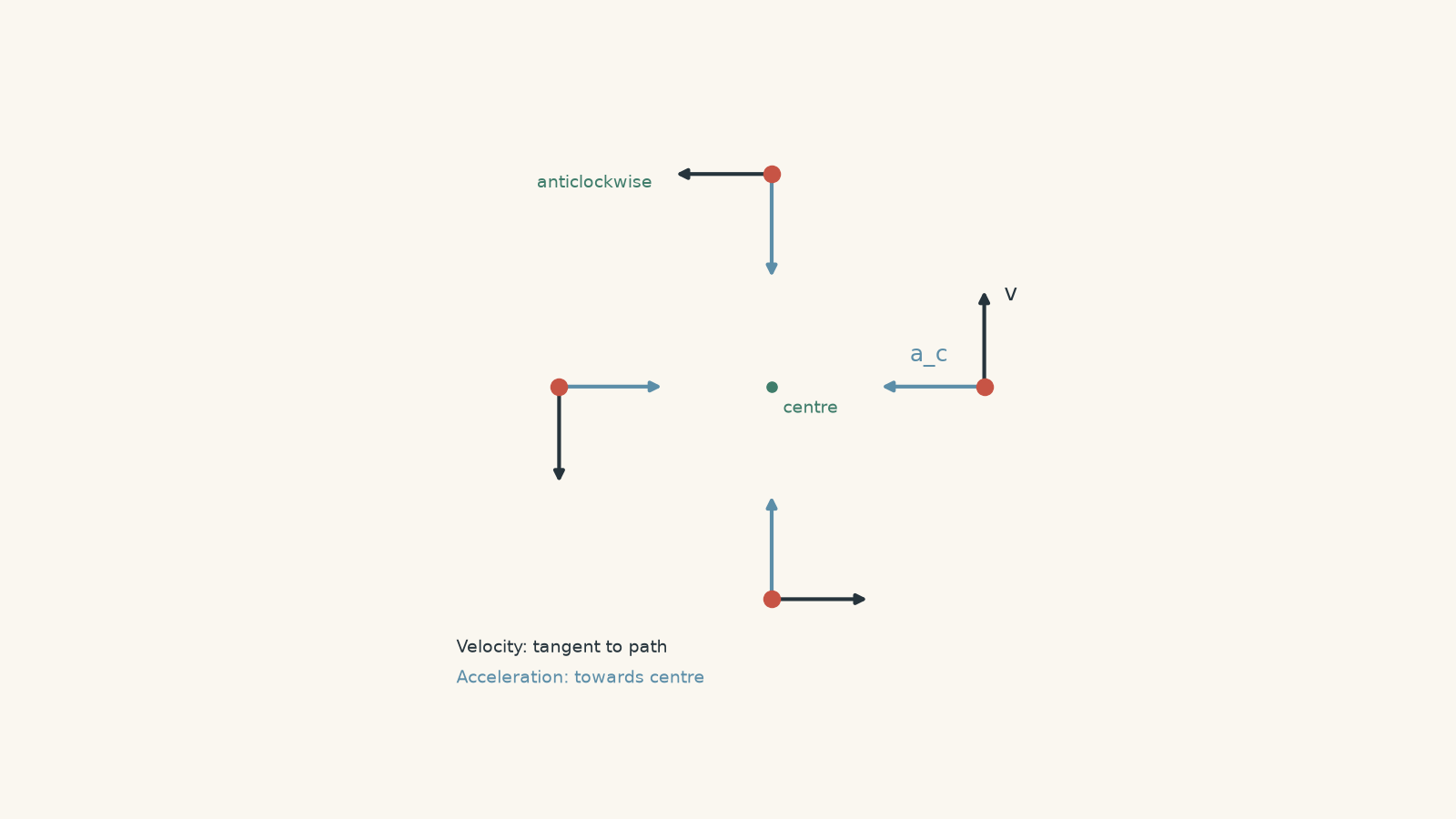
Suppose the ball is at the right-hand side of the circle. Its velocity points upwards. A short time later, slightly further around the circle, its velocity points upwards and slightly left.
The two velocity vectors have the same length because the speed has not changed. But they do not point in the same direction.
Acceleration depends on the change in velocity:
\[ \vec a=\frac{\Delta \vec v}{\Delta t} \]
Here, \(\Delta \vec v\) means the change in the velocity vector, not simply the change in speed.
That distinction is the whole story.
02Why does the acceleration point towards the centre?
Take two velocity vectors from moments very close together. They have equal lengths but slightly different directions.
Now subtract the first velocity vector from the second to find \(\Delta \vec v\).
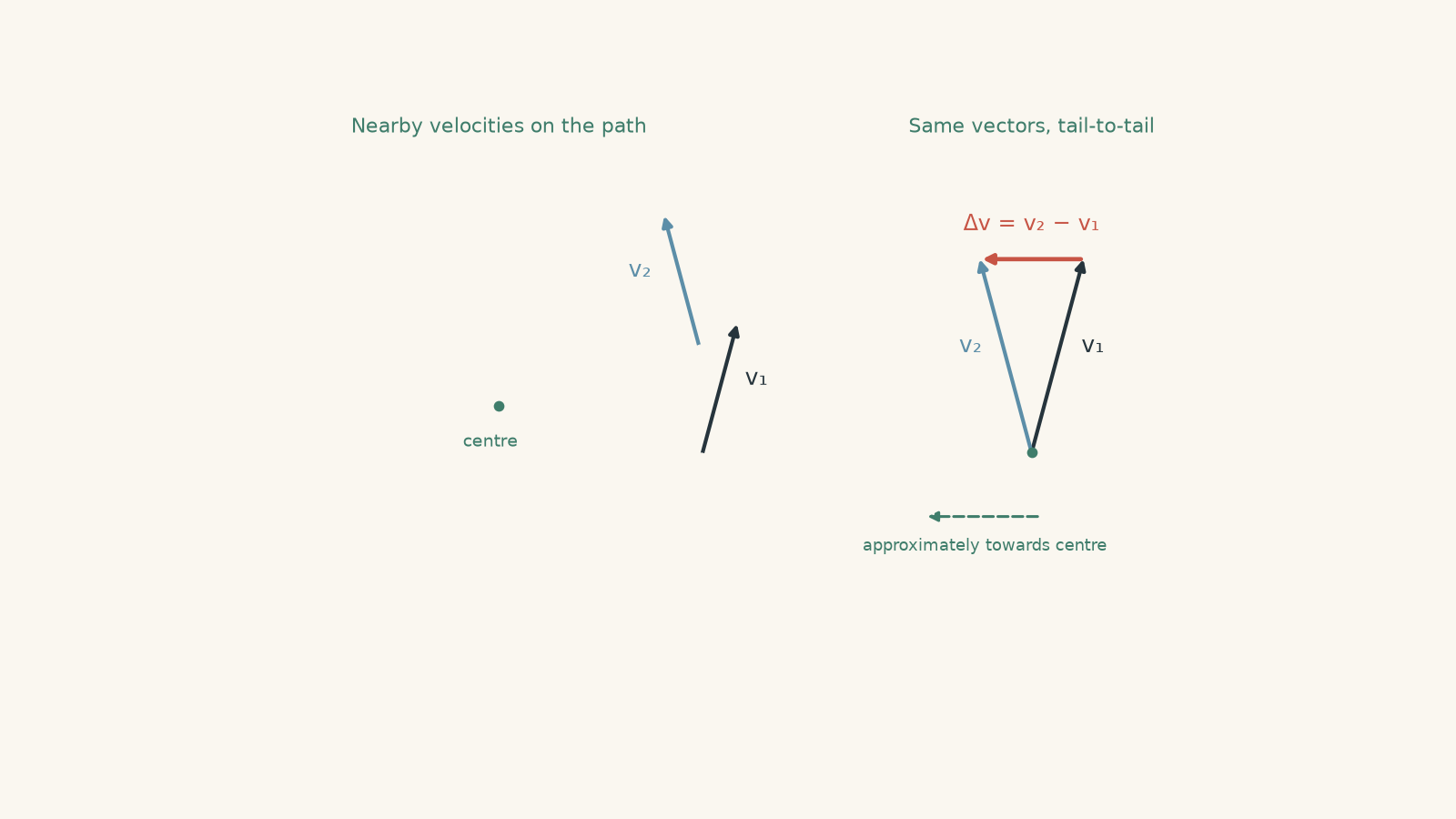
For a very small time interval, that change in velocity points almost directly towards the centre of the circle. As the time interval becomes smaller and smaller, the direction approaches exactly radial inward.
Because
\[ \vec a=\frac{\Delta \vec v}{\Delta t}, \]
the acceleration points in the same direction as \(\Delta \vec v\): towards the centre.
This inward acceleration is called centripetal acceleration. “Centripetal” literally describes something directed towards the centre.
A useful mental picture is a shopping trolley that keeps trying to roll straight while you continually turn it around a circular path. At every moment, its current motion is tangent to the circle, while your steering changes that motion towards the inside of the turn.
The analogy has a limit. The trolley is not actually “trying” to do anything, and the inward acceleration is not a separate substance or mysterious pull. It is simply the acceleration required for the velocity vector to keep rotating.
03Getting \(a_c=\frac{v^2}{r}\)
We can now make the picture more precise.
During a very short time interval \(\Delta t\), an object moving at speed \(v\) travels approximately
\[ \Delta s=v\Delta t. \]
If the circular path has radius \(r\), the small angle through which the object moves, measured in radians, is approximately
\[ \Delta \theta=\frac{\Delta s}{r}. \]
Substituting \(\Delta s=v\Delta t\),
\[ \Delta \theta=\frac{v\Delta t}{r}. \]
The velocity vector turns through the same small angle \(\Delta\theta\). For a sufficiently small angle, the magnitude of the velocity change is approximately
\[ \Delta v=v\Delta\theta. \]
So
\[ \Delta v = v\left(\frac{v\Delta t}{r}\right) = \frac{v^2\Delta t}{r}. \]
Divide by \(\Delta t\):
\[ a_c = \frac{\Delta v}{\Delta t} = \frac{v^2}{r}. \]
For an infinitesimally small time interval, this becomes the exact instantaneous centripetal acceleration.
This derivation tells us more than the formula alone does. The acceleration becomes larger when the velocity direction has to rotate more quickly.
There are two obvious ways to make that happen:
- increase the speed \(v\), or
- make the circle tighter by decreasing \(r\).
The speed has a particularly strong effect because it is squared.
04What the formula is really saying
The relationship
\[ a_c=\frac{v^2}{r} \]
gives some useful predictions.
| Change | Effect on \(a_c\) |
|---|---|
| Double \(v\), same \(r\) | \(a_c\) becomes four times larger |
| Triple \(v\), same \(r\) | \(a_c\) becomes nine times larger |
| Double \(r\), same \(v\) | \(a_c\) halves |
| Halve \(r\), same \(v\) | \(a_c\) doubles |
This is why increasing your speed through a bend changes the situation so dramatically. Going twice as fast does not merely require twice the centripetal acceleration. It requires four times as much.
Worked example: Car travelling around a bend
A car travels at a constant speed of \(12.0\text{ m s}^{-1}\) around a circular bend of radius \(30.0\text{ m}\). Calculate its centripetal acceleration.
Step 1
\[ v=12.0\text{ m s}^{-1}, \qquad r=30.0\text{ m}. \]
Step 2
\[ a_c=\frac{v^2}{r}. \]
Step 3
\[ a_c = \frac{(12.0\text{ m s}^{-1})^2}{30.0\text{ m}} = \frac{144\text{ m}^2\text{ s}^{-2}}{30.0\text{ m}} = 4.80\text{ m s}^{-2}. \]
Step 4
The car’s centripetal acceleration is \(4.80\text{ m s}^{-2}\), directed towards the centre of the bend.
Notice what has not happened. The car has not gained speed. The acceleration is changing the direction of its velocity.
05Finding the speed from the period
Sometimes an HSC question will not hand you \(v\) directly.
If an object completes one full circle of radius \(r\), it travels a distance equal to the circumference:
\[ 2\pi r. \]
If one revolution takes a period \(T\), then its speed is
\[ v=\frac{2\pi r}{T}, \]
where \(T\) is measured in seconds.
You can then substitute that speed into \(a_c=v^2/r\).
Worked example: Centripetal acceleration from a period
A point on the edge of a rotating platform is \(4.00\text{ m}\) from the centre. The platform completes one revolution every \(5.00\text{ s}\). Calculate the point’s centripetal acceleration.
Step 1
\[ 2\pi r = 2\pi(4.00\text{ m}) = 25.1\text{ m}. \]
Step 2
\[ v = \frac{2\pi r}{T} = \frac{25.1\text{ m}}{5.00\text{ s}} = 5.03\text{ m s}^{-1}. \]
Step 3
\[ a_c = \frac{v^2}{r} = \frac{(5.03\text{ m s}^{-1})^2}{4.00\text{ m}} = 6.32\text{ m s}^{-2}. \]
Step 4
The point has an acceleration of \(6.32\text{ m s}^{-2}\) towards the centre even though its speed stays constant. Its velocity is continually rotating as the platform turns.
06The tempting misconception: “If acceleration points inward, shouldn’t the object move inward?”
This is probably the most important misconception to remove.
At one instant, an object in uniform circular motion has:
- velocity tangent to the circle, and
- acceleration perpendicular to that velocity, towards the centre.
Acceleration tells you how velocity is changing. It does not tell you the direction of the velocity itself.
Imagine the object moving upwards at the right-hand side of a circle. During a tiny time interval, the inward acceleration adds a tiny leftward change to its velocity. Its new velocity therefore points upwards and slightly left.
A moment later, another inward change turns it a little further.
Repeated continuously, these changes curve the path into a circle.
The object does not suddenly travel towards the centre because it already has a tangential velocity. The inward acceleration keeps bending that velocity rather than replacing it.
07“Centripetal” does not name a new kind of force
The word centripetal describes the direction and role of the acceleration: towards the centre of a circular path.
It does not mean there must be a special physical force called “the centripetal force”.
For different systems, different real forces can produce the required inward acceleration. Gravity can do it for an orbiting satellite. Tension can do it for an object attached to a string. Friction can contribute to it when a car turns on a flat road.
That distinction becomes important when you move from the kinematics of circular motion to Newton’s laws.
For now, keep the chain of reasoning clear:
\[ \text{velocity changes direction} \rightarrow \text{acceleration is inward} \rightarrow a_c=\frac{v^2}{r}. \]
08Questions and solutions
Question 1
A cyclist moves at a constant speed of \(15.0\text{ m s}^{-1}\) around a circular track of radius \(25.0\text{ m}\).
Calculate the cyclist’s centripetal acceleration and state its direction.
Solution 1
The cyclist’s centripetal acceleration is \(9.00\text{ m s}^{-2}\), directed towards the centre of the track.
The governing relationship is
\[ a_c=\frac{v^2}{r}. \]
Substitute \(v=15.0\text{ m s}^{-1}\) and \(r=25.0\text{ m}\):
\[ a_c = \frac{(15.0\text{ m s}^{-1})^2}{25.0\text{ m}} = \frac{225\text{ m}^2\text{ s}^{-2}}{25.0\text{ m}} = 9.00\text{ m s}^{-2}. \]
The tempting mistake is to say the acceleration is zero because the speed is constant. The cyclist’s speed is constant, but the direction of the velocity continually changes, so the velocity is not constant.
Question 2
A car travels around a circular track whose circumference is \(120\text{ m}\). It completes one lap in \(8.00\text{ s}\) at constant speed.
a. Calculate the radius of the track.
b. Calculate the car’s speed.
c. Calculate its centripetal acceleration.
d. The driver then increases the speed by \(10\%\) while following the same circular path. By what percentage does the centripetal acceleration increase?
Solution 2
The radius is approximately \(19.1\text{ m}\), the original speed is \(15.0\text{ m s}^{-1}\), the original centripetal acceleration is approximately \(11.8\text{ m s}^{-2}\), and a \(10\%\) increase in speed produces a \(21\%\) increase in centripetal acceleration.
For part a, the circumference \(C\) is
\[ C=2\pi r. \]
Therefore,
\[ r = \frac{C}{2\pi} = \frac{120\text{ m}}{2\pi} = 19.1\text{ m}. \]
For part b,
\[ v = \frac{\text{distance}}{\text{time}} = \frac{120\text{ m}}{8.00\text{ s}} = 15.0\text{ m s}^{-1}. \]
For part c,
\[ a_c = \frac{v^2}{r} = \frac{(15.0\text{ m s}^{-1})^2}{19.1\text{ m}} \approx 11.8\text{ m s}^{-2}. \]
For part d, the new speed is \(1.10v\). Therefore,
\[ a_c' = \frac{(1.10v)^2}{r} = 1.21\frac{v^2}{r} = 1.21a_c. \]
So the acceleration increases by \(21\%\).
The tempting route is to say that a \(10\%\) increase in speed gives a \(10\%\) increase in acceleration. That would only be true if acceleration were directly proportional to \(v\). Instead, \(a_c\propto v^2\), so the percentage effect is larger.
Question 3
Two students stand on a large horizontal rotating platform that turns at a constant rate. Student A is \(2.0\text{ m}\) from the centre, and Student B is \(4.0\text{ m}\) from the centre.
Both students complete each revolution in the same time.
A student argues:
Student B has the smaller centripetal acceleration because \(a_c=v^2/r\), and B has the larger radius.
Is the argument correct? Determine the ratio \(a_B:a_A\).
Solution 3
The argument is incorrect. Student B has twice the centripetal acceleration of Student A, so
\[ a_B:a_A=2:1. \]
The trap is treating \(v\) as though it stays the same while \(r\) changes.
Both students complete a revolution in the same period \(T\), but B travels around a larger circumference during that same time. Therefore B must move faster.
For an object completing one revolution in period \(T\),
\[ v=\frac{2\pi r}{T}. \]
Substitute this into
\[ a_c=\frac{v^2}{r}: \]
\[ a_c = \frac{\left(\frac{2\pi r}{T}\right)^2}{r} = \frac{4\pi^2r}{T^2}. \]
Because the platform has the same period for both students,
\[ a_c\propto r. \]
B is twice as far from the centre:
\[ r_B=2r_A. \]
Therefore,
\[ a_B=2a_A. \]
The formula \(a_c=v^2/r\) does say that increasing \(r\) decreases acceleration if \(v\) is held constant. Here, however, \(v\) is not constant between the students. The larger radius also produces a proportionally larger speed, and that squared speed dominates the calculation.
Question 4
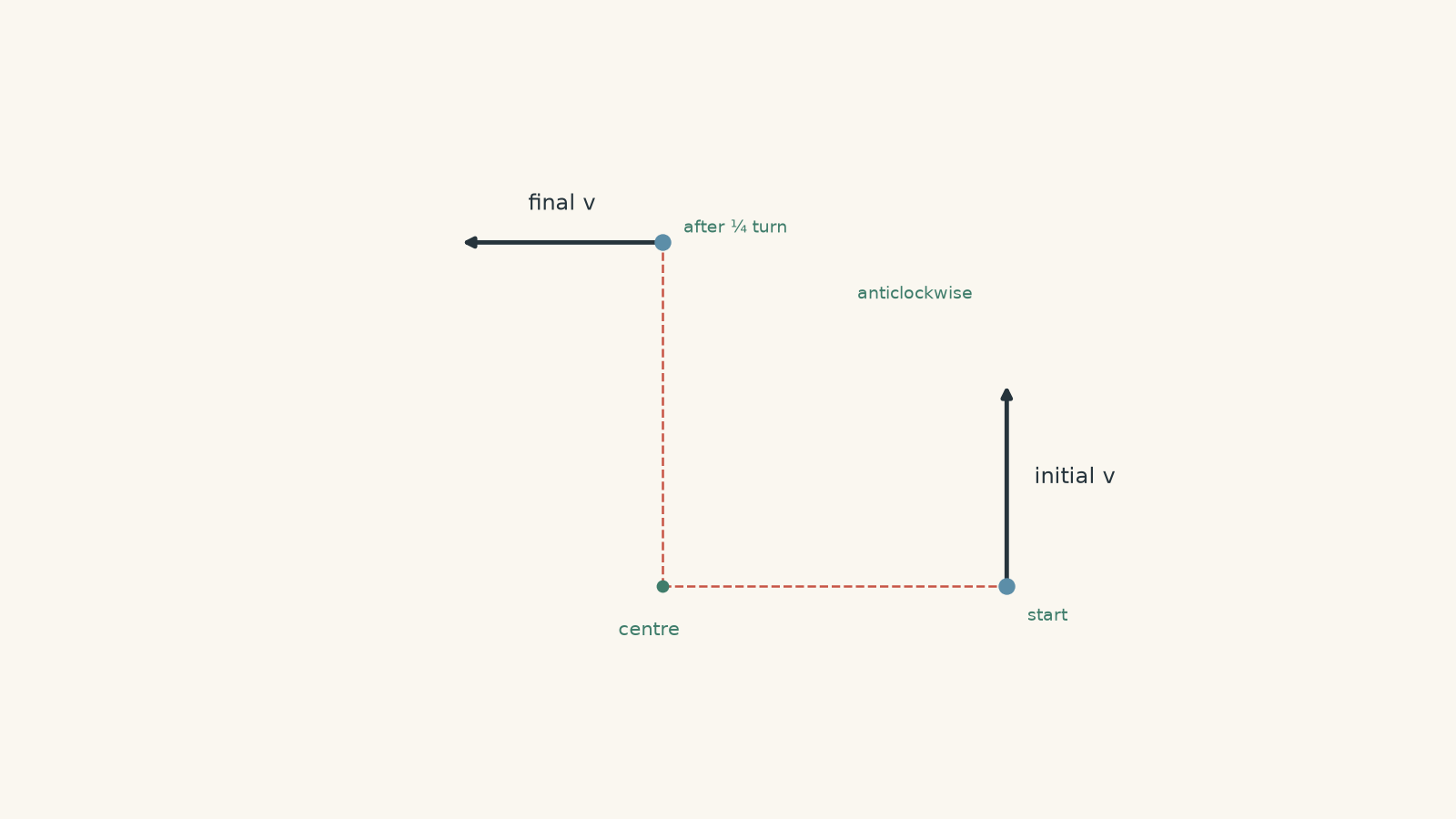
A particle moves anticlockwise at constant speed \(v\) around a circle of radius \(r\). It starts at the rightmost point of the circle, where its velocity points vertically upwards. It then travels through one quarter of a revolution to the top of the circle.
a. What is the direction of its final velocity?
b. Find the magnitude of its change in velocity over the quarter-circle.
c. Find the magnitude of its average acceleration over this interval.
d. Compare this average acceleration magnitude with the instantaneous centripetal acceleration \(v^2/r\).
Solution 4
The final velocity points left, the change in velocity has magnitude \(\sqrt{2}v\), and the average acceleration magnitude is
\[ \frac{2\sqrt{2}}{\pi}\frac{v^2}{r}, \]
which is about \(0.900\,v^2/r\).
At the rightmost point, the initial velocity is
\[ \vec v_i=(0,v). \]
At the top of the circle, anticlockwise motion gives a final velocity pointing left:
\[ \vec v_f=(-v,0). \]
The change in velocity is
\[ \Delta\vec v = \vec v_f-\vec v_i = (-v,-v). \]
Its magnitude is therefore
\[ |\Delta\vec v| = \sqrt{(-v)^2+(-v)^2} = \sqrt{2}v. \]
The particle travels one quarter of the circumference:
\[ \Delta s = \frac14(2\pi r) = \frac{\pi r}{2}. \]
Because its speed is \(v\),
\[ \Delta t = \frac{\Delta s}{v} = \frac{\pi r}{2v}. \]
The magnitude of the average acceleration is
\[ a_{\text{avg}} = \frac{|\Delta\vec v|}{\Delta t} = \frac{\sqrt{2}v}{\pi r/(2v)} = \frac{2\sqrt{2}v^2}{\pi r}. \]
Since
\[ \frac{2\sqrt{2}}{\pi}\approx0.900, \]
we obtain
\[ a_{\text{avg}}\approx0.900\frac{v^2}{r}. \]
The tempting assumption is that the average acceleration over the interval must simply equal \(v^2/r\), because the instantaneous centripetal acceleration has that magnitude everywhere. But acceleration is a vector. Its direction continually changes as the particle moves around the circle, so averaging the vector over a finite part of the orbit is not the same as averaging only its magnitude.
Question 5
A particle travels around a circle of radius \(10.0\text{ m}\). At one instant its speed is \(8.00\text{ m s}^{-1}\), and its speed is increasing.
At that instant, the magnitude of its total acceleration is \(10.0\text{ m s}^{-2}\).
a. Calculate the inward centripetal component of the acceleration.
b. Calculate the component of acceleration tangent to the circle.
c. Does the total acceleration vector point directly towards the centre? Explain.
d. A student says, “If an object is moving in a circle, its acceleration must always point exactly towards the centre.” Identify the hidden assumption in that statement.
Solution 5
The inward centripetal component is \(6.40\text{ m s}^{-2}\), the tangential component is \(7.68\text{ m s}^{-2}\), and the total acceleration does not point directly towards the centre because the particle is also speeding up.
For part a,
\[ a_c=\frac{v^2}{r}. \]
Substituting the values,
\[ a_c = \frac{(8.00\text{ m s}^{-1})^2}{10.0\text{ m}} = 6.40\text{ m s}^{-2}. \]
This component must point towards the centre because it is the part of the acceleration responsible for changing the velocity’s direction.
For part b, the particle is also speeding up, so it has a tangential acceleration \(a_t\) in the direction of motion.
The radial and tangential directions are perpendicular. Therefore the magnitude of the total acceleration satisfies
\[ a^2=a_c^2+a_t^2. \]
Hence
\[ a_t = \sqrt{a^2-a_c^2} = \sqrt{(10.0\text{ m s}^{-2})^2-(6.40\text{ m s}^{-2})^2} = 7.68\text{ m s}^{-2}. \]
For part c, the total acceleration does not point directly towards the centre. It is the vector sum of:
- \(6.40\text{ m s}^{-2}\) radially inward, which changes the direction of the velocity, and
- \(7.68\text{ m s}^{-2}\) tangentially forwards, which increases its speed.
The tempting answer is to call the entire \(10.0\text{ m s}^{-2}\) “centripetal acceleration”. That is not correct. The required centripetal acceleration is the inward component \(v^2/r\).
For part d, the hidden assumption is that the object is undergoing uniform circular motion: circular motion at constant speed.
If the speed is constant, the acceleration has no tangential component, so the total acceleration is entirely centripetal and points towards the centre.
If the speed changes, the object can still follow a circular path, but its total acceleration generally has both radial and tangential components.
That distinction is the useful next step. Once you know the inward acceleration required by a curved path, Newton’s second law lets you ask a new question: which real force, or combination of forces, is producing that inward acceleration?