
Thermal Radiation: Energy Transfer and Surface Effects
Learn how thermal radiation transfers energy through electromagnetic waves, and how absorption, reflection, emission, temperature, and surface properties affect the process.
Two identical metal cans sit the same distance from an infrared heater. One is coated with a dull, dark surface. The other is polished until it looks like a tiny mirror. Which warms faster?
You might predict the dark can, because “black things absorb heat”. That prediction is useful, but the wording needs fixing. The can does not absorb heat as a substance. It absorbs electromagnetic radiation, which transfers energy into the can. The surface determines how much of the incoming radiation is absorbed, reflected, or transmitted.
Now switch the heater off after both cans reach the same high temperature. Which can loses energy faster by radiation?
The surprising answer is usually the dull, highly absorbing surface again. A surface that is a strong absorber at a particular wavelength is also a strong emitter at that wavelength. The same surface property that helped energy get in can help energy get out.
That idea is the key to understanding thermal radiation.
01Radiation transfers energy without carrying matter across the gap
Suppose you stand near a hot barbecue without touching it. You can feel energy reaching your skin even when the hot air is not blowing towards you.
Conduction cannot explain that transfer across an air gap without contact. Convection may contribute if warm air moves towards you, but there is another mechanism: thermal radiation.
Thermal radiation is electromagnetic radiation emitted by matter because of its temperature. Like all electromagnetic radiation, it can travel through a vacuum. No particles need to move from the hot object to the cooler one.
That is why energy can travel from the Sun to Earth across mostly empty space.
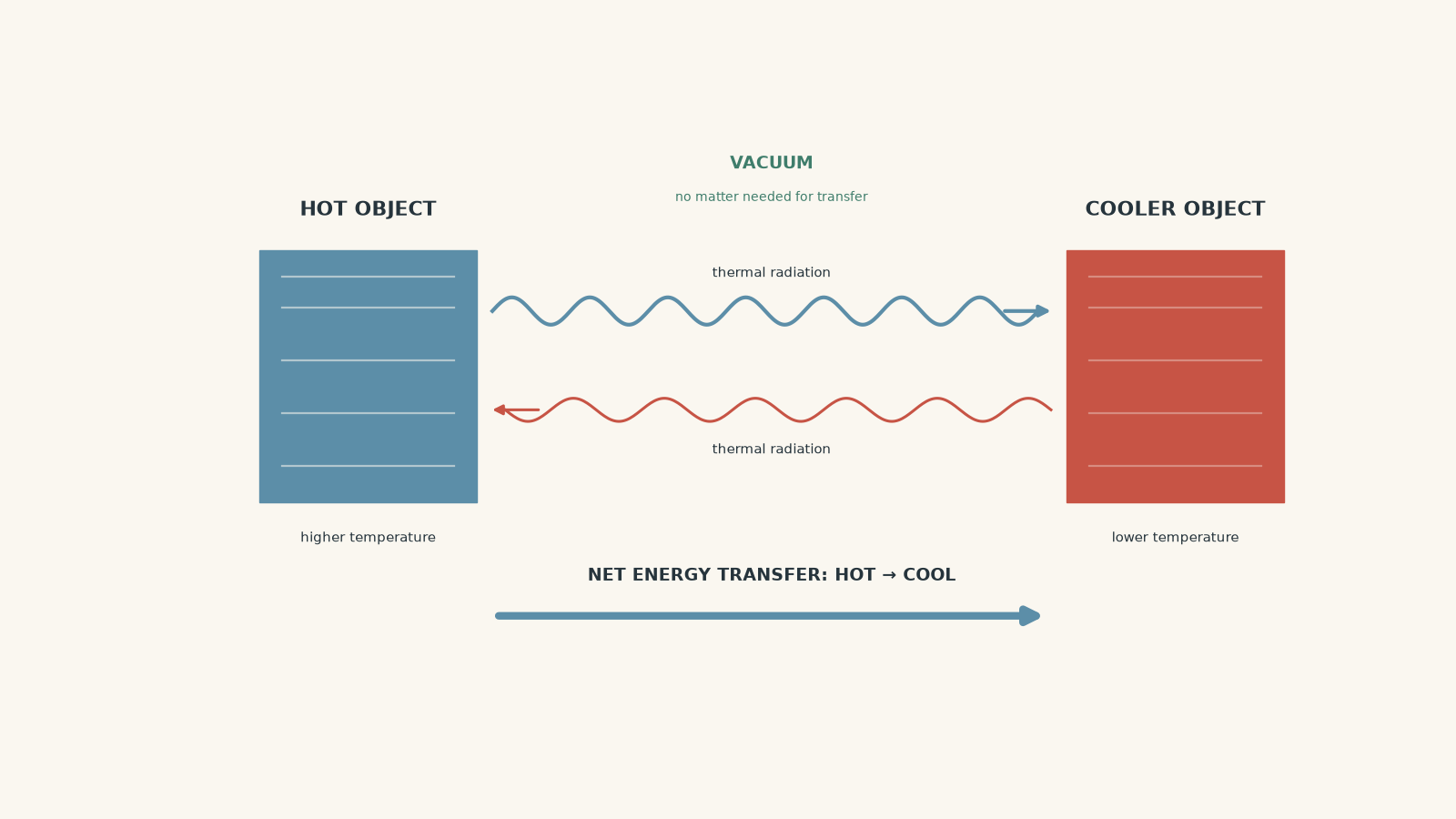
Every object above absolute zero emits electromagnetic radiation. An ordinary desk, your hand, an ice cube, and the Sun all emit thermal radiation. The important differences are how much they emit and which wavelengths carry most of that radiation.
At everyday temperatures, most thermal radiation is infrared, so your eyes cannot see it. Make an object hot enough and some of its emission moves into the visible range. A metal element that begins to glow dull red is not suddenly starting to radiate. It was radiating before you could see it.
02What happens when radiation reaches a surface?
Imagine incoming radiation as a group arriving at a very selective party.
Some gets absorbed and stays. Some gets reflected straight back outside. In some materials, some is transmitted through.
The analogy is useful because the incoming energy has to go somewhere. It breaks down because real electromagnetic waves do not make one permanent decision at the door. Surface behaviour depends on wavelength, material, surface condition, and sometimes the angle of incidence.
We describe the three possibilities using fractions:
- absorptivity, \(\alpha\): the fraction of incident radiant power absorbed
- reflectivity, \(\rho\): the fraction reflected
- transmissivity, \(\tau\): the fraction transmitted
Energy conservation gives
\[
\alpha + \rho + \tau = 1
\]
These quantities have no units because they are fractions.
For an opaque object, essentially no radiation is transmitted through it, so \(\tau \approx 0\). The relationship becomes
\[
\alpha + \rho \approx 1
\]
This creates an important trade-off. If an opaque surface reflects a large fraction of the incoming radiation, it must absorb a smaller fraction.
What about shiny and dull surfaces?
For many common surfaces in thermal-radiation experiments:
| Surface | Absorption | Reflection | Thermal emission |
|---|---|---|---|
| Dull, strongly absorbing surface | High | Low | High |
| Polished metallic surface | Low | High | Low |
This table is a useful HSC model, not a universal rule about visible colour.
A surface can behave differently at different wavelengths. Something that looks white because it reflects visible light may still absorb or emit infrared radiation strongly. Something that looks black to your eyes is mainly telling you about its behaviour in the visible part of the electromagnetic spectrum.
That wavelength dependence becomes important in thermal engineering.
03Absorbing radiation increases internal energy
Suppose electromagnetic radiation carrying 100 J reaches an opaque surface, and its absorptivity is \(0.70\).
The surface absorbs
\[
E_{\text{absorbed}} = 0.70(100\text{ J}) = 70\text{ J}
\]
The remaining 30 J is reflected if transmission is negligible.
What does the absorbed 70 J do?
It contributes to the object’s internal energy. This may increase the object’s temperature, cause a change of state, or be transferred elsewhere by conduction, convection, or further radiation.
Be careful with the language here. An object contains internal energy. Heat describes energy transferred because of a temperature difference.
Worked example: How much radiant energy is absorbed?
An infrared lamp delivers \(40\text{ W}\) of radiant power to a sensor for \(30\text{ s}\). The sensor surface has an absorptivity of \(0.75\) at the lamp’s wavelengths. How much energy does the sensor absorb?
Step 1
The incident power is \(P_{\text{inc}} = 40\text{ W}\), and the absorptivity is \(\alpha = 0.75\).
\[
P_{\text{abs}} = \alpha P_{\text{inc}}
= 0.75(40\text{ W})
= 30\text{ W}
\]
So the sensor absorbs energy at a rate of \(30\text{ J s}^{-1}\).
Step 2
Power is energy transferred per unit time:
\[
P = \frac{E}{t}
\]
so
\[
E = Pt
\]
where \(E\) is energy in joules, \(P\) is power in watts, and \(t\) is time in seconds.
Substituting,
\[
E_{\text{abs}} = (30\text{ W})(30\text{ s})
= 900\text{ J}
\]
The sensor absorbs 900 J of radiant energy.
This does not necessarily mean its internal energy increases by 900 J. While it is absorbing radiation, it may also be emitting radiation or losing energy by conduction and convection.
04Emission happens at the same time as absorption
A common mistake is to imagine that a hot object emits radiation while a cold object only absorbs it.
Both objects emit and absorb.
Put a hot mug in a cooler room. The mug emits thermal radiation towards the room, but the walls, table, and everything else in the room also emit radiation towards the mug.
So why does the mug cool?
Because the mug is hotter. It emits radiant energy at a greater rate than it absorbs from its cooler surroundings. There is a net transfer of energy out of the mug.
If we focus only on radiation,
\[
P_{\text{net,in}} = P_{\text{abs}} – P_{\text{emit}}
\]
where \(P_{\text{abs}}\) is absorbed radiant power and \(P_{\text{emit}}\) is emitted radiant power.
If \(P_{\text{net,in}}>0\), the object gains energy by radiation.
If \(P_{\text{net,in}}<0\), it loses energy by radiation.
At thermal equilibrium, the net transfer is zero. That does not mean radiation has stopped. Energy continues to be exchanged in both directions at equal rates.
Worked example: Is the object gaining or losing energy?
A panel receives \(150\text{ W}\) of infrared radiation. At these wavelengths, its absorptivity is \(0.80\). At the same time, the panel emits \(65\text{ W}\) of thermal radiation. Ignore conduction and convection.
Find the panel’s net radiative energy change over \(48\text{ s}\).
Step 1
\[
P_{\text{abs}}=\alpha P_{\text{inc}}
=(0.80)(150\text{ W})
=120\text{ W}
\]
The panel absorbs \(120\text{ W}\).
Step 2
\[
P_{\text{net,in}}
=P_{\text{abs}}-P_{\text{emit}}
=120\text{ W}-65\text{ W}
=55\text{ W}
\]
The positive result means the panel is gaining energy by radiation.
Step 3
\[
E_{\text{net}}
=P_{\text{net,in}}t
=(55\text{ W})(48\text{ s})
=2640\text{ J}
\]
So the panel gains
\[
\boxed{2.64\times10^3\text{ J}}
\]
of energy by radiation during the \(48\text{ s}\) interval.
The important idea is the balance. A body can be emitting energy continuously and still warm up if it absorbs energy even faster.
05Good absorbers are good emitters, with an important condition
Return to the two metal cans.
Why can the dull surface both warm faster under radiation and cool faster by radiation?
For a surface in thermal equilibrium, good absorbers at a particular wavelength are also good emitters at that wavelength. This relationship is associated with Kirchhoff’s law of thermal radiation.
That “at that wavelength” condition matters.
Suppose a coating reflects most visible sunlight but emits infrared radiation strongly. There is no contradiction. The incoming solar radiation and the object’s outgoing thermal radiation occupy different wavelength ranges.
This is why the shortcut
black = absorber, shiny = reflector
is only a first model.
A better question is:
At the wavelengths involved, how strongly does this surface absorb, reflect, and emit?
That version survives harder HSC questions.
06Temperature changes the radiation too
Surface properties are only part of the story. Temperature matters strongly.
As an object’s absolute temperature increases:
- it emits more thermal radiation overall
- the distribution of emitted wavelengths changes
- the wavelength at which emission is strongest shifts towards shorter wavelengths
You do not need this idea to explain why radiation can cross a vacuum, but it explains observations such as a heating metal changing from invisible infrared emission to a visible red glow.
This also prevents another misconception: a dull black object is not automatically emitting more total radiation than every shiny object you can find. Temperature matters. A cool black plate can emit less total power than a much hotter polished object.
When comparing surfaces, hold the other important variables, especially temperature and area, constant.
07Surface area changes the total transfer
Imagine two objects made from the same material and held at the same temperature. One has twice the exposed surface area.
Each small patch of surface can emit radiation, so the larger object can emit more total radiant power.
This is why a fair experiment comparing surface finishes should control:
- temperature
- exposed area
- distance and orientation relative to the source
- material beneath the coating where relevant
- surrounding conditions
If several variables change at once, you cannot confidently say which one caused the observed difference.
08The misconception to avoid: “Black objects absorb heat”
That sentence often leads to the right prediction for the wrong reason.
Three corrections make it much stronger physics.
First, the object absorbs radiation, transferring energy into its internal energy.
Second, “black” usually describes what your eyes see in the visible spectrum. Thermal radiation from ordinary objects is mainly infrared.
Third, absorption is only one side of the exchange. The object is also emitting radiation.
So, if a dull black and polished metal container are placed under the same infrared source, the dull surface may absorb energy faster. If both are then heated to the same temperature and placed in cooler surroundings, that same dull surface may also lose energy faster by radiation.
The surface did not switch jobs. Absorption and emission are linked properties.
09Questions and solutions
Question 1
A spacecraft is travelling through a region where there is effectively no atmosphere. An electronic component becomes hot. Explain whether it can lose thermal energy to space, even though there are no surrounding air particles to carry the energy away.
Solution 1
Yes. The component can lose energy by emitting electromagnetic radiation.
Conduction and convection require matter, so neither can transfer energy through empty space away from the spacecraft. Thermal radiation does not require a material medium.
The hot component emits electromagnetic radiation, mostly at infrared wavelengths for ordinary engineering temperatures. The radiation carries energy away from the spacecraft.
The tempting misconception is that “no particles means no heat transfer”. The correct statement is narrower: no particles means no conduction or convection through that region. Radiation still works.
Question 2
A surface receives \(72\text{ W}\) of infrared radiation and has an absorptivity of \(0.60\) at those wavelengths.
Calculate:
a. the radiant power absorbed
b. the radiant energy absorbed in \(20\text{ s}\)
Assume the absorptivity stays constant.
Solution 2
The surface absorbs \(43.2\text{ W}\), corresponding to \(864\text{ J}\) in \(20\text{ s}\).
The absorbed power is
\[
P_{\text{abs}}
=\alpha P_{\text{inc}}
=(0.60)(72\text{ W})
=43.2\text{ W}
\]
For a time of \(t=20\text{ s}\),
\[
E_{\text{abs}}
=P_{\text{abs}}t
=(43.2\text{ W})(20\text{ s})
=864\text{ J}
\]
So:
- a. \(P_{\text{abs}}=43.2\text{ W}\)
- b. \(E_{\text{abs}}=864\text{ J}\)
This is the amount absorbed from the incident radiation. It is not automatically the increase in the object’s internal energy, because the object may simultaneously lose energy by radiation, conduction, or convection.
Question 3
Two identical metal containers are at \(80^\circ\text{C}\) in the same \(20^\circ\text{C}\) room. Container A has a dull surface with high infrared emissivity. Container B has a polished metallic surface with low infrared emissivity.
A student says, “Container A only cools faster because black surfaces absorb more radiation.”
Evaluate the student’s explanation, considering radiation only.
Solution 3
Container A is expected to cool faster by radiation, but the student’s explanation uses the wrong direction of energy transfer.
Both containers emit thermal radiation and absorb radiation from the room. Because the containers are hotter than their surroundings, the net radiative transfer is outward.
Container A has the higher infrared emissivity, so at the same temperature and exposed area it emits thermal radiation more strongly. It is therefore expected to have a greater net radiative energy loss.
Its high absorptivity also means it absorbs infrared radiation from the room strongly, but this does not reverse the result. The cooler room supplies less radiant energy than the hot container emits.
The trap is focusing only on absorption because that is how surface colour is often introduced. Cooling requires you to examine emission and the net energy balance.
Question 4
An object has reached thermal equilibrium with the walls of a closed room. Everything is at the same temperature.
A student argues that the object must have stopped emitting infrared radiation, because otherwise it would keep losing energy.
Explain what is actually happening.
Solution 4
The object is still emitting infrared radiation, but it absorbs radiant energy at the same average rate, so its net radiative energy transfer is zero.
All objects above absolute zero emit thermal radiation. The room’s walls also emit radiation towards the object.
At thermal equilibrium,
\[
P_{\text{abs}}=P_{\text{emit}}
\]
so
\[
P_{\text{net,in}}
=P_{\text{abs}}-P_{\text{emit}}
=0
\]
The object’s internal energy therefore does not change because of radiation on average.
The misconception comes from confusing zero net transfer with zero transfer in each direction. Thermal equilibrium is dynamic. Energy is still being exchanged.
Question 5
An engineer is choosing an opaque coating for a device operating in the vacuum of space. The device receives radiation mainly at short solar wavelengths but emits most of its own thermal radiation at much longer infrared wavelengths.
The measured properties are:
| Coating | Absorptivity at solar wavelengths | Emissivity at thermal infrared wavelengths |
|---|---|---|
| A | 0.15 | 0.20 |
| B | 0.30 | 0.90 |
| C | 0.60 | 0.95 |
The aim is to reduce heating from the Sun while allowing the device to lose thermal energy effectively.
Which coating is the most suitable based on the information given? Explain why your choice does not violate the rule that good absorbers are good emitters.
Solution 5
Coating B is the most suitable of the three because it combines relatively low absorption of incoming solar radiation with very strong emission in the thermal infrared.
Coating A absorbs the least solar radiation, which initially looks ideal. However, its infrared emissivity is only \(0.20\), so once the device becomes warm it is poor at radiating its own thermal energy away.
Coating C is an excellent infrared emitter, with emissivity \(0.95\), but it also absorbs \(60\%\) of the incident radiation at the solar wavelengths being considered. That produces a much larger incoming energy load.
Coating B is the useful compromise. It absorbs only \(30\%\) of the incoming solar radiation while having an infrared emissivity of \(0.90\), so it can reject thermal energy strongly.
This does not violate the relationship between absorption and emission because that relationship must be compared at the same wavelength. The table gives absorptivity at short solar wavelengths and emissivity at much longer thermal infrared wavelengths. A material can therefore reflect one part of the electromagnetic spectrum while emitting strongly in another.
The hidden assumption in the simple rule “good absorbers are good emitters” is that you are discussing the same wavelength range.
10Where thermal radiation leads next
Once you separate emission, absorption, reflection, and net energy transfer, black-body radiation becomes much easier to understand.
A black body is an idealised absorber and emitter. Its emitted spectrum depends on temperature, which allows thermal radiation to reveal information about objects that cannot be touched directly, including stars. The same idea that explains why a dull surface cools efficiently eventually becomes a way of estimating the temperature of objects across astronomical distances.