
Relative Position and Motion in Two Dimensions for HSC Physics
Learn how to model relative position and velocity for observers moving on a plane, using vector subtraction, components, and clear worked examples.
Imagine you are standing on a ferry moving east while a speedboat cuts north-east across the harbour. Someone on the shore measures one velocity for the speedboat. You measure another. Neither measurement has to be wrong.
Before doing any mathematics, predict this: if the speedboat and ferry happened to move with exactly the same velocity, what would the speedboat look like from the ferry?
It would appear stationary. Its velocity relative to you would be zero.
That simple idea is the heart of two-dimensional relative motion. We compare two objects by subtracting their position vectors or velocity vectors.
01Start with position: where is A relative to B?
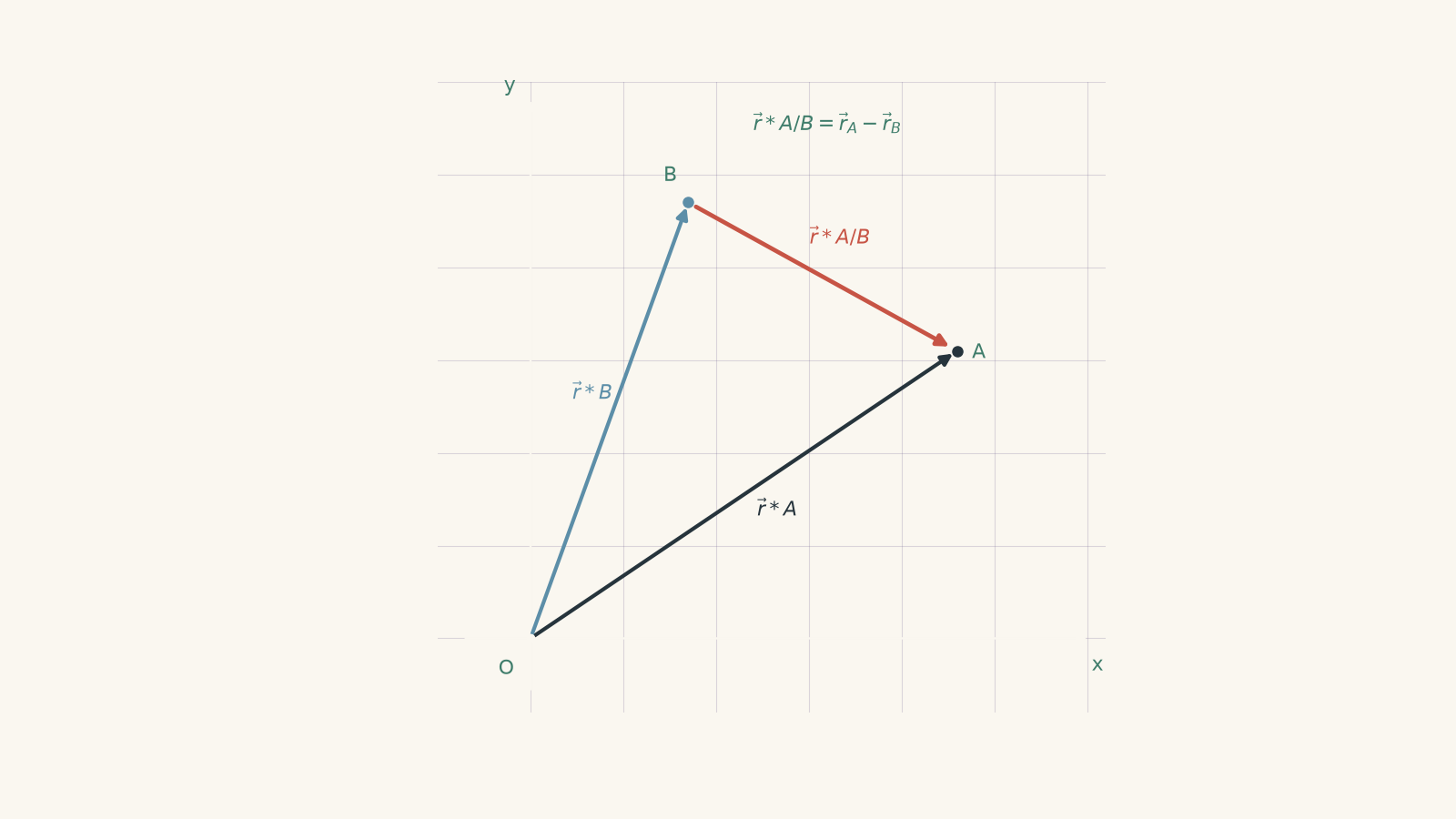
Suppose two objects, A and B, are moving across a flat plane. An observer at a fixed origin measures their position vectors:
- \(\vec r_A\): position of A
- \(\vec r_B\): position of B
Both vectors must be measured from the same origin and at the same instant.
Now imagine you are sitting at B. You do not really care where A is relative to some distant origin. You care where A is relative to you.
The vector from B to A is:
\[
\vec r_{A/B} = \vec r_A – \vec r_B
\]
Here, \(\vec r_{A/B}\) means “the position of A relative to B”.
Why subtraction?
Picture two friends standing in a park. One friend is at \((8,5)\) m and the other is at \((3,2)\) m.
From the second friend’s point of view, the first friend is:
\[
(8,5) – (3,2) = (5,3)\text{ m}
\]
So the first friend is 5 m east and 3 m north of the second.
The subtraction removes the part of their positions that they share relative to the original origin.
A slightly silly analogy is comparing two people’s bank balances. If Alex has $80 and Bailey has $50, Alex has $30 more than Bailey. Relative position works similarly, except we subtract vectors, so direction matters too.
The analogy stops there. Positions have spatial directions and can change continuously as objects move.
02Relative position in components
For motion on a plane, it is usually easiest to work with horizontal and vertical components.
If
\[
\vec r_A = x_A\hat i + y_A\hat j
\]
and
\[
\vec r_B = x_B\hat i + y_B\hat j
\]
then
\[
\vec r_{A/B}
= (x_A-x_B)\hat i + (y_A-y_B)\hat j
\]
where:
- \(x_A\) and \(x_B\) are the horizontal coordinates of A and B, usually in metres
- \(y_A\) and \(y_B\) are the vertical coordinates
- \(\hat i\) is a unit vector in the positive \(x\)-direction
- \(\hat j\) is a unit vector in the positive \(y\)-direction
For compass problems, we often choose:
- east as positive \(x\)
- north as positive \(y\)
That choice is not compulsory. What matters is that you choose axes and use them consistently.
Worked example: Where is the drone relative to the boat?
A drone is at position \((420,310)\) m relative to a harbour marker. A boat is at \((170,190)\) m relative to the same marker. Find the position of the drone relative to the boat.
Step 1
\[
\vec r_{\text{drone/boat}}
=
\vec r_{\text{drone}}
–
\vec r_{\text{boat}}
\]
Step 2
\[
\begin{aligned}
\vec r_{\text{drone/boat}}
&= (420-170)\hat i + (310-190)\hat j\\
&= 250\hat i + 120\hat j\text{ m}
\end{aligned}
\]
Step 3
The drone is 250 m east and 120 m north of the boat.
If we want the straight-line distance between them:
\[
\begin{aligned}
|\vec r_{\text{drone/boat}}|
&= \sqrt{250^2+120^2}\\
&\approx 277\text{ m}
\end{aligned}
\]
The relative-position vector tells us more than the distance. It tells us both distance and direction.
03Now let both objects move
Position tells us where A is relative to B at one instant. Usually, the more useful question is how that relative position is changing.
Suppose:
- A has velocity \(\vec v_A\)
- B has velocity \(\vec v_B\)
Differentiate the relative-position equation with respect to time:
\[
\vec r_{A/B} = \vec r_A-\vec r_B
\]
so
\[
\vec v_{A/B} = \vec v_A-\vec v_B
\]
This is the central relative-velocity equation.
\[
\boxed{\vec v_{A/B} = \vec v_A-\vec v_B}
\]
It means:
Velocity of A as observed from B = velocity of A minus velocity of B.
The order matters.
\[
\vec v_{A/B} \neq \vec v_{B/A}
\]
Instead,
\[
\vec v_{B/A}=-\vec v_{A/B}
\]
If I see you moving north-east at 4 m s\(^{-1}\), you see me moving south-west at 4 m s\(^{-1}\).
Same magnitude, opposite direction.
04Why relative velocity is vector subtraction
Suppose two cars travel east along neighbouring lanes.
Car A travels at 25 m s\(^{-1}\), and car B travels at 20 m s\(^{-1}\).
From the roadside, A moves at 25 m s\(^{-1}\). From B, however, A slowly pulls ahead at only:
\[
v_{A/B}=25-20=5\text{ m s}^{-1}
\]
Now change B’s velocity. If B moves west at 20 m s\(^{-1}\), we represent that as \(-20\text{ m s}^{-1}\).
Then:
\[
v_{A/B}=25-(-20)=45\text{ m s}^{-1}
\]
Subtraction still works. The signs carry the direction information.
In two dimensions, exactly the same idea applies, except the subtraction happens component by component.
05Relative velocity on a plane
Suppose
\[
\vec v_A=v_{Ax}\hat i+v_{Ay}\hat j
\]
and
\[
\vec v_B=v_{Bx}\hat i+v_{By}\hat j
\]
Then:
\[
\vec v_{A/B}
=
(v_{Ax}-v_{Bx})\hat i
+
(v_{Ay}-v_{By})\hat j
\]
Once you have the components, the magnitude is:
\[
|\vec v_{A/B}|
=
\sqrt{(v_{Ax}-v_{Bx})^2+(v_{Ay}-v_{By})^2}
\]
If you need the direction, use trigonometry on the relative-velocity components.
For example, if the relative velocity is \(6\hat i+8\hat j\text{ m s}^{-1}\), then its magnitude is:
\[
\sqrt{6^2+8^2}=10\text{ m s}^{-1}
\]
and the direction is:
\[
\theta=\tan^{-1}\left(\frac{8}{6}\right)\approx53.1^\circ
\]
So A moves at \(10\text{ m s}^{-1}\), \(53.1^\circ\) north of east, relative to B.
Be careful with direction. The inverse tangent gives you an angle, but the signs of the components tell you which quadrant the vector actually lies in.
06The most tempting mistake: subtracting speeds instead of velocities
Consider two aircraft:
- A travels east at \(200\text{ m s}^{-1}\)
- B travels north at \(200\text{ m s}^{-1}\)
A student might say:
“Their speeds are equal, so their relative speed is zero.”
That sounds reasonable if you focus only on the numbers.
But velocity includes direction.
Using east as \(+x\) and north as \(+y\):
\[
\vec v_A=200\hat i
\]
\[
\vec v_B=200\hat j
\]
Therefore:
\[
\vec v_{A/B}
=
200\hat i-200\hat j
\]
The relative speed is:
\[
|\vec v_{A/B}|
=
\sqrt{200^2+(-200)^2}
\approx283\text{ m s}^{-1}
\]
Equal speeds do not imply zero relative velocity. Zero relative velocity requires equal velocity vectors.
That means equal magnitude and equal direction.
07A useful decision rule
Whenever you see a relative-motion problem, ask:
“Whose motion am I describing, and relative to whom?”
Then write the labels before putting in numbers.
For example:
\[
\vec v_{\text{plane/air}}
=
\vec v_{\text{plane}}
–
\vec v_{\text{air}}
\]
or
\[
\vec v_{\text{boat/water}}
=
\vec v_{\text{boat}}
–
\vec v_{\text{water}}
\]
The notation prevents one of the most common mistakes: reversing the subtraction.
A reliable verbal version is:
first object minus second object.
So “A relative to B” means \(A-B\).
08Worked example: Two boats moving in different directions
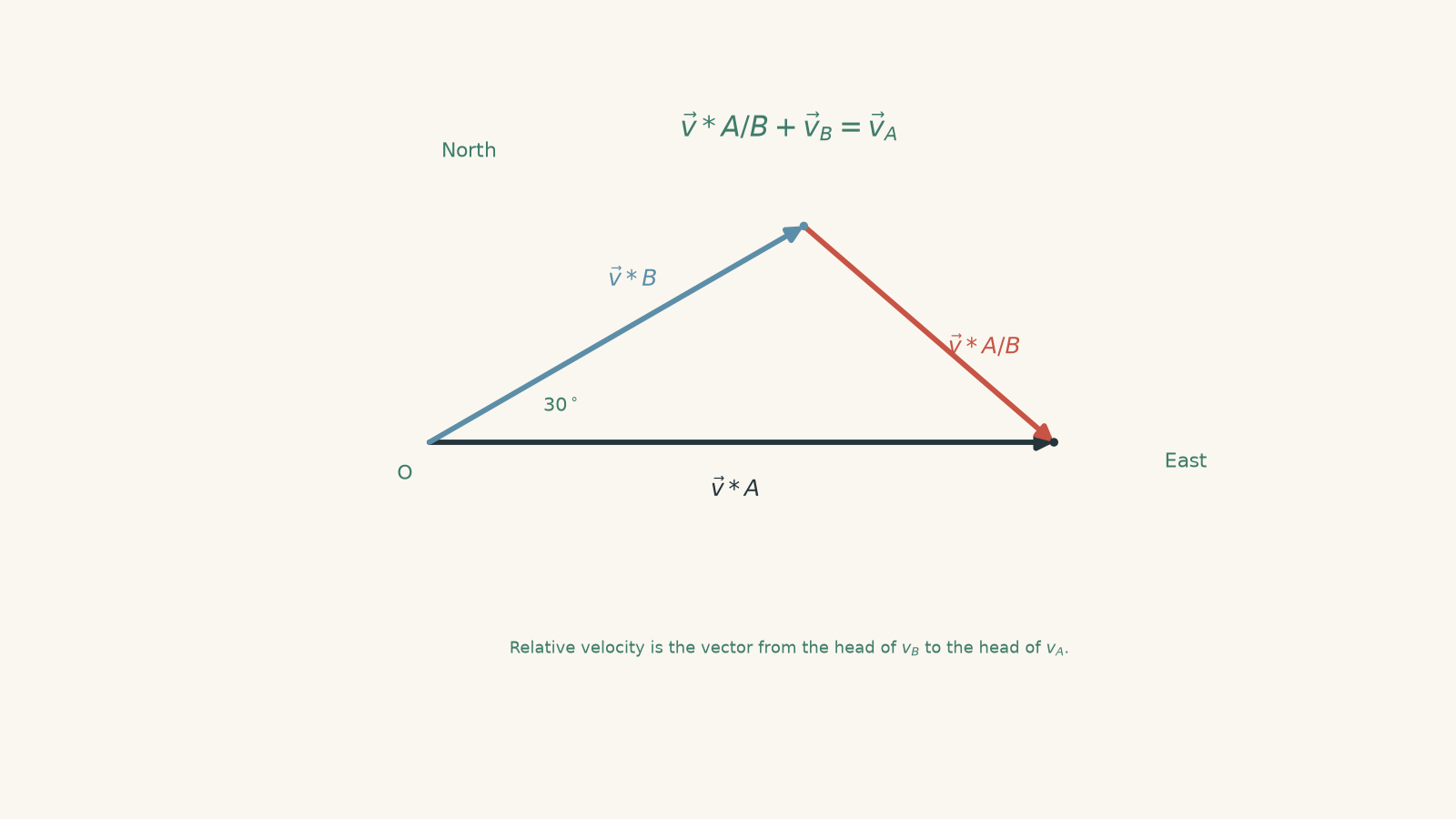
Boat A moves east at \(12.0\text{ m s}^{-1}\). Boat B moves at \(8.0\text{ m s}^{-1}\), \(30^\circ\) north of east. Find the velocity of A relative to B.
Step 1
Let east be \(+x\) and north be \(+y\).
Boat A has components:
\[
\vec v_A=12.0\hat i\text{ m s}^{-1}
\]
Boat B must first be resolved into components:
\[
\begin{aligned}
v_{Bx}&=8.0\cos30^\circ=6.93\text{ m s}^{-1}\\
v_{By}&=8.0\sin30^\circ=4.00\text{ m s}^{-1}
\end{aligned}
\]
Therefore:
\[
\vec v_B
=
6.93\hat i+4.00\hat j\text{ m s}^{-1}
\]
Step 2
\[
\begin{aligned}
\vec v_{A/B}
&=\vec v_A-\vec v_B\\
&=(12.0-6.93)\hat i+(0-4.00)\hat j\\
&=5.07\hat i-4.00\hat j\text{ m s}^{-1}
\end{aligned}
\]
The negative vertical component means A appears to move south relative to B.
Step 3
\[
\begin{aligned}
|\vec v_{A/B}|
&=\sqrt{5.07^2+(-4.00)^2}\\
&=6.46\text{ m s}^{-1}
\end{aligned}
\]
Step 4
The relative velocity has a positive east component and a negative north component, so it points south of east.
\[
\begin{aligned}
\theta
&=\tan^{-1}\left(\frac{4.00}{5.07}\right)\\
&=38.3^\circ
\end{aligned}
\]
Therefore:
\[
\boxed{\vec v_{A/B}=6.46\text{ m s}^{-1},\ 38.3^\circ\text{ south of east}}
\]
From boat B, boat A appears to move diagonally towards the south-east, even though A is actually travelling due east relative to the shore.
09The triangle form of relative velocity
The equation
\[
\vec v_{A/B}=\vec v_A-\vec v_B
\]
can be rearranged:
\[
\vec v_A=\vec v_{A/B}+\vec v_B
\]
This form is useful when one velocity is naturally measured relative to a moving medium or observer.
For example, an aircraft’s motion relative to the ground can be thought of as:
\[
\vec v_{\text{plane/ground}}
=
\vec v_{\text{plane/air}}
+
\vec v_{\text{air/ground}}
\]
Here:
- \(\vec v_{\text{plane/air}}\) is the aircraft’s velocity through the surrounding air
- \(\vec v_{\text{air/ground}}\) is the wind velocity
- \(\vec v_{\text{plane/ground}}\) is what an observer fixed to the ground measures
This is not a new law. It is the same relative-velocity relationship rearranged.
10Worked example: A research drone in a crosswind
A drone must travel due north relative to the ground at \(15.0\text{ m s}^{-1}\). A wind blows east at \(6.0\text{ m s}^{-1}\). Find the velocity the drone must have relative to the air.
At first, you might predict that the drone should simply point north.
It cannot. If it pointed north relative to the air, the wind would carry it east. It must aim partly west so that its westward motion through the air cancels the eastward wind.
Step 1
\[
\vec v_{\text{drone/ground}}
=
\vec v_{\text{drone/air}}
+
\vec v_{\text{air/ground}}
\]
Rearranging:
\[
\vec v_{\text{drone/air}}
=
\vec v_{\text{drone/ground}}
–
\vec v_{\text{air/ground}}
\]
Step 2
Taking east as \(+x\) and north as \(+y\):
\[
\vec v_{\text{drone/ground}}
=
0\hat i+15.0\hat j\text{ m s}^{-1}
\]
and
\[
\vec v_{\text{air/ground}}
=
6.0\hat i+0\hat j\text{ m s}^{-1}
\]
Step 3
\[
\begin{aligned}
\vec v_{\text{drone/air}}
&=(0-6.0)\hat i+(15.0-0)\hat j\\
&=-6.0\hat i+15.0\hat j\text{ m s}^{-1}
\end{aligned}
\]
Step 4
\[
\begin{aligned}
|\vec v_{\text{drone/air}}|
&=\sqrt{(-6.0)^2+15.0^2}\\
&=\sqrt{261}\\
&=16.2\text{ m s}^{-1}
\end{aligned}
\]
Step 5
The velocity points west of north.
\[
\begin{aligned}
\theta
&=\tan^{-1}\left(\frac{6.0}{15.0}\right)\\
&=21.8^\circ
\end{aligned}
\]
Therefore the drone must fly at:
\[
\boxed{16.2\text{ m s}^{-1},\ 21.8^\circ\text{ west of north}}
\]
That heading produces a westward component of \(6.0\text{ m s}^{-1}\), exactly cancelling the wind’s eastward velocity. The resulting ground motion is due north.
11Relative position changes according to relative velocity
The position and velocity equations are connected.
For constant velocities:
\[
\vec r_{A/B}(t)
=
\vec r_{A/B}(0)
+
\vec v_{A/B}t
\]
where:
- \(\vec r_{A/B}(0)\) is the initial position of A relative to B
- \(\vec v_{A/B}\) is the constant velocity of A relative to B
- \(t\) is elapsed time in seconds
- \(\vec r_{A/B}(t)\) is the relative position after time \(t\)
This equation turns many “Will they meet?” or “How close will they get?” problems into ordinary motion questions.
There is one particularly important case.
If:
\[
\vec r_{A/B}(t)=\vec 0
\]
then A and B occupy the same position at that instant.
For a collision or interception to occur under constant velocity, the same value of \(t\) must make both components of the relative position zero.
That last condition matters. Getting \(x=0\) at one time and \(y=0\) at another does not mean the objects collide.
12Relative acceleration
The same pattern continues.
Starting from:
\[
\vec v_{A/B}=\vec v_A-\vec v_B
\]
differentiate again:
\[
\vec a_{A/B}=\vec a_A-\vec a_B
\]
where \(\vec a_{A/B}\) is A’s acceleration relative to B.
If both objects have exactly the same acceleration, then:
\[
\vec a_{A/B}=\vec 0
\]
Their relative velocity stays constant.
There is an important limit to this simple picture. Our equations assume that the coordinate axes used by the observers remain parallel and do not rotate relative to each other. Rotating reference frames require extra terms, because a changing direction of the observer’s axes affects the measured motion.
For standard HSC relative-motion problems involving translating observers, vector subtraction is the model you need.
13A compact way to organise problems
When a two-dimensional relative-motion question becomes messy, use this sequence:
- Choose positive \(x\) and \(y\) directions.
- Draw or identify each relevant velocity vector.
- Resolve angled vectors into components.
- Decide exactly which relative quantity is required.
- Write the symbolic equation first, such as \(\vec v_{A/B}=\vec v_A-\vec v_B\).
- Subtract the \(x\)-components.
- Subtract the \(y\)-components.
- Find magnitude and direction only if the question asks for them.
- Interpret the result physically.
Writing the symbolic equation before substituting numbers is worth the extra line. It makes reversed subtraction much easier to spot.
14Questions and solutions
Question 1
A cyclist moves east at \(9.0\text{ m s}^{-1}\). A second cyclist beside them moves east at \(6.5\text{ m s}^{-1}\).
Find the velocity of the first cyclist relative to the second.
Solution 1
The first cyclist moves at \(2.5\text{ m s}^{-1}\) east relative to the second cyclist.
Take east as positive. Then:
\[
\begin{aligned}
v_{1/2}
&=v_1-v_2\\
&=9.0-6.5\\
&=2.5\text{ m s}^{-1}
\end{aligned}
\]
The positive result means cyclist 1 moves east relative to cyclist 2.
Although both cyclists move much faster relative to the road, their separation increases at only \(2.5\text{ m s}^{-1}\).
Question 2
A weather balloon has ground velocity
\[
\vec v_B=4.0\hat i+7.0\hat j\text{ m s}^{-1}
\]
while a monitoring aircraft has ground velocity
\[
\vec v_A=10.0\hat i+3.0\hat j\text{ m s}^{-1}
\]
Find the velocity of the balloon relative to the aircraft, including its magnitude and direction.
Solution 2
The balloon moves at \(7.21\text{ m s}^{-1}\), \(33.7^\circ\) north of west, relative to the aircraft.
The required velocity is balloon relative to aircraft, so the order is:
\[
\vec v_{B/A}=\vec v_B-\vec v_A
\]
Substituting:
\[
\begin{aligned}
\vec v_{B/A}
&=(4.0-10.0)\hat i+(7.0-3.0)\hat j\\
&=-6.0\hat i+4.0\hat j\text{ m s}^{-1}
\end{aligned}
\]
Its magnitude is:
\[
\begin{aligned}
|\vec v_{B/A}|
&=\sqrt{(-6.0)^2+4.0^2}\\
&=\sqrt{52}\\
&=7.21\text{ m s}^{-1}
\end{aligned}
\]
The vector has a negative east component and a positive north component, so it points north of west.
\[
\theta
=
\tan^{-1}\left(\frac{4.0}{6.0}\right)
=
33.7^\circ
\]
The main trap is reversing the subtraction. Doing so would give the aircraft’s velocity relative to the balloon instead. That vector would have the same magnitude but the opposite direction.
Question 3
A boat moves through still water at \(10.0\text{ m s}^{-1}\), directed due north relative to the water. The river current flows east at \(4.0\text{ m s}^{-1}\).
A student claims that the boat’s speed relative to the riverbank is \(10.0-4.0=6.0\text{ m s}^{-1}\).
Explain why this is incorrect, and find the boat’s actual velocity relative to the bank.
Solution 3
The boat moves at \(10.8\text{ m s}^{-1}\), \(21.8^\circ\) east of north, relative to the bank. The student’s subtraction is incorrect because the two velocities point in perpendicular directions.
The velocity relationship is:
\[
\vec v_{\text{boat/bank}}
=
\vec v_{\text{boat/water}}
+
\vec v_{\text{water/bank}}
\]
Taking east as \(+x\) and north as \(+y\):
\[
\vec v_{\text{boat/water}}
=
0\hat i+10.0\hat j\text{ m s}^{-1}
\]
and
\[
\vec v_{\text{water/bank}}
=
4.0\hat i+0\hat j\text{ m s}^{-1}
\]
Therefore:
\[
\vec v_{\text{boat/bank}}
=
4.0\hat i+10.0\hat j\text{ m s}^{-1}
\]
Its magnitude is:
\[
\begin{aligned}
|\vec v_{\text{boat/bank}}|
&=\sqrt{4.0^2+10.0^2}\\
&=\sqrt{116}\\
&=10.8\text{ m s}^{-1}
\end{aligned}
\]
The direction is:
\[
\theta
=
\tan^{-1}\left(\frac{4.0}{10.0}\right)
=
21.8^\circ
\]
measured east of north.
The tempting mistake is treating vectors as ordinary positive numbers. Speeds can be subtracted directly only when the relevant velocities lie along the same line and their directions have already been handled using signs.
Question 4
At \(t=0\), vehicle A is \(240\text{ m}\) east and \(120\text{ m}\) south of vehicle B.
Their velocities relative to the ground are:
\[
\vec v_A=-8.0\hat i+6.0\hat j\text{ m s}^{-1}
\]
and
\[
\vec v_B=4.0\hat i\text{ m s}^{-1}
\]
where east is \(+x\) and north is \(+y\).
Determine whether the vehicles will collide if both maintain constant velocity.
Solution 4
The vehicles will collide, after \(20.0\text{ s}\).
First write A’s initial position relative to B. A is 240 m east and 120 m south of B, so:
\[
\vec r_{A/B}(0)
=
240\hat i-120\hat j\text{ m}
\]
Now find A’s velocity relative to B:
\[
\begin{aligned}
\vec v_{A/B}
&=\vec v_A-\vec v_B\\
&=(-8.0-4.0)\hat i+(6.0-0)\hat j\\
&=-12.0\hat i+6.0\hat j\text{ m s}^{-1}
\end{aligned}
\]
The relative position at time \(t\) is:
\[
\vec r_{A/B}(t)
=
\vec r_{A/B}(0)+\vec v_{A/B}t
\]
so:
\[
\vec r_{A/B}(t)
=
(240-12t)\hat i+(-120+6t)\hat j
\]
For a collision, both components must equal zero at the same time.
For the \(x\)-component:
\[
\begin{aligned}
240-12t&=0\\
t&=20.0\text{ s}
\end{aligned}
\]
For the \(y\)-component:
\[
\begin{aligned}
-120+6t&=0\\
t&=20.0\text{ s}
\end{aligned}
\]
Both components vanish at \(20.0\text{ s}\), so:
\[
\boxed{t=20.0\text{ s}}
\]
The important reasoning is not simply that the vehicles are moving generally towards each other. Their relative-position vector must become exactly zero. Here, both coordinate conditions are satisfied at the same instant.
Question 5
Two probes, P and Q, move across a flat testing field.
At a particular instant:
\[
\vec r_{P/Q}=80\hat i-60\hat j\text{ m}
\]
and
\[
\vec v_{P/Q}=-12\hat i+9\hat j\text{ m s}^{-1}
\]
A student notices that \(\vec v_{P/Q}\) points in the opposite direction to \(\vec r_{P/Q}\), and concludes that the probes must eventually collide if their velocities remain constant.
Is the conclusion correct? If so, determine when the collision occurs. If not, explain why not.
Solution 5
The conclusion is correct in this particular case, and the probes collide after \(6.67\text{ s}\). However, merely moving “roughly towards” each other would not be enough. The relative velocity must have exactly the direction needed to reduce the entire relative-position vector to zero.
A collision requires:
\[
\vec r_{P/Q}(t)
=
\vec r_{P/Q}(0)
+
\vec v_{P/Q}t
=
\vec 0
\]
Using the \(x\)-component:
\[
\begin{aligned}
80-12t&=0\\
t&=\frac{80}{12}\\
&=6.67\text{ s}
\end{aligned}
\]
Using the \(y\)-component:
\[
\begin{aligned}
-60+9t&=0\\
t&=\frac{60}{9}\\
&=6.67\text{ s}
\end{aligned}
\]
Both components reach zero at the same time, so the probes collide.
There is also a faster conceptual check. Compare the component ratios:
\[
\frac{-12}{80}=-0.15\text{ s}^{-1}
\]
and
\[
\frac{9}{-60}=-0.15\text{ s}^{-1}
\]
Both components of the relative velocity are the same negative multiple of the corresponding components of the relative position:
\[
\vec v_{P/Q}=-0.15\vec r_{P/Q}
\]
So the relative velocity points exactly opposite the relative-position vector. The probes move directly towards one another in the relative frame.
If those ratios were different, the probes could pass close to each other without colliding. That distinction becomes important when studying closest approach and more complicated interception problems.
15What this model lets you do next
Relative motion turns a two-object problem into a one-object problem.
Instead of tracking A and B separately, you can imagine B fixed at the origin and study how A moves relative to it. The essential equations are:
\[
\vec r_{A/B}=\vec r_A-\vec r_B
\]
\[
\vec v_{A/B}=\vec v_A-\vec v_B
\]
and, when needed,
\[
\vec a_{A/B}=\vec a_A-\vec a_B
\]
That viewpoint is especially useful for interception, collision, closest-approach, wind, current, and moving-observer problems. The next step is learning to use the relative-position equation to decide not merely how two objects appear to move, but whether their paths will actually meet.