
Adding Perpendicular Vector Components in HSC Physics
Learn how to combine perpendicular vector components, calculate the resultant magnitude, and state its direction correctly. Includes worked examples and HSC-style practice.
You walk 30 m east, then 40 m north. Your total path is 70 m, but suppose a friend walks straight from your starting point to your finishing point. How far do they walk?
A tempting prediction is 70 m. After all, \(30 + 40 = 70\). But east and north are different directions, so those distances cannot be added as ordinary numbers. The straight-line displacement is 50 m.
That simple problem contains the main idea of perpendicular vector components: combine directions separately, then rebuild the single resultant vector from those components.
01Start with the picture
Think of your motion on a grid.
- The 30 m east movement changes only your east-west position.
- The 40 m north movement changes only your north-south position.
- Your final displacement points diagonally from the start to the finish.
Those two movements form the perpendicular sides of a right-angled triangle. The diagonal is the resultant vector.
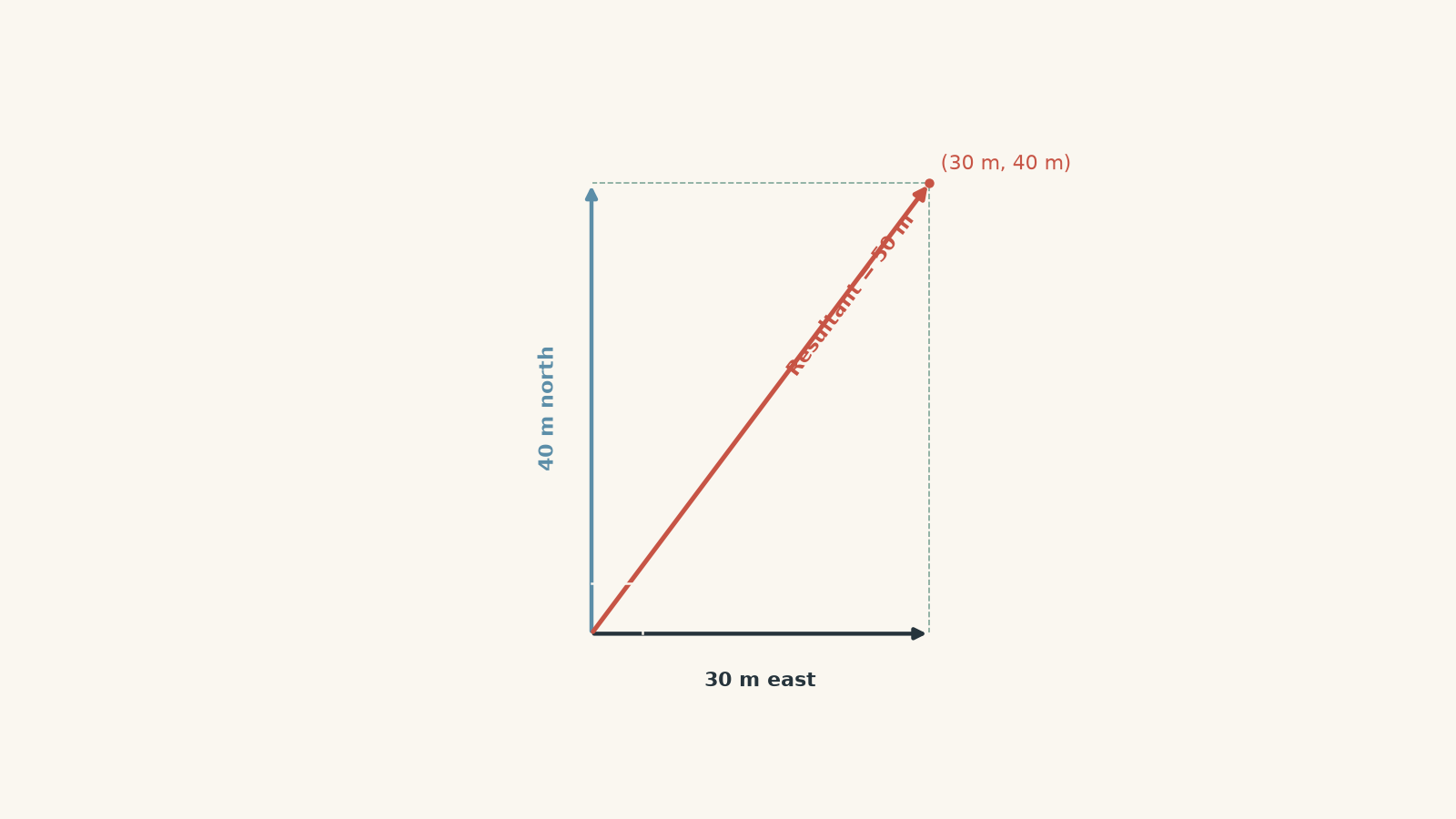
Because the two components are perpendicular, Pythagoras gives the magnitude:
\[ R = \sqrt{30^2 + 40^2} = 50\text{ m} \]
Here, \(R\) is the magnitude of the resultant displacement.
Notice what 50 m means. It is not the distance you walked. You still travelled 70 m along the path. It is the magnitude of your displacement from the starting point.
That distinction becomes important whenever vectors represent displacement, velocity, acceleration, force, electric field, or anything else with both magnitude and direction.
02Why components are useful
A diagonal vector can be awkward to work with directly. Components replace it with two simpler pieces:
- an \(x\)-component, usually horizontal
- a \(y\)-component, usually vertical
These components are perpendicular.
Suppose a vector has components \(R_x\) and \(R_y\). Its magnitude is
\[ R = \sqrt{R_x^2 + R_y^2} \]
where:
- \(R\) is the magnitude of the resultant vector
- \(R_x\) is its horizontal component
- \(R_y\) is its vertical component
This works because the components form the perpendicular sides of a right-angled triangle.
The equation is not a special vector formula that appeared from nowhere. It is just Pythagoras.
03Components need signs
Now we need one extra layer of precision.
Saying that a component has magnitude 8 N is not enough. An 8 N force east is different from an 8 N force west.
A useful sign convention is:
- east or right: positive \(x\)
- west or left: negative \(x\)
- north or up: positive \(y\)
- south or down: negative \(y\)
So:
- 6 m east becomes \(R_x = +6\text{ m}\)
- 6 m west becomes \(R_x = -6\text{ m}\)
- 4 m north becomes \(R_y = +4\text{ m}\)
- 4 m south becomes \(R_y = -4\text{ m}\)
You could choose the opposite convention. Physics does not care which direction you call positive. It does care that you stay consistent.
This is why vector components behave a little like money entering and leaving two separate bank accounts. East-west has one account, and north-south has another. A westward contribution can cancel an eastward contribution, but it cannot directly cancel a northward one.
The analogy stops there. Components are geometric quantities with direction, not actual financial transactions.
04Add like components first
Suppose several vectors act at once. Do not immediately calculate the magnitude of each one and add those magnitudes.
Instead, add all the \(x\)-components together:
\[ R_x = A_x + B_x + C_x + \cdots \]
Then add all the \(y\)-components:
\[ R_y = A_y + B_y + C_y + \cdots \]
Only after that do you reconstruct the resultant:
\[ R = \sqrt{R_x^2 + R_y^2} \]
This gives the magnitude. We still need the direction.
05Recovering the direction
Suppose the resultant has a positive horizontal component and a positive vertical component.
If the direction angle \(\theta\) is measured from the positive \(x\)-axis, then
\[ \tan\theta = \frac{R_y}{R_x} \]
so
\[ \theta = \tan^{-1}\left(\frac{R_y}{R_x}\right) \]
For the 30 m east and 40 m north displacement:
\[ \theta = \tan^{-1}\left(\frac{40}{30}\right) = 53.1^\circ \]
The displacement is therefore
\[ 50\text{ m at }53.1^\circ\text{ north of east} \]
The phrase north of east matters. It tells us to start facing east, then rotate \(53.1^\circ\) towards north.
If you instead measured from north, the angle would be
\[ 90^\circ - 53.1^\circ = 36.9^\circ \]
so the same direction could be written as \(36.9^\circ\) east of north.
06The calculator does not know your quadrant
Here is a common trap.
Suppose
\[ R_x = -8\text{ N}, \qquad R_y = 15\text{ N} \]
The negative \(x\)-component means west. The positive \(y\)-component means north. Before touching the calculator, you already know the resultant points north-west.
If you calculate
\[ \tan^{-1}\left(\frac{15}{8}\right) \]
you get the acute reference angle between the vector and the westward horizontal direction. You still need the component signs to identify the correct quadrant.
A useful decision table is:
| \(R_x\) | \(R_y\) | Resultant direction |
|---|---|---|
| positive | positive | north-east |
| negative | positive | north-west |
| negative | negative | south-west |
| positive | negative | south-east |
When finding the small angle from the horizontal, it is often clearest to use the component magnitudes:
\[ \theta = \tan^{-1}\left(\frac{|R_y|}{|R_x|}\right) \]
Then use the signs to describe the direction correctly.
Worked example: Two perpendicular displacement components
A research rover moves 9.0 m east and 12.0 m north. Find the magnitude and direction of its resultant displacement.
Step 1
Take east as positive \(x\) and north as positive \(y\):
\[ R_x = 9.0\text{ m}, \qquad R_y = 12.0\text{ m} \]
Step 2
\[ R = \sqrt{R_x^2 + R_y^2} = \sqrt{(9.0)^2 + (12.0)^2} = \sqrt{225} = 15.0\text{ m} \]
Step 3
\[ \theta = \tan^{-1}\left(\frac{R_y}{R_x}\right) = \tan^{-1}\left(\frac{12.0}{9.0}\right) = 53.1^\circ \]
Step 4
The resultant displacement is
\[ \boxed{15.0\text{ m at }53.1^\circ\text{ north of east}} \]
The rover is 15.0 m from its starting point, in a direction \(53.1^\circ\) above the eastward axis.
Worked example: Add components from two forces first
Two forces act on a small object. Force A has components \(+12\text{ N}\) horizontally and \(-5\text{ N}\) vertically. Force B has components \(-4\text{ N}\) horizontally and \(+11\text{ N}\) vertically. Find the magnitude and direction of the net force.
Step 1
\[ R_x = 12 + (-4) = 8\text{ N} \]
So the net horizontal component is 8 N east.
Step 2
\[ R_y = -5 + 11 = 6\text{ N} \]
So the net vertical component is 6 N north.
Step 3
\[ R = \sqrt{R_x^2 + R_y^2} = \sqrt{8^2 + 6^2} = \sqrt{100} = 10\text{ N} \]
Step 4
\[ \theta = \tan^{-1}\left(\frac{6}{8}\right) = 36.9^\circ \]
Both net components are positive, so the force lies in the north-east quadrant.
Therefore,
\[ \boxed{R = 10\text{ N at }36.9^\circ\text{ north of east}} \]
The important move happened before Pythagoras: we combined all horizontal effects with other horizontal effects, and all vertical effects with other vertical effects.
07The tempting mistake: adding magnitudes
Suppose a 10 N force acts east and another 10 N force acts north.
What is the resultant magnitude?
A student might predict 20 N because there are two 10 N forces. That would be correct only if the forces pointed in the same direction.
For perpendicular forces,
\[ R = \sqrt{10^2 + 10^2} = 14.1\text{ N} \]
Why is it smaller than 20 N?
Because neither force contributes its full 10 N in the direction of the resultant. The two forces point in different directions.
This also tells us something useful about limits. For two non-zero perpendicular components, the resultant magnitude must be:
- larger than either individual component
- smaller than the sum of their magnitudes
For components of 10 N and 10 N:
\[ 10\text{ N} < 14.1\text{ N} < 20\text{ N} \]
That is a quick way to catch calculator errors.
08What happens when a component is zero?
The tangent method needs some care when \(R_x = 0\).
Suppose
\[ R_x = 0, \qquad R_y = -7\text{ m/s} \]
There is no horizontal component at all. The vector simply points south, with magnitude 7 m/s.
Trying to evaluate
\[ \tan^{-1}\left(\frac{7}{0}\right) \]
is unnecessary. The components already tell you the direction.
There is an even more interesting edge case:
\[ R_x = 0, \qquad R_y = 0 \]
Then
\[ R = 0 \]
A zero vector has no defined direction. There is no arrow to point anywhere.
That matters when two or more vectors cancel exactly.
09A reliable method
When you need to combine perpendicular components, use this order:
- Choose positive \(x\) and positive \(y\) directions.
- Write each component with the correct sign.
- Add all \(x\)-components to find \(R_x\).
- Add all \(y\)-components to find \(R_y\).
- Use \(R = \sqrt{R_x^2 + R_y^2}\) for the magnitude.
- Use the component ratio to find the reference angle.
- Use the signs of \(R_x\) and \(R_y\) to state the actual direction.
- Check whether the magnitude and quadrant make physical sense.
Do not skip step 7. An inverse tangent calculation can give you an angle without telling you the full physical direction.
10Questions and solutions
Question 1
A force has a horizontal component of 5.0 N east and a vertical component of 12.0 N north. Find the magnitude and direction of the force.
Solution 1
The force is 13.0 N at \(67.4^\circ\) north of east.
Take east and north as positive:
\[ R_x = 5.0\text{ N}, \qquad R_y = 12.0\text{ N} \]
The magnitude is
\[ R = \sqrt{R_x^2 + R_y^2} = \sqrt{(5.0)^2 + (12.0)^2} = \sqrt{169} = 13.0\text{ N} \]
The direction measured from east is
\[ \theta = \tan^{-1}\left(\frac{12.0}{5.0}\right) = 67.4^\circ \]
Both components are positive, so the vector points north-east.
Therefore,
\[ \boxed{R = 13.0\text{ N at }67.4^\circ\text{ north of east}} \]
The result is sensible because 13.0 N is larger than either component but smaller than \(5.0 + 12.0 = 17.0\text{ N}\).
Question 2
A drone’s velocity relative to the ground has components 8.0 m/s west and 15.0 m/s north. Find its speed and direction.
Solution 2
The drone’s velocity is 17.0 m/s at \(61.9^\circ\) north of west.
Using east as positive \(x\) and north as positive \(y\):
\[ R_x = -8.0\text{ m/s}, \qquad R_y = 15.0\text{ m/s} \]
The speed is the magnitude of the velocity:
\[ R = \sqrt{(-8.0)^2 + (15.0)^2} = \sqrt{64 + 225} = \sqrt{289} = 17.0\text{ m/s} \]
For the reference angle from the horizontal:
\[ \theta = \tan^{-1}\left(\frac{15.0}{8.0}\right) = 61.9^\circ \]
The negative \(x\)-component and positive \(y\)-component place the vector in the north-west quadrant.
Therefore,
\[ \boxed{R = 17.0\text{ m/s at }61.9^\circ\text{ north of west}} \]
A common mistake is to report \(61.9^\circ\) north of east. The calculator gives the size of the reference angle, but the signs of the components determine which quadrant is correct.
Question 3
A vector initially has components 6.0 N east and 8.0 N north. Its eastward component is then doubled while its northward component stays unchanged.
A student claims that the magnitude of the vector must also double. Determine whether the claim is correct, and calculate the new magnitude and direction.
Solution 3
The claim is incorrect. The new vector has magnitude 14.4 N at \(33.7^\circ\) north of east, not twice the original magnitude.
Initially,
\[ R_x = 6.0\text{ N}, \qquad R_y = 8.0\text{ N} \]
so
\[ R_{\text{initial}} = \sqrt{6.0^2 + 8.0^2} = 10.0\text{ N} \]
After the eastward component doubles:
\[ R_x = 12.0\text{ N}, \qquad R_y = 8.0\text{ N} \]
The new magnitude is
\[ R_{\text{new}} = \sqrt{12.0^2 + 8.0^2} = \sqrt{208} = 14.4\text{ N} \]
The direction is
\[ \theta = \tan^{-1}\left(\frac{8.0}{12.0}\right) = 33.7^\circ \]
Therefore,
\[ \boxed{R_{\text{new}} = 14.4\text{ N at }33.7^\circ\text{ north of east}} \]
Doubling one component does not double the whole vector because the other component has not changed. The direction changes as well: the resultant rotates closer to east because the eastward component has become more dominant.
Question 4
Four component forces act on an object:
- 9.0 N east
- 4.0 N west
- 12.0 N south
- 7.0 N north
Find the magnitude and direction of the net force.
A student instead adds all four magnitudes and reports 32 N. Explain the error.
Solution 4
The net force is 7.07 N at \(45.0^\circ\) south of east. The 32 N answer is wrong because opposite components partly cancel rather than all contributing in the same direction.
First combine the horizontal components:
\[ R_x = 9.0 - 4.0 = 5.0\text{ N} \]
So the net horizontal component is 5.0 N east.
Now combine the vertical components:
\[ R_y = 7.0 - 12.0 = -5.0\text{ N} \]
So the net vertical component is 5.0 N south.
The magnitude is
\[ R = \sqrt{(5.0)^2 + (-5.0)^2} = \sqrt{50} = 7.07\text{ N} \]
The reference angle is
\[ \theta = \tan^{-1}\left(\frac{5.0}{5.0}\right) = 45.0^\circ \]
Since \(R_x\) is positive and \(R_y\) is negative, the resultant points south-east.
Therefore,
\[ \boxed{R = 7.07\text{ N at }45.0^\circ\text{ south of east}} \]
Adding \(9.0 + 4.0 + 12.0 + 7.0\) treats every force as though it acts along the same line in the same direction. It ignores both cancellation and the perpendicular relationship between the final horizontal and vertical components.
Question 5
After all force components on an object have been added, the result is
\[ R_x = 0\text{ N}, \qquad R_y = 0\text{ N} \]
A student writes, “The magnitude is zero, so the direction must be \(0^\circ\).”
Is this correct? Explain what the resultant vector actually tells you about the object.
Solution 5
The student’s conclusion is incorrect. The resultant force has magnitude 0 N and no defined direction.
Using the magnitude equation:
\[ R = \sqrt{R_x^2 + R_y^2} = \sqrt{0^2 + 0^2} = 0\text{ N} \]
But a direction describes where a non-zero vector points. A zero vector has no length, so there is no arrow whose orientation can be measured. Calling its direction \(0^\circ\) would incorrectly suggest that it points east.
A zero resultant force also does not automatically mean the object is stationary. From Newton’s second law,
\[ \vec F_{\text{net}} = m\vec a \]
so a zero net force means
\[ \vec a = 0 \]
for an object with non-zero mass. Its velocity therefore remains constant. It could be stationary, or it could already be moving at constant velocity.
This edge case is a useful reminder that components tell you more than a calculator does. Before finding an angle, first ask whether there is actually a non-zero resultant whose direction needs to be found.
Once you can add perpendicular components and recover a resultant, the next step is to resolve a vector in the opposite direction: starting with a magnitude and angle, and finding its \(x\)- and \(y\)-components. That is the same geometry run backwards, and it is what allows angled forces, velocities, fields, and projectile motion to be handled component by component.