
Conical Pendulums: Resolving Tension and Weight in HSC Physics
Learn how to resolve tension and weight for a mass moving in a horizontal circle, then connect the force equations to radius, speed, angle, and period.
A mass swings on a string in a perfectly horizontal circle. Its height stays constant, even though gravity is pulling it down the entire time.
So here is the puzzle: if the mass has no vertical acceleration, what stops it falling? And if the string is sloping, which force actually makes the mass turn in a circle?
Before reading on, predict this: is the tension in the string equal to the centripetal force?
It isn’t. That tempting idea is the source of most mistakes in this model.
01One tension force has two jobs
Imagine the mass from the side. The string runs diagonally from the mass up to the fixed pivot.
There are only two forces acting on the mass:
- its weight, \(mg\), vertically downward
- the tension, \(F_T\), along the string towards the pivot
There is no separate force called “centripetal force”. Centripetal force is the name for the net force directed towards the centre of a circular path. If that distinction is unclear, see Centripetal Force: How to Identify the Real Force in HSC Physics.
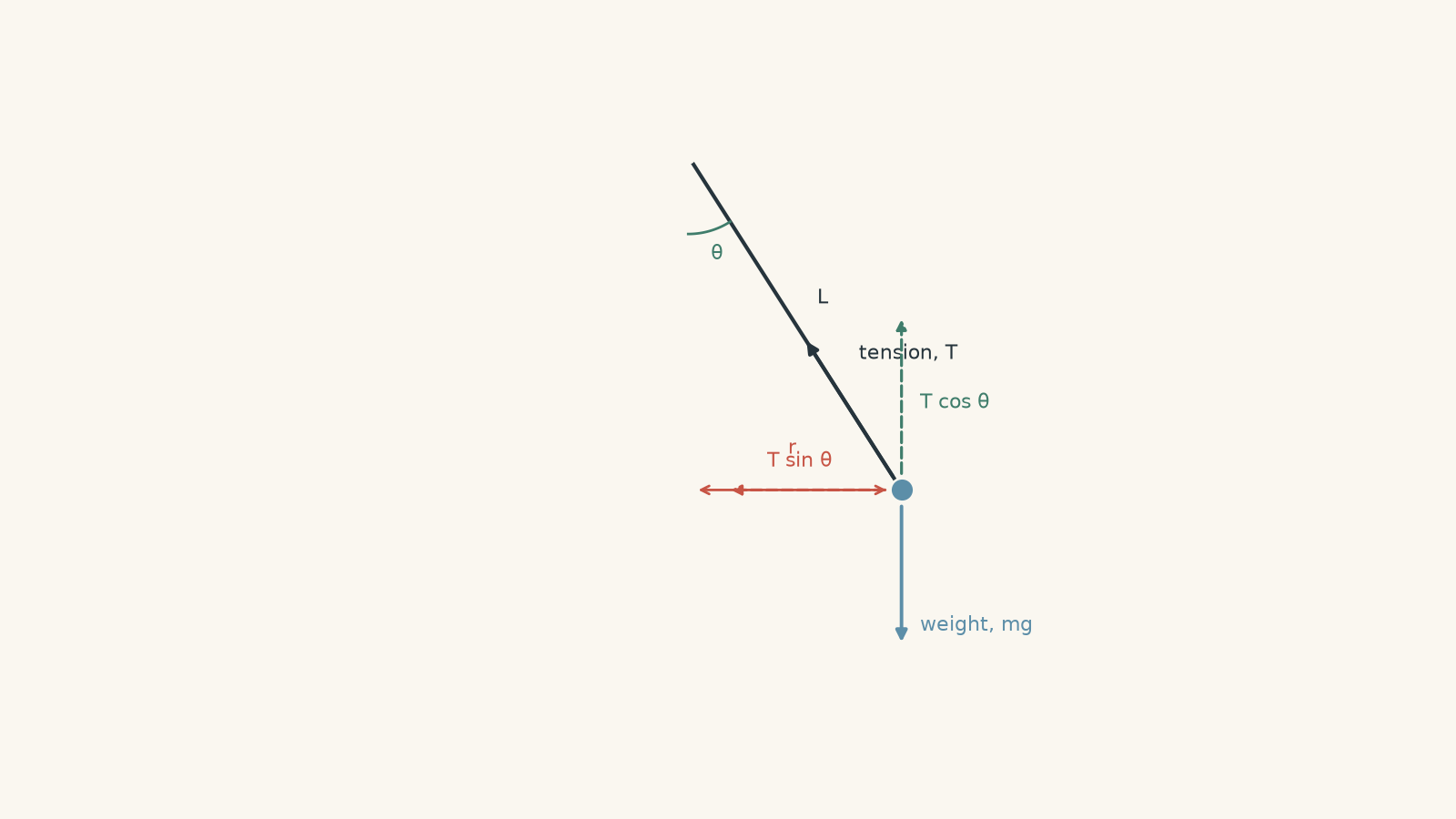
Suppose the string makes an angle \(\theta\) from the vertical.
The tension points diagonally, so we can resolve it into two perpendicular components:
- \(F_T\cos\theta\) vertically upward
- \(F_T\sin\theta\) horizontally towards the centre of the circle
The vertical component prevents the mass from falling. The horizontal component makes it turn.
This is a bit like pulling a wheeled suitcase using a handle angled upwards. One pull can have both an upward component and a forward component. The analogy stops there, because the suitcase also has forces from the ground, while our mass has only tension and weight.
02Start with the accelerations, not the forces
The phrase “horizontal circle” tells you something crucial about acceleration.
The mass is not moving up or down. Therefore its vertical acceleration is zero.
But its horizontal velocity is constantly changing direction, so it has centripetal acceleration towards the centre:
\[ a_c=\frac{v^2}{r} \]
where:
- \(a_c\) is centripetal acceleration in \(\text{m s}^{-2}\)
- \(v\) is the speed in \(\text{m s}^{-1}\)
- \(r\) is the radius of the horizontal circle in metres
Now Newton’s second law can be applied separately in the vertical and horizontal directions.
| Direction | Acceleration | Force equation |
|---|---|---|
| Vertical | \(0\) | \(F_T\cos\theta=mg\) |
| Horizontally inward | \(\dfrac{v^2}{r}\) | \(F_T\sin\theta=\dfrac{mv^2}{r}\) |
This pair of equations is the core of the model.
Notice what they say physically. The whole tension does not produce the centripetal acceleration. Only its horizontal component does.
03Why tension is larger than the centripetal force
A common first attempt is
\[ F_T=\frac{mv^2}{r} \]
but this cannot be correct for the sloping string shown above.
If the entire tension were being used horizontally, there would be no upward force to balance \(mg\). The mass would accelerate downwards, so its path could not remain in one horizontal plane.
Instead,
\[ F_T\sin\theta=\frac{mv^2}{r} \]
and
\[ F_T\cos\theta=mg \]
Because \(F_T\) must provide both components,
\[ F_T=\sqrt{\left(\frac{mv^2}{r}\right)^2+(mg)^2} \]
So \(F_T\) is greater than both \(mg\) and the required horizontal centripetal force.
There is another useful relation. Divide the horizontal equation by the vertical one:
\[ \frac{F_T\sin\theta}{F_T\cos\theta} = \frac{mv^2/r}{mg} \]
so
\[ \tan\theta=\frac{v^2}{rg} \]
The mass cancels. For a given speed and radius, changing the mass does not change the required angle. It does change the tension.
Worked example: Find the tension and string angle
A \(0.40\ \text{kg}\) mass moves at \(2.5\ \text{m s}^{-1}\) in a horizontal circle of radius \(0.75\ \text{m}\). Find the tension in the string and the angle the string makes with the vertical. Use \(g=9.8\ \text{m s}^{-2}\).
Step 1
\[ \frac{mv^2}{r} = \frac{(0.40)(2.5)^2}{0.75} = 3.33\ \text{N} \]
So the horizontal component of tension is \(3.33\ \text{N}\).
Step 2
\[ mg=(0.40)(9.8)=3.92\ \text{N} \]
Therefore,
\[ F_T\cos\theta=3.92\ \text{N} \]
Step 3
\[ F_T = \sqrt{(3.33)^2+(3.92)^2} = 5.15\ \text{N} \]
Step 4
\[ \tan\theta = \frac{3.33}{3.92} \]
\[ \theta=40.4^\circ \]
The tension is therefore \(5.15\ \text{N}\), and the string is \(40.4^\circ\) from the vertical.
The result makes physical sense. The tension must exceed the \(3.92\ \text{N}\) weight because some of the tension is also needed to pull the mass horizontally inward.
04The radius is not usually the string length
Now suppose the string has length \(L\).
It is tempting to write \(r=L\). That would only be true if the string were horizontal.
For a conical pendulum, the horizontal radius is the horizontal component of the string length:
\[ r=L\sin\theta \]
The vertical distance from the pivot to the plane of the circle is
\[ L\cos\theta \]
This geometry becomes important whenever a question gives the string length instead of the radius.
Worked example: Use the string length to find the speed
A \(0.25\ \text{kg}\) mass is attached to a \(1.20\ \text{m}\) string. It moves in a horizontal circle with the string at \(35^\circ\) from the vertical. Find the radius, tension, speed, and period of the motion. Use \(g=9.8\ \text{m s}^{-2}\).
Step 1
\[ r=L\sin\theta =(1.20)\sin35^\circ =0.688\ \text{m} \]
Step 2
\[ F_T\cos\theta=mg \]
\[ F_T = \frac{(0.25)(9.8)}{\cos35^\circ} = 2.99\ \text{N} \]
Step 3
\[ F_T\sin\theta = (2.99)\sin35^\circ = 1.72\ \text{N} \]
This must equal \(mv^2/r\).
Step 4
\[ 1.72=\frac{(0.25)v^2}{0.688} \]
\[ v = \sqrt{\frac{(1.72)(0.688)}{0.25}} = 2.17\ \text{m s}^{-1} \]
Step 5
The circumference of the circular path is \(2\pi r\), so
\[ P=\frac{2\pi r}{v} = \frac{2\pi(0.688)}{2.17} = 1.99\ \text{s} \]
The mass completes one revolution every \(1.99\ \text{s}\).
For more practice connecting \(v\), \(r\), and period, see Speed, Radius and Period in Uniform Circular Motion.
05A useful relation for a conical pendulum
There is another way to describe the motion using angular speed.
Angular speed is
\[ \omega=\frac{v}{r} \]
where \(\omega\) is measured in \(\text{rad s}^{-1}\).
The horizontal force equation becomes
\[ F_T\sin\theta=m\omega^2r \]
and because \(r=L\sin\theta\),
\[ F_T\sin\theta=m\omega^2L\sin\theta \]
For a genuine circular orbit, \(\sin\theta\neq0\), so
\[ F_T=m\omega^2L \]
Combine this with
\[ F_T\cos\theta=mg \]
to obtain
\[ m\omega^2L\cos\theta=mg \]
and therefore
\[ \omega^2=\frac{g}{L\cos\theta} \]
Since \(P=2\pi/\omega\),
\[ P=2\pi\sqrt{\frac{L\cos\theta}{g}} \]
This relation contains a slightly surprising result: the period depends on the vertical distance \(L\cos\theta\) from the pivot to the circular path, not directly on the radius.
That observation becomes important in the final question below.
06A compact decision rule
When you see a mass moving in a horizontal circle on a sloping string:
- Draw only the real forces: tension and weight.
- Choose vertical and horizontally inward directions.
- Use zero vertical acceleration:
\[ F_T\cos\theta=mg \]
- Use centripetal acceleration horizontally:
\[ F_T\sin\theta=\frac{mv^2}{r} \]
- If string length is given, connect the force model to the geometry:
\[ r=L\sin\theta \]
These equations assume that \(\theta\) is measured from the vertical. If a question measures the angle from the horizontal, the sine and cosine components swap. Redraw the triangle rather than trying to memorise a second set of equations.
07Questions and solutions
Question 1
A \(0.30\ \text{kg}\) mass moves at \(3.0\ \text{m s}^{-1}\) in a horizontal circle of radius \(0.80\ \text{m}\). Find:
a. the horizontal component of tension
b. the vertical component of tension
c. the total tension
d. the angle of the string from the vertical
Use \(g=9.8\ \text{m s}^{-2}\).
Solution 1
The horizontal and vertical components are \(3.38\ \text{N}\) and \(2.94\ \text{N}\), giving a total tension of \(4.48\ \text{N}\) at \(48.9^\circ\) from the vertical.
For the horizontal direction,
\[ F_{T,x} = \frac{mv^2}{r} = \frac{(0.30)(3.0)^2}{0.80} = 3.375\ \text{N} \]
so
\[ F_{T,x}=3.38\ \text{N} \]
Vertically, the acceleration is zero:
\[ F_{T,y}=mg=(0.30)(9.8)=2.94\ \text{N} \]
The total tension is the vector magnitude:
\[ F_T = \sqrt{(3.375)^2+(2.94)^2} = 4.48\ \text{N} \]
Finally,
\[ \tan\theta=\frac{3.375}{2.94} \]
so
\[ \theta=48.9^\circ \]
A tempting shortcut is to call \(3.38\ \text{N}\) the tension because it equals \(mv^2/r\). It is only the horizontal component of tension. The same tension vector must also supply the \(2.94\ \text{N}\) upward component that balances the weight.
Question 2
A \(0.20\ \text{kg}\) mass hangs from a \(1.00\ \text{m}\) string and moves as a conical pendulum. The string is \(50^\circ\) from the vertical.
Calculate:
a. the radius of the circular path
b. the tension in the string
c. the speed of the mass
d. the period
Use \(g=9.8\ \text{m s}^{-2}\).
Solution 2
The radius is \(0.766\ \text{m}\), the tension is \(3.05\ \text{N}\), the speed is \(2.99\ \text{m s}^{-1}\), and the period is \(1.61\ \text{s}\).
First use the string geometry:
\[ r=L\sin\theta =(1.00)\sin50^\circ =0.766\ \text{m} \]
Vertically,
\[ F_T\cos50^\circ=mg \]
so
\[ F_T = \frac{(0.20)(9.8)}{\cos50^\circ} = 3.05\ \text{N} \]
Its horizontal component is
\[ F_T\sin50^\circ = (3.05)\sin50^\circ = 2.34\ \text{N} \]
Therefore,
\[ 2.34=\frac{(0.20)v^2}{0.766} \]
which gives
\[ v = \sqrt{\frac{(2.34)(0.766)}{0.20}} = 2.99\ \text{m s}^{-1} \]
The period is
\[ P = \frac{2\pi r}{v} = \frac{2\pi(0.766)}{2.99} = 1.61\ \text{s} \]
The tempting mistake is \(r=1.00\ \text{m}\). The string length is the hypotenuse of the geometric triangle; the circular radius is its horizontal component, \(L\sin\theta\).
Question 3
A mass moves as a conical pendulum with a period of \(1.80\ \text{s}\).
Initially, its string is \(1.00\ \text{m}\) long.
a. Determine the angle of the string from the vertical and the radius of the circle.
The string is then shortened to \(0.70\ \text{m}\), while a mechanism attempts to keep the period at exactly \(1.80\ \text{s}\).
b. Can the mass settle into a non-zero-radius conical pendulum with that period? Justify your answer physically and mathematically.
Use \(g=9.8\ \text{m s}^{-2}\).
Solution 3
Initially the angle is \(36.5^\circ\) and the radius is \(0.594\ \text{m}\). After the string is shortened to \(0.70\ \text{m}\), no non-zero-radius conical-pendulum state with a \(1.80\ \text{s}\) period is possible.
The angular speed corresponding to the period is
\[ \omega = \frac{2\pi}{P} = \frac{2\pi}{1.80} = 3.49\ \text{rad s}^{-1} \]
For a conical pendulum,
\[ \omega^2=\frac{g}{L\cos\theta} \]
so
\[ \cos\theta=\frac{g}{\omega^2L} \]
For \(L=1.00\ \text{m}\),
\[ \cos\theta = \frac{9.8}{(3.49)^2(1.00)} = 0.804 \]
Therefore,
\[ \theta=36.5^\circ \]
and
\[ r=L\sin\theta = (1.00)\sin36.5^\circ = 0.594\ \text{m} \]
Now shorten the string to \(0.70\ \text{m}\) while keeping the same \(\omega\):
\[ \cos\theta = \frac{9.8}{(3.49)^2(0.70)} = 1.15 \]
But a real angle cannot have \(\cos\theta>1\).
So the requested steady circular motion is impossible.
The tempting idea is that the system could simply increase its tension until the shorter string works. Tension is not free to fix every constraint independently. Vertical balance, horizontal centripetal acceleration, the specified angular speed, and the fixed string geometry must all hold at the same time. Here they demand an impossible value of \(\cos\theta\).
Equivalently, at this angular speed there is a minimum possible string length:
\[ L_{\min}=\frac{g}{\omega^2} = \frac{9.8}{(3.49)^2} = 0.804\ \text{m} \]
The proposed \(0.70\ \text{m}\) string is shorter than this limit.
Question 4
A \(0.40\ \text{kg}\) mass is moving as a conical pendulum on a \(1.00\ \text{m}\) string. Its circular path is \(1.25\ \text{m}\) above a horizontal floor.
The string suddenly breaks. Ignore air resistance. The mass lands \(1.10\ \text{m}\) horizontally from the point on the floor directly below the position where the string broke.
Determine:
a. the speed immediately before the string broke
b. the angle the string had made with the vertical
c. the tension in the string immediately before it broke
Use \(g=9.8\ \text{m s}^{-2}\).
Solution 4
Immediately before the break, the mass was travelling at \(2.18\ \text{m s}^{-1}\), the string was \(38.1^\circ\) from the vertical, and its tension was \(4.98\ \text{N}\).
At the instant the string breaks, the mass keeps its instantaneous velocity. That velocity is horizontal and tangent to the circular path.
Its initial vertical velocity is therefore zero.
For the \(1.25\ \text{m}\) fall,
\[ h=\frac{1}{2}gt^2 \]
so
\[ 1.25=\frac{1}{2}(9.8)t^2 \]
and
\[ t = \sqrt{\frac{2(1.25)}{9.8}} = 0.505\ \text{s} \]
Horizontally,
\[ v=\frac{d}{t} = \frac{1.10}{0.505} = 2.18\ \text{m s}^{-1} \]
Before the break, the conical-pendulum relation was
\[ \tan\theta=\frac{v^2}{rg} \]
but the radius is not yet known. Since the string has length \(L=1.00\ \text{m}\),
\[ r=L\sin\theta \]
Therefore,
\[ v^2 = gL\sin\theta\tan\theta = gL\frac{\sin^2\theta}{\cos\theta} \]
Let \(c=\cos\theta\). Since \(\sin^2\theta=1-c^2\),
\[ \frac{v^2}{gL} = \frac{1-c^2}{c} \]
Using \(v=2.18\ \text{m s}^{-1}\),
\[ \frac{(2.18)^2}{(9.8)(1.00)} = 0.484 \]
so
\[ 0.484=\frac{1-c^2}{c} \]
and hence
\[ c^2+0.484c-1=0 \]
The physically meaningful root is
\[ c=0.787 \]
so
\[ \cos\theta=0.787 \]
and
\[ \theta=38.1^\circ \]
Finally, vertical balance before the string broke gives
\[ F_T\cos\theta=mg \]
so
\[ F_T = \frac{(0.40)(9.8)}{\cos38.1^\circ} = 4.98\ \text{N} \]
A tempting route is to treat the \(1.10\ \text{m}\) projectile displacement as the radius of the original circle. It is not. Once the string breaks, the mass travels initially along a tangent to its old path. The projectile motion reveals the tangential speed; the original radius must then be recovered from the string geometry and circular-motion equations.
Question 5
Two different conical pendulums have their pivots on the same horizontal level.
For pendulum A, the string length is \(1.20\ \text{m}\). For pendulum B, the string length is \(0.80\ \text{m}\).
In both cases, the horizontal circular path lies exactly \(0.60\ \text{m}\) vertically below the pivot. The masses need not be equal.
A student argues:
Pendulum A has the larger circular radius, so it must take longer to complete each revolution.
Determine whether the periods are actually different. Then calculate the radius and linear speed of each mass.
Use \(g=9.8\ \text{m s}^{-2}\).
Solution 5
The two pendulums have exactly the same period, \(1.55\ \text{s}\), even though pendulum A has the larger radius and moves at the greater linear speed.
Let the vertical distance from the pivot to the plane of the circle be \(h\).
From the geometry,
\[ h=L\cos\theta \]
For the force balance,
\[ F_T\cos\theta=mg \]
and
\[ F_T\sin\theta=m\omega^2r \]
Divide the horizontal equation by the vertical equation:
\[ \tan\theta=\frac{\omega^2r}{g} \]
But the geometry of the string also gives
\[ \tan\theta=\frac{r}{h} \]
Therefore,
\[ \frac{r}{h} = \frac{\omega^2r}{g} \]
Both pendulums have non-zero radii, so \(r\) cancels:
\[ \omega^2=\frac{g}{h} \]
This is the key constraint. The radius looks important, but once the force equations and string geometry are required simultaneously, it disappears from the expression for angular speed.
With \(h=0.60\ \text{m}\),
\[ \omega = \sqrt{\frac{9.8}{0.60}} = 4.04\ \text{rad s}^{-1} \]
Hence
\[ P = \frac{2\pi}{\omega} = \frac{2\pi}{4.04} = 1.55\ \text{s} \]
for both pendulums.
Now find the radii.
For pendulum A,
\[ r_A = \sqrt{L_A^2-h^2} = \sqrt{(1.20)^2-(0.60)^2} = 1.04\ \text{m} \]
For pendulum B,
\[ r_B = \sqrt{L_B^2-h^2} = \sqrt{(0.80)^2-(0.60)^2} = 0.529\ \text{m} \]
Linear speed is \(v=\omega r\).
Therefore,
\[ v_A = (4.04)(1.04) = 4.20\ \text{m s}^{-1} \]
and
\[ v_B = (4.04)(0.529) = 2.14\ \text{m s}^{-1} \]
Pendulum A does travel a larger circumference, but it also travels faster by exactly the amount needed to keep the period unchanged.
The student’s argument treats radius and speed as though one could change while the other stayed fixed. In a conical pendulum they are linked by the force balance and the geometry. When the vertical distance \(h=L\cos\theta\) is the same, the angular speed is fixed by
\[ \omega=\sqrt{\frac{g}{h}} \]
regardless of the mass or radius.
08What this model lets you do next
The important habit here is not memorising two component equations. It is deciding which direction actually has acceleration.
For a horizontal circular path, the vertical acceleration is zero, so the vertical forces balance. Horizontally, there is an inward acceleration, so the horizontal components of the real forces must produce \(mv^2/r\).
That same approach carries into harder circular-motion problems. If the circle is tilted, vertical, or supported by more than one force, the component equations change, but the method does not: choose the radial direction, identify the real forces, resolve them, and only then write Newton’s second law.