
How Scientists Measured the Speed of Light: Key Experiments
Explore how scientists measured the speed of light, from Rømer’s astronomical observations to Fizeau’s toothed wheel, Foucault’s rotating mirror and modern laser timing. Includes worked examples and practice questions with solutions.
Light feels instant. If you switch on a torch, you do not watch the beam slowly crawl across the room. It appears wherever you point it immediately.
That creates a surprisingly difficult question: does light actually take time to travel, or is its speed just too fast for everyday experience?
Try predicting this. If a person on Earth shines a powerful beam towards the Moon, would someone on the Moon see it at the exact same moment? The answer is no. The light must cross the space between Earth and the Moon, and that delay is the clue that light has a measurable speed.
Finding that speed was not a single discovery. Scientists had to solve a measurement problem: light was too fast for ordinary timing methods. Over hundreds of years, they moved from astronomical observations, to rotating machinery, to electronic timing systems, each design fixing a weakness in the previous one.
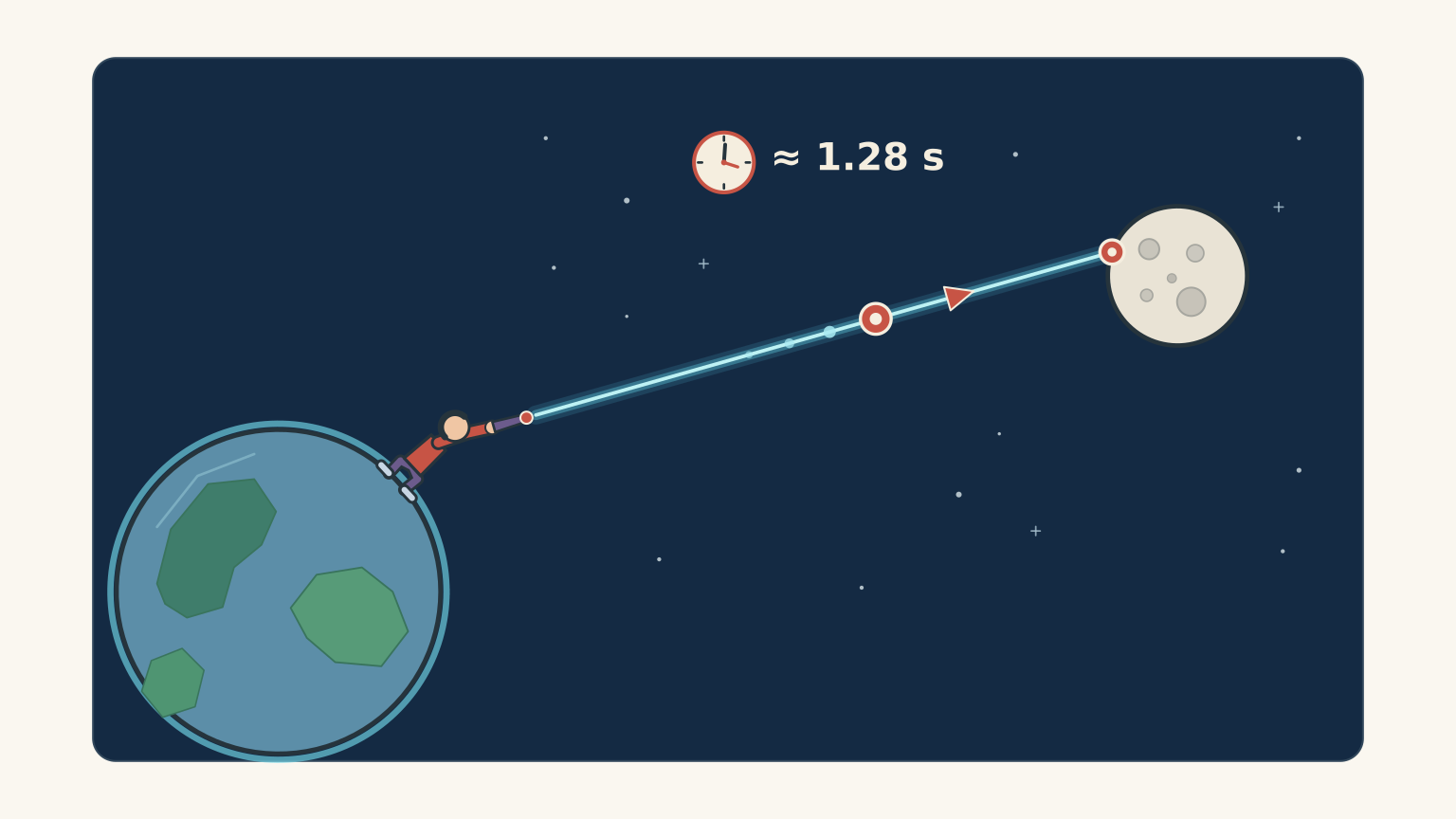
The modern accepted value is approximately:
\[ c = 3.00 \times 10^8 \text{ m s}^{-1} \]
where:
- \(c\) is the speed of light in a vacuum,
- \(3.00 \times 10^8\) means 300 million metres per second.
That number is not just a fact to memorise. It is the result of a long chain of clever experiments.
01The first problem: was light instantaneous?
For much of history, scientists disagreed about whether light travelled at a finite speed.
The argument for instant light was understandable. If you clap your hands across a football field, you see the clap almost immediately, but you hear the sound later. People could measure the delay for sound, so they wondered: why not for light?
The problem was that light was far faster than sound. A human reaction time was nowhere near enough.
Imagine trying to measure a race where the winner crosses the finish line before your stopwatch button can move. You do not need a better stopwatch alone. You need a completely different race track.
Scientists had to create experiments where light travelled a much longer distance or interacted with a mechanism fast enough to reveal the delay.
02Römer’s astronomical measurement: using Jupiter’s moons as a clock
The first convincing measurement came from astronomy.
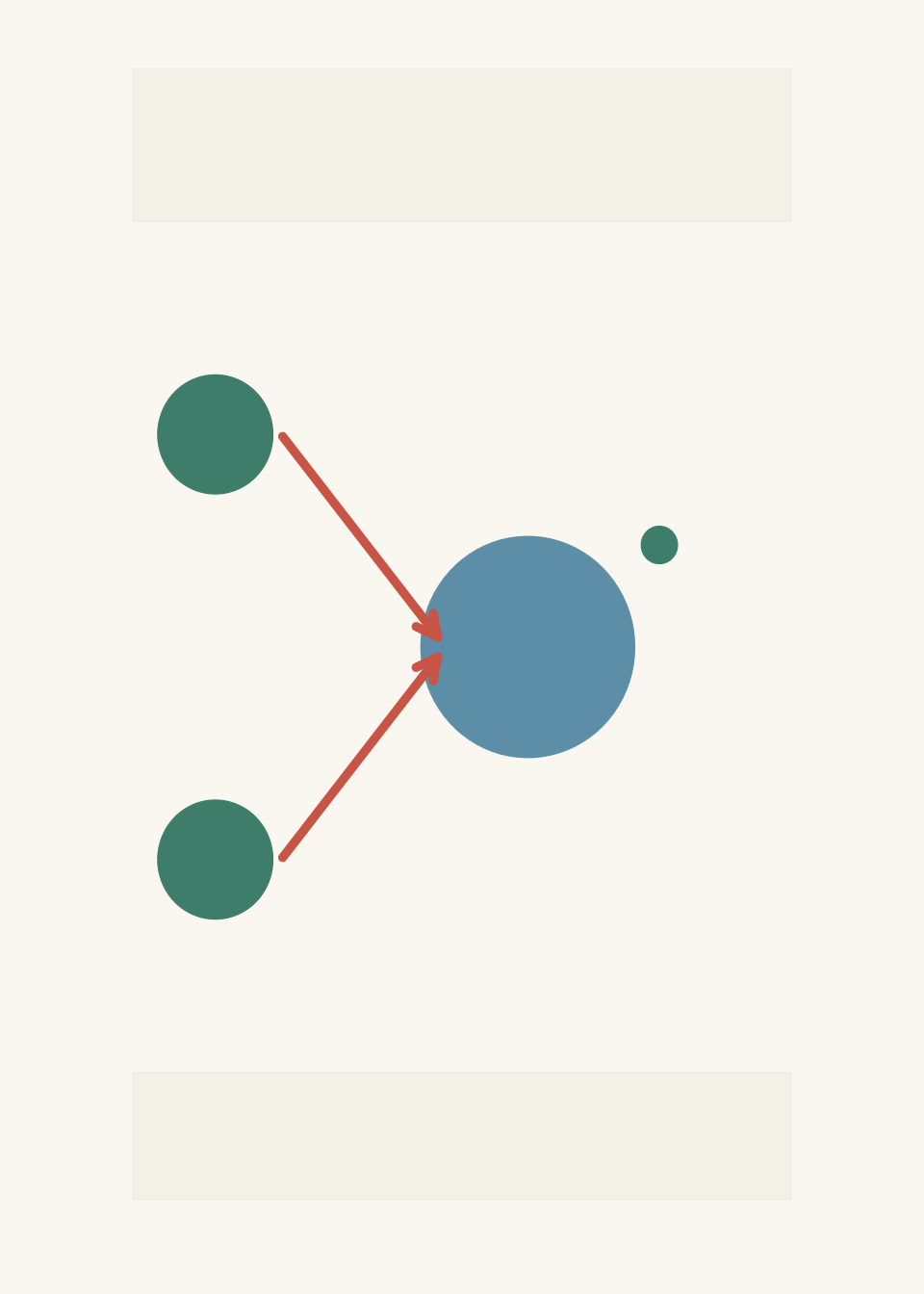
In the 1600s, Danish astronomer Ole Rømer studied Io, one of Jupiter’s moons. Io regularly moves behind Jupiter and disappears from view. Because this orbit repeats, it acts like a natural clock in space.
The question was simple:
If Io disappears at a predictable time, should every observation match the prediction exactly?
The original prediction was yes. If light travelled instantly, the timing of Io’s eclipses should not depend on where Earth was in its orbit.
But Rømer noticed something strange. When Earth was moving farther away from Jupiter, Io’s eclipses appeared later than expected. When Earth moved closer, they appeared earlier.
Why?
The event itself was not changing. Io was still orbiting Jupiter. The delay came from the light taking longer to reach Earth when the distance was greater.
The observation supported a finite speed of light.
Turning Rømer’s observation into a calculation
Rømer did not directly measure the speed in metres per second. Later scientists used his timing difference and Earth’s orbital size to estimate it.
Suppose Earth moves about \(3.0 \times 10^{11}\) m farther from Jupiter over part of its orbit, and the observed delay is about 1000 seconds.
Using:
\[ v = \frac{d}{t} \]
where:
- \(v\) is speed in metres per second,
- \(d\) is distance travelled by the light,
- \(t\) is travel time,
we get:
\[ v = \frac{3.0 \times 10^{11}}{1000} \]
\[ v = 3.0 \times 10^8 \text{ m s}^{-1} \]
The estimate is close to the accepted value.
The assumption is that the extra delay is caused only by the extra distance light travels. In reality, orbital motion and measurement limits make the calculation more complicated.
Rømer’s method was powerful, but it depended on knowing the motion of planets accurately. Scientists wanted a laboratory experiment where they controlled the distance and timing themselves.
03Fizeau’s toothed wheel experiment: bringing the measurement to Earth
In 1849, French physicist Hippolyte Fizeau designed the first successful terrestrial measurement of light’s speed.
The problem he faced was different:
How can you measure a tiny travel time when light moves hundreds of kilometres every millisecond?
His solution was mechanical.
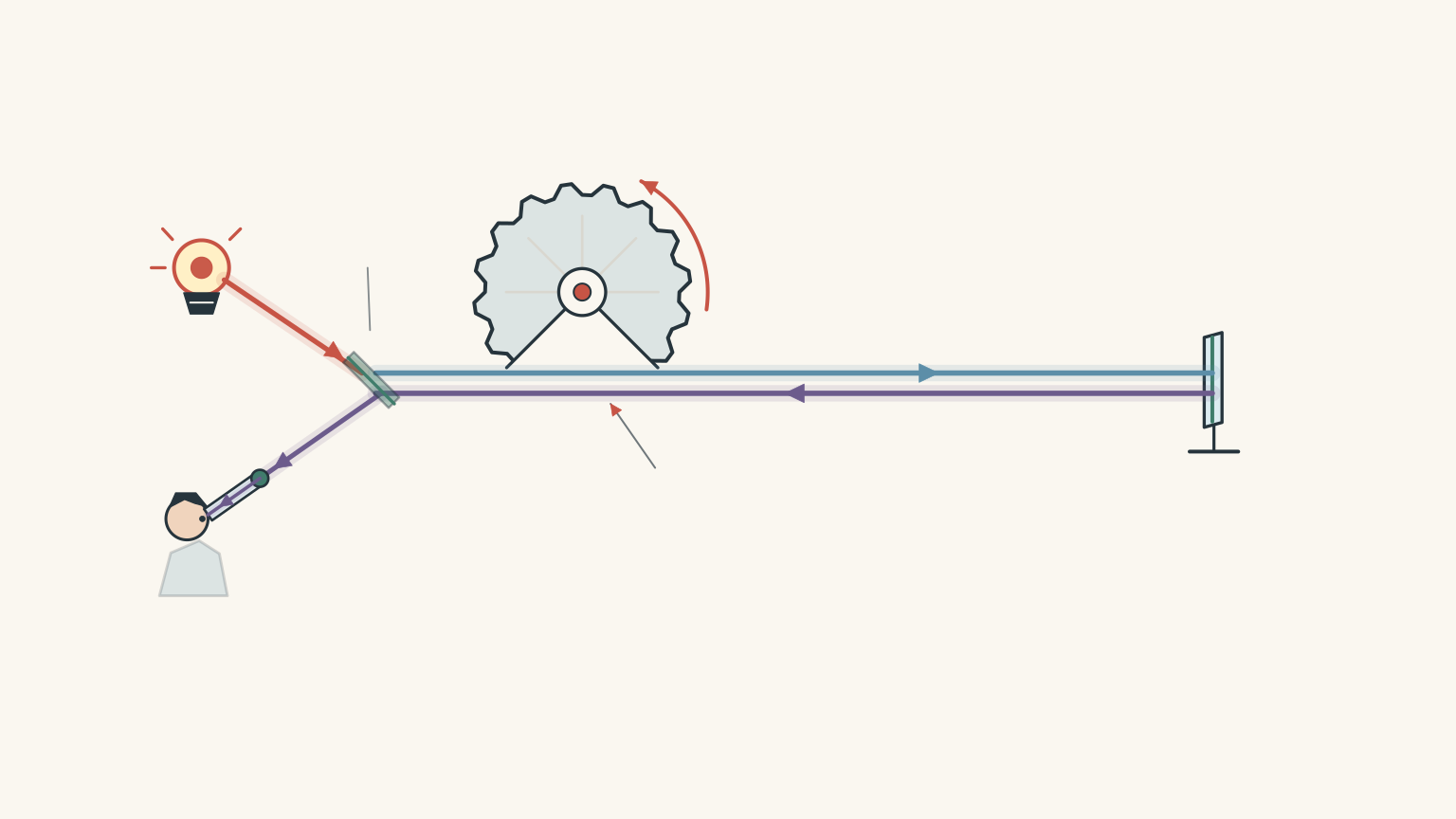
The apparatus was arranged in a straight line:
- A lamp produced a beam of light.
- The light passed through gaps in a rotating toothed wheel.
- The beam travelled to a distant mirror.
- The mirror reflected the light back along the same path.
- The returning beam passed through the wheel again and was observed.
The key idea was timing the wheel’s rotation.
Fizeau predicted that if the wheel rotated slowly, the returning light would pass through the same gap. But if the wheel rotated faster, the returning light would hit a tooth and be blocked.
That missing light meant the travel time could be calculated.
04What did Fizeau observe?
The original design should show a clear pattern:
- slow wheel rotation → light visible,
- faster rotation → light blocked at a specific speed.
The observation matched the prediction. The light was not arriving instantly. It was taking a measurable amount of time to travel to the mirror and back.
Worked example: estimating the speed of light from Fizeau’s method
A simplified Fizeau experiment uses a mirror 8.0 km away from the toothed wheel. The wheel has 720 teeth and rotates at 625 revolutions per second when the returning light is first blocked.
Estimate the speed of light.
Step 1Find the time for the wheel to move one tooth position
One complete rotation moves 720 teeth past the beam.
The time for one rotation is:
\[ t_{\text{rotation}}=\frac{1}{625} \]
\[ t_{\text{rotation}}=0.00160 \text{ s} \]
The time to move one tooth spacing is:
\[ t_{\text{gap}}=\frac{0.00160}{720} \]
\[ t_{\text{gap}}=2.22 \times 10^{-6}\text{ s} \]
Step 2Relate this to the light travel time
The light travels to the mirror and back:
\[ d = 2(8000) \]
\[ d=16000\text{ m} \]
The travel time is:
\[ t=2.22 \times 10^{-6}\text{ s} \]
Step 3Calculate speed
\[ v=\frac{d}{t} \]
\[ v=\frac{16000}{2.22 \times 10^{-6}} \]
\[ v=7.2 \times 10^9\text{ m s}^{-1} \]
This simplified result is too large because the real relationship involves the wheel’s tooth-to-gap arrangement and the first blockage condition is more subtle than this model.
The important lesson is not the number. It is the measurement strategy: turn a tiny travel time into a visible mechanical event.
That idea appears repeatedly in physics. When something is too fast, too small, or too far away to measure directly, scientists often convert it into a slower, larger, easier-to-observe effect.
05Foucault’s rotating mirror method: improving the design
Fizeau’s experiment was a breakthrough, but it had limits. The rotating wheel only gave certain timing points, and mechanical movement introduced uncertainty.
French physicist Léon Foucault improved the idea using a rotating mirror.
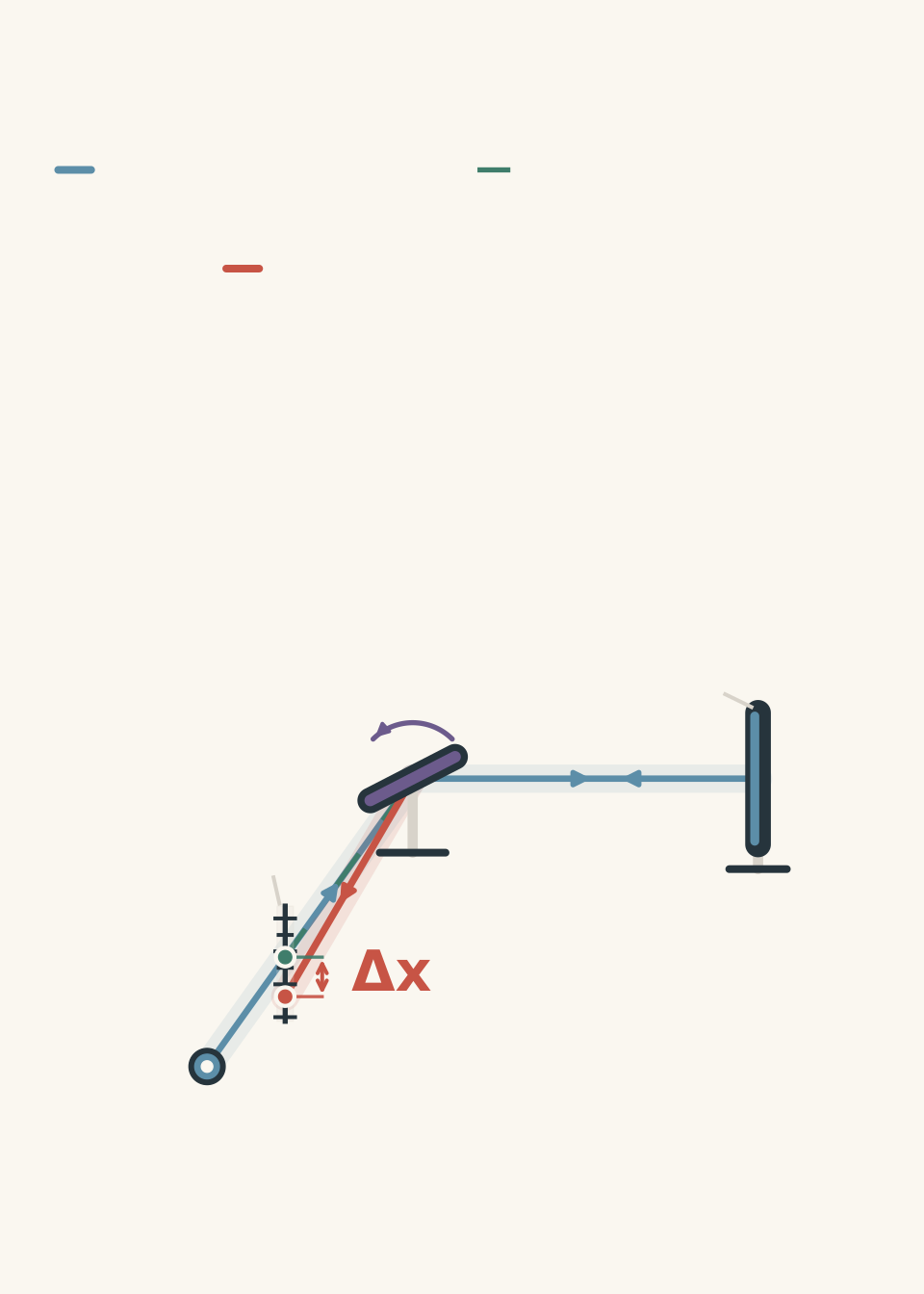
The design used:
- a rapidly rotating mirror,
- a fixed distant mirror,
- a light source,
- a measuring scale.
The light travelled to the distant mirror and returned. During that tiny travel time, the rotating mirror changed angle slightly.
That small rotation changed the direction of the returning beam.
The question was:
If light took no time to travel, would the beam move?
No. The mirror would not have time to rotate, so the reflected beam would return exactly where it started.
But the beam shifted. The amount of shift revealed the travel time.
Foucault’s method also helped answer another question: did light travel faster in air or water?
He found that light travelled more slowly in water. This supported the wave model of light and challenged earlier ideas that light behaved like particles moving faster in denser materials.
06Modern measurements: from spinning mirrors to lasers and electronics
Modern experiments no longer rely on mechanical parts moving at exactly the right moment.
Instead, scientists use:
- extremely stable lasers,
- precise electronic detectors,
- carefully measured distances,
- atomic clocks.
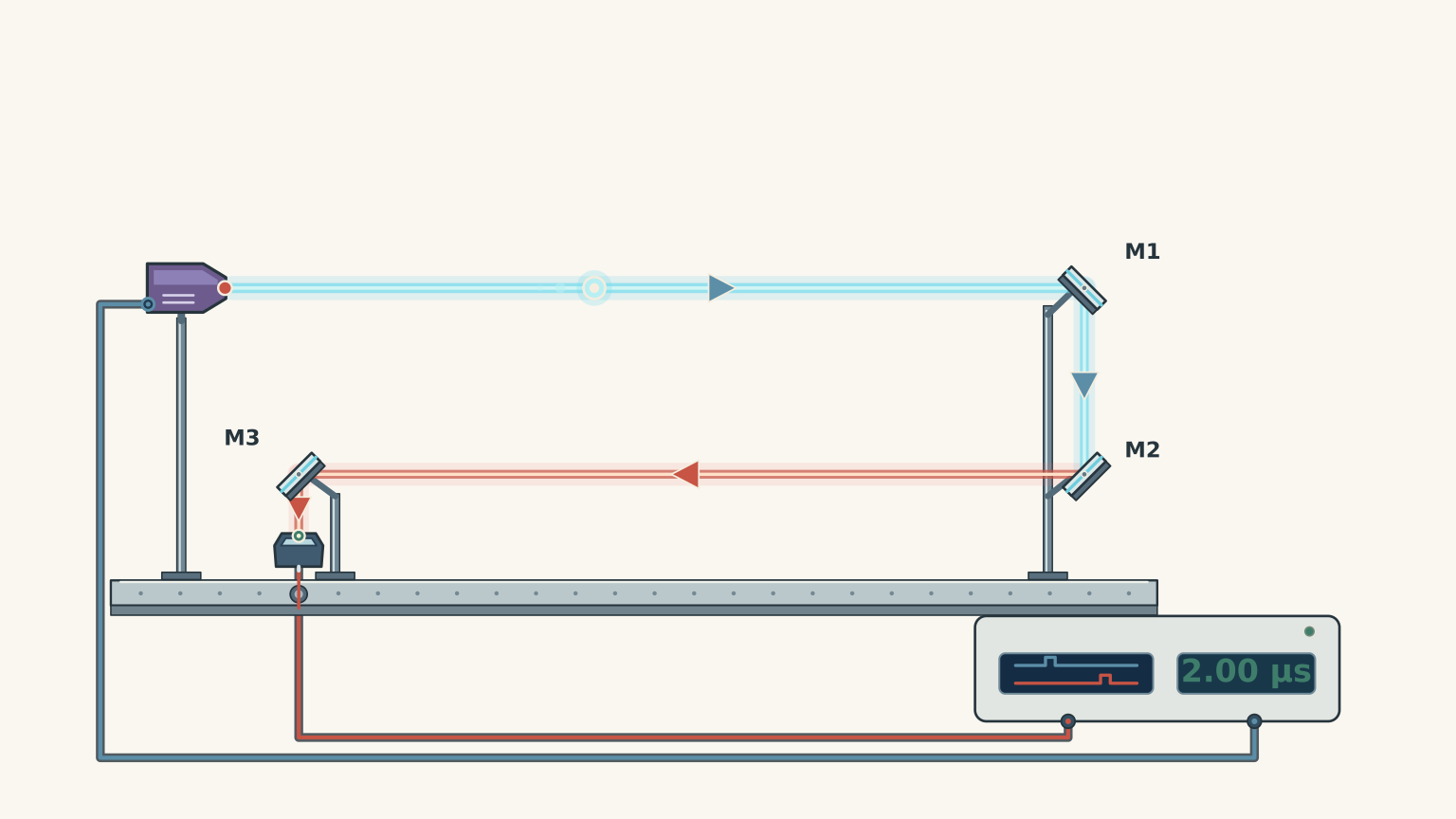
A modern method is essentially the same idea as Fizeau’s experiment:
- Send a pulse of light.
- Measure how long it takes to return or reach another detector.
- Divide distance by time.
The difference is that electronics can measure unbelievably small time intervals.
For example, if a laser pulse travels 300 m and returns after travelling 600 m total:
\[ d=600\text{ m} \]
The expected time is:
\[ t=\frac{d}{c} \]
\[ t=\frac{600}{3.00\times10^8} \]
\[ t=2.00\times10^{-6}\text{ s} \]
The round trip takes:
\[ 2.00\ \mu\text{s} \]
where \(\mu\text{s}\) means microseconds, or \(10^{-6}\) seconds.
The measurement problem has changed. It is no longer “can we detect the delay?” It is “how accurately can we measure the delay?”
07Comparing the methods
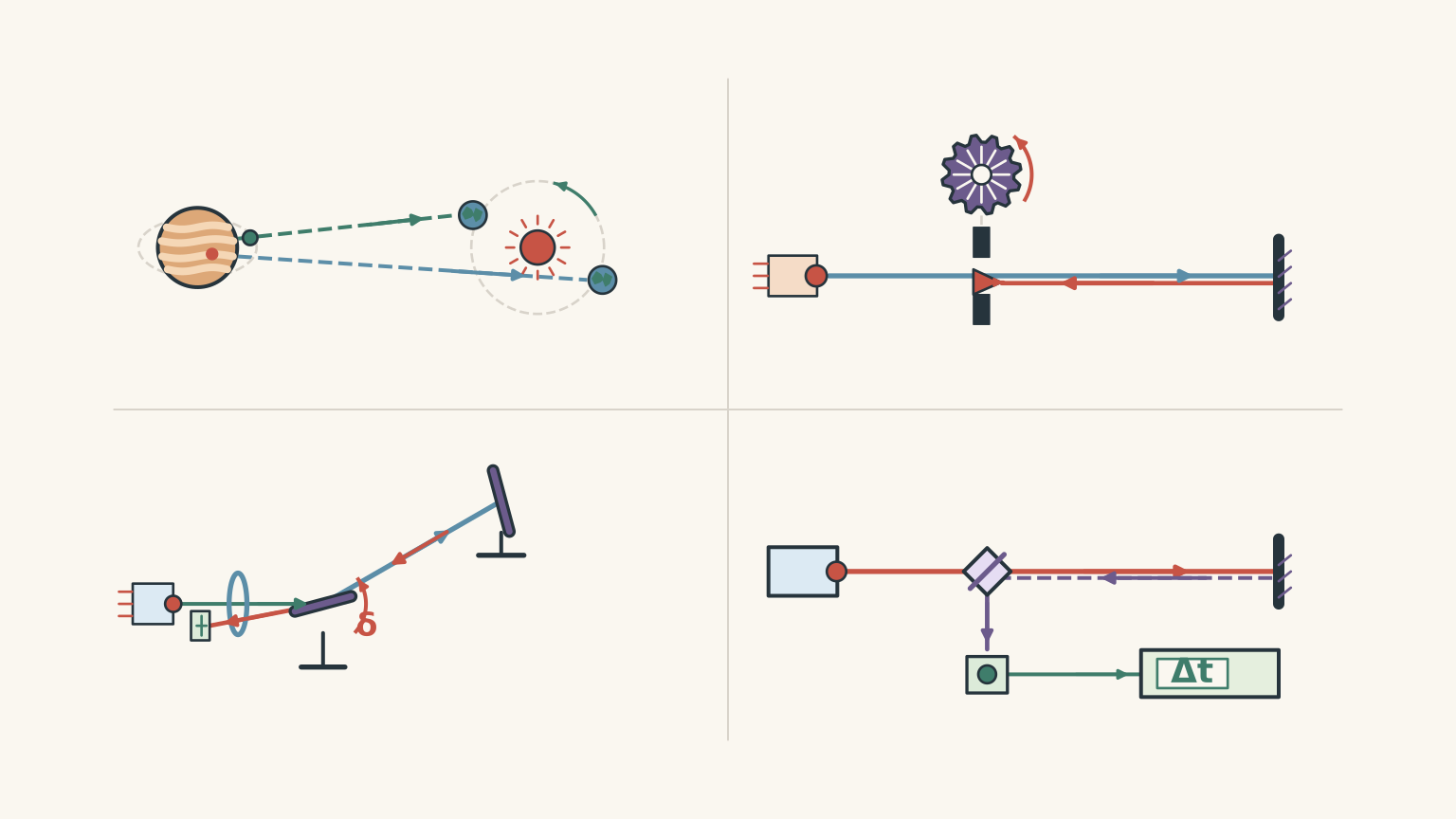
| Method | Main idea | Strength | Limitation |
|---|---|---|---|
| Rømer’s moons | Use astronomical distances as a clock | Huge travel distance | Relies on planetary motion |
| Fizeau’s toothed wheel | Convert travel time into wheel timing | First Earth-based measurement | Mechanical precision limits |
| Foucault’s rotating mirror | Convert travel time into angle shift | More precise control | Still uses moving parts |
| Modern laser timing | Measure short delays electronically | Extremely accurate | Requires advanced equipment |
08The bigger idea: measuring the invisible
The history of measuring light speed is really a lesson about experimental design.
The problem was never simply “find a better stopwatch”.
Scientists had to ask:
- What hidden quantity are we trying to measure?
- What effect would that quantity cause?
- Can we make that effect large enough to observe?
Rømer made a tiny delay visible through the motion of planets.
Fizeau made a tiny delay visible through a spinning wheel.
Foucault made a tiny delay visible through a change in angle.
Modern physics continues the same pattern. For example, measurements of electromagnetic waves depend on understanding how waves are produced and how they propagate. You can explore this connection in How Electromagnetic Waves Are Produced and Propagate.
The measured value of \(c\) also became central to later theories of electromagnetism. Maxwell’s equations predicted that electromagnetic waves should travel at the same speed as light, linking electricity, magnetism, and optics into one picture. This prediction is explored further in Maxwell’s Prediction of the Speed of Light.
09Questions and solutions
Question 1
A spacecraft sends a radio signal from Mars to Earth when Mars is \(2.4 \times 10^{11}\) m away.
Calculate the minimum time taken for the signal to reach Earth. Assume radio waves travel at the speed of light.
Solution 1
The signal takes 800 seconds, or about 13 minutes, to reach Earth.
Radio waves are electromagnetic waves, so they travel at:
\[ c=3.00\times10^8\text{ m s}^{-1} \]
Use:
\[ v=\frac{d}{t} \]
Rearrange:
\[ t=\frac{d}{v} \]
Substitute:
\[ t=\frac{2.4\times10^{11}}{3.00\times10^8} \]
\[ t=800\text{ s} \]
So the signal arrives about 13 minutes after it is sent.
The common mistake is thinking the signal travels instantly because radio communication feels immediate. The distance between planets is the factor that reveals the finite speed.
Question 2
A student argues:
“Fizeau’s experiment proved that light moves slowly because the wheel physically blocked the light.”
Explain why this conclusion is incorrect.
Solution 2
The conclusion is incorrect because the wheel only acted as a timing device; it did not slow the light down.
The light still travelled at approximately \(3.00\times10^8\text{ m s}^{-1}\). The rotating wheel created a situation where the returning beam either passed through a gap or hit a tooth.
The tempting idea is that the wheel is controlling the light’s speed because the visibility changes when the wheel rotates. However, the changing brightness is caused by the timing of the returning beam, not a change in how fast the light travels.
The experiment measured a travel time by creating a mechanical event that depended on that travel time.
Question 3
A Foucault experiment uses a rotating mirror. A student says:
“If the rotating mirror spins faster, the speed of light must increase because the reflected beam moves further.”
Explain why this reasoning is wrong.
Solution 3
The speed of light does not increase. The reflected beam moves further because the mirror’s angle changes more during the fixed light travel time.
The light still travels the same distance between the mirrors at the same speed. Increasing the mirror’s rotation rate increases the angle change:
\[ \text{angle change}=\text{rotation rate}\times\text{travel time} \]
The trap is confusing the size of the measured effect with the size of the quantity being measured. A faster-spinning mirror makes the delay easier to detect, but it does not change the delay itself.
Question 4
Two experiments measure the speed of light.
Experiment A uses a laboratory distance of 100 m and measures a travel time of \(333\) ns.
Experiment B uses a space probe \(1.5\times10^{11}\) m away and measures the signal delay.
Explain why Experiment B is not automatically a better measurement, even though the distance is much larger.
Solution 4
Experiment B is not automatically better because measurement accuracy depends on controlling uncertainties, not only increasing distance.
For Experiment A:
\[ t=333\text{ ns}=333\times10^{-9}\text{ s} \]
\[ v=\frac{100}{333\times10^{-9}} \]
\[ v\approx3.00\times10^8\text{ m s}^{-1} \]
The large distance in Experiment B creates a larger delay, which is easier to detect. However, it also introduces extra factors such as the exact position and motion of the spacecraft, the path through space, and timing accuracy.
The tempting route is to assume “bigger distance means better experiment”. A better experiment is one where the measurement uncertainty is small compared with the effect being measured.
Question 5
A scientist proposes a new method to measure light speed:
A laser pulse is sent from Earth to a satellite and reflected back. The scientist argues:
“The satellite’s motion does not matter because light always travels at the same speed, so the distance can be measured once before the experiment.”
Evaluate this argument.
Solution 5
The argument is incomplete because the satellite’s motion changes the distance travelled by the light during the measurement, so the distance cannot always be treated as fixed.
The correct starting idea is that light in a vacuum does travel at the same speed \(c\). However, the measurement is not only about the speed of light. It requires the distance and time to be measured accurately:
\[ c=\frac{d}{t} \]
If the satellite is moving, the satellite position changes between the pulse being sent and the reflection returning. The outgoing and returning paths may not match the original measured distance.
A strong student might initially focus on the constant value of \(c\) and conclude that the satellite motion is irrelevant. The hidden constraint is that the experiment does not measure \(c\) directly; it infers \(c\) from a changing geometry.
A high-precision version of this experiment must track the satellite position throughout the measurement and account for the motion of the objects involved.
This is the same pattern seen throughout the history of light-speed measurements: the physics is often simple, but the challenge is designing a measurement where hidden assumptions cannot distort the result.