
Projectile Initial Velocity Components for HSC Physics
Learn how to resolve a projectile's launch speed and angle into horizontal and vertical velocity components, including signs, angles, and harder applications.
A projectile is launched at \(20.0\ \text{m s}^{-1}\), \(30^\circ\) above the horizontal. You know its speed and direction, but the projectile-motion equations want something more useful: how fast is it initially moving horizontally, and how fast is it initially moving vertically?
Before calculating, predict which component should be larger. Since the launch direction is much closer to horizontal than vertical, the horizontal component should be larger. If your mathematics later gives the opposite result, that is a useful warning that something has gone wrong.
01One velocity, viewed in two directions
The projectile does not actually have one horizontal velocity and a separate vertical velocity fighting over where to send it. It has one velocity vector.
We split that vector into two perpendicular components because horizontal and vertical motion behave differently after launch.
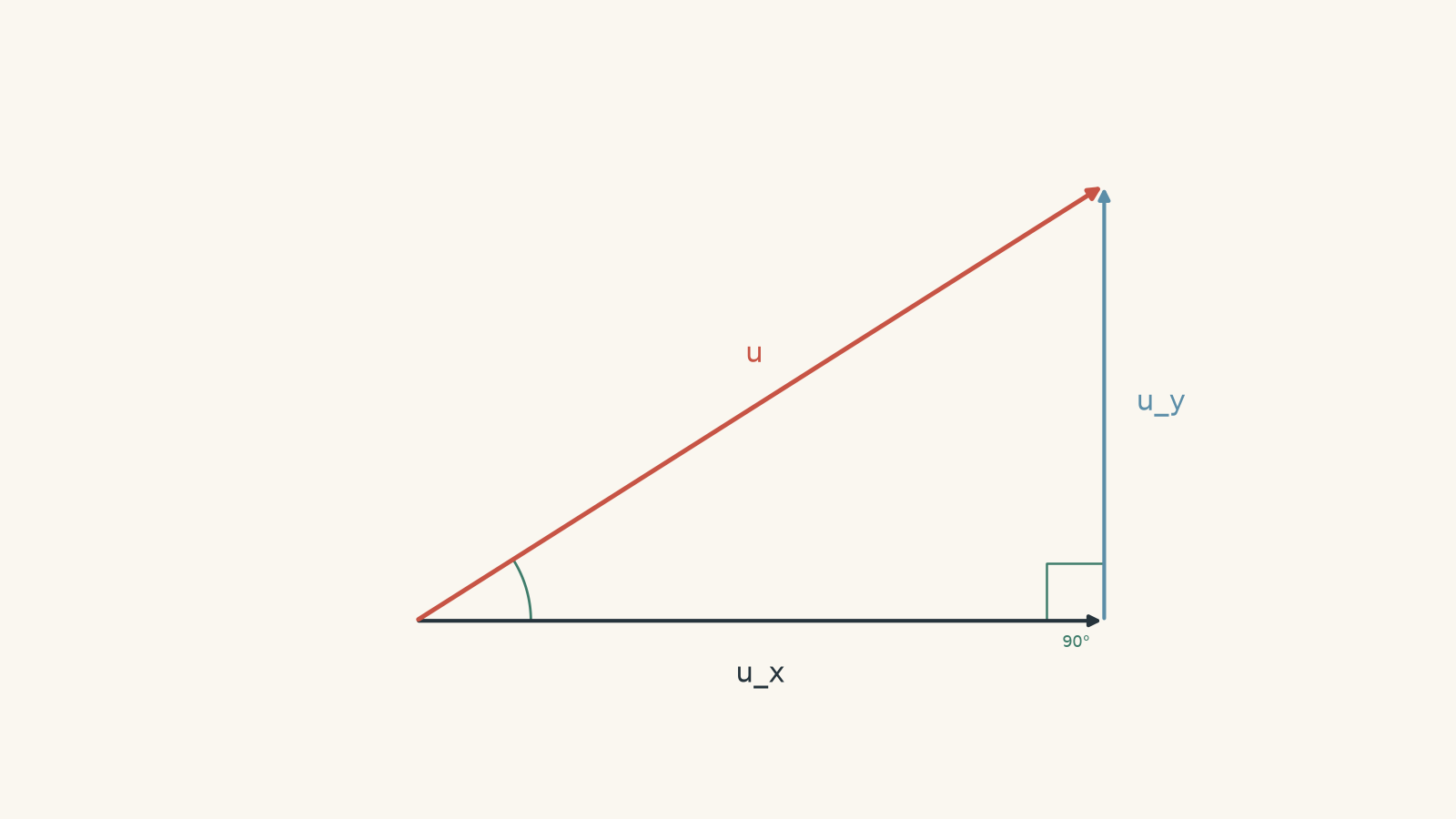
Picture the velocity arrow as the diagonal of a right-angled triangle. Its horizontal component is the width of the triangle, and its vertical component is the height.
For an initial speed \(u\) launched at an angle \(\theta\) above the horizontal,
\[
u_x=u\cos\theta
\]
and
\[
u_y=u\sin\theta
\]
where:
- \(u\) is the initial speed, in \(\text{m s}^{-1}\),
- \(u_x\) is the initial horizontal velocity component, in \(\text{m s}^{-1}\),
- \(u_y\) is the initial vertical velocity component, in \(\text{m s}^{-1}\), and
- \(\theta\) is the launch angle measured from the horizontal.
Why cosine horizontally and sine vertically? Relative to the angle \(\theta\), \(u_x\) is the adjacent side of the right-angled triangle, while \(u_y\) is the opposite side.
That last sentence is more important than memorising “cos is horizontal”. If the angle is measured from a different direction, the sine and cosine relationships change.
02A quick reasonableness check
Suppose \(u=20.0\ \text{m s}^{-1}\) and \(\theta=30^\circ\).
Then
\[
u_x=(20.0)\cos30^\circ=17.3\ \text{m s}^{-1}
\]
and
\[
u_y=(20.0)\sin30^\circ=10.0\ \text{m s}^{-1}.
\]
That matches our prediction: the horizontal component is larger.
Notice that \(17.3+10.0\neq20.0\). Components do not add like ordinary numbers because they point in perpendicular directions.
Instead,
\[
u=\sqrt{u_x^2+u_y^2}.
\]
Checking,
\[
\sqrt{(17.3)^2+(10.0)^2}\approx20.0\ \text{m s}^{-1}.
\]
That Pythagorean check is one of the fastest ways to catch a component error.
03The angle decides which component gets sine
A common shortcut is:
horizontal \(=\cos\), vertical \(=\sin\)
That works only when the stated angle is measured from the horizontal.
Suppose instead that a velocity vector makes an angle \(\phi\) from the vertical. Now the vertical component is adjacent to the angle, so
\[
u_y=u\cos\phi,
\]
while the horizontal component is opposite:
\[
u_x=u\sin\phi.
\]
The safer rule is therefore:
- identify the given angle,
- identify the side adjacent to that angle,
- use cosine for the adjacent component,
- use sine for the opposite component.
Think of sine and cosine as caring about the triangle, not about whether a direction has been named “horizontal” or “vertical”.
Worked example: Resolve a launch velocity above the horizontal
A ball is launched at \(24.0\ \text{m s}^{-1}\), \(35.0^\circ\) above the horizontal. Find its initial horizontal and vertical velocity components.
Step 1
The initial speed is
\[
u=24.0\ \text{m s}^{-1},
\]
and the angle is measured from the horizontal, so
\[
u_x=u\cos\theta
\]
and
\[
u_y=u\sin\theta.
\]
Step 2
\[
u_x=(24.0)\cos35.0^\circ=19.7\ \text{m s}^{-1}.
\]
Step 3
\[
u_y=(24.0)\sin35.0^\circ=13.8\ \text{m s}^{-1}.
\]
Step 4
The ball initially moves to the right at \(19.7\ \text{m s}^{-1}\) while also moving upward at \(13.8\ \text{m s}^{-1}\). Those two components together make the original \(24.0\ \text{m s}^{-1}\) velocity vector.
The horizontal component is larger, which makes sense because \(35^\circ\) is closer to horizontal than vertical.
04Components have signs as well as sizes
So far, both components have been positive. That is not guaranteed.
Suppose we choose:
- right as positive \(x\),
- up as positive \(y\).
A projectile launched downward and to the right has:
- \(u_x>0\),
- \(u_y<0\).
A projectile launched upward and to the left has:
- \(u_x<0\),
- \(u_y>0\).
The speed \(u\) itself is a magnitude, so it is not negative. The components can be negative because they describe direction as well as size.
Worked example: A projectile launched downwards
A rock leaves a ledge at \(32.0\ \text{m s}^{-1}\), directed \(40.0^\circ\) below the horizontal to the right. Take right and up as positive. Find its initial velocity components.
Step 1
The horizontal component has magnitude
\[
|u_x|=(32.0)\cos40.0^\circ=24.5\ \text{m s}^{-1}.
\]
The vertical component has magnitude
\[
|u_y|=(32.0)\sin40.0^\circ=20.6\ \text{m s}^{-1}.
\]
Step 2
The projectile travels to the right, so \(u_x\) is positive.
It travels downward, while positive \(y\) is upward, so \(u_y\) is negative.
Therefore,
\[
u_x=24.5\ \text{m s}^{-1},
\qquad
u_y=-20.6\ \text{m s}^{-1}.
\]
Step 3
\[
\sqrt{(24.5)^2+(-20.6)^2}\approx32.0\ \text{m s}^{-1}.
\]
The negative sign does not mean the projectile has a “negative speed”. It means its initial vertical motion is downward.
05Why resolving the velocity is so useful
The split becomes powerful because, under the standard projectile model, the two components evolve differently.
Horizontally, with air resistance neglected,
\[
a_x=0.
\]
So the horizontal velocity stays constant:
\[
v_x=u_x.
\]
Vertically,
\[
a_y=-g,
\]
where \(g\approx9.8\ \text{m s}^{-2}\).
So the vertical velocity changes continuously:
\[
v_y=u_y-gt.
\]
This is why resolving the initial velocity is usually the first real step in a projectile-motion problem. Once \(u_x\) and \(u_y\) are known, the horizontal and vertical equations can be used separately while sharing the same time \(t\).
These conclusions depend on the usual projectile model. In particular, they rely on assumptions such as negligible air resistance and approximately constant gravitational acceleration. Those assumptions are developed in more detail in Projectile Motion Assumptions in HSC Physics Explained.
06The most tempting mistake: using displacement to find the launch angle
Suppose a projectile later reaches a point \(20\ \text{m}\) horizontally away and \(10\ \text{m}\) higher.
It is tempting to say
\[
\tan\theta=\frac{10}{20}
\]
and conclude that the launch angle was \(26.6^\circ\).
That generally does not work.
The line from the launch point to the projectile’s later position is a displacement vector. The initial velocity points along the tangent to the trajectory at the instant of launch. Gravity bends the trajectory after launch, so the displacement direction and initial velocity direction are usually different.
A projectile is a little like someone who leaves home walking north-east but keeps being shoved south every second. Drawing a straight line from their house to where they eventually end up does not tell you the direction they first started walking.
The analogy breaks because gravity changes velocity smoothly rather than arriving as a sequence of literal shoves. The useful point is simply that later position does not directly reveal initial direction.
07A reliable component routine
For most HSC questions, this short process is enough:
| Situation | What to do |
|---|---|
| Angle measured above the horizontal | \(u_x=u\cos\theta,\quad u_y=u\sin\theta\) |
| Angle measured below the horizontal | Find the same magnitudes, then give \(u_y\) the appropriate negative sign |
| Motion is to the left | \(u_x\) is negative if right has been defined as positive |
| Angle measured from the vertical | Rebuild the triangle rather than automatically using the horizontal-angle formulas |
| Components are given and speed is required | \(u=\sqrt{u_x^2+u_y^2}\) |
| Components are given and angle is required | Use \(\tan\theta=u_y/u_x\), then check the quadrant and signs |
The last row needs care. A calculator’s inverse tangent can give you an angle without understanding which quadrant the velocity vector actually lies in. Always sketch the signs of \(u_x\) and \(u_y\) first.
08Questions and solutions
Question 1
A ball is kicked at \(25.0\ \text{m s}^{-1}\), \(53.0^\circ\) above the horizontal.
Find its initial horizontal and vertical velocity components.
Solution 1
The initial components are approximately \(u_x=15.0\ \text{m s}^{-1}\) horizontally and \(u_y=20.0\ \text{m s}^{-1}\) upward.
Because the angle is measured from the horizontal,
\[
u_x=u\cos\theta,
\qquad
u_y=u\sin\theta.
\]
Substituting,
\[
\begin{aligned}
u_x&=(25.0)\cos53.0^\circ\\
&=15.0\ \text{m s}^{-1},
\\[4pt]
u_y&=(25.0)\sin53.0^\circ\\
&=20.0\ \text{m s}^{-1}.
\end{aligned}
\]
A tempting error is to swap sine and cosine. The geometry catches it: a \(53^\circ\) launch is steeper than \(45^\circ\), so its vertical component should be larger than its horizontal component.
Question 2
A projectile is launched from the origin. After \(1.20\ \text{s}\), it is \(18.0\ \text{m}\) horizontally from the launch point and \(8.00\ \text{m}\) above it.
Neglect air resistance and use \(g=9.80\ \text{m s}^{-2}\).
Find:
- the initial horizontal velocity component,
- the initial vertical velocity component,
- the initial speed, and
- the launch angle above the horizontal.
Solution 2
The projectile was launched with components \(u_x=15.0\ \text{m s}^{-1}\) and \(u_y=12.5\ \text{m s}^{-1}\), giving an initial speed of \(19.6\ \text{m s}^{-1}\) at approximately \(39.9^\circ\) above the horizontal.
Horizontally, acceleration is zero, so
\[
x=u_xt.
\]
Therefore,
\[
u_x=\frac{x}{t}
=\frac{18.0}{1.20}
=15.0\ \text{m s}^{-1}.
\]
Vertically,
\[
y=u_yt+\frac12a_yt^2,
\]
with \(a_y=-9.80\ \text{m s}^{-2}\). Hence,
\[
8.00=(u_y)(1.20)-\frac12(9.80)(1.20)^2.
\]
Rearranging,
\[
\begin{aligned}
u_y
&=\frac{8.00+\frac12(9.80)(1.20)^2}{1.20}\\
&=\frac{8.00+7.056}{1.20}\\
&=12.5\ \text{m s}^{-1}.
\end{aligned}
\]
The initial speed is the magnitude of the velocity vector:
\[
\begin{aligned}
u&=\sqrt{u_x^2+u_y^2}\\
&=\sqrt{(15.0)^2+(12.5)^2}\\
&=19.6\ \text{m s}^{-1}.
\end{aligned}
\]
Finally,
\[
\begin{aligned}
\tan\theta&=\frac{u_y}{u_x}\\
&=\frac{12.5}{15.0},
\end{aligned}
\]
so
\[
\theta\approx39.9^\circ.
\]
The tempting route is to calculate \(8.00/1.20=6.67\ \text{m s}^{-1}\) and call that the initial vertical velocity. It is not. That value is the average vertical velocity over the \(1.20\ \text{s}\) interval. Gravity has been reducing the upward velocity throughout the motion, so the initial vertical component must be larger.
Question 3
A projectile is launched from ground level at a speed of \(40.0\ \text{m s}^{-1}\) at an unknown angle \(\theta\) above the positive horizontal direction.
Exactly \(2.00\ \text{s}\) later, its velocity points \(10.0^\circ\) below the positive horizontal direction.
Neglect air resistance and use \(g=9.80\ \text{m s}^{-2}\).
Find the launch angle \(\theta\).
Solution 3
The projectile was launched at approximately \(18.9^\circ\) above the horizontal.
The important distinction is between the initial velocity and the velocity after \(2.00\ \text{s}\). The horizontal component has stayed constant, but gravity has changed the vertical component.
Initially,
\[
u_x=40.0\cos\theta
\]
and
\[
u_y=40.0\sin\theta.
\]
After \(2.00\ \text{s}\),
\[
v_x=40.0\cos\theta
\]
and
\[
v_y=40.0\sin\theta-(9.80)(2.00).
\]
The final velocity points \(10.0^\circ\) below the horizontal, so
\[
\frac{v_y}{v_x}=\tan(-10.0^\circ).
\]
Therefore,
\[
\frac{40.0\sin\theta-19.6}{40.0\cos\theta}
=-\tan10.0^\circ.
\]
Rearranging,
\[
\sin\theta+\tan10.0^\circ\cos\theta
=\frac{19.6}{40.0}.
\]
Using
\[
\sin\theta+\tan10^\circ\cos\theta
=\frac{\sin(\theta+10^\circ)}{\cos10^\circ},
\]
we obtain
\[
\sin(\theta+10.0^\circ)
=\frac{19.6}{40.0}\cos10.0^\circ.
\]
Thus,
\[
\sin(\theta+10.0^\circ)\approx0.4826.
\]
For a launch to the right with \(0^\circ<\theta<90^\circ\),
\[
\theta+10.0^\circ\approx28.9^\circ,
\]
so
\[
\theta\approx18.9^\circ.
\]
A tempting approach is to treat the \(10^\circ\) direction after two seconds as though it directly determines the original component ratio. It does not. Gravity has altered \(v_y\), while \(v_x\) remains equal to its initial value.
Question 4
A projectile is launched from the origin. It later passes through point \(P\), located \(20.0\ \text{m}\) horizontally from the launch point and \(10.0\ \text{m}\) above it. It then reaches point \(Q\), located \(40.0\ \text{m}\) horizontally from the launch point at the same vertical level as the launch point.
Neglect air resistance and use \(g=9.80\ \text{m s}^{-2}\).
Determine:
- whether \(P\) is the highest point of the trajectory,
- the initial horizontal and vertical velocity components,
- the initial speed, and
- the launch angle.
Solution 4
Point \(P\) is the highest point, and the projectile was launched with \(u_x=14.0\ \text{m s}^{-1}\) and \(u_y=14.0\ \text{m s}^{-1}\), giving \(u=19.8\ \text{m s}^{-1}\) at \(45.0^\circ\).
The subtle part is proving that \(P\) is the apex rather than assuming it because it looks conveniently placed.
Horizontal acceleration is zero, so equal horizontal distances correspond to equal time intervals. Point \(P\) lies halfway from \(x=0\) to \(x=40.0\ \text{m}\), so the projectile reaches \(P\) halfway through its total flight time to \(Q\).
Because \(Q\) is at the same height as the launch point, the upward and downward parts of the vertical motion are symmetric in time. The projectile reaches its highest point halfway through that flight.
Therefore, \(P\) is the apex.
At the apex,
\[
v_y=0.
\]
Using
\[
v_y^2=u_y^2+2a_y\Delta y,
\]
with \(\Delta y=10.0\ \text{m}\) and \(a_y=-9.80\ \text{m s}^{-2}\),
\[
0=u_y^2-2(9.80)(10.0).
\]
Thus,
\[
\begin{aligned}
u_y&=\sqrt{196}\\
&=14.0\ \text{m s}^{-1}.
\end{aligned}
\]
The total time to return to the original height is
\[
T=\frac{2u_y}{g}
=\frac{2(14.0)}{9.80}
=2.86\ \text{s}.
\]
Horizontally,
\[
x=u_xT,
\]
so
\[
u_x=\frac{40.0}{2.86}
=14.0\ \text{m s}^{-1}.
\]
The initial speed is
\[
\begin{aligned}
u&=\sqrt{u_x^2+u_y^2}\\
&=\sqrt{(14.0)^2+(14.0)^2}\\
&=19.8\ \text{m s}^{-1}.
\end{aligned}
\]
The launch angle is
\[
\tan\theta=\frac{14.0}{14.0}=1,
\]
so
\[
\theta=45.0^\circ.
\]
The tempting claim is that halfway across the horizontal range must always be the highest point. That is not generally true for arbitrary motion. It works here because the horizontal velocity is constant and the projectile lands at the same vertical level from which it was launched.
Question 5
A projectile is launched from the origin at a fixed speed of \(25.0\ \text{m s}^{-1}\). It must pass through a target located \(30.0\ \text{m}\) horizontally away and \(5.00\ \text{m}\) above the launch point.
Neglect air resistance and use \(g=9.80\ \text{m s}^{-2}\).
Find:
- all possible launch angles between \(0^\circ\) and \(90^\circ\),
- the initial horizontal and vertical velocity components for each launch,
- the time taken to reach the target for each launch, and
- the speed of the projectile as it passes through the target in each case.
Explain the last result.
Solution 5
There are two possible launches: approximately \(24.2^\circ\) and \(75.3^\circ\). They reach the target after about \(1.32\ \text{s}\) and \(4.72\ \text{s}\), respectively, but both pass through the target with the same speed, approximately \(23.0\ \text{m s}^{-1}\).
The surprising part is that one launch spends much longer in the air, yet its speed at the target has the same magnitude.
Start with the component equations:
\[
x=(u\cos\theta)t
\]
and
\[
y=(u\sin\theta)t-\frac12gt^2.
\]
From the horizontal equation,
\[
t=\frac{x}{u\cos\theta}.
\]
Substitute this into the vertical equation:
\[
y=x\tan\theta-\frac{gx^2}{2u^2\cos^2\theta}.
\]
Using
\[
\frac{1}{\cos^2\theta}=1+\tan^2\theta,
\]
and substituting \(x=30.0\ \text{m}\), \(y=5.00\ \text{m}\), and \(u=25.0\ \text{m s}^{-1}\),
\[
5.00
=30.0\tan\theta
-\frac{(9.80)(30.0)^2}{2(25.0)^2}
\left(1+\tan^2\theta\right).
\]
The numerical coefficient is
\[
\frac{(9.80)(900)}{1250}=7.056.
\]
Let
\[
T=\tan\theta.
\]
Then
\[
5.00=30.0T-7.056(1+T^2),
\]
so
\[
7.056T^2-30.0T+12.056=0.
\]
Solving the quadratic gives
\[
T\approx0.4494
\]
or
\[
T\approx3.802.
\]
Therefore,
\[
\theta\approx24.2^\circ
\]
or
\[
\theta\approx75.3^\circ.
\]
For the lower trajectory,
\[
\begin{aligned}
u_x&=(25.0)\cos24.2^\circ\\
&=22.8\ \text{m s}^{-1},
\\
u_y&=(25.0)\sin24.2^\circ\\
&=10.2\ \text{m s}^{-1}.
\end{aligned}
\]
Its time to the target is
\[
t=\frac{30.0}{22.8}=1.32\ \text{s}.
\]
For the higher trajectory,
\[
\begin{aligned}
u_x&=(25.0)\cos75.3^\circ\\
&=6.36\ \text{m s}^{-1},
\\
u_y&=(25.0)\sin75.3^\circ\\
&=24.2\ \text{m s}^{-1}.
\end{aligned}
\]
Its time to the target is
\[
t=\frac{30.0}{6.36}=4.72\ \text{s}.
\]
Now compare the speeds at the target.
For either launch, horizontal acceleration is zero, while the vertical component obeys
\[
v_y^2=u_y^2+2a_y\Delta y.
\]
Since \(a_y=-g\) and \(\Delta y=5.00\ \text{m}\),
\[
v_y^2=u_y^2-2g(5.00).
\]
The total speed satisfies
\[
v^2=v_x^2+v_y^2.
\]
Since \(v_x=u_x\),
\[
\begin{aligned}
v^2
&=u_x^2+u_y^2-2g(5.00)\\
&=u^2-2g(5.00).
\end{aligned}
\]
Both projectiles began with the same speed \(u=25.0\ \text{m s}^{-1}\), and both are being examined at the same final height. Therefore,
\[
\begin{aligned}
v^2
&=(25.0)^2-2(9.80)(5.00)\\
&=527,
\end{aligned}
\]
giving
\[
v=23.0\ \text{m s}^{-1}.
\]
The lower path reaches the target with approximately
\[
v_x=22.8\ \text{m s}^{-1},
\qquad
v_y=-2.65\ \text{m s}^{-1},
\]
while the higher path arrives with approximately
\[
v_x=6.36\ \text{m s}^{-1},
\qquad
v_y=-22.1\ \text{m s}^{-1}.
\]
Their directions are very different, but their speed magnitudes are the same.
The tempting prediction is that the high trajectory must arrive more slowly because gravity has acted for much longer. Gravity does act for longer, but the projectile also rises much higher and then gains that vertical speed again while falling. For a given initial speed and a given final height, the final speed magnitude is fixed under this ideal projectile model.
Once you can resolve \(u\) into \(u_x\) and \(u_y\) confidently, projectile motion becomes two linked one-dimensional problems. The next useful step is learning to choose the horizontal or vertical equation that gives the shared time, then using that same time to connect the two directions.