
Quarks and Hadrons: How Protons, Neutrons and Mesons Form
Learn how quarks are arranged into hadrons and how particle structure explains protons, neutrons, and mesons. Includes HSC Physics examples and practice questions.
A particle detector records a spray of particles after a high-energy collision. A student looks at the data and asks: “Why do we see protons and other particles, but never a single quark flying out?”
That is the puzzle that leads to quarks and hadrons. The particles we call “matter particles” are not all fundamental. Some, like protons and neutrons, are built from smaller particles called quarks. However, quarks behave in a very unusual way: they are always found locked together inside larger particles.
Before we name the particles, predict this:
If a proton is made from smaller pieces, what should happen if we smash a proton with enough energy? Should the pieces simply fly apart like broken Lego?
The answer is no. The energy creates new particles, but individual quarks remain trapped inside combinations called hadrons. Understanding why requires a model of what is inside the atom’s nucleus.
01From protons and neutrons to quarks
For most of school physics, we treat protons and neutrons as the basic building blocks of the nucleus.
That model works well for explaining atoms:
- protons have a positive charge,
- neutrons have no charge,
- electrons surround the nucleus.
But experiments in the late twentieth century showed that protons and neutrons have internal structure.
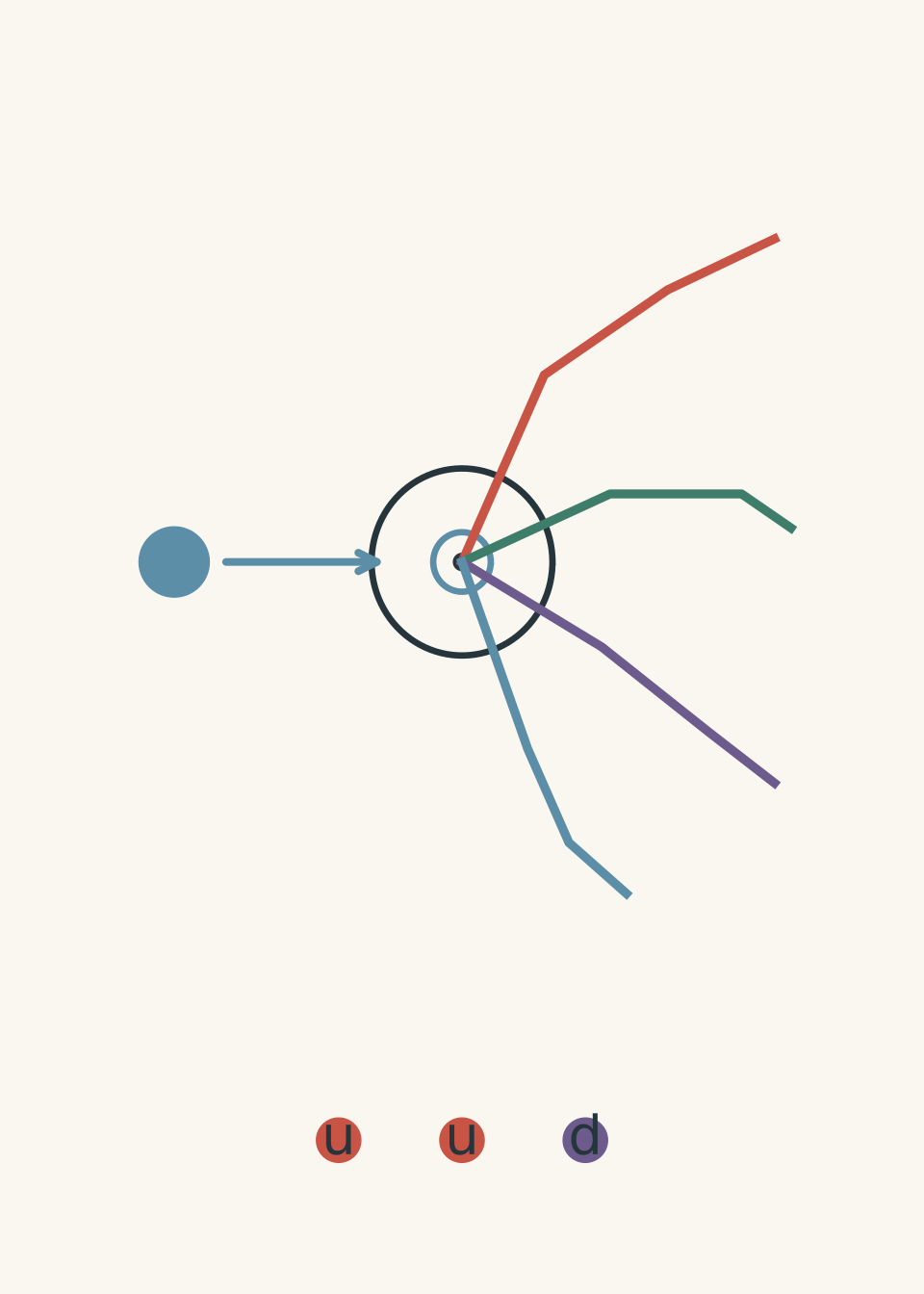
Scientists fired high-energy electrons at protons and studied how the electrons scattered. If a proton were completely smooth and empty inside, the scattering pattern would look different. Instead, the electrons behaved as if they were hitting smaller charged objects inside the proton.
Those smaller objects were quarks.
A proton is not a single point-like particle. It is a hadron, meaning it is a particle made from quarks.
02The six quark flavours
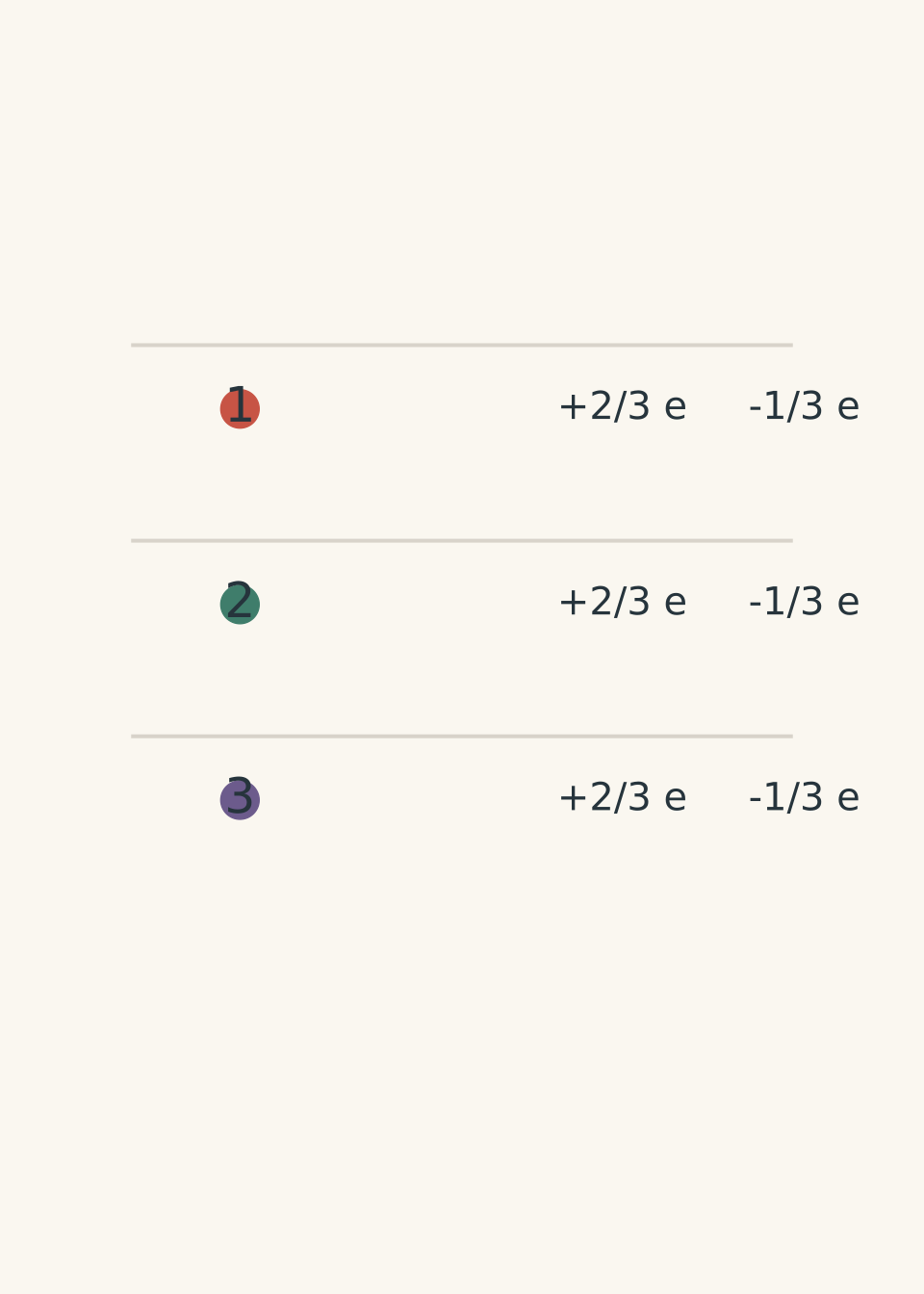
Quarks come in six types, called flavours:
| Quark flavour | Symbol | Electric charge |
|---|---|---|
| up | \(u\) | \(+\frac{2}{3}e\) |
| down | \(d\) | \(-\frac{1}{3}e\) |
| charm | \(c\) | \(+\frac{2}{3}e\) |
| strange | \(s\) | \(-\frac{1}{3}e\) |
| top | \(t\) | \(+\frac{2}{3}e\) |
| bottom | \(b\) | \(-\frac{1}{3}e\) |
Here, \(e\) is the magnitude of the elementary charge, the charge of a proton.
The quarks are arranged into three generations:
- up and down,
- charm and strange,
- top and bottom.
The first generation is the one you meet most often because ordinary matter is made mainly from up and down quarks.
The heavier quarks are unstable. They usually decay into lighter particles very quickly.
03Building a proton from quarks
A proton contains:
\[ uud \]
This means two up quarks and one down quark.
Let’s check the charge:
\[ +\frac{2}{3}e+\frac{2}{3}e-\frac{1}{3}e=+e \]
So the proton has a total charge of \(+e\), exactly as observed.
A neutron contains:
\[ udd \]
Its charge is:
\[ +\frac{2}{3}e-\frac{1}{3}e-\frac{1}{3}e=0 \]
So the neutron is electrically neutral.
This gives a useful pattern:
- up-type quarks (\(u,c,t\)) have charge \(+\frac{2}{3}e\),
- down-type quarks (\(d,s,b\)) have charge \(-\frac{1}{3}e\).
The particle’s overall charge comes from adding the charges of its quarks.
04Hadrons: the family containing quark combinations
The word hadron means a particle made from quarks held together by the strong nuclear force.
There are two major groups you need to know for HSC Physics:
- baryons,
- mesons.
Baryons
Baryons contain three quarks.
Examples:
| Baryon | Quark composition | Charge |
|---|---|---|
| proton | \(uud\) | \(+e\) |
| neutron | \(udd\) | \(0\) |
A simple mental model is to imagine three friends forming a team. The team’s overall identity depends on who the three members are.
The analogy works because the combination of members determines the final properties.
However, it breaks down because quarks are not little balls sitting next to each other. Their behaviour is governed by quantum mechanics and the strong force.
Mesons
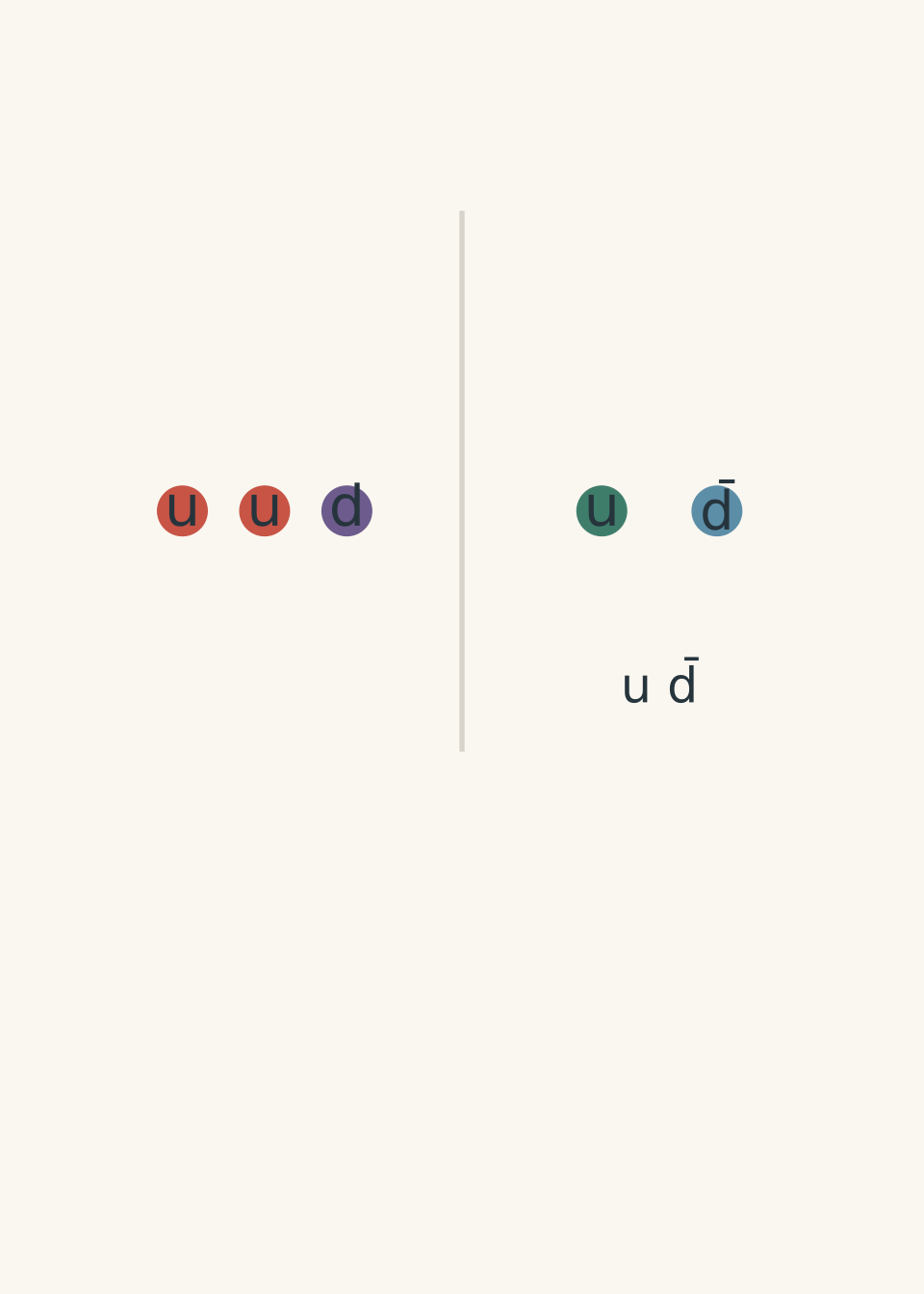
Mesons contain one quark and one antiquark.
A pion is an example:
\[ \pi^+ = u\bar{d} \]
The symbol \(\bar{d}\) means an anti-down quark.
Antiquarks have the opposite charge of their corresponding quarks:
- \(u\) has charge \(+\frac{2}{3}e\),
- \(\bar{d}\) has charge \(+\frac{1}{3}e\).
Therefore:
\[ +\frac{2}{3}e+\frac{1}{3}e=+e \]
So the pion has charge \(+e\).
05Why do we never see a single quark?
This is where the quark model becomes strange.
A student might predict:
“If a proton contains quarks, increasing the collision energy should eventually knock one quark out.”
That prediction feels reasonable because it works for many everyday objects. If you break a rock, the pieces separate. If you break a molecule, the atoms separate.
Quarks do not behave that way.
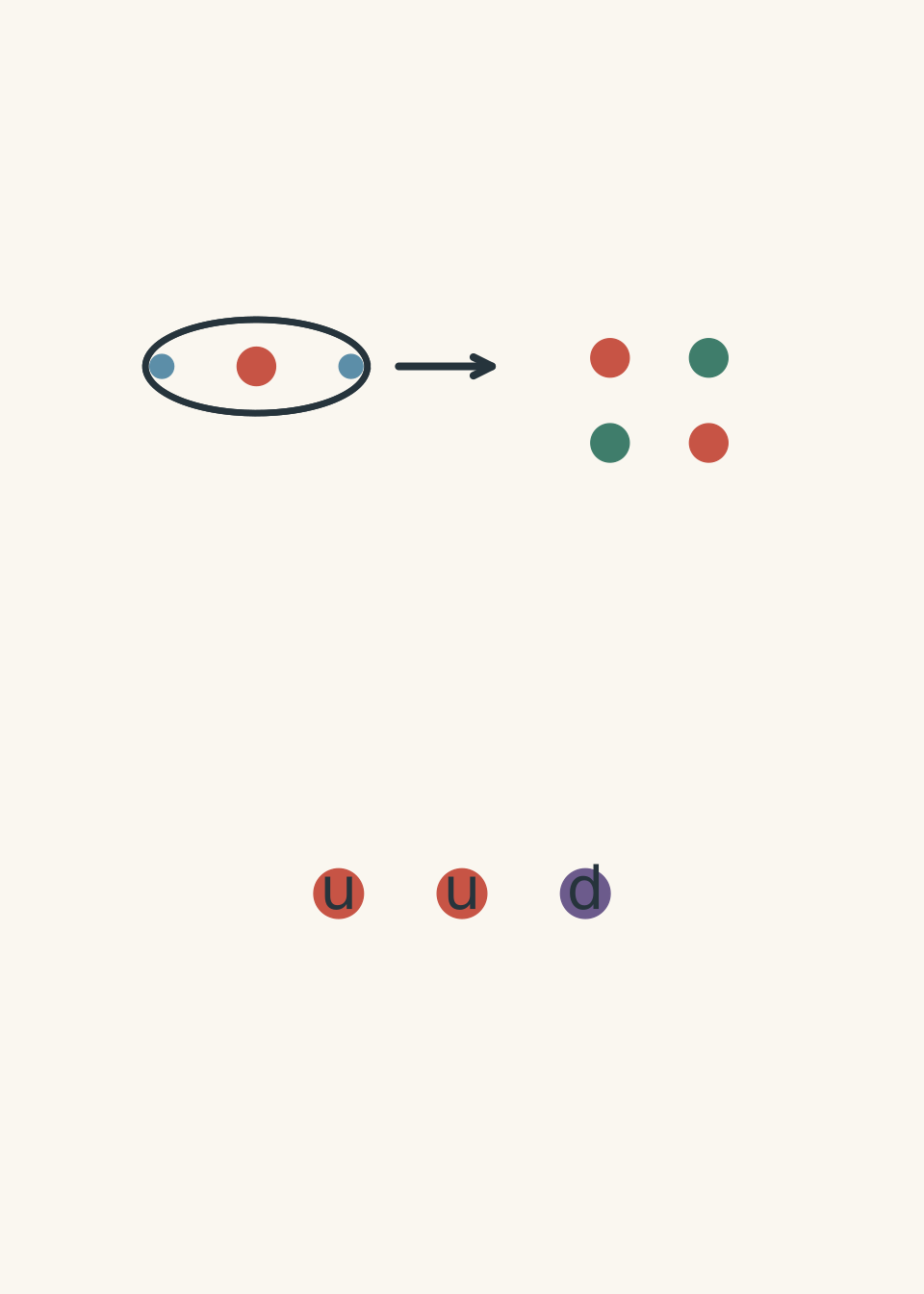
The strong force between quarks becomes stronger as they move farther apart. This is called confinement.
A useful analogy is a very unusual elastic band. Imagine trying to pull apart two objects connected by a band. At first, separation is easy. But as you pull further, the stored energy increases. Eventually, there is enough energy to create new objects rather than leaving the original pieces separated.
The analogy helps explain why energy becomes particles.
It fails because quarks are not literally attached by elastic bands. The strong interaction is described by quantum chromodynamics, and the force is carried by particles called gluons.
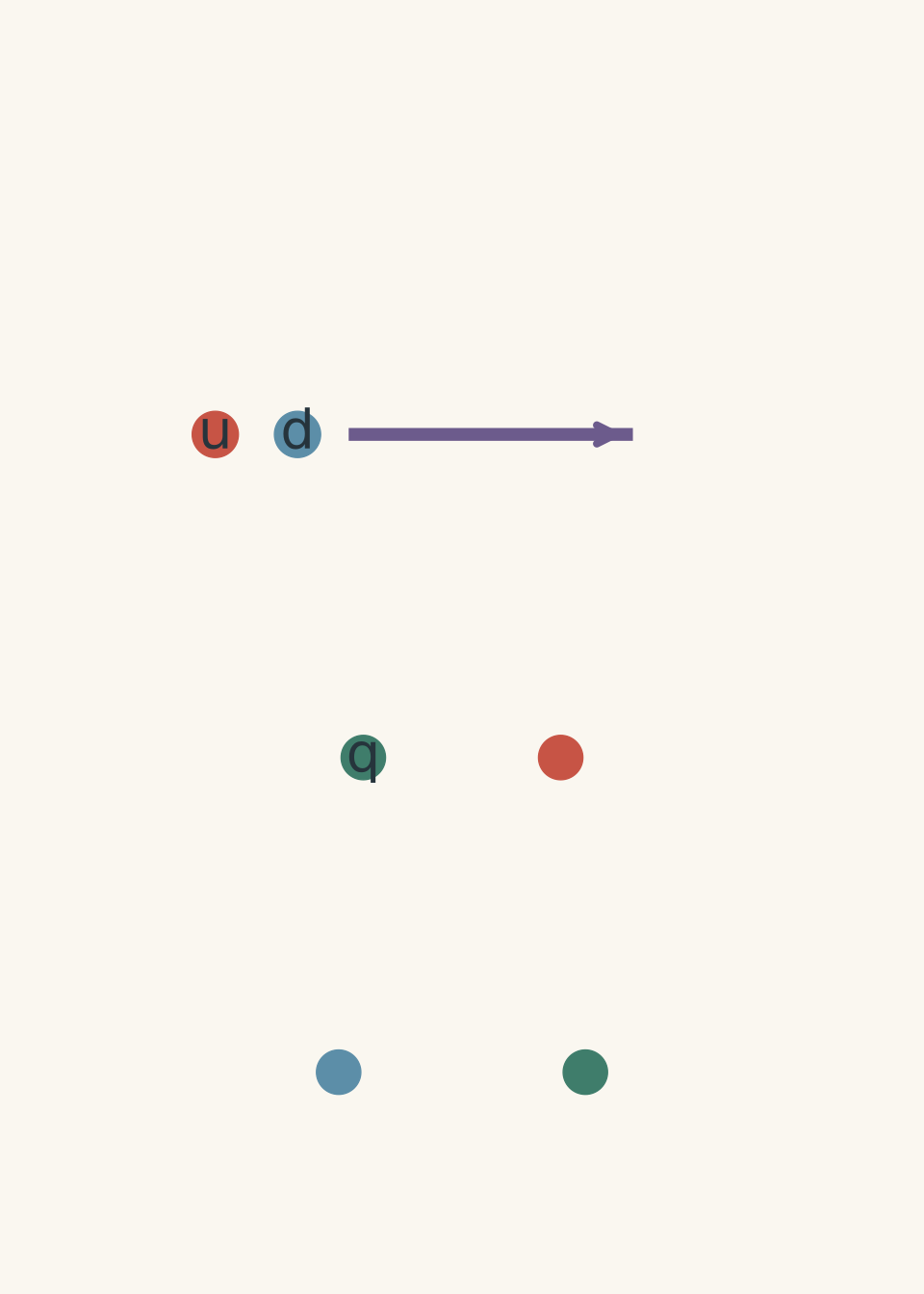
When a high-energy collision tries to separate quarks, the energy can create a new quark-antiquark pair. The result is a collection of new hadrons, not an isolated quark.
06Quarks, leptons, and the structure of matter
It helps to separate two groups of fundamental particles:
| Group | Examples | Made of quarks? |
|---|---|---|
| quarks | up, down, strange | No, they are fundamental |
| leptons | electron, neutrino | No, they are fundamental |
Quarks combine to form hadrons.
Electrons do not contain quarks. They are leptons.
This distinction prevents a common mistake:
“Everything inside an atom is made from quarks.”
Not quite. The proton and neutron are made from quarks, but electrons are not.
07Worked example: Find the charge of a neutron
A neutron contains one up quark and two down quarks. Find its total electric charge.
Step 1
A neutron is:
\[ udd \]
Step 2
The charges are:
\[ u=+\frac{2}{3}e \]
and
\[ d=-\frac{1}{3}e \]
Therefore:
\[ Q=+\frac{2}{3}e-\frac{1}{3}e-\frac{1}{3}e \]
Step 3
\[ Q=0e \]
Step 4
The neutron is electrically neutral because the positive charge of the up quark is exactly cancelled by the two down quarks.
08Worked example: Determine the composition of a charged meson
A meson has a total charge of \(+e\) and contains an up quark. Find a possible quark composition.
Step 1
A meson contains:
\[ \text{quark}+\text{antiquark} \]
Step 2
The up quark contributes:
\[ +\frac{2}{3}e \]
The meson needs a total charge of \(+e\), so the remaining contribution must be:
\[ +e-\frac{2}{3}e=\frac{1}{3}e \]
Step 3
A down quark has charge:
\[ -\frac{1}{3}e \]
so an anti-down quark has:
\[ +\frac{1}{3}e \]
Therefore:
\[ u\bar{d} \]
has charge:
\[ +\frac{2}{3}e+\frac{1}{3}e=+e \]
Step 4
A possible particle is a positively charged pion, \(\pi^+\). The important skill is not memorising every hadron, but using the quark charges to test whether a combination is possible.
09The key misconception: “Three quarks always make a baryon”
For HSC questions, remember that the number and type of quarks matter.
Three quarks make a baryon.
One quark plus one antiquark makes a meson.
A particle with two quarks is not automatically a normal hadron in the basic HSC model. The allowed combinations are controlled by the rules of the strong interaction.
When you see a particle composition question, do not guess from the charge alone. First identify the particle family, then check the quark arrangement.
10Questions and solutions
Question 1
A proton contains two up quarks and one down quark. Calculate its total electric charge.
Solution 1
The proton has charge \(+e\). Its quark composition is \(uud\), so:
\[ Q=+\frac{2}{3}e+\frac{2}{3}e-\frac{1}{3}e \]
\[ Q=+e \]
The tempting mistake is to think the down quark’s negative charge makes the proton less than positive. However, the two up quarks contribute a larger positive charge, leaving one elementary charge overall.
Question 2
A particle is made from three quarks: \(uds\). Determine whether it is a baryon and calculate its charge.
Solution 2
The particle is a baryon with charge \(0\). It contains three quarks, so it fits the baryon structure.
The charges are:
\[ u=+\frac{2}{3}e,\quad d=-\frac{1}{3}e,\quad s=-\frac{1}{3}e \]
Adding:
\[ Q=+\frac{2}{3}e-\frac{1}{3}e-\frac{1}{3}e=0 \]
The trap is focusing only on the charge. Many different combinations can have the same charge, so the number of quarks is what identifies the family.
Question 3
A meson contains a strange quark and has a total charge of \(-e\). Determine a possible antiquark that completes the meson.
Solution 3
A possible meson is \(s\bar{u}\), giving a charge of \(-e\).
The strange quark has charge:
\[ s=-\frac{1}{3}e \]
The meson needs:
\[ -e=-\frac{3}{3}e \]
so the antiquark must contribute:
\[ -\frac{3}{3}e-\left(-\frac{1}{3}e\right)=-\frac{2}{3}e \]
An anti-up quark has charge:
\[ \bar{u}=-\frac{2}{3}e \]
Therefore:
\[ s\bar{u} \]
has charge:
\[ -\frac{1}{3}e-\frac{2}{3}e=-e \]
The tempting route is to choose a down-type antiquark because its charge is negative. The constraint is that the meson’s second particle must provide exactly the missing \(-\frac{2}{3}e\).
Question 4
A high-energy experiment produces many particles after smashing protons together. A student claims: “The experiment has proven that free quarks exist because the proton was broken apart.”
Explain why this conclusion is incorrect.
Solution 4
The conclusion is incorrect because high-energy collisions produce new hadrons rather than isolated quarks.
The collision can transfer enough energy to disturb the quarks inside the proton. However, quark confinement prevents individual quarks from existing freely. As quarks separate, the energy in the strong interaction field can create new quark-antiquark pairs, which combine into new hadrons.
The student’s idea is reasonable because many familiar objects break into smaller pieces. The missing constraint is that quarks are not like ordinary pieces of matter. The strong force changes the outcome of the separation process.
Question 5
A scientist proposes a new particle with the following description:
- it has a total charge of \(+e\),
- it is made of three quarks,
- its quarks are \(u\), \(d\), and \(\bar{s}\).
Decide whether this description can represent a normal baryon in the HSC quark model. Explain your reasoning.
Solution 5
The description cannot represent a normal baryon because it contains an antiquark.
A baryon is made from three quarks. The proposed particle contains:
\[ u+d+\bar{s} \]
This is a mixture of quarks and an antiquark, not three quarks.
Checking the charge:
\[ u=+\frac{2}{3}e \]
\[ d=-\frac{1}{3}e \]
\[ \bar{s}=+\frac{1}{3}e \]
so:
\[ Q=+\frac{2}{3}e-\frac{1}{3}e+\frac{1}{3}e \]
\[ Q=+\frac{2}{3}e \]
It does not even produce the claimed charge of \(+e\).
The tempting mistake is to focus only on arranging charges until they match. The deeper constraint is that hadron families have structure rules. A baryon requires three quarks, while a meson requires a quark and an antiquark. Charge alone cannot identify a particle.
Understanding quark combinations gives you the language needed for the next step: analysing particle interactions and conservation laws, where HSC Physics connects quark structure with reactions, forces, and particle decay.