
Potential Difference and Electrical Work: Using W = qV
Learn how potential difference measures energy transferred per unit charge, and how to apply W = qV in HSC Physics calculations and reasoning.
A 9 V battery and a 1.5 V cell can both move charge through a circuit. But suppose exactly \(2.0\ \text{C}\) of charge passes through each one. Which source transfers more energy to that charge?
Predict before calculating. The same amount of charge moves in both cases, so the difference must come from the voltage. The 9 V battery transfers \(18\ \text{J}\), while the 1.5 V cell transfers only \(3.0\ \text{J}\).
That is what potential difference tells you: how much electrical energy is transferred per unit charge.
01What does a voltage actually tell you?
A voltmeter might read \(6.0\ \text{V}\) across a battery. It is tempting to think that “6 volts” is an amount of energy. It is not.
A voltage is an energy-per-charge quantity.
\[
1\ \text{V} = 1\ \text{J C}^{-1}
\]
So a potential difference of \(6.0\ \text{V}\) means that \(6.0\ \text{J}\) of energy is transferred for every \(1.0\ \text{C}\) of charge that moves through that potential difference.
A useful first model is shopping by unit price:
- voltage is like the price per kilogram,
- charge is like the number of kilograms,
- energy transferred is like the total cost.
If apples cost $6 per kilogram, then buying \(3\ \text{kg}\) costs three times as much as buying \(1\ \text{kg}\). In the same way, if a potential difference transfers \(6\ \text{J}\) per coulomb, then moving \(3\ \text{C}\) transfers three times as much energy as moving \(1\ \text{C}\).
The analogy is only mathematical. A battery is not “selling” energy to charges, and charge is not used up like apples. Charge moves through the circuit while energy is transferred between electrical and other forms.
02From energy per charge to \(W=qV\)
Potential difference is defined using the relationship
\[
V = \frac{W}{q}
\]
where:
- \(V\) is the potential difference in volts (\(\text{V}\)),
- \(W\) is the electrical work done, or energy transferred, in joules (\(\text{J}\)),
- \(q\) is the charge moved in coulombs (\(\text{C}\)).
Rearranging gives the form you will often use in calculations:
\[
W = qV
\]
This equation says something simple:
Energy transferred = charge moved x energy transferred per coulomb.
The units confirm the idea:
\[
\text{C} \times \frac{\text{J}}{\text{C}} = \text{J}
\]
The coulombs cancel, leaving joules.
What does one volt mean?
If \(1.0\ \text{C}\) moves through a potential difference of \(1.0\ \text{V}\),
\[
W = qV = (1.0)(1.0) = 1.0\ \text{J}
\]
So:
\[
1\ \text{V} = 1\ \text{J C}^{-1}
\]
This interpretation is more useful than memorising the equation by itself.
If you know the potential difference, you know the energy transfer for each coulomb of charge.
03Worked example: energy transferred by a battery
A \(12\ \text{V}\) battery moves \(3.5\ \text{C}\) of charge through the battery. Calculate the energy transferred to the charge.
Step 1
A potential difference of \(12\ \text{V}\) means \(12\ \text{J}\) of energy is transferred per coulomb of charge.
Step 2
\[
W = qV
\]
Step 3
\[
W = (3.5\ \text{C})(12\ \text{V}) = 42\ \text{J}
\]
Step 4
The battery transfers \(42\ \text{J}\) of energy to the \(3.5\ \text{C}\) of charge.
Notice that the battery has not supplied \(12\ \text{J}\) in total. It supplies \(12\ \text{J}\) per coulomb.
04Potential difference needs two points
Electrical potential by itself describes a point. Potential difference compares two points.
That is why voltage is measured across a component.
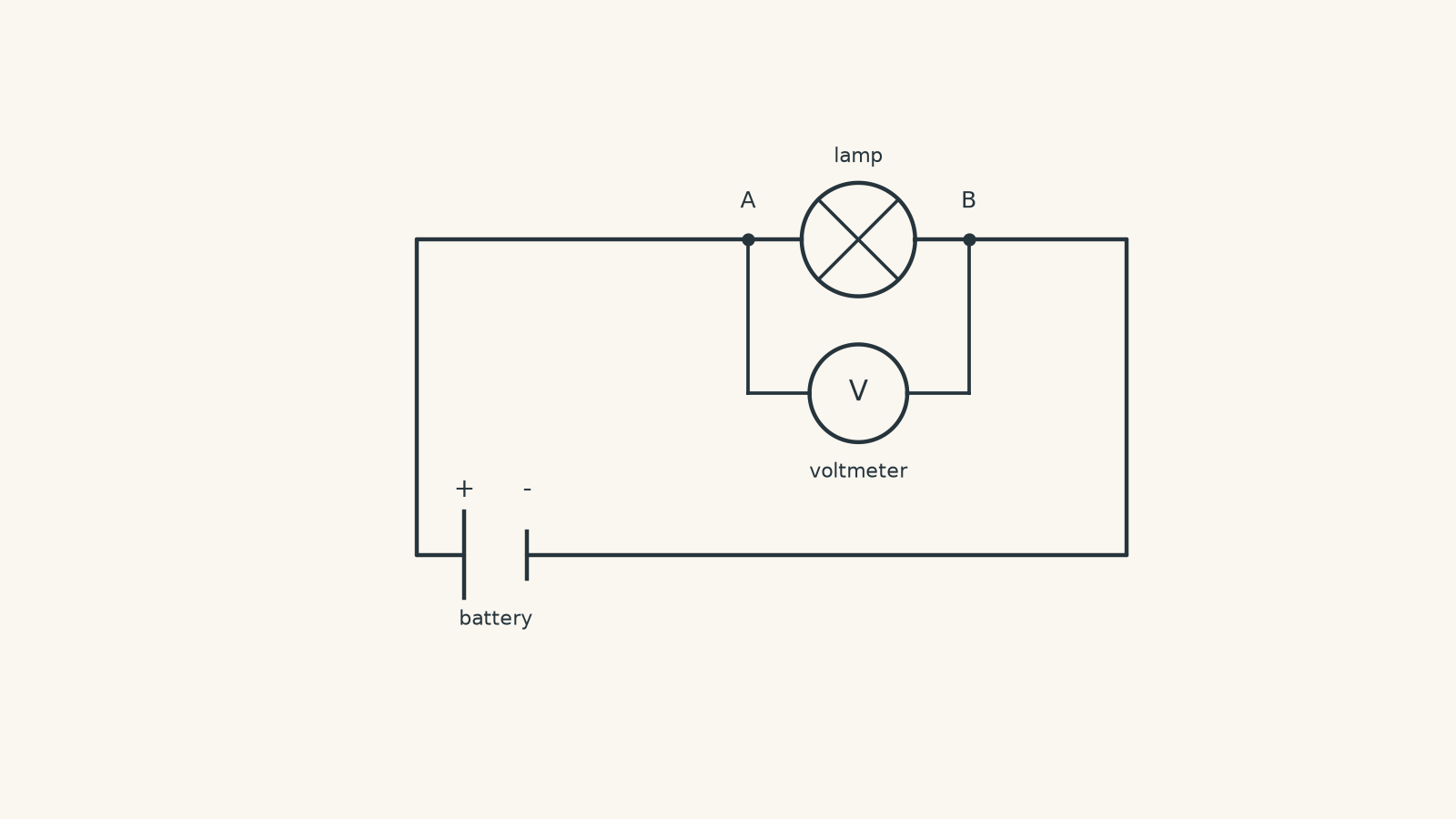
Suppose a lamp has a potential difference of \(5.0\ \text{V}\) across it. If \(1.0\ \text{C}\) of charge passes through the lamp, \(5.0\ \text{J}\) of electrical energy is transferred from the charges to the lamp.
That energy might eventually appear mainly as thermal energy and light.
If \(4.0\ \text{C}\) passes through instead, the voltage has not necessarily changed. There is simply more charge transferring energy:
\[
W = (4.0\ \text{C})(5.0\ \text{V}) = 20\ \text{J}
\]
This is an important distinction:
- voltage tells you energy transferred per coulomb,
- charge tells you how much charge has moved,
- their product gives the total energy transferred.
If you need to revise what actually moves through a metal conductor, see Electric Current in Metals: Charge Carriers and Drift.
05Where does the energy go?
Consider a simple circuit containing a battery and a resistor.
Inside the battery, chemical processes transfer energy to the charges. As those charges move through the external circuit, the electric field transfers that energy to circuit components.
Across the resistor, electrical energy is converted mainly into thermal energy.
So if \(50\ \text{C}\) passes through a resistor with \(8.0\ \text{V}\) across it,
\[
W = qV = (50\ \text{C})(8.0\ \text{V}) = 400\ \text{J}
\]
The resistor receives \(400\ \text{J}\) of energy from the electrical system.
The charge itself is not consumed. It continues around the circuit.
That last point matters. A common mistake is to imagine that a resistor “uses up electrons”. It does not. It receives energy from moving charges.
06Worked example: finding the potential difference
A heating element receives \(1.8\ \text{kJ}\) of electrical energy while \(150\ \text{C}\) of charge passes through it. Calculate the potential difference across the element.
Step 1
\[
1.8\ \text{kJ} = 1.8 \times 10^3\ \text{J}
\]
Step 2
\[
V = \frac{W}{q}
\]
Step 3
\[
V = \frac{1.8\times10^3\ \text{J}}{150\ \text{C}}
= 12\ \text{J C}^{-1}
= 12\ \text{V}
\]
Step 4
The potential difference is \(12\ \text{V}\). This means the element receives \(12\ \text{J}\) of electrical energy for every coulomb of charge passing through it.
07A more precise picture: positive and negative charges
So far, we have mostly talked about the magnitude of energy transferred. That is usually what simple \(W=qV\) questions are asking for.
There is another layer.
Charge can be positive or negative. A proton has positive charge, while an electron has negative charge:
\[
q_{\text{electron}} = -1.602\times10^{-19}\ \text{C}
\]
Because \(q\) can have a sign, equations involving electric potential can also carry signs.
For example, the change in electric potential energy of a charge can be written as
\[
\Delta U = q\Delta V
\]
where:
- \(\Delta U\) is the change in electric potential energy,
- \(q\) is the charge,
- \(\Delta V = V_{\text{final}}-V_{\text{initial}}\).
Here is the important prediction.
Suppose an electron moves to a point of higher electric potential. Does its electric potential energy increase or decrease?
It decreases.
For an electron, \(q\) is negative. If \(\Delta V\) is positive, then
\[
\Delta U = q\Delta V
\]
is negative.
This is why blindly saying “moving to higher voltage always means gaining potential energy” is wrong. That statement works for a positive test charge, but an electron has the opposite sign.
For many HSC circuit calculations, however, you are asked for the amount of energy transferred. In that case, the magnitude relationship is often the clearest form:
\[
W = |q|\,|\Delta V|
\]
Read the wording carefully before deciding whether signs are physically important.
08Worked example: energy transferred to one electron
An electron moves through a potential difference with a magnitude of \(250\ \text{V}\). Calculate the magnitude of the energy transferred.
Step 1
\[
|q| = 1.602\times10^{-19}\ \text{C}
\]
Step 2
\[
W = |q|V
\]
Step 3
\[
W
= (1.602\times10^{-19}\ \text{C})(250\ \text{V})
= 4.005\times10^{-17}\ \text{J}
\]
To an appropriate number of significant figures,
\[
W = 4.01\times10^{-17}\ \text{J}
\]
Step 4
A single electron transfers only a tiny amount of energy because its charge is extremely small.
Large electrical energy transfers involve enormous numbers of electrons. One coulomb corresponds to about \(6.24\times10^{18}\) elementary charges.
09The misconception to avoid: “higher voltage means more charge”
Imagine two circuits. One battery is \(3.0\ \text{V}\), and the other is \(12\ \text{V}\).
A student might predict that the \(12\ \text{V}\) battery must move four times as much charge.
That prediction feels reasonable because a larger voltage sounds like “more electricity”. But voltage does not tell you how much charge moves.
It tells you how much energy is transferred per coulomb.
A \(12\ \text{V}\) battery transfers four times as much energy per coulomb as a \(3.0\ \text{V}\) battery:
\[
12\ \text{J C}^{-1}
\quad\text{compared with}\quad
3.0\ \text{J C}^{-1}
\]
How much charge actually passes depends on the current and the time for which the circuit operates.
A useful decision rule is:
| If the question asks for… | Think… | Useful relationship |
|---|---|---|
| Energy transferred | total energy | \(W=qV\) |
| Potential difference | energy per charge | \(V=\frac{W}{q}\) |
| Charge transferred | amount of charge involved | \(q=\frac{W}{V}\) |
| Meaning of \(1\ \text{V}\) | joules per coulomb | \(1\ \text{V}=1\ \text{J C}^{-1}\) |
10What \(W=qV\) does not tell you
The equation connects energy, charge, and potential difference. It does not tell you how quickly the energy transfer happens.
Compare two appliances that each receive \(600\ \text{J}\).
One might receive that energy in \(2\ \text{s}\), while another takes \(30\ \text{s}\). Their energy transfers are equal, but their rates of energy transfer are very different.
That next idea is power:
\[
P = \frac{W}{t}
\]
Combining electrical work with charge flow eventually leads to relationships such as \(P=VI\). But \(W=qV\) is the foundation: voltage tells you the energy transferred for each coulomb before you worry about how quickly those coulombs are moving.
11Questions and solutions
Question 1
A \(7.5\ \text{V}\) power supply moves \(4.0\ \text{C}\) of charge through a circuit component. Calculate the energy transferred.
Solution 1
The energy transferred is \(30\ \text{J}\).
Potential difference is energy transferred per unit charge, so use
\[
W=qV
\]
Substituting,
\[
W=(4.0\ \text{C})(7.5\ \text{V})
=30\ \text{J}
\]
The component therefore receives \(30\ \text{J}\) of energy as \(4.0\ \text{C}\) of charge moves through a potential difference of \(7.5\ \text{V}\).
Question 2
A motor receives \(540\ \text{J}\) of electrical energy while \(45\ \text{C}\) of charge passes through it. Determine the potential difference across the motor and explain what your answer means physically.
Solution 2
The potential difference is \(12\ \text{V}\), meaning \(12\ \text{J}\) of energy is transferred for every coulomb of charge passing through the motor.
Use
\[
V=\frac{W}{q}
\]
Substituting,
\[
V=\frac{540\ \text{J}}{45\ \text{C}}
=12\ \text{J C}^{-1}
=12\ \text{V}
\]
The value \(12\ \text{V}\) is not the motor’s total energy use. It is the energy transferred per coulomb.
Question 3
Two components, X and Y, transfer the same total electrical energy. Component X has \(6.0\ \text{V}\) across it, while component Y has \(18\ \text{V}\) across it.
A student claims that the same amount of charge must have passed through both components because they transferred the same energy.
Is the student correct? If not, determine the ratio \(q_X:q_Y\).
Solution 3
The student is not correct. The charge ratio is \(q_X:q_Y=3:1\).
The transferred energy is
\[
W=qV
\]
Both components transfer the same \(W\), so
\[
q_XV_X=q_YV_Y
\]
Substitute the potential differences:
\[
q_X(6.0\ \text{V})=q_Y(18\ \text{V})
\]
Therefore,
\[
\frac{q_X}{q_Y}
=
\frac{18}{6.0}
=3
\]
so
\[
q_X:q_Y=3:1
\]
Component X transfers only \(6.0\ \text{J}\) per coulomb, while component Y transfers \(18\ \text{J}\) per coulomb. X therefore needs three times as much charge to transfer the same total energy.
The trap is assuming that equal energy means equal charge. It does not when the potential differences are different.
Question 4
A charged particle with charge \(+3.2\times10^{-19}\ \text{C}\) moves from a point at \(20\ \text{V}\) to a point at \(65\ \text{V}\).
Calculate its change in electric potential energy. State whether the potential energy increases or decreases.
Solution 4
The particle’s electric potential energy increases by \(1.44\times10^{-17}\ \text{J}\).
First calculate the change in potential:
\[
\Delta V
=
V_{\text{final}}-V_{\text{initial}}
=
65\ \text{V}-20\ \text{V}
=
45\ \text{V}
\]
Use
\[
\Delta U=q\Delta V
\]
Substituting,
\[
\Delta U
=
(3.2\times10^{-19}\ \text{C})(45\ \text{V})
=
1.44\times10^{-17}\ \text{J}
\]
The result is positive, so the electric potential energy increases.
This makes sense for a positive charge moving to a higher electric potential. The same reasoning cannot be copied unchanged for a negative charge because the sign of \(q\) would reverse the sign of \(\Delta U\).
Question 5
An electron moves from point A at \(10\ \text{V}\) to point B at \(70\ \text{V}\).
One student says, “The electron moves to a higher potential, so its electric potential energy must increase.”
Another says, “The potential difference is \(60\ \text{V}\), so the electron’s potential energy changes by \(+60\ \text{J}\).”
Evaluate both claims and calculate the electron’s actual change in electric potential energy.
Use \(q_{\text{electron}}=-1.602\times10^{-19}\ \text{C}\).
Solution 5
Both claims are incorrect. The electron’s electric potential energy decreases by \(9.61\times10^{-18}\ \text{J}\).
First calculate the potential change:
\[
\Delta V
=
70\ \text{V}-10\ \text{V}
=
60\ \text{V}
\]
Now use
\[
\Delta U=q\Delta V
\]
Substituting the electron’s negative charge,
\[
\Delta U
=
(-1.602\times10^{-19}\ \text{C})(60\ \text{V})
=
-9.612\times10^{-18}\ \text{J}
\]
Therefore,
\[
\Delta U\approx-9.61\times10^{-18}\ \text{J}
\]
The negative result means the electron loses electric potential energy.
The first student’s mistake is treating the electron as though it were a positive charge. Higher electric potential corresponds to higher potential energy for a positive charge, but an electron has negative charge.
The second student’s mistake is treating volts as joules. A volt is a joule per coulomb, so the charge must be included. A \(60\ \text{V}\) potential difference does not mean a \(60\ \text{J}\) energy change unless the charge involved has a magnitude of exactly \(1\ \text{C}\).
The important next step is to connect this energy-per-charge idea to current and power. Once you know how much energy each coulomb transfers and how much charge passes each second, you can determine how quickly an electrical device transfers energy.