
Nuclear Binding Energy: Convert Mass Defect with E = mc²
Learn how to convert nuclear mass defect into binding energy using E = mc², with clear worked examples, unit conversions, and HSC-style questions.
Imagine weighing a group of free protons and neutrons, then letting them form a nucleus. The finished nucleus has slightly less mass than the separate particles had. Where did that mass go, and how can a tiny mass difference turn into an energy of several MeV?
The answer is \(E=mc^2\), but the important HSC skill is knowing exactly what mass difference to use, which units you have, and what the resulting energy actually means.
Due to technical limitations, this figure may display incorrectly or contain inaccuracies. Please check key details against your course materials.
01Start with the physical picture
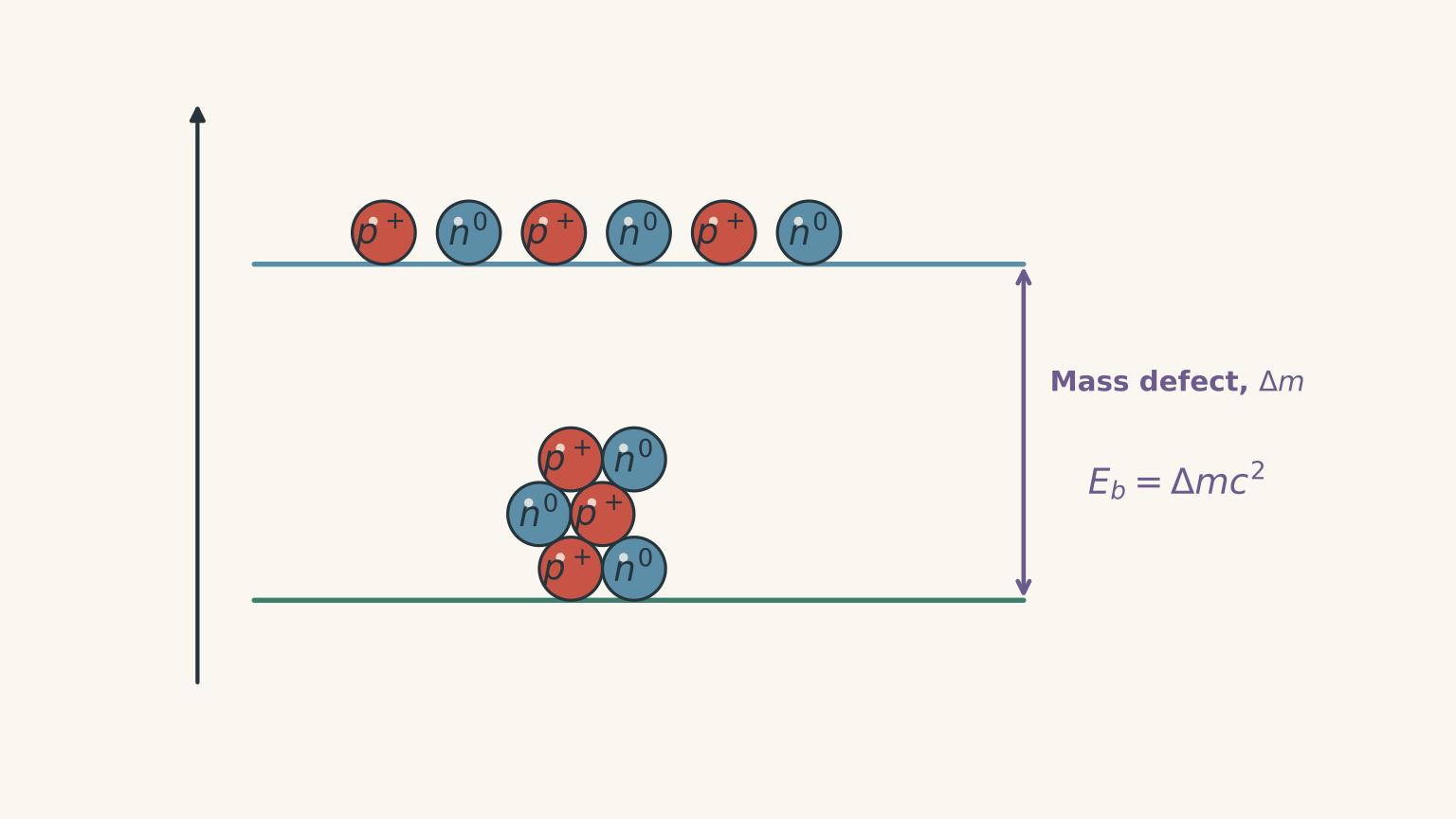
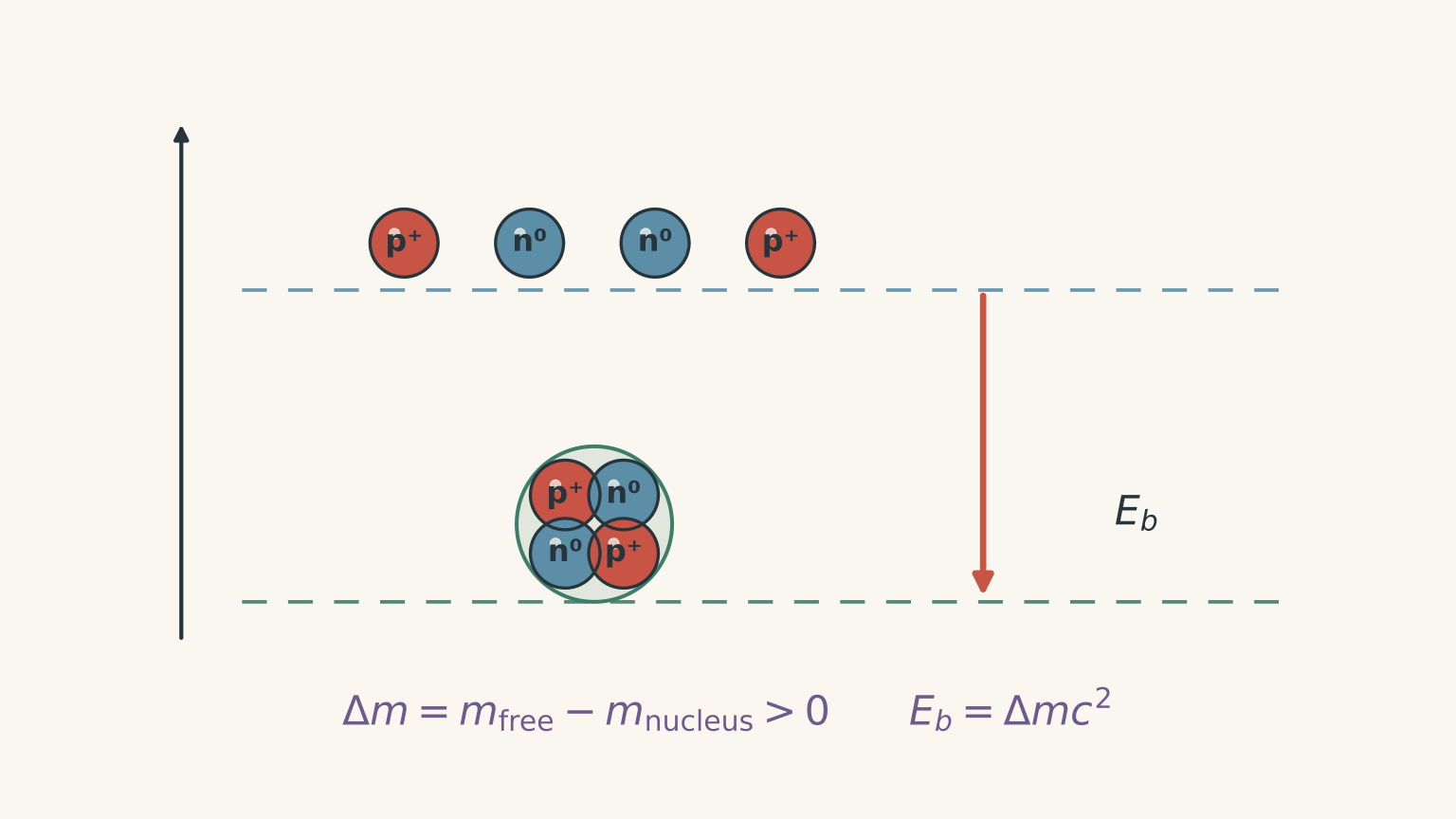
Think of the free nucleons as sitting on a higher energy level. When they form a stable bound nucleus, the system moves to a lower energy state.
Energy has to leave the system for that to happen. Because mass and energy are equivalent, the lower-energy nucleus also has a lower rest mass.
That difference is the mass defect, \(\Delta m\).
The useful definition is
\[ \Delta m = m_{\text{free nucleons}} - m_{\text{nucleus}} \]
So, for a normal bound nucleus, the mass defect is positive.
The corresponding binding energy, \(E_b\), is the energy required to completely separate the nucleus into its individual free protons and neutrons. It is also the energy released when those free nucleons form the bound nucleus, assuming the same initial and final states.
Due to technical limitations, this figure may display incorrectly or contain inaccuracies. Please check key details against your course materials.
There is a useful but limited mental model here: imagine a ball rolling into a lower valley. The ball has less potential energy at the bottom, and the difference has been released. A nucleus is not literally a ball in a valley, of course. Nuclear states are quantum mechanical, and this picture does not explain the nuclear force. It is just a way to picture the energy difference.
So where does \(E=mc^2\) come in?
Strictly, \(E=mc^2\) gives the rest energy associated with a mass \(m\).
For a change in mass, use
\[ \Delta E = \Delta m c^2 \]
where:
- \(\Delta E\) is the corresponding change in rest energy, in joules,
- \(\Delta m\) is the mass difference, in kilograms,
- \(c\) is the speed of light, \(3.00\times10^8\ \mathrm{m\,s^{-1}}\).
For nuclear binding energy, we use the positive magnitude:
\[ E_b=\Delta m c^2 \]
The surprising part is the \(c^2\). Since
\[ c^2 \approx 9.00\times10^{16}\ \mathrm{m^2\,s^{-2}}, \]
even an extremely small mass defect corresponds to a significant amount of energy.
02The unit decision that makes the calculation easy
Before touching the calculator, look at the unit of the mass defect.
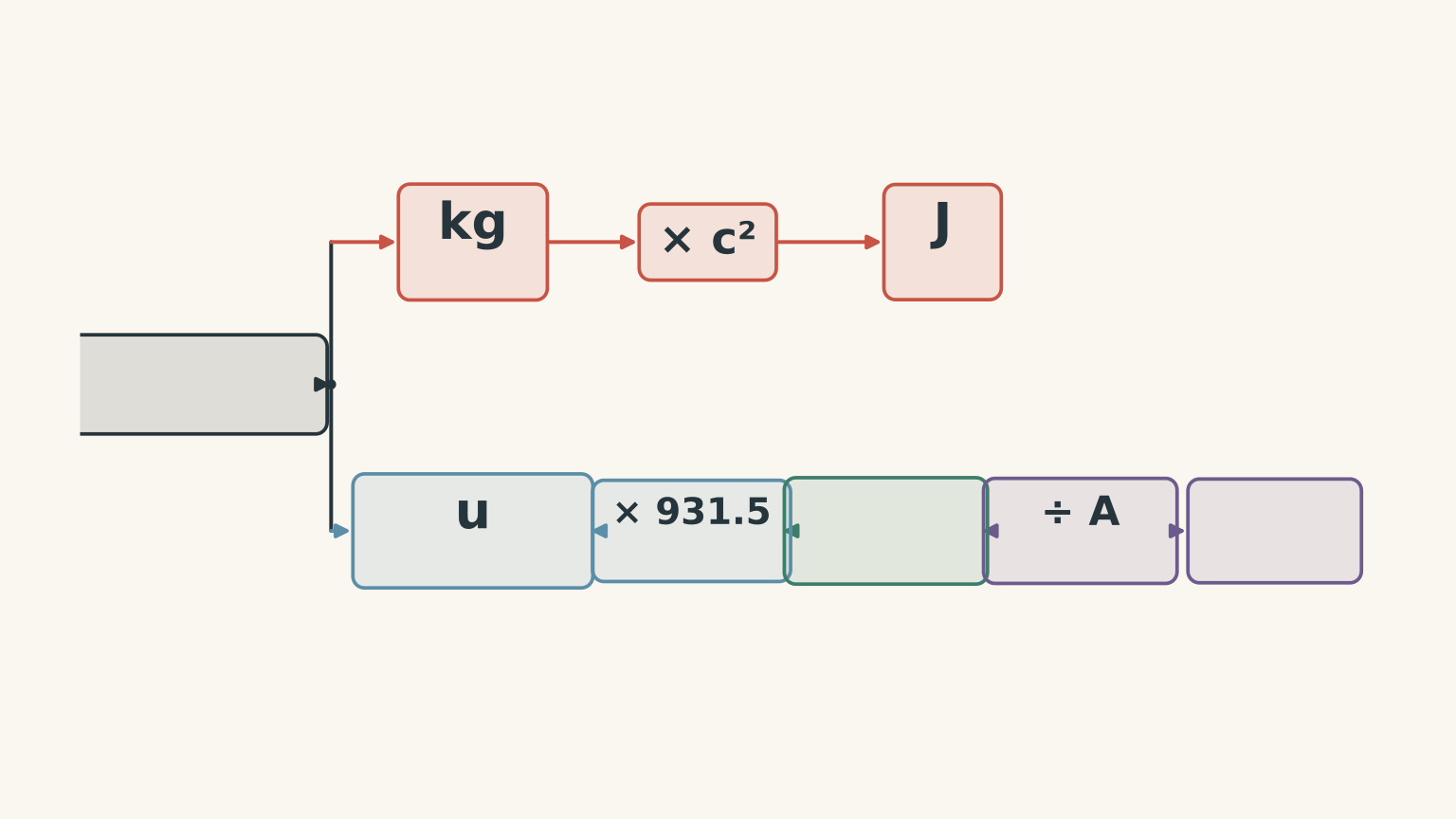
| Mass defect given as | Use | Binding energy comes out as |
|---|---|---|
| kilograms, kg | \(E_b=\Delta m c^2\) | joules, J |
| atomic mass units, u | \(E_b=\Delta m\times931.5\) | MeV |
| binding energy in MeV | divide by \(A\), if needed | MeV per nucleon |
Here, \(\mathrm{u}\) is the atomic mass unit, and \(A\) is the mass number, the total number of protons and neutrons.
The shortcut
\[ 1\ \mathrm{u}\,c^2 \approx 931.5\ \mathrm{MeV} \]
comes directly from \(E=mc^2\). It is not a different piece of physics.
Using
\[ 1\ \mathrm{u}=1.6605\times10^{-27}\ \mathrm{kg}, \]
gives
\[ (1\ \mathrm{u})c^2 \approx 1.49\times10^{-10}\ \mathrm{J}, \]
which is approximately \(931.5\ \mathrm{MeV}\).
So if the mass defect is already in u, multiplying by \(c^2\) again is a mistake. The \(c^2\) is already built into the \(931.5\ \mathrm{MeV/u}\) conversion.
Due to technical limitations, this figure may display incorrectly or contain inaccuracies. Please check key details against your course materials.
03Worked example: binding energy of a helium-4 nucleus
A helium-4 nucleus has a mass defect of \(0.0304\ \mathrm{u}\). Calculate its total binding energy in MeV and joules.
Step 1
\[ E_b=\Delta m\times931.5 \]
Step 2
\[ E_b=(0.0304)(931.5) \]
\[ E_b=28.3176\ \mathrm{MeV} \]
Step 3
\[ \boxed{E_b\approx28.3\ \mathrm{MeV}} \]
Step 4
Since \(1\ \mathrm{MeV}=1.602\times10^{-13}\ \mathrm{J}\),
\[ E_b=(28.3176)(1.602\times10^{-13}) \]
\[ \boxed{E_b\approx4.54\times10^{-12}\ \mathrm{J}} \]
Step 5
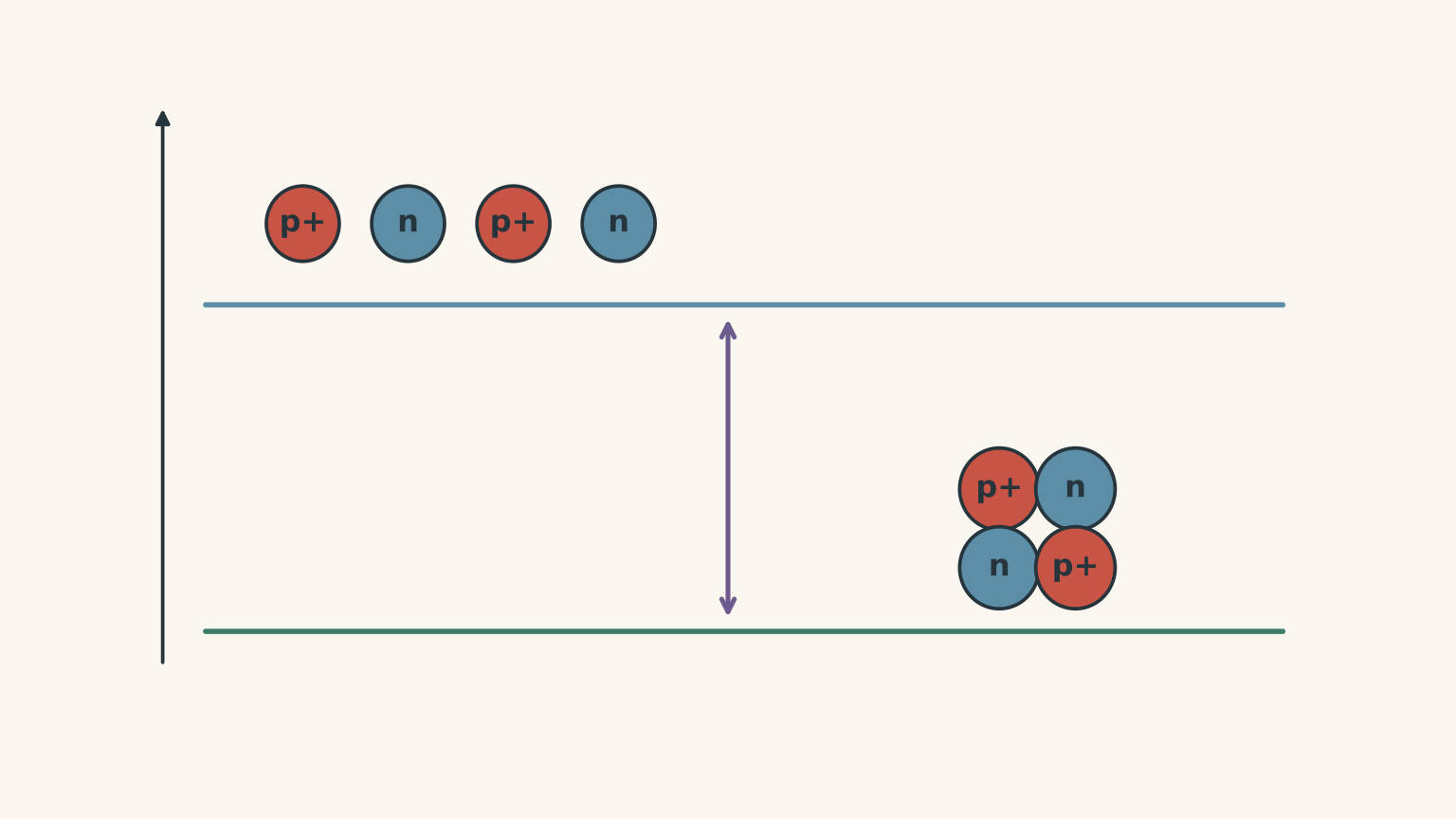
About \(28.3\ \mathrm{MeV}\) of energy is required to completely separate the helium-4 nucleus into two free protons and two free neutrons.
Notice what the answer is not saying. It is not saying the nucleus contains a little packet of \(28.3\ \mathrm{MeV}\) that can simply be taken out. Binding energy describes the energy difference between the bound nucleus and the separated-nucleon state.
Due to technical limitations, this figure may display incorrectly or contain inaccuracies. Please check key details against your course materials.
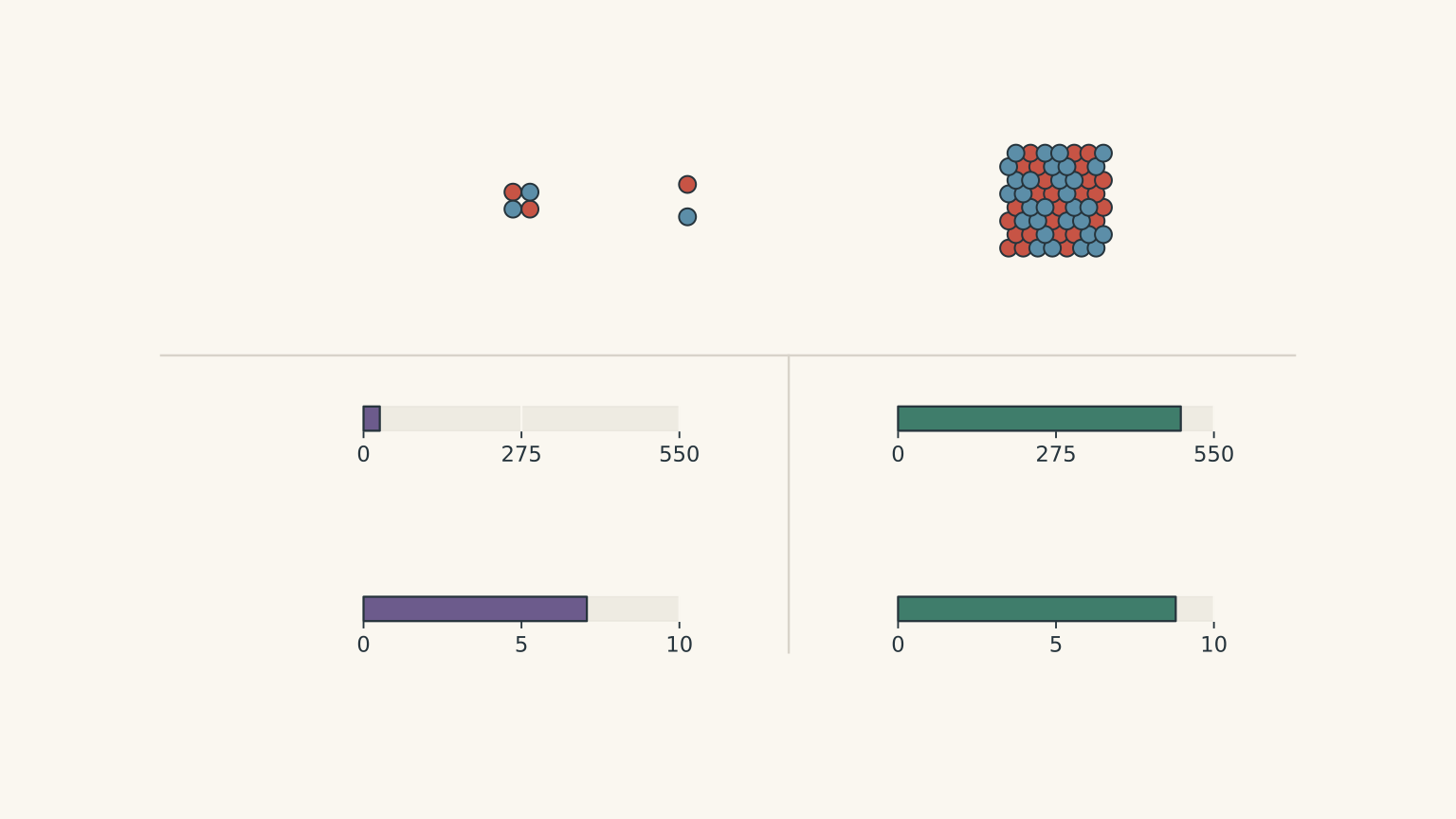
04Worked example: total binding energy versus binding energy per nucleon
Suppose an iron-56 nucleus has a mass defect of \(0.5285\ \mathrm{u}\). Calculate its total binding energy and its binding energy per nucleon.
Step 1
\[ E_b=(0.5285)(931.5) \]
\[ E_b=492.3\ \mathrm{MeV} \]
So the total binding energy is
\[ \boxed{E_b\approx492\ \mathrm{MeV}} \]
Step 2
Iron-56 has \(A=56\).
\[ \frac{E_b}{A} = \frac{492.3}{56} \]
\[ \boxed{\frac{E_b}{A}\approx8.79\ \mathrm{MeV/nucleon}} \]
Step 3
The \(492\ \mathrm{MeV}\) is the binding energy of the whole nucleus.
The \(8.79\ \mathrm{MeV/nucleon}\) is an average used to compare nuclei of different sizes.
It does not mean that each individual nucleon contributes exactly \(8.79\ \mathrm{MeV}\). Nuclear binding is not divided equally between nucleons.
Due to technical limitations, this figure may display incorrectly or contain inaccuracies. Please check key details against your course materials.
05The mistakes worth catching before you submit
1. Using the wrong units
If \(\Delta m\) is in kg,
\[ E_b=\Delta m c^2 \]
gives joules.
If \(\Delta m\) is in u,
\[ E_b=\Delta m\times931.5 \]
gives MeV.
Don’t put \(c^2\) into the second calculation again.
2. Reversing the mass defect
The usual definition is
\[ \Delta m = m_{\text{free nucleons}} - m_{\text{nucleus}} \]
If you get a negative value for a normal bound nucleus, check the subtraction.
Binding energy is reported as a positive quantity:
\[ E_b=\Delta m c^2 \]
using the positive mass defect.
3. Confusing total binding energy with binding energy per nucleon
A nucleus with more nucleons can have a much larger total binding energy simply because it contains more nucleons.
For comparisons between different nuclei, binding energy per nucleon is often the more useful quantity:
\[ \text{binding energy per nucleon} = \frac{E_b}{A} \]
Do not divide by \(A\) unless the question asks for a per-nucleon value.
4. Thinking mass has simply been destroyed
It is better to say that the bound nucleus has lower rest mass because the system has released energy.
Total mass-energy is conserved.
The phrase “missing mass” is useful shorthand, but the mass has not vanished into nowhere.
5. Calling every nuclear energy release a binding energy
Binding energy is the energy required to separate a particular nucleus into free nucleons.
A nuclear decay or reaction is a different question. To find the energy released in a reaction, compare the total mass-energy of the initial and final states.
That distinction becomes especially important in fission.
If you need to calculate the mass defect itself from proton, neutron, and nucleus masses first, see Mass defect: how missing mass becomes nuclear binding energy.
06A reliable HSC calculation routine
When you see a mass-defect question, run through this sequence:
- Identify the unit of \(\Delta m\).
- Choose the matching equation.
- Calculate the total binding energy.
- Convert units only if the question asks for another unit.
- Divide by \(A\) only if binding energy per nucleon is required.
- Check the scale and units of your answer.
- State what the energy means.
The last step is easy to skip. In a written response, don’t just leave \(E_b=492\ \mathrm{MeV}\) sitting on the page. Say that this is the energy required to separate the nucleus into its free nucleons.
07Questions and solutions
Question 1
A nucleus has a mass defect of \(0.00400\ \mathrm{u}\). Calculate its binding energy in MeV.
Solution 1
The binding energy is \(3.73\ \mathrm{MeV}\). Because the mass defect is given in atomic mass units, use the \(931.5\ \mathrm{MeV/u}\) conversion.
\[ E_b=\Delta m\times931.5 \]
\[ E_b=(0.00400)(931.5) \]
\[ \boxed{E_b=3.73\ \mathrm{MeV}} \]
The important decision was the unit. Using \(E_b=\Delta mc^2\) directly would require first converting the mass defect from u to kg.
Question 2
A nucleus has a mass defect of \(6.64\times10^{-29}\ \mathrm{kg}\).
Calculate:
- its binding energy in joules,
- its binding energy in MeV.
Explain why the numerical value becomes much larger when expressed in MeV.
Solution 2
The binding energy is \(5.98\times10^{-12}\ \mathrm{J}\), or \(37.4\ \mathrm{MeV}\). The mass defect is already in kilograms, so \(E_b=\Delta mc^2\) can be used directly.
Step 1: Substitute the mass defect and the speed of light.
\[ E_b = (6.64\times10^{-29}) (3.00\times10^8)^2 \]
\[ E_b=5.976\times10^{-12}\ \mathrm{J} \]
So,
\[ \boxed{E_b=5.98\times10^{-12}\ \mathrm{J}} \]
Step 2: Convert joules to MeV.
Since
\[ 1\ \mathrm{MeV}=1.60\times10^{-13}\ \mathrm{J}, \]
\[ E_b = \frac{5.976\times10^{-12}} {1.60\times10^{-13}} \]
\[ \boxed{E_b\approx37.4\ \mathrm{MeV}} \]
The numerical value changes because a MeV is a much smaller unit of energy than a joule. Nothing about the physical energy has increased.
A tempting mistake is to look at \(6.64\times10^{-29}\ \mathrm{kg}\) and expect the energy to have a similarly tiny numerical value. The factor \(c^2\) is what converts the tiny mass difference into a much larger energy scale.
Question 3
Nucleus A has mass number \(A=40\) and a mass defect of \(0.342\ \mathrm{u}\).
Nucleus B has mass number \(A=16\) and a mass defect of \(0.150\ \mathrm{u}\).
Calculate the total binding energy and binding energy per nucleon for each nucleus. Which nucleus has the greater total binding energy, and which has the greater binding energy per nucleon?
Solution 3
Nucleus A has the greater total binding energy, but nucleus B has the greater binding energy per nucleon. The trap is assuming that “more total binding energy” and “more binding energy per nucleon” must identify the same nucleus.
For nucleus A:
\[ E_{b,A}=(0.342)(931.5) \]
\[ E_{b,A}=318.6\ \mathrm{MeV} \]
Therefore,
\[ \boxed{E_{b,A}\approx319\ \mathrm{MeV}} \]
Per nucleon,
\[ \frac{E_{b,A}}{A} = \frac{318.6}{40} \]
\[ \boxed{7.96\ \mathrm{MeV/nucleon}} \]
For nucleus B:
\[ E_{b,B}=(0.150)(931.5) \]
\[ E_{b,B}=139.7\ \mathrm{MeV} \]
Therefore,
\[ \boxed{E_{b,B}\approx140\ \mathrm{MeV}} \]
Per nucleon,
\[ \frac{E_{b,B}}{A} = \frac{139.7}{16} \]
\[ \boxed{8.73\ \mathrm{MeV/nucleon}} \]
So A has the greater total binding energy because \(319\ \mathrm{MeV}>140\ \mathrm{MeV}\).
B has the greater binding energy per nucleon because \(8.73>7.96\ \mathrm{MeV/nucleon}\).
The exact constraint is the different number of nucleons. Total binding energy accumulates across the whole nucleus, while the per-nucleon value removes the effect of nuclear size.
Question 4
A nucleus in its ground state has a mass defect of \(0.250\ \mathrm{u}\). It absorbs \(5.00\ \mathrm{MeV}\) of energy and becomes excited without gaining or losing any nucleons.
Calculate:
- the mass defect of the excited nucleus, in u,
- the binding energy of the excited nucleus, in MeV.
A student says, “The nucleus has gained energy, so its mass defect must increase.” Explain why this is wrong.
Solution 4
The excited nucleus has a mass defect of \(0.2446\ \mathrm{u}\) and a binding energy of \(227.9\ \mathrm{MeV}\). The key point is that adding energy increases the mass-energy of the nucleus, so its mass gets closer to the mass of the separated nucleons. Its mass defect therefore decreases.
Step 1: Find the ground-state binding energy.
\[ E_b=(0.250)(931.5) \]
\[ E_b=232.875\ \mathrm{MeV} \]
Step 2: Convert the \(5.00\ \mathrm{MeV}\) excitation energy into an equivalent mass.
From
\[ E=\Delta mc^2, \]
using the nuclear conversion,
\[ \Delta m = \frac{5.00}{931.5} \]
\[ \Delta m=0.00537\ \mathrm{u} \]
Step 3: Find the excited-state mass defect.
The free-nucleon reference has not changed. The excited nucleus is heavier by \(0.00537\ \mathrm{u}\), so the mass defect becomes smaller:
\[ \Delta m_{\text{excited}} = 0.250-0.00537 \]
\[ \boxed{\Delta m_{\text{excited}} =0.2446\ \mathrm{u}} \]
Step 4: Find the excited-state binding energy.
\[ E_{b,\text{excited}} = (0.2446)(931.5) \]
\[ \boxed{E_{b,\text{excited}}\approx227.9\ \mathrm{MeV}} \]
The student’s prediction feels reasonable because “more energy” sounds like “more binding”. But excitation does the opposite: the nucleus moves to a higher-energy state, which is less tightly bound relative to the free-nucleon reference. The binding energy has fallen by exactly \(5.00\ \mathrm{MeV}\).
Question 5
Consider a hypothetical nucleus X.
In its ground state, X has a mass defect of \(0.400\ \mathrm{u}\). X is initially excited by \(6.00\ \mathrm{MeV}\).
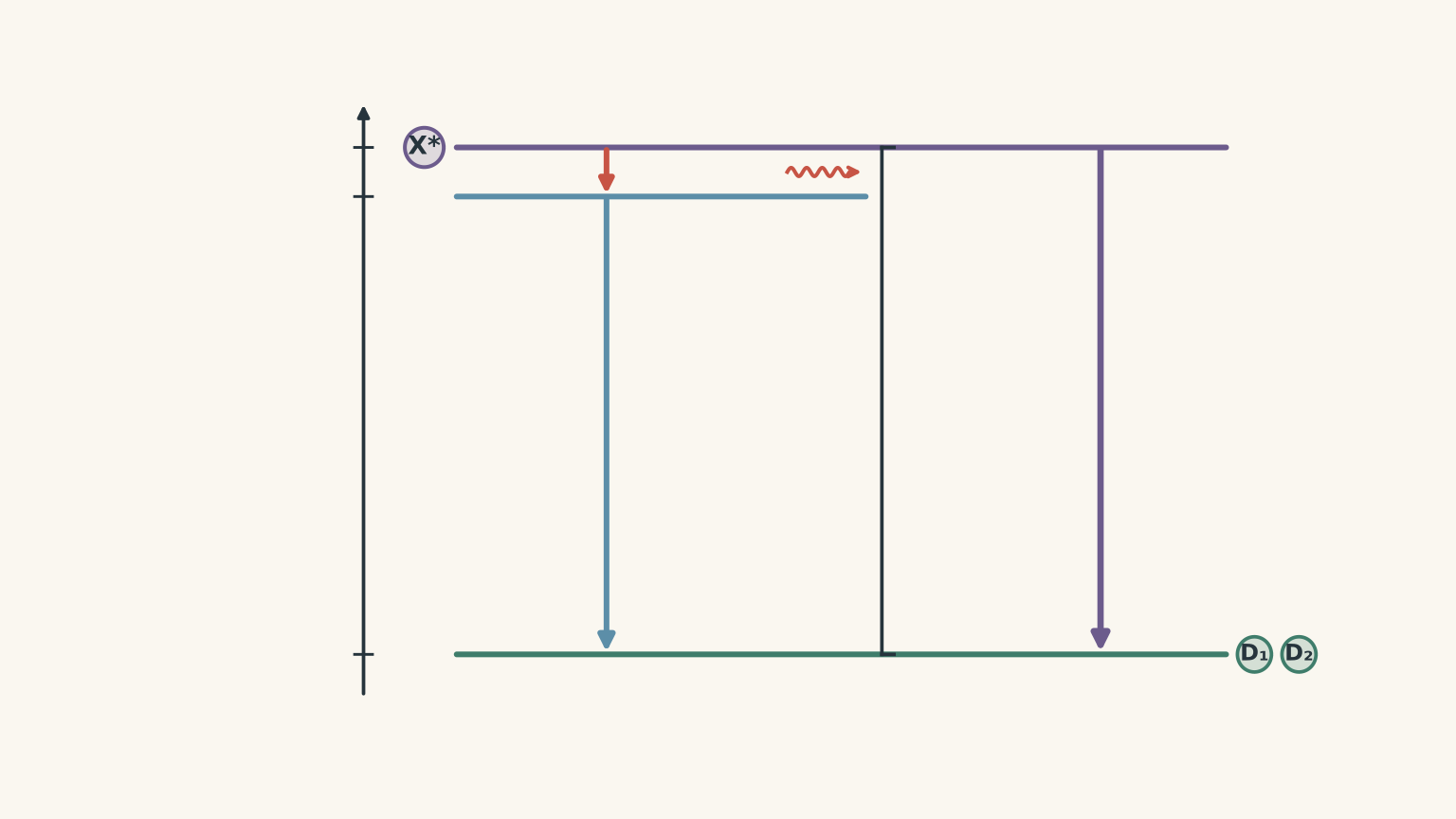
It can eventually become the same two ground-state daughter nuclei by either of these paths:
- Path A: X first emits a \(6.00\ \mathrm{MeV}\) gamma ray, returns to its ground state, and then splits into the two daughters.
- Path B: X splits directly while still excited, producing the same two ground-state daughters without first emitting the gamma ray.
The combined mass defect of the two daughter nuclei is \(0.460\ \mathrm{u}\).
Assume no nucleons are emitted or absorbed, and that all released energy is carried either by the gamma ray or by the kinetic energy of the products.
Calculate the energy released in the splitting step of Path A, then calculate the total energy released from the original excited state for both paths. Finally, explain why Path B does not release less total energy, even though the excited nucleus has a smaller binding energy.
Due to technical limitations, this figure may display incorrectly or contain inaccuracies. Please check key details against your course materials.
Solution 5
Both paths release a total of \(61.9\ \mathrm{MeV}\), but Path B releases \(61.9\ \mathrm{MeV}\) during the direct split, whereas Path A releases \(6.00\ \mathrm{MeV}\) as gamma radiation and \(55.9\ \mathrm{MeV}\) during the subsequent split. The crucial constraint is that both paths start from the same excited state and finish at the same final state.
Step 1: Calculate the ground-state binding energy of X.
\[ E_{b,X} = (0.400)(931.5) \]
\[ E_{b,X}=372.6\ \mathrm{MeV} \]
Step 2: Calculate the total binding energy of the two daughters.
\[ E_{b,\text{products}} = (0.460)(931.5) \]
\[ E_{b,\text{products}} = 428.49\ \mathrm{MeV} \]
The products are therefore more tightly bound overall than the ground-state parent.
Step 3: Find the energy released when ground-state X splits.
The increase in total binding energy is
\[ 428.49-372.6 = 55.89\ \mathrm{MeV} \]
So the splitting step in Path A releases
\[ \boxed{55.9\ \mathrm{MeV}} \]
The tempting mistake here is to use the \(0.460\ \mathrm{u}\) product mass defect as though it were the energy released. It is not. Energy release depends on the difference between the final and initial mass-energy states.
Step 4: Account for the initial excitation.
Before either path begins, X has an extra \(6.00\ \mathrm{MeV}\) of energy compared with ground-state X.
For Path A:
\[ E_{\text{total}} = 6.00+55.89 \]
\[ \boxed{E_{\text{total}}=61.9\ \mathrm{MeV}} \]
The first \(6.00\ \mathrm{MeV}\) leaves as the gamma ray. The remaining \(55.9\ \mathrm{MeV}\) is released when the ground-state nucleus splits.
Step 5: Consider Path B.
The excited nucleus starts \(6.00\ \mathrm{MeV}\) higher than the ground-state nucleus, but it finishes in exactly the same final state as Path A.
Therefore the total energy difference between the starting and final states is still
\[ \boxed{61.9\ \mathrm{MeV}} \]
In Path B, the \(6.00\ \mathrm{MeV}\) excitation energy has not disappeared. It is still part of the energy available when the excited nucleus splits, so the direct split releases
\[ 55.89+6.00 = \boxed{61.9\ \mathrm{MeV}} \]
as energy carried by the products.
Step 6: Explain the apparent contradiction.
The excited nucleus does have a smaller binding energy than the ground-state nucleus. That means it is less tightly bound relative to the free-nucleon state.
But “less tightly bound” does not mean “lower energy”.
The excited nucleus actually has higher mass-energy. Starting from a higher-energy state and ending at the same final state gives more energy available to release.
So the student who predicts that Path B must release less energy has confused binding energy with initial energy.
The deeper rule is simple: when two nuclear pathways have the same initial state and the same final state, the total energy released is the same, even though the energy can be distributed differently along the way.
08What this lets you understand next
Once you can turn a mass defect into binding energy, nuclear reactions become much easier to analyse. You can compare the binding energies of initial and final nuclei and determine whether a reaction has energy available to release.
That is the key idea behind nuclear fission: fission products, neutrons and energy: the products can have greater total binding energy than the original nucleus, corresponding to a lower total mass-energy and therefore energy released.