
Kirchhoff’s Current and Voltage Laws for HSC Physics
Learn how Kirchhoff's current and voltage laws apply charge conservation at junctions and energy conservation around circuit loops. Includes worked examples, sign conventions, misconceptions, and original HSC-style questions.
A current of \(5.0\ \text{A}\) reaches a junction. One branch carries \(2.0\ \text{A}\) away and another carries \(4.0\ \text{A}\) away. Could that happen continuously?
Predict before reading on. If \(5.0\ \text{C}\) of charge arrives each second but \(6.0\ \text{C}\) leaves each second, the junction would somehow have to create \(1.0\ \text{C}\) of charge every second. It can’t.
Now try a different puzzle. A charge goes once around a circuit containing a \(12\ \text{V}\) battery. Could the components produce voltage drops totalling \(15\ \text{V}\) with no other source present? Again, no. The charge would apparently lose more energy per coulomb than the battery supplied.
Those two problems are the reason Kirchhoff’s laws exist. Kirchhoff’s current law keeps track of charge at junctions. Kirchhoff’s voltage law keeps track of energy per unit charge around loops. Used together, they let you analyse circuits that are too complicated for one simple series or parallel rule.
01The two conservation ideas behind Kirchhoff’s laws
Before the equations, picture what the circuit is actually doing.
Current measures how quickly charge passes a point:
\[
I=\frac{q}{t}
\]
where \(I\) is current in amperes (A), \(q\) is charge in coulombs (C), and \(t\) is time in seconds (s). If that idea needs refreshing, see Current as Charge Flow Rate: Using I = q/t in HSC Physics.
Imagine a train station with one entrance and several exits. If 100 people enter each minute but only 80 leave, the station must become more crowded. If the number of people inside stays steady, the number entering per minute must equal the number leaving per minute.
A circuit junction behaves similarly with charge flow. The analogy isn’t exact because charges are not little commuters sprinting through wires, but the counting idea is useful: charge cannot simply disappear at a junction.
Voltage needs a different mental model. Potential difference tells us how much energy is transferred per coulomb of charge. A \(12\ \text{V}\) battery provides \(12\ \text{J}\) of energy for every coulomb that passes through it.
If that charge goes all the way around a closed loop and returns to its starting point, its net change in electric potential must be zero. The energy gained per coulomb from sources must therefore balance the energy transferred per coulomb elsewhere in the loop.
That gives us two questions to ask whenever a circuit becomes messy:
| Where are you looking? | Conservation question | Law |
|---|---|---|
| At a junction | Where can the charge go? | Kirchhoff’s current law |
| Around a closed loop | Where does the energy per coulomb go? | Kirchhoff’s voltage law |
02Kirchhoff’s current law: charge cannot vanish at a junction
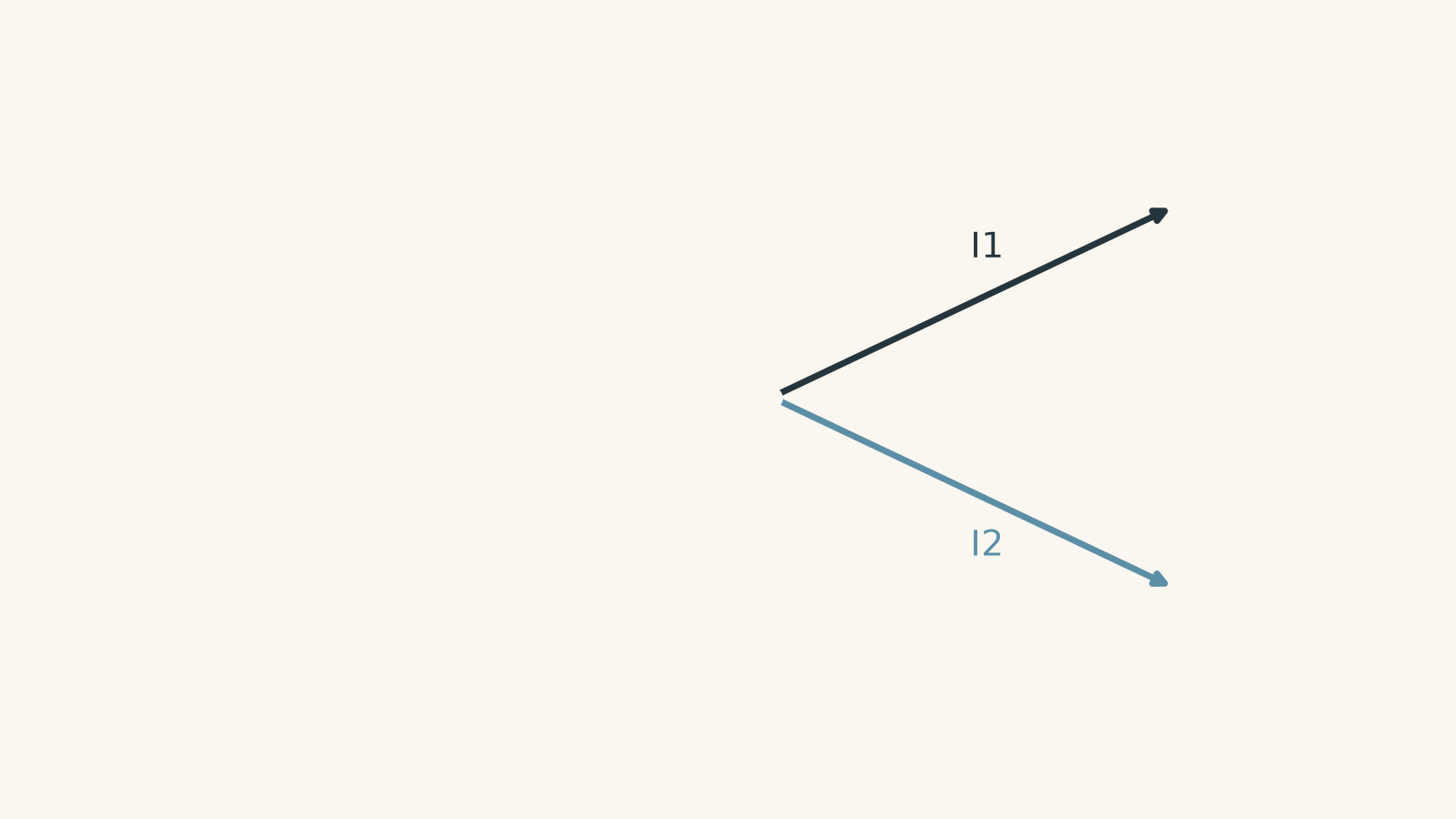
Suppose current \(I\) reaches a junction and splits into currents \(I_1\) and \(I_2\).
For a steady circuit,
\[
I=I_1+I_2
\]
More generally,
\[
\sum I_{\text{in}}=\sum I_{\text{out}}
\]
The symbol \(\sum\) means “the sum of”. So the equation simply says:
total current entering a junction = total current leaving the junction.
This is Kirchhoff’s current law, often shortened to KCL.
Why current can split without charge being split apart
A common mistake is to imagine that each electron reaches the junction and gets chopped into smaller pieces. That isn’t what happens.
Current is a rate of charge flow. At the junction, charge carriers move into different available paths. If \(3.0\ \text{C}\) arrives each second, perhaps \(1.0\ \text{C}\) per second travels down one branch and \(2.0\ \text{C}\) per second travels down another.
The current values split because the flow rate splits.
Worked example: Finding an unknown branch current
A current of \(2.40\ \text{A}\) enters a junction. Currents of \(0.75\ \text{A}\) and \(0.95\ \text{A}\) leave through two branches. Find the current leaving through a third branch.
Step 1
\[
I_{\text{in}}=I_1+I_2+I_3
\]
Step 2
\[
2.40=0.75+0.95+I_3
\]
Step 3
\[
\begin{aligned}
I_3&=2.40-0.75-0.95\\
&=0.70\ \text{A}
\end{aligned}
\]
So the third branch carries \(0.70\ \text{A}\) away from the junction.
Check the physical meaning: \(0.75+0.95+0.70=2.40\ \text{A}\), so the amount of charge arriving each second matches the amount leaving each second.
Does KCL ever stop working?
Charge conservation does not stop working.
The simple statement “current in equals current out” assumes you have included every relevant path and that charge is not continually building up at the junction itself. In the steady DC circuits usually analysed at HSC level, that is an excellent model.
If a circuit contains something such as a charging capacitor, you need to include the charging current correctly. An apparent mismatch does not mean charge conservation has failed.
03Kirchhoff’s voltage law: energy must balance around a loop
Now move your attention away from a junction and follow one complete path around a circuit.
Suppose you start just before a battery, move around every component, and eventually return to exactly the same point. Because you have returned to the same electric potential, all rises and falls in potential must add to zero.
Kirchhoff’s voltage law, or KVL, is therefore
\[
\sum \Delta V=0
\]
where \(\Delta V\) is the change in electric potential across each part of the loop, measured in volts (V).
Another common way to say the same thing is:
\[
\text{total voltage rises}=\text{total voltage drops}
\]
This is energy conservation written per coulomb of charge.
The sign rules that make KVL manageable
Choose a direction to travel around the loop. Clockwise is not more correct than anticlockwise. Just choose one and stay consistent.
For an ideal voltage source:
- crossing from its negative terminal to its positive terminal is a voltage rise, so use \(+V\)
- crossing from its positive terminal to its negative terminal is a voltage drop, so use \(-V\)
For a resistor with resistance \(R\) carrying current \(I\):
- travelling through the resistor with the current gives a potential change of \(-IR\)
- travelling against the current gives a potential change of \(+IR\)
Here \(V\) is potential difference in volts, \(I\) is current in amperes, and \(R\) is resistance in ohms (\(\Omega\)). The relation \(V=IR\) comes from Ohm’s law for an ohmic resistor. You can revise that relationship in Ohm’s Law in HSC Physics: When Resistance Is Constant.
Do not try to memorise the signs as random rules. Ask what is physically happening. A battery can raise electric potential as you move from its negative to positive terminal. An ordinary resistor transfers electrical energy to other forms, so potential falls as you move through it in the direction of conventional current.
Worked example: Current in a single loop
An ideal \(12.0\ \text{V}\) battery is connected in series with a \(2.0\ \Omega\) resistor and a \(4.0\ \Omega\) resistor. Find the current.
Step 1
Assume the current \(I\) travels clockwise. We can choose this direction before knowing whether it is correct.
Step 2
Crossing the battery from negative to positive gives \(+12.0\ \text{V}\).
Travelling through the \(2.0\ \Omega\) and \(4.0\ \Omega\) resistors with the current gives voltage changes of \(-2.0I\) and \(-4.0I\).
So KVL gives
\[
12.0-2.0I-4.0I=0
\]
Step 3
\[
\begin{aligned}
12.0-6.0I&=0\\
6.0I&=12.0\\
I&=2.0\ \text{A}
\end{aligned}
\]
Step 4
Across the \(2.0\ \Omega\) resistor,
\[
V_1=IR=(2.0)(2.0)=4.0\ \text{V}
\]
Across the \(4.0\ \Omega\) resistor,
\[
V_2=IR=(2.0)(4.0)=8.0\ \text{V}
\]
The total voltage drop is
\[
4.0+8.0=12.0\ \text{V}
\]
which exactly matches the battery’s \(12.0\ \text{V}\) rise.
The current is therefore \(2.0\ \text{A}\), and the battery’s energy transfer per coulomb is completely accounted for by the two resistors.
04Using KCL and KVL together
The laws become most useful when a circuit contains both junctions and multiple possible loops.
The method is not “spot the right formula”. It is:
- assign current variables
- use KCL at junctions
- choose useful closed loops
- use KVL around those loops
- use component relationships such as \(V=IR\)
- solve the equations together
- interpret any negative signs physically
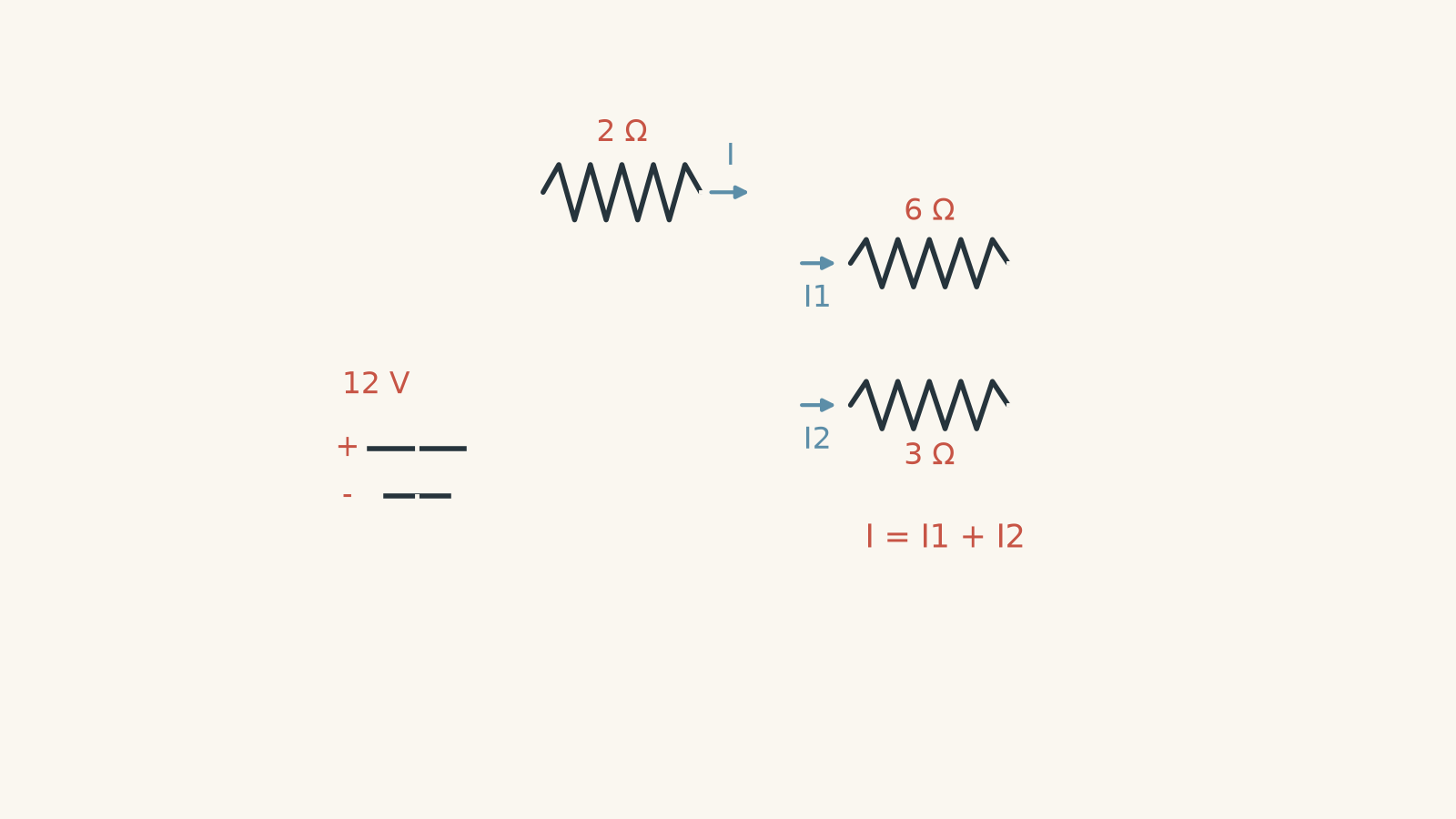
Suppose an ideal \(12\ \text{V}\) battery sends current through a \(2\ \Omega\) resistor before reaching a junction. The current then splits between a \(6\ \Omega\) branch and a \(3\ \Omega\) branch before recombining.
Let:
- \(I\) be the current through the \(2\ \Omega\) resistor
- \(I_1\) be the current through the \(6\ \Omega\) branch
- \(I_2\) be the current through the \(3\ \Omega\) branch
Before calculating, predict which parallel branch should carry more current.
The \(3\ \Omega\) branch has the lower resistance. Both parallel branches connect between the same two junctions, so they have the same voltage across them. You should therefore expect the \(3\ \Omega\) branch to carry more current.
Now Kirchhoff’s laws can tell us exactly how much more.
Worked example: Solving a circuit with a junction and two loops
An ideal \(12\ \text{V}\) battery is connected to a \(2\ \Omega\) resistor in series with two parallel branches of \(6\ \Omega\) and \(3\ \Omega\). Find \(I\), \(I_1\), and \(I_2\) using Kirchhoff’s laws.
Step 1
The current \(I\) splits into \(I_1\) and \(I_2\):
\[
I=I_1+I_2
\]
Step 2
\[
12-2I-6I_1=0
\]
Step 3
\[
12-2I-3I_2=0
\]
The \(12\ \text{V}\) battery and \(2\ \Omega\) resistor appear in both equations because both loops pass through them.
Step 4
Because both left sides equal zero,
\[
6I_1=3I_2
\]
so
\[
I_2=2I_1
\]
That matches our prediction: the \(3\ \Omega\) branch carries twice the current of the \(6\ \Omega\) branch.
Step 5
\[
\begin{aligned}
I&=I_1+I_2\\
&=I_1+2I_1\\
&=3I_1
\end{aligned}
\]
Substitute \(I=3I_1\) into the first loop equation:
\[
\begin{aligned}
12-2(3I_1)-6I_1&=0\\
12-12I_1&=0\\
I_1&=1.0\ \text{A}
\end{aligned}
\]
Therefore,
\[
I_2=2.0\ \text{A}
\]
and
\[
I=3.0\ \text{A}
\]
Step 6
At the junction,
\[
3.0=1.0+2.0
\]
so charge flow balances.
The voltage drop across the \(2\ \Omega\) resistor is
\[
V=(3.0)(2)=6.0\ \text{V}
\]
The voltage across the \(6\ \Omega\) branch is
\[
V=(1.0)(6)=6.0\ \text{V}
\]
and across the \(3\ \Omega\) branch,
\[
V=(2.0)(3)=6.0\ \text{V}
\]
Each complete loop therefore has a \(12\ \text{V}\) rise and total drops of \(6\ \text{V}+6\ \text{V}=12\ \text{V}\).
Both charge and energy are accounted for.
05The misconception that causes the most trouble
A student sees current pass through a resistor and thinks:
The resistor uses some current, so there should be less current after it.
That feels reasonable because resistors transfer electrical energy to thermal energy. Something really is being transferred.
But it is energy, not charge.
In a single series path, the same rate of charge flow passes through every component. If \(2.0\ \text{C}\) passes the first resistor each second, \(2.0\ \text{C}\) must also leave it each second. Otherwise charge would continuously pile up inside the resistor.
What changes across the resistor is electric potential energy per coulomb. That is why there is a voltage drop.
Keep these two ideas separate:
- current tracks charge per second
- voltage tracks energy per coulomb
KCL handles the first. KVL handles the second.
06Negative current is information, not an error
When setting up a Kirchhoff problem, you often have to choose a current direction before you know the real direction.
That is fine.
Suppose you assume \(I\) is clockwise and solve the equations to get
\[
I=-0.60\ \text{A}
\]
The negative sign does not mean “negative electricity” is flowing. It means your original arrow pointed the wrong way.
The physical current is \(0.60\ \text{A}\) in the opposite direction.
This is one reason Kirchhoff’s method is powerful. You do not have to guess every direction correctly before you begin. You do have to keep your signs consistent.
07A compact decision rule
When you meet an unfamiliar circuit, do not immediately hunt for equivalent resistance.
Ask:
Is there a junction?
Write a KCL equation relating currents entering and leaving it.
Is there a closed loop?
Write a KVL equation so that all potential rises and drops around that loop sum to zero.
Does a resistor appear?
For an ohmic resistor, connect its voltage, current, and resistance using \(V=IR\).
Did an unknown current come out negative?
Keep the magnitude and reverse the assumed direction.
Does your final answer conserve both charge and energy?
Check the junction currents and the voltage balance before accepting it.
08Questions and solutions
Question 1
A current of \(1.80\ \text{A}\) enters a junction. One outgoing branch carries \(0.40\ \text{A}\). A second branch carries current \(I\). Find \(I\).
Solution 1
The unknown current is \(1.40\ \text{A}\) leaving the junction.
Kirchhoff’s current law requires the total current entering the junction to equal the total current leaving:
\[
I_{\text{in}}=I_1+I
\]
Substituting,
\[
\begin{aligned}
1.80&=0.40+I\\
I&=1.80-0.40\\
I&=1.40\ \text{A}
\end{aligned}
\]
So \(1.40\ \text{C}\) of charge leaves through the second branch each second. Together, the two outgoing currents carry \(1.80\ \text{A}\), matching the incoming current.
Question 2
An ideal \(9.0\ \text{V}\) battery is connected in one loop with a \(3.0\ \Omega\) resistor and a \(6.0\ \Omega\) resistor. Find the current and the voltage drop across each resistor.
Solution 2
The current is \(1.0\ \text{A}\), with voltage drops of \(3.0\ \text{V}\) and \(6.0\ \text{V}\) across the \(3.0\ \Omega\) and \(6.0\ \Omega\) resistors respectively.
Applying KVL around the loop,
\[
9.0-3.0I-6.0I=0
\]
so
\[
\begin{aligned}
9.0-9.0I&=0\\
I&=1.0\ \text{A}
\end{aligned}
\]
Across the \(3.0\ \Omega\) resistor,
\[
V_1=IR=(1.0)(3.0)=3.0\ \text{V}
\]
Across the \(6.0\ \Omega\) resistor,
\[
V_2=IR=(1.0)(6.0)=6.0\ \text{V}
\]
The check is
\[
3.0+6.0=9.0\ \text{V}
\]
so the voltage drops equal the battery’s voltage rise. Energy per coulomb is conserved around the loop.
Question 3
A \(10\ \text{V}\) battery is connected in series with a \(2.0\ \Omega\) resistor and a \(3.0\ \Omega\) resistor. A student says the current must be larger before the first resistor than after the second resistor because each resistor “uses some current”.
Determine the current in the circuit and explain what the student has confused.
Solution 3
The current is \(2.0\ \text{A}\) everywhere in the series path. The resistors transfer energy, but they do not consume charge or current.
Apply KVL:
\[
10-2.0I-3.0I=0
\]
Therefore,
\[
\begin{aligned}
10-5.0I&=0\\
I&=2.0\ \text{A}
\end{aligned}
\]
The first resistor has a voltage drop
\[
V_1=(2.0)(2.0)=4.0\ \text{V}
\]
and the second has a voltage drop
\[
V_2=(2.0)(3.0)=6.0\ \text{V}
\]
so
\[
4.0+6.0=10\ \text{V}
\]
The tempting mistake is to treat voltage and current as though they measure the same thing. They do not. Current is the rate of charge flow, so the same \(2.0\ \text{A}\) must pass every point in this single series path. Voltage describes energy transferred per coulomb, so it can decrease across each resistor while the current remains unchanged.
Question 4
An ideal \(12\ \text{V}\) battery is connected to a \(2.0\ \Omega\) resistor. After this resistor, the circuit splits into two parallel branches containing \(4.0\ \Omega\) and \(12\ \Omega\) resistors before recombining.
Let \(I\) be the current through the \(2.0\ \Omega\) resistor, \(I_1\) the current through the \(4.0\ \Omega\) branch, and \(I_2\) the current through the \(12\ \Omega\) branch.
A student writes
\[
12-2I-4I_1-12I_2=0
\]
as a KVL equation.
Explain why this equation is not a valid single-loop equation, then find \(I\), \(I_1\), and \(I_2\).
Solution 4
The student’s loop equation is invalid because no single closed path passes through both parallel resistors one after the other. The correct currents are \(I=2.40\ \text{A}\), \(I_1=1.80\ \text{A}\), and \(I_2=0.60\ \text{A}\).
At the junction, KCL gives
\[
I=I_1+I_2
\]
A loop through the \(4.0\ \Omega\) branch gives
\[
12-2I-4I_1=0
\]
A different loop through the \(12\ \Omega\) branch gives
\[
12-2I-12I_2=0
\]
The parallel branches share the same two junctions, so their voltage drops must be equal:
\[
4I_1=12I_2
\]
Therefore,
\[
I_1=3I_2
\]
Using KCL,
\[
I=3I_2+I_2=4I_2
\]
Substitute this into the loop equation containing the \(12\ \Omega\) branch:
\[
\begin{aligned}
12-2(4I_2)-12I_2&=0\\
12-20I_2&=0\\
I_2&=0.60\ \text{A}
\end{aligned}
\]
Hence,
\[
I_1=3(0.60)=1.80\ \text{A}
\]
and
\[
I=1.80+0.60=2.40\ \text{A}
\]
Check the voltage drops. Across the shared \(2.0\ \Omega\) resistor,
\[
V=(2.40)(2.0)=4.80\ \text{V}
\]
so each parallel branch must have
\[
12.0-4.80=7.20\ \text{V}
\]
across it.
For the \(4.0\ \Omega\) branch,
\[
(1.80)(4.0)=7.20\ \text{V}
\]
and for the \(12\ \Omega\) branch,
\[
(0.60)(12)=7.20\ \text{V}
\]
Both loops satisfy KVL, and the junction satisfies KCL.
The trap was not algebra. It was geometry. A KVL equation must follow a real closed path through the circuit.
Question 5
A single circuit loop contains two ideal batteries and two resistors. Travelling clockwise, you cross the first battery from negative to positive, giving a \(6.0\ \text{V}\) rise. You then cross the second battery from positive to negative, giving a \(9.0\ \text{V}\) drop. The resistors are \(1.0\ \Omega\) and \(4.0\ \Omega\).
Assume the current \(I\) is clockwise.
Find \(I\), state the actual current direction, and explain why a negative result does not mean Kirchhoff’s voltage law has failed.
Solution 5
The calculation gives \(I=-0.60\ \text{A}\), so the actual current is \(0.60\ \text{A}\) anticlockwise. The negative sign means the assumed direction was opposite to the real direction.
Using the assumed clockwise direction, KVL gives
\[
6.0-9.0-1.0I-4.0I=0
\]
Therefore,
\[
\begin{aligned}
-3.0-5.0I&=0\\
-5.0I&=3.0\\
I&=-0.60\ \text{A}
\end{aligned}
\]
The magnitude of the current is therefore
\[
|I|=0.60\ \text{A}
\]
but its direction is anticlockwise.
That makes physical sense. The \(9.0\ \text{V}\) source is stronger than the \(6.0\ \text{V}\) source, so the net driving voltage is
\[
9.0-6.0=3.0\ \text{V}
\]
The total resistance is
\[
R=1.0+4.0=5.0\ \Omega
\]
so the current magnitude is
\[
I=\frac{3.0}{5.0}=0.60\ \text{A}
\]
Kirchhoff’s law did exactly what it should. The algebra corrected the initial guess about current direction.
Once you can move between KCL at junctions and KVL around loops, more complicated circuits stop being a collection of special cases. You can analyse them by keeping track of two conserved quantities: charge flow at each junction, and energy per coulomb around each closed path. The next useful step is to connect those currents and potential differences to electrical power, so you can determine not just how charge and energy move through a circuit, but how quickly components transfer that energy.