
Net Force and Equilibrium Calculations for HSC Physics
Learn how to calculate resultant force in one and two dimensions, recognise equilibrium, and avoid common mistakes about force and motion.
A trolley is rolling to the right at a steady speed. Someone pushes it to the right, while friction pushes to the left. Which way is the net force?
It is tempting to say “right”, because that is the way the trolley is moving. But if its velocity is constant, its acceleration is zero. Newton’s second law then tells us something important: the forces must combine to give a net force of zero.
That is the job of resultant force. Instead of treating every force separately, we combine them into one force that has the same overall effect on the object’s motion.
01Start by thinking in arrows
A force is a vector. It has both a magnitude and a direction.
Imagine two people pulling a wheeled box. One pulls with 40 N to the right and the other with 25 N to the left. The pulls partly cancel, leaving the same effect as one 15 N force to the right.
We call that single combined force the resultant force, or net force.
\[ \vec F_{\text{net}}=\sum \vec F \]
Here, \(\vec F_{\text{net}}\) is the net force, measured in newtons (N), and \(\sum \vec F\) means the vector sum of all forces acting on the object.
The arrow above \(F\) reminds us that force has a direction.
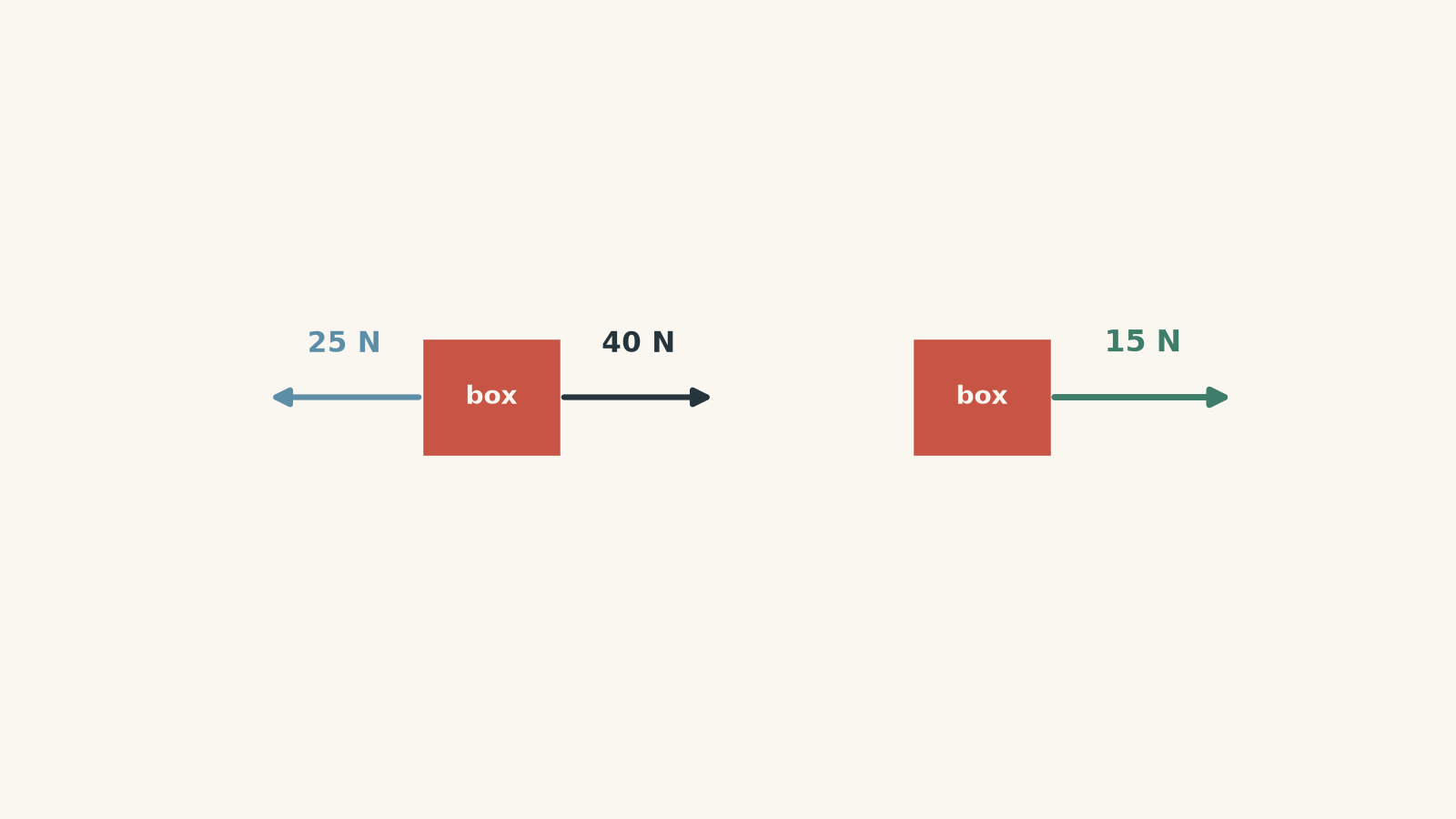
There is one trap already: the net force does not have to point in the direction the object is moving.
Velocity tells you how the object is moving now. Net force tells you how that velocity is changing.
02Resultant force in one dimension
When every relevant force acts along one straight line, the calculation is mostly about signs.
Choose one direction as positive. The other direction is negative.
For example, we might choose:
- right as positive
- left as negative
Then a 30 N force to the right is \(+30\text{ N}\), while a 12 N force to the left is \(-12\text{ N}\).
So:
\[ F_{\text{net}}=30+(-12)=18\text{ N} \]
The positive result tells us that the resultant force is 18 N to the right.
You could choose left as positive instead. The numerical signs would change, but the physical answer would not. The important thing is to choose a convention and use it consistently.
Worked example: What is the resultant force on the equipment case?
An 8.0 kg equipment case is pushed with 52 N to the right. Friction exerts 19 N to the left, and a cable pulls with another 11 N to the left. Find the resultant force and the acceleration of the case.
Step 1
The three horizontal forces are therefore \(+52\text{ N}\), \(-19\text{ N}\), and \(-11\text{ N}\).
Step 2
\[ F_{\text{net}}=52-19-11=22\text{ N} \]
The resultant force is 22 N to the right.
Step 3
\[ F_{\text{net}}=ma \]
Here, \(m\) is mass in kilograms, and \(a\) is acceleration in metres per second squared.
Rearranging:
\[ a=\frac{F_{\text{net}}}{m} =\frac{22}{8.0} =2.75\text{ m s}^{-2} \]
So the case accelerates at \(2.75\text{ m s}^{-2}\) to the right.
The 52 N push does not determine the acceleration by itself. The case responds to the 22 N net force after the opposing forces are included.
03What does zero net force actually mean?
Suppose the rightward and leftward forces are equal:
\[ F_{\text{net}}=0 \]
From Newton’s second law,
\[ F_{\text{net}}=ma \]
so, for an object with non-zero mass,
\[ a=0 \]
This is translational equilibrium.
What happens to the object?
There are two possibilities:
- If it is already at rest, it remains at rest.
- If it is already moving with constant velocity, it keeps moving with that constant velocity.
That second case causes a lot of mistakes.
A student might picture a car travelling east and think there must be a net force east to “keep it going”. That sounds reasonable because everyday objects usually slow down when we stop pushing them. But they slow because friction and drag provide an unbalanced force.
If all forces genuinely balance, no extra forward net force is required to maintain constant velocity.
| Motion | Acceleration | Net force |
|---|---|---|
| At rest and staying at rest | \(0\) | \(0\) |
| Moving in a straight line at constant velocity | \(0\) | \(0\) |
| Speeding up | Not zero | Not zero |
| Slowing down | Not zero | Not zero |
| Changing direction | Not zero | Not zero |
Notice the wording in the second row: constant velocity, not merely constant speed. Direction matters.
04Resultant force in two dimensions
Now suppose one force pulls east and another pulls north. They cannot simply be added as ordinary numbers because they point in different directions.
Instead, deal with the horizontal and vertical directions separately.
We usually call them the \(x\)- and \(y\)-directions:
\[ \Sigma F_x = \text{sum of horizontal force components} \]
\[ \Sigma F_y = \text{sum of vertical force components} \]
Once those two components are known, the magnitude of the resultant force is
\[ F_{\text{net}}=\sqrt{(\Sigma F_x)^2+(\Sigma F_y)^2} \]
This is just Pythagoras applied to the force triangle.
Its direction can then be found using trigonometry. If the angle \(\theta\) is measured from the positive \(x\)-direction,
\[ \tan\theta=\frac{\Sigma F_y}{\Sigma F_x} \]
The signs of the components tell you which quadrant the resultant actually lies in. Do not let the inverse tangent button choose the physical direction for you without checking the diagram.
05Resolving an angled force into components
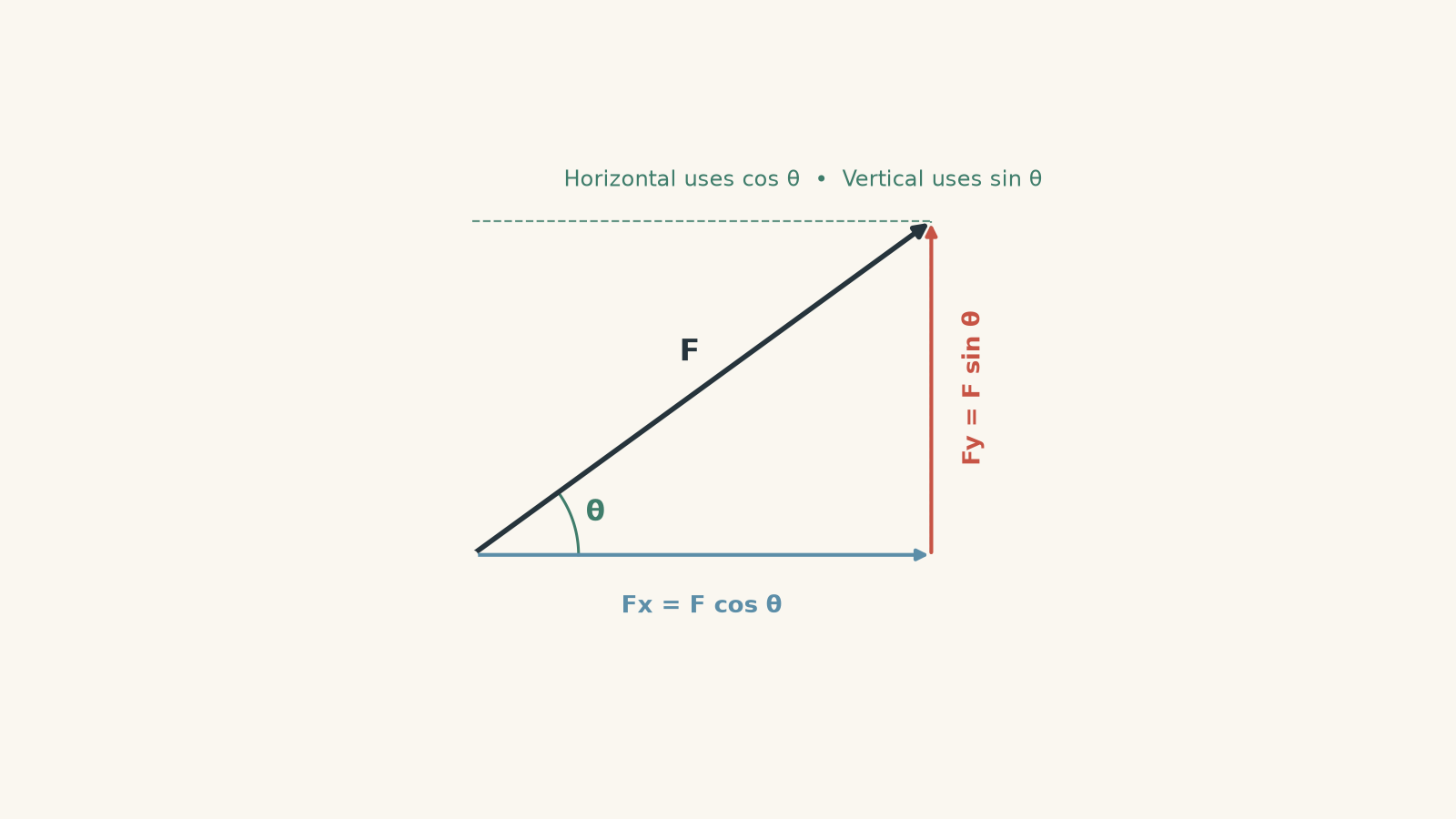
A force pointing diagonally can be replaced by horizontal and vertical components.
For a force of magnitude \(F\) at an angle \(\theta\) above the positive horizontal direction:
\[ F_x=F\cos\theta \]
\[ F_y=F\sin\theta \]
Here:
- \(F_x\) is the horizontal component
- \(F_y\) is the vertical component
- \(F\) is the magnitude of the original force
- \(\theta\) is its angle measured from the horizontal
These components are not extra forces. They are two mathematical pieces of the same original force.
Worked example: Find a two-dimensional resultant force
A low-friction trolley is pulled by three cords. One cord pulls with 50 N at \(30^\circ\) north of east. A second pulls with 18 N west, and a third pulls with 12 N south. Find the magnitude and direction of the resultant force.
Step 1
The 50 N angled force must first be resolved into components.
\[ F_x=50\cos30^\circ=43.3\text{ N} \]
\[ F_y=50\sin30^\circ=25.0\text{ N} \]
So that cord contributes 43.3 N east and 25.0 N north.
Step 2
The 18 N westward force is negative.
\[ \Sigma F_x=43.3-18=25.3\text{ N} \]
So the net horizontal component is 25.3 N east.
Step 3
The 12 N southward force is negative.
\[ \Sigma F_y=25.0-12=13.0\text{ N} \]
So the net vertical component is 13.0 N north.
Step 4
\[ F_{\text{net}} =\sqrt{25.3^2+13.0^2} =28.4\text{ N} \]
Step 5
\[ \theta =\tan^{-1}\left(\frac{13.0}{25.3}\right) =27.2^\circ \]
Both components are positive, so the force points north of east.
The resultant force is therefore 28.4 N at \(27.2^\circ\) north of east.
That one vector would produce the same translational effect as all three cords acting together.
06Recognising equilibrium in two dimensions
In one dimension, equilibrium requires the forces in opposite directions to cancel.
In two dimensions, there is an extra condition:
\[ \Sigma F_x=0 \]
and
\[ \Sigma F_y=0 \]
Both must be true.
Suppose a suspended object has perfectly balanced leftward and rightward forces but has 20 N more force upward than downward. It is not in equilibrium. Its horizontal acceleration may be zero, but its vertical acceleration is not.
This gives you a useful decision rule:
An object is in translational equilibrium only when the resultant force vector is zero.
You do not need every individual force to have an identical opposite partner. Several forces can combine to cancel another force.
For example, two diagonal cable tensions might have horizontal components that cancel each other while their vertical components combine to balance the object’s weight.
07Finding the force needed for equilibrium
Sometimes the unknown is not the resultant. Instead, you are asked what extra force would make the resultant zero.
The method is simple:
- Find the resultant of the forces already acting.
- Give the required balancing force the same magnitude but the opposite direction.
If the existing forces have a resultant of 40 N east, another 40 N west would produce equilibrium.
In two dimensions, if the existing resultant has components
\[ \vec F_{\text{net}}=(30\text{ N east},40\text{ N north}), \]
the balancing force must have components
\[ (-30\text{ N},-40\text{ N}), \]
meaning 30 N west and 40 N south.
This opposite force is sometimes called the equilibrant.
08The misconception to avoid: motion is not the same as net force
Consider a puck sliding east while a net force acts west.
Which way does it accelerate?
West.
Which way does it move immediately after the force begins acting?
Still east.
There is no contradiction. The westward acceleration changes the eastward velocity. The puck first slows down. If the westward force continues for long enough, the puck may eventually stop and then begin moving west.
Keep these quantities separate:
- velocity tells you the current direction and rate of motion
- acceleration tells you how velocity is changing
- net force points in the same direction as acceleration, because \(\vec F_{\text{net}}=m\vec a\)
This is why you cannot work out the direction of the net force just by looking at the direction of motion.
09A reliable method for HSC force questions
When several forces appear in a problem, use the same sequence each time.
- Choose your object. Decide exactly which object’s forces you are adding.
- Choose positive directions. In two dimensions, usually take right as \(+x\) and up as \(+y\).
- Resolve angled forces. Break them into \(x\)- and \(y\)-components when necessary.
- Add components separately. Find \(\Sigma F_x\) and \(\Sigma F_y\).
- Recombine if required. Use Pythagoras for magnitude and trigonometry for direction.
- Interpret the result. A zero resultant means zero translational acceleration. A non-zero resultant gives the direction of acceleration.
The calculation is usually not the difficult part. The difficult part is deciding which forces belong in the sum and keeping velocity, acceleration, and force separate.
10Questions and solutions
Question 1
A cyclist experiences a 180 N driving force forwards. Air resistance is 145 N backwards, and rolling resistance is 35 N backwards. Calculate the horizontal resultant force. What does this tell you about the cyclist’s horizontal acceleration?
Solution 1
The horizontal resultant force is 0 N, so the cyclist has zero horizontal acceleration.
Choose forwards as positive. The resultant is
\[ F_{\text{net}} =180-145-35 =0\text{ N} \]
Using Newton’s second law,
\[ F_{\text{net}}=ma, \]
a net force of zero means \(a=0\).
This does not tell us that the cyclist is stationary. If the cyclist is already moving, they can continue at constant velocity. The common trap is to assume that forward motion requires a forward resultant force.
Question 2
A 2.0 kg laboratory cart experiences four forces in the horizontal plane: 24 N east, 10 N north, 8 N west, and 4 N south. Find the magnitude and direction of the resultant force, then calculate the cart’s acceleration.
Solution 2
The resultant force is 17.1 N at \(20.6^\circ\) north of east, giving an acceleration of \(8.54\text{ m s}^{-2}\) in the same direction.
Take east as positive \(x\) and north as positive \(y\).
The horizontal resultant is
\[ \Sigma F_x=24-8=16\text{ N} \]
and the vertical resultant is
\[ \Sigma F_y=10-4=6\text{ N}. \]
The resultant magnitude is
\[ F_{\text{net}} =\sqrt{16^2+6^2} =\sqrt{292} =17.1\text{ N}. \]
Its direction is
\[ \theta =\tan^{-1}\left(\frac{6}{16}\right) =20.6^\circ. \]
Both components are positive, so this is \(20.6^\circ\) north of east.
Now use Newton’s second law:
\[ a=\frac{F_{\text{net}}}{m} =\frac{17.1}{2.0} =8.54\text{ m s}^{-2}. \]
The acceleration points in the same direction as the net force, not necessarily in the same direction as the cart’s existing velocity.
Question 3
Two forces act on a small object: 30 N east and 40 N north. Find the single additional force required to place the object in translational equilibrium.
Solution 3
The required force is 50 N directed \(53.1^\circ\) south of west.
First find the resultant of the existing forces.
Its magnitude is
\[ F_{\text{resultant}} =\sqrt{30^2+40^2} =50\text{ N}. \]
The angle of that resultant north of east is
\[ \theta =\tan^{-1}\left(\frac{40}{30}\right) =53.1^\circ. \]
So the existing forces combine to produce 50 N at \(53.1^\circ\) north of east.
For equilibrium, the additional force must make the total vector sum zero. It therefore needs the same magnitude and exactly the opposite direction:
\[ F_{\text{additional}}=50\text{ N at }53.1^\circ\text{ south of west}. \]
Its components are 30 N west and 40 N south, which cancel the original components individually.
The trap is to add another 50 N force in any convenient direction. Equal magnitudes are not enough. The directions must make the vector sum zero.
Question 4
A 4.0 kg cart is initially moving west at \(3.0\text{ m s}^{-1}\). A constant resultant force of 8.0 N east then acts for 2.0 s. Is the cart in equilibrium? Determine its velocity after the 2.0 s interval.
Solution 4
The cart is not in equilibrium, and after 2.0 s it is moving east at \(1.0\text{ m s}^{-1}\).
The net force is 8.0 N east, which is not zero. Therefore the cart has an acceleration and is not in equilibrium.
Using Newton’s second law,
\[ a=\frac{F_{\text{net}}}{m} =\frac{8.0}{4.0} =2.0\text{ m s}^{-2}\text{ east}. \]
Take east as positive. The initial westward velocity is therefore
\[ u=-3.0\text{ m s}^{-1}. \]
Using
\[ v=u+at, \]
we obtain
\[ v=-3.0+(2.0)(2.0) =+1.0\text{ m s}^{-1}. \]
The positive sign means east.
The interesting part is what happens in between. The force points east while the cart initially moves west, so the cart first slows down. It reaches zero velocity after
\[ 0=-3.0+(2.0)t, \]
giving
\[ t=1.5\text{ s}. \]
The force is still acting, so the cart then accelerates east. This is a useful reminder that force determines acceleration, not the object’s instantaneous direction of travel.
Question 5
A 900 kg car travels around a flat circular track at a constant speed of \(12\text{ m s}^{-1}\). The track has a radius of 30 m. A student argues that the forces on the car must be in equilibrium because its speed is constant. Evaluate the claim and calculate the resultant force.
Solution 5
The claim is incorrect. The car has a resultant force of \(4.32\times10^3\text{ N}\) directed towards the centre of the circle, so it is not in translational equilibrium.
The trap is the word speed. Speed has no direction, but velocity does.
Although the car’s speed remains \(12\text{ m s}^{-1}\), its direction of motion changes continuously as it travels around the circle. Its velocity is therefore changing, which means it has an acceleration.
For circular motion, the inward acceleration has magnitude
\[ a=\frac{v^2}{r}, \]
where \(v\) is speed and \(r\) is the radius of the circular path.
Substituting,
\[ a=\frac{12^2}{30} =\frac{144}{30} =4.8\text{ m s}^{-2}. \]
Using Newton’s second law,
\[ F_{\text{net}}=ma =(900)(4.8) =4320\text{ N}. \]
So
\[ F_{\text{net}}=4.32\times10^3\text{ N} \]
towards the centre of the circle.
A constant velocity would mean zero acceleration and zero resultant force. Constant speed while changing direction does not.
11What net force lets you do next
Once you can replace several forces with one resultant vector, Newton’s laws become much easier to use. A free-body diagram gives you the individual forces, vector addition gives you \(\vec F_{\text{net}}\), and Newton’s second law turns that resultant into an acceleration.
The same chain of reasoning appears again when you analyse tension, normal forces, friction, inclined planes, and circular motion. The key decision stays the same: before asking how an object will move, work out what the forces add to.