
Balancing Nuclear Transmutation Equations: HSC Physics Guide
Learn how to balance nuclear transmutation equations using nucleon number and charge conservation, then apply mass-energy conservation and Q-values.
Suppose you are told that radium-226 emits an alpha particle, but the daughter nucleus is missing:
\[ {}^{226}_{88}\mathrm{Ra}\rightarrow ?+{}^{4}_{2}\mathrm{He} \]
Before reading on, predict the missing nucleus. You only need two facts: the total number of nucleons cannot change, and total charge cannot change. So the daughter must have
\[ A=226-4=222 \]
and
\[ Z=88-2=86. \]
Atomic number 86 is radon, so the missing nucleus is \({}^{222}_{86}\mathrm{Rn}\).
That is the basic idea behind balancing nuclear transmutation equations. The particles can change identity, but the bookkeeping has to work.

01The two conservation ledgers
A nuclear equation becomes much easier when you treat it as two separate ledgers.
In the notation
\[ {}^{A}_{Z}X, \]
- \(A\) is the nucleon number: protons + neutrons.
- \(Z\) is the charge number: number of protons.
- \(X\) is the element, determined by \(Z\).
Think of \(A\) as the nuclear headcount and \(Z\) as the number of positive-charge badges. A particle leaving the nucleus has to take the right number of each with it.
The analogy breaks down when you start thinking about energy. A headcount does not tell you how much the nucleus weighs. That requires the mass-energy check later.
For any nuclear equation,
\[ \sum A_{\text{before}} = \sum A_{\text{after}} \]
and
\[ \sum Z_{\text{before}} = \sum Z_{\text{after}}. \]
These are your first two checks.
What each type of radiation does
| Process | Change in nucleon number \(A\) | Change in nuclear charge \(Z\) |
|---|---|---|
| Alpha, \({}^{4}_{2}\mathrm{He}\) | \(-4\) | \(-2\) |
| Beta-minus, \({}^{0}_{-1}e\) | \(0\) | \(+1\) |
| Beta-plus, \({}^{0}_{+1}e\) | \(0\) | \(-1\) |
| Gamma, \(\gamma\) | \(0\) | \(0\) |
The beta rows can look strange at first. The emitted beta particle has \(A=0\), because an electron or positron is not a nucleon. Its lower number represents its charge contribution in the nuclear equation, not an atomic number.
For example, beta-minus decay can be pictured at the nucleon level as
\[ {}^{1}_{0}n \rightarrow {}^{1}_{1}p + {}^{0}_{-1}e + \bar{\nu}_e. \]
The neutron becomes a proton, so the total number of nucleons stays at one, while the nuclear charge increases by one. The antineutrino has \(A=0\) and \(Z=0\), so it does not affect these two balances.

For beta-plus decay, the opposite happens:
\[ {}^{1}_{1}p \rightarrow {}^{1}_{0}n + {}^{0}_{+1}e + \nu_e. \]
The number of nucleons again stays the same, but the nuclear charge decreases by one.
If beta decay notation is the part that tends to get mixed up, the beta decay guide gives the particle changes separately.
Gamma decay is different again. A gamma photon carries energy, but no nucleon number or electric charge:
\[ {}^{A}_{Z}X^* \rightarrow {}^{A}_{Z}X+\gamma. \]
The star means the nucleus was in an excited energy state. The nucleus does not become a different element when it emits the gamma ray.
02A reliable way to balance any nuclear equation
When an equation has a missing particle or nucleus, use this order.
Step 1: Write the \(A\) and \(Z\) numbers for everything you know.
Step 2: Balance \(A\).
Find the missing nucleon number.
Step 3: Balance \(Z\).
Find the missing charge number.
Step 4: Identify the element.
Use the periodic table to match the missing \(Z\) to an element.
Step 5: Check the particle.
Does the result correspond to an alpha particle, beta particle, neutron, proton, or another nucleus?
Step 6: If masses or energies are given, do a mass-energy check.
That last step is where many otherwise correct answers fall apart.
03Balancing mass-energy: mass itself is not conserved
Here is the important refinement.
It is not correct to say that mass is conserved in a nuclear reaction.
Total mass-energy is conserved.
A nuclear reaction can produce products with less rest mass than the original system. The missing rest mass has become other forms of energy, such as kinetic energy or photon energy.
The rest energy of an object is
\[ E_0=mc^2, \]
where \(m\) is mass and \(c\) is the speed of light.
For a nuclear reaction, the useful quantity is the Q-value:
\[ Q= \left( \sum m_{\text{before}} - \sum m_{\text{after}} \right)c^2. \]
If \(Q>0\), the reaction releases energy.
If \(Q<0\), the reaction needs energy supplied from elsewhere.
So a reaction can pass the \(A\) and \(Z\) tests and still be endothermic.

This is the point where \(A\) and actual mass must not be confused. The mass number \(A\) is an integer headcount of nucleons. It is not the measured mass in atomic mass units.
The small difference between the actual nuclear masses is connected to nuclear binding energy and mass defect. For a deeper treatment of that connection, see Mass defect: how missing mass becomes nuclear binding energy.
What does the sign of \(Q\) actually tell you?
A positive \(Q\) means the products have less total rest mass than the reactants, so energy is available.
A negative \(Q\) means the products have greater total rest mass, so extra energy must be supplied.
But \(Q>0\) does not tell you how quickly a decay happens. An energetically possible decay can still have a very long half-life.
For a decay from an initial state with negligible kinetic energy, the released energy can appear as:
- kinetic energy of the daughter nucleus,
- kinetic energy of an alpha or beta particle,
- neutrino or antineutrino energy,
- gamma-ray energy,
- or a combination of these.
So don’t automatically give the entire \(Q\)-value to the alpha or beta particle.
04Worked example: alpha decay and released energy
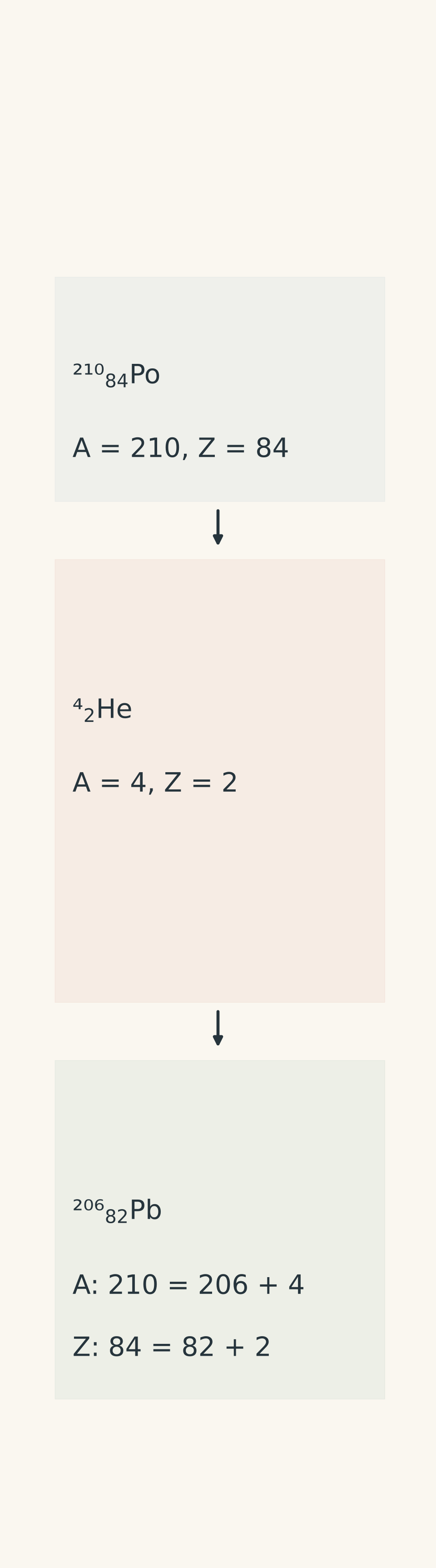
A polonium-210 nucleus undergoes alpha decay to lead-206.
Given:
- \(m({}^{210}\mathrm{Po})=209.982874\,\mathrm{u}\)
- \(m({}^{206}\mathrm{Pb})=205.974465\,\mathrm{u}\)
- \(m({}^{4}\mathrm{He})=4.002603\,\mathrm{u}\)
- \(1\,\mathrm{u}c^2=931.5\,\mathrm{MeV}\)
Write the balanced equation and calculate the energy released.
Step 1
Alpha decay removes four nucleons:
\[ 210=206+4. \]
Step 2
The alpha particle has charge number \(+2\):
\[ 84=82+2. \]
So the balanced equation is
\[ {}^{210}_{84}\mathrm{Po} \rightarrow {}^{206}_{82}\mathrm{Pb} + {}^{4}_{2}\mathrm{He}. \]
Step 3
\[ \begin{aligned} \Delta m &= 209.982874 - (205.974465+4.002603)\\ &=0.005806\,\mathrm{u}. \end{aligned} \]
Step 4
\[ \begin{aligned} Q &=\Delta m c^2\\ &=(0.005806)(931.5\,\mathrm{MeV})\\ &=5.41\,\mathrm{MeV}. \end{aligned} \]
Step 5
The decay releases \(5.41\,\mathrm{MeV}\) of energy. That is the total energy available from the rest-mass difference. It is not necessarily all carried by the alpha particle; the daughter nucleus must also recoil, and an excited daughter could emit further radiation.
05Worked example: a balanced reaction that needs energy
An alpha particle strikes aluminium-27 and produces phosphorus-30 and a neutron.
Given:
- \(m({}^{27}\mathrm{Al})=26.981539\,\mathrm{u}\)
- \(m({}^{4}\mathrm{He})=4.002603\,\mathrm{u}\)
- \(m({}^{30}\mathrm{P})=29.978314\,\mathrm{u}\)
- \(m(n)=1.008665\,\mathrm{u}\)
- \(1\,\mathrm{u}c^2=931.5\,\mathrm{MeV}\)
Write the balanced equation and determine whether energy is released or absorbed.
Step 1
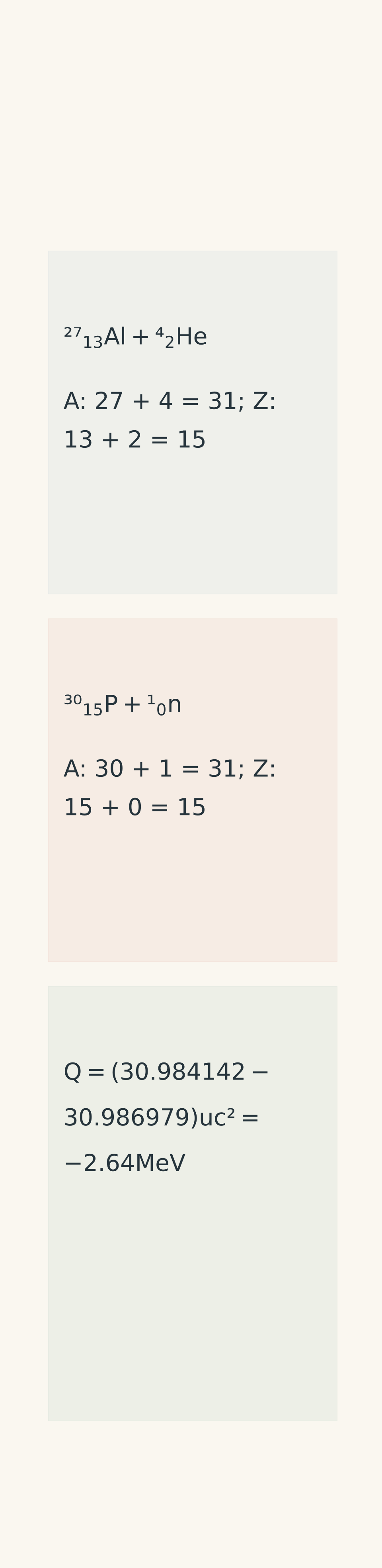
The reactants contain
\[ 27+4=31 \]
nucleons. If the neutron has \(A=1\), the phosphorus nucleus must have \(A=30\).
Step 2
The reactants have
\[ 13+2=15. \]
Phosphorus has \(Z=15\), and the neutron has \(Z=0\). So the charge balances.
The equation is
\[ {}^{27}_{13}\mathrm{Al} + {}^{4}_{2}\mathrm{He} \rightarrow {}^{30}_{15}\mathrm{P} + {}^{1}_{0}n. \]
Step 3
\[ \begin{aligned} m_{\text{before}} &=26.981539+4.002603\\ &=30.984142\,\mathrm{u}, \end{aligned} \]
and
\[ \begin{aligned} m_{\text{after}} &=29.978314+1.008665\\ &=30.986979\,\mathrm{u}. \end{aligned} \]
The products have more rest mass.
Step 4
\[ \begin{aligned} Q &=(30.984142-30.986979) (931.5\,\mathrm{MeV})\\ &=(-0.002837)(931.5\,\mathrm{MeV})\\ &=-2.64\,\mathrm{MeV}. \end{aligned} \]
Step 5
The reaction is endothermic. It requires at least \(2.64\,\mathrm{MeV}\) of additional energy in the overall energy budget.
Notice the trap: \(A\) and \(Z\) both balance perfectly. That does not mean the reaction releases energy. Conservation laws tell you what must be conserved; the mass-energy calculation tells you whether the proposed change has an energy surplus or deficit.
06The mistakes worth catching before you move on
| Tempting idea | What is actually true |
|---|---|
| “Mass number is the mass of the nucleus.” | \(A\) is a count of nucleons, not a measured mass. |
| “Beta decay changes \(A\).” | A neutron becomes a proton, or vice versa, so \(A\) stays constant. |
| “Alpha decay only changes the element.” | It changes both \(A\) and \(Z\): \(A-4\), \(Z-2\). |
| “Gamma decay changes the atomic number.” | Gamma emission changes neither \(A\) nor \(Z\). |
| “If \(A\) and \(Z\) balance, the reaction can happen.” | It may still have \(Q<0\), meaning energy must be supplied. |
| “A positive \(Q\) means all the energy goes to the emitted particle.” | The energy can be shared between several products and radiation. |
| “Mass has disappeared.” | A decrease in rest mass corresponds to an increase in other forms of energy. |
One particularly useful exam habit is to keep the questions separate in your head:
A and \(Z\): Is the equation balanced?
\(Q\): Is the energy accounting possible, and where does the energy go?
Those are related checks, but they are not the same check.

07Questions and solutions
Question 1
Complete the nuclear equation and identify the missing nucleus:
\[ {}^{226}_{88}\mathrm{Ra} \rightarrow {}^{A}_{Z}X + {}^{4}_{2}\mathrm{He}. \]
Solution 1
The missing nucleus is \({}^{222}_{86}\mathrm{Rn}\).
Balance the nucleon number:
\[ 226=A+4 \]
so
\[ A=222. \]
Now balance the charge number:
\[ 88=Z+2 \]
so
\[ Z=86. \]
Atomic number 86 is radon, giving
\[ \boxed{ {}^{226}_{88}\mathrm{Ra} \rightarrow {}^{222}_{86}\mathrm{Rn} + {}^{4}_{2}\mathrm{He} } \]
The tempting shortcut is to recognise radium-226 as an alpha emitter, but the conservation method is safer because it works even when the isotope is unfamiliar.
Question 2
Phosphorus-32 undergoes beta-minus decay.
- Write the complete nuclear equation, including the antineutrino.
- Given \(m({}^{32}\mathrm{P})=31.9739073\,\mathrm{u}\) and \(m({}^{32}\mathrm{S})=31.9720712\,\mathrm{u}\), calculate the \(Q\)-value.
- Explain why the mass number stays at 32 while the atomic number increases from 15 to 16.
Use \(1\,\mathrm{u}c^2=931.5\,\mathrm{MeV}\).
Solution 2
The balanced equation is
\[ {}^{32}_{15}\mathrm{P} \rightarrow {}^{32}_{16}\mathrm{S} + {}^{0}_{-1}e + \bar{\nu}_e, \]
and the decay releases \(1.71\,\mathrm{MeV}\).
Step 1: Balance \(A\).
\[ 32=32+0+0. \]
So the nucleon number is unchanged.
Step 2: Balance \(Z\).
\[ 15=16-1+0. \]
The daughter has one more proton, but the emitted electron carries charge number \(-1\), so total charge is conserved.
Step 3: Calculate the mass-energy difference.
When atomic masses are used for beta-minus decay, the electron bookkeeping is already contained in the tabulated atomic masses, so
\[ Q= \left[ m({}^{32}\mathrm{P}) - m({}^{32}\mathrm{S}) \right]c^2. \]
Therefore,
\[ \begin{aligned} Q &=(31.9739073-31.9720712) (931.5\,\mathrm{MeV})\\ &=(0.0018361\,\mathrm{u}) (931.5\,\mathrm{MeV/u})\\ &=1.71\,\mathrm{MeV}. \end{aligned} \]
Step 4: Interpret the result.
The decay releases \(1.71\,\mathrm{MeV}\). The energy is shared between the beta particle, antineutrino, and recoil of the daughter nucleus. It is therefore wrong to assume the electron always has \(1.71\,\mathrm{MeV}\) of kinetic energy.
The key physical change is a neutron becoming a proton. One nucleon has not been created; one neutron has changed into one proton.
Question 3
An alpha particle is fired at nitrogen-14, producing oxygen-17 and an unknown particle:
\[ {}^{14}_{7}\mathrm{N} + {}^{4}_{2}\mathrm{He} \rightarrow {}^{17}_{8}\mathrm{O} + ? \]
- Identify the unknown particle.
- Given the atomic masses
\[ m({}^{14}\mathrm{N})=14.003074\,\mathrm{u}, \]
\[ m({}^{4}\mathrm{He})=4.002603\,\mathrm{u}, \]
\[ m({}^{17}\mathrm{O})=16.999132\,\mathrm{u}, \]
and
\[ m({}^{1}\mathrm{H})=1.007825\,\mathrm{u}, \]
calculate the \(Q\)-value.
3. A student says, “The reaction cannot be valid because the \(Q\)-value is negative.” Explain the error.
Use \(1\,\mathrm{u}c^2=931.5\,\mathrm{MeV}\).
Solution 3
The unknown particle is a proton, \({}^{1}_{1}p\), and the reaction has \(Q=-1.19\,\mathrm{MeV}\), so it is endothermic rather than forbidden by the conservation laws.
Step 1: Balance \(A\).
The reactants contain
\[ 14+4=18 \]
nucleons.
Oxygen-17 contains 17, so the missing particle must have
\[ A=18-17=1. \]
Step 2: Balance \(Z\).
The reactants have total charge number
\[ 7+2=9. \]
Oxygen-17 has \(Z=8\), so the missing particle must have
\[ Z=9-8=1. \]
A particle with \(A=1\) and \(Z=1\) is a proton:
\[ {}^{1}_{1}p. \]
The balanced equation is therefore
\[ {}^{14}_{7}\mathrm{N} + {}^{4}_{2}\mathrm{He} \rightarrow {}^{17}_{8}\mathrm{O} + {}^{1}_{1}p. \]
Step 3: Calculate the mass difference.
Because the problem supplies atomic masses, the hydrogen-1 atomic mass can be used consistently for the proton term; the electron bookkeeping cancels between the two sides.
\[ \begin{aligned} m_{\text{before}} &=14.003074+4.002603\\ &=18.005677\,\mathrm{u}, \end{aligned} \]
and
\[ \begin{aligned} m_{\text{after}} &=16.999132+1.007825\\ &=18.006957\,\mathrm{u}. \end{aligned} \]
So
\[ \Delta m = 18.005677-18.006957 = -0.001280\,\mathrm{u}. \]
Step 4: Calculate \(Q\).
\[ \begin{aligned} Q &=(-0.001280\,\mathrm{u}) (931.5\,\mathrm{MeV/u})\\ &=-1.19\,\mathrm{MeV}. \end{aligned} \]
Step 5: Interpret the result.
The negative sign means \(1.19\,\mathrm{MeV}\) of additional energy must be supplied to make the reaction energetically possible.
The student’s mistake is treating conservation and energy release as the same thing. The reaction conserves both nucleon number and charge. It simply has a rest-mass energy deficit.
Question 4
An alpha decay has a \(Q\)-value of \(5.60\,\mathrm{MeV}\) when the daughter nucleus is in its ground state.
In an experiment, the alpha particle is measured to have \(4.90\,\mathrm{MeV}\) of kinetic energy, followed by a \(0.70\,\mathrm{MeV}\) gamma ray. Ignore nuclear recoil.
- Was the daughter nucleus initially in its ground state?
- What was the energy of the daughter’s excited state above its ground state?
- Explain why adding a gamma ray does not change the \(A\) or \(Z\) balance.
Solution 4
The daughter nucleus was initially excited by \(0.70\,\mathrm{MeV}\), and the gamma ray carried away that excitation energy.
Step 1: Compare the available energy with the alpha-particle energy.
The total \(Q\)-value is
\[ 5.60\,\mathrm{MeV}. \]
The alpha particle takes
\[ 4.90\,\mathrm{MeV}. \]
So the remaining energy is
\[ 5.60-4.90=0.70\,\mathrm{MeV}. \]
Because recoil is being ignored, this remaining energy is stored in the excited daughter state and then released as the gamma photon.
Thus the daughter was initially in a state
\[ 0.70\,\mathrm{MeV} \]
above its ground state.
The sequence is
\[ {}^{A}_{Z}X \rightarrow {}^{A-4}_{Z-2}Y^* + {}^{4}_{2}\mathrm{He}, \]
followed by
\[ {}^{A-4}_{Z-2}Y^* \rightarrow {}^{A-4}_{Z-2}Y+\gamma. \]
Step 2: Check the gamma ray.
A photon has
\[ A=0 \]
and
\[ Z=0. \]
Therefore, adding \(\gamma\) to the equation changes neither the nucleon number nor the nuclear charge.
The tempting answer is that the alpha particle should receive all \(5.60\,\mathrm{MeV}\). The missing piece is that a nucleus can carry energy internally as excitation energy. Mass-energy conservation accounts for that energy even though \(A\) and \(Z\) remain unchanged.
Question 5
A nucleus \({}^{210}_{83}\mathrm{Bi}\) can reach \({}^{206}_{82}\mathrm{Pb}\) through one alpha decay and one beta-minus decay. The order of the two decays is not specified.
For this question, use the following rounded atomic masses:
- \(m({}^{210}\mathrm{Bi})=209.984120\,\mathrm{u}\)
- \(m({}^{210}\mathrm{Po})=209.982873\,\mathrm{u}\)
- \(m({}^{206}\mathrm{Tl})=205.976110\,\mathrm{u}\)
- \(m({}^{206}\mathrm{Pb})=205.974465\,\mathrm{u}\)
- \(m({}^{4}\mathrm{He})=4.002603\,\mathrm{u}\)
Use \(1\,\mathrm{u}c^2=931.5\,\mathrm{MeV}\). Assume all nuclei are in their ground states, and ignore neutrino mass and recoil. The isotope masses are rounded standard nuclear-data values.
Determine:
- The two possible decay sequences.
- The \(Q\)-value of each individual decay in each sequence.
- The total energy released along each route.
- Why the two routes can have different energy releases at each step but the same total energy release.
Solution 5
Both sequences are energetically allowed, but they divide the total \(6.57\,\mathrm{MeV}\) differently between the two steps.
Step 1: Try beta-minus decay first.
Beta-minus decay leaves \(A\) unchanged and increases \(Z\) by one:
\[ {}^{210}_{83}\mathrm{Bi} \rightarrow {}^{210}_{84}\mathrm{Po} + {}^{0}_{-1}e + \bar{\nu}_e. \]
Then polonium-210 undergoes alpha decay:
\[ {}^{210}_{84}\mathrm{Po} \rightarrow {}^{206}_{82}\mathrm{Pb} + {}^{4}_{2}\mathrm{He}. \]
So the first route is
\[ \boxed{\mathrm{Bi\!-\!210} \rightarrow \mathrm{Po\!-\!210} \rightarrow \mathrm{Pb\!-\!206}}. \]
Step 2: Calculate the beta-minus \(Q\)-value for the first route.
Using atomic masses,
\[ \begin{aligned} Q_{\beta^-} &= (209.984120-209.982873) (931.5\,\mathrm{MeV/u})\\ &=(0.001247\,\mathrm{u}) (931.5\,\mathrm{MeV/u})\\ &=1.16\,\mathrm{MeV}. \end{aligned} \]
Step 3: Calculate the alpha-decay \(Q\)-value.
\[ \begin{aligned} Q_{\alpha} &= (209.982873 -205.974465 -4.002603) (931.5\,\mathrm{MeV/u})\\ &=(0.005805\,\mathrm{u}) (931.5\,\mathrm{MeV/u})\\ &=5.41\,\mathrm{MeV}. \end{aligned} \]
So the first route releases
\[ 1.16+5.41=6.57\,\mathrm{MeV}. \]
Step 4: Now try alpha decay first.
Alpha decay changes
\[ A\rightarrow A-4 \]
and
\[ Z\rightarrow Z-2. \]
Therefore,
\[ {}^{210}_{83}\mathrm{Bi} \rightarrow {}^{206}_{81}\mathrm{Tl} + {}^{4}_{2}\mathrm{He}. \]
Then beta-minus decay gives
\[ {}^{206}_{81}\mathrm{Tl} \rightarrow {}^{206}_{82}\mathrm{Pb} + {}^{0}_{-1}e + \bar{\nu}_e. \]
The second route is therefore
\[ \boxed{\mathrm{Bi\!-\!210} \rightarrow \mathrm{Tl\!-\!206} \rightarrow \mathrm{Pb\!-\!206}}. \]
Step 5: Calculate the alpha \(Q\)-value for the second route.
\[ \begin{aligned} Q_{\alpha} &= (209.984120 -205.976110 -4.002603) (931.5\,\mathrm{MeV/u})\\ &=(0.005407\,\mathrm{u}) (931.5\,\mathrm{MeV/u})\\ &=5.04\,\mathrm{MeV}. \end{aligned} \]
Step 6: Calculate the beta-minus \(Q\)-value.
\[ \begin{aligned} Q_{\beta^-} &= (205.976110-205.974465) (931.5\,\mathrm{MeV/u})\\ &=(0.001645\,\mathrm{u}) (931.5\,\mathrm{MeV/u})\\ &=1.53\,\mathrm{MeV}. \end{aligned} \]
So this route releases
\[ 5.04+1.53=6.57\,\mathrm{MeV}. \]
Step 7: Explain the apparent contradiction.
The total energy is the same:
\[ \boxed{Q_{\text{total}}\approx6.57\,\mathrm{MeV}} \]
for either route.
But the individual steps are different because the intermediate nucleus is different.
In the beta-first route, the intermediate nucleus is Po-210, so the first mass difference is between Bi-210 and Po-210.
In the alpha-first route, the intermediate nucleus is Tl-206, so the first mass difference is between Bi-210 and Tl-206 plus an alpha particle.
The tempting argument is, “The starting and finishing nuclei are the same, so each step should release the same energy.” That ignores the intermediate state. Energy depends on the masses of the states involved in that particular step.
The reason the total is still identical is beautifully simple: when the two \(Q\)-values are added, the intermediate mass cancels. Only the initial state, final state, and particles emitted overall remain.
This is conservation of mass-energy working across an entire transmutation chain, not just one equation at a time.
Once this bookkeeping becomes automatic, the next useful step is to use the same \(Q\)-value idea to understand why nuclear fission, fusion, and radioactive decay release energy even though the nucleons themselves are not disappearing.