
Speed, Radius and Period in Uniform Circular Motion
Learn how speed, radius, and period are connected in uniform circular motion using \ (v = 2 \ pi r/T \ ). Includes worked examples, misconceptions, and challenging HSC Physics questions.
A rider on a Ferris wheel and a marker on the edge of a spinning record can both move at constant speed. But if the record spins once every 2 seconds, how fast is that marker actually travelling? You cannot answer from the period alone. A point near the centre travels a much shorter path each revolution than a point near the edge.
Before using an equation, predict this: two points complete one revolution in exactly the same time, but one is twice as far from the centre. Which point has the greater speed?
The outer point does. In one revolution, it has twice as far to travel in the same time. That simple idea is the whole reason
\[ v=\frac{2\pi r}{T} \]
works.
01Start with distance divided by time
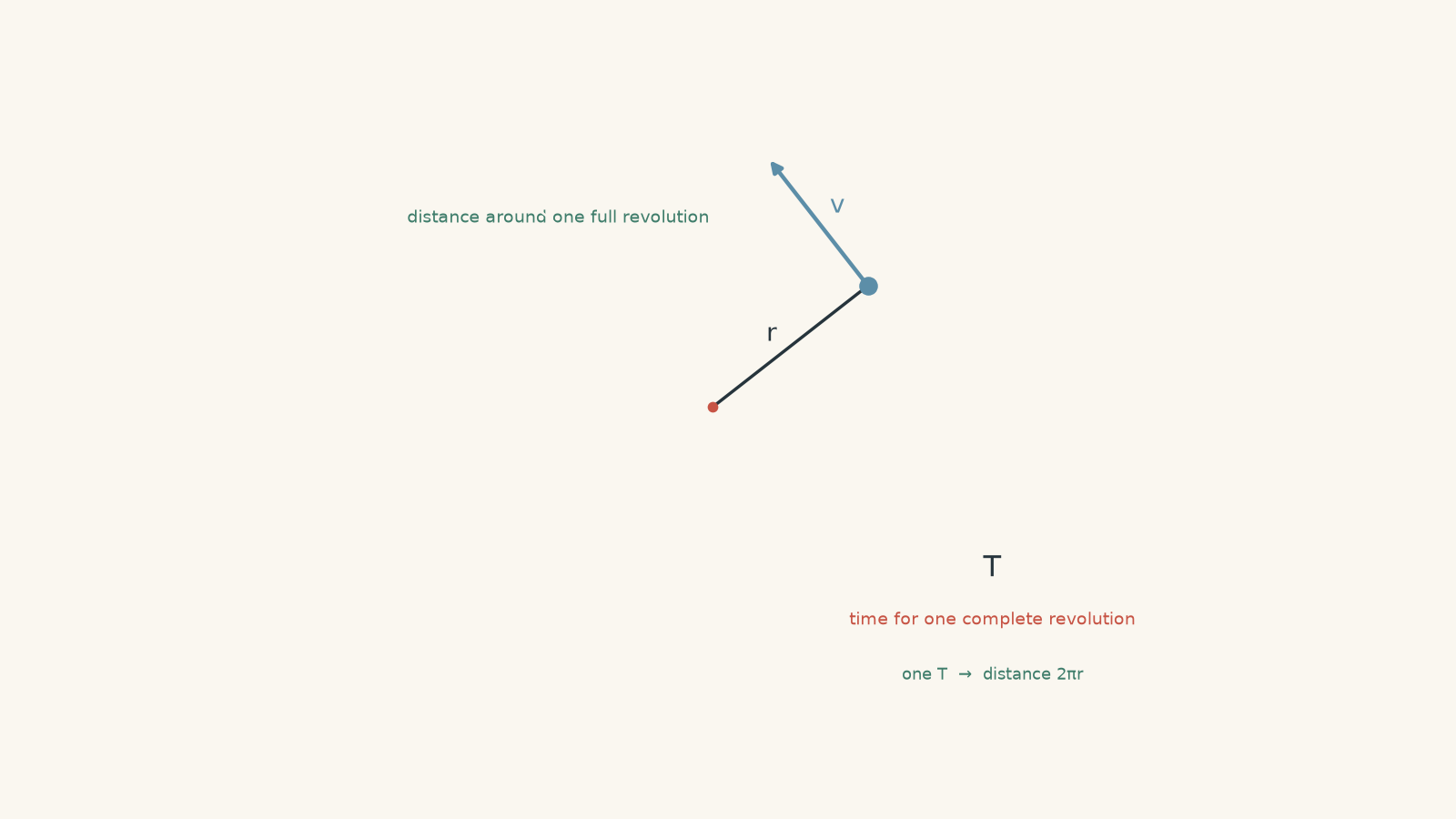
Imagine a small ball moving around a circular track at constant speed. One complete lap has length equal to the circumference of the circle:
\[ \text{distance in one revolution}=2\pi r \]
where \(r\) is the radius of the circular path, measured in metres.
Suppose one revolution takes \(T\) seconds. \(T\) is called the period.
Speed is distance divided by time, so over one complete revolution,
\[ v=\frac{\text{distance}}{\text{time}} =\frac{2\pi r}{T} \]
where:
- \(v\) is the speed in metres per second, \(\text{m s}^{-1}\),
- \(r\) is the radius of the circular path in metres, \(\text{m}\), and
- \(T\) is the period, the time for one complete revolution, in seconds, \(\text{s}\).
The equation is not a special new rule invented just for circles. It is the familiar rule
\[ \text{speed}=\frac{\text{distance}}{\text{time}} \]
applied to one circular lap.
02What “uniform” actually means
In uniform circular motion, the object moves around a circle at constant speed.
That does not mean its velocity is constant.
Velocity includes direction. As the object moves around the circle, its direction of motion continuously changes, even if the speedometer reading stays exactly the same.
At every instant, the velocity points along the tangent to the circle.
Picture swinging a ball on a string. If the string suddenly breaks, does the ball fly directly away from the centre?
A common first prediction is yes, because it feels as though the ball has been “trying to escape outwards”. But once the string breaks, the ball continues in the direction it was already moving at that instant: along the tangent.
That changing velocity is why circular motion involves acceleration even when \(v\) stays constant. The acceleration is directed towards the centre, which is explored in more detail in Centripetal Acceleration: Why It Points Inward in HSC Physics.
03Why radius changes the speed
Suppose two students are standing on a rotating platform.
Student A is \(1.0\text{ m}\) from the centre. Student B is \(2.0\text{ m}\) from the centre. The platform is rigid, so both complete each revolution at the same time.
You could think of them as two people walking around two circular running tracks while somehow being forced to finish every lap together. The person on the larger track has farther to travel, so they must move faster.
The analogy breaks if the runners are free to choose their own pace. On a rigid rotating platform, the points are mechanically constrained to complete each turn together.
If both students have the same period \(T\),
\[ v=\frac{2\pi r}{T} \]
shows that speed is directly proportional to radius:
\[ v\propto r \]
when \(T\) is constant.
So doubling \(r\) doubles \(v\). Tripling \(r\) triples \(v\).
The outer edge of a spinning disc therefore moves faster than a point close to the centre, even though both make the same number of revolutions per second.
Worked example: Comparing two points on a rotating platform
A circular platform rotates uniformly with a period of \(4.0\text{ s}\). Point A is \(1.2\text{ m}\) from the centre, while point B is \(2.4\text{ m}\) from the centre. Calculate the speed of each point.
Step 1
Both points are fixed to the same platform, so both have period
\[ T=4.0\text{ s} \]
Their radii are different.
Step 2
Using
\[ v=\frac{2\pi r}{T} \]
gives
\[ v_A=\frac{2\pi(1.2)}{4.0} =1.88\text{ m s}^{-1} \]
Step 3
\[ v_B=\frac{2\pi(2.4)}{4.0} =3.77\text{ m s}^{-1} \]
Step 4
Point B is twice as far from the centre, so it travels twice the distance during every revolution. Because both points take the same \(4.0\text{ s}\) to complete that revolution, point B moves at twice the speed.
04Why period changes the speed
Now keep the radius fixed instead.
Imagine the same ball moving around the same circular track. If it completes one lap in \(8\text{ s}\), then completes the same distance in \(4\text{ s}\), its speed must double.
From
\[ v=\frac{2\pi r}{T} \]
if \(r\) is constant,
\[ v\propto \frac{1}{T} \]
So a smaller period means a greater speed.
This relationship is inverse, not direct.
| Change, with the other quantity fixed | Effect on \(v\) |
|---|---|
| Double \(r\) | Double \(v\) |
| Halve \(r\) | Halve \(v\) |
| Double \(T\) | Halve \(v\) |
| Halve \(T\) | Double \(v\) |
Be careful with that table. It describes what happens when the other listed variable is genuinely held fixed. Real physical systems may have additional constraints that prevent you from changing one variable independently.
05Period and frequency describe the same rotation differently
Sometimes a question gives frequency instead of period.
Frequency \(f\) tells you how many revolutions occur each second. Its unit is hertz, \(\text{Hz}\), where \(1\text{ Hz}=1\text{ s}^{-1}\).
Period and frequency are reciprocals:
\[ T=\frac{1}{f} \]
and
\[ f=\frac{1}{T} \]
For example, if an object completes \(5.0\) revolutions every second,
\[ f=5.0\text{ Hz} \]
so
\[ T=\frac{1}{5.0}=0.20\text{ s} \]
Substituting \(T=1/f\) into the circular-speed equation gives
\[ v=\frac{2\pi r}{1/f}=2\pi rf \]
So the two useful forms are
\[ v=\frac{2\pi r}{T} \]
and
\[ v=2\pi rf \]
They say the same thing.
Worked example: Finding speed from revolutions per minute
A laboratory turntable has radius \(0.180\text{ m}\) and rotates uniformly at \(45.0\) revolutions per minute. Calculate the speed of a point on its outer edge.
Step 1
The frequency must be in revolutions per second:
\[ f=\frac{45.0}{60} =0.750\text{ Hz} \]
Step 2
Using
\[ v=2\pi rf \]
we get
\[ v=2\pi(0.180)(0.750) =0.848\text{ m s}^{-1} \]
Step 3
A point at the outer edge travels about \(0.848\text{ m}\) along its circular path every second. The entire turntable has the same angular rotation rate, but points closer to its centre have smaller linear speeds.
06The tempting mistake: “After one lap, displacement is zero”
There is a subtle problem hiding in our derivation.
After one complete revolution, the object returns to its starting point. Its displacement is therefore zero.
So why did we write
\[ v=\frac{2\pi r}{T} \]
instead of zero divided by \(T\)?
Because this equation gives the object’s constant speed, not its average velocity over the whole revolution.
These are different quantities.
Over one revolution:
- distance travelled is \(2\pi r\),
- displacement is \(0\),
- average speed is \(\frac{2\pi r}{T}\), and
- average velocity is \(0\).
An object in uniform circular motion can therefore have a non-zero speed at every instant while having zero average velocity over one complete revolution.
That sounds strange until you remember that velocity cares about direction. During a full lap, motion in different directions cancels when calculating total displacement.
07Rearranging the equation without losing the physics
You may need to find \(T\) or \(r\), rather than \(v\).
Starting from
\[ v=\frac{2\pi r}{T} \]
multiply both sides by \(T\):
\[ vT=2\pi r \]
Then
\[ T=\frac{2\pi r}{v} \]
or
\[ r=\frac{vT}{2\pi} \]
Rather than memorising three separate equations, it is usually safer to remember what is happening physically:
one revolution covers a distance \(2\pi r\) in a time \(T\).
You can often rebuild the required equation from that sentence.
Worked example: Finding an unknown radius
A particle moves with uniform circular motion at \(7.5\text{ m s}^{-1}\). It completes \(12\) revolutions in \(30\text{ s}\). Find the radius of its path.
Step 1
Twelve revolutions take \(30\text{ s}\), so one revolution takes
\[ T=\frac{30}{12}=2.50\text{ s} \]
Step 2
From
\[ v=\frac{2\pi r}{T} \]
we obtain
\[ r=\frac{vT}{2\pi} \]
Step 3
\[ r=\frac{(7.5)(2.50)}{2\pi} =2.98\text{ m} \]
Step 4
A circle of radius \(2.98\text{ m}\) has circumference
\[ 2\pi(2.98)\approx18.7\text{ m} \]
At \(7.5\text{ m s}^{-1}\), travelling \(18.7\text{ m}\) takes about \(2.50\text{ s}\), matching the stated period.
That check is useful because it reconnects the algebra to the actual motion.
08Speed is not enough to describe circular motion
Two objects can have the same speed while following circles of very different radii.
Suppose both travel at \(6.0\text{ m s}^{-1}\). One moves around a \(2.0\text{ m}\) radius circle and the other around an \(8.0\text{ m}\) radius circle.
Their periods are
\[ T=\frac{2\pi r}{v} \]
so the smaller circle has the smaller period. Its direction changes much more rapidly because it completes revolutions more often.
This leads directly to centripetal acceleration:
\[ a_c=\frac{v^2}{r} \]
where \(a_c\) is the acceleration directed towards the centre.
Combining this with
\[ v=\frac{2\pi r}{T} \]
gives
\[ a_c =\frac{(2\pi r/T)^2}{r} =\frac{4\pi^2r}{T^2} \]
This tells us something important: if two points on the same rigid rotating object have the same period, the point farther from the centre not only moves faster, but also has greater centripetal acceleration.
Do not turn “centripetal” into an extra mysterious force, though. The inward acceleration must be caused by a real force or combination of forces. That distinction is developed in Centripetal Force: How to Identify the Real Force in HSC Physics.
09Questions and solutions
Question 1
A model aircraft flies in uniform circular motion around a horizontal circle of radius \(25\text{ m}\). It completes one revolution every \(10\text{ s}\).
Calculate its speed.
Solution 1
The aircraft’s speed is \(15.7\text{ m s}^{-1}\).
One complete revolution has distance
\[ 2\pi r=2\pi(25)\text{ m} \]
and takes \(T=10\text{ s}\). Therefore,
\[ v=\frac{2\pi r}{T} =\frac{2\pi(25)}{10} =15.7\text{ m s}^{-1} \]
The tempting mistake is to divide the radius by the period. The aircraft does not travel \(25\text{ m}\) in one revolution; it travels the full circumference, \(2\pi r\).
Question 2
Two points, A and B, lie on the same rigid rotating disc. A is \(0.30\text{ m}\) from the centre and B is \(0.75\text{ m}\) from the centre. Point A moves at \(2.4\text{ m s}^{-1}\).
Determine:
a. the period of the disc,
b. the speed of B, and
c. the ratio of B’s centripetal acceleration to A’s centripetal acceleration.
Solution 2
The period is \(0.785\text{ s}\), B’s speed is \(6.0\text{ m s}^{-1}\), and B’s centripetal acceleration is \(2.5\) times A’s.
For point A,
\[ T=\frac{2\pi r_A}{v_A} =\frac{2\pi(0.30)}{2.4} =0.785\text{ s} \]
Because A and B are fixed to the same rigid disc, they complete each revolution together. Therefore,
\[ T_B=T_A=0.785\text{ s} \]
For B,
\[ v_B=\frac{2\pi r_B}{T} =\frac{2\pi(0.75)}{0.785} =6.0\text{ m s}^{-1} \]
For centripetal acceleration,
\[ a_c=\frac{v^2}{r} \]
so
\[ \frac{a_B}{a_A} = \frac{v_B^2/r_B}{v_A^2/r_A} = \frac{(6.0)^2/0.75}{(2.4)^2/0.30} =2.5 \]
There is also a faster conceptual route. Because the disc has the same period everywhere,
\[ a_c=\frac{4\pi^2r}{T^2} \]
so \(a_c\propto r\). Thus
\[ \frac{a_B}{a_A} =\frac{0.75}{0.30} =2.5 \]
A tempting prediction is that the two points have the same speed and acceleration because they belong to the same disc. What is actually shared is their period. The larger radius forces B to cover more distance in that same time.
Question 3
A satellite moves in a circular orbit of radius \(7.0\times10^6\text{ m}\) with speed \(7.5\times10^3\text{ m s}^{-1}\).
a. Calculate its orbital period.
b. A student says, “Its average velocity over one orbit must also be \(7.5\times10^3\text{ m s}^{-1}\), because its velocity magnitude never changes.” Explain why this is incorrect.
Solution 3
The orbital period is approximately \(5.86\times10^3\text{ s}\), or \(97.7\text{ min}\), and its average velocity over one complete orbit is zero.
For part a,
\[ T=\frac{2\pi r}{v} \]
so
\[ T= \frac{2\pi(7.0\times10^6)} {7.5\times10^3} =5.86\times10^3\text{ s} \]
Converting to minutes,
\[ T=\frac{5.86\times10^3}{60} =97.7\text{ min} \]
For part b, after one complete orbit the satellite returns to its starting position. Its total displacement is therefore zero.
Average velocity is
\[ \text{average velocity} = \frac{\text{displacement}}{\text{time}} \]
so over the complete orbit,
\[ \text{average velocity} = \frac{0}{5.86\times10^3} =0 \]
The student’s reasoning confuses speed with velocity. The magnitude of the instantaneous velocity remains \(7.5\times10^3\text{ m s}^{-1}\), but its direction continuously changes. The satellite’s average speed is non-zero, while its average velocity over a complete orbit is zero.
Question 4
Two particles, X and Y, are each in uniform circular motion.
X travels around a circle of radius \(r\) with period \(T\).
Y travels around a circle of radius \(4r\).
At one instant, X and Y have equal centripetal accelerations.
Without assigning numerical values to \(r\) or \(T\), determine:
a. the ratio \(\frac{v_Y}{v_X}\),
b. the ratio \(\frac{T_Y}{T_X}\), and
c. whether Y completes more or fewer revolutions than X during a fixed time interval.
Explain why simply saying “Y has four times the radius, so it must have four times the speed” fails here.
Solution 4
Y has twice X’s speed, twice X’s period, and therefore completes half as many revolutions in any fixed time interval.
Equal centripetal accelerations means
\[ \frac{v_X^2}{r_X} = \frac{v_Y^2}{r_Y} \]
With
\[ r_X=r \]
and
\[ r_Y=4r \]
we have
\[ \frac{v_X^2}{r} = \frac{v_Y^2}{4r} \]
Therefore,
\[ v_Y^2=4v_X^2 \]
and, since speeds are positive,
\[ v_Y=2v_X \]
Hence
\[ \frac{v_Y}{v_X}=2 \]
Now use
\[ T=\frac{2\pi r}{v} \]
so
\[ \frac{T_Y}{T_X} = \frac{r_Y/v_Y}{r_X/v_X} = \frac{4r/(2v_X)}{r/v_X} =2 \]
Thus
\[ T_Y=2T_X \]
Y takes twice as long for each revolution, so during the same total time it completes half as many revolutions as X.
The tempting argument \(v\propto r\) is only valid when period is held constant. Nothing in this question says that X and Y have equal periods. Instead, they have equal centripetal accelerations. That different constraint changes how speed must scale with radius.
This is an important habit in circular-motion problems: before using a proportional relationship, identify what has actually been kept constant.
Question 5
Two small objects, A and B, initially move in uniform circular motion.
For A,
\[ r_A=R,\qquad T_A=T \]
For B,
\[ r_B=4R,\qquad T_B=2T \]
A student reasons:
“B has four times the radius and only twice the period, so B must have twice the speed. Since centripetal acceleration is \(v^2/r\), B therefore has the same centripetal acceleration as A.”
The student is correct so far.
The system is then changed. A remains in its original motion. B is moved to a new circular path, but two conditions are imposed:
- B must keep the same speed it had before the change.
- B must now have twice A’s centripetal acceleration.
Determine B’s new radius and new period in terms of \(R\) and \(T\).
Then explain why it would be impossible to satisfy those two new conditions while also keeping B’s original period \(2T\).
Solution 5
B’s new radius is \(2R\), its new period is \(T\), and keeping its original period \(2T\) at the same time would contradict the required speed and centripetal acceleration.
First find the original speeds.
For A,
\[ v_A=\frac{2\pi R}{T} \]
For B initially,
\[ v_B = \frac{2\pi(4R)}{2T} = \frac{4\pi R}{T} =2v_A \]
So the student’s first conclusion is correct.
A’s centripetal acceleration is
\[ a_A=\frac{v_A^2}{R} \]
B must keep its speed \(v_B=2v_A\), but after the change it must have
\[ a_B=2a_A \]
Let B’s new radius be \(r'_B\). Then
\[ a_B=\frac{v_B^2}{r'_B} \]
so
\[ 2a_A = \frac{(2v_A)^2}{r'_B} \]
Substitute \(a_A=v_A^2/R\):
\[ 2\left(\frac{v_A^2}{R}\right) = \frac{4v_A^2}{r'_B} \]
Cancelling \(v_A^2\),
\[ \frac{2}{R} = \frac{4}{r'_B} \]
which gives
\[ r'_B=2R \]
Now find B’s new period:
\[ T'_B=\frac{2\pi r'_B}{v_B} \]
Substituting \(r'_B=2R\) and \(v_B=2v_A\),
\[ T'_B = \frac{2\pi(2R)}{2v_A} = \frac{2\pi R}{v_A} \]
But for A,
\[ v_A=\frac{2\pi R}{T} \]
so
\[ T'_B=T \]
Therefore B’s new motion is
\[ r'_B=2R,\qquad T'_B=T \]
Now consider the extra condition that B somehow keeps its original period \(2T\).
If B kept both its original speed \(2v_A\) and original period \(2T\), then
\[ r=\frac{vT}{2\pi} \]
would force its radius to remain
\[ r = \frac{(2v_A)(2T)}{2\pi} =4R \]
But at \(r=4R\) and speed \(2v_A\),
\[ a_c = \frac{(2v_A)^2}{4R} = \frac{v_A^2}{R} =a_A \]
not \(2a_A\).
So the three requirements cannot all be satisfied simultaneously.
The tempting route is to treat radius, speed, and period as though they can be adjusted independently. They cannot. Once any two of \(v\), \(r\), and \(T\) are fixed for uniform circular motion, the third is fixed by
\[ v=\frac{2\pi r}{T} \]
The deeper lesson is that this equation is not just a calculator formula. It is a constraint connecting the geometry of the path to the timing of the motion. Once that connection is secure, the next step is to combine it with \(a_c=v^2/r\) and identify what physical force is capable of producing the required inward acceleration.