
How Charged Particles Deflect Between Parallel Plates
Learn how electric forces change the motion of electrons and ions, why charged particles follow parabolic paths between parallel plates, and how to predict their motion after leaving the field. Includes worked examples and practice questions covering deflection, screen positions and plate clearance.
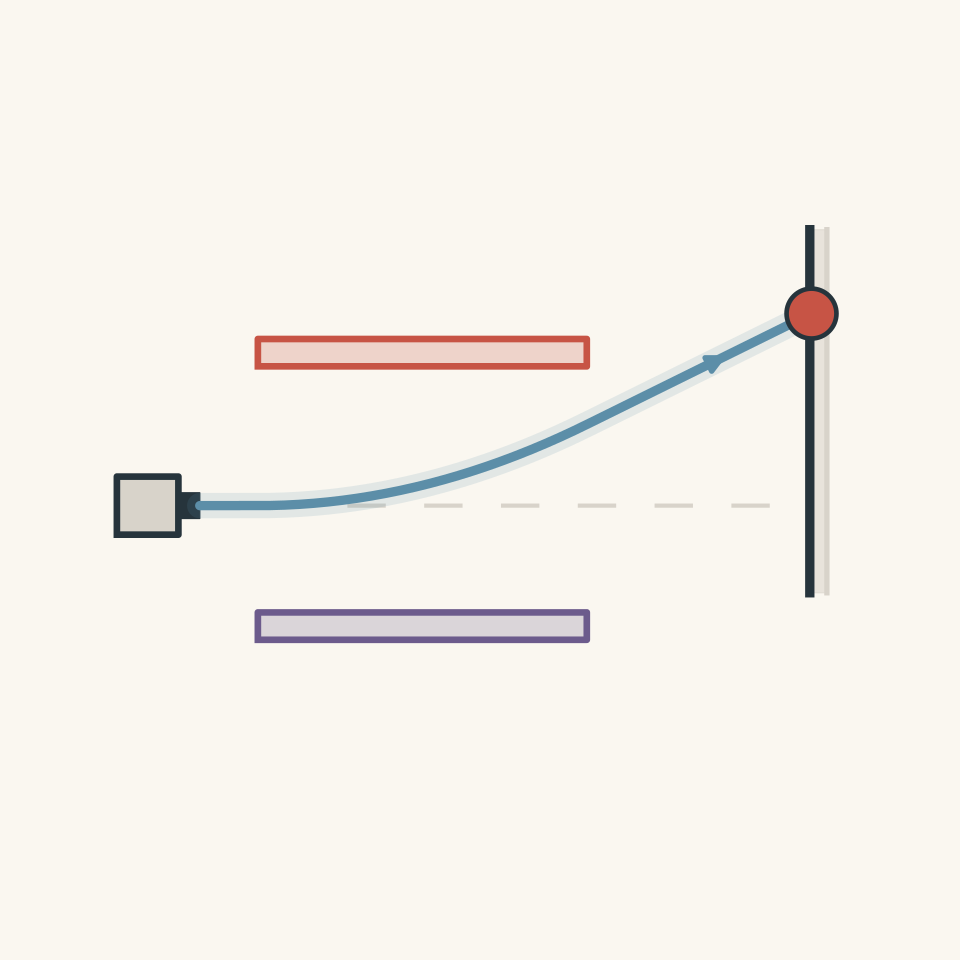
An electron shoots horizontally between two charged metal plates. The upper plate is positive, and the lower plate is negative. As the electron travels through the gap, its path curves upwards towards the positive plate.
Now predict what happens when it reaches the end of the plates. Does it keep curving upwards, turn back towards its original direction, or travel in a straight line?
It travels in a straight line, but at an upward angle. The electric field has given the electron some upward velocity. Once the electron leaves the field, that upward velocity doesn’t disappear.
This is the key to understanding charged particle motion: an electric force changes a particle’s velocity, and the resulting path depends on both the force and the velocity it already had.
01How an electric field changes motion
Imagine pushing a shopping trolley straight down an aisle. While it’s rolling forwards, someone gives it a shove sideways.
The trolley doesn’t suddenly forget it was moving forwards. It continues forwards while also gaining sideways motion.
A charged particle behaves similarly when an electric force acts perpendicular to its velocity. The difference is that a uniform electric field provides a continuous force, rather than a single shove. Real shopping trolleys also have friction and wheels, so the analogy helps us picture the motion, not calculate it.
Which way does the force act?
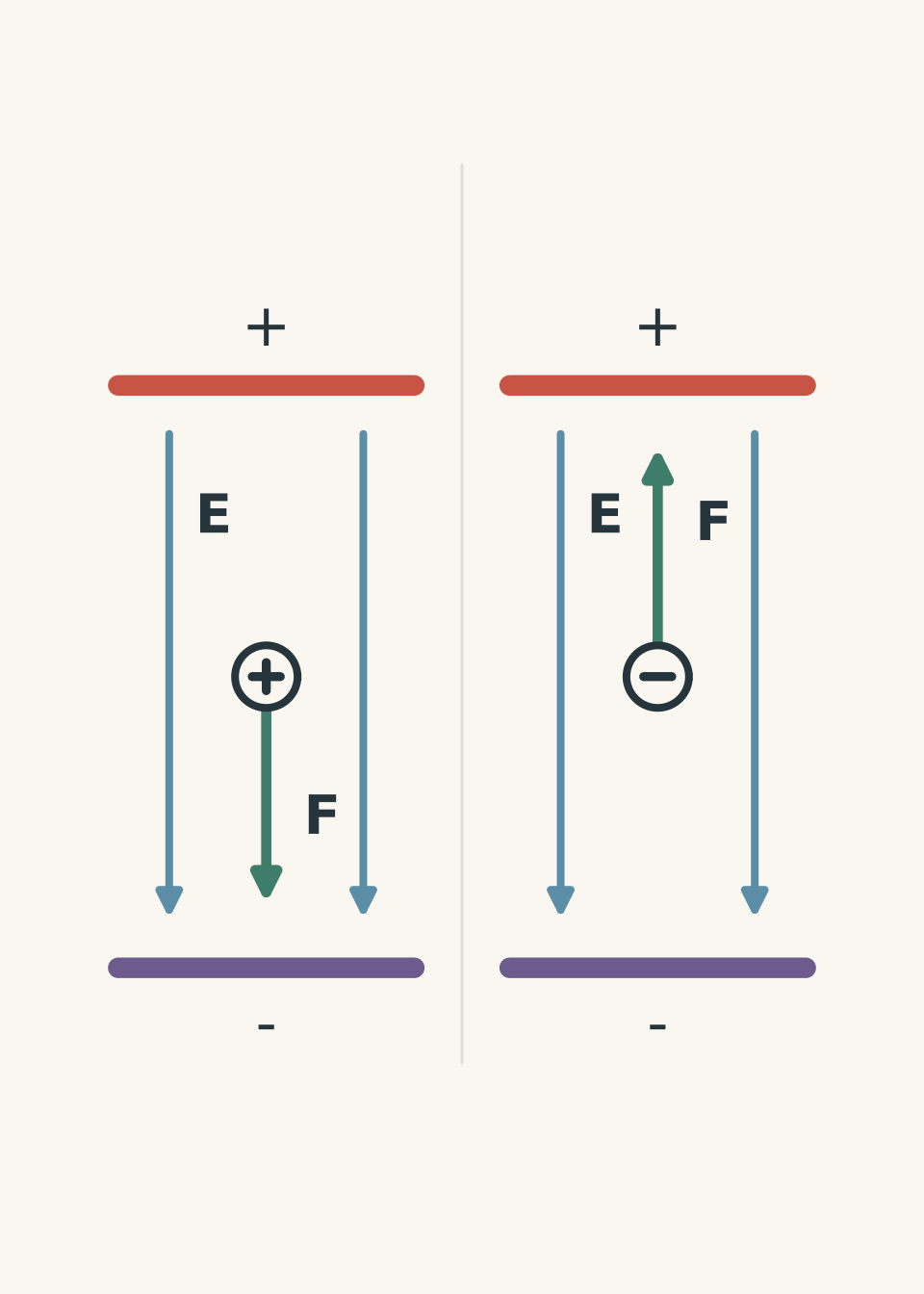
The direction of an electric field is defined as the direction of the force on a positive test charge.
Between two oppositely charged parallel plates:
- The electric field points from the positive plate towards the negative plate.
- A positive particle experiences a force in the direction of the field.
- A negative particle experiences a force opposite to the field.
So if the upper plate is positive and the lower plate is negative, the field points downwards. A proton accelerates downwards, while an electron accelerates upwards.
The electric force is described by
\[ \vec F=q\vec E \]
where:
- \(\vec F\) is the electric force, measured in newtons (N).
- \(q\) is the particle’s charge, measured in coulombs (C), including its positive or negative sign.
- \(\vec E\) is the electric field strength and direction, measured in newtons per coulomb (\(\mathrm{N\\,C^{-1}}\)).
The arrows above \(F\) and \(E\) tell us they’re vectors: quantities with both magnitude and direction.
For a negative charge, the negative value of \(q\) reverses the direction of the force.
Force produces acceleration
Newton’s second law tells us
\[ \vec F=m\vec a \]
Here, \(m\) is the particle’s mass in kilograms (kg), and \(\vec a\) is its acceleration in metres per second squared (\(\mathrm{m\\,s^{-2}}\)).
Combining the two equations gives
\[ \boxed{\vec a=\frac{q\vec E}{m}} \]
This equation explains three important things.
First, a stronger electric field produces greater acceleration.
Second, a particle with greater charge magnitude experiences greater acceleration if its mass stays the same.
Third, a more massive particle accelerates less for the same electric force.
For example, an electron and a proton experience electric forces of equal magnitude in the same field because their charges have equal magnitudes. But a proton has about 1836 times the mass of an electron, so its acceleration is about 1836 times smaller.
Their accelerations also point in opposite directions.
Why a uniform electric field matters
A uniform electric field has the same magnitude and direction at every point in the region being considered.
That means a particle with constant charge and mass experiences a constant electric force and, therefore, constant acceleration.
Two large, oppositely charged parallel plates produce an approximately uniform field in the region well away from their edges.
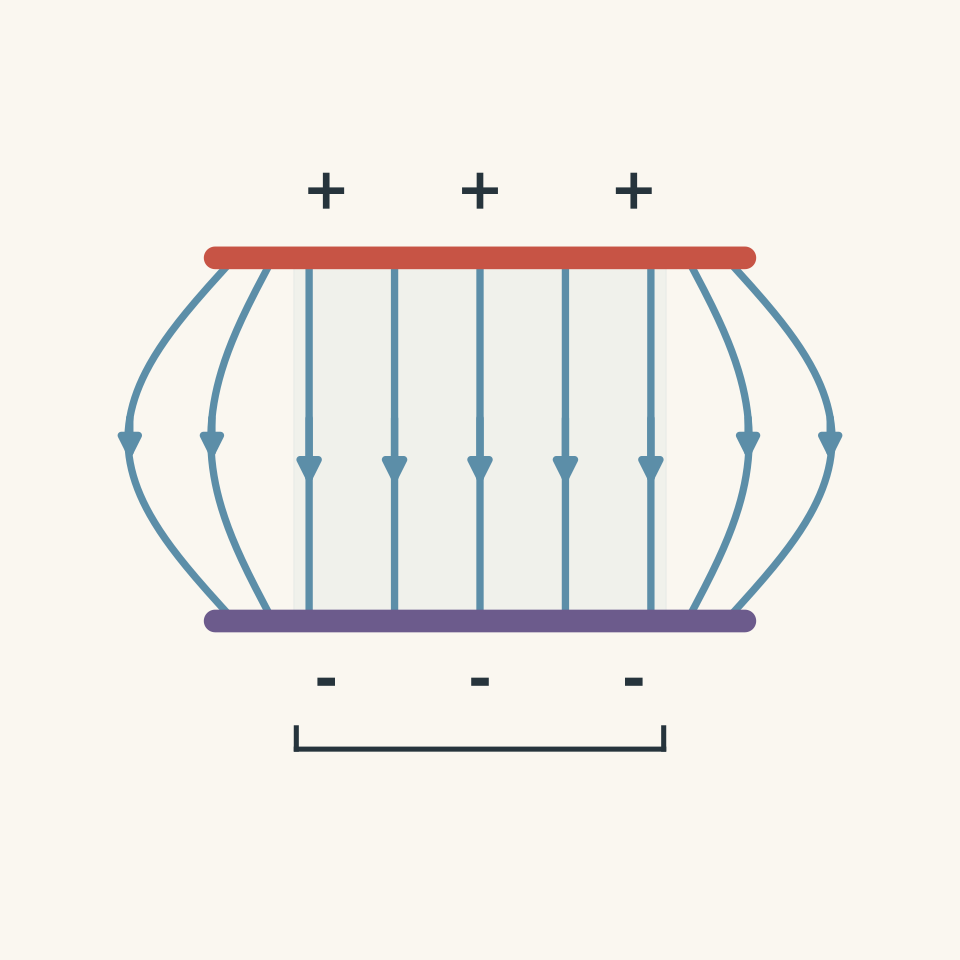
For plates separated by a distance \(d\), with a potential difference of magnitude \(V\), the field strength is approximately
\[ E=\frac{V}{d} \]
Here, \(E\) is the field magnitude in \(\mathrm{V\\,m^{-1}}\), \(V\) is the potential difference in volts (V), and \(d\) is the plate separation in metres (m).
One volt per metre is equivalent to one newton per coulomb.
You can see how this relationship is derived in our guide to electric field strength and potential difference.
For the calculations in this article, we’ll assume:
- The electric field is uniform between the plates and negligible outside them.
- Air resistance, collisions, gravity, and magnetic forces can be ignored.
- The particle is moving slowly enough for Newtonian mechanics to apply.
These are useful idealisations, not exact descriptions of the fields near real plate edges.
02Why the particle follows a parabola
Suppose an electron enters a uniform electric field travelling horizontally to the right.
The electric force points vertically upwards.
Does that mean its horizontal velocity decreases as it curves?
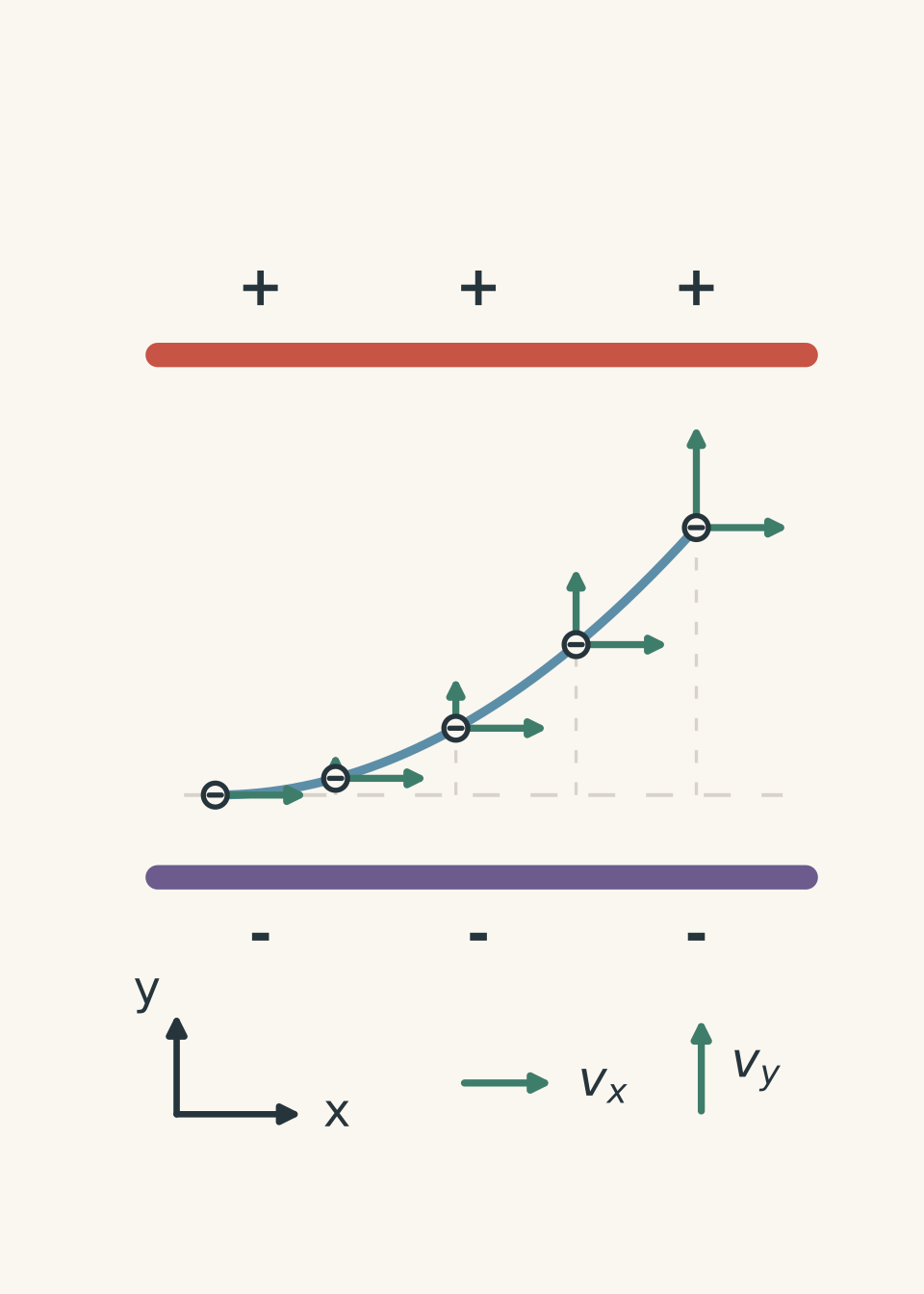
No. There’s no horizontal force, so there’s no horizontal acceleration. The electron continues moving right at a constant horizontal velocity, while its upward velocity increases.
We can treat these as two separate motions.
Horizontal motion
Let’s call the initial horizontal velocity \(u_x\), measured in \(\mathrm{m\\,s^{-1}}\).
Because the horizontal acceleration is zero,
\[ a_x=0,\qquad v_x=u_x,\qquad x=u_xt \]
Here, \(a_x\) is horizontal acceleration, \(v_x\) is horizontal velocity at time \(t\), and \(x\) is horizontal displacement from the entrance.
The horizontal velocity stays constant.
Vertical motion
Take upwards as the positive direction.
The vertical acceleration is
\[ a_y=\frac{qE_y}{m} \]
Here, \(E_y\) is the signed vertical component of the electric field. A downward field has \(E_y<0\).
For a particle entering horizontally, its initial vertical velocity is zero. The constant-acceleration equations become
\[ v_y=a_yt \]
\[ y=\frac12a_yt^2 \]
Here, \(v_y\) is the vertical velocity at time \(t\), and \(y\) is vertical displacement from the entrance.
Notice that vertical displacement depends on time squared. The longer the particle spends in the field, the more its vertical speed builds up.
Combining the two directions
From horizontal motion,
\[ t=\frac{x}{u_x} \]
Substitute this into the vertical displacement equation:
\[ \begin{aligned} y&=\frac12a_yt^2\\\ &=\frac12\left(\frac{qE_y}{m}\right) \left(\frac{x}{u_x}\right)^2\\\ y&=\frac{qE_y}{2mu_x^2}x^2 \end{aligned} \]
This has the form \(y=kx^2\), where \(k\) is a constant.
That’s the equation of a parabola.
The particle follows a parabolic path because its horizontal velocity remains constant while its vertical velocity changes at a constant rate.
The sign of \(qE_y\) determines whether the parabola bends upwards or downwards.
What if the particle enters faster?
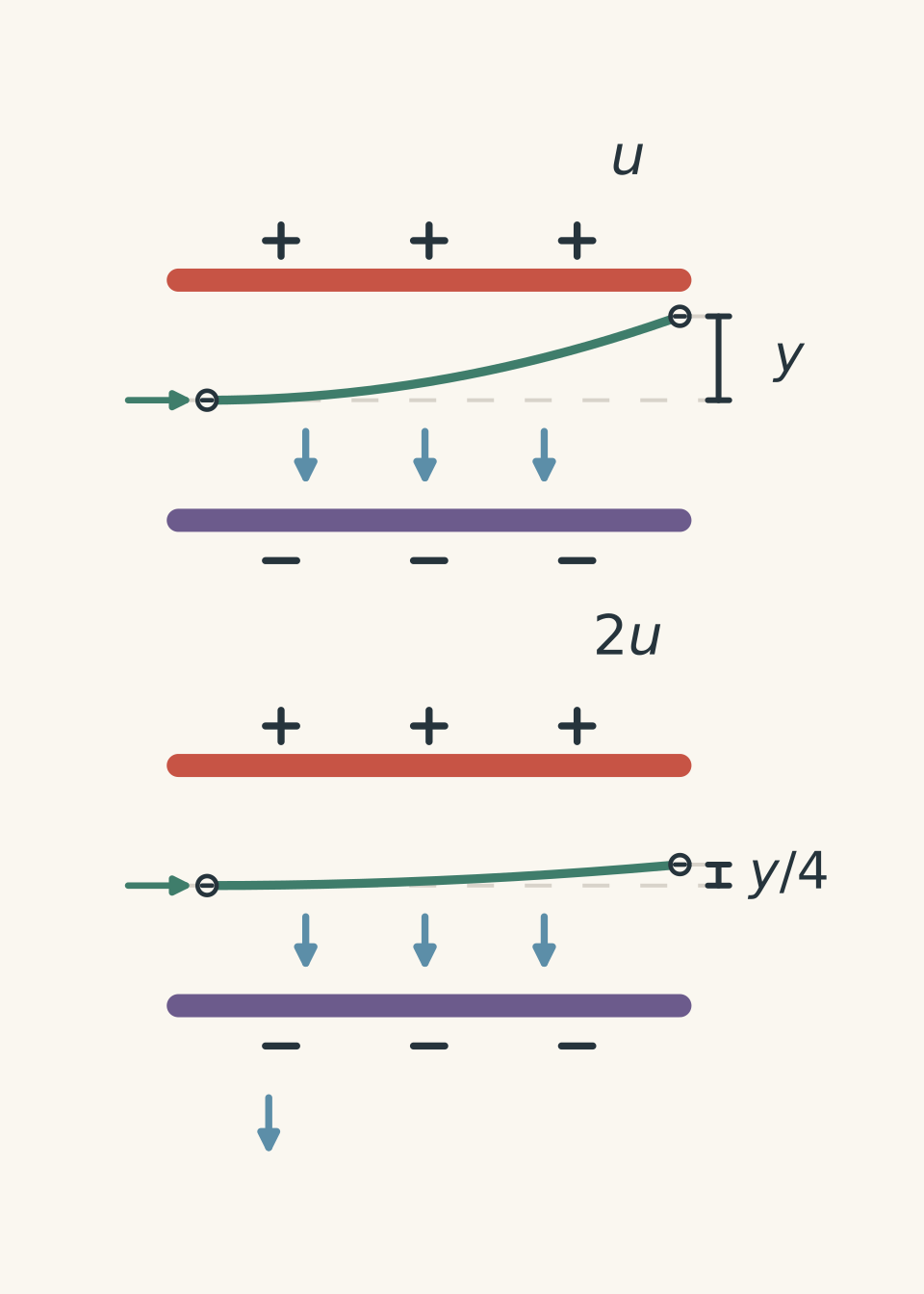
Imagine two identical electrons entering the same field horizontally, but one has twice the horizontal speed of the other.
You might predict that the faster electron experiences more deflection because it’s moving more quickly. In fact, the opposite happens.
The faster electron spends half as long between the plates. Because vertical displacement depends on \(t^2\), it undergoes only one-quarter of the vertical deflection, provided both electrons make it through the gap.
If the plates have horizontal length \(L\), the time spent inside is
\[ t_{\text{inside}}=\frac{L}{u_x} \]
So the vertical displacement at the exit is
\[ y_{\text{exit}}=\frac{qE_yL^2}{2mu_x^2} \]
And the vertical exit velocity is
\[ v_{y,\text{exit}}=\frac{qE_yL}{mu_x} \]
These formulas assume the particle enters horizontally and doesn’t hit either plate.
If it already has a vertical entry velocity \(u_{y0}\), we must instead use
\[ y=u_{y0}t+\frac12a_yt^2,\qquad v_y=u_{y0}+a_yt \]
The trajectory is still parabolic while the field is uniform, but it needn’t start with a horizontal tangent.
Worked example: How far does an electron bend?
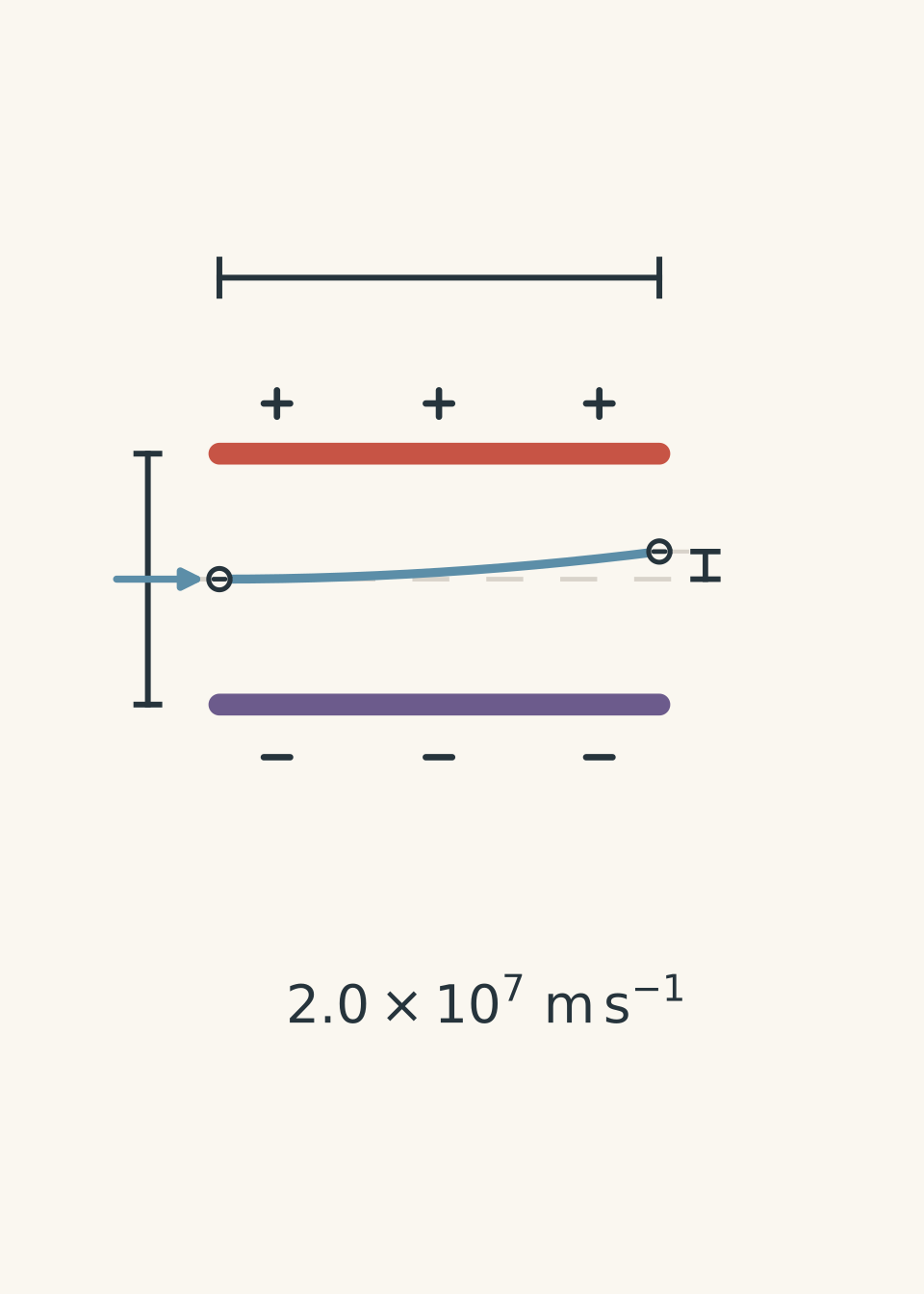
An electron enters horizontally midway between two parallel plates of length \(5.0\ \mathrm{cm}\), separated by \(1.0\ \mathrm{cm}\).
The upper plate is positive, and the uniform electric field has magnitude \(2.0\times10^3\ \mathrm{N\\,C^{-1}}\). The electron enters with horizontal speed \(2.0\times10^7\ \mathrm{m\\,s^{-1}}\).
Calculate its vertical displacement when it reaches the end of the plates. Determine whether it strikes a plate.
Use:
- Electron charge: \(q=-1.60\times10^{-19}\ \mathrm C\)
- Electron mass: \(m_e=9.11\times10^{-31}\ \mathrm{kg}\)
Step 1: Determine the direction of acceleration.
The field points downwards, but the electron is negatively charged.
Therefore, the electron experiences an upward force and acceleration.
Taking upwards as positive,
\[ \begin{aligned} F_y&=qE_y\\\ &=(-1.60\times10^{-19})(-2.0\times10^3)\\\ &=+3.20\times10^{-16}\ \mathrm N\\\\[4pt] a_y&=\frac{F_y}{m_e}\\\ &=\frac{3.20\times10^{-16}}{9.11\times10^{-31}}\\\ &=+3.51\times10^{14}\ \mathrm{m\\,s^{-2}} \end{aligned} \]
Step 2: Calculate the time inside the plates.
Convert the plate length to metres: \(L=0.050\ \mathrm m\).
\[ t=\frac{L}{u_x} =\frac{0.050}{2.0\times10^7} =2.50\times10^{-9}\ \mathrm s \]
Step 3: Calculate vertical displacement.
The electron enters with zero vertical velocity, so
\[ \begin{aligned} y&=\frac12a_yt^2\\\ &=\frac12(3.51\times10^{14})(2.50\times10^{-9})^2\\\ &=+1.10\times10^{-3}\ \mathrm m\\\ &=+1.10\ \mathrm{mm} \end{aligned} \]
Step 4: Check whether the electron hits a plate.
The electron begins halfway between plates separated by \(10\ \mathrm{mm}\). The upper plate is therefore \(5.0\ \mathrm{mm}\) above its starting position.
Because the electron rises by only \(1.10\ \mathrm{mm}\) and its upward displacement increases throughout the gap, it doesn’t hit the plate.
The electron leaves the field \(1.10\ \mathrm{mm}\) above its original path, travelling at an upward angle.
03What happens after the particle leaves the field?
A charged particle doesn’t need a continuous force to keep moving.
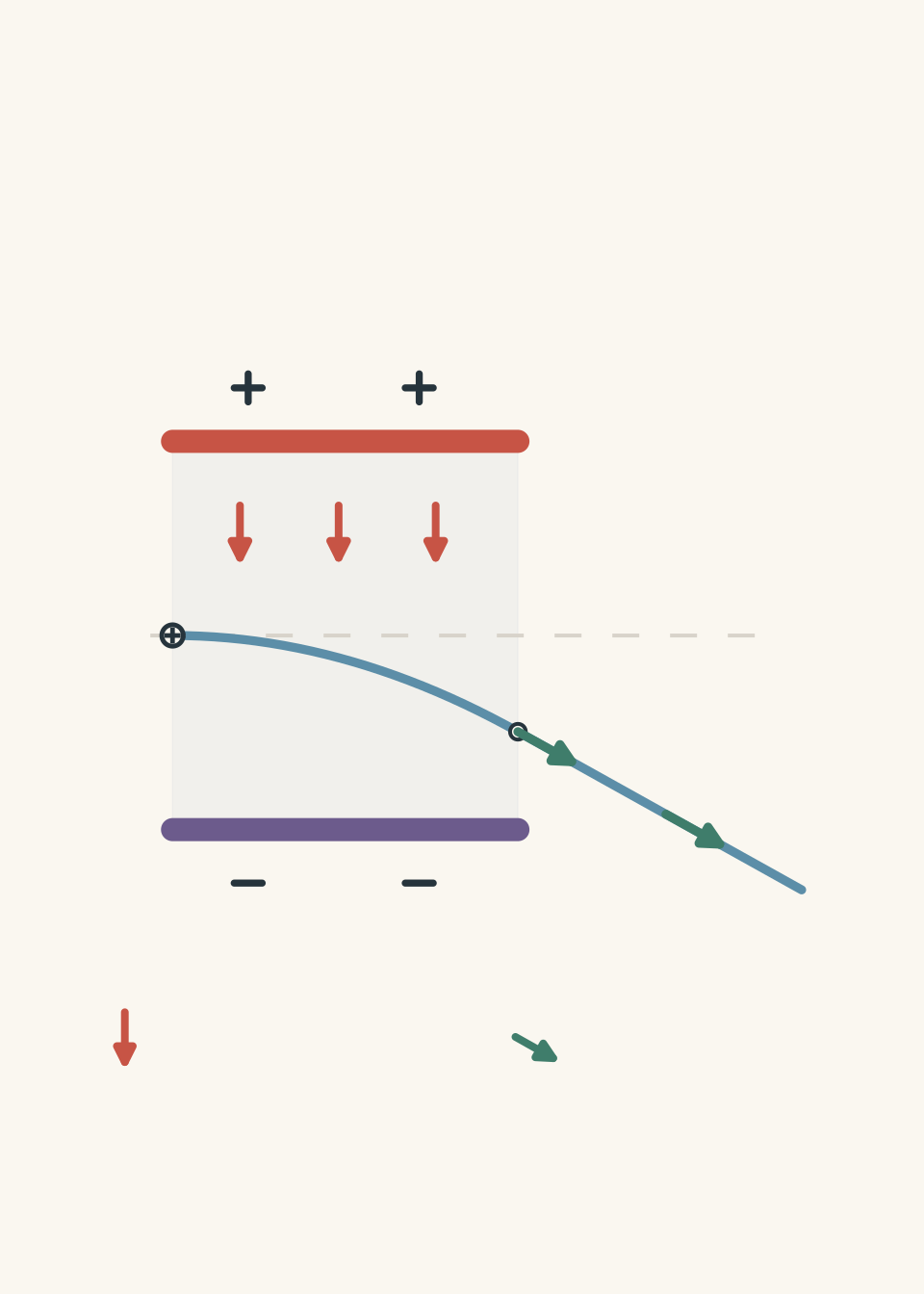
Inside the plates, the electric force changes its vertical velocity. Outside the plates, we assume the electric field is negligible, so the force and acceleration become zero.
But the particle keeps whatever horizontal and vertical velocities it had at the instant it left.
That means:
| Between the plates | After leaving the plates |
|---|---|
| Electric force acts vertically | Electric force is negligible |
| Vertical acceleration is constant | Vertical acceleration is zero |
| Vertical velocity changes | Vertical velocity stays constant |
| Path is parabolic | Path is straight |
Finding where the particle hits a screen
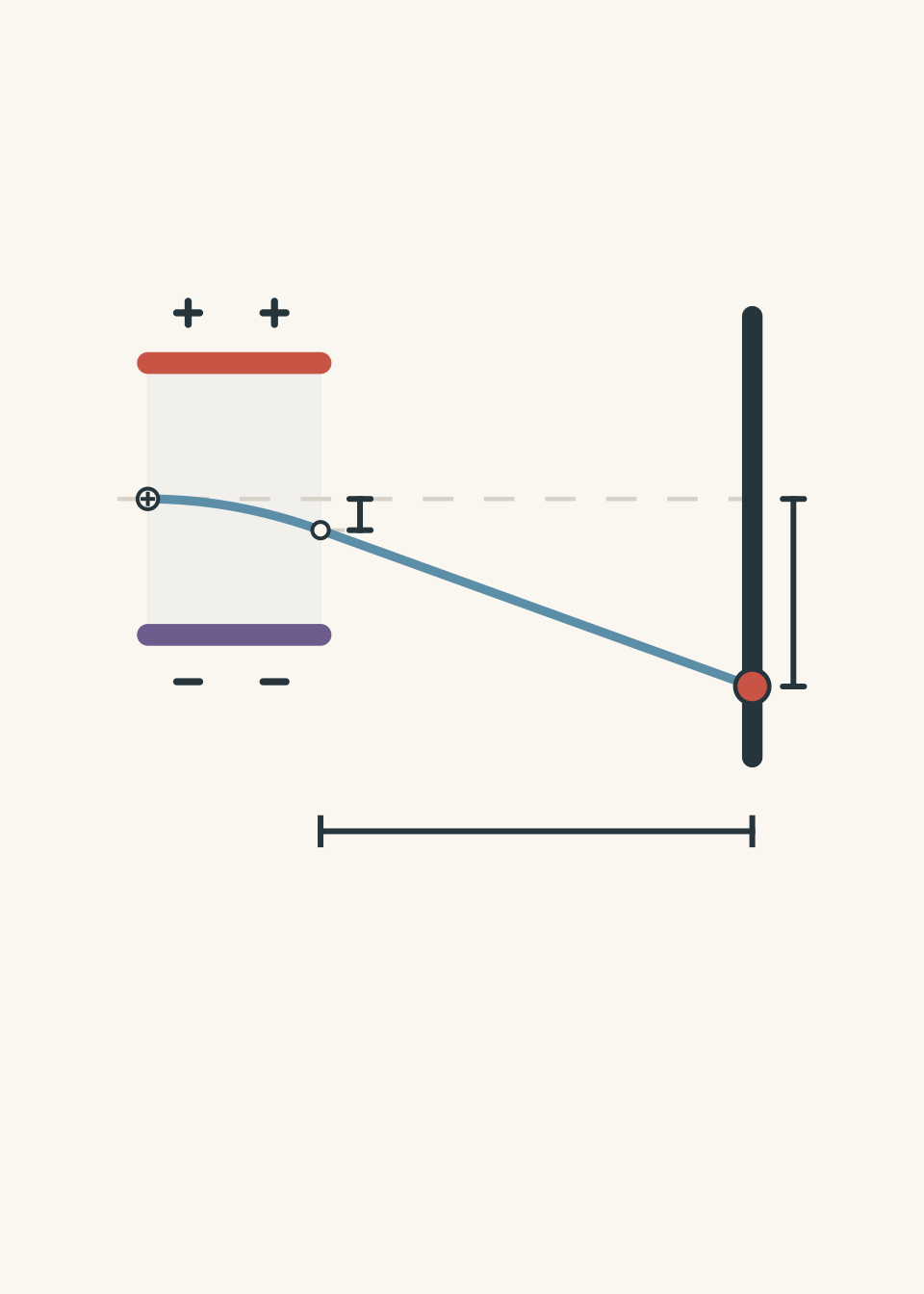
Suppose a screen is located a horizontal distance \(D\) beyond the end of the plates.
The particle still travels horizontally at \(u_x\), so its time between the plate exit and the screen is
\[ t_{\text{screen}}=\frac{D}{u_x} \]
Since there’s no acceleration outside, the additional vertical displacement is
\[ \Delta y=v_{y,\text{exit}}\frac{D}{u_x} \]
Therefore,
\[ y_{\text{screen}}=y_{\text{exit}}+ v_{y,\text{exit}}\frac{D}{u_x} \]
This tells us something important: the final displacement on the screen has two contributions.
The particle was already displaced when it left the plates. Then it travelled farther vertically because it had gained vertical velocity.
Don’t use the accelerated-motion equation \(y=\frac12at^2\) for the entire journey. The acceleration applies only while the particle is in the field.
Worked example: Where does a proton strike the screen?
A proton enters horizontally through the centre of two parallel plates with the upper plate positive and lower plate negative.
The apparatus has:
- Electric field magnitude: \(3.0\times10^4\ \mathrm{N\\,C^{-1}}\)
- Plate length: \(8.0\ \mathrm{cm}\)
- Plate separation: \(2.0\ \mathrm{cm}\)
- Initial horizontal speed: \(2.0\times10^6\ \mathrm{m\\,s^{-1}}\)
- Screen distance beyond the plates: \(20\ \mathrm{cm}\)
Find the proton’s vertical displacement at the screen, measured from its original horizontal path. Check that it clears the plates.
Use \(q_p=+1.60\times10^{-19}\ \mathrm C\) and \(m_p=1.67\times10^{-27}\ \mathrm{kg}\).
Step 1: Calculate the acceleration.
The proton is positively charged, so its force points downwards, along the electric field.
Taking upwards as positive,
\[ \begin{aligned} a_y&=\frac{qE_y}{m_p}\\\ &=\frac{(1.60\times10^{-19})(-3.0\times10^4)} {1.67\times10^{-27}}\\\ &=-2.87\times10^{12}\ \mathrm{m\\,s^{-2}} \end{aligned} \]
Step 2: Find its displacement at the plate exit.
First find the time inside:
\[ t=\frac{0.080}{2.0\times10^6} =4.0\times10^{-8}\ \mathrm s \]
Then calculate the vertical displacement:
\[ \begin{aligned} y_{\text{exit}} &=\frac12a_yt^2\\\ &=\frac12(-2.87\times10^{12})(4.0\times10^{-8})^2\\\ &=-2.30\times10^{-3}\ \mathrm m\\\ &=-2.30\ \mathrm{mm} \end{aligned} \]
The lower plate is \(10\ \mathrm{mm}\) below the centreline. The proton has moved only \(2.30\ \mathrm{mm}\) downwards, so it clears the plates.
Step 3: Find its vertical velocity at the exit.
\[ \begin{aligned} v_{y,\text{exit}}&=a_yt\\\ &=(-2.87\times10^{12})(4.0\times10^{-8})\\\ &=-1.15\times10^5\ \mathrm{m\\,s^{-1}} \end{aligned} \]
The proton now has a significant downward velocity, even though its horizontal velocity is still \(2.0\times10^6\ \mathrm{m\\,s^{-1}}\).
Step 4: Calculate its displacement at the screen.
The screen is \(0.20\ \mathrm m\) beyond the plates.
\[ t_{\text{screen}}= \frac{0.20}{2.0\times10^6} =1.0\times10^{-7}\ \mathrm s \]
The additional displacement is
\[ \begin{aligned} \Delta y&=v_{y,\text{exit}}t_{\text{screen}}\\\ &=(-1.15\times10^5)(1.0\times10^{-7})\\\ &=-1.15\times10^{-2}\ \mathrm m \end{aligned} \]
Add the displacement from inside the plates:
\[ \begin{aligned} y_{\text{screen}} &=-2.30\times10^{-3}-1.15\times10^{-2}\\\ &=-1.38\times10^{-2}\ \mathrm m\\\ &=-1.38\ \mathrm{cm} \end{aligned} \]
The proton hits the screen approximately \(1.38\ \mathrm{cm}\) below its original horizontal path.
Most of that displacement occurs after the proton leaves the field. It isn’t accelerating there; it’s simply continuing with the downward velocity acquired earlier.
04Three checks that prevent common mistakes
Check the charge sign before calculating
Students often remember that electric field arrows point from positive to negative, then accidentally use those arrows as the force direction for every particle.
Remember:
- Positive charge: acceleration along the electric field.
- Negative charge: acceleration opposite the electric field.
A positive particle doesn’t necessarily move in the field’s direction immediately. If it enters with sideways velocity, it initially keeps moving sideways while acceleration changes its velocity.
Check whether the particle actually reaches the exit
A calculated displacement at \(x=L\) is only physically meaningful if the particle can travel that far without hitting a plate.
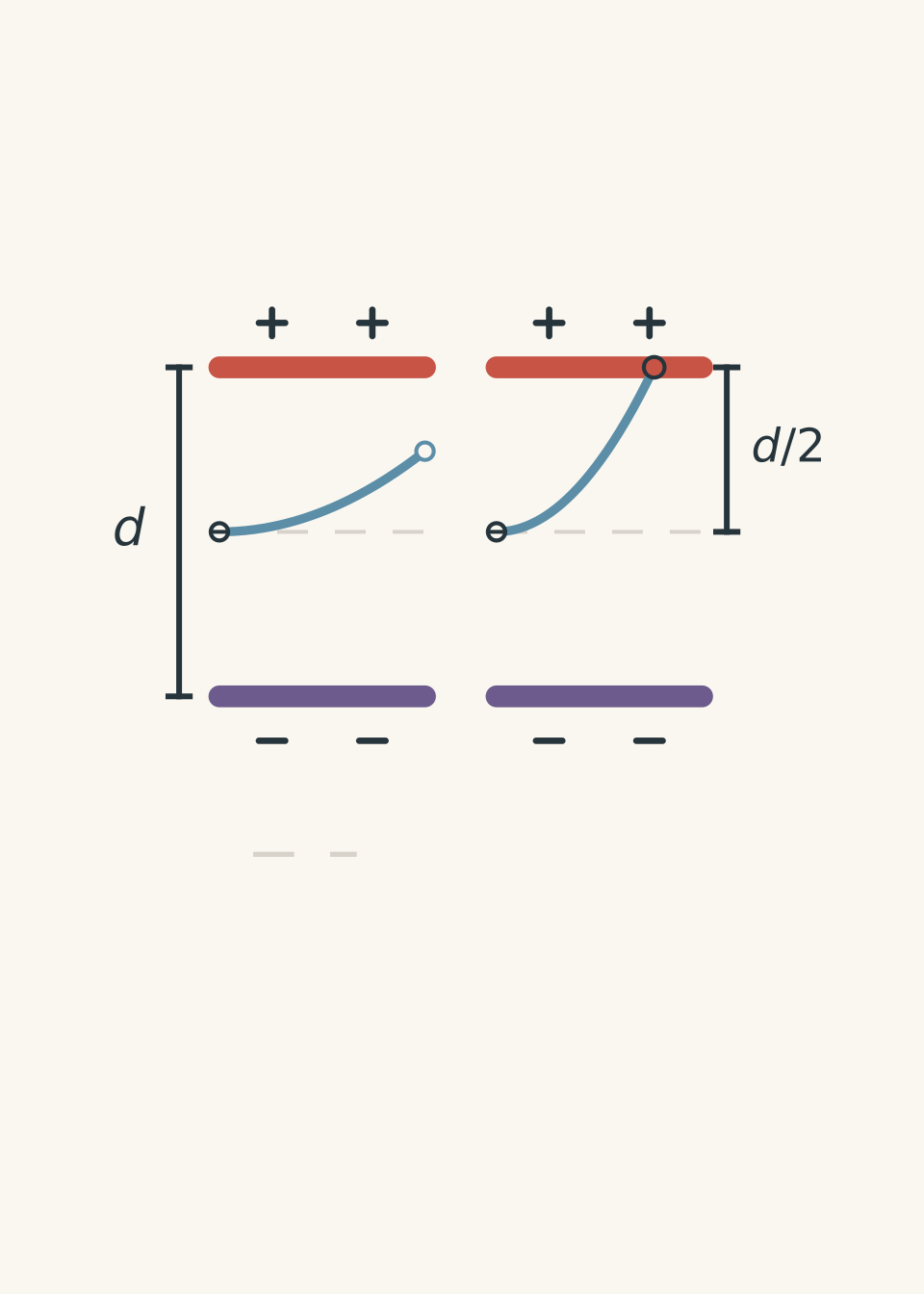
For a particle starting halfway between plates, entering horizontally, and experiencing constant vertical acceleration in one direction, compare the predicted exit displacement with half the plate separation:
\[ |y_{\text{exit}}|<\frac d2 \]
If the predicted displacement is larger, the particle hits a plate before reaching the exit. Equality means it reaches the plate at the exit.
This simple test works because the vertical displacement grows continuously towards one plate. If the particle has an initial vertical velocity or the field reverses, it may turn around inside the gap. In those cases, check its greatest and smallest vertical positions, not just its exit position.
Check whether the entry speed is actually fixed
At a fixed electric field, plate length, mass, and charge magnitude, doubling horizontal entry speed reduces the exit deflection to one-quarter.
But sometimes the particle’s entry speed is produced by an accelerating voltage. Then speed isn’t independent of charge and mass.
If a particle starts from rest and gains kinetic energy from a potential difference of magnitude \(V_a\), the electrical work becomes kinetic energy:
\[ |q|V_a=\frac12mu_x^2 \]
Here, \(V_a\) is the accelerating potential difference in volts, and \(\frac12mu_x^2\) is the kinetic energy in joules (J). This assumes the particle enters the next region horizontally and the accelerating field has supplied all its kinetic energy.
That relationship connects motion in electric fields with electric potential energy and work.
It’s especially important when comparing particles with different masses or charges.
05Questions and solutions
Question 1
A positively charged ion with charge \(+1.60\times10^{-19}\ \mathrm C\) and mass \(4.00\times10^{-26}\ \mathrm{kg}\) enters a uniform electric field travelling horizontally at \(1.0\times10^6\ \mathrm{m\\,s^{-1}}\).
The electric field has magnitude \(5.0\times10^3\ \mathrm{N\\,C^{-1}}\) and points vertically downwards.
Calculate the ion’s electric force, acceleration, and vertical velocity after \(2.0\ \mathrm{ns}\), where \(1\ \mathrm{ns}=10^{-9}\ \mathrm s\). State what happens to its horizontal velocity.
Solution 1
The ion experiences a downward force of \(8.0\times10^{-16}\ \mathrm N\), accelerates downwards at \(2.0\times10^{10}\ \mathrm{m\\,s^{-2}}\), and reaches a downward vertical velocity of \(40\ \mathrm{m\\,s^{-1}}\). Its horizontal velocity stays unchanged.
Because its charge is positive, the force acts along the downward electric field.
Taking upwards as positive,
\[ \begin{aligned} F_y&=qE_y\\\ &=(1.60\times10^{-19})(-5.0\times10^3)\\\ &=-8.0\times10^{-16}\ \mathrm N\\\\[4pt] a_y&=\frac{F_y}{m}\\\ &=\frac{-8.0\times10^{-16}}{4.00\times10^{-26}}\\\ &=-2.0\times10^{10}\ \mathrm{m\\,s^{-2}} \end{aligned} \]
Its initial vertical velocity is zero, so after \(2.0\times10^{-9}\ \mathrm s\),
\[ \begin{aligned} v_y&=u_{y0}+a_yt\\\ &=0+(-2.0\times10^{10})(2.0\times10^{-9})\\\ &=-40\ \mathrm{m\\,s^{-1}} \end{aligned} \]
The negative sign represents downward motion.
The horizontal velocity remains \(1.0\times10^6\ \mathrm{m\\,s^{-1}}\), since there is no horizontal force.
The important distinction is that the downward force adds downward velocity; it doesn’t remove the ion’s existing horizontal velocity.
Question 2
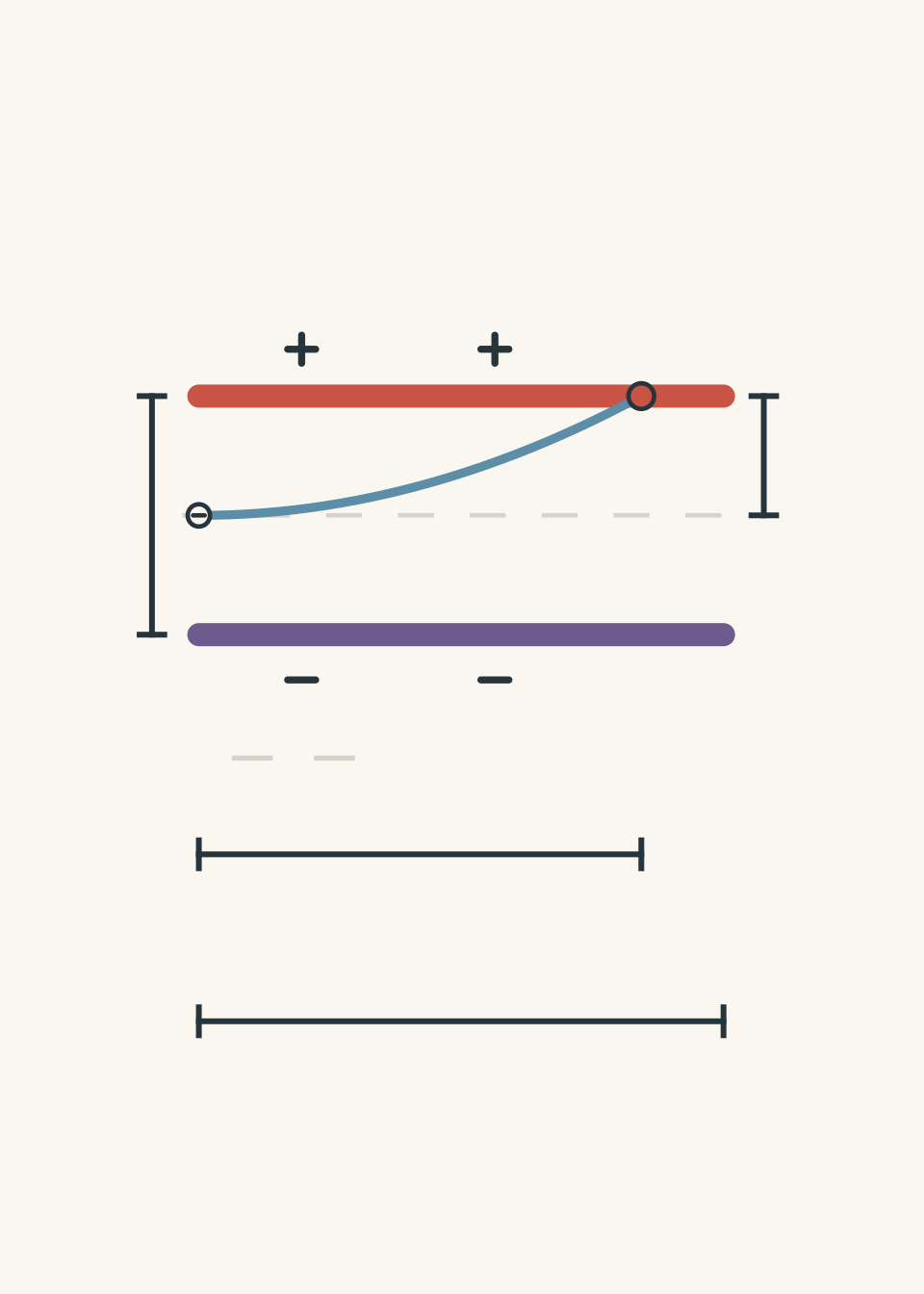
An electron enters horizontally through the centre of two parallel plates. The upper plate is positive, and the lower plate is negative.
The plates are \(6.0\ \mathrm{cm}\) long and separated by \(6.0\ \mathrm{mm}\). The uniform electric field magnitude is \(3.0\times10^3\ \mathrm{N\\,C^{-1}}\). The electron’s horizontal entry speed is \(1.5\times10^7\ \mathrm{m\\,s^{-1}}\).
A student calculates the electron’s vertical displacement at the end of the plates and uses it to predict a screen position.
Determine whether the electron actually reaches the plate exit. If not, calculate the horizontal distance from the entrance at which it first hits a plate.
Use the electron charge and mass from the first worked example.
Solution 2
The electron doesn’t reach the exit. It strikes the upper, positive plate approximately \(5.1\ \mathrm{cm}\) from the entrance, before the end of the \(6.0\ \mathrm{cm}\) plates.
The electron is negatively charged, so its acceleration is upwards, opposite to the downward electric field.
The magnitude of that acceleration is
\[ \begin{aligned} a&=\frac{|q|E}{m_e}\\\ &=\frac{(1.60\times10^{-19})(3.0\times10^3)} {9.11\times10^{-31}}\\\ &=5.27\times10^{14}\ \mathrm{m\\,s^{-2}} \end{aligned} \]
First, calculate how far it would move vertically if it travelled the full plate length:
\[ \begin{aligned} t_{\text{full}}&=\frac{0.060}{1.5\times10^7} =4.0\times10^{-9}\ \mathrm s\\\\[4pt] y_{\text{predicted}} &=\frac12(5.27\times10^{14})(4.0\times10^{-9})^2\\\ &=4.22\times10^{-3}\ \mathrm m\\\ &=4.22\ \mathrm{mm} \end{aligned} \]
But the plates are only \(6.0\ \mathrm{mm}\) apart, and the electron begins halfway between them. The upper plate is just \(3.0\ \mathrm{mm}\) above its starting position.
The predicted \(4.22\ \mathrm{mm}\) displacement is impossible without passing through the plate.
We therefore find the time taken to travel upwards by \(3.0\ \mathrm{mm}\):
\[ \begin{aligned} y&=\frac12at^2\\\ t&=\sqrt{\frac{2y}{a}}\\\ &=\sqrt{\frac{2(3.0\times10^{-3})}{5.27\times10^{14}}}\\\ &=3.37\times10^{-9}\ \mathrm s \end{aligned} \]
The horizontal distance travelled in that time is
\[ \begin{aligned} x&=u_xt\\\ &=(1.5\times10^7)(3.37\times10^{-9})\\\ &=0.0506\ \mathrm m\\\ &=5.06\ \mathrm{cm} \end{aligned} \]
So the electron hits the upper plate at about \(5.1\ \mathrm{cm}\).
The tempting mistake is treating \(x=L\) as a guaranteed final position. The motion equations predict where the electron would be if the field continued without obstruction, but the physical plate ends its free flight earlier.
No screen-impact calculation based on a freely exiting electron is valid here.
Question 3
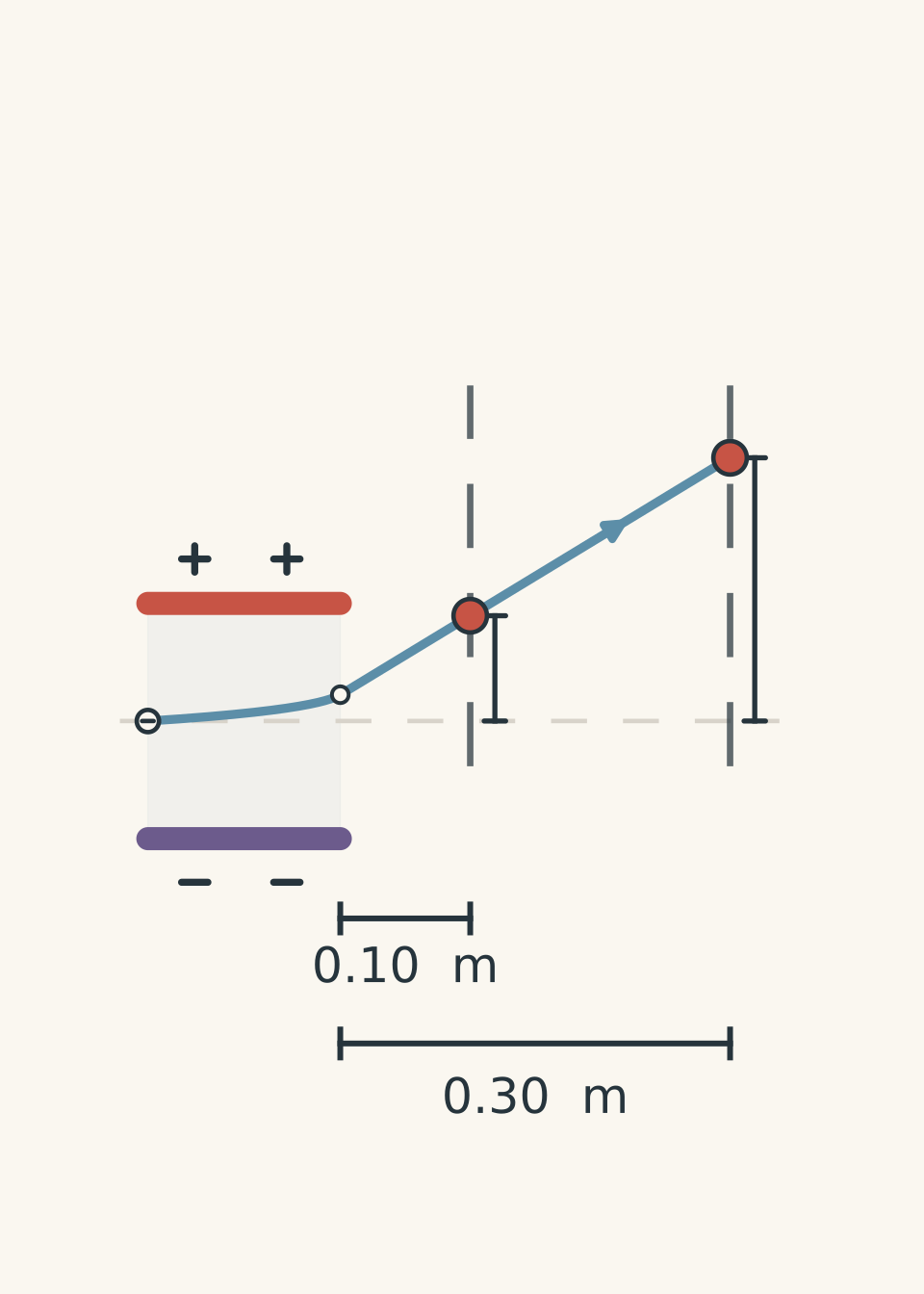
An electron enters a uniform electric field between two horizontal plates. The upper plate is positive and the lower plate negative.
The plate length is \(4.0\ \mathrm{cm}\), the separation is \(2.0\ \mathrm{cm}\), and the electron’s horizontal velocity component is \(2.0\times10^7\ \mathrm{m\\,s^{-1}}\).
Its initial vertical velocity is unknown.
In two otherwise identical trials, a detection screen is placed at different horizontal distances beyond the plate exit:
| Distance from plate exit | Impact above original centreline |
|---|---|
| \(0.10\ \mathrm m\) | \(4.0\ \mathrm{mm}\) |
| \(0.30\ \mathrm m\) | \(10.0\ \mathrm{mm}\) |
Assume the field is uniform between the plates and zero outside.
Determine the electron’s vertical velocity when it entered the plates and the electric field magnitude. Verify that it didn’t hit either plate.
Solution 3
The electron entered with an upward vertical velocity of \(4.0\times10^5\ \mathrm{m\\,s^{-1}}\). The field magnitude is approximately \(5.7\times10^2\ \mathrm{N\\,C^{-1}}\), directed downwards. The electron clears the plates.
The key is that the two screen positions let us reconstruct the electron’s velocity and position at the plate exit, without assuming it entered horizontally.
First, determine the trajectory after the plates.
The vertical impact height increases by
\[ 10.0-4.0=6.0\ \mathrm{mm} \]
when the screen moves another
\[ 0.30-0.10=0.20\ \mathrm m \]
horizontally.
Because the path outside the field is straight, its slope is
\[ \begin{aligned} \frac{v_{y,\text{exit}}}{u_x} &=\frac{\Delta y}{\Delta x}\\\ &=\frac{0.0060}{0.20}\\\ &=0.030 \end{aligned} \]
Therefore,
\[ \begin{aligned} v_{y,\text{exit}} &=0.030(2.0\times10^7)\\\ &=+6.0\times10^5\ \mathrm{m\\,s^{-1}} \end{aligned} \]
The exit velocity has an upward vertical component.
Next, find the exit height.
The straight path rises by \(0.030\ \mathrm m\) for each metre travelled horizontally.
At the first screen, it is \(4.0\ \mathrm{mm}\) above the original centreline. Moving backwards \(0.10\ \mathrm m\) to the exit gives
\[ \begin{aligned} y_{\text{exit}} &=0.0040-(0.030)(0.10)\\\ &=0.0010\ \mathrm m\\\ &=+1.0\ \mathrm{mm} \end{aligned} \]
Now reconstruct the motion inside the field.
The electron spends
\[ t=\frac{0.040}{2.0\times10^7} =2.0\times10^{-9}\ \mathrm s \]
inside the plates.
Under constant acceleration, average vertical velocity equals the mean of initial and final vertical velocities:
\[ y_{\text{exit}}= \frac{u_{y0}+v_{y,\text{exit}}}{2}t \]
Rearrange:
\[ \begin{aligned} u_{y0} &=\frac{2y_{\text{exit}}}{t}-v_{y,\text{exit}}\\\ &=\frac{2(0.0010)}{2.0\times10^{-9}}-6.0\times10^5\\\ &=+4.0\times10^5\ \mathrm{m\\,s^{-1}} \end{aligned} \]
The electron was already travelling upwards when it entered.
Calculate the acceleration and field.
\[ \begin{aligned} a_y&=\frac{v_{y,\text{exit}}-u_{y0}}{t}\\\ &=\frac{6.0\times10^5-4.0\times10^5} {2.0\times10^{-9}}\\\ &=+1.0\times10^{14}\ \mathrm{m\\,s^{-2}} \end{aligned} \]
Using the magnitudes of the electron’s charge and mass,
\[ \begin{aligned} E&=\frac{m_ea}{|q_e|}\\\ &=\frac{(9.11\times10^{-31})(1.0\times10^{14})} {1.60\times10^{-19}}\\\ &=5.69\times10^2\ \mathrm{N\\,C^{-1}} \end{aligned} \]
The field points downwards because the negatively charged electron accelerates upwards.
Finally, check clearance.
The electron begins at the centre of a \(20\ \mathrm{mm}\) gap. It is already moving upwards and continues accelerating upwards, so its greatest height inside the gap is at the exit.
That height is only \(1.0\ \mathrm{mm}\), compared with \(10\ \mathrm{mm}\) available above the centreline. It clears the plates.
A tempting approach is to assume the electron entered horizontally and calculate its acceleration from its exit velocity alone. But that assumption would predict a different exit displacement and contradict the two screen measurements.
The measurements provide enough information to reveal the earlier state of motion.
Question 4
An electron enters horizontally through the centre of two parallel plates of length \(L\) and separation \(d\).
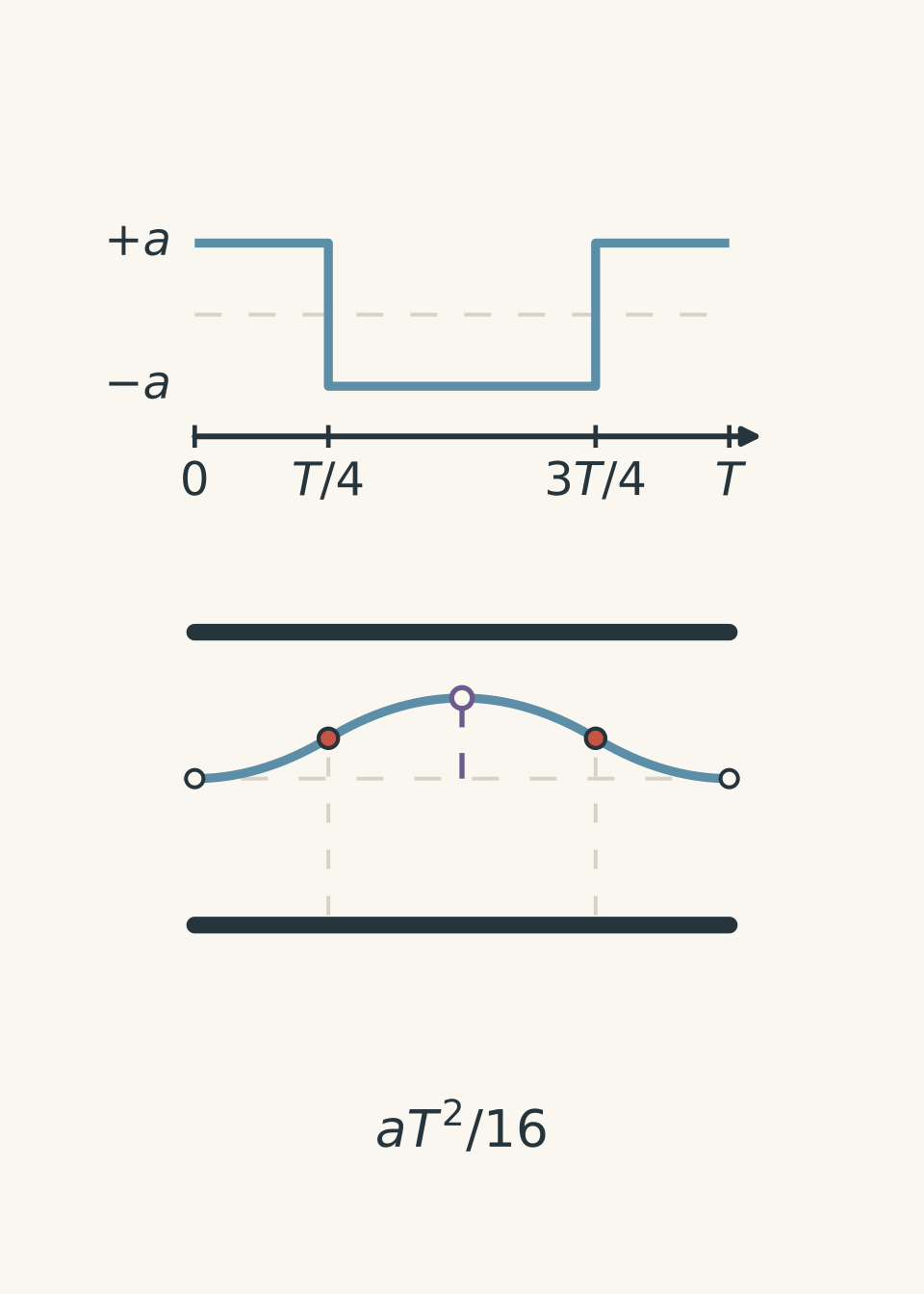
An electrical controller can reverse the plate polarity while the electron is inside. Initially, the electron accelerates upwards with magnitude \(a\). After a reversal, it accelerates downwards with the same magnitude. The controller can reverse the polarity again.
The electron’s horizontal velocity \(u_x\) remains constant, so its total time inside the plates is \(T=L/u_x\).
A tiny aperture lies on the original centreline immediately after the plates. A second aperture lies on the same centreline, farther downstream.
Assume the electric field is zero outside the plates, polarity changes are instantaneous, and any effects during switching can be ignored.
(a) Prove that a single polarity reversal cannot make the electron pass through both aperture centres.
(b) Find two polarity-reversal times, measured from when the electron enters, that allow it to pass through both centres.
(c) Determine the maximum vertical displacement during this motion, and derive the condition on \(d\) required to avoid hitting a plate.
Solution 4
One polarity reversal is insufficient. Two reversals at \(T/4\) and \(3T/4\) allow the electron to leave on the centreline with zero vertical velocity. Its maximum upward displacement is \(aT^2/16\), so the plate separation must satisfy \(d>aT^2/8\).
The important insight is that returning to the original position isn’t the same as returning to the original velocity.
Part (a): Why one reversal fails
To pass through both apertures, the electron must satisfy two conditions at the exit:
\[ y(T)=0,\qquad v_y(T)=0 \]
The first puts it at the centre of the exit aperture. The second ensures that it continues horizontally through the downstream aperture.
Suppose the field initially produces acceleration \(+a\) and is reversed once, at time \(t_s\).
Its final vertical velocity is
\[ \begin{aligned} v_y(T)&=at_s-a(T-t_s)\\\ &=a(2t_s-T) \end{aligned} \]
For this to equal zero,
\[ t_s=\frac T2 \]
So the electron must accelerate upwards for the first half and downwards for the second half.
But what happens to its position?
In the first half,
\[ y_1=\frac12a\left(\frac T2\right)^2 =\frac{aT^2}{8} \]
Its vertical velocity at that point is \(aT/2\).
During the second half, the electron initially continues upwards while decelerating. The displacement in that half is
\[ \begin{aligned} y_2&=\left(\frac{aT}{2}\right)\left(\frac T2\right) -\frac12a\left(\frac T2\right)^2\\\ &=\frac{aT^2}{8} \end{aligned} \]
Therefore,
\[ y(T)=y_1+y_2=\frac{aT^2}{4} \]
Its vertical velocity is zero, but it is still above the centreline. It misses the first aperture.
Could we instead change the switching time to make the exit displacement zero?
For one reversal, the displacement at time \(T\) is
\[ y(T)=\frac12aT^2-a(T-t_s)^2 \]
Setting this equal to zero gives the valid switching time
\[ t_s=T\left(1-\frac1{\sqrt2}\right) \]
But its final vertical velocity would then be
\[ v_y(T)=aT(1-\sqrt2) \]
which is negative, not zero.
It would pass through the first aperture travelling downwards and miss the second.
So one reversal cannot satisfy both conditions.
Part (b): Find two reversals
Now let the acceleration follow this sequence:
- \(+a\) from \(0\) to \(t_1\).
- \(-a\) from \(t_1\) to \(t_2\).
- \(+a\) from \(t_2\) to \(T\).
The final vertical velocity is
\[ \begin{aligned} v_y(T)&=at_1-a(t_2-t_1)+a(T-t_2)\\\ &=a[T-2(t_2-t_1)] \end{aligned} \]
For zero final vertical velocity,
\[ t_2-t_1=\frac T2 \]
The downward-acceleration interval must last half the total time.
Now impose the displacement condition.
A useful way to calculate the displacement is to start with acceleration \(+a\) for the whole time, then subtract the effect of changing the acceleration to \(-a\) between \(t_1\) and \(t_2\).
This gives
\[ y(T)=\frac12aT^2-a\left[(T-t_1)^2-(T-t_2)^2\right] \]
Using \(t_2=t_1+T/2\), it simplifies to
\[ y(T)=aT\left(t_1-\frac T4\right) \]
For \(y(T)=0\),
\[ t_1=\frac T4 \]
Therefore,
\[ t_2=\frac T4+\frac T2=\frac{3T}{4} \]
The required sequence is:
\[ \boxed{+a\ \text{for }T/4,\quad -a\ \text{for }T/2,\quad +a\ \text{for }T/4} \]
The electron returns to the centreline with zero vertical velocity. Beyond the plates, it travels horizontally through both apertures.
Part (c): Check the maximum displacement
The electron travels upwards initially.
After the first reversal at \(T/4\), it begins accelerating downwards, but still has upward velocity. That velocity reaches zero at \(T/2\).
Therefore, its highest position occurs at \(T/2\).
The displacement during the first quarter is
\[ y_1=\frac12a\left(\frac T4\right)^2 =\frac{aT^2}{32} \]
During the next quarter,
\[ \begin{aligned} y_2&=\left(\frac{aT}{4}\right)\left(\frac T4\right) -\frac12a\left(\frac T4\right)^2\\\ &=\frac{aT^2}{32} \end{aligned} \]
Thus,
\[ y_{\max}=\frac{aT^2}{16} \]
The upper plate is \(d/2\) above the centreline. To avoid contact,
\[ \begin{aligned} \frac{aT^2}{16}&<\frac d2\\\ d&>\frac{aT^2}{8} \end{aligned} \]
The electron never travels below the centreline in this two-reversal motion, so the upper plate determines the clearance requirement.
This problem exposes a subtle difference between cancelling acceleration, cancelling velocity, and cancelling displacement. Reversing a force doesn’t automatically undo everything the earlier force has done.
Question 5
Two different positive ions are accelerated from rest through the same potential difference before entering a region of uniform electric field.
Ion A has charge \(+e\) and mass \(m\).
Ion B has charge \(+2e\) and mass \(4m\).
Here, \(e\) is the magnitude of the elementary charge, and \(m\) is the mass of Ion A.
The accelerating potential difference is \(V_a=2000\ \mathrm V\).
Both ions then enter horizontally through the centre of identical deflecting plates with:
- Plate length \(L=4.0\ \mathrm{cm}\)
- Plate separation \(d=1.0\ \mathrm{cm}\)
- Deflecting potential difference \(V_d=100\ \mathrm V\), with the upper plate positive
- A detection screen located \(D=20\ \mathrm{cm}\) beyond the plate exit
Assume ideal uniform transverse fields, negligible fields outside the plates, no particle interactions, and non-relativistic motion.
A student argues that Ion B must bend less than Ion A because its mass is four times greater, while its charge is only twice as large.
(a) Determine whether the ions hit different positions on the screen. Calculate each ion’s displacement at the plate exit and screen.
(b) Derive the condition on the ratio \(V_d/V_a\) that allows both ions to clear the plates.
(c) The operator doubles both the accelerating voltage and the deflecting voltage. Determine what changes about the trajectories and compare the ions’ times inside the plates.
(d) The operator then proposes adding a second region of uniform transverse electric field, with any fixed strength and length, to separate the ions by their screen positions. Explain whether this can work under the same idealisations.
Solution 5
The ions follow identical spatial trajectories, despite having different masses, charges, accelerations, and speeds. Both leave the plates \(2.0\ \mathrm{mm}\) below the centreline and strike the screen \(22\ \mathrm{mm}\) below it. Neither hits a plate. Doubling both voltages doesn’t change their paths, and another ideal transverse electric deflector cannot separate them by position.
The surprising constraint is that the ions don’t enter with the same speed. Their speeds are determined by the same accelerating voltage.
Part (a): Compare the trajectories
Start with the energy gained during acceleration.
For a positive ion starting from rest,
\[ qV_a=\frac12mu_x^2 \]
Rearranging,
\[ u_x^2=\frac{2qV_a}{m} \]
For Ion A,
\[ u_{x,A}^2=\frac{2eV_a}{m} \]
For Ion B,
\[ \begin{aligned} u_{x,B}^2&=\frac{2(2e)V_a}{4m}\\\ &=\frac12u_{x,A}^2 \end{aligned} \]
Therefore,
\[ u_{x,B}=\frac{u_{x,A}}{\sqrt2} \]
Ion B enters more slowly.
Now look at the electric acceleration between the deflecting plates.
Since
\[ E=\frac{V_d}{d} \]
the magnitude of its acceleration is
\[ a=\frac{qV_d}{md} \]
Ion B’s acceleration is half Ion A’s acceleration. But because Ion B moves more slowly horizontally, it spends \(\sqrt2\) times as long in the field.
Vertical displacement depends on acceleration multiplied by time squared.
Let’s combine those effects:
\[ \begin{aligned} |y_{\text{exit}}| &=\frac12\left(\frac{qV_d}{md}\right) \left(\frac{L}{u_x}\right)^2\\\\[4pt] &=\frac{qV_dL^2}{2md\\,u_x^2} \end{aligned} \]
Substitute \(u_x^2=2qV_a/m\):
\[ \begin{aligned} |y_{\text{exit}}| &=\frac{qV_dL^2}{2md(2qV_a/m)}\\\ &=\frac{V_dL^2}{4dV_a} \end{aligned} \]
The charge \(q\) and mass \(m\) have cancelled.
This means both positive ions have the same displacement when accelerated from rest through the same voltage and passed through this deflector.
Substituting the given values,
\[ \begin{aligned} |y_{\text{exit}}| &=\frac{(100)(0.040)^2} {4(0.010)(2000)}\\\ &=0.0020\ \mathrm m\\\ &=2.0\ \mathrm{mm} \end{aligned} \]
Both ions move downwards because they’re positively charged and the deflecting field points downwards.
Now calculate the screen displacement.
The magnitude of the slope at the exit is
\[ \begin{aligned} \left|\frac{v_{y,\text{exit}}}{u_x}\right| &=\frac{qV_dL}{md\\,u_x^2}\\\ &=\frac{V_dL}{2dV_a}\\\ &=\frac{(100)(0.040)}{2(0.010)(2000)}\\\ &=0.10 \end{aligned} \]
Both ions leave at the same angle.
The additional vertical distance travelled before the screen is
\[ \Delta y=0.10(0.20)=0.020\ \mathrm m \]
Adding the displacement acquired inside the plates,
\[ \begin{aligned} |y_{\text{screen}}| &=0.0020+0.020\\\ &=0.022\ \mathrm m\\\ &=22\ \mathrm{mm} \end{aligned} \]
Both ions land at the same spot, \(22\ \mathrm{mm}\) below the original centreline.
Part (b): Derive the plate-clearance condition
Because both ions enter horizontally from the centre, their downward displacement increases continuously while they’re between the plates.
To clear the lower plate,
\[ |y_{\text{exit}}|<\frac d2 \]
Substituting the expression just derived,
\[ \begin{aligned} \frac{V_dL^2}{4dV_a}&<\frac d2\\\ \frac{V_d}{V_a}&<\frac{2d^2}{L^2} \end{aligned} \]
This condition is independent of the ion’s charge and mass.
For the given apparatus,
\[ \begin{aligned} \frac{2d^2}{L^2} &=\frac{2(0.010)^2}{(0.040)^2}\\\ &=0.125 \end{aligned} \]
The actual voltage ratio is
\[ \frac{V_d}{V_a}=\frac{100}{2000}=0.050 \]
Since \(0.050<0.125\), both ions clear the lower plate.
Their \(2.0\ \mathrm{mm}\) downward deflection is also less than the available \(5.0\ \mathrm{mm}\) half-gap.
Part (c): Double both voltages
Doubling the deflecting voltage doubles the electric field and the force on each ion.
It would be tempting to conclude that the ions now bend twice as much.
But doubling the accelerating voltage also increases their horizontal speeds by a factor of \(\sqrt2\), since
\[ u_x^2=\frac{2qV_a}{m} \]
Their times inside the plates decrease by a factor of \(1/\sqrt2\).
Because displacement is proportional to acceleration times time squared, the doubled acceleration is exactly cancelled by the halved value of time squared.
Equivalently, the displacement formula depends only on the voltage ratio:
\[ |y_{\text{exit}}|=\frac{V_dL^2}{4dV_a} \]
Both voltages double, so the ratio stays unchanged.
The screen displacement and plate-clearance condition also remain unchanged.
The ions still differ in how long they spend inside the plates. Since Ion B’s horizontal speed is \(u_{x,A}/\sqrt2\),
\[ \frac{t_B}{t_A}=\sqrt2 \]
Ion B takes \(\sqrt2\) times as long to cross the plates. After both voltages are doubled, each ion’s crossing time becomes \(1/\sqrt2\) of its previous value, but the ratio between their times remains \(\sqrt2\).
Identical trajectories don’t imply identical velocities or travel times.
Part (d): Can another electric deflector separate them?
No. Under the stated idealisations, a second purely transverse electric field also produces identical changes to their spatial trajectories.
To see why, consider another uniform field region of horizontal length \(\ell\), with vertical field component \(E_{2y}\).
The change in vertical velocity is
\[ \Delta v_y=\frac{qE_{2y}}{m}\frac{\ell}{u_x} \]
Divide by the horizontal velocity to find the change in the trajectory’s slope:
\[ \begin{aligned} \Delta\left(\frac{v_y}{u_x}\right) &=\frac{qE_{2y}\ell}{mu_x^2}\\\ &=\frac{E_{2y}\ell}{2V_a} \end{aligned} \]
Again, charge and mass cancel.
Both ions enter the second region with the same position and trajectory slope. They also acquire the same additional change in slope and displacement as functions of horizontal distance.
So adding another ideal transverse electric deflector won’t separate their beam spots.
The student’s original prediction considered mass and force but overlooked the time spent accelerating. Greater mass reduces acceleration, yet the lower horizontal speed increases the time available for the field to act. Because both speeds came from the same accelerating voltage, those effects cancel exactly in the spatial trajectory.
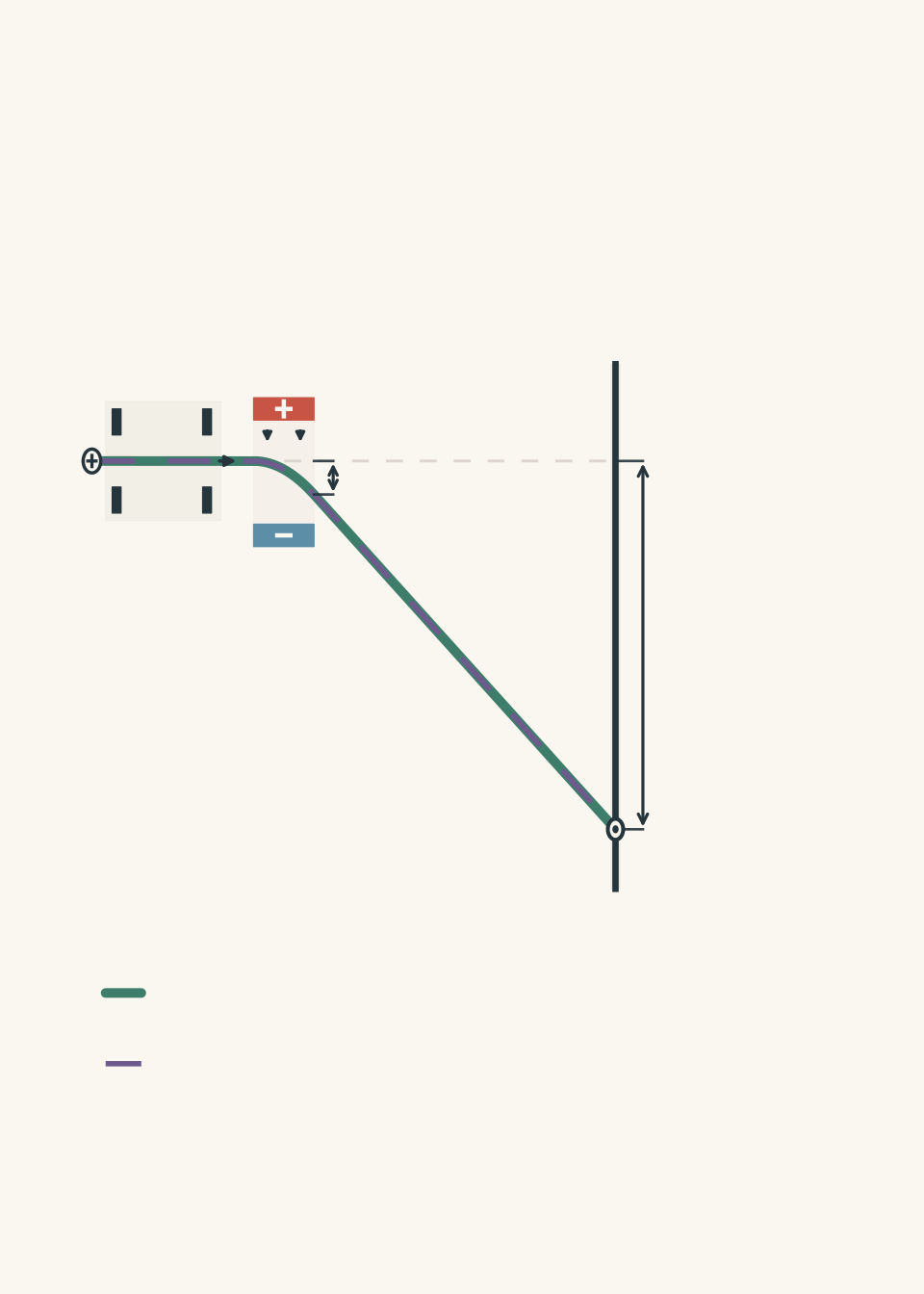
This is also the limitation of using an electric field alone to separate ions by mass when their entry speeds come from the same accelerating voltage.
A magnetic field introduces a different relationship: its force on a moving charge depends on the particle’s velocity as well as its charge. That changes how particles curve and makes it possible to distinguish ions with different mass-to-charge ratios.
The next useful question is no longer just which way does the particle accelerate? It’s how do electric and magnetic forces produce different trajectories for particles that enter the fields with different speeds?