
Final Velocity of a Projectile: HSC Physics Guide
Learn how to recombine horizontal and vertical velocity components to find a projectile's final speed and direction, with worked HSC-style examples.
A projectile is about to hit the ground. At that instant, it is moving at \(17.3\text{ m s}^{-1}\) to the right and \(9.6\text{ m s}^{-1}\) downward. What is its final velocity?
A tempting answer is \(17.3-9.6=7.7\text{ m s}^{-1}\). But those two numbers describe motion in perpendicular directions, so ordinary addition does not work. The actual velocity is diagonal.
Before reading on, predict this: should the final speed be smaller than \(17.3\text{ m s}^{-1}\), equal to it, or larger?
It must be larger. The projectile has horizontal motion and vertical motion at the same time. Recombining those components is the last step in many HSC projectile questions.
01From two components to one velocity
Suppose we choose right as positive \(x\) and up as positive \(y\).
A projectile’s velocity can then be written using two components:
- \(v_x\): the horizontal velocity component, in \(\text{m s}^{-1}\)
- \(v_y\): the vertical velocity component, in \(\text{m s}^{-1}\)
If the projectile is moving right and downward, \(v_x\) is positive and \(v_y\) is negative.
For example,
\[ v_x=17.3\text{ m s}^{-1}, \qquad v_y=-9.6\text{ m s}^{-1} \]
does not mean one velocity is fighting the other. Both components describe the same motion.
Picture a rectangle. \(v_x\) is its horizontal side, \(v_y\) is its vertical side, and the actual velocity vector is the diagonal.
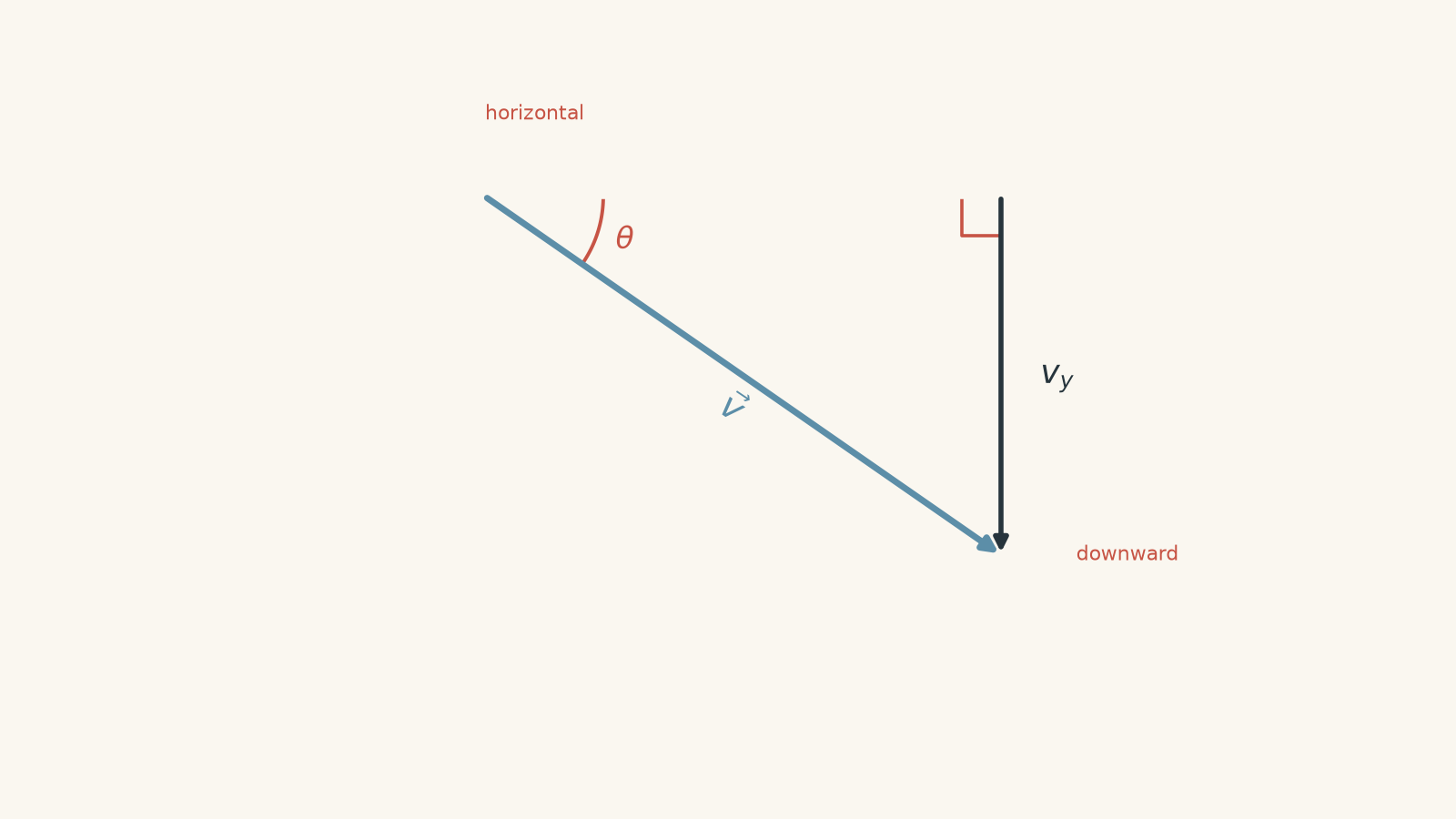
Because the components are perpendicular, the speed \(v\), which is the magnitude of the velocity vector, comes from Pythagoras:
\[ v=\sqrt{v_x^2+v_y^2} \]
The negative sign on a downward \(v_y\) disappears when it is squared. That makes sense: speed is a magnitude, so it cannot be negative.
The direction comes from trigonometry. If the projectile is travelling to the right,
\[ \theta=\tan^{-1}\left(\frac{|v_y|}{v_x}\right) \]
where \(\theta\) is the angle above or below the horizontal.
The absolute value \(|v_y|\) gives the size of the vertical component. You then use the sign of \(v_y\) to state whether the direction is above or below horizontal.
So if \(v_y<0\), say something like:
\(29^\circ\) below the horizontal.
Do not throw away the sign before deciding the direction.
02Where the final components come from
Recombining the components is usually the final step, not the whole projectile calculation.
Under the standard HSC projectile model, with negligible air resistance:
\[ a_x=0 \]
so the horizontal velocity stays constant:
\[ v_x=u_x \]
Here \(u_x\) is the initial horizontal velocity component.
Vertically,
\[ a_y=-g \]
where \(g=9.8\text{ m s}^{-2}\), if upward is positive.
Therefore,
\[ v_y=u_y-gt \]
where:
- \(u_y\) is the initial vertical velocity component
- \(t\) is the elapsed time in seconds
- \(v_y\) is the vertical velocity after that time
If you need a refresher on turning an initial launch speed and angle into \(u_x\) and \(u_y\), see Projectile Initial Velocity Components for HSC Physics.
A useful decision table is:
| Information you have | Useful step |
|---|---|
| \(v_x\) and \(v_y\) | Recombine directly using Pythagoras and trigonometry |
| Initial velocity and time | Find \(v_x=u_x\) and \(v_y=u_y-gt\) |
| Initial vertical velocity and vertical displacement | Use \(v_y^2=u_y^2+2a_y\Delta y\) |
| Flight ends at the same height as launch | Under the ideal model, \(v_y=-u_y\) at landing |
| Flight time is unknown | Find the time first, then calculate the final components |
One important detail: “final velocity” does not automatically mean “velocity when it hits the ground”. It means the velocity at the end of the interval you are analysing.
Worked example: Recombine the components after 2.0 seconds
A projectile is launched at \(20.0\text{ m s}^{-1}\) at \(30^\circ\) above the horizontal. Find its velocity \(2.0\text{ s}\) after launch. Ignore air resistance and use \(g=9.8\text{ m s}^{-2}\).
Step 1
\[ \begin{aligned} u_x&=u\cos\theta\\ &=(20.0)\cos30^\circ\\ &=17.3\text{ m s}^{-1} \end{aligned} \]
and
\[ \begin{aligned} u_y&=u\sin\theta\\ &=(20.0)\sin30^\circ\\ &=10.0\text{ m s}^{-1} \end{aligned} \]
So initially the projectile moves right at \(17.3\text{ m s}^{-1}\) and upward at \(10.0\text{ m s}^{-1}\).
Step 2
There is no horizontal acceleration in the model, so
\[ v_x=u_x=17.3\text{ m s}^{-1} \]
Step 3
Taking upward as positive,
\[ \begin{aligned} v_y&=u_y+a_yt\\ &=10.0+(-9.8)(2.0)\\ &=-9.6\text{ m s}^{-1} \end{aligned} \]
The negative result tells us the projectile is moving downward after \(2.0\text{ s}\).
Step 4
\[ \begin{aligned} v&=\sqrt{v_x^2+v_y^2}\\ &=\sqrt{(17.3)^2+(-9.6)^2}\\ &=19.8\text{ m s}^{-1} \end{aligned} \]
Step 5
\[ \begin{aligned} \theta&=\tan^{-1}\left(\frac{9.6}{17.3}\right)\\ &=29.0^\circ \end{aligned} \]
Therefore, the velocity after \(2.0\text{ s}\) is approximately
\[ 19.8\text{ m s}^{-1}\text{ at }29.0^\circ\text{ below the horizontal.} \]
Notice that the speed is close to the original \(20.0\text{ m s}^{-1}\), but that is not a general rule. Here the projectile happens to have nearly returned to its original height.
03The sign of \(v_y\) does a lot of work
Suppose your calculator gives
\[ v_y=-14\text{ m s}^{-1}. \]
The \(14\) tells you how strongly the velocity points vertically. The negative sign tells you that it points downward.
Students sometimes substitute \(-14\) directly into
\[ \tan^{-1}\left(\frac{v_y}{v_x}\right) \]
and obtain a negative angle. The calculator is not wrong. An angle of \(-35^\circ\), for example, means \(35^\circ\) below the positive horizontal axis.
In an HSC response, it is usually clearer to state the magnitude of the angle and then give the direction in words:
\[ 35^\circ\text{ below the horizontal.} \]
A quick sketch is safer than trying to make your calculator decide the physical direction for you.
04You do not always need the flight time
Suppose a projectile lands below its launch point. You might think you must calculate the time of flight before finding the final velocity.
Sometimes you do. But if the vertical displacement is known, this equation can go directly from the initial vertical component to the final one:
\[ v_y^2=u_y^2+2a_y\Delta y \]
There is a catch. Squaring loses the sign of \(v_y\). After taking the square root, you must decide from the physical situation whether \(v_y\) is positive or negative.
At impact, if the projectile is descending, choose the negative root.
Worked example: Landing below the launch point
A ball is launched from a ledge at \(24.0\text{ m s}^{-1}\), \(40^\circ\) above the horizontal. It lands \(15.0\text{ m}\) below its launch point. Find its velocity immediately before impact. Ignore air resistance.
Step 1
\[ \begin{aligned} u_x&=(24.0)\cos40^\circ\\ &=18.4\text{ m s}^{-1} \end{aligned} \]
\[ \begin{aligned} u_y&=(24.0)\sin40^\circ\\ &=15.4\text{ m s}^{-1} \end{aligned} \]
Step 2
Horizontal velocity remains constant:
\[ v_x=18.4\text{ m s}^{-1} \]
Step 3
Take upward as positive. The landing point is \(15.0\text{ m}\) lower, so
\[ \Delta y=-15.0\text{ m} \]
and
\[ a_y=-9.8\text{ m s}^{-2}. \]
Therefore,
\[ \begin{aligned} v_y^2&=u_y^2+2a_y\Delta y\\ &=(15.4)^2+2(-9.8)(-15.0)\\ &\approx532 \end{aligned} \]
so
\[ v_y=\pm23.1\text{ m s}^{-1}. \]
Which sign should we choose?
The ball is hitting a point below its launch position, so it must be descending immediately before impact. Therefore,
\[ v_y=-23.1\text{ m s}^{-1}. \]
Step 4
\[ \begin{aligned} v&=\sqrt{(18.4)^2+(-23.1)^2}\\ &=29.5\text{ m s}^{-1} \end{aligned} \]
Step 5
\[ \begin{aligned} \theta&=\tan^{-1}\left(\frac{23.1}{18.4}\right)\\ &=51.4^\circ \end{aligned} \]
The impact velocity is therefore approximately
\[ 29.5\text{ m s}^{-1}\text{ at }51.4^\circ\text{ below the horizontal.} \]
The impact speed is greater than the launch speed because the ball finishes \(15.0\text{ m}\) lower than it started. Gravity has converted gravitational potential energy into additional kinetic energy.
If a question instead requires you to calculate when the projectile reaches its landing height, the methods in Projectile Time of Flight for Level and Uneven Landings are useful before you recombine the velocity components.
05The symmetry shortcut – and its limit
Here is a useful prediction.
A projectile is launched at speed \(u\) at an angle \(\alpha\) above horizontal. It later returns to exactly the same height. With no air resistance, what will its velocity be?
The horizontal component has not changed:
\[ v_x=u\cos\alpha \]
At the same height on the way down, the vertical component has the same magnitude as initially but the opposite sign:
\[ v_y=-u\sin\alpha \]
So the final speed is
\[ \begin{aligned} v&=\sqrt{(u\cos\alpha)^2+(-u\sin\alpha)^2}\\ &=\sqrt{u^2(\cos^2\alpha+\sin^2\alpha)}\\ &=u \end{aligned} \]
and the direction is \(\alpha\) below the horizontal.
So a launch at \(25\text{ m s}^{-1}\), \(37^\circ\) above horizontal returns to the same height at \(25\text{ m s}^{-1}\), \(37^\circ\) below horizontal.
A common mistake is to say the final velocity is simply the negative of the initial velocity.
It is not.
If
\[ \vec u=(u_x,u_y), \]
then at the same height on the descending side,
\[ \vec v=(u_x,-u_y). \]
Only the vertical component reverses. The horizontal component still points the same way.
The shortcut also fails when the final height differs from the initial height, when air resistance matters, or when another force gives the projectile horizontal acceleration.
06A reliable final-velocity routine
When an HSC question asks for final velocity, use this order:
- Choose your positive directions.
- Find \(v_x\), keeping its sign.
- Find \(v_y\), keeping its sign.
- Sketch the two components.
- Calculate the speed using \(v=\sqrt{v_x^2+v_y^2}\).
- Calculate the reference angle using trigonometry.
- State the direction clearly, such as “below the horizontal”.
Do not calculate the angle before you know what the signs mean physically.
07Questions and solutions
Question 1
A projectile has final velocity components
\[ v_x=12.0\text{ m s}^{-1}, \qquad v_y=-5.0\text{ m s}^{-1}. \]
Determine its final speed and direction.
Solution 1
The final velocity is \(13.0\text{ m s}^{-1}\) at \(22.6^\circ\) below the horizontal.
The speed is the magnitude of the two perpendicular components:
\[ \begin{aligned} v&=\sqrt{v_x^2+v_y^2}\\ &=\sqrt{(12.0)^2+(-5.0)^2}\\ &=\sqrt{169}\\ &=13.0\text{ m s}^{-1} \end{aligned} \]
For the direction,
\[ \begin{aligned} \theta&=\tan^{-1}\left(\frac{|v_y|}{v_x}\right)\\ &=\tan^{-1}\left(\frac{5.0}{12.0}\right)\\ &=22.6^\circ. \end{aligned} \]
Because \(v_y\) is negative, the projectile is moving downward. Therefore, its direction is \(22.6^\circ\) below the horizontal.
The tempting mistake is to calculate \(12.0-5.0=7.0\text{ m s}^{-1}\). That treats perpendicular components as though they act along the same line.
Question 2
A projectile travels \(40.0\text{ m}\) horizontally in \(2.50\text{ s}\). During the same interval, it finishes \(5.00\text{ m}\) below its launch point.
Ignore air resistance and use \(g=9.8\text{ m s}^{-2}\).
Determine:
- its initial vertical velocity component,
- its final velocity components, and
- its final speed and direction.
Solution 2
The initial vertical component is \(10.25\text{ m s}^{-1}\) upward, and the final velocity is approximately \(21.4\text{ m s}^{-1}\) at \(41.7^\circ\) below the horizontal.
First find the horizontal velocity. With zero horizontal acceleration,
\[ \begin{aligned} v_x&=\frac{\Delta x}{t}\\ &=\frac{40.0}{2.50}\\ &=16.0\text{ m s}^{-1}. \end{aligned} \]
Now use the vertical displacement equation:
\[ \Delta y=u_yt+\frac12a_yt^2. \]
Here,
\[ \Delta y=-5.00\text{ m},\qquad a_y=-9.8\text{ m s}^{-2}. \]
Substituting,
\[ \begin{aligned} -5.00&=u_y(2.50)+\frac12(-9.8)(2.50)^2\\ -5.00&=2.50u_y-30.625\\ 25.625&=2.50u_y\\ u_y&=10.25\text{ m s}^{-1}. \end{aligned} \]
The final vertical component is
\[ \begin{aligned} v_y&=u_y+a_yt\\ &=10.25+(-9.8)(2.50)\\ &=-14.25\text{ m s}^{-1}. \end{aligned} \]
So the final components are
\[ v_x=16.0\text{ m s}^{-1},\qquad v_y=-14.25\text{ m s}^{-1}. \]
Now recombine them:
\[ \begin{aligned} v&=\sqrt{(16.0)^2+(-14.25)^2}\\ &=21.4\text{ m s}^{-1}. \end{aligned} \]
The direction is
\[ \begin{aligned} \theta&=\tan^{-1}\left(\frac{14.25}{16.0}\right)\\ &=41.7^\circ. \end{aligned} \]
Since \(v_y<0\), the direction is \(41.7^\circ\) below the horizontal.
A tempting route is to use the average vertical velocity,
\[ \frac{-5.00}{2.50}=-2.00\text{ m s}^{-1}, \]
as the final vertical velocity. That is incorrect because gravity continuously changes \(v_y\). The average vertical velocity over the interval is not the final vertical velocity.
Question 3
At point \(A\), a projectile is travelling at \(18.0\text{ m s}^{-1}\), \(25^\circ\) above the horizontal.
It later reaches point \(B\), which is \(3.00\text{ m}\) below point \(A\). At \(B\), the projectile is descending.
Ignore air resistance.
Determine:
- the velocity of the projectile at \(B\), and
- the time taken to travel from \(A\) to \(B\).
Solution 3
At \(B\), the projectile is travelling at approximately \(19.6\text{ m s}^{-1}\), \(33.5^\circ\) below the horizontal, and the travel time from \(A\) to \(B\) is \(1.88\text{ s}\).
Start by resolving the velocity at \(A\):
\[ \begin{aligned} v_{Ax}&=(18.0)\cos25^\circ\\ &=16.3\text{ m s}^{-1}, \end{aligned} \]
and
\[ \begin{aligned} v_{Ay}&=(18.0)\sin25^\circ\\ &=7.61\text{ m s}^{-1}. \end{aligned} \]
The horizontal component remains constant, so
\[ v_{Bx}=16.3\text{ m s}^{-1}. \]
For the vertical component, use
\[ v_{By}^2=v_{Ay}^2+2a_y\Delta y. \]
Here,
\[ a_y=-9.8\text{ m s}^{-2},\qquad \Delta y=-3.00\text{ m}. \]
Therefore,
\[ \begin{aligned} v_{By}^2 &=(7.61)^2+2(-9.8)(-3.00)\\ &\approx116.7. \end{aligned} \]
Thus,
\[ v_{By}=\pm10.8\text{ m s}^{-1}. \]
The question says the projectile is descending at \(B\), so the physically correct root is
\[ v_{By}=-10.8\text{ m s}^{-1}. \]
Now find the speed:
\[ \begin{aligned} v_B&=\sqrt{(16.3)^2+(-10.8)^2}\\ &=19.6\text{ m s}^{-1}. \end{aligned} \]
Its direction is
\[ \begin{aligned} \theta&=\tan^{-1}\left(\frac{10.8}{16.3}\right)\\ &=33.5^\circ. \end{aligned} \]
So the velocity is \(19.6\text{ m s}^{-1}\) at \(33.5^\circ\) below horizontal.
To find the time, use
\[ v_{By}=v_{Ay}+a_yt. \]
Hence,
\[ \begin{aligned} -10.8&=7.61-9.8t\\ t&=\frac{-10.8-7.61}{-9.8}\\ &=1.88\text{ s}. \end{aligned} \]
The trap is the square root. The equation for \(v_{By}^2\) produces two mathematical possibilities. The statement that \(B\) is reached while descending is what selects the negative one.
Question 4
A projectile is launched from point \(O\). At a later point \(P\), \(8.00\text{ m}\) above \(O\), it is travelling at \(20.0\text{ m s}^{-1}\), \(30^\circ\) below the horizontal.
Assume standard projectile motion with no air resistance.
Determine:
- the projectile’s launch speed,
- its launch angle above the horizontal, and
- the time between launch and reaching \(P\).
Solution 4
The projectile was launched at approximately \(23.6\text{ m s}^{-1}\), \(42.8^\circ\) above the horizontal, and reaches \(P\) after \(2.66\text{ s}\).
The unusual feature is that we are reconstructing an earlier velocity from a later one.
At \(P\),
\[ \begin{aligned} v_x&=(20.0)\cos30^\circ\\ &=17.3\text{ m s}^{-1}, \end{aligned} \]
and because the projectile is descending,
\[ \begin{aligned} v_y&=-(20.0)\sin30^\circ\\ &=-10.0\text{ m s}^{-1}. \end{aligned} \]
Horizontal velocity is unchanged throughout the flight, so the initial horizontal component was also
\[ u_x=17.3\text{ m s}^{-1}. \]
Now work backwards vertically using
\[ v_y^2=u_y^2+2a_y\Delta y. \]
From \(O\) to \(P\),
\[ \Delta y=+8.00\text{ m} \]
and
\[ a_y=-9.8\text{ m s}^{-2}. \]
Therefore,
\[ \begin{aligned} (-10.0)^2 &=u_y^2+2(-9.8)(8.00)\\ 100&=u_y^2-156.8\\ u_y^2&=256.8. \end{aligned} \]
This gives
\[ u_y=\pm16.0\text{ m s}^{-1}. \]
The positive root is required:
\[ u_y=+16.0\text{ m s}^{-1}. \]
Why can we reject \(-16.0\text{ m s}^{-1}\)?
If the projectile began by moving downward and its vertical acceleration was also downward, it could never later reach a point \(8.00\text{ m}\) above its launch position. The negative root satisfies the squared equation but not the physical path.
Now recombine the initial components:
\[ \begin{aligned} u&=\sqrt{u_x^2+u_y^2}\\ &=\sqrt{(17.3)^2+(16.0)^2}\\ &=23.6\text{ m s}^{-1}. \end{aligned} \]
The launch angle is
\[ \begin{aligned} \alpha&=\tan^{-1}\left(\frac{16.0}{17.3}\right)\\ &=42.8^\circ. \end{aligned} \]
Finally,
\[ v_y=u_y+a_yt, \]
so
\[ \begin{aligned} -10.0&=16.0-9.8t\\ t&=\frac{-10.0-16.0}{-9.8}\\ &=2.66\text{ s}. \end{aligned} \]
The tempting mistake is to see a later downward velocity and assume the projectile must also have been launched downward. Projectile motion can reverse its vertical component: upward motion slows to zero, then becomes downward motion.
Question 5
A calibrated launch sensor records a projectile leaving a platform at \(26.0\text{ m s}^{-1}\), \(35^\circ\) above the horizontal.
At the end of its flight, high-speed video reliably shows that its velocity is directed \(50^\circ\) below the horizontal. A separate speed display reports \(30.0\text{ m s}^{-1}\).
Assume the projectile obeys the ideal HSC model: negligible air resistance and gravitational acceleration \(9.8\text{ m s}^{-2}\) downward.
Can all three measurements be correct?
If not:
- identify the inconsistency,
- determine the final speed required by the ideal projectile model,
- determine the final vertical velocity component, and
- determine the final point’s vertical displacement relative to the launch point.
Solution 5
No. The three measurements cannot all be correct under the ideal projectile model. The launch data and final direction require a final speed of approximately \(33.1\text{ m s}^{-1}\), not \(30.0\text{ m s}^{-1}\), and the final point is about \(21.5\text{ m}\) below the launch point.
The key constraint is the one that is easiest to overlook: horizontal velocity must remain constant.
From the launch data,
\[ \begin{aligned} u_x&=(26.0)\cos35^\circ\\ &=21.3\text{ m s}^{-1}. \end{aligned} \]
Therefore, throughout the flight,
\[ v_x=21.3\text{ m s}^{-1}. \]
Now test the reported final speed of \(30.0\text{ m s}^{-1}\) at \(50^\circ\) below horizontal.
Its horizontal component would be
\[ \begin{aligned} v_x&=(30.0)\cos50^\circ\\ &=19.3\text{ m s}^{-1}. \end{aligned} \]
But the ideal projectile model requires \(v_x=21.3\text{ m s}^{-1}\).
So the measurements are inconsistent.
Because the launch reading is stated to be calibrated and the final direction is stated to be reliable, the final speed must be the incorrect measurement.
Let the physically consistent final speed be \(v_f\). Then
\[ v_f\cos50^\circ=21.3. \]
Therefore,
\[ \begin{aligned} v_f&=\frac{21.3}{\cos50^\circ}\\ &=33.1\text{ m s}^{-1}. \end{aligned} \]
Its vertical component is downward:
\[ \begin{aligned} v_y&=-v_f\sin50^\circ\\ &=-(33.1)\sin50^\circ\\ &=-25.4\text{ m s}^{-1}. \end{aligned} \]
Now find the initial vertical component:
\[ \begin{aligned} u_y&=(26.0)\sin35^\circ\\ &=14.9\text{ m s}^{-1}. \end{aligned} \]
Use
\[ v_y^2=u_y^2+2a_y\Delta y. \]
Substituting,
\[ \begin{aligned} (-25.4)^2 &=(14.9)^2+2(-9.8)\Delta y\\ 644.2&=222.4-19.6\Delta y. \end{aligned} \]
Hence,
\[ \begin{aligned} 421.8&=-19.6\Delta y\\ \Delta y&=-21.5\text{ m}. \end{aligned} \]
So the final point is approximately \(21.5\text{ m}\) below the launch point.
The tempting route is to accept the reported \(30.0\text{ m s}^{-1}\) and immediately use its vertical component in a kinematics equation. That would produce a numerical answer, but the answer would be built from data that already violate the projectile model.
The deeper check comes first: before recombining or applying another equation, ask whether the horizontal component is consistent. A physically plausible-looking speed and angle are not automatically compatible with the rest of the motion.
08What this lets you do next
Once you can move confidently between \(v_x\), \(v_y\), speed, and direction, projectile questions become much easier to organise.
The components tell you what gravity has changed and what it has not. Recombining them tells you what the projectile is actually doing at one instant.
That same idea is what makes comparisons between launch velocity, velocity at maximum height, and impact velocity precise. At maximum height, \(v_y=0\), but \(v_x\) remains. At a same-height landing, \(v_y\) has reversed sign. At a lower landing, its downward magnitude is larger.
So the useful habit is not merely remembering
\[ v=\sqrt{v_x^2+v_y^2}. \]
It is learning to read the two components as a physical story before turning them back into one final velocity vector.